

Best Gaming Phones Under $700 at a Glance
The most convincing gaming phone under $700 is not automatically the device with the loudest design, the largest benchmark number, or the highest advertised refresh rate. A phone has to sustain speed after the first ten minutes, register touches accurately, manage heat without becoming uncomfortable, deliver useful battery life, and remain dependable when it is no longer running a game. That broader standard is why this guide includes dedicated gaming-style models, performance-focused flagships, an iPhone, and balanced mainstream phones.
Our top overall recommendation is the OnePlus 15R. Its Snapdragon 8 Gen 5 platform, 165Hz AMOLED display, unusually large 7,400mAh battery, fast storage, and $699.99 starting price create the strongest complete gaming package that stays inside the limit. Readers who want to see how it compares with specialist hardware can also browse our wider gaming phone hub for category-level guidance.
The most aggressive raw-value alternative is the POCO F8 Pro, but it comes with a material qualification: it is generally an imported device for US buyers. The Snapdragon 8 Elite, 120Hz AMOLED panel, 6,210mAh battery, and 100W charging are exceptional for its typical international pricing, yet carrier-band support, Wi-Fi calling, warranty service, and return rights require more homework. Buyers who would prefer a lower-cost domestic or mainstream device should compare our best gaming phones under $500 before accepting import risk.
Editorial Price Rule: Every recommendation must be purchasable for $699.99 or less before sales tax and optional accessories. A higher-capacity configuration that exceeds $700 does not qualify merely because the base model does.
Quick Summary
The OnePlus 15R is the best overall choice for players who want flagship-class speed, a 165Hz screen, excellent endurance, and official US availability without crossing the ceiling. The POCO F8 Pro is the stronger performance-per-dollar import, while the iPhone 17e is the best iOS option for buyers invested in Apple Arcade, controller accessories, or cross-device services. Samsung’s Galaxy S25 FE trades some peak gaming aggression for better cameras, long-term support, and a familiar US retail experience.
Battery-first shoppers should look closely at the POCO X8 Pro Max, whose 8,500mAh cell is extraordinary, although its size, weight, and import status matter. The less expensive POCO X8 Pro offers a similar high-refresh-rate philosophy at a lower performance tier. The OnePlus 13R remains a polished previous-generation value choice, especially when discounted, and the Motorola Edge (2026) is the compact, durable alternative for casual-to-moderate gaming.
The Samsung Galaxy A57 5G is not the fastest phone here, but its software support, bright 120Hz display, US availability, and balanced daily experience make it sensible for people who game several hours a week rather than several hours a day. The nubia Neo 3 GT 5G fills the opposite niche: physical shoulder triggers and gaming-focused controls at a low international price, paired with substantially weaker warranty and network certainty in the United States.
If $700 is more than you need to spend, our best gaming phones under $300 guide focuses on playable frame rates and practical compromises. If you want the fastest devices regardless of budget, the broader best gaming phones roundup covers premium models that may exceed this article’s hard cap.
The 10 Best Gaming Phones Under $700
| Rank | Phone | Award | Qualifying Price Position | Display | Gaming Advantage | Main Compromise |
|---|---|---|---|---|---|---|
| 1 | OnePlus 15R | Best Overall | Starts at $699.99 | 165Hz AMOLED | Flagship chip, huge battery, advanced cooling | Base price sits exactly at the cap |
| 2 | POCO F8 Pro | Best Imported Value | Commonly below $600 through importers | 120Hz AMOLED | Snapdragon 8 Elite and 100W charging | No official US launch |
| 3 | Apple iPhone 17e | Best iPhone | 256GB model at $599 | 6.1-inch OLED | A19 performance and strong game optimization | 60Hz display limits visual fluidity |
| 4 | Samsung Galaxy S25 FE | Best Mainstream Android | 128GB model at $649.99 | 120Hz AMOLED | Balanced performance, camera, and support | 256GB version exceeds $700 |
| 5 | OnePlus 13R | Best Discounted Flagship Value | $599.99 list price | 1–120Hz LTPO AMOLED | Snapdragon 8 Gen 3 and 6,000mAh battery | No dedicated gaming triggers |
| 6 | POCO X8 Pro Max | Best Battery | Global pricing starts near $469 | 6.83-inch 120Hz AMOLED | 8,500mAh battery and Dimensity 9500s | Large, heavy, and import-only |
| 7 | POCO X8 Pro | Best Lower-Cost Performance | Global pricing starts near $329 | 1.5K 120Hz AMOLED | Strong midrange chip and 100W charging | US compatibility requires checking |
| 8 | Motorola Edge (2026) | Best Compact All-Rounder | $599.99 official price | 6.3-inch 120Hz AMOLED | Durable design and comfortable size | Midrange chip trails top picks |
| 9 | Samsung Galaxy A57 5G | Best for Long Support | $549.99 regular price | 6.7-inch 120Hz AMOLED | Six-year support promise and US warranty | Not built for maximum graphics settings |
| 10 | nubia Neo 3 GT 5G | Best with Shoulder Triggers | Roughly $250–$320 internationally | 6.8-inch 120Hz OLED | Capacitive triggers and gaming interface | Import, software, and network caveats |
How We Evaluated Gaming Performance
We assessed each device as a complete mobile gaming phone, not as a one-minute benchmark contest. Chip generation and GPU capability establish the performance ceiling, but thermal design determines how much of that ceiling remains available during a long match. Display refresh rate, touch response, battery capacity, charging behavior, speaker placement, storage speed, memory, software tools, wireless stability, and physical comfort all influence the final ranking.
We also separated advertised capability from useful capability. A 165Hz screen is valuable only in games and system interfaces that can supply correspondingly high frame rates. Intel’s clear explanation of refresh rate and frame-rate matching applies to phones as well: the display can refresh quickly, but the processor and game must still deliver frames fast enough to benefit.
Every phone also had to function credibly outside gaming. Camera consistency, update policy, durability, cellular reliability, storage capacity, and ergonomics affected placement because most buyers will use one device for communication, navigation, video, work, photography, and entertainment. Readers prioritizing camera output over frame rates can use our camera phone guide to rebalance those priorities.
Price and availability were checked against official US listings when available and reputable international or importer references when no US launch existed. Pricing changes frequently, so the value judgment is tied to the stated ceiling rather than a temporary coupon. Shoppers considering a general-purpose device instead of a performance-first model may find a more appropriate fit in our Android phone collection.
Important US Import Warning
Three POCO models and the nubia model are included because their hardware-to-price ratios are relevant to enthusiasts, not because importing is equally convenient for every buyer. A global phone can lack a carrier’s preferred LTE or 5G bands, certification for Wi-Fi calling or visual voicemail, local eSIM support, official repairs, or a US-valid warranty. It may work well on one network and poorly on another.
Before ordering, compare the exact model number and band list with your carrier, ask whether VoLTE and Wi-Fi calling are supported, confirm who pays return shipping, and determine where warranty repair occurs. Buyers who want a predictable domestic purchase should stay with the OnePlus, Apple, Samsung, or Motorola entries. Our budget phone hub also contains conventional choices that may sacrifice peak graphics speed for easier ownership.
Why Several Famous Gaming Phones Are Missing
The REDMAGIC 11S Pro is excluded because its official starting price is above the limit. Other REDMAGIC generations may occasionally fall under $700, but stock and configuration availability can be inconsistent; an out-of-stock page is not a dependable recommendation. ASUS ROG Phone and premium foldable gaming options generally exceed the cap as well.
We also avoided filling the list with weak phones simply to hit ten names. Every selection has a distinct reason to exist, whether that is performance, iOS access, battery endurance, physical controls, software support, compact ergonomics, or balanced everyday use. For shoppers considering flexible screens despite their higher cost, our foldable phone hub explains why a large canvas can be useful but does not automatically improve sustained gaming.
OnePlus 15R Review — Best Overall Gaming Phone Under $700
Overall Rating: 9.3/10
The OnePlus 15R wins this comparison because it delivers the right hardware in the right US-market package. Its Snapdragon 8 Gen 5 platform is paired with 12GB of LPDDR5X memory, UFS 4.1 storage, a 165Hz 1.5K AMOLED display, and a 7,400mAh battery. At an official starting price of $699.99, the base configuration qualifies by a single cent and gives demanding players far more headroom than most mainstream midrange phones.
Its value is not limited to peak speed. OnePlus emphasizes a tri-chip gaming system and a large cooling architecture, both intended to coordinate frame rendering, touch response, and connectivity. That matters in extended sessions of demanding titles because a fast chip that rapidly throttles is less useful than a well-managed platform that holds a steadier frame rate. The phone’s generous battery also reduces the pressure to charge between short sessions.
The 165Hz screen is a competitive advantage for games that support very high frame rates and for players who notice motion clarity in fast shooters. It should not be treated as a promise that every title will run at 165 frames per second. Many games impose their own caps, and maximum refresh consumes more power. A smart setup uses the highest mode for supported competitive titles and a more moderate refresh behavior for video, reading, and ordinary apps.
Outside gaming, the 50MP Sony IMX906 main camera, modern OxygenOS software, stereo audio, strong storage performance, and comprehensive ingress-protection claims make the 15R easier to justify as a daily flagship alternative. The main reservation is simple: there is no price buffer. Add a storage upgrade or buy from an overpriced third party and the phone leaves the category immediately.
OnePlus 15R Key Specifications
| Specification | OnePlus 15R |
|---|---|
| Processor | Qualcomm Snapdragon 8 Gen 5 |
| Memory and storage | 12GB LPDDR5X; 256GB or 512GB UFS 4.1 |
| Display | 1.5K AMOLED, up to 165Hz |
| Battery | 7,400mAh |
| Main camera | 50MP Sony IMX906 |
| Software | OxygenOS 16 |
| US status | Officially sold in the US |
| Qualifying configuration | Base model at $699.99 |
Official specifications and available configurations can change by region, so verify the exact SKU on the OnePlus 15R product page and check the current total on the official OnePlus store before purchasing.
Gaming Experience: Speed, Cooling, and Touch Control
The Snapdragon 8 Gen 5 gives the phone a high performance ceiling for graphically demanding Android games. Fast UFS 4.1 storage reduces asset-loading delays, while 12GB of physical RAM provides comfortable room for a game, voice chat, screen recording, and background apps. This is the kind of configuration that should remain useful after future game updates increase texture and memory demands.
Cooling is equally important. During a long session, the chassis will still become warm—no thin phone can make sustained flagship power disappear—but a large thermal system can spread heat and delay aggressive throttling. Players should remove thick insulating cases for marathon sessions, avoid gaming while fast charging when possible, and lower one graphics setting before lowering resolution if stable frame pacing is the priority.
Competitive players coming from an entry-level device will notice the combination of rapid touch response and high refresh more than a small benchmark difference. To understand what less expensive alternatives sacrifice, compare the 15R with our best Android phones under $500 guide, where chips and cooling systems usually occupy a lower performance tier.
The phone has no built-in shoulder buttons, so users who want console-like inputs must add a compatible Bluetooth controller or clip-on trigger accessory. That makes it less specialized than the nubia entry, but its cleaner design, higher performance, and broader everyday usefulness make it the superior single-phone solution.
Battery, Charging, and Daily Practicality
A 7,400mAh battery is unusually large for an officially sold US performance phone. It provides meaningful endurance for travel, cloud gaming, GPS use, and high-brightness outdoor play. Actual runtime still depends on frame rate, graphics settings, network strength, temperature, and whether a title keeps the processor near its maximum power state.
For mixed use, the 15R sits closer to a premium all-rounder than a gaming appliance. Users considering a more camera- or design-focused flagship should also review our premium smartphone recommendations. The OnePlus remains the stronger choice when battery capacity and sustained play matter more than optical zoom variety or luxury materials.
Expert Tip: Buy only the configuration that remains at or below $699.99 before tax. The ranking does not extend to a 512GB variant if its checkout price exceeds the article’s ceiling.
OnePlus 15R Pros and Cons
| Pros | Cons |
|---|---|
| Snapdragon 8 Gen 5 offers flagship-class speed | Starting price leaves no room below the cap |
| 165Hz AMOLED is excellent for supported competitive games | Not every game supports 165fps |
| Huge 7,400mAh battery | Large battery contributes to a substantial device |
| Fast LPDDR5X memory and UFS 4.1 storage | No integrated shoulder triggers |
| Official US sales and easier warranty support | Camera system is less versatile than some camera-first rivals |
Buy it if: You want the strongest complete Android gaming phone under $700 with official US availability, top-tier performance, high refresh, and long endurance.
Skip it if: You need physical triggers, prefer a compact phone, or require a higher storage tier that pushes the price above $700.
Editorial Recommendation: The OnePlus 15R is the benchmark for this category. It makes the fewest serious compromises for a US buyer and earns the Best Overall Gaming Phone Under $700 award.
POCO F8 Pro Review — Best Imported Performance Value
Overall Rating: 9.1/10
The POCO F8 Pro offers the sort of specification sheet that makes imported phones tempting. A Snapdragon 8 Elite chipset, 12GB of memory, UFS 4-class storage, a 120Hz AMOLED display, a 6,210mAh battery, and 100W charging create a performance profile that can challenge substantially more expensive devices. Typical importer pricing below $600 leaves room in the budget for a controller, cooler, or protective case.
Its Snapdragon 8 Elite is the centerpiece. This is a genuine flagship platform with enough CPU and GPU capability for demanding 3D games, high-resolution texture packs, emulation within legal boundaries, and heavy multitasking. POCO also uses a gaming-oriented thermal design, which is essential because the chip’s upper performance range can generate substantial heat during prolonged loads.
The 6.59-inch 120Hz HyperRGB AMOLED panel is large enough for touch controls without making the phone as unwieldy as the X8 Pro Max. A 120Hz ceiling is less eye-catching than the OnePlus 15R’s 165Hz figure, but it aligns with the maximum frame-rate modes offered by many competitive mobile games. The 6,210mAh battery and 100W charging are especially useful for players who alternate between intense sessions and short breaks.
This hardware value comes with ownership friction. POCO does not officially market the F8 Pro in the United States, and importer inventory may be sold out, backordered, or supplied with a regional charger. Network bands, carrier activation, VoLTE, Wi-Fi calling, eSIM, warranty coverage, and return costs must be confirmed for the exact global SKU. A low price does not compensate for a phone that cannot reliably make calls on your carrier.
POCO F8 Pro Key Specifications
| Specification | POCO F8 Pro |
|---|---|
| Processor | Qualcomm Snapdragon 8 Elite |
| Memory and storage | 12GB RAM; 256GB or 512GB storage |
| Display | 6.59-inch 120Hz AMOLED |
| Battery and charging | 6,210mAh; 100W wired charging |
| Rear camera | 50MP main with OIS, ultrawide, telephoto |
| US status | Import-only; no official US launch |
| Price position | Commonly listed below $600, availability varies |
For the regional hardware details, consult the official POCO F8 Pro specifications. For a realistic US buying example, check the exact model and stock status on an importer such as Swiftronics rather than assuming a global launch price will apply at checkout.
Sustained Performance and Display Quality
The F8 Pro’s strongest argument is not that it wins every synthetic test; it is that it combines a flagship chip with enough battery and charging capability to support repeated play. Fast storage helps large titles install and update quickly. Twelve gigabytes of RAM reduces forced reloads when moving between a game, streaming app, browser, and messaging service.
For competitive shooters, 120Hz is a practical target. The display refreshes twice as often as a 60Hz panel, but the game must still expose a matching frame-rate option. In visually demanding open-world titles, a stable 60 or 90fps with controlled temperatures can feel better than an unstable maximum mode. POCO’s Game Turbo tools can centralize performance modes, notifications, and touch preferences, though menu availability can differ by HyperOS version.
Shoppers who like this value-first approach but need a much lower price can compare it with our budget Android phones for everyday use. Those phones will not match the F8 Pro’s GPU, but they may offer simpler returns and lower financial risk.
The 50MP main camera with optical stabilization and a dedicated telephoto lens make this more versatile than a typical gaming-branded phone. It still prioritizes performance over computational-camera leadership, so photography-first buyers should review our best camera phones under $1,000 before deciding.
Import Checklist for US Buyers
Ask the seller for the exact model number and supported LTE/5G bands. Compare those bands with your carrier’s current requirements, and obtain written confirmation about VoLTE, Wi-Fi calling, and return eligibility. Verify whether the charger is compatible with US outlets and whether 100W charging requires the included regional adapter.
Warranty language deserves equal attention. Manufacturer service may require shipping the device to another country, while an importer warranty can depend entirely on that retailer’s policy. Buyers uncomfortable with that uncertainty should choose the officially sold OnePlus 15R or Galaxy S25 FE instead.
Import Alert: Treat the F8 Pro as an enthusiast purchase. Its ranking reflects exceptional hardware value, but it does not receive the same ownership-confidence score as an official US phone.
POCO F8 Pro Pros and Cons
| Pros | Cons |
|---|---|
| Snapdragon 8 Elite delivers excellent gaming speed | No official US distribution |
| 120Hz AMOLED suits competitive play | Carrier features may be incomplete |
| Large 6,210mAh battery | Warranty service can be complicated |
| Very fast 100W charging | Import price and inventory fluctuate |
| More versatile cameras than many gaming phones | Regional software and charger details vary |
Buy it if: You understand importing, have verified carrier compatibility, and want maximum performance per dollar.
Skip it if: You need guaranteed US warranty support, effortless carrier activation, or a phone that can be returned locally without complication.
Editorial Recommendation: The POCO F8 Pro is the Best Imported Performance Value here, but only informed buyers should choose it over an official US model.
Apple iPhone 17e Review — Best iPhone for Gaming Under $700
Overall Rating: 8.9/10
The iPhone 17e is the strongest iOS recommendation under the limit because Apple starts the 256GB configuration at $599. Its A19 chip delivers excellent single-core speed, efficient graphics, and access to a mature catalog of games optimized for a relatively small number of Apple devices. The generous base storage is particularly welcome because large titles and downloadable assets can consume tens of gigabytes.
Its 6.1-inch Super Retina XDR OLED display is sharp, bright, and easier to hold than the oversized panels on many Android gaming phones. The trade-off is its 60Hz refresh rate. Games can still look polished and respond well, but players accustomed to 90Hz, 120Hz, or 165Hz motion will notice less fluid scrolling and a lower visible frame-rate ceiling.
Apple’s ecosystem creates advantages that specifications do not fully show. Controller support, Apple Arcade, reliable accessory compatibility, Game Center integration, and strong developer optimization make the phone approachable. The A19 also provides enough performance for high-quality graphics, although sustained load can warm the compact body and eventually reduce speed to manage temperature.
As an everyday phone, the 17e is unusually balanced for this list. It includes a 48MP Fusion camera, MagSafe charging, USB-C, Ceramic Shield 2, strong privacy controls, and long software relevance. Its 256GB model easily qualifies, but the 512GB version starts above $700 and is outside this guide.
iPhone 17e Key Specifications
| Specification | Apple iPhone 17e |
|---|---|
| Processor | Apple A19 |
| Storage | 256GB or 512GB |
| Display | 6.1-inch Super Retina XDR OLED, 60Hz |
| Main camera | 48MP Fusion camera |
| Charging | USB-C and MagSafe up to 15W |
| Weight | 169g |
| US status | Officially sold in the US |
| Qualifying configuration | 256GB at $599 |
Apple’s iPhone 17e announcement confirms the starting price and core positioning, while the official iPhone 17e technical specifications provide the detailed display, camera, size, and connectivity information.
iOS Gaming Strengths and Display Limitation
The A19 gives the 17e ample power for Call of Duty Mobile, PUBG Mobile, Fortnite, Genshin Impact, Apple Arcade releases, and demanding premium titles. Developers can target a tightly controlled hardware and software stack, which often produces consistent performance without requiring users to tune numerous manufacturer-specific game modes.
The phone’s compact dimensions help with reachability, but touch controls consume more of a smaller 6.1-inch canvas. A controller improves comfort for long sessions and makes cloud or remote-play services more console-like. Players who rely exclusively on touch may prefer the larger 6.7- to 6.8-inch Android entries.
For a deeper comparison across Apple’s lineup, see our iPhone buying guide. Shoppers seeking the best balance rather than the most gaming-specific device can also compare our best iPhone for most people.
The 60Hz panel is the central compromise. It does not make games unplayable, and many cinematic titles target 30 or 60fps, but it prevents the 17e from displaying 90fps or 120fps output. Competitive players who value motion clarity above iOS should choose the OnePlus 15R, POCO F8 Pro, or Galaxy S25 FE.
Battery, Heat, and Storage Planning
Apple does not market battery capacity in the same way as most Android brands, so practical endurance should be considered through workload rather than a direct milliamp-hour comparison. Brightness, 5G signal, graphics quality, controller use, background recording, and ambient temperature all change runtime. The A19 is efficient, but a compact chassis has less surface area for dissipating sustained heat.
The 256GB base capacity is an advantage. It leaves substantially more room than a 128GB phone after system files, photos, videos, and offline media are counted. Students considering the 17e for gaming and school should also review our best iPhone for students for productivity and budget context.
Expert Tip: Do not pay more than $700 for the 512GB version and still treat it as part of this comparison. The qualifying recommendation is specifically the 256GB iPhone 17e at $599.
iPhone 17e Pros and Cons
| Pros | Cons |
|---|---|
| Powerful and efficient A19 chip | 60Hz display is behind Android rivals |
| 256GB base storage at $599 | Compact body can warm during long sessions |
| Strong game and controller ecosystem | Smaller screen gives touch controls less room |
| Official US support and broad carrier compatibility | MagSafe charging is relatively modest at 15W |
| Excellent everyday software and camera balance | 512GB version is outside the budget |
Buy it if: You want iOS, 256GB of storage, dependable game optimization, and a compact phone that remains excellent away from gaming.
Skip it if: You demand 120Hz motion, the largest display, very fast wired charging, or extensive game-performance controls.
Editorial Recommendation: The iPhone 17e is the Best iPhone for Gaming Under $700, especially for players who value optimization, storage, controllers, and ecosystem reliability over display refresh rate.
Samsung Galaxy S25 FE Review — Best Mainstream Android Gaming Phone
Overall Rating: 8.8/10
The Samsung Galaxy S25 FE is the safest recommendation for buyers who want a recognizable flagship-style Android experience, US carrier compatibility, capable cameras, and a 120Hz display without buying a dedicated gaming phone. Its 128GB configuration lists at $649.99, leaving a modest buffer under the ceiling. The 256GB configuration normally costs more than $700 and therefore does not qualify unless a genuine discount lowers its checkout price.
Samsung uses the Exynos 2400, an upper-tier processor that handles popular competitive and open-world games well. It does not consistently match the Snapdragon 8 Gen 5 or Snapdragon 8 Elite entries at maximum load, but its performance is appropriate for high settings in many titles. The phone’s 8GB of memory is adequate, though less generous than the 12GB configurations offered by several performance-focused rivals.
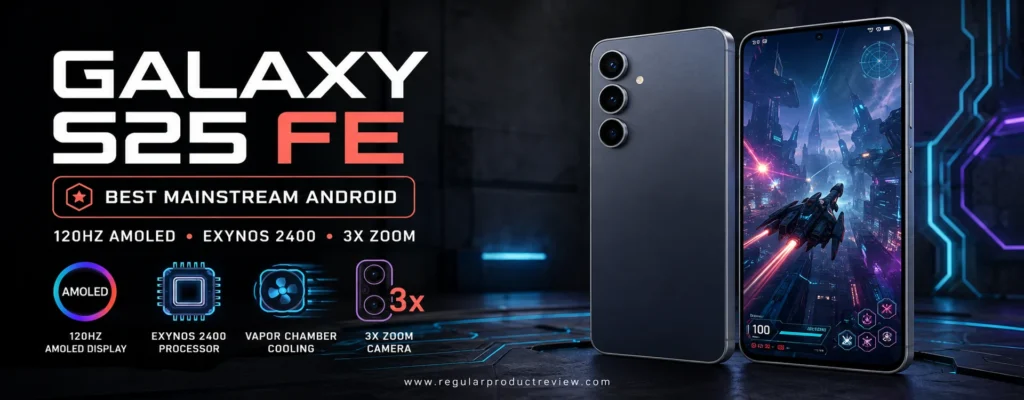
The 6.7-inch Dynamic AMOLED 2X screen combines Full HD+ resolution with an adaptive refresh rate up to 120Hz. It provides the space, color, and fluidity players expect from a premium-feeling device. Samsung’s software ecosystem, Game Booster tools, broad accessory availability, and predictable security support improve the ownership experience even when they do not increase a benchmark score.
The S25 FE is also the camera-first option among the top gaming picks. Its 50MP main camera with optical stabilization, 12MP ultrawide, and 8MP 3x telephoto provide more framing flexibility than most performance-first competitors. That balance is valuable for buyers who want one phone for gaming, travel, family photos, work, and social video.
Galaxy S25 FE Key Specifications
| Specification | Samsung Galaxy S25 FE |
|---|---|
| Processor | Samsung Exynos 2400 |
| Memory and storage | 8GB RAM; 128GB or 256GB |
| Display | 6.7-inch FHD+ Dynamic AMOLED 2X, up to 120Hz |
| Battery | 4,900mAh |
| Rear cameras | 50MP main, 12MP ultrawide, 8MP 3x telephoto |
| Durability | IP68 water and dust resistance |
| US status | Officially sold in the US |
| Qualifying configuration | 128GB at $649.99 |
Samsung’s Galaxy S25 FE announcement documents the core specifications and launch pricing. Always confirm the storage capacity and live price on the official Galaxy S25 FE product page because only a configuration at $700 or less belongs in this guide.
Gaming Performance and Thermal Expectations
The Exynos 2400 can drive high-quality graphics, but users should approach maximum settings intelligently. Competitive games often benefit more from a stable high frame rate and reduced shadows than from every visual option being enabled. Open-world games may run more consistently when resolution or effects are lowered one step, particularly during extended sessions in a warm room.
Samsung’s Game Booster can help organize notifications, performance behavior, and monitoring. Its value is convenience rather than magic; software cannot eliminate heat generated by sustained GPU use. Avoid direct sunlight, remove heat-trapping cases during long sessions, and do not expect the same thermal headroom as a thicker dedicated gaming handset.
Buyers who value Samsung’s complete experience can compare the S25 FE with our best flagship Android phones. Those premium devices may offer faster chips or better cameras, but they often exceed this article’s price limit.
The 128GB capacity is the main practical concern. After Android, apps, photos, cached streaming media, and several large games, free space can shrink quickly. There is no reason to pay above the ceiling for the 256GB model within this roundup; instead, wait for a sale or choose the 256GB OnePlus 15R or iPhone 17e.
Camera, Support, and Everyday Value
The telephoto camera distinguishes the S25 FE from gaming-centric alternatives that sometimes include low-value secondary sensors. IP68 resistance, mainstream service availability, strong security features, and a polished interface make it easier to keep as a primary phone for several years.
Photography-focused shoppers should compare sample-driven priorities through our best flagship phones for photography. The S25 FE will not replace the most expensive camera flagships, but it is the best-rounded imaging system among the safest US gaming options in this price class.
Storage Alert: The normal 256GB price exceeds $700. Buy it only if a verified promotion brings the final device price under the cap; otherwise, the 128GB model is the qualifying pick.
Galaxy S25 FE Pros and Cons
| Pros | Cons |
|---|---|
| Smooth 120Hz AMOLED display | 128GB can feel tight for large games |
| Capable Exynos 2400 performance | Peak gaming speed trails top Snapdragon picks |
| Useful 3x telephoto camera | 256GB list price exceeds the ceiling |
| IP68 and official US support | 8GB RAM is merely adequate for the price |
| Polished software and broad accessory ecosystem | No physical gaming controls |
Buy it if: You want a polished Samsung phone that combines good gaming, strong cameras, official support, and a familiar Android experience.
Skip it if: You want maximum sustained frame rates, 256GB without waiting for a discount, or the largest possible battery.
Editorial Recommendation: The Galaxy S25 FE earns the Best Mainstream Android Gaming Phone award because it balances play, photography, durability, and long-term ownership better than a specialist device.
OnePlus 13R Review — Best Discounted Flagship Gaming Value
Overall Rating: 8.8/10
The OnePlus 13R remains a strong buy because its core gaming hardware has aged gracefully. A Snapdragon 8 Gen 3 processor, 12GB of LPDDR5X RAM, 256GB of UFS 4.0 storage, a 6.78-inch LTPO AMOLED display, and a 6,000mAh battery provide the ingredients of a premium performance phone at a $599.99 official list price. Discounts can make the value even stronger.
Unlike some lower-cost phones that pair a fast chip with slow storage or limited memory, the 13R is balanced. Games load quickly, multitasking remains comfortable, and 256GB provides room for several large installations. The LTPO panel can scale from 1Hz to 120Hz, reducing unnecessary refresh activity when the screen is showing static content while maintaining fluid motion in supported apps and games.
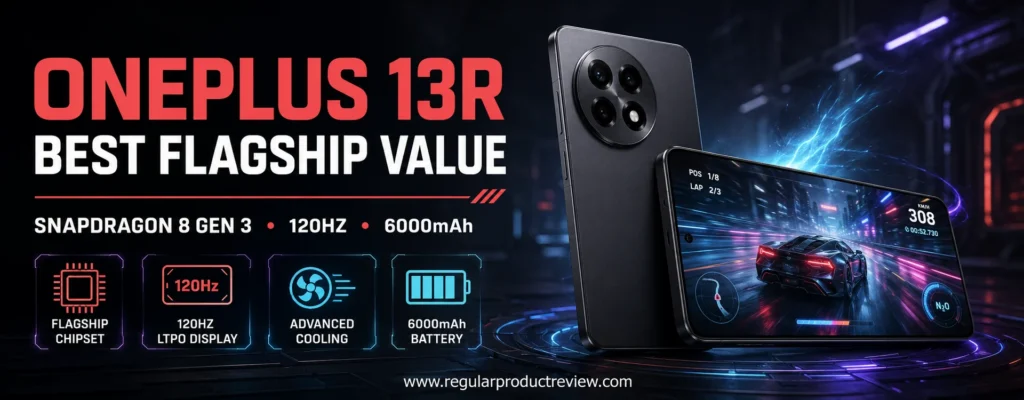
The Snapdragon 8 Gen 3 is no longer Qualcomm’s newest flagship platform, yet it remains substantially faster than typical midrange silicon. It is especially compelling for players who care more about stable 60–120fps experiences than possessing the newest chip name. OnePlus’s cooling design and large battery help turn that capability into useful session length.
Its compromises are conventional rather than alarming. There are no built-in triggers, the camera system is good rather than category-leading, and the software support runway is shorter than that of a brand-new model purchased on the same day. Buyers should compare its actual sale price with the newer 15R; if the difference is small, the newer phone is the better long-term investment.
OnePlus 13R Key Specifications
| Specification | OnePlus 13R |
|---|---|
| Processor | Qualcomm Snapdragon 8 Gen 3 |
| Memory and storage | 12GB LPDDR5X; 256GB UFS 4.0 |
| Display | 6.78-inch 2780 × 1264 LTPO AMOLED, 1–120Hz |
| Battery | 6,000mAh |
| Main camera | 50MP Sony LYT-700 |
| Software at launch | OxygenOS 15 based on Android 15 |
| US status | Officially sold in the US |
| Official list price | $599.99 |
The official OnePlus 13R specifications confirm the memory, storage, display, processor, and battery configuration. Check the OnePlus 13R product page for current stock and price because an older model’s availability can change quickly.
Why the Snapdragon 8 Gen 3 Still Makes Sense
Mobile games do not instantly become unplayable when a new processor launches. The 8 Gen 3 has enough CPU and GPU strength for high-quality settings in current titles, and game developers must support a broad installed base. The more meaningful questions are whether the phone can manage heat and whether its battery can sustain the chosen performance mode.
The 13R’s 6,000mAh capacity is a practical advantage over slimmer mainstream flagships. Its 120Hz LTPO panel is also more universally useful than an extreme refresh figure because many games cap output at 60, 90, or 120fps. Users can reserve the highest performance mode for demanding titles and use balanced behavior elsewhere.
Shoppers deciding whether to spend less should compare the 13R with our best Android phones under $300. The price gap buys significantly faster graphics, better storage, more memory, a higher-quality display, and greater performance longevity.
Those considering a premium upgrade should read our best flagship phones overview. The 13R’s appeal depends on remaining well below the latest flagship price while preserving most of the speed that gaming actually uses.
Ownership Considerations
OnePlus sells the phone directly in the US, avoiding the compatibility uncertainty attached to imported POCO and nubia models. That means easier activation, clearer warranty recourse, and accessories designed for the domestic SKU. These advantages do not appear in benchmark charts, but they materially reduce purchase risk.
The most important comparison is with the OnePlus 15R. At a $100 difference, the 13R is attractive to value-conscious players. If clearance pricing falls substantially lower, it becomes one of the easiest recommendations in the article. If third-party sellers raise the price toward $700, choose the 15R instead.
Expert Tip: Treat the 13R as a value pick only when it is meaningfully cheaper than the 15R. A previous-generation phone should compensate buyers with a real discount, not merely a different listing.
OnePlus 13R Pros and Cons
| Pros | Cons |
|---|---|
| Snapdragon 8 Gen 3 remains very fast | Newer 15R offers more performance headroom |
| 12GB RAM and 256GB fast storage | No gaming triggers or active fan |
| Excellent 1–120Hz LTPO AMOLED | Camera versatility is not class-leading |
| Large 6,000mAh battery | Shorter remaining support life than a new-generation model |
| Official US sales and straightforward compatibility | Value depends on a meaningful price gap |
Buy it if: You want flagship-grade Android gaming, 256GB of storage, and official US support for substantially less than the newest performance phone.
Skip it if: The price approaches the OnePlus 15R, or you want the latest chip, the biggest battery, or built-in gaming controls.
Editorial Recommendation: The OnePlus 13R is the Best Discounted Flagship Gaming Value when its price remains clearly below the newer 15R.
POCO X8 Pro Max Review — Best Battery for Marathon Gaming
Overall Rating: 8.7/10
The POCO X8 Pro Max is built around endurance on a scale that changes how a phone can be used. Its 8,500mAh battery is paired with 100W charging, a MediaTek Dimensity 9500s processor, 12GB of LPDDR5X RAM, UFS 4.1 storage, and a 6.83-inch 120Hz AMOLED display. Global pricing starts near $469, giving imported units an unusually aggressive combination of battery, speed, and screen size.
The 3nm Dimensity 9500s uses a high-performance CPU configuration and Immortalis-G925 graphics. It has the capacity to run demanding mobile games at high settings while providing considerably more headroom than mainstream midrange silicon. The large chassis also gives POCO more room for battery and thermal hardware, although the phone’s 218g weight will be noticeable during long handheld sessions.
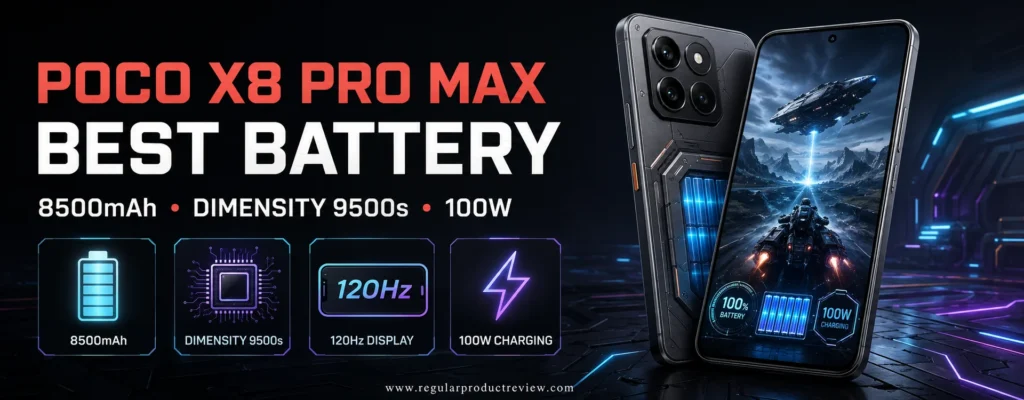
Its 6.83-inch 1.5K AMOLED panel refreshes at up to 120Hz and supports high touch-sampling behavior in Game Turbo mode. The broad canvas makes interface elements and virtual controls easier to separate, which is useful in shooters, racing games, MOBAs, and strategy titles. Symmetrical stereo speakers and an X-axis linear vibration motor strengthen immersion without requiring headphones for every session.
Like the F8 Pro, the X8 Pro Max is not officially sold in the United States. The global specifications list extensive bands, but a band appearing on a sheet does not guarantee carrier certification or full services. The phone is best suited to an experienced importer who has verified network behavior and is comfortable handling warranty claims through a retailer or overseas service channel.
POCO X8 Pro Max Key Specifications
| Specification | POCO X8 Pro Max |
|---|---|
| Processor | MediaTek Dimensity 9500s, 3nm |
| Graphics | Immortalis-G925 MC11 |
| Memory and storage | 12GB LPDDR5X; 256GB or 512GB UFS 4.1 |
| Display | 6.83-inch 2772 × 1280 AMOLED, up to 120Hz |
| Battery and charging | 8,500mAh; 100W wired; up to 27W reverse wired |
| Rear camera | 50MP OIS main and 8MP ultrawide |
| Durability | IP68 under specified laboratory conditions |
| US status | Import-only; no official US launch |
The official POCO X8 Pro Max specifications list the exact chipset, memory, display, battery, bands, and regional caveats. Independent launch coverage from The Verge confirms that the X8 series is not launching in the US and provides useful global-price context.
Gaming Endurance, Heat, and Hand Comfort
An 8,500mAh battery does not guarantee a fixed number of gaming hours. A demanding title at maximum brightness and high frame rates can consume several times more power than a casual puzzle game. What the capacity provides is margin: less anxiety during travel, fewer mid-day top-ups, and more flexibility to use high-performance modes without immediately reaching for a charger.
The trade-off is physical. At 218g and 77.9mm wide, the device can fatigue smaller hands, especially when virtual controls require constant grip pressure. A stand and Bluetooth controller can transform it into a compact gaming screen, while a slim textured case may improve grip without trapping as much heat as a thick rugged case.
Battery-focused users who do not need this level of GPU performance can review our best budget phones under $250. Those alternatives cost less and may be easier to replace, but they will not match the X8 Pro Max in high-end gaming or charging speed.
Players attracted by the large screen should also consider our best foldable phones for multitasking. A foldable provides more canvas, yet the POCO’s conventional slab design is usually lighter on cost, simpler to cool, and less vulnerable to hinge or inner-screen damage.
Display, Audio, and Secondary Features
The 120Hz AMOLED panel supports a 480Hz touch-sampling mode and a much higher instant touch-sampling claim under specific Game Turbo conditions. Those figures indicate an emphasis on responsive input, but buyers should judge the complete chain: game engine, frame rate, network latency, touch tuning, and individual reaction time all influence perceived responsiveness.
IP68 protection, Wi-Fi 7 capability where regionally supported, dual Bluetooth, stereo speakers, and fast storage give the phone flagship-like breadth. The 50MP main camera with OIS is useful, but the 8MP ultrawide and lack of a telephoto reinforce that this is a performance-and-battery purchase rather than a photography leader.
Expert Tip: Confirm whether the seller includes a compatible 100W charger. POCO states that package contents vary by region, and using another adapter may reduce charging speed.
POCO X8 Pro Max Pros and Cons
| Pros | Cons |
|---|---|
| Exceptional 8,500mAh battery | Heavy and wide for long handheld play |
| Powerful Dimensity 9500s chipset | No official US launch or local manufacturer warranty |
| 12GB RAM and UFS 4.1 storage | Carrier features require exact verification |
| Large 120Hz AMOLED and fast touch modes | Camera system is secondary to gaming hardware |
| 100W charging and 27W reverse wired charging | Import price, charger, and returns vary by seller |
Buy it if: Battery endurance, a large display, fast storage, and high-end gaming power matter more than compact dimensions or domestic support.
Skip it if: You have small hands, need a lightweight phone, or want guaranteed US carrier and warranty compatibility.
Editorial Recommendation: The POCO X8 Pro Max earns the Best Battery for Marathon Gaming award, provided the buyer accepts its import-only ownership model.
POCO X8 Pro Review — Best Affordable High-Refresh Gaming Phone
Overall Rating: 8.5/10
The POCO X8 Pro brings several enthusiast features to a much lower global starting price. Its Dimensity 8500-Ultra chipset, 1.5K 120Hz AMOLED display, 6,500mAh battery, and 100W charging make it a credible option for players who want smooth competitive gaming without paying flagship money. International pricing near $329 gives it enough budget room for import fees and accessories while remaining well below $700.
The Dimensity 8500-Ultra is not a direct substitute for the flagship processors in the OnePlus 15R or POCO F8 Pro. It targets the upper midrange, which means popular esports titles should run comfortably at high frame rates, while the most demanding open-world games may require reduced shadows, resolution scaling, or effects to maintain consistent performance. That is a reasonable trade for the price.
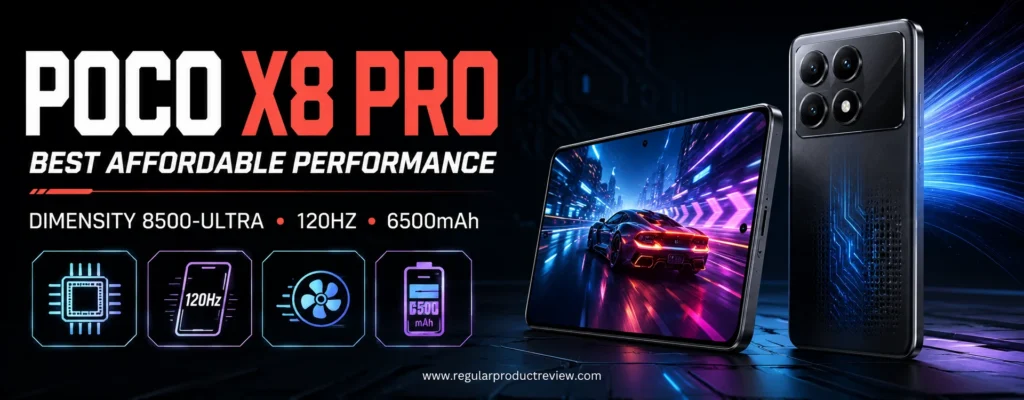
Its 6,500mAh battery is large enough to support long sessions, and 100W charging shortens downtime when a compatible adapter and electrical conditions are available. The 120Hz screen gives competitive games room to feel fluid, while the 1.5K resolution keeps text and media crisp. IP68 resistance adds reassurance for daily use, although water resistance should never be treated as permission to charge or play while the device is wet.
The US warning remains decisive. There is no official US launch, and a low global price can grow after shipping, duties, seller markup, or return costs. Buyers must confirm the exact global SKU, bands, carrier features, charger, language support, warranty, and return destination. This is a high-value enthusiast option, not a default recommendation for every shopper.
POCO X8 Pro Key Specifications
| Specification | POCO X8 Pro |
|---|---|
| Processor | MediaTek Dimensity 8500-Ultra |
| Display | 1.5K AMOLED, up to 120Hz |
| Battery and charging | 6,500mAh; 100W wired charging |
| Rear camera | 50MP main camera with OIS and 8MP ultrawide |
| Front camera | 20MP |
| Durability | IP68 under rated conditions |
| US status | Import-only; no official US launch |
| Global price position | Starts near $329, regional prices vary |
Consult the official POCO X8 Pro product page for region-specific specifications and packaging. The same independent X8-series launch report used above is valuable because it clearly distinguishes global pricing from US availability.
Realistic Game Settings and Performance Tier
The X8 Pro is best understood as a high-value 60–120fps phone rather than a universal maximum-settings device. Competitive games with scalable graphics should take good advantage of the 120Hz panel. Heavy titles that stress the GPU for extended periods will benefit from a balanced preset, capped frame rate, or one-step reduction in effects.
That approach can improve frame pacing and battery life simultaneously. A slightly lower graphics preset often looks similar on a 6.7-inch-class screen while reducing heat and avoiding abrupt throttling. Players should prioritize a stable minimum frame rate over a higher but erratic peak.
Buyers comparing entry-level models can use our best budget phones under $200 to see what the extra money buys. The X8 Pro’s stronger chip, faster charging, high-resolution AMOLED, and larger battery are meaningful upgrades for gaming.
If photography matters nearly as much as play, our best camera phones under $500 may produce a better balance. The POCO’s 50MP stabilized main camera is useful, but its imaging hierarchy is secondary to speed and endurance.
Who Benefits Most from the X8 Pro
This model fits a knowledgeable buyer who plays esports titles, wants long battery life, and prefers to spend well below the maximum budget. It is also a rational backup or dedicated gaming device for someone who keeps a separate primary phone, provided Wi-Fi use covers most play and cellular limitations are understood.
It is less suitable for a one-phone household that depends on Wi-Fi calling, guaranteed 911 behavior, effortless carrier support, or local repairs. In that case, the Samsung Galaxy A57 or Motorola Edge (2026) provides less graphics power but more predictable US ownership.
Editorial Insight: A $329 global launch price is not a guaranteed US checkout price. Evaluate the complete landed cost and return exposure before calling any import a bargain.
POCO X8 Pro Pros and Cons
| Pros | Cons |
|---|---|
| Strong upper-midrange gaming performance | Slower than flagship-chip recommendations |
| 120Hz 1.5K AMOLED display | Import-only for US shoppers |
| Large 6,500mAh battery | Carrier services may be incomplete |
| Very fast 100W charging | Seller, warranty, and charger details vary |
| Attractive global starting price | Cameras are not the central strength |
Buy it if: You want a lower-cost performance phone, understand imports, and are willing to tune demanding games for stable frame rates.
Skip it if: You need official US support, maximum graphics in the hardest games, or a premium camera system.
Editorial Recommendation: The POCO X8 Pro is the Best Affordable High-Refresh Gaming Phone for import-savvy buyers who prioritize value over domestic convenience.
Motorola Edge (2026) Review — Best Compact Gaming All-Rounder
Overall Rating: 8.3/10
The Motorola Edge (2026) approaches gaming from a practical direction. It uses a compact 6.3-inch 1.5K AMOLED display with a 120Hz refresh rate, a MediaTek Dimensity 7450 processor, up to 8GB of RAM, and a 5,000mAh battery. At an official US price of $599.99, it targets buyers who want smooth casual-to-moderate play without carrying a giant gaming slab.
Its smaller screen makes the phone easier to grip, pocket, and use one-handed between games. That comfort comes with less space for virtual controls and a lower thermal ceiling than a large performance phone. The Dimensity 7450 is capable for popular games, but it belongs below the Snapdragon 8-class and Dimensity 9500s entries when graphics settings and sustained frame rates are pushed aggressively.
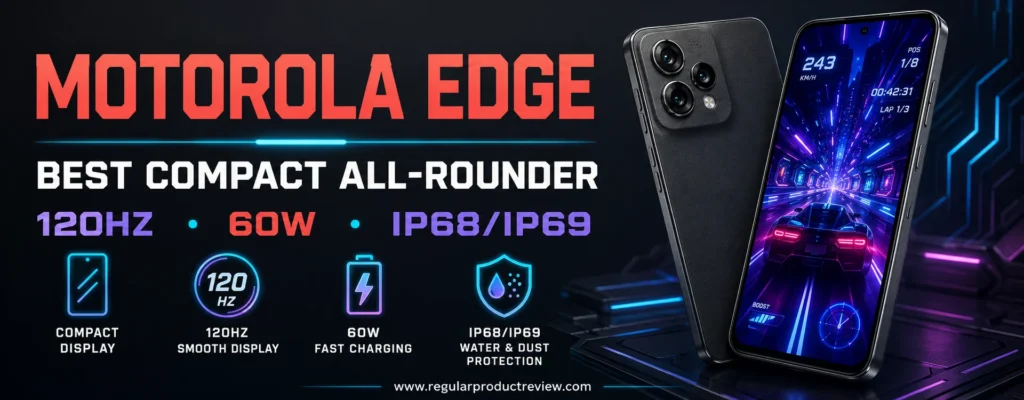
Motorola compensates with excellent everyday hardware. IP68 and IP69 ratings, Gorilla Glass 7i, a durable construction claim, 60W wired charging, 15W wireless charging, Dolby Atmos stereo speakers, and a triple-camera system with a dedicated 3x optical telephoto make the Edge more versatile than its gaming score alone suggests.
The main long-term concern is software support. Motorola promises two Android OS upgrades, which is modest compared with Samsung’s longer policy. Buyers planning to keep a phone for five or six years should weigh that limitation against its compact ergonomics and more robust physical design.
Motorola Edge (2026) Key Specifications
| Specification | Motorola Edge (2026) |
|---|---|
| Processor | MediaTek Dimensity 7450 |
| Memory | Up to 8GB RAM plus virtual RAM Boost |
| Display | 6.3-inch 1.5K AMOLED, 120Hz |
| Battery and charging | 5,000mAh; 60W wired; 15W wireless |
| Cameras | 50MP main, 50MP ultrawide, 3x optical telephoto, 50MP selfie |
| Durability | IP68/IP69 and Gorilla Glass 7i |
| Software support | Two guaranteed Android OS upgrades |
| Official US price | $599.99 |
Motorola’s official Edge (2026) product page documents the processor, display, cameras, battery, charging, durability, and update promise. Confirm the live price through the Motorola Edge family store, as carrier promotions and unlocked pricing can differ.
Gaming on a Smaller 120Hz Phone
The 120Hz AMOLED display gives ordinary scrolling and supported games a fluid presentation. Competitive titles should run well at sensible settings, while demanding open-world releases are better treated as 30–60fps experiences. The phone’s high 1.5K resolution can be visually pleasing, but dynamic resolution or reduced rendering scale may improve consistency in GPU-heavy games.
Hand comfort is the Edge’s main advantage over the largest phones. A smaller device creates less leverage against the wrists and fits more controllers. Players with large hands may feel the opposite, because virtual buttons sit closer together. The ideal choice depends on grip style rather than a specification-sheet winner.
Users who need an inexpensive work-and-school phone that also games can compare our best Android phones for students. The Edge offers a stronger display, charging system, and camera set than many student-focused models, but it costs more.
For shoppers who prioritize price over premium build, our budget phone recommendations show how far costs can be reduced. Those devices are appropriate for light titles, not for the same performance expectations as the Edge.
Battery, Camera, and Durability Balance
The 5,000mAh battery is conventional rather than extraordinary, but 60W charging is useful and 15W wireless charging adds convenience that performance-first imports sometimes omit. Gaming runtime will trail the POCO X8 Pro Max and OnePlus 15R under similar loads, yet the smaller display and midrange chip can be efficient during ordinary use.
The dedicated telephoto camera is rare in this price-performance niche. Combined with an ultrawide and strong main sensor, it makes the phone suitable for travel and events. IP68/IP69 ratings and tougher glass reinforce the all-rounder argument, although accidental damage and liquid ingress are still subject to warranty exclusions.
Expert Tip: Choose the Edge for comfort and daily versatility, not for winning raw frame-rate contests. It is a compact premium midranger that games well, not a disguised flagship gaming phone.
Motorola Edge (2026) Pros and Cons
| Pros | Cons |
|---|---|
| Compact 6.3-inch form is comfortable and portable | Dimensity 7450 trails flagship chips |
| Smooth 120Hz 1.5K AMOLED | Smaller screen gives touch controls less space |
| 60W wired and 15W wireless charging | Two OS upgrades are a modest commitment |
| IP68/IP69 and Gorilla Glass 7i | 5,000mAh battery is ordinary for this list |
| Versatile cameras with 3x optical zoom | 8GB RAM provides less headroom than 12GB rivals |
Buy it if: You want a compact, durable, officially supported US phone that balances gaming, cameras, and everyday comfort.
Skip it if: Maximum graphics performance, a giant display, or a very long software-support window matters most.
Editorial Recommendation: The Motorola Edge (2026) earns the Best Compact Gaming All-Rounder award for buyers who reject oversized performance phones.
Samsung Galaxy A57 5G Review — Best Gaming Phone for Long Software Support
Overall Rating: 8.2/10
The Samsung Galaxy A57 5G is a longevity-first choice. Its regular US price begins at $549.99 for 128GB, while periodic official discounts can make both storage variants more attractive. An Exynos 1680 processor, 6.7-inch 120Hz AMOLED display, 5,000mAh battery, 45W charging, IP68 resistance, and six years of software support create a dependable platform for moderate gaming and long ownership.
The Exynos 1680 is a midrange chip, so the A57 should not be compared directly with the Snapdragon 8 Gen 5 or Snapdragon 8 Elite on peak graphics. It is better suited to competitive games at balanced settings, casual titles, emulation of less-demanding systems where legally appropriate, and graphically heavy games with adjusted quality. Players who insist on maximum settings will reach its limits sooner.
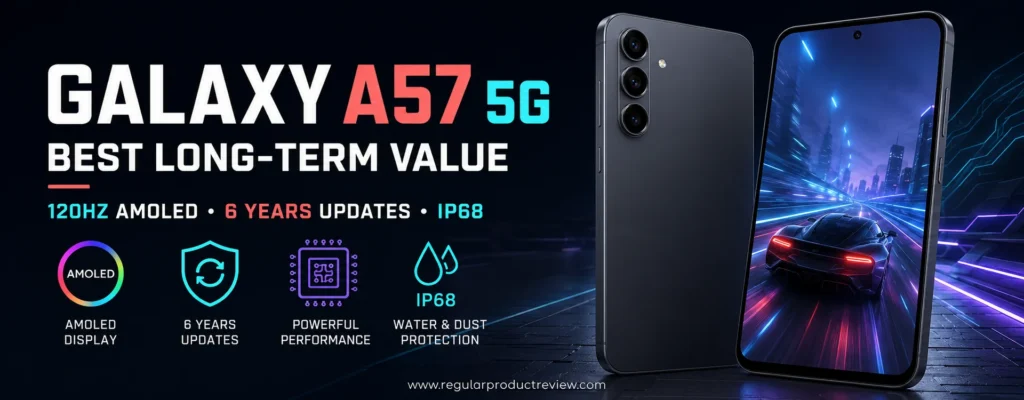
The 120Hz AMOLED display is the feature users will appreciate every day. Motion looks smoother in menus, web pages, social feeds, and compatible games, while Samsung’s bright panel remains useful outdoors. A 5,000mAh battery is adequate for a full mixed-use day for many people, and 45W charging reduces downtime without chasing the most aggressive charging speeds in the category.
Samsung’s six-year update commitment, metal frame, Gorilla Glass Victus+, IP68 rating, official US warranty, and broad service network are the reasons to choose it over a faster import. The A57 is not pretending to be a tournament handset; it is a durable mainstream phone that can remain secure and useful long after an imported bargain becomes difficult to repair.
Samsung Galaxy A57 5G Key Specifications
| Specification | Samsung Galaxy A57 5G |
|---|---|
| Processor | Samsung Exynos 1680 |
| Storage | 128GB or 256GB |
| Display | 6.7-inch 120Hz AMOLED |
| Battery and charging | 5,000mAh; 45W wired charging |
| Durability | IP68, metal frame, Gorilla Glass Victus+ |
| Software support | Six years of updates |
| US status | Officially sold in the US |
| Official pricing | $549.99 for 128GB; $609.99 for 256GB before discounts |
The official Samsung Galaxy A57 store provides live US prices and storage options. Independent reporting from The Verge corroborates the processor, display, battery, charging, durability, and six-year support positioning.
Appropriate Game Settings and Longevity
In esports titles, start with the highest supported frame-rate option and medium graphics, then raise detail only if frame pacing remains consistent after 20–30 minutes. In demanding open-world games, a 30 or 45fps target may deliver a more stable experience than an aspirational 60fps mode. This method also reduces heat and battery drain.
The six-year update policy matters because mobile games increasingly depend on current operating-system APIs, security components, and store compatibility. Long support does not make the processor faster, but it reduces the chance that an otherwise functional phone becomes obsolete because software maintenance ends early.
Budget-focused Samsung buyers should compare alternatives in our best Android phones under $500, especially when the A57 is not discounted. The comparison makes it easier to see whether long support is worth paying more for than immediate performance.
If camera versatility is the priority, our best camera phones under $500 provides a more photography-centered selection. That guide weights image quality, lens usefulness, and video consistency more heavily than gaming speed.
The 128GB base model can become crowded with games, so the 256GB version is worth considering when its price remains below $700. Unlike the Galaxy S25 FE, both regular A57 storage prices fit the ceiling, leaving buyers free to prioritize capacity without waiting for a sale.
Everyday Strengths Beyond Gaming
Samsung’s interface, security tools, accessory ecosystem, and US service presence reduce friction. IP68 resistance and tougher glass help with ordinary accidents, while the metal frame gives the phone a more premium feel than many performance-focused midrangers.
The camera system is designed for social and everyday photography rather than high-end optical reach. Its output should satisfy casual users in good light, but buyers who photograph sports, wildlife, or concerts should favor a phone with a dedicated telephoto lens.
Expert Tip: For long-term use, choose 256GB if the price stays under $700. Storage cannot be upgraded later, and large games tend to grow after updates.
Galaxy A57 5G Pros and Cons
| Pros | Cons |
|---|---|
| Six years of software support | Exynos 1680 is midrange, not flagship-class |
| Bright 120Hz AMOLED display | Heavy games require adjusted settings |
| Both storage tiers fit below $700 | 45W charging is slower than POCO and OnePlus rivals |
| IP68, metal frame, and Victus+ glass | No dedicated gaming features or triggers |
| Official US sales and service | Camera system lacks a telephoto lens |
Buy it if: You want moderate gaming, long software support, a 120Hz screen, durable construction, and predictable US ownership.
Skip it if: You prioritize maximum GPU performance, ultra-fast charging, physical controls, or the largest battery.
Editorial Recommendation: The Galaxy A57 5G is the Best Gaming Phone for Long Software Support, especially for buyers who play regularly but live outside games even more.
nubia Neo 3 GT 5G Review — Best Budget Gaming Phone with Shoulder Triggers
Overall Rating: 8.0/10
The nubia Neo 3 GT 5G is the most gaming-specific design in the list despite being one of the least expensive. Its 6.8-inch 120Hz OLED display, dual capacitive shoulder triggers, gaming interface, programmable controls, 6,000mAh battery, and 80W charging deliver features that mainstream phones often omit. International prices around $250–$320 make it attractive as a secondary gaming device.
Its Unisoc T9100 processor is an important reality check. The chip is capable of esports and moderate games, but it cannot match the flagship platforms ranked above it in advanced graphics, emulation, or sustained high frame rates. The Neo 3 GT earns its place through control ergonomics and price, not through the highest benchmark performance.
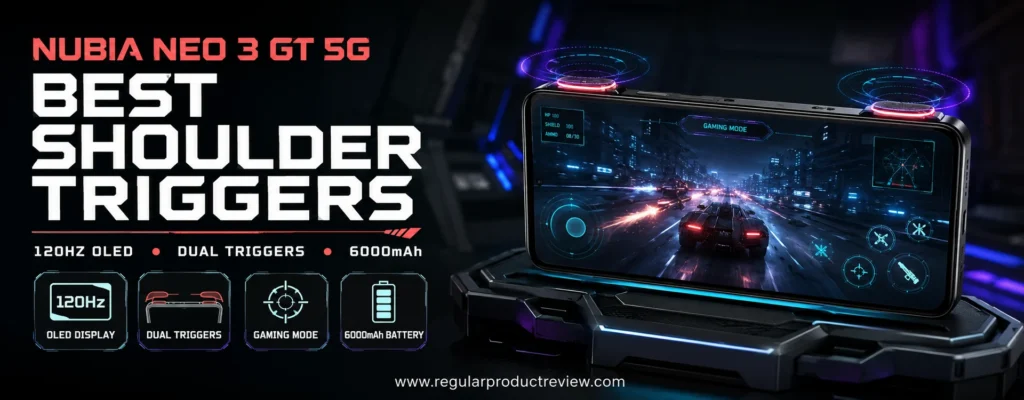
Shoulder triggers can materially improve touch gaming. Mapping aim, fire, acceleration, braking, or other actions to the top edge reduces the need to cover the screen with multiple fingers. The 120Hz OLED panel, high touch-sampling claims, stereo presentation, lighting effects, and dedicated gaming software make the experience feel purpose-built even when the processor requires sensible quality settings.
US buyers face the strongest caveats in the article. nubia does not offer this model as a mainstream official US device, and importer warranty, software updates, network bands, VoLTE, Wi-Fi calling, eSIM, charger compatibility, and returns vary. It is easiest to recommend as a Wi-Fi-first gaming device or to an experienced importer who has verified every carrier requirement.
nubia Neo 3 GT 5G Key Specifications
| Specification | nubia Neo 3 GT 5G |
|---|---|
| Processor | Unisoc T9100, 6nm, up to 2.7GHz |
| Memory and storage | Up to 12GB RAM and 256GB storage; virtual expansion varies |
| Display | 6.8-inch 1080 × 2392 OLED, 120Hz |
| Battery and charging | 6,000mAh; 80W wired charging |
| Gaming controls | Dual capacitive shoulder triggers |
| Design extras | Gaming interface and RGB-style lighting features |
| US status | Import-only; no mainstream official US launch |
| Price position | Roughly $250–$320 internationally, seller-dependent |
The official nubia Neo 3 GT page details the display, triggers, processor, battery, and charging hardware. A marketplace comparison such as Kimovil’s current Neo 3 GT listings can help establish price context, but the seller’s warranty and supported model number matter more than the lowest displayed price.
Shoulder Triggers and Game-Space Experience
Physical or capacitive top-edge controls are most useful in games that allow flexible on-screen button mapping. A shooter can assign aim and fire to the triggers while thumbs handle movement and camera control. Racing games can move acceleration and braking away from the screen. The advantage is ergonomic and repeatable, although trigger mapping may need reconfiguration after a game’s interface update.
The gaming interface can block notifications, prioritize resources, record gameplay, and provide performance shortcuts, depending on software version. These tools make the phone feel more specialized than a mainstream midranger. They do not change the fundamental capability of the Unisoc GPU, so heavy titles should use medium settings and a stable target frame rate.
Users who want the lowest possible entry cost should compare our best budget phones under $100. Those models are designed for basic communication and light games, while the nubia’s extra cost buys a far more appropriate screen, controls, battery, and charging system.
Buyers who can give up triggers in exchange for stronger everyday value should consult our best budget phones for everyday use. A mainstream device may offer cleaner software, better cameras, and safer carrier support even when its gaming interface is less exciting.
Network and Warranty Reality
Do not order the Neo 3 GT solely from a product photo or headline price. Confirm the full model identifier, supported bands, carrier approval, Wi-Fi calling, VoLTE, language and Google service availability, charger plug, return address, restocking fees, and written warranty term. Ask whether a defective device must be shipped internationally.
As a dedicated Wi-Fi gaming unit, some cellular concerns become less important, but software support and repair access still matter. Its low purchase price limits financial exposure, yet that does not transform a difficult return process into a good experience.
Import Alert: The Neo 3 GT is a specialist value pick, not a universal US recommendation. Buy it only after verifying the exact network and warranty conditions.
nubia Neo 3 GT Pros and Cons
| Pros | Cons |
|---|---|
| Useful capacitive shoulder triggers | Unisoc T9100 trails flagship chips substantially |
| Large 120Hz OLED display | No mainstream official US availability |
| 6,000mAh battery and 80W charging | Carrier features and bands require verification |
| Distinct gaming software and lighting | Update policy and warranty path are less reassuring |
| Low international price | Cameras and everyday polish are secondary |
Buy it if: You want inexpensive shoulder triggers, a large OLED screen, and a gaming-first secondary device.
Skip it if: You need flagship frame rates, premium cameras, assured US cellular services, or straightforward domestic repairs.
Editorial Recommendation: The nubia Neo 3 GT 5G is the Best Budget Gaming Phone with Shoulder Triggers, but its import risks are as important as its control advantages.
Gaming Phone Buying Guide — What Matters Below $700
A useful gaming phone buying guide begins by separating features that improve play from numbers that merely improve advertising. Processor naming matters, but sustained performance, display behavior, battery size, storage, controls, network reliability, and software support determine whether a phone still feels good after the excitement of setup disappears. The best purchase is the device whose compromises fit your games and ownership plan.
Start by listing the three titles you play most often and how you play them. A Call of Duty Mobile competitor needs reliable touch input, high frame-rate support, stable Wi-Fi or 5G, comfortable grip, and clear directional audio. A Genshin Impact or Wuthering Waves player places more stress on sustained GPU performance, cooling, and battery. A strategy or card-game player may gain more from screen size, battery life, and software longevity than from a flagship chip.
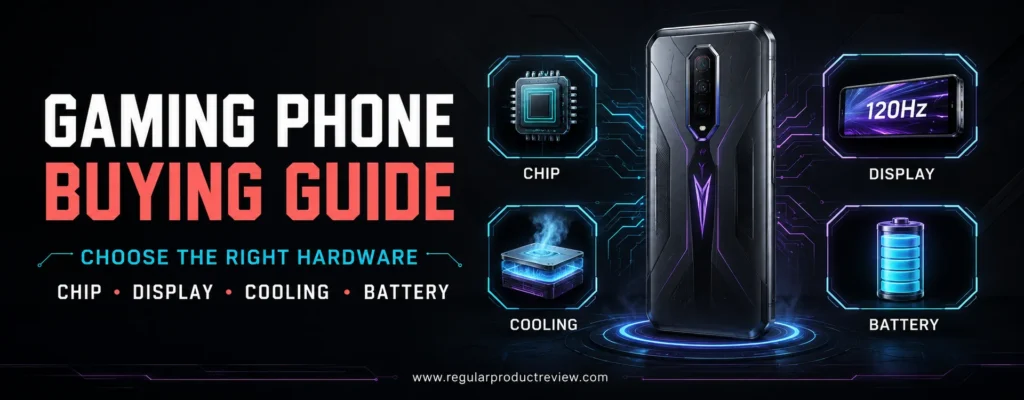
If gaming is only one part of your day, consider the broader selection in our Android phone hub. A specialist gaming device can sacrifice cameras, wireless charging, water resistance, update duration, or domestic support. Those compromises are rational only when the gaming benefits will be used frequently.
Buyers working with a stricter budget can use our best phones under $200 to establish a practical baseline. Spending more should purchase measurable improvements—faster graphics, more RAM, larger storage, a better panel, stronger cooling, faster charging, or longer support—not simply a more dramatic design.
1. Choose the Right Processor Tier
The processor combines CPU cores, GPU, image processing, modem functions, AI acceleration, and memory support. Gaming depends heavily on the GPU, but CPU performance affects physics, simulation, asset preparation, frame pacing, background processes, and online-game logic. A flagship chip generally provides more performance headroom than a midrange chip, but heat and software tuning determine how much of that headroom remains usable.
For maximum settings and long-term performance, prioritize the Snapdragon 8 Gen 5 in the OnePlus 15R, Snapdragon 8 Elite in the POCO F8 Pro, Dimensity 9500s in the POCO X8 Pro Max, A19 in the iPhone 17e, Snapdragon 8 Gen 3 in the OnePlus 13R, or Exynos 2400 in the Galaxy S25 FE. The Dimensity 8500-Ultra is a strong value tier. The Dimensity 7450, Exynos 1680, and Unisoc T9100 are better suited to balanced settings or less-demanding games.
Do not compare platforms using a single cross-platform benchmark alone. Android and iOS games may use different graphics APIs, resolution targets, thermal policies, and frame-rate caps. A benchmark can reveal relative capability, but it cannot guarantee the exact experience in a specific game update.
Expert Tip: Search for long-duration performance tests of the exact phone, not only the processor. Two devices using similar silicon can behave differently because of cooling, power limits, firmware, and chassis design.
2. Refresh Rate Must Match Game Support
A 120Hz display can draw up to 120 updates per second, while a 165Hz panel can draw up to 165. This creates smoother motion only when the game and processor deliver sufficiently high frame rates. A title capped at 60fps will not suddenly render 120 unique frames because the phone has a 120Hz panel.
High refresh still improves system animations and can reduce the perceived delay between input and visible response. Competitive players benefit most, particularly in shooters and racing games with high-frame-rate modes. Cinematic RPGs often prioritize visual quality and may target 30 or 60fps, making brightness, color, resolution, and thermal consistency equally important.
Adaptive or LTPO refresh behavior can reduce power use by lowering refresh when content is static. The OnePlus 13R’s 1–120Hz LTPO panel is a good example. The OnePlus 15R’s 165Hz capability is more specialized, while the iPhone 17e’s 60Hz display is the clearest limitation in this group.
3. Touch Response, Triggers, and Controllers
Touch-sampling rate describes how frequently the screen checks for input and is different from refresh rate. Manufacturers sometimes advertise enormous instant-sampling numbers that apply only in a game mode, a defined area, or a brief condition. Consistent touch calibration and low end-to-end latency matter more than the largest headline.
Shoulder triggers free the thumbs from selected on-screen controls. The nubia Neo 3 GT makes them available at a low price, while the mainstream phones require clip-on triggers or controllers. Before buying for one specific game, verify that its interface permits the necessary button mapping and that the phone’s software does not violate the game’s competitive rules.
Bluetooth controllers work well for compatible games, cloud streaming, and remote play. They add cost and reduce portability, but they can dramatically improve comfort and precision. Controller latency, support, mapping, and phone-mount balance should be checked rather than assumed.
4. Cooling and Sustained Frame Pacing
Peak speed is easy to demonstrate in a short test. Sustained speed is harder because the processor, battery, display, and charging circuit all create heat. When temperature rises, the phone reduces power to protect components and maintain safe skin temperature. The result can be lower frame rates or uneven frame pacing after an initially fast start.
Large vapor chambers, graphite layers, internal thermal paths, and a bigger chassis can delay throttling. Active fan accessories can help but increase noise, size, and battery consumption. A simple stand and room-temperature airflow may also improve results. Never block vents on a phone that includes active cooling, and avoid placing a hot phone in a refrigerator or against ice because condensation can cause damage.
Frame pacing deserves special attention. A stable 60fps experience presents one frame about every 16.7 milliseconds. A fluctuating average can feel worse even if its numerical average is higher. Reduce shadows, reflections, post-processing, or rendering resolution until the minimum frame rate becomes comfortable.
5. Battery Capacity and Charging Strategy
Gaming is one of the heaviest phone workloads. The processor, GPU, display, speakers, modem, and touch controller operate simultaneously, so battery capacity that seems excessive during ordinary use becomes valuable. The POCO X8 Pro Max’s 8,500mAh cell leads the group, followed by the OnePlus 15R at 7,400mAh, POCO X8 Pro at 6,500mAh, POCO F8 Pro at 6,210mAh, and OnePlus 13R and nubia Neo 3 GT at 6,000mAh.
Capacity cannot be compared in isolation. Display brightness, resolution, refresh rate, chip efficiency, modem signal, frame cap, and software optimization alter runtime. A smaller efficient phone may last longer in light use, while a huge battery provides more absolute margin under heavy load.
Fast charging reduces downtime but generates heat. Gaming at maximum load while charging can increase battery temperature and accelerate long-term wear. When possible, charge first and play unplugged. If bypass charging is available and documented for the exact device, it can reduce battery cycling by powering the system more directly, but users should follow manufacturer instructions.
Battery Care Insight: Heat is the shared enemy of sustained frame rates and battery health. Lowering brightness or graphics one step often provides a better long-session experience than forcing every setting to maximum.
6. RAM and Storage: Capacity Before Marketing
Eight gigabytes of RAM is workable for current mainstream gaming, while 12GB provides more room for future games, multitasking, recording, and keeping apps alive. Virtual RAM uses storage and is not equal to physical memory; it should never be added to physical RAM as if the combined number described the same resource.
Storage capacity matters because many large games download substantial data after the initial app installation. A 128GB phone can fill quickly once the operating system, photos, videos, music, caches, and several major titles are included. For frequent gamers, 256GB is the practical target. Fast UFS storage improves installation, loading, and asset streaming, although it does not compensate for a weak GPU.
The iPhone 17e, OnePlus 15R, and OnePlus 13R provide 256GB in their relevant configurations, while the Galaxy S25 FE’s qualifying base model has 128GB. The Galaxy A57 offers both capacities under the ceiling. Imported POCO variants require careful seller verification because memory and storage options vary by region.
7. Speakers, Haptics, and Headset Support
Stereo speakers help locate directional effects and prevent one hand from covering all sound output. Symmetrical speaker arrangements are especially useful in landscape orientation. Dolby Atmos and other processing can widen presentation, but speaker position, balance, distortion, and game mixing remain important.
An X-axis linear vibration motor generally produces sharper, more controlled haptics than a basic rotary motor. Good haptics reinforce firing, impacts, menu selection, and vehicle behavior without feeling mushy. Competitive players may reduce vibration to improve precision or save power, while single-player users may prefer greater immersion.
Most modern phones omit a 3.5mm jack. USB-C audio can provide low latency, but adapter and digital-audio compatibility vary. Bluetooth headsets add convenience; latency depends on codec, headset, phone, and game. For competitive play, test the complete audio chain rather than assuming a codec name guarantees perfect synchronization.
8. Network Compatibility and Online Latency
Online-game latency depends on server distance, router quality, Wi-Fi congestion, cellular signal, carrier routing, background downloads, and the phone’s radio behavior. A newer Wi-Fi standard does not fix a slow internet connection or a distant server. Stable latency and low packet loss matter more than a spectacular peak download speed.
Official US devices provide the most predictable carrier support. Imported global phones may list common bands yet lack certification for features such as Wi-Fi calling or visual voicemail. Carrier policies can change, so check compatibility immediately before buying rather than relying on an old forum post.
For home play, connect to a well-positioned 5GHz or 6GHz network when supported, minimize competing downloads, and use a router channel with less congestion. Cellular gaming can be excellent in strong coverage, but signal fluctuations and network management make it less predictable.
9. Software Support and Game Tools
Game modes can suppress notifications, lock brightness, record the screen, monitor performance, change touch sensitivity, and prioritize network behavior. They are convenient, but an aggressive mode can also increase heat and battery drain. Use the balanced profile for most games and reserve maximum-performance settings for titles that visibly benefit.
Update policy affects security, compatibility, and resale value. Samsung’s Galaxy A57 is the standout longevity choice, while a current iPhone generally benefits from Apple’s cohesive ecosystem. OnePlus provides a polished performance-oriented interface. Imported devices can receive updates on a regional schedule and may include software behavior unfamiliar to US buyers.
10. Cameras, Durability, and Daily Use
A phone remains in the pocket after a match ends. The Galaxy S25 FE and Motorola Edge (2026) offer the most versatile camera arrangements in this guide because they include telephoto capability. The iPhone 17e offers consistent single-camera simplicity, while performance imports commonly emphasize a strong main camera and accept weaker secondary lenses.
IP ratings, glass, frame material, wireless charging, biometrics, and repair access can be more valuable than a small benchmark advantage. Buyers who regularly travel, commute, or work outdoors should prioritize durability and domestic service. Our camera phone collection provides a more suitable ranking when photography is equal to or more important than gaming.
Foldable displays can enlarge games but add cost and durability complexity. Anyone tempted by that experience should study our best foldable phones for everyday use before assuming a foldable is automatically the better gaming purchase.
Recommended Minimum Specifications
| Buyer Type | Processor Target | RAM | Storage | Display | Battery Target | Best Match Here |
|---|---|---|---|---|---|---|
| Competitive player | Current or recent flagship | 12GB preferred | 256GB | 120Hz or higher | 6,000mAh+ | OnePlus 15R |
| Demanding open-world player | Flagship with strong cooling | 12GB | 256GB+ | Bright 120Hz AMOLED | 6,000mAh+ | POCO F8 Pro |
| iOS player | Apple A19 | Platform-managed | 256GB | OLED; accept 60Hz | Workload-dependent | iPhone 17e |
| Battery-first traveler | Upper-tier or flagship | 12GB | 256GB | Large 120Hz AMOLED | 7,000mAh+ | POCO X8 Pro Max |
| Casual-to-moderate gamer | Strong midrange | 8GB | 128GB minimum | 120Hz AMOLED | 5,000mAh | Galaxy A57 5G |
| Trigger-focused budget player | Competent midrange | 8GB+ | 256GB preferred | 120Hz OLED | 6,000mAh | nubia Neo 3 GT |
Head-to-Head Gaming Comparisons by Player Type
Specifications become easier to understand when tied to a real decision. The following comparisons identify the best choice for specific playing styles, ownership needs, and risk tolerance. They do not assume that every buyer should select the fastest chip.
Enthusiasts considering performance at any price can compare these models with our flagship phone recommendations. Buyers who mainly need school, communication, and lighter games should instead use our student Android phone guide to avoid overspending on unused GPU capability.
Best for Call of Duty Mobile, PUBG Mobile, and Competitive Shooters
The OnePlus 15R is the best overall competitive choice because its 165Hz display, flagship chip, large battery, official US support, and gaming-oriented system create a strong end-to-end package. Game-specific frame-rate support remains necessary, but the hardware has substantial headroom.
The POCO F8 Pro is the value challenger. Its 120Hz screen aligns with common competitive caps, and the Snapdragon 8 Elite is extremely capable. Choose it only after resolving import and carrier concerns. The nubia Neo 3 GT offers a unique control advantage through shoulder triggers, but its weaker chip means it is better at tuned settings than at maximum visual quality.
Best for Genshin Impact and Demanding Open-World Games
The OnePlus 15R, POCO F8 Pro, and POCO X8 Pro Max form the top performance tier. The OnePlus is safest for a US buyer, the F8 Pro maximizes imported performance value, and the X8 Pro Max combines strong graphics with enormous battery capacity.
For long sessions, cap the frame rate at a level the phone can sustain and reduce shadows or effects before texture quality. High-resolution textures are often less thermally expensive than pushing every lighting and post-processing feature. The OnePlus 13R remains a strong discounted alternative because Snapdragon 8 Gen 3 performance is still highly relevant.
Best for Fortnite Mobile and Controller Play
The iPhone 17e is appealing for controller users who value iOS integration, strong A19 performance, 256GB of base storage, and a compact device. Its 60Hz panel is less suitable for users seeking the highest visible frame rates, but controller-driven games targeting 30 or 60fps can still feel responsive and polished.
On Android, the OnePlus 15R offers the best hardware headroom, while the POCO X8 Pro Max provides the largest screen and longest battery. Confirm that a chosen controller supports the phone, case thickness, game, and operating system version before purchasing.
Best for Cloud Gaming and Remote Play
Cloud gaming shifts rendering to a server, which reduces the importance of the phone’s GPU but increases the importance of display quality, decoding efficiency, Wi-Fi stability, battery, audio, and controller support. The POCO X8 Pro Max is excellent for a large-screen setup, while the OnePlus 15R combines a fast panel with official US network support.
The Motorola Edge (2026) is a comfortable compact client, especially for users who value wireless charging and durable daily construction. The iPhone 17e benefits from a mature accessory ecosystem, although its smaller screen and 60Hz panel may be less immersive.
Best for Emulation and Large Offline Libraries
Emulation should involve software and game images that the user has the legal right to use. Within that boundary, processor architecture, GPU driver behavior, storage capacity, thermal performance, and controller compatibility are important. The OnePlus 15R and POCO F8 Pro provide the highest Android headroom, while the OnePlus 13R remains attractive for price-conscious users.
Choose 256GB or more when maintaining a large legitimate offline library. The Galaxy S25 FE’s 128GB base capacity is less convenient, and cloud storage cannot replace local capacity when a game or emulator needs immediate access to large files.
Best for Gaming and Photography Together
The Galaxy S25 FE is the strongest balanced choice because its 50MP main camera, ultrawide, and 3x telephoto cover more photographic situations. The Motorola Edge (2026) is another versatile option with a 3x optical telephoto, durable body, and compact size, although its gaming processor is slower.
The POCO F8 Pro offers a useful stabilized main camera and telephoto while keeping a performance-first identity. Shoppers who want a camera-led ranking should compare our best camera phones and best camera phones under $300 rather than assuming a gaming hierarchy predicts image quality.
Best for Students and Budget-Conscious Players
The Galaxy A57 5G is the easiest long-term student recommendation because it combines official US support, a 120Hz AMOLED, six years of updates, IP68 resistance, and pricing well below the ceiling. It is fast enough for regular gaming when quality settings are realistic.
The POCO X8 Pro offers far more aggressive performance value for import-savvy buyers, while the nubia Neo 3 GT provides physical controls at the lowest price in the list. Students who depend on one phone for emergency calls, campus Wi-Fi calling, banking, and work should prioritize reliable domestic connectivity over imported benchmark value.
Best for Buyers Who Keep a Phone for Years
The Galaxy A57’s six-year update commitment gives it the clearest stated longevity case, but its midrange processor may become the performance limit before software support ends. The iPhone 17e’s A19 and strong ecosystem are better for users who want more processing headroom, while Samsung’s Galaxy S25 FE combines an upper-tier chip with flagship-style support and service.
Storage is part of longevity. A 256GB phone is more resilient to growing game installations than a 128GB model. Battery replacement availability, repair pricing, case supply, and manufacturer presence also matter after the first two years.
Gaming Priority Matrix
| Priority | First Choice | Second Choice | Why |
|---|---|---|---|
| Safest high-performance US purchase | OnePlus 15R | OnePlus 13R | Official sales, fast chips, large batteries |
| Maximum import value | POCO F8 Pro | POCO X8 Pro | Exceptional hardware per dollar |
| Longest battery focus | POCO X8 Pro Max | OnePlus 15R | 8,500mAh and 7,400mAh capacities |
| iOS gaming | iPhone 17e | None | A19, 256GB, Apple ecosystem |
| Mainstream camera balance | Galaxy S25 FE | Motorola Edge (2026) | Telephoto cameras and US support |
| Compact ergonomics | Motorola Edge (2026) | iPhone 17e | Smaller 6.3- and 6.1-inch displays |
| Long software support | Galaxy A57 5G | Galaxy S25 FE | Strong Samsung update positioning |
| Physical shoulder controls | nubia Neo 3 GT | Accessory required on others | Integrated capacitive triggers |
Final Ranking Logic
The OnePlus 15R ranks first because it avoids the biggest compromises: it is fast, officially sold in the US, equipped with ample memory and storage, capable of very high refresh, and powered by a huge battery. The POCO F8 Pro has comparable enthusiast appeal at a lower price but loses ground for import uncertainty. The iPhone 17e ranks third because its performance, storage, support, and ecosystem are excellent, even though 60Hz prevents it from leading competitive play.
The Galaxy S25 FE and OnePlus 13R represent two versions of balance. Samsung emphasizes cameras, support, and mainstream polish; OnePlus emphasizes battery, memory, storage, and performance value. The POCO X8 Pro Max is spectacular for endurance but physically large and import-dependent. The remaining phones occupy narrower, clearly defined roles rather than pretending to be universal winners.
Pullquote: The best gaming phone is the one that maintains comfortable performance in your games, works reliably on your network, and remains useful when the match ends.
Gaming Phone FAQ, Final Verdict, and Buying Checklist
This final section resolves common questions that specification tables cannot answer on their own. Prices, carrier policies, software versions, game frame-rate modes, and stock can change, so verify the exact configuration immediately before purchase.
Readers who decide that premium performance is unnecessary can compare our best budget phones under $100 for basic use and light gaming. Those willing to spend more for a true premium device should consult our best premium smartphones and treat this guide’s $700 limit as a firm decision boundary.
What is the best gaming phone under $700 overall?
The OnePlus 15R is the best overall choice at its $699.99 starting price. It combines a Snapdragon 8 Gen 5 platform, 12GB of RAM, fast storage, a 165Hz AMOLED display, a 7,400mAh battery, cooling-focused hardware, and official US availability. The exact qualifying base configuration must remain at or below $700 before tax.
Which phone offers the best gaming performance per dollar?
The POCO F8 Pro is the strongest performance-per-dollar option when imported at a legitimate sub-$600 price. Its Snapdragon 8 Elite, 120Hz AMOLED, 12GB of RAM, large battery, and 100W charging are exceptional. However, US carrier compatibility, warranty service, stock, and returns must be verified before purchase.
What is the best iPhone for gaming under $700?
The iPhone 17e 256GB is the qualifying choice at $599. Its A19 chip, large base storage, game optimization, controller ecosystem, and everyday usability are compelling. Competitive players should understand that its 60Hz display cannot show the 90fps or 120fps output available on high-refresh Android phones.
Is 8GB of RAM enough for mobile gaming?
Eight gigabytes is sufficient for most current mobile games and ordinary multitasking. Twelve gigabytes provides better headroom for screen recording, voice chat, switching between heavy apps, and future game growth. Virtual RAM uses storage and should not be considered equal to physical memory.
Do I need a 165Hz display?
No. A 120Hz screen is already excellent for mobile gaming, and many titles cap frame rates at 60, 90, or 120fps. A 165Hz panel benefits supported competitive games and system motion, but the processor and game must deliver enough frames. Higher refresh can also increase power consumption.
Which phone has the best battery for gaming?
The POCO X8 Pro Max has the largest listed battery here at 8,500mAh, followed by the OnePlus 15R at 7,400mAh. Actual runtime depends on display brightness, frame rate, graphics load, network strength, temperature, and software. The POCO is an import-only device for US buyers.
Are imported POCO and nubia phones safe to buy in the US?
They can be appropriate for experienced buyers, but they are not risk-free. Verify the exact model’s LTE and 5G bands, carrier activation, VoLTE, Wi-Fi calling, eSIM, Google services, charger, warranty location, return address, and restocking terms. An official US phone is safer when reliable communication and local service are essential.
Does a bigger battery make a phone better for gaming?
A larger battery provides more endurance margin, but it also adds weight and size. Efficiency, display settings, processor power, cooling, and software influence runtime. The best battery phone is one that lasts through the intended session without becoming too heavy or uncomfortable to hold.
Can fast charging damage a gaming phone battery?
Modern phones include charging controls, but heat accelerates battery aging. Repeatedly gaming at maximum load while fast charging can raise temperature. Charge before playing when practical, use approved adapters, keep the device ventilated, and enable battery-protection features if the manufacturer provides them.
Should I choose 128GB or 256GB for gaming?
Choose 256GB if you install several large games, record gameplay, keep offline media, or plan to own the phone for years. A 128GB model can work for a smaller library, but usable space is lower after the operating system and apps are installed. Storage expansion is uncommon on performance phones.
Which phone is best for gaming and photography?
The Samsung Galaxy S25 FE offers the strongest combination because it includes a stabilized 50MP main camera, ultrawide, and 3x telephoto while maintaining capable performance and a 120Hz display. The Motorola Edge (2026) is a good compact alternative with a dedicated optical telephoto.
Which phone is best for students who game?
The Samsung Galaxy A57 5G is the safest long-term student option because it combines official US support, six years of updates, IP68 resistance, a 120Hz AMOLED, and pricing below $700. The OnePlus 13R is faster and a better choice for a student who prioritizes demanding games and can spend more.
Are shoulder triggers worth having?
They are useful in shooters and racing games because they move selected controls away from the display. Their value depends on game mapping support and the player’s grip. A Bluetooth controller offers more complete physical input but is less portable. The nubia Neo 3 GT is the only selected phone with integrated capacitive triggers.
Can a gaming phone replace a handheld console?
It can provide an excellent portable experience through native mobile games, cloud gaming, remote play, and legally used emulation, especially with a controller. A handheld console may still offer more consistent physical controls, platform exclusives, cooling, and game optimization. The right answer depends on the games and services you already own.
Final Buying Checklist
Before pressing the purchase button, confirm every item below:
- The exact phone and storage configuration costs $699.99 or less before tax.
- The listing is new, refurbished, open-box, or used exactly as expected.
- The seller is authorized or has a clear written warranty and return policy.
- The model supports your carrier’s necessary bands and activation requirements.
- VoLTE, Wi-Fi calling, eSIM, hotspot, and visual voicemail work where needed.
- The selected games support the desired frame-rate modes on that device.
- Storage capacity is sufficient for games, updates, recordings, and personal files.
- The charger is included where expected and compatible with US electrical outlets.
- A case, cooler, or controller will fit the phone and not block buttons or airflow.
- The software-support policy matches the number of years you plan to keep it.
Our Final Verdict
The OnePlus 15R is the best gaming phone under $700 for most US buyers. It reaches the ceiling but justifies the price with a flagship Snapdragon platform, 12GB of memory, fast storage, 165Hz AMOLED, 7,400mAh battery, gaming-oriented cooling, and official domestic support. It is the closest option here to a dedicated gaming flagship without accepting import uncertainty or exceeding the budget.
The POCO F8 Pro is the enthusiast value winner. It can deliver remarkable Snapdragon 8 Elite performance for less money, but the burden of checking bands, carrier features, warranty, and returns belongs to the buyer. The iPhone 17e is the right iOS choice, particularly for its A19 chip and 256GB base storage, as long as the 60Hz display is acceptable.
The Galaxy S25 FE is the best hybrid of gaming, cameras, support, and mainstream polish. The OnePlus 13R is the smartest discounted flagship alternative. Battery specialists should choose the POCO X8 Pro Max, value seekers can consider the POCO X8 Pro, compact-phone buyers should select the Motorola Edge (2026), long-term users should examine the Galaxy A57 5G, and shoulder-trigger fans can evaluate the nubia Neo 3 GT with full awareness of import risk.
Final Expert Recommendation: Buy the OnePlus 15R at $699.99 or less for the strongest all-around combination. Choose the POCO F8 Pro only after completing the import checklist, or the iPhone 17e 256GB when iOS is non-negotiable.
Awards Recap
| Phone | Award | Final Score |
|---|---|---|
| OnePlus 15R | Best Overall Gaming Phone Under $700 | 9.3/10 |
| POCO F8 Pro | Best Imported Performance Value | 9.1/10 |
| Apple iPhone 17e | Best iPhone for Gaming Under $700 | 8.9/10 |
| Samsung Galaxy S25 FE | Best Mainstream Android Gaming Phone | 8.8/10 |
| OnePlus 13R | Best Discounted Flagship Gaming Value | 8.8/10 |
| POCO X8 Pro Max | Best Battery for Marathon Gaming | 8.7/10 |
| POCO X8 Pro | Best Affordable High-Refresh Gaming Phone | 8.5/10 |
| Motorola Edge (2026) | Best Compact Gaming All-Rounder | 8.3/10 |
| Samsung Galaxy A57 5G | Best Gaming Phone for Long Software Support | 8.2/10 |
| nubia Neo 3 GT 5G | Best Budget Gaming Phone with Shoulder Triggers | 8.0/10 |
Ready to Choose Your Gaming Phone?
Check current prices, verify the exact storage configuration, confirm US carrier compatibility, and choose the phone whose sustained performance—not merely its peak specification—matches the games you play →
Explore more options in our complete gaming phone guide →