

Flagship phones now differ in ways that matter more than a single benchmark or megapixel number. One model may offer more physical camera focal lengths, another may provide a better-documented professional video workflow, and another may prioritize battery capacity and charging. Software policy, regional compatibility, storage, repair access, ergonomics, and price can be just as important as raw hardware.
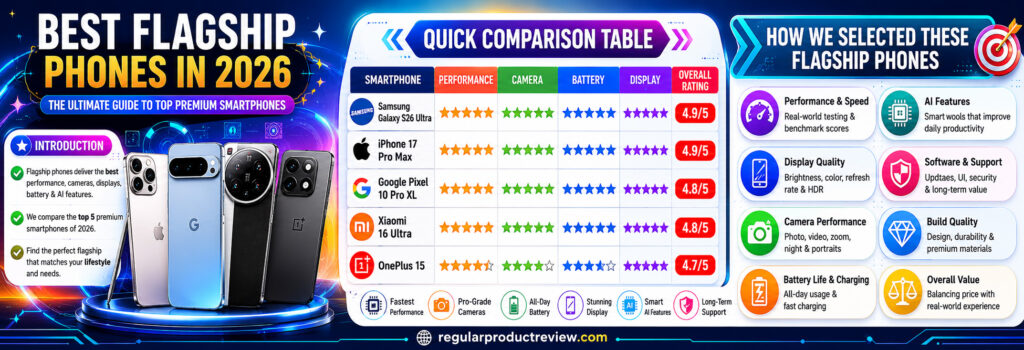
This guide examines the same five product names: Samsung Galaxy S26 Ultra, Apple iPhone 17 Pro Max, Google Pixel 10 Pro XL, Xiaomi 16 Ultra, and OnePlus 15. Four correspond to official manufacturer products. The name Xiaomi 16 Ultra could not be matched to an official Xiaomi global product page; Xiaomi officially documents the Xiaomi 15 Ultra and Xiaomi 17 Ultra instead. That entry is included as a buyer warning, not a recommendation.
The comparison uses official specification pages, manufacturer launch information, documented camera and video modes, battery and charging disclosures, software statements, and regional ownership considerations. It does not claim that the five phones completed the same in-house camera, gaming, thermal, or battery test. Where real-world results would be required, the guide explains what buyers should verify independently.
For more choices, visit our flagship-phone hub or compare the broader selection in our flagship Android phone guide. Prices and configurations change, so confirm the exact model number, seller, warranty, storage, network support, and return window before paying.
📊 Quick Comparison Table
| Smartphone | Officially Documented Highlights | Research-Based Category Fit | Important Buying Check |
|---|---|---|---|
| Samsung Galaxy S26 Ultra | 6.9-inch QHD+ display; four rear cameras; 3x and 5x optical telephotos; S Pen; 5,000mAh battery | Broad hardware coverage and productivity | Large body, premium price, and feature complexity |
| Apple iPhone 17 Pro Max | A19 Pro; 6.9-inch OLED; three 48MP rear cameras; ProRes RAW, Apple Log 2, ACES, and Genlock | Professional video workflow and Apple ecosystem | Storage/accessory cost and eSIM configuration |
| Google Pixel 10 Pro XL | Tensor G5; 6.8-inch LTPO OLED; 50MP + 48MP + 48MP cameras; seven-year update commitment | Google camera/AI tools and long support | Some features depend on region, language, account, or cloud processing |
| Xiaomi 16 Ultra | No official product page verified | None until product identity is confirmed | Do not buy or recommend under an unverified model name |
| OnePlus 15 | Snapdragon 8 Elite Gen 5; 165Hz gaming mode; 7,300mAh battery; triple 50MP rear cameras | Battery capacity, charging, and performance-oriented hardware | U.S. charging specification differs from some global markets |
Evidence boundary: Specifications establish what a phone supports; they do not prove which phone is fastest, lasts longest, or produces the best images. Those conclusions require repeatable tests with matching settings, software versions, scenes, networks, temperatures, and workloads.
🔬 How We Selected These Flagship Phones
This page uses a research-based selection method. The five phones were not run through one shared test suite, so unsupported hands-on claims and numerical star scores are not used.
The review process included:
- Confirming each product name against an official manufacturer page.
- Checking the display, chipset, memory, storage, camera hardware, video modes, battery, charging, durability, and operating-system information disclosed by the manufacturer.
- Separating physical optical zoom from “optical-quality,” digital, computational, or branded zoom ranges.
- Treating battery-duration, charging-time, performance, brightness, and durability statements as manufacturer claims unless independently measured.
- Considering U.S. availability, network compatibility, warranty, repair access, accessories, and regional differences.
- Avoiding universal rankings where no controlled comparison supports them.
Our broader editorial process is described in the site’s review methodology. For this page, category labels mean “strong documented fit for this use case,” not “winner of a laboratory test.”
⚡ Performance & Everyday Speed
Chip model, RAM, storage technology, cooling design, display resolution, and software optimization all affect responsiveness. Peak benchmark results alone cannot establish sustained gaming speed, heat, battery drain, or long-term smoothness. Buyers who care about demanding games should consult recent tests using the same game version and ambient conditions.
📱 Display Quality
We compared panel size, resolution, refresh-rate range, peak-brightness claims, and manufacturer-described display features. Outdoor readability, color accuracy, flicker behavior, reflections, and minimum brightness still require instrumented or direct testing.
📷 Camera and Video Capability
Camera resolution, focal length, autofocus, stabilization, capture formats, and recording modes were checked against official sources. Hardware can indicate flexibility, but it cannot establish skin-tone accuracy, motion handling, low-light detail, autofocus reliability, stabilization, or lens matching without shared samples. Readers focused on imaging can also consult our flagship phones for photography comparison.
🎮 Gaming Considerations
The chipset and high-refresh display indicate potential. Sustained frame rate depends on game support, thermal limits, battery level, network conditions, graphics settings, and software updates. Manufacturer laboratory claims are identified as claims rather than reproduced as independent findings.
🔋 Battery and Charging
Battery capacity and charging power are not the same as endurance or total charging time. Screen brightness, radios, camera use, background activity, temperature, and battery age all matter. Charging figures can also differ by region, adapter, cable, protocol, and test conditions.
🤖 AI and Software
AI tools may require an account, internet connection, supported language, region, or subscription. They can change after launch. Long software support is valuable, but buyers should distinguish a manufacturer’s update commitment from the number or timing of specific feature releases.
🏗️ Build, Size, and Ownership
Premium materials do not guarantee comfortable ergonomics. Large camera modules, heavy bodies, curved or flat edges, case compatibility, repair options, and water-resistance terms affect long-term ownership. Water resistance is not permanent and usually does not mean liquid damage is covered by warranty.
🎯 How to Use This Guide
Start with the category that matters most to you, then confirm the compromises:
- Broad hardware and productivity: Samsung Galaxy S26 Ultra
- Professional video workflow: Apple iPhone 17 Pro Max
- Google camera/AI tools and long support: Google Pixel 10 Pro XL
- Unverified product name: Xiaomi 16 Ultra — avoid until officially confirmed
- Battery capacity and charging-oriented hardware: OnePlus 15
📱 Samsung Galaxy S26 Ultra
Research-Based Category Fit: Broad Hardware Coverage and Productivity
⭐ Overview
The Samsung Galaxy S26 Ultra combines a 6.9-inch QHD+ Dynamic AMOLED 2X display, Snapdragon 8 Elite Gen 5 for Galaxy, integrated S Pen, and a four-camera rear system. Samsung lists a 200MP wide camera, 50MP ultrawide, 50MP 5x telephoto, 10MP 3x telephoto, and 12MP autofocus front camera.
Its strongest documented advantage is range: the two physical telephoto cameras provide more distinct optical viewpoints than the other verified phones in this five-product list. Samsung distinguishes 3x and 5x optical zoom from 2x and 10x “optical-quality” positions and digital zoom up to 100x. That wording matters; 100x is not a 100x optical lens.
The phone also supports 8K recording at 30fps and 4K recording up to 120fps in specified modes. Samsung’s launch material documents APV codec support, a built-in Privacy Display, updated cooling, and seven years of security updates. These features make the S26 Ultra a broad, productivity-oriented flagship on paper, but they do not prove a universal real-world win.
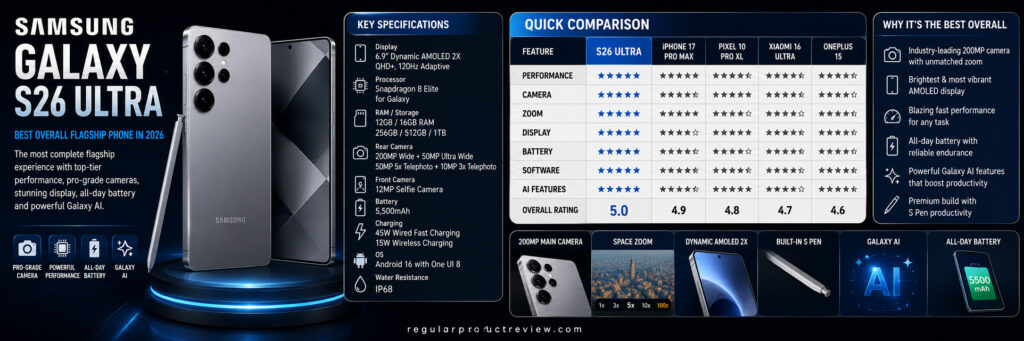
📋 Key Specifications
| Feature | Officially Documented Detail |
|---|---|
| Operating System | Android 16 with One UI 8.5 at launch |
| Display | 6.9-inch QHD+ Dynamic AMOLED 2X; adaptive 1–120Hz |
| Processor | Snapdragon 8 Elite Gen 5 for Galaxy |
| Memory / Storage | 12GB + 256GB; 12GB + 512GB; 16GB + 1TB, market dependent |
| Rear Cameras | 200MP wide + 50MP ultrawide + 50MP 5x telephoto + 10MP 3x telephoto |
| Front Camera | 12MP autofocus |
| Video | Up to 8K30; up to 4K120 in supported modes; APV codec support |
| Battery | 5,000mAh typical |
| Charging | Up to 60W wired; Samsung states up to 75% in about 30 minutes with supported adapter and conditions |
| Durability | IP68 under specified laboratory conditions |
🎨 Design & Build Quality
The S26 Ultra is a large phone intended for buyers who value screen area, camera hardware, and S Pen input. Its size can benefit note-taking, editing, navigation, and split-screen work, but one-handed comfort will depend on hand size and case choice. The published 214g weight is lighter than the iPhone 17 Pro Max’s listed 233g, although dimensions and weight alone cannot predict comfort.
The integrated S Pen remains a practical differentiator for handwriting, annotation, precise selections, and remote productivity. Buyers who will not use it may find a smaller flagship more sensible.
📱 Display Quality
Samsung documents a 6.9-inch QHD+ Dynamic AMOLED 2X panel with an adaptive 1–120Hz refresh rate. The built-in Privacy Display is designed to limit side-angle viewing when enabled, with configurable privacy behavior. That feature may help during travel or sensitive work, but buyers should examine its effect on brightness, viewing angle, and battery use in person.
⚡ Performance
The customized Snapdragon 8 Elite Gen 5 for Galaxy and redesigned vapor chamber indicate high-end performance intent. Samsung publishes comparative CPU, GPU, and NPU improvement claims, but those are manufacturer measurements against earlier products. Sustained gaming and export performance should be judged from independent tests using the final retail software.
For everyday work, the chipset, memory tiers, USB connectivity, large display, and S Pen give the phone a strong documented productivity foundation. The 1TB model also includes 16GB RAM, although storage availability varies by market.
📷 Camera Capability
The rear system covers ultrawide, wide, 3x, and 5x optical viewpoints. This is useful for travel, portraits, events, architecture, and subjects that cannot be approached physically. The 200MP main sensor and 50MP telephoto/ultrawide figures describe capture hardware; they do not guarantee better output than a lower-resolution camera.
Samsung says wider apertures on the main and 5x telephoto cameras admit more light than the previous generation. Treat that as a generation-over-generation manufacturer claim, not proof that the S26 Ultra beats every rival in low light.
🌞 Daylight Photography
Multiple focal lengths can reduce dependence on heavy digital cropping. Daylight quality still depends on processing, shutter timing, motion, HDR behavior, and the selected output mode. Buyers should compare original files rather than social-media thumbnails.
🌙 Low-Light Photography
Optical stabilization and wider apertures are relevant in dim scenes, while Nightography modes add computational processing. Moving people, pets, concerts, and indoor action remain more demanding than static night scenes. No controlled low-light comparison was performed for this page.
🔭 Zoom Photography
The meaningful hardware points are the 3x and 5x optical telephotos. Samsung describes 10x as optical-quality and 100x as digital Space Zoom. Image quality normally becomes more dependent on light, stabilization, cropping, and processing as magnification rises. Compare samples at the exact zoom levels you plan to use.
🎥 Video Recording
Samsung documents 8K30, 4K120 in supported modes, upgraded Super Steady behavior, and APV codec support on the S26 Ultra. Creators should check file sizes, editor compatibility, external-storage requirements, heat, and sustained recording time before adopting APV or high-frame-rate modes.
🤳 Selfie Camera
The 12MP front camera includes autofocus and supports 4K60 recording. Resolution alone should not be compared directly with 18MP, 32MP, or 42MP front cameras because lens, sensor, focus, processing, and output mode differ.
🤖 AI Features
Galaxy AI includes photo, search, assistance, and personalization tools. Some require a Samsung or Google account, network access, and supported language or region. AI-generated or edited results may be inaccurate, and Samsung states that some generated images include a visible watermark.
🔋 Battery Life
Samsung lists a 5,000mAh typical battery and up to 60W wired charging. The company’s “up to 75% in around 30 minutes” figure uses specified test conditions and a compatible adapter sold separately. It should not be read as a full-charge guarantee or a prediction of screen-on time.
💻 Software Experience
One UI offers extensive customization, multitasking, S Pen support, and Samsung ecosystem integration. The feature set can feel powerful or busy depending on preference. Samsung states seven years of security updates, improving the long-term ownership case, though service timing and availability can vary.
🧠 Flagship Technology Explained (ELI10)
Think of the S26 Ultra as a digital toolkit. It carries several fixed camera viewpoints, a pen, a large screen, and software for many tasks. More tools create flexibility, but only the tools you actually use add value.
✅ Documented Advantages
- Four rear cameras with dedicated 3x and 5x optical telephotos
- Large QHD+ 1–120Hz display
- Integrated S Pen and productivity features
- Up to 1TB storage and 16GB RAM on the top configuration
- 8K30, 4K120 in supported modes, and APV codec support
- Seven-year security-update statement from Samsung
❌ Limitations and Checks
- Large size and premium pricing will not suit everyone
- 10x is optical-quality and 100x is digital, not physical optical zoom
- Charger is sold separately
- AI features and configurations can vary by region
- This guide does not provide controlled camera, thermal, gaming, or battery measurements
👤 Who Should Consider It?
- Buyers who want multiple physical focal lengths
- S Pen users and productivity-focused Android buyers
- Travelers or creators who value a large display and camera flexibility
- Buyers seeking 1TB storage in a mainstream U.S. flagship
🚫 Who Should Avoid It?
- People who prefer compact or light phones
- Buyers who will not use the S Pen or telephoto flexibility
- Shoppers interpreting the largest zoom number as optical reach
- Anyone wanting a decision based only on this page’s hands-on testing
⭐ Overall Assessment
The Galaxy S26 Ultra has the broadest documented hardware coverage among the four verified phones here. Its position is justified by feature breadth and productivity potential, not an unsupported perfect score.
🏆 Bottom Line
The Samsung Galaxy S26 Ultra is the lead research-based fit for buyers who want S Pen productivity, several physical camera focal lengths, a large display, and high storage capacity. Confirm price, size, regional configuration, and whether you will use its specialized features before choosing it.
Best For: Broad flagship hardware, S Pen productivity, camera focal-length flexibility, and buyers who value a 1TB option.
🍎 Apple iPhone 17 Pro Max
Research-Based Category Fit: Professional Video Workflow and Apple Ecosystem
⭐ Overview
The Apple iPhone 17 Pro Max pairs the A19 Pro chip with a 6.9-inch Super Retina XDR OLED display, three 48MP rear cameras, an 18MP Center Stage front camera, and storage from 256GB to 2TB. Apple’s official specification includes ProRes RAW, Apple Log 2, ACES, Genlock, external recording, USB 3 transfer, and 4K Dolby Vision up to 120fps on the main camera.
That documented capture-to-edit toolset is the clearest reason to consider this phone. It can fit creators who already use Mac, Final Cut Pro, AirDrop, iCloud, compatible external drives, and Apple accessories. The value is not simply “better video”; it is a coherent workflow with specific recording formats and transfer options.
The Pro Max is also the heaviest verified phone in this comparison at Apple’s listed 233g. Its large screen and battery-oriented chassis can help with framing and editing, but buyers who prioritize one-handed use should compare the smaller iPhone 17 Pro.
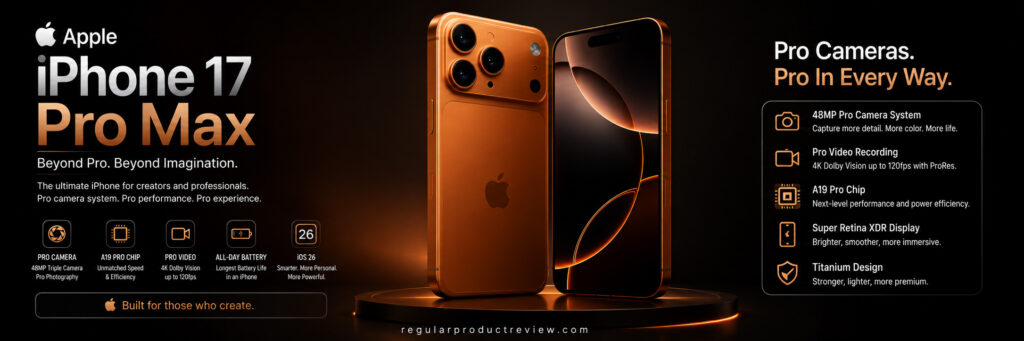
📋 Key Specifications
| Feature | Officially Documented Detail |
|---|---|
| Operating System | iOS 26 at launch |
| Display | 6.9-inch 2868 × 1320 Super Retina XDR OLED; ProMotion up to 120Hz |
| Processor | Apple A19 Pro |
| Storage | 256GB, 512GB, 1TB, or 2TB |
| Rear Cameras | 48MP main + 48MP ultrawide + 48MP 4x telephoto; 8x optical-quality option |
| Front Camera | 18MP Center Stage camera with autofocus |
| Video | 4K Dolby Vision up to 120fps on the main camera; ProRes RAW, Apple Log 2, ACES, Genlock, and external recording |
| Battery Claim | Apple states up to 39 hours of video playback; this is not camera-recording runtime |
| Charging | Up to 50% in 20 minutes with supported 40W-or-higher adapter; MagSafe/Qi2 up to 25W |
| Durability | IP68 under IEC 60529 conditions |
🎨 Design & Build Quality
Apple specifies an aluminum unibody, Ceramic Shield 2 front, Ceramic Shield back, and IP68 rating. The 6.9-inch body provides a large preview and editing surface but will not suit everyone’s hands or pockets. A protective case increases bulk further, so comfort should be tested rather than inferred from materials.
The Camera Control and Action button offer dedicated access to capture functions and shortcuts. Their usefulness depends on grip, case design, and whether the buyer prefers physical or on-screen controls.
📱 Display Quality
The 2868 × 1320 OLED panel supports ProMotion up to 120Hz, Always-On display, HDR, True Tone, wide color, up to 3,000 nits peak outdoor brightness, and an anti-reflective coating. These are strong documented specifications. Color accuracy, reflections, PWM behavior, and readability under specific conditions still require independent measurement.
⚡ Performance
The A19 Pro includes a six-core CPU, six-core GPU with Neural Accelerators, a 16-core Neural Engine, and hardware-accelerated ray tracing. Apple does not publish RAM in its consumer specification, so an unsupported memory figure is not added here.
This hardware supports demanding capture and editing workflows, but sustained gaming speed, heat, render time, and battery drain depend on application, settings, ambient temperature, and software version. Buyers should use task-specific benchmarks rather than a universal performance score.
📷 Camera Capability
The three 48MP rear cameras cover a 24mm-equivalent main, 13mm ultrawide, and 100mm-equivalent 4x telephoto. Apple also describes 2x and 8x optical-quality framing options created from its sensors. The physical dedicated telephoto is 4x; 8x should not be described as a separate 8x optical lens.
ProRAW, macro capture, Photographic Styles, Night mode, portrait controls, and multiple focal lengths provide a flexible still-photo toolkit. Output quality, skin tones, HDR preference, motion handling, and lens matching were not scored in a shared test for this guide.
☀️ Daylight Photography
High-resolution capture across the rear cameras can help with framing and editing flexibility. Real detail depends on light, selected output resolution, motion, processing, and lens choice. Compare original files at the sizes you actually print or publish.
🌙 Low-Light Photography
Night mode and optical stabilization support handheld low-light capture, but telephoto and moving-subject results remain scene dependent. Static cityscapes are easier than children, pets, or concerts. No claim of low-light superiority is made without matching samples.
🎥 Professional Video Recording
This is the iPhone 17 Pro Max’s strongest documented category. Apple lists 4K Dolby Vision up to 120fps on the main camera, ProRes up to 4K120 with external recording, ProRes RAW, Apple Log 2, ACES, Genlock, external storage support, four microphones, and USB 3 up to 10Gb/s.
Those features can matter to filmmakers, multi-camera productions, and color-managed workflows. They also create larger files, accessory costs, storage requirements, and post-production demands. Our flagship phones for video editing guide covers more workflow considerations.
🤳 Selfie Camera
The 18MP Center Stage camera includes autofocus, 4K Dolby Vision up to 60fps, ultra-stabilized video, and Dual Capture. Buyers should review current samples for indoor noise, skin tone, field of view, and stabilization instead of relying on resolution alone.
🤖 Apple Intelligence & AI Features
Apple Intelligence integrates writing, image, communication, and assistant features across supported apps. Availability varies by language, region, device setup, and software version; some capabilities may require network access. AI output should be checked before professional or factual use.
🔋 Battery Life
Apple states up to 39 hours of local video playback and up to 35 hours of streamed video playback for the Pro Max. These are manufacturer playback tests, not predictions for camera use, gaming, navigation, or mixed daily activity.
Fast charging requires a compatible adapter sold separately. Apple states up to 50% in 20 minutes with a 40W-or-higher adapter and supported cable; MagSafe can reach up to 25W with appropriate hardware. Actual charging time varies with heat, battery state, and activity.
💻 Software Experience
iOS connects capture, Photos, Files, AirDrop, iCloud, external storage, and third-party editors. That integration can be valuable to existing Apple users. Android users who depend on different file management, sideloading, interface customization, or device interoperability should confirm whether iOS fits their workflow.
🧠 Flagship Technology Explained (ELI10)
Think of the iPhone as a camera attached to a production pipeline. Ordinary modes simplify sharing, while ProRes RAW and Log preserve more editing flexibility. The advanced formats are valuable only when storage, accessories, and editing software can support them.
✅ Documented Advantages
- Three 48MP rear cameras and an autofocus 18MP front camera
- Extensive professional video formats and synchronization options
- USB 3 and supported external-recording workflows
- 2TB storage option on Pro Max
- Large 120Hz OLED display and Apple ecosystem integration
- Published 39-hour video-playback claim
❌ Limitations and Checks
- High purchase price and potentially substantial storage/accessory cost
- 233g weight before adding a case
- Dedicated telephoto is 4x; 8x is optical-quality
- U.S. models use eSIM and may not suit every travel scenario
- Playback battery figures do not predict recording or mixed-use endurance
👤 Who Should Consider It?
- Video creators who need Log, ProRes, external recording, ACES, or Genlock
- Apple ecosystem users who value AirDrop, iCloud, and Mac workflows
- Buyers who need up to 2TB internal storage
- Users who prefer a large display for capture and editing
🚫 Who Should Avoid It?
- Buyers who prefer compact, light phones
- Users who do not need professional capture formats
- Shoppers who require a physical SIM in a U.S. model
- Android users whose workflows depend on Android-specific flexibility
⭐ Overall Assessment
The iPhone 17 Pro Max has the most extensive officially documented professional video workflow in this list. That supports a category-fit recommendation, not a numerical claim that it is best at every camera or performance task.
🏆 Bottom Line
The Apple iPhone 17 Pro Max is the research-based choice here for professional video features and tight Apple ecosystem integration. Confirm storage needs, accessories, eSIM requirements, and whether the large 233g body is comfortable before buying.
Best For: Professional mobile video workflows, Apple ecosystem users, high-capacity storage, and creators prepared for large files.
🤖 Google Pixel 10 Pro XL
Research-Based Category Fit: Google Camera/AI Tools and Long Software Support
⭐ Overview
The Google Pixel 10 Pro XL uses Google’s Tensor G5, 16GB RAM, a 6.8-inch LTPO OLED display, a 5,200mAh typical battery, and a triple rear camera system. Google lists a 50MP main, 48MP autofocus ultrawide with Macro Focus, 48MP 5x optical telephoto, and 42MP autofocus front camera.
The Pixel’s documented distinction is the combination of Google camera tools, on-device/cloud-assisted AI features, a seven-year operating-system/security-update and Pixel Drop commitment, and a relatively simple first-party Android experience. Those qualities can be more meaningful than a benchmark lead for buyers who prioritize photography assistance, editing, call features, and long support.
Some capabilities depend on supported countries, languages, accounts, subscriptions, or network processing. Buyers should verify feature availability in their location rather than assuming every advertised AI tool works everywhere.
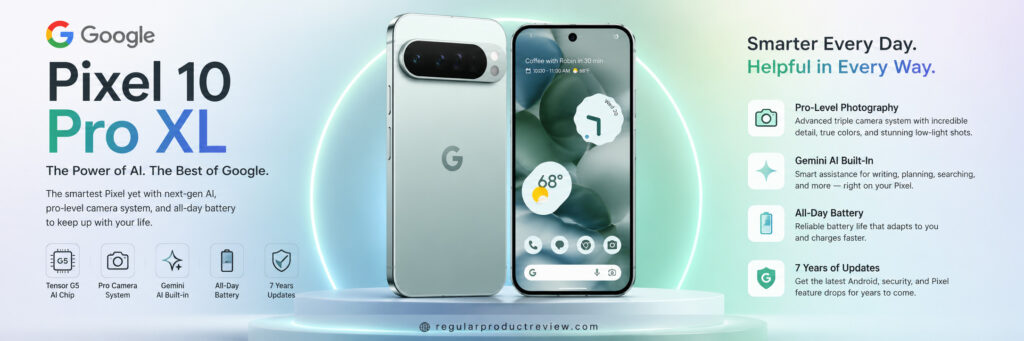
📋 Key Specifications
| Feature | Officially Documented Detail |
|---|---|
| Operating System | Android 16 at launch |
| Display | 6.8-inch 1344 × 2992 LTPO OLED; adaptive 1–120Hz; up to 3,300 nits peak |
| Processor | Google Tensor G5 with Titan M2 security coprocessor |
| Memory / Storage | 16GB RAM; 256GB, 512GB, or 1TB |
| Rear Cameras | 50MP main + 48MP autofocus ultrawide + 48MP 5x optical telephoto |
| Front Camera | 42MP autofocus, 103-degree field of view |
| Video | 4K up to 60fps; 8K at 24/30fps through Video Boost |
| Battery | 5,200mAh typical; Google claims 24+ hours under its test profile |
| Charging | Google states up to 70% in about 30 minutes with a 45W-or-higher USB-C PPS charger; Qi2-certified Pixelsnap up to 25W |
| Support | Seven years of OS/security updates and Pixel Drops |
🎨 Design & Build Quality
Google specifies Gorilla Glass Victus 2 on the front and back, an aluminum frame, and IP68 dust/water resistance. The 6.8-inch XL body provides a large canvas but is not a compact option. Buyers should evaluate grip, camera-bar balance, and case compatibility in person.
IP68 is based on laboratory conditions and can diminish with wear. It should not be treated as permission for intentional water exposure or proof of liquid-damage warranty coverage.
📱 Display Quality
The Super Actua display has a 1344 × 2992 resolution, adaptive 1–120Hz refresh rate, up to 2,200 nits HDR brightness, and up to 3,300 nits peak brightness. Those published figures suggest strong outdoor potential, while reflections, color accuracy, minimum brightness, and flicker require measurement.
⚡ Performance
Tensor G5 is designed around Google’s camera, security, and AI workload priorities. It supports everyday flagship tasks and local AI functions, but this page does not claim that it beats Snapdragon or A19 Pro in sustained CPU/GPU performance.
Gaming-oriented buyers should compare frame-rate stability, heat, and power use for their exact titles. The Pixel’s strongest purchase case is its integrated software and camera feature set, not an unverified universal speed ranking.
📷 Camera Capability
The 50MP main, 48MP autofocus ultrawide, and 48MP OIS 5x telephoto provide wide, macro, and long-range framing. Google also lists optical-quality positions and Pro Zoom up to 100x. Only the 5x telephoto is the dedicated physical long lens; the highest zoom numbers rely on cropping and computation.
Google documents Camera Coach, Night Sight, Macro Focus, Real Tone, Add Me, High-Res Portrait Mode, Pro controls, and multiple editing features. These tools can assist capture, but they do not substitute for comparative image evidence.
☀️ Daylight Photography
The camera hardware and automated processing are suited to point-and-shoot use on paper. Color, HDR, motion, facial rendering, and fine detail should be judged from recent full-resolution samples using final retail software.
🌙 Low-Light Photography
Night Sight, optical stabilization, and multi-frame processing are relevant in dim conditions. Subject movement remains difficult, and computational brightening is not always the same as natural rendering. No controlled night-scene winner is declared here.
🔭 Zoom Photography
The physical 5x telephoto is the defensible optical claim. Google describes 10x as optical-quality and Pro Zoom up to 100x. For wildlife, sports, or concerts, compare the exact zoom levels and lighting conditions you expect to use.
🎥 Video Recording
Google lists 4K recording up to 60fps, 10-bit HDR, several stabilization modes, and 8K at 24/30fps powered by Video Boost. Because Video Boost can involve cloud-assisted processing, creators should examine upload time, connectivity, privacy, availability, and turnaround requirements.
🤳 Selfie Camera
The 42MP front camera includes autofocus and a 103-degree ultrawide field of view, which can help with group framing. Megapixels alone cannot establish indoor detail or skin-tone preference.
🤖 AI Features
Gemini Nano, Gemini, Magic Cue, Circle to Search, Live Translate, Call Assist, Camera Coach, and editing tools are part of Google’s documented feature set. Availability and behavior can change with software, language, region, account, and connectivity.
AI output should be reviewed before it is used for factual, professional, or sensitive tasks. A feature list demonstrates capability, not accuracy in every situation.
🔋 Battery Life
Google lists a 5,200mAh typical battery and “24+ hour” battery language based on its test profile. Camera use, navigation, gaming, signal strength, screen brightness, AI processing, and battery age can materially change runtime.
The company states up to 70% charging in about 30 minutes with a compatible 45W-or-higher USB-C PPS charger, sold separately. Pixelsnap Qi2-certified charging reaches up to 25W with supported equipment.
💻 Software Experience
The Pixel launched with Android 16 and carries a seven-year commitment for operating-system updates, security updates, and Pixel Drops. That gives buyers a clearer support horizon, though individual features may still vary by hardware, country, language, and service.
🧠 Flagship Technology Explained (ELI10)
The Pixel is like a camera with a software assistant. The hardware captures the scene, while Google’s processing and AI tools help combine frames, choose edits, or guide composition. Software can help, but it cannot fully replace good light, steady framing, or a longer physical lens.
✅ Documented Advantages
- 50MP + 48MP + 48MP rear camera system with 5x optical telephoto
- 42MP autofocus ultrawide front camera
- 16GB RAM across the XL storage tiers
- Seven-year update commitment
- Qi2-certified magnetic wireless charging
- Broad Google camera, call, editing, and AI feature set
❌ Limitations and Checks
- Several AI features have language, region, account, or network requirements
- 8K recording depends on Video Boost rather than fully local capture
- 100x Pro Zoom is computational, not physical optical zoom
- Charger is sold separately
- This article does not measure gaming, thermal, camera, or battery performance
👤 Who Should Consider It?
- Buyers who prefer Google’s camera and editing tools
- Users who value seven years of official software support
- Travelers and families wanting ultrawide, macro, and 5x options
- Android users who prefer Google’s first-party software experience
🚫 Who Should Avoid It?
- Buyers who need the highest sustained gaming performance
- Creators requiring fully local 8K capture
- Users in regions where desired Google AI features are unavailable
- Anyone who wants a compact phone rather than a 6.8-inch XL model
⭐ Overall Assessment
The Pixel 10 Pro XL is a strong documented fit for Google camera/AI tools, long update support, and point-and-shoot assistance. The evidence does not justify unsupported perfect camera, battery, or performance scores.
🏆 Bottom Line
The Google Pixel 10 Pro XL is the research-based choice here for buyers who prioritize Google’s camera software, AI-assisted features, a 5x telephoto, Qi2, and a seven-year support commitment. Confirm regional feature availability and current pricing before buying.
Best For: Google software, computational-camera tools, long update support, group selfies, macro, and 5x telephoto use.
📸 Xiaomi 16 Ultra
Unverified Product Name — Buyer Verification Required, Not Recommended
⭐ Overview
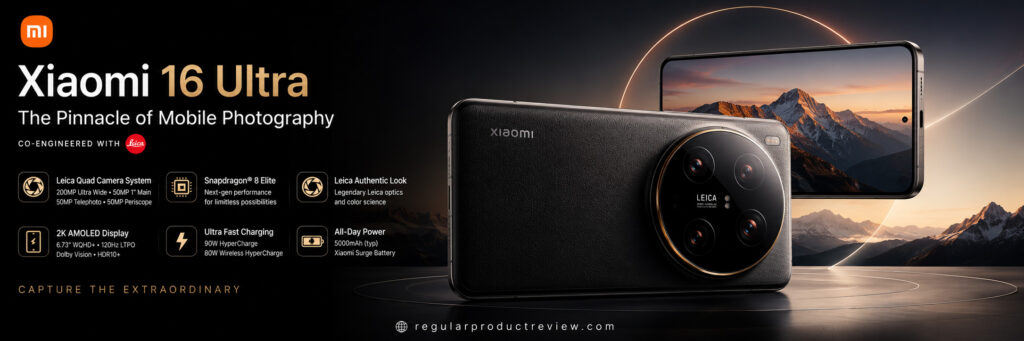
No official Xiaomi global product or specification page for Xiaomi 16 Ultra was verified during this review. Xiaomi’s official global material documents the Xiaomi 15 Ultra and the later Xiaomi 17 Ultra, but not a product matching this exact name.
Without a verified product identity, claims about its processor, cameras, display, battery, charging, software, Leica features, availability, or performance cannot be presented as facts. A seller listing may be mislabeled, unofficial, or confused with another Xiaomi model.
This entry remains in the same product position to prevent readers from treating an unverified name as a purchase recommendation. Do not transfer Xiaomi 15 Ultra or Xiaomi 17 Ultra specifications to a supposed “16 Ultra.”
📋 Key Specifications
| Feature | Verification Result |
|---|---|
| Official Product Identity | Not verified |
| Official Global Product Page | Not found for “Xiaomi 16 Ultra” |
| Processor / Memory / Storage | Not verifiable for this name |
| Display | Not verifiable for this name |
| Rear / Front Cameras | Not verifiable for this name |
| Video | Not verifiable for this name |
| Battery / Charging | Not verifiable for this name |
| Software / Update Policy | Not verifiable for this name |
| Recommendation Status | Do not buy without an exact model number and matching official page |
| Possible Name Confusion | Xiaomi 15 Ultra or Xiaomi 17 Ultra |
🎨 Design & Build Quality
No verified design, materials, dimensions, weight, or ingress-protection specification can be assigned to this product name. Marketing images or third-party listings are not sufficient proof of an official model.
📱 Display Quality
No verified panel size, resolution, brightness, refresh rate, glass, or display certification is available for this exact name. Do not copy specifications from a neighboring Xiaomi generation.
⚡ Performance
No verified chipset, RAM, storage standard, cooling system, or software build can be attributed to Xiaomi 16 Ultra. Performance claims would be speculation until an official product identity exists.
📷 Camera Capability
No defensible Leica camera, sensor, lens, focal-length, autofocus, stabilization, or image-processing claim is available for this name. A Leica badge or Ultra label in a marketplace image does not establish authenticity.
☀️ Daylight Photography
Not evaluated and not verifiable for this product name.
🌙 Low-Light Photography
Not evaluated and not verifiable for this product name.
🔭 Zoom Photography
Not evaluated and not verifiable for this product name.
🎥 Video Recording
No official resolution, frame-rate, stabilization, log, HDR, or codec support can be confirmed for this name.
🤳 Selfie Camera
No verified front-camera specification is available for this name.
🤖 AI Features
No supported HyperOS version, AI feature list, language availability, or service policy can be assigned to an unverified phone. Software features from another model may not apply.
🔋 Battery Life
Battery capacity and charging claims cannot be verified. Do not rely on seller-provided figures unless the exact model number matches an official Xiaomi specification page.
💻 Software Experience
Operating system, update support, Google service availability, network bands, languages, and regional firmware are unknown for this product name. These are critical checks for any imported Xiaomi device.
🧠 Flagship Technology Explained (ELI10)
A phone name is like the model number on a medicine or camera lens: if the identity is wrong, every attached specification may describe something else. Confirm the exact model first; compare features second.
✅ What Can Be Preserved
- The product name and original image provide context for this warning
- The section can help readers identify ambiguous marketplace listings
- Official Xiaomi 15 Ultra and 17 Ultra specification pages are linked for comparison
❌ Critical Problems
- No verified official identity for Xiaomi 16 Ultra
- No defensible hardware, software, availability, or performance claims
- No basis for a category award or numerical rating
- High risk of confusing specifications from different Xiaomi generations
👤 Who Should Buy It?
No reader should buy a device under this unverified name without an exact model number, official specification match, reliable seller, warranty, and return protection.
🚫 Who Should Avoid It?
Everyone should avoid listings that cannot be matched to an official Xiaomi product page.
⭐ Overall Assessment
No score or recommendation is appropriate because the product identity is not established.
🏆 Bottom Line
The Xiaomi 16 Ultra is not a valid recommendation at the September 6, 2026 verification point. Official Xiaomi global pages document Xiaomi 15 Ultra and Xiaomi 17 Ultra instead. Recheck Xiaomi’s official catalog if the manufacturer later announces a product with this exact name.
Best For: None until product identity is officially verified.
⚡ OnePlus 15
Research-Based Category Fit: Battery Capacity, Charging, and Performance-Oriented Hardware
⭐ Overview
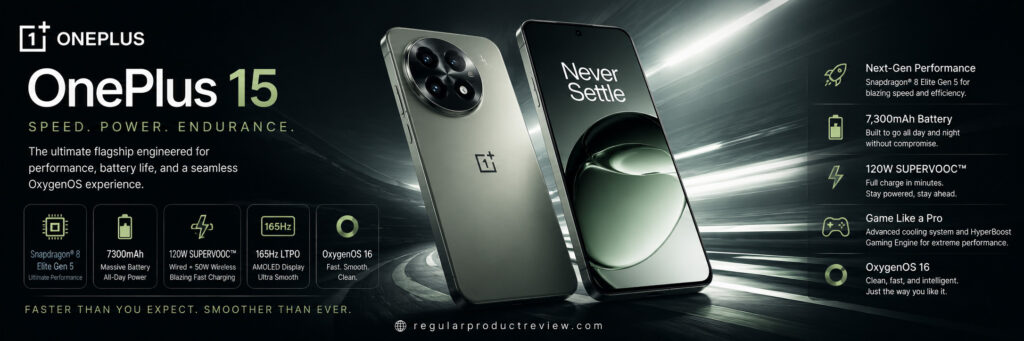
The OnePlus 15 is a verified U.S. model built around Snapdragon 8 Elite Gen 5, OxygenOS 16 based on Android 16, a 6.78-inch display with up to 165Hz in supported gaming situations, and a 7,300mAh typical battery. U.S. specifications list 80W SUPERVOOC wired charging and 50W AIRVOOC wireless charging.
OnePlus offers 12GB RAM with 256GB storage or 16GB RAM with 512GB storage in the official U.S. specification. Its rear camera system uses three 50MP cameras: a main camera with OIS, an autofocus ultrawide, and a 3.5x optical telephoto with OIS. The 32MP front camera includes autofocus.
The original 120W charging figure describes some global configurations, not the official U.S. specification. Because this site primarily serves U.S. buyers, the section uses the U.S. 80W wired figure and explains the regional difference.
📋 Key Specifications
| Feature | Official U.S. Detail |
|---|---|
| Operating System | OxygenOS 16 based on Android 16 |
| Display | 6.78-inch 2772 × 1272; adaptive 1–120Hz and up to 165Hz in supported gaming modes |
| Processor | Snapdragon 8 Elite Gen 5 |
| Memory / Storage | 12GB + 256GB or 16GB + 512GB; LPDDR5X Ultra/Ultra+ and UFS 4.1 |
| Rear Cameras | 50MP main OIS + 50MP autofocus ultrawide + 50MP 3.5x optical telephoto OIS |
| Front Camera | 32MP autofocus |
| Video | Up to 8K30; up to 4K120 rear; up to 4K60 front |
| Battery | 7,300mAh typical |
| Charging | 80W SUPERVOOC wired and 50W AIRVOOC wireless on the U.S. specification page |
| Connectivity / Port | 5G, Wi-Fi, Bluetooth, NFC, eSIM support, USB 3.2 Gen 1 Type-C |
🎨 Design & Build Quality
OnePlus lists Gorilla Glass Victus 2 on the display and promotes broad dust/water protection for the phone. Water-resistance performance can decline with wear, and warranty coverage should be checked before intentional exposure.
The 6.78-inch body targets buyers who prefer a large display without moving to the very largest 6.9-inch options. Weight, surface finish, button placement, and case comfort should still be evaluated in person.
📱 Display Quality
The official U.S. specification lists a 2772 × 1272 panel, adaptive 1–120Hz operation, and a maximum 165Hz rate in gaming. The 165Hz figure does not mean every app or game runs at 165fps. Title support, software behavior, temperature, settings, and rendering performance determine what appears in practice.
OnePlus also lists 1,800 nits high-brightness mode. Outdoor readability, reflections, color accuracy, and flicker behavior require independent measurement.
⚡ Performance
Snapdragon 8 Elite Gen 5, UFS 4.1 storage, and up to 16GB LPDDR5X Ultra+ RAM create a strong performance-oriented specification. OnePlus publishes gaming and efficiency claims from its own laboratory; those figures should be treated as manufacturer results under specified conditions.
For buyers focused on gaming, our best gaming phones in 2026 guide provides a wider category context. Sustained performance should be checked for the buyer’s exact games, frame-rate targets, network, and ambient temperature.
📷 Camera Capability
The main, ultrawide, and telephoto cameras are all 50MP. The 3.5x telephoto has OIS, while OnePlus describes 7x as optical-quality and digital still-photo zoom up to 120x. The physical telephoto claim is 3.5x; the larger values rely increasingly on cropping and computation.
The hardware offers useful framing flexibility, but it does not establish better image quality than the Samsung, Apple, or Pixel systems. Recent full-resolution samples are necessary to judge motion, HDR, skin tones, low light, focus, and lens consistency.
☀️ Daylight Photography
The autofocus ultrawide and OIS-equipped main/telephoto cameras provide a versatile hardware base. Daylight detail and color still depend on the selected mode, light, processing, motion, and software version.
🌙 Low-Light Photography
OIS on the main and telephoto cameras can help with static scenes. Low-light action remains demanding, and manufacturer descriptions of night processing are not independent evidence. Compare original files with moving subjects as well as static scenes.
🔭 Zoom Photography
The dedicated lens provides 3.5x optical zoom. OnePlus describes 7x as optical-quality and still-photo digital zoom up to 120x. Buyers should evaluate the exact 3.5x, 7x, 10x, and higher ranges they expect to use.
🎥 Video Recording
The U.S. specification lists 8K30 and 4K up to 120fps on the rear cameras, with 4K up to 60fps on the front camera. Supported modes do not guarantee sustained recording duration, stabilization quality, heat control, or matching color between lenses.
🤳 Selfie Camera
The 32MP Sony IMX709 front camera includes autofocus and 4K60 support. Actual indoor detail, face rendering, stabilization, and field of view should be checked with current samples.
🤖 AI Features
OxygenOS includes OnePlus and Google-assisted AI features, with availability depending on account, software, language, country, and network. Buyers should prioritize tools they will actually use and verify subscription or data requirements.
🔋 Battery Life
The 7,300mAh typical capacity is the largest published battery figure among the four verified phones in this list. Capacity alone does not prove the longest endurance because display behavior, modem efficiency, performance tuning, apps, and usage differ.
OnePlus lists 80W wired and 50W wireless charging for the U.S. model. The global page may show 120W wired charging, so accessories and claims must match the exact regional device. Manufacturer charging-time claims use controlled conditions and supported chargers.
💻 Software Experience
OxygenOS 16 is based on Android 16 and offers OnePlus customization, gaming tools, and AI features. “Clean” or “best” software is subjective; buyers should examine preinstalled apps, update policy, interface behavior, and device integration themselves.
🧠 Flagship Technology Explained (ELI10)
The OnePlus 15 is like a performance laptop with a large fuel tank. Powerful hardware and a large battery create potential, but the actual speed and runtime still depend on cooling, workload, settings, and software.
✅ Documented Advantages
- Snapdragon 8 Elite Gen 5 with UFS 4.1 and up to 16GB RAM
- 7,300mAh typical battery
- 80W wired and 50W wireless charging on the U.S. model
- Triple 50MP rear cameras with 3.5x optical telephoto
- Up to 165Hz in supported gaming modes
- 8K30, rear 4K120, and front 4K60 support
❌ Limitations and Checks
- U.S. wired charging is 80W, not the 120W listed for some global markets
- 165Hz does not apply to every app or game
- 7x is optical-quality and 120x is digital, not physical optical zoom
- No 1TB U.S. storage option is listed
- Battery, camera, gaming, and thermal results were not independently measured here
👤 Who Should Consider It?
- Buyers prioritizing battery capacity and fast charging
- Performance-focused Android users and mobile gamers
- Users who want 12GB/256GB or 16GB/512GB configurations
- Buyers who value a 3.5x telephoto and autofocus front camera
🚫 Who Should Avoid It?
- Buyers who need 1TB or 2TB internal storage
- Shoppers expecting 120W charging on the U.S. model
- Users who prioritize S Pen or Apple ecosystem workflows
- Anyone treating capacity alone as proof of battery endurance
⭐ Overall Assessment
OnePlus 15 has the strongest battery-capacity and charging-oriented specification among the verified entries, together with flagship performance hardware. It should not receive a numerical battery or performance score without shared testing.
🏆 Bottom Line
The OnePlus 15 is the research-based fit for buyers who prioritize a 7,300mAh battery, U.S. 80W/50W charging, Snapdragon performance, and a high-refresh gaming display. Verify current price, regional model, software policy, and game support before choosing it.
Best For: Battery capacity, fast charging, performance-oriented Android use, and buyers comfortable with a 512GB maximum U.S. storage tier.
🛒 Buying Guide: How to Choose the Best Flagship Phone in 2026
The right flagship is the one whose strengths match your repeated daily tasks. Paying for every premium feature makes little sense if you use only a few of them. Begin with your operating system, physical size, camera needs, storage, and support horizon; then compare price and accessories.
1. Choose the Ecosystem First
An iPhone may be more valuable to someone using a Mac, Apple Watch, AirPods, AirDrop, iMessage, and iCloud. An Android flagship may fit better with Windows workflows, Google services, USB file management, customization, and a broader accessory ecosystem. Switching platforms can also change app purchases, authentication, backups, watches, and family communication.
Buyers committed to Apple can compare other sizes and price levels in our best iPhones in 2026 guide.
2. Decide What Size You Can Live With
Large displays help with maps, video, editing, documents, split-screen work, and gaming. They also add weight and can be awkward one-handed. Compare the phone with a realistic case attached, not only a display model without one.
Samsung’s 6.9-inch Ultra and Apple’s 6.9-inch Pro Max are especially large. Pixel 10 Pro XL and OnePlus 15 are also large-screen devices. If comfort matters more than maximum battery or display area, a smaller Pro-class model may be a better flagship.
3. Match Camera Hardware to Subjects
For children, pets, and action, autofocus and shutter behavior matter. For wildlife or concerts, a physical telephoto and stabilization matter. For portraits, focal length and skin-tone preference matter. For video, formats, microphones, heat, storage, stabilization, and editing compatibility matter.
Do not treat a high megapixel count or digital zoom number as a complete camera review. Compare original samples from the same scenes and software version. Social-media compression can hide important differences.
4. Treat Video as a Workflow
Professional formats create value only when the rest of the workflow can use them. Apple’s ProRes RAW, Log 2, ACES, Genlock, USB 3, and external recording form the broadest documented creator pipeline here. Samsung’s APV support and high-resolution modes may fit other workflows. Pixel’s Video Boost adds cloud-assisted processing considerations, while OnePlus supports high-resolution and high-frame-rate recording.
Check file sizes, storage media, editor support, microphones, cages, power, and transfer time before choosing a phone for production.
5. Understand Optical and Digital Zoom
A physical telephoto lens gives the phone a real optical viewpoint. “Optical-quality” modes often crop a high-resolution sensor, while hybrid, AI, Space Zoom, Pro Zoom, and digital zoom rely increasingly on processing. These tools can be useful, but they are not identical to an optical lens at the advertised maximum number.
In this list, Samsung provides dedicated 3x and 5x telephotos, Pixel provides a dedicated 5x telephoto, iPhone provides a dedicated 4x telephoto, and OnePlus provides a dedicated 3.5x telephoto.
6. Compare Battery Claims Carefully
Milliamp-hours describe nominal capacity, not guaranteed endurance. Display size and brightness, network, chipset tuning, camera use, gaming, background apps, temperature, and battery age all influence runtime. Manufacturer playback figures use controlled conditions and cannot be compared directly with a different brand’s test.
Charging power also needs context. OnePlus lists 80W wired charging for its U.S. model even though some global pages list 120W. Samsung’s 60W, Google’s 45W-or-higher adapter requirement, and Apple’s fast-charge statements use specific hardware and conditions.
7. Buy Enough Storage
4K/8K video, RAW photos, offline media, large games, and AI assets can fill storage quickly. Cloud storage helps only when connectivity, subscription cost, upload time, and privacy fit the user. Because these models do not offer microSD expansion, storage choice matters at purchase.
For buyers who expect heavy local storage use, our flagship phones with 1TB storage comparison covers more options. Apple goes to 2TB here; Samsung and Pixel go to 1TB; the U.S. OnePlus 15 specification tops out at 512GB.
8. Verify Software Support and AI Availability
An update commitment improves long-term value, but it does not guarantee that every future feature arrives on every model. Read the manufacturer’s exact wording and consider security updates, operating-system upgrades, repair support, battery replacement, and resale.
AI tools may require network access, supported languages, accounts, or subscriptions. Do not pay extra for an AI feature that is unavailable in your country or unnecessary for your work.
9. Check U.S. Model and Seller Details
Confirm the model number, carrier bands, eSIM/physical-SIM support, Wi-Fi calling, warranty eligibility, charger, return window, and repair route. An imported phone can have excellent hardware while creating problems with network features or warranty service.
The Xiaomi 16 Ultra entry is a stronger warning: the product identity itself could not be verified. Do not proceed until the seller provides an exact model that matches an official Xiaomi page.
10. Compare Total Cost, Not Only Phone Price
Add the case, charger, screen protection, storage tier, cloud subscription, camera accessories, repair plan, and ecosystem costs. A phone that costs less initially may become more expensive after accessories, while an expensive model may include features you never use.
Our broader premium smartphones worth buying guide can help place flagship pricing in context. Current street prices matter more than launch-price assumptions.
📷 If Photography Is Your Highest Priority
Choose based on subjects and focal lengths rather than a universal camera label. Samsung offers the most physical rear-camera viewpoints in this list. Pixel emphasizes Google’s computational tools and 5x telephoto. iPhone combines three 48MP cameras with ProRAW and a creator workflow. OnePlus provides three 50MP cameras and a 3.5x telephoto.
This page does not provide shared full-resolution sample sets, so it does not crown an image-quality winner. Use our camera-phone coverage to compare more models, then inspect recent samples from independent reviewers.
🎥 If You Create Videos
The iPhone 17 Pro Max has the broadest officially documented professional video pipeline here. Samsung’s APV support, Pixel’s Video Boost features, and OnePlus’s 4K120/8K30 modes may serve different priorities. Recording resolution alone does not establish stabilization, heat management, rolling shutter, autofocus, audio, or sustained duration.
🤖 If You Want the Smartest AI Features
Pixel and Samsung place AI throughout capture, editing, calls, search, and productivity. Apple integrates Apple Intelligence across supported iOS experiences, while OnePlus combines OxygenOS and Google-assisted tools. “Smartest” cannot be measured by feature count alone; prioritize accuracy, availability, privacy, speed, subscription terms, and the tasks you repeat.
🎮 If Gaming Is Your Priority
OnePlus 15’s Snapdragon platform and up-to-165Hz supported gaming mode make it the clearest gaming-oriented specification in this group. Samsung also uses a customized Snapdragon flagship platform and advanced cooling. Actual frame rates depend on game support and thermal behavior, so consult sustained tests rather than launch benchmarks.
🔭 If You Need the Most Physical Camera Focal Lengths
Samsung Galaxy S26 Ultra offers the broadest documented focal-length hardware among these verified phones because it includes separate 3x and 5x telephoto cameras. Do not confuse its 10x optical-quality or 100x digital range with additional physical optical lenses.
🔋 If Battery Capacity Matters Most
OnePlus 15 has the largest published battery capacity here at 7,300mAh. That makes it the capacity leader on paper, not a proven endurance winner. Compare standardized battery tests and your own charging access before deciding.
🛡️ If You Plan to Keep Your Phone for Years
Google states seven years of OS/security updates and Pixel Drops for Pixel 10 Pro XL. Samsung states seven years of security updates for the S26 series. Apple does not express support as the same fixed promise on its specification page, although iPhones historically receive long software support. Also consider repairability, battery replacement, parts availability, and storage.
💰 Is the Most Expensive Phone Always the Best?
No. The most expensive configuration may add storage or specialized features that do not improve your daily tasks. Compare current price against the capabilities you will use, the time you expect to keep the phone, and the total ecosystem cost.
🧠 Flagship Terms Explained (ELI10)
📷 Computational Photography
The phone captures several pieces of image information and uses software to combine or adjust them. This can improve highlights, shadows, noise, motion, or faces, but it also introduces each manufacturer’s processing choices.
🤖 Artificial Intelligence (AI)
AI identifies patterns to assist with writing, searching, translation, images, calls, and organization. It can be useful and still produce errors. Important output should be reviewed.
⚡ Refresh Rate
Refresh rate is how often the display can update each second. Higher rates can look smoother, but apps must supply enough frames and the phone may reduce the rate to save power.
🔭 Optical Zoom
Optical zoom uses a physical lens or optical system. Optical-quality, hybrid, AI, and digital zoom may crop or reconstruct the image. Read the wording beside the number.
🌈 HDR
HDR helps preserve bright and dark detail in photos, video, or displays. Different HDR formats and processing styles can look different even when both devices support HDR.
🔋 Fast Charging
Charging wattage is a maximum capability, not a constant rate. The phone slows charging as the battery fills or becomes warm, and results depend on the adapter, cable, protocol, temperature, and usage.
❓ Frequently Asked Questions
Which flagship phone is the best overall in 2026?
There is no universal winner in this research-based guide. Galaxy S26 Ultra offers the broadest hardware and productivity set, iPhone 17 Pro Max the most extensive documented pro-video workflow, Pixel 10 Pro XL Google-centric camera/AI tools and long support, and OnePlus 15 the largest battery specification with fast U.S. charging.
Which flagship has the best camera?
This page cannot establish that without controlled, full-resolution samples. Samsung has the most physical focal lengths here; Pixel emphasizes Google processing; iPhone provides ProRAW and extensive video tools; OnePlus provides three 50MP rear cameras. Choose by subject and verified samples.
Which flagship records the best video?
The iPhone 17 Pro Max has the broadest documented professional toolset among these entries, including ProRes RAW, Apple Log 2, ACES, Genlock, and external recording. A real-world winner would still require matched tests of heat, stabilization, focus, audio, rolling shutter, and duration.
Which flagship has the best AI features?
No objective answer is supported here. Pixel and Samsung list many integrated AI tools; Apple and OnePlus provide their own assisted features. Availability, privacy, accuracy, speed, and usefulness matter more than feature count.
Which flagship offers the best battery life?
OnePlus 15 has the largest published capacity at 7,300mAh, but capacity alone does not prove endurance. Use a standardized independent battery comparison for actual runtime.
Which flagship is best for gaming?
OnePlus 15 has the clearest gaming-focused specification with Snapdragon 8 Elite Gen 5 and up to 165Hz in supported gaming modes. Samsung is also performance-oriented. Confirm support and sustained results for the exact games you play.
Are flagship phones worth the extra money?
They can be worthwhile for specialized cameras, creator video, large storage, long support, premium displays, productivity tools, or heavy workloads. A mid-range phone may be a better value if those features are unnecessary.
Is Xiaomi 16 Ultra an official phone?
No official Xiaomi global product page for that exact name was verified on September 6, 2026. Xiaomi officially documents 15 Ultra and 17 Ultra. Do not buy a “16 Ultra” listing without an exact model number and official match.
Do large zoom numbers mean optical zoom?
Not necessarily. Samsung’s 100x, Pixel’s 100x, and OnePlus’s 120x maximums involve digital/computational processing. The dedicated telephotos in this list are Samsung 3x/5x, Pixel 5x, iPhone 4x, and OnePlus 3.5x.
How much storage should a flagship phone have?
256GB is a practical starting point for many flagship buyers. Frequent 4K/8K video, RAW photography, large games, and offline media can justify 512GB, 1TB, or 2TB. Estimate your current use and expected ownership period before choosing.
🏆 Final Verdict
The evidence supports matching each verified phone to a buyer rather than assigning nearly perfect scores to all of them.
The Samsung Galaxy S26 Ultra offers the broadest documented hardware and productivity package in this group, including S Pen, multiple physical telephotos, 1TB storage, and a large display. The Apple iPhone 17 Pro Max is the strongest documented fit for professional video workflows and Apple ecosystem users. The Google Pixel 10 Pro XL suits buyers prioritizing Google’s camera/AI tools and a seven-year update commitment. The OnePlus 15 has the most battery-capacity and charging-oriented specification for U.S. buyers.
The Xiaomi 16 Ultra should not be recommended because its official product identity was not verified. Do not substitute Xiaomi 15 Ultra or 17 Ultra specifications for it.
Before buying, confirm the exact model, current price, storage, network compatibility, SIM setup, warranty, charger, repair access, return policy, and the features available in your region. Official specifications establish capabilities; they do not replace controlled comparative evidence.
⭐ Editor’s Choice
Samsung Galaxy S26 Ultra — Research-Based Lead Option
No numerical Editor’s Choice score is assigned because the phones were not compared under one documented controlled protocol. If one lead option must be selected from the verified products in this article, the Samsung Galaxy S26 Ultra is the research-based choice for the broadest combination of camera focal lengths, productivity tools, display size, storage, and long-term security support.
Why it is the lead research-based option:
- Dedicated 3x and 5x optical telephoto cameras
- Integrated S Pen and large QHD+ display
- Snapdragon 8 Elite Gen 5 for Galaxy
- Up to 1TB storage and 16GB RAM
- 8K30, 4K120 in supported modes, and APV codec support
- Seven-year security-update statement
Choose iPhone 17 Pro Max instead for the most extensive documented professional video workflow, Pixel 10 Pro XL for Google software and long OS support, or OnePlus 15 for battery-capacity and charging priorities.