

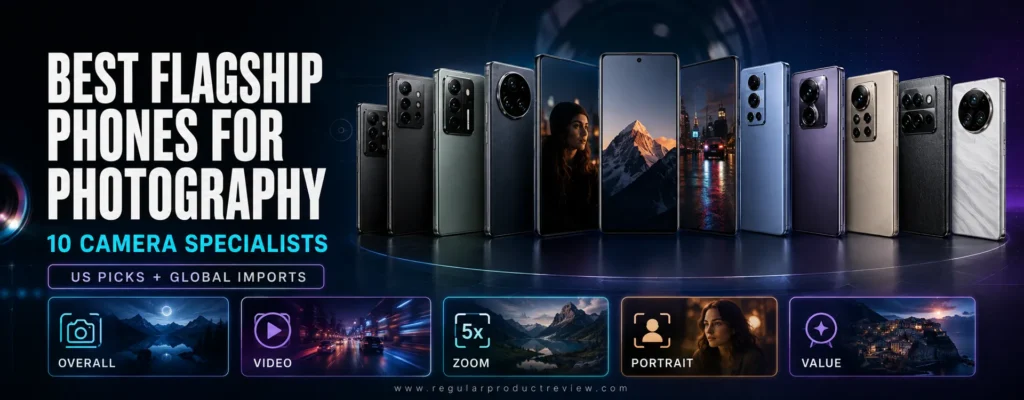
Best Flagship Phones for Photography | Our Expert Shortlist
The best phone camera is not automatically the model with the largest megapixel number, the longest digital-zoom claim, or the most lenses arranged across its back. A truly capable flagship phone for photography must make good decisions quickly, preserve believable color, focus reliably on moving subjects, switch lenses without jarring exposure changes, and give experienced photographers enough control to shape the final image. It must also be a phone you can realistically own, service, and use on your preferred network.
That last point matters especially for US shoppers. Several of the most ambitious mobile-camera systems are sold primarily in Europe or Asia. They may offer remarkable sensors and optics, yet an imported phone can bring missing cellular bands, uncertain eSIM support, no domestic warranty, delayed repairs, region-specific software, or incompatible banking and streaming apps. This guide therefore separates photographic excellence from purchase practicality instead of pretending they are the same thing.
Our top overall recommendation is the Samsung Galaxy S26 Ultra. It combines a versatile four-camera system, a 200MP main camera, two useful telephoto focal lengths, strong video modes, reliable US carrier support, and a mature editing ecosystem. It does not win every specialized category, but it creates the fewest compromises for a photographer who wants one premium phone to shoot landscapes, portraits, pets, travel, concerts, and family video.
The Apple iPhone 17 Pro Max is our preferred choice for professional mobile video. Its consistent color between lenses, strong stabilization, ProRes and Log options, timecode-friendly workflow, and broad accessory support make it unusually easy to place inside a serious production pipeline. The Google Pixel 11 Pro XL is the most persuasive point-and-shoot alternative because its computational photography, faster Night Sight, improved telephoto camera, and accessible editing tools reduce the effort required to get a shareable result.
Photographers willing to import hardware have more exotic options. The OPPO Find X9 Ultra brings a native 10x optical telephoto alongside enormous main and portrait-telephoto sensors. The vivo X300 Ultra targets portrait, concert, and telephoto specialists with ZEISS-tuned optics and dual 200MP cameras. The Xiaomi 17 Ultra offers perhaps the most camera-like experience of the group, especially when paired with its optional photography grip and filter adapter.
Before committing to an expensive model, browse our wider camera phone hub and current best camera phone recommendations. Readers who care as much about total performance and support as image quality should also compare the broader flagship phone category.
Editorial Insight: A spectacular imported camera phone can still be a poor US purchase. We rank image-making potential and ownership practicality together, then state clearly when a model is best treated as an enthusiast import.
📸 Quick Picks at a Glance
| Rank | Phone | Photography Award | Best For | US Buying Status | Starting Price or Position |
|---|---|---|---|---|---|
| 1 | Samsung Galaxy S26 Ultra | Best Overall | Maximum versatility with domestic support | Official US model | $1,299.99 launch MSRP |
| 2 | Apple iPhone 17 Pro Max | Best for Pro Video | Log, ProRes, stabilization, creator ecosystem | Official US model | $1,199 launch MSRP |
| 3 | Google Pixel 11 Pro XL | Best Point-and-Shoot | Computational photography and fast editing | Official US model; preorder at publication | $1,299 launch MSRP |
| 4 | OPPO Find X9 Ultra | Best Long-Range Zoom | Native 10x optical reach and travel detail | Import only | Regional pricing |
| 5 | vivo X300 Ultra | Best for Portraits and Concerts | ZEISS rendering, 85mm framing, telephoto kits | Import only | Regional pricing |
| 6 | Xiaomi 17 Ultra | Best Camera-Like Controls | Leica styles, optical zoom, grip accessories | Import only | Regional pricing |
| 7 | OnePlus 15 | Best Value Flagship | Action, battery life, 4K120 Dolby Vision | Official US model | $899.99 launch MSRP |
| 8 | HONOR Magic8 Pro | Best Low-Light Telephoto | Stabilized night zoom and stage photography | Import only | Regional pricing |
| 9 | Sony Xperia 1 VIII | Best Manual Workflow | Physical shutter, pro controls, microSD | Import only | €1,499 regional MSRP |
| 10 | HUAWEI Pura 90s Pro Max | Best Creative Hardware | Variable aperture and high-resolution telephoto | Import only; major software caveats | Regional pricing |
🧪 How We Evaluated These Flagship Camera Phones
This is a research-led editorial buying guide, not a claim that every phone was tested side by side in one controlled laboratory. We reviewed current manufacturer specifications, documented camera modes, regional sales pages, independent photographic coverage, platform support, and real-world ownership constraints. Manufacturer performance claims are treated as claims not independent measurements and are described accordingly.
Our scoring framework gives the greatest weight to results that affect everyday photography:
| Evaluation Area | Weight | What We Looked For |
|---|---|---|
| Still-image quality and consistency | 24% | Natural detail, color, HDR behavior, skin tone, lens matching |
| Optical versatility | 18% | Useful focal lengths, ultrawide quality, telephoto reach, macro ability |
| Motion, autofocus, and capture speed | 12% | Pets, children, sports, street scenes, burst reliability |
| Low-light performance | 12% | Noise control, motion blur, highlight protection, usable telephoto results |
| Video capability | 12% | Stabilization, frame rates, HDR, Log/RAW options, lens switching, audio |
| Pro controls and editing workflow | 8% | RAW/DNG, manual exposure, focus tools, LUT or color-management options |
| US ownership practicality | 9% | Carrier compatibility, warranty, repairs, official sales, ecosystem support |
| Value and longevity | 5% | Price, software commitment, storage options, accessory ecosystem |
We do not award points merely for a high digital-zoom ceiling. A 100x or 120x mode may help identify a distant sign, but it rarely produces the best photograph. We care more about whether 3x, 5x, 7x, or 10x images retain believable texture and manageable motion blur. Likewise, a 200MP sensor is useful only when the lens, processing, stabilization, and shooting conditions allow that resolution to matter.
🏆 What Makes a Phone “Flagship” for Photography?
A premium chipset and expensive materials are not enough. For this guide, a professional photography smartphone needs at least three of the following strengths: a large and well-stabilized main sensor, a genuinely useful telephoto camera, a high-quality ultrawide with autofocus, advanced video capture, robust RAW/manual controls, or a mature computational pipeline. It should also maintain respectable quality across multiple focal lengths rather than producing one excellent 1x image and weak everything else.
Consistency is often more valuable than peak performance. A travel photographer may move from an ultrawide cityscape to a 3x portrait and then a 5x architectural detail within seconds. If white balance shifts dramatically or one lens crushes shadows, the set becomes harder to edit. Samsung, Apple, and Google generally earn their high positions partly because their output is predictable and their US software/support experience is straightforward.
Import models can surpass them in specific scenes. OPPO’s native 10x module offers optical reach that mainstream US flagships do not match. Xiaomi’s mechanical telephoto range reduces the need for abrupt digital cropping between portrait focal lengths. vivo’s imaging accessories turn the phone into a more specialized tool. Those advantages are real, but so are the risks of buying a device without an official US warranty.
✅ Who Should Buy a Photography Flagship?
- Travelers who want several focal lengths without carrying interchangeable lenses
- Parents who need fast autofocus, dependable HDR, and good video in one device
- Creators producing vertical video, short films, product clips, or social campaigns
- Street photographers who value discretion and immediate editing
- Journalists who need rapid capture, transmission, transcription, and backup
- Enthusiasts who shoot RAW and understand the limits of small-sensor optics
⚠️ Who May Be Better Served by a Dedicated Camera?
A phone cannot fully replace a larger-sensor camera when you need clean high-ISO files, sustained burst shooting, precise flash control, long-lens subject isolation, dependable heat management during lengthy recording, or interchangeable optics. A flagship phone is best understood as the camera you always carry and the fastest end-to-end publishing tool not as a physics-defying substitute for every camera system.
If your budget cannot comfortably absorb a four-figure purchase, do not stretch only for a camera badge. Our guides to camera phones under $500 and camera phones under $1,000 identify less expensive options that may already meet your needs.
Expert Recommendation: Start by choosing your most important subject people, distant action, low light, landscapes, or video. The phone that wins your dominant use case is more valuable than the phone with the longest specification sheet.
Samsung Galaxy S26 Ultra | Best Overall Camera Flagship
Photography Rating: 9.4/10
Award: 🏆 Best Overall Flagship Phone for Photography
The Samsung Galaxy S26 Ultra is the safest high-end recommendation for a US photographer who wants maximum range without accepting import complications. Its 200MP main camera, 50MP ultrawide, 3x portrait telephoto, and 50MP 5x periscope create a flexible set of focal lengths. Samsung complements that hardware with familiar Pro modes, high-resolution capture, strong stabilization, advanced video options, and broad availability through carriers and major retailers.
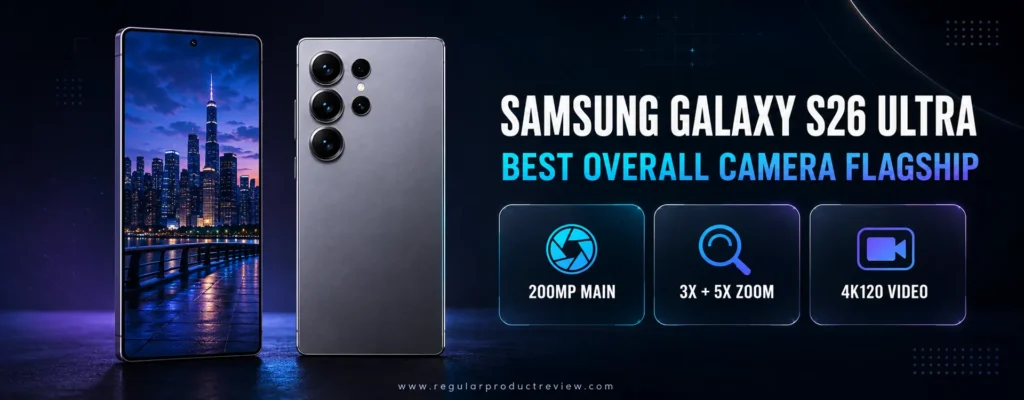
The official US launch price was $1,299.99 for 256GB, although promotions can reduce the current price. Check Samsung’s official Galaxy S26 Ultra page for current configurations and offers. Buyers comparing the entire premium Android field can also consult our flagship Android phone guide and best premium smartphone recommendations.
📷 Camera System and Key Specifications
| Camera | Resolution and Role | Photography Value |
|---|---|---|
| Main | 200MP wide, f/1.4, OIS | High detail, stronger low-light intake, flexible cropping |
| Ultrawide | 50MP | Landscapes, architecture, group shots, close focus |
| Telephoto 1 | 10MP, 3x optical | Natural portrait perspective and midrange framing |
| Telephoto 2 | 50MP, 5x optical, OIS | Travel detail, events, wildlife at moderate distance |
| Front | 12MP | Video calls, selfies, creator-facing capture |
| Video | Up to 8K30 and 4K120 on supported modes | High-resolution capture and slow-motion flexibility |
Samsung says the wider f/1.4 main aperture improves brightness relative to the prior generation. That does not guarantee a 47% improvement in every photograph, because exposure, subject motion, processing, and lens behavior all change the outcome. It does give the camera more light-gathering potential, which is particularly useful when the phone needs a faster shutter speed for a moving child, pet, or street subject at dusk.
Why the S26 Ultra Earns the Overall Win
The strength of this camera is coverage. At 1x, the 200MP sensor can produce detailed daylight files and offers room for moderate cropping. The 3x camera is useful for portraits because it avoids the facial exaggeration common with a close 1x shot. The 5x unit reaches concerts, architectural features, and distant travel subjects without forcing an extreme digital crop. The ultrawide rounds out the set for interiors and dramatic foreground compositions.
Samsung’s processing tends to favor an immediately attractive result: clear local contrast, bright color, controlled skies, and visible shadow detail. That style can look slightly processed to photographers who prefer a restrained, film-like file, especially around foliage or fine textures. The important advantage is that the system usually delivers a usable image quickly. You can reduce some of the baked-in look by using Pro or RAW-oriented workflows when the scene deserves more careful editing.
The phone also performs well as a hybrid camera. Supported 4K120 capture is useful for action that may later be slowed down, while 8K30 can provide reframing flexibility when light is strong and storage is plentiful. Samsung’s Super Steady and Nightography video features aim to improve handheld motion and low-light clips. For creators who shoot both stills and video, this breadth is more practical than a phone that excels only at static photographs.
Portraits, Skin Tone, and Subject Separation
The dedicated 3x focal length is a major reason to choose the Ultra over a less expensive flagship with only main-camera portrait crops. It lets you stand farther from the subject, which creates more flattering facial proportions and cleaner background geometry. Samsung’s portrait segmentation is generally capable with hair and clothing, though complex glasses, translucent objects, and flyaway strands can still expose computational errors.
For the most natural result, use moderate blur rather than the strongest artificial aperture effect. Realistic portrait photography depends on gradual depth transition: ears, shoulders, and nearby objects should not fall into blur as abruptly as a software cutout. The S26 Ultra gives you enough resolution and focal-length choice to create a strong portrait even without exaggerated simulated bokeh.
Zoom Photography in the Real World
Samsung advertises up to 100x digital zoom, but the best photographic range is much lower. The 5x camera is the dependable long lens. Around 10x, computational enhancement and good light can still produce useful travel images. Beyond that, atmospheric haze, hand movement, small-sensor noise, and aggressive reconstruction become increasingly visible.
Treat 100x as a viewing or identification tool, not a default creative focal length. Brace the phone against a stable surface, use the on-screen framing aid, and capture several frames when shooting far away. A single gust of wind or small hand movement can shift the composition dramatically at extreme magnification.
Expert Tip: For cleaner 10x results, shoot in bright light, tap the subject to lock focus, lower exposure slightly to protect highlights, and capture a short burst. Choose the sharpest frame later instead of trusting one shutter press.
Low Light and Night Photography
The main camera is the strongest night option because it combines the largest sensor in the system with the brightest aperture. The 5x telephoto can still be effective around illuminated buildings or stages, but dim subjects may trigger longer exposures and stronger noise reduction. If a person is moving, a technically bright night image can still fail because of motion blur.
Use the 1x camera when the scene is extremely dark. Switch to 3x or 5x only when the subject has enough direct light. Night mode is valuable for static architecture, but standard Photo mode may preserve motion more effectively because it can choose a shorter capture sequence. This distinction matters more than a generic claim that one night mode is “better.”
Pro Controls, RAW, and Editing
Samsung’s appeal to enthusiasts comes from choice. The camera software supports manual adjustments and RAW-oriented capture on compatible lenses and modes. RAW files provide more freedom for white balance, highlight recovery, and noise treatment, but they are not automatically superior. Computational JPEG or HEIF images combine multiple frames and may deliver cleaner shadows with less effort.
Use RAW when lighting is stable, you have time to expose deliberately, and you plan to edit. Use the standard computational pipeline for moving people, quick travel scenes, and difficult high-contrast moments. Adobe explains the broader advantages of an editable raw container in its Digital Negative overview, but phone RAW files still inherit optical and sensor limitations.
Battery, Storage, and Daily Ownership
High-resolution photography consumes storage quickly. Video at 4K120 or 8K is especially demanding, so 512GB is the more comfortable configuration for frequent creators. Cloud backup helps, but uploading large files while traveling can be slow or expensive. Plan a transfer routine to a computer or external drive rather than treating the phone as permanent archival storage.
Unlike the import specialists in this list, Samsung provides straightforward US carrier compatibility, domestic warranty service, trade-in programs, and a large accessory market. That ownership advantage is a meaningful part of the ranking. A camera is only useful when it remains connected, repairable, and available when the shot happens.
Samsung Galaxy S26 Ultra Pros and Cons
| Pros | Cons |
|---|---|
| Versatile four-camera system | Large and expensive |
| Strong 1x, 3x, and 5x coverage | Processing can look over-sharpened |
| 200MP main camera offers crop flexibility | 100x mode is more novelty than fine-art tool |
| 4K120 and 8K30 options | Large video files demand substantial storage |
| Official US sales, warranty, and carrier support | Charging and accessories add to total cost |
| Mature Pro and RAW workflow | Telephoto quality falls in very dim light |
Buy it if: You want the most balanced camera flagship with official US support, shoot many different subjects, and value both photo and video versatility.
Skip it if: You want the smallest phone, prefer understated processing without editing, or need the native 10x optics offered by an import-only specialist.
Bottom Line: The Galaxy S26 Ultra is not the absolute winner in every isolated camera test. It is the best complete ownership package for most serious US photographers because its strong camera range, dependable software, domestic support, and hybrid-video capability work together.
Apple iPhone 17 Pro Max | Best Flagship for Professional Video
Photography Rating: 9.3/10
Award: 🎬 Best Flagship Phone for Professional Video
The Apple iPhone 17 Pro Max is the strongest recommendation for filmmakers, commercial creators, journalists, and social teams that need repeatable color and a well-supported production workflow. Its three rear cameras use 48MP sensors, while the redesigned telephoto provides a native 4x view and an 8x optical-quality option created from the central sensor area. Apple also supports ProRAW stills, ProRes video, Log capture, timecode-oriented workflows, and a vast ecosystem of cages, microphones, storage accessories, gimbals, and editing software.
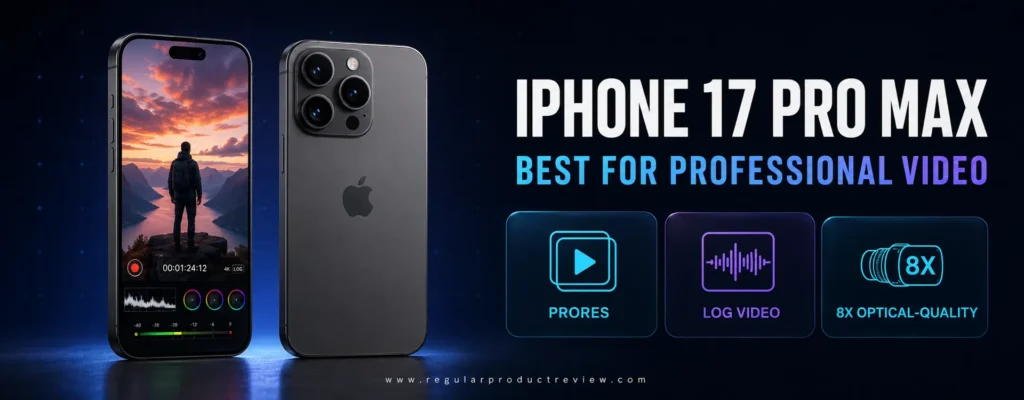
Apple lists the 256GB iPhone 17 Pro Max at a $1,199 US launch price. The official iPhone 17 Pro technical specifications detail the camera modes and storage options. Readers comparing Apple’s entire lineup should visit our Apple iPhone hub and best iPhones guide.
🍎 Camera Hardware at a Glance
| Camera | Official Specification | Best Use |
|---|---|---|
| Main | 48MP, 24mm equivalent, f/1.78, sensor-shift OIS | Everyday photography, low light, documentary work |
| 2x crop | 12MP optical-quality, 48mm equivalent | Environmental portraits and food |
| Ultrawide | 48MP, 13mm equivalent, f/2.2, 120° | Landscapes, interiors, macro-style close framing |
| Telephoto | 48MP, 100mm equivalent native 4x, f/2.8, 3D sensor-shift OIS | Portraits, events, compressed landscapes |
| Extended tele | 12MP optical-quality 8x, 200mm equivalent | Distant detail in favorable light |
| Front | 18MP Center Stage camera | Self-recording, group framing, Dual Capture |
Why Video Creators Should Choose the iPhone
Professional video is less about one headline resolution and more about predictability. A creator may shoot the wide camera, cut to telephoto, add an external microphone, record to external storage, synchronize multiple cameras, grade footage, and deliver to several platforms. Apple’s strength is that these steps fit together with fewer surprises than most phone ecosystems.
The iPhone can capture ProRes and Log footage in supported settings, giving experienced editors more latitude to balance color and contrast. Log video is intentionally flat and unfinished; it is valuable only if you plan to apply a correct transform or LUT and grade the image. Casual users should remain in standard or Dolby Vision modes, which create a finished result without the storage and post-production burden.
Apple’s lens-to-lens color matching is another practical advantage. No smartphone switches perfectly because each camera has different optics and sensor behavior, but iPhone footage generally maintains coherent skin tone and exposure as you move through focal lengths. That consistency reduces correction time when a project combines multiple angles.
Still Photography: Natural Results with Strong Editing Headroom
The main 48MP camera remains the most dependable choice. It produces detailed daylight images, handles mixed indoor light well, and benefits from sensor-shift stabilization. The default computational output balances several frames to control bright skies and lift faces. At times, Apple’s HDR can brighten shadows more than a photographer wants, but the result is usually cohesive and easy to share.
ProRAW is useful for landscapes, architecture, product photography, and deliberate portraits. It combines computational information with greater editing flexibility than a finished JPEG or HEIF. The trade-off is file size. A library filled with high-resolution ProRAW images and ProRes clips can exhaust 256GB quickly, which is why 512GB or external recording storage is more practical for regular production.
The ultrawide’s 48MP sensor improves detail potential compared with older low-resolution ultrawides. It is valuable for interiors and dramatic perspective, but faces near the edge can still stretch because of geometry. Keep people closer to the center or step back and use the main camera when natural proportions matter.
4x and 8x Telephoto Performance
The native 100mm-equivalent 4x camera gives the iPhone a flattering portrait perspective and useful reach for stage, travel, and landscape details. The 8x option uses a 12MP central crop from that 48MP telephoto sensor. Calling it “optical-quality” is more accurate than calling it a separate 8x optical lens. It can look excellent in good light, but it has less light and resolution flexibility than a truly separate long telephoto module.
At 4x, the camera is well suited to head-and-shoulders portraits, provided you have enough working distance. At 8x, stabilization and shutter speed become critical. Use the 8x view outdoors, at a bright venue, or on a stable support. In dim indoor scenes, the main or native 4x view will often produce a cleaner file.
Center Stage, Dual Capture, and Solo Production
The 18MP Center Stage front camera can adjust framing and orientation, making it easier to keep a person or small group composed. Dual Capture records front and rear perspectives together, which can be valuable for travel commentary, event reactions, interviews, and behind-the-scenes clips. The feature is not a replacement for a carefully planned two-camera setup, but it reduces equipment and synchronization work for solo creators.
Apple’s official product information also emphasizes expanded professional video features and integration with Final Cut Camera. The value is not merely that a mode exists; it is that the phone is widely supported by third-party monitoring, audio, stabilization, and editing tools.
Editorial Insight: Buy the iPhone for workflow consistency, not because every individual still image beats every Android rival. Its greatest advantage appears after capture when footage must be monitored, transferred, synchronized, graded, edited, and delivered on schedule.
Low-Light Photo and Video
The main camera is the preferred night lens. It combines the brightest aperture with the largest and most stabilized sensor in the rear system. The 4x telephoto can create attractive compressed night scenes around signs, streetlights, and stages, but its f/2.8 aperture demands more light. Subject movement can create blur even when the phone produces a bright-looking frame.
For handheld night video, avoid unnecessary digital zoom and keep the phone close to the native focal lengths. A small grip or gimbal can improve operator stability, but it cannot freeze a moving subject. Good mobile cinematography still depends on positioning, lighting, and a realistic shutter speed.
iPhone 17 Pro Max Pros and Cons
| Pros | Cons |
|---|---|
| Excellent professional video ecosystem | Expensive, especially with more storage |
| ProRes, Log, ProRAW, and mature editing support | Large ProRes and ProRAW files |
| Consistent color between rear cameras | 8x is a sensor crop, not a separate optical module |
| Strong stabilization and accessory compatibility | Manual still controls are less direct than some enthusiast rivals |
| Reliable US carrier, warranty, and repair support | US models rely on eSIM |
| 48MP resolution across all rear cameras | Telephoto needs good light for best results |
Buy it if: Video quality, fast production, dependable color, accessory choice, and post-production compatibility matter more than maximum still-photo zoom.
Skip it if: You want native 10x optical reach, extensive on-screen manual still controls, expandable storage, or Android-specific workflows.
Bottom Line: The iPhone 17 Pro Max is the best phone for professional video recording because it connects capture, sound, monitoring, storage, editing, and delivery more smoothly than its competitors. Its still cameras are excellent, but its production ecosystem is the decisive advantage.
Google Pixel 11 Pro XL | Best Point-and-Shoot Camera Phone
Photography Rating: 9.2/10
Award: ✨ Best Point-and-Shoot Flagship for Photography
The Google Pixel 11 Pro XL is built for photographers who want the phone to solve difficult scenes before they have time to think about exposure bracketing, subject masks, or multi-frame noise reduction. Google combines a new main sensor, a redesigned 48MP telephoto with a larger light-sensitive area, faster Night Sight, 5x portrait capture, and up to 120x Pro Zoom. The system is powered by Tensor G6 and Google’s latest imaging models, making software as important as the lenses.
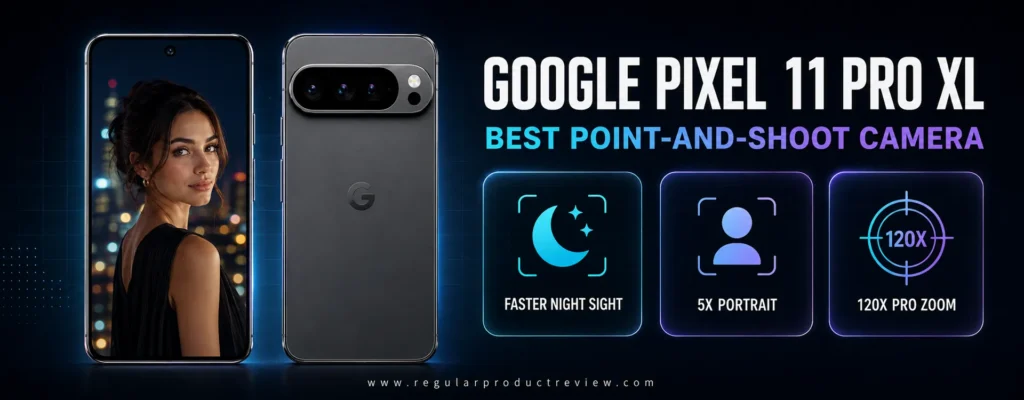
At publication, the phone is available for preorder and reaches stores on August 20. Google lists the Pro XL from $1,299 with 256GB. That status is important: early buyers should expect camera tuning to evolve through initial software updates, and shoppers who do not need a phone immediately may benefit from waiting for mature independent comparisons. Google’s official Pixel 11 launch details explain the camera changes and seven-year update commitment.
For a broader Android comparison, see our Android phone hub and flagship phone recommendations.
🪄 The Pixel Photography Advantage
Google’s defining strength is computational decision-making. Pixel cameras traditionally prioritize faces, dynamic range, and a finished image that can be shared immediately. The Pixel 11 Pro XL extends that approach with a faster imaging pipeline and new tools designed to reduce missed moments rather than simply add manual complexity.
Google says the Pro models use a new main sensor and an upgraded 48MP telephoto sensor with 30% greater light sensitivity than the relevant earlier systems. Night Sight can complete a capture up to 4.5 times faster under Google’s stated comparisons. Faster night capture is meaningful because a shorter wait reduces camera shake and subject movement two problems that no amount of brightening can fully repair after the fact.
The redesigned telephoto also supports Portrait Mode at 5x. That focal length gives substantial background compression and can isolate a subject against distant scenery, although it requires more physical distance than a traditional 2x or 3x portrait lens. It is especially useful outdoors, at events, and for candid portraits where approaching the subject would change the moment.
Pixel 11 Pro XL Camera Profile
| Capability | What It Means in Practice |
|---|---|
| New Pro main sensor | Google’s strongest all-purpose capture and low-light foundation |
| 48MP redesigned telephoto | Better long-range detail and more light sensitivity |
| 5x Portrait Mode | Compressed outdoor portraits and candid framing |
| Up to 120x Pro Zoom | AI-assisted extreme reach; best treated as occasional utility |
| Faster Night Sight | Less waiting and lower risk of subject or hand movement |
| Tensor G6 ISP | Faster computational imaging and on-device camera features |
| Seven years of updates | Long software runway for a premium purchase |
Google’s launch material does not turn the 120x number into a promise of optical quality. Results vary, and the mode is not available everywhere. For serious photographs, the native telephoto range and modest extensions remain the priority. Extreme AI zoom can help read a distant board or document a landmark, but it may reconstruct texture rather than record it faithfully.
People, Pets, and Unpredictable Moments
Pixel is an excellent family camera because it prioritizes recognizable faces and usable expressions. A photograph of a child running through mixed shade is technically demanding: the camera must focus, select a fast enough shutter speed, balance bright background light, protect skin tone, and merge data without creating halos. Google’s computational pipeline is designed around this kind of messy real-world scene.
That automation is not infallible. Multi-frame processing can create edge artifacts around moving hands, hair, wheels, or pet fur. Aggressive face correction may also produce a result that looks cleaner than the instant actually was. The photographer should capture several frames and inspect small details before deleting alternatives.
Google’s Real Tone work remains relevant for skin representation across varied complexions and lighting. The benefit is not a promise that every portrait is perfectly colorimetric; it is a system-level attempt to avoid exposure and white-balance assumptions that historically failed many subjects.
Night Sight and Low-Light Usability
The practical value of faster Night Sight is speed. Traditional phone night modes ask the user to hold still while collecting several frames. A faster sequence makes the experience more forgiving, particularly when photographing people. Static buildings will tolerate a longer exposure; a laughing friend will not.
Use the main camera for the darkest scenes. The telephoto is most effective when a subject has direct illumination, such as a performer under stage lights or a building facade. When the light falls too low, stepping closer and using 1x can create a better photograph than forcing 5x magnification.
Expert Tip: In low light, watch the subject rather than the phone’s brightness preview. If the subject is moving, capture sooner in standard Photo mode or add light; a longer Night Sight exposure may brighten the frame while blurring the moment.
Editing and AI Transparency
Pixel’s editing tools are powerful because they reduce the steps between capture and publication. They can adjust framing, remove distractions, select better expressions, and create alternative looks. These features are useful, but responsible photographers should distinguish correction from reconstruction. Removing a trash can from a travel image is a creative edit; changing a newsworthy scene can alter its meaning.
Professionals in journalism, documentation, insurance, research, or evidence-sensitive work should preserve the original file and maintain a clear edit history. AI tools are not inherently dishonest, but undisclosed generative changes can be inappropriate when authenticity matters. For personal and commercial creative work, they are best used intentionally rather than automatically.
Ownership, Updates, and Timing
Unlike many camera-specialist imports, Pixel 11 Pro XL is designed for US networks and Google Store support. Seven years of OS, security, and Pixel Drop updates strengthen long-term value. The phone also begins at 256GB, which is sensible for high-resolution photo and video use.
The main caveat is launch timing. Preorder hardware has less independent long-term evidence than a phone that has been in customers’ hands for months. Camera behavior can change through firmware. Buyers who need proven stability for paid work should wait for initial updates and repeatable camera comparisons rather than relying solely on launch samples.
Readers who want similar computational convenience at a lower price can compare our camera phones under $1,000 and best Android phones under $500.
Google Pixel 11 Pro XL Pros and Cons
| Pros | Cons |
|---|---|
| Excellent point-and-shoot computational pipeline | New release has limited long-term evidence at publication |
| Faster Night Sight reduces capture delay | 120x zoom can look reconstructed |
| Improved 48MP telephoto and 5x portraits | $1,299 starting price is high |
| Strong skin-tone and face-focused processing | AI edits need ethical judgment in documentary work |
| Official US support and seven years of updates | Fewer camera-like physical controls than specialist imports |
| Starts at 256GB | Best video-production ecosystem still belongs to Apple |
Buy it if: You value a high success rate with minimal setup, regularly photograph people or pets, and want Google’s editing tools plus official US ownership support.
Skip it if: You need a proven launch-day production device, extensive manual camera controls, native 10x optics, or the most established professional video workflow.
Bottom Line: The Pixel 11 Pro XL is the best point-and-shoot flagship camera phone for buyers who want computational photography to reduce technical friction. Its greatest feature is not 120x zoom; it is the ability to turn difficult everyday light into a usable photograph quickly.
OPPO Find X9 Ultra | Best Flagship Phone for Long-Range Zoom
Photography Rating: 9.1/10
Award: 🔭 Best Long-Range Zoom Camera Phone
The OPPO Find X9 Ultra is the most ambitious optical system in this guide. It combines a 200MP 23mm main camera, a 200MP 70mm portrait telephoto, a 50MP 14mm ultrawide, and a separate 50MP 230mm-equivalent camera with native 10x optical zoom. Those four lenses cover environmental scenes, portraits, macro details, distant architecture, wildlife, concerts, and travel landmarks with less dependence on extreme digital cropping.
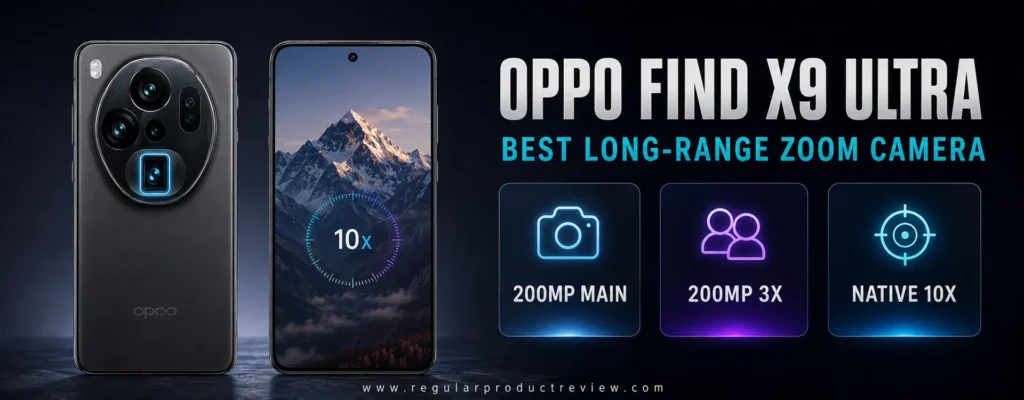
This is not an official US phone. Buyers must import it, confirm network bands and eSIM behavior, accept uncertain repair logistics, and understand that a global product page does not equal domestic carrier certification. OPPO’s official Find X9 Ultra camera page documents the imaging system, while our camera phone hub and premium smartphone guide provide more practical alternatives.
🔬 A Four-Camera System Built Around Real Focal Lengths
| Camera | Key Hardware | Equivalent View | Primary Use |
|---|---|---|---|
| Main | 200MP, 1/1.12-inch, f/1.5, OIS | 23mm | Night scenes, landscapes, documentary work |
| Ultrawide | 50MP, 1/1.95-inch, f/2.0 | 14mm | Architecture, interiors, expansive foregrounds |
| Portrait telephoto | 200MP, 1/1.28-inch, f/2.2, macro focus | 70mm | Portraits, products, details, close-ups |
| Long telephoto | 50MP, f/3.5, sensor-shift stabilization | 230mm / 10x | Wildlife, concerts, distant travel subjects |
| Front | 50MP with 4K60 | 21mm | Creator-facing video and group selfies |
The 10x module is what separates the OPPO from most conventional flagships. Samsung, Apple, Google, and OnePlus can all reach high digital magnifications, but their longest native cameras stop earlier. OPPO begins with an actual 230mm-equivalent optical view and can then extend to a claimed 20x optical-quality crop. In daylight, that gives the photographer a stronger foundation for distant subjects.
The 200MP 70mm camera may be even more useful day to day. Seventy millimeters is a natural short-telephoto perspective for portraits, food, product details, and travel scenes. Its large 1/1.28-inch sensor and f/2.2 aperture give it more light-gathering potential than many phones’ main cameras. It can also focus at approximately 15cm for telephoto macro, allowing close detail without the exaggerated perspective of an ultrawide macro mode.
Native 10x: Powerful, Not Magical
A native 10x lens still faces the same physical challenges as every long lens: camera shake, atmospheric haze, subject motion, and limited light. The f/3.5 aperture is impressive for the folded design, yet far darker than the main camera’s f/1.5 aperture. During the day, that trade-off is manageable. At night, the phone must raise sensitivity, lengthen exposure, or apply heavier computational processing.
For concerts, photograph when the performer’s face is hit by direct stage light and use burst capture. For wildlife, keep the shutter speed high and avoid magnifying heat shimmer over long distances. For cityscapes, a railing or compact tripod can dramatically improve fine detail. The hardware creates opportunity, but technique still determines whether the 10x image is sharp.
OPPO offers an optional 300mm Explorer Teleconverter that extends the system optically with a dedicated lens accessory. It is a specialist tool: bulkier, slower to deploy, and inappropriate for casual pockets, but potentially valuable for birding, field observation, or deliberate travel photography.
Hasselblad Color and Portrait Rendering
OPPO co-developed the system with Hasselblad and includes Master modes, focal-length-specific portrait options, and a dedicated multi-channel color-sensing camera. Brand collaboration does not automatically produce objective color accuracy, but it can influence tonal response, portrait styles, interface design, and creative profiles.
The most valuable portrait feature is still the 70mm optics. Software blur looks more convincing when the starting perspective and subject distance already resemble a real portrait lens. Use the native telephoto and moderate simulated blur; avoid pushing the effect until hair and clothing look cut out.
Video and Filmmaking Features
The Find X9 Ultra supports 8K30 capture and 4K120 Dolby Vision in compatible modes, plus Log recording and LUT preview. OPPO also promotes a TILTA KHRONOS filmmaking kit for more controlled handheld or rigged shooting. That collection makes the phone a serious creative instrument, but compatibility, accessories, replacement parts, and app behavior may vary by region.
For paid work in the US, the iPhone remains the safer video-platform recommendation because its storage, audio, editing, and accessory workflow is more broadly supported. The OPPO wins when long optical reach and still-photo versatility outweigh ecosystem convenience.
Import Risk and US Network Reality
Do not buy this phone from an overseas marketplace until the seller provides the exact model number, supported LTE/5G bands, return policy, warranty process, and software region. A phone can connect to a US network yet still lack optimal rural coverage, Wi-Fi calling, visual voicemail, emergency features, or carrier-specific 5G behavior. Those failures are difficult to evaluate from a generic “unlocked” label.
Repair logistics are equally important. A cracked lens cover or failed stabilization module may require international shipping. Import taxes, restocking terms, and firmware region can also change the total cost. For most US buyers, the Galaxy S26 Ultra is the better ownership decision even if OPPO wins a specialized zoom comparison.
Our best flagship Android phone guide focuses on broader ownership value, while the best camera phones under $1,000 can save money without import-level risk.
Import Warning: Confirm bands, warranty, returns, language support, Google services, banking-app compatibility, and repair arrangements in writing. An overseas seller’s “global ROM” claim is not the same as an official global model.
OPPO Find X9 Ultra Pros and Cons
| Pros | Cons |
|---|---|
| Native 10x optical telephoto | No official US sales or warranty |
| Large 200MP main and portrait sensors | Large, heavy, and expensive to import |
| Excellent focal-length coverage | Long telephoto still needs strong light |
| 70mm telephoto macro capability | Carrier features may be incomplete |
| 8K, 4K120 Dolby Vision, Log, LUT preview | Repairs may require international shipping |
| Optional teleconverter and filmmaking kit | Accessory availability varies by market |
Buy it if: You are an experienced importer, understand network compatibility, and need genuine long-range optics more than domestic service convenience.
Skip it if: This is your only phone, dependable US carrier features are essential, or you cannot tolerate uncertain warranty and repair logistics.
Bottom Line: The Find X9 Ultra is the best flagship phone for long-range photography on hardware ambition. For a US buyer, it is a specialist camera purchase attached to a phone not the most responsible default recommendation.
vivo X300 Ultra | Best Camera Phone for Portraits and Concerts
Photography Rating: 9.0/10
Award: 🎭 Best Flagship for Portrait and Concert Photography
The vivo X300 Ultra is designed around focal lengths that portrait and event photographers actually use. Its rear system combines a 200MP main camera, a 50MP ultrawide, a 200MP ZEISS APO telephoto, and a dedicated color-related sensor. vivo also offers optional 200mm and 400mm-equivalent telephoto accessories in selected markets, along with an imaging grip. That makes the phone particularly attractive for concerts, stage events, travel portraits, and distant detail.
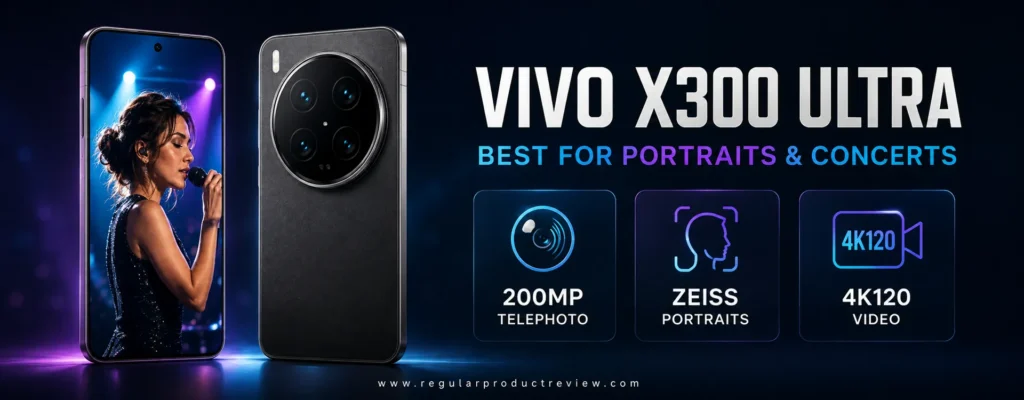
The global specifications list a 50MP front camera, 4K120 pro video, a 6,600mAh battery, 100W wired charging, 40W wireless charging, and IP68/IP69 protection. See vivo’s official X300 Ultra page and parameter sheet. Because there is no official US version, buyers should compare the safer domestic choices in our flagship phone hub and best camera phone guide.
🎨 ZEISS Optics and Portrait Priorities
The 200MP telephoto is the center of the experience. vivo markets it as a ZEISS APO system, a term associated with controlling chromatic aberration the colored fringing that can appear around high-contrast edges. In practical portrait work, the important questions are whether eyelashes, hair, fabric, and backlit edges remain clean, and whether skin retains texture instead of being smoothed into plastic.
The phone offers portrait styles and focal-length choices intended to mimic different lens aesthetics. These modes are creative interpretations, not literal replacements for specific ZEISS lenses. Their value comes from providing coherent starting points: one style may emphasize softer contrast and warm highlights, while another creates stronger microcontrast and cooler color. Photographers should choose a style that supports the subject rather than applying the most dramatic effect by default.
Camera Hardware Summary
| Camera | Resolution | Practical Role |
|---|---|---|
| Main | 200MP | High-detail scenes, low light, flexible crops |
| Ultrawide | 50MP | Landscapes, interiors, groups, close perspective |
| ZEISS APO telephoto | 200MP | Portraits, stage work, distant subjects, telephoto detail |
| Auxiliary color sensor | 5MP | Color and scene-data assistance |
| Front | 50MP | High-resolution selfies and creator video |
| Video | Up to 4K120 with 10-bit Log support in designated modes | Slow motion and graded production |
The product’s dual-200MP architecture gives the main and telephoto cameras generous resolution for cropping. High resolution does not mean every 200MP file contains 200MP of unique detail, especially in low light. It is best used when light is strong, the subject is stable, and the photographer needs a large crop or print. Pixel-binned default modes will often produce cleaner everyday images.
Concert and Stage Photography
Concert photography punishes weak camera systems. Lighting changes rapidly, performers move, LED screens create extreme contrast, haze reduces clarity, and the photographer may be far from the stage. vivo’s telephoto emphasis and stage modes address those conditions with subject tracking, stabilization, and processing tuned for intense light sources.
Use exposure compensation to protect faces and bright costumes. A phone may see a mostly dark scene and overexpose the performer, destroying highlight color. Capturing a slightly darker frame preserves stage atmosphere and gives the processing more headroom. Burst shooting helps, but avoid holding the shutter continuously for an entire song; select moments when movement pauses or a spotlight stabilizes.
The optional telephoto extenders can add real reach, but they require alignment, physical support, and setup time. They are best for a seated venue, wildlife outing, or planned event not spontaneous street photography. Check venue rules before carrying a lens attachment, as some locations restrict detachable optics even when attached to a phone.
Portrait Quality and Working Distance
Longer portrait framing lets the photographer step back and reduce perspective distortion. Noses and foreheads appear more natural than in a close main-camera shot, while the background seems larger and closer. This compression is optical geometry, not AI. Software then adds segmentation and blur to simulate a larger aperture.
For a flattering portrait, position the subject several feet from the background and use the telephoto camera. Good physical separation gives the algorithm cleaner depth cues. Look for highlights in the eyes, keep the face within the lens’s focusing comfort zone, and capture both portrait-mode and standard telephoto frames. The standard frame may look more timeless if artificial blur makes an error.
4K120, Log, and Creator Use
vivo advertises 4K120 professional video and 10-bit Log capture. High-frame-rate 4K is useful for sports, dance, and short cinematic slow motion, while Log can preserve grading flexibility. Both modes generate large files, increase heat, and demand fast storage. Long recordings should be tested before paid work because thermal behavior depends on ambient temperature, brightness, stabilization, and codec.
The imaging grip improves handling and can make the shutter gesture more deliberate. It still does not provide the physical viewfinder, mechanical zoom ring, or large battery of a dedicated camera. Treat it as an ergonomic enhancement rather than a full camera conversion.
Import and Software Considerations
The X300 Ultra is sold in some global markets, but US availability and carrier certification remain the central limitation. An official Philippine or European model may differ from a China-market version in software, bands, notifications, Android Auto support, and preinstalled services. Confirm the exact regional SKU, not just the phone name.
OriginOS behavior, update timing, warranty coverage, and Google-service integration can vary. Photographers who rely on instant cloud backup, Lightroom synchronization, banking apps, eSIM, Wi-Fi calling, or client-delivery tools must confirm each workflow before replacing a US-supported phone.
For lower-risk alternatives, see our best Android phones for everyday use and Android phone category, then decide whether vivo’s portrait advantage justifies the additional effort.
Expert Tip: At a concert, the best camera setting is the one that protects the performer’s face. Reduce exposure, use the native telephoto range, and shoot during brief pauses in movement; extreme zoom and aggressive brightening usually reduce detail.
vivo X300 Ultra Pros and Cons
| Pros | Cons |
|---|---|
| Dual 200MP main and telephoto cameras | No official US model |
| Strong portrait and stage-oriented features | Regional software differences require research |
| ZEISS APO telephoto emphasis | Import warranty and repair complications |
| Optional 200mm/400mm telephoto accessories | Lens kits add bulk and cost |
| 4K120 and 10-bit Log options | High-end video modes use storage and create heat |
| Large battery and fast charging | Not the simplest point-and-shoot interface |
Buy it if: Portraits, concerts, stage events, and long-lens creativity dominate your photography and you already understand import-phone ownership.
Skip it if: You need guaranteed US carrier behavior, domestic repairs, simple software, or a camera phone that works without accessory and regional research.
Bottom Line: The vivo X300 Ultra is the best portrait and concert camera phone in this lineup for photographers who prioritize telephoto rendering. Its creative ceiling is high, but so is the responsibility of importing and supporting it.
Xiaomi 17 Ultra | Best Flagship for Camera-Like Controls
Photography Rating: 8.9/10
Award: 🎛️ Best Camera-Like Smartphone Experience
The Xiaomi 17 Ultra is for photographers who want a phone to feel less like a sealed computational appliance and more like a compact camera. Its Leica-branded system uses a 50MP one-inch-type main sensor, a 50MP ultrawide, and a 200MP telephoto with a mechanically adjustable optical range from approximately 75mm to 100mm equivalent. An optional Photography Kit Pro adds a grip, physical controls, a 67mm filter adapter, and a supplemental battery.
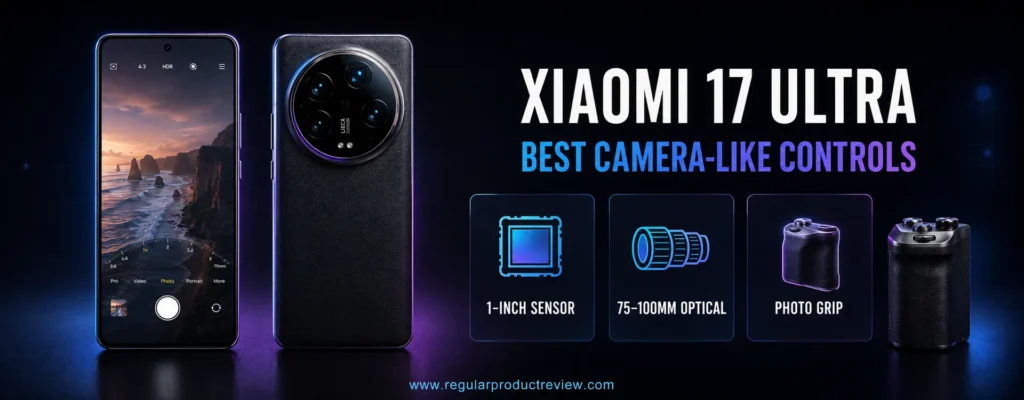
Xiaomi’s official 17 Ultra specifications document the camera hardware, while the Photography Kit Pro page explains the accessory. The phone is not officially sold in the United States, so our camera phones under $1,000 and best flagship Android phones remain more practical starting points for most US readers.
📐 Leica Camera System
| Camera | Key Specification | Creative Strength |
|---|---|---|
| Main | 50MP, one-inch-type sensor, 23mm, f/1.67, OIS | Low light, depth, dynamic range, natural detail |
| Ultrawide | 50MP, 14mm, f/2.2, autofocus | Landscapes, architecture, 5cm close focus |
| Telephoto | 200MP, continuous optical design around 75–100mm, OIS | Portraits, product work, compressed landscapes |
| Video | 8K30; 4K Dolby Vision up to 120fps in supported modes | High-resolution and high-frame-rate production |
| Pro workflow | Log, ACES support, RAW/manual tools | Color grading and controlled capture |
The one-inch-type main sensor is physically large for a phone. A larger sensor can gather more total light at a comparable exposure and can produce smoother tonal transitions, better shadow quality, and a more natural sense of depth. It does not automatically create better images. Lens quality, focus accuracy, multi-frame processing, and the photographer’s exposure choices still matter.
Xiaomi pairs that main camera with LOFIC-based high-dynamic-range technology in its imaging pipeline. The practical goal is to protect highlights while maintaining shadow information in difficult scenes such as sunsets, backlit portraits, and neon-lit streets. Extreme HDR can look flat if the phone removes every shadow; photographers should select the Leica style and exposure that preserve the intended mood.
Mechanical Telephoto Zoom
Most phones switch between fixed cameras and crop digitally between them. Xiaomi’s 200MP telephoto uses an optical mechanism across its portrait-oriented range. That provides smoother framing between roughly 75mm and 100mm equivalent and helps the photographer refine composition without stepping into a lower-quality intermediate crop.
This range is ideal for portraits, products, food, architectural details, and compressed landscapes. It is not a substitute for OPPO’s native 230mm lens when the subject is extremely distant. Xiaomi emphasizes precision within a highly useful short-telephoto range; OPPO emphasizes maximum reach.
At around 75mm, include some environment around a subject. Near 100mm, move farther back for head-and-shoulders work or stronger background compression. Because the phone has a very high-resolution telephoto sensor, daylight crops can extend framing further, though noise and processing increase as the light falls.
Leica Styles and Photographic Intent
Xiaomi provides distinct Leica color approaches often framed as more natural or more vivid interpretations. The best choice depends on the scene. A restrained style can suit documentary work, overcast streets, and skin tone. A stronger style can make travel color and high-contrast architecture more immediate.
Do not confuse a branded style with universal accuracy. Camera color is always a rendering decision: white balance, tone curve, saturation, local contrast, and skin treatment all shape the file. The advantage is the ability to choose a coherent look at capture time, then keep that look consistent across a series.
Photography Kit Pro and Physical Handling
The optional kit gives the phone a more secure grip and adds physical interaction that reduces the need to tap the display. The 67mm adapter can accept common photographic filters. A circular polarizer may reduce reflections and deepen skies, while a neutral-density filter can support slower shutter speeds or more cinematic video settings in bright light.
Filters introduce their own risks. A polarizer used on an ultrawide can create uneven sky darkening. Cheap filters can reduce sharpness or introduce flare. Heavy accessories also place stress on the mount. Buy quality glass, test for vignetting, and remove the kit before placing the phone loosely in a bag.
The grip’s extra battery is useful during long photo walks, but it does not eliminate the need for storage planning. 8K and 4K120 footage can fill internal storage quickly. Transfer and back up files after each major shoot.
RAW, Log, and ACES Workflow
Xiaomi supports pro capture modes, Log video, and an ACES-oriented workflow in compatible settings. These are meaningful tools for creators who understand exposure and color management. Log should be exposed carefully; severely underexposed Log footage will reveal noise when lifted. RAW stills should be compared with the phone’s processed output because the computational version may handle moving subjects and multi-frame noise better.
The phone’s strongest creative value comes from giving the photographer multiple routes: fast Leica-styled output for immediate use, high-resolution files for cropping, and pro formats for controlled editing. A complex toolset can slow down a beginner, so save custom settings and practice before important work.
US Ownership Caveats
There is no official US retail channel, domestic warranty, or carrier-certified version. Xiaomi models can vary by region in radio bands, eSIM, software services, and update cadence. Accessories may be hard to replace locally. An imported camera kit also adds shipping, customs, and return complexity.
US buyers should use the phone as a secondary creative device unless they have verified carrier performance in their exact area. A photographer who travels through rural regions may find missing low-band coverage more damaging than any camera-quality advantage.
Those seeking a domestic daily driver can compare our flagship phone recommendations or best premium smartphones.
Expert Tip: The one-inch main sensor is the reason to slow down. Use exposure compensation, lock focus, and shoot RAW only when the subject allows deliberation. For motion, the computational default mode may produce a higher keeper rate.
Xiaomi 17 Ultra Pros and Cons
| Pros | Cons |
|---|---|
| Large one-inch-type main sensor | No official US availability |
| Mechanical optical telephoto range | Camera grip and filters cost extra |
| Leica color styles | Large camera module and bulky kit |
| Optional grip with 67mm filter support | Regional ROM and carrier research required |
| Strong RAW, Log, Dolby Vision, and ACES options | Pro tools can overwhelm casual shooters |
| Useful 75–100mm portrait framing | Less native reach than OPPO’s 10x camera |
Buy it if: You enjoy manual photography, want physical controls and filters, and value a large main sensor plus refined portrait focal lengths.
Skip it if: You want official US support, a lightweight phone, or effortless point-and-shoot processing without configuration.
Bottom Line: The Xiaomi 17 Ultra is the most camera-like flagship phone here. It rewards photographic intent and accessories, but its import status prevents it from replacing Samsung, Apple, or Google as the responsible US default.
OnePlus 15 | Best Value Flagship Camera Phone
Photography Rating: 8.7/10
Award: 💎 Best Value Flagship for Photography
At a $899.99 US launch price, the OnePlus 15 costs hundreds less than the top Samsung, Apple, and Google models while retaining a triple-50MP rear system, optical stabilization on the main and telephoto cameras, a 3.5x periscope, 4K120 Dolby Vision video, an autofocus front camera, and a huge 7,300mAh battery. It is the value choice for creators who care about action, endurance, fast charging, and official North American support.
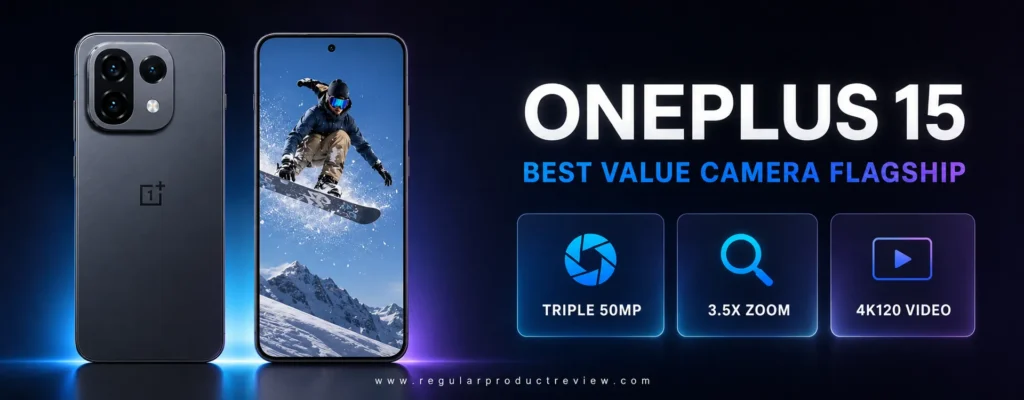
OnePlus describes the full camera and video system on its official US product page. Shoppers deciding between a camera-first device and a performance-first flagship should also compare our Android phone hub and gaming phone guide.
⚡ Triple 50MP Camera Specifications
| Camera | Specification | Best Use |
|---|---|---|
| Main | 50MP with OIS | Everyday stills, night scenes, action |
| Ultrawide | 50MP, 112° field of view | Landscapes, groups, interiors |
| Periscope | 50MP, 3.5x optical, OIS | Portraits, events, travel details |
| Extended zoom | 7x optical-quality claim | Daylight reach and moderate cropping |
| Front | 32MP RGBW sensor with autofocus | Vlogging, group selfies, low-light front capture |
| Video | 4K120 Dolby Vision; O-Log support | Slow motion and color-managed creator work |
The system’s most useful feature is balance. Each rear camera begins at 50MP, avoiding the common budget compromise of a high-resolution main camera paired with a weak 8MP ultrawide. That does not make the lenses identical in quality, but it gives the phone enough resolution to maintain respectable detail across common focal lengths.
The 3.5x periscope is a smart middle ground. It is long enough for flattering portraits and event details while remaining easier to stabilize than a native 10x lens. OnePlus advertises a 7x optical-quality mode, which should be understood as a high-quality crop and processing result rather than a separate 7x optical camera.
Action Photography and Clear Burst
OnePlus emphasizes its DetailMax engine, dual-exposure Clear Burst, Ultra Clear Mode, and Clear Night Engine. For action, the key challenge is shutter speed. A phone may merge a short exposure that freezes movement with a longer exposure that improves brightness and dynamic range. When alignment works, the result preserves a moving subject without sacrificing the entire background.
This is useful for pets, children, recreational sports, bicycles, and street scenes. Capture a burst and review at full size; computational sharpening can make a small preview appear crisp even when fine subject detail is smeared. Choose the frame with the cleanest eyes and edges, not necessarily the brightest frame.
The OnePlus 15 is also a capable gaming phone, which indirectly benefits photography. Strong sustained performance and cooling help the device process bursts and high-frame-rate video. Our best gaming phones and gaming phones under $500 explain the performance side in more depth.
Portrait and Telephoto Quality
The 3.5x camera gives a natural perspective for portraits. OnePlus includes enhanced portrait processing and AI Portrait Glow, which aims to relight faces. Use such tools cautiously. Portrait lighting should preserve the direction and character of the real scene. Too much correction can create a face that looks detached from its environment.
Start with natural window light or open shade. Frame at 3.5x, keep the subject several feet from the background, and lower exposure slightly if highlights are bright. Physical light and distance give the software better information than an edit applied to a poorly lit frame.
4K120 Dolby Vision and O-Log
OnePlus advertises 4K120 Dolby Vision capture and O-Log. High-frame-rate HDR recording at this price is impressive and can create polished slow motion when light is adequate. It is not the right setting for every scene. At 120fps, each frame has less time to gather light, so indoor clips can become noisy. Storage use and heat also increase.
Use 4K30 or 4K60 for interviews, travel, and longer recordings. Reserve 4K120 for short action sequences that will actually be slowed down. O-Log is useful if you plan to grade footage; standard Dolby Vision is easier for immediate sharing.
Battery Life as a Camera Feature
The 7,300mAh battery is not merely a general-performance benefit. Photography drains power through screen brightness, GPS tagging, stabilization, computational processing, uploads, and repeated camera launches. A larger battery makes the phone more dependable for travel days and events.
OnePlus supports 80W wired and 50W wireless charging in the US product configuration, with higher wired potential using specific accessories in some contexts. Charging speed does not replace battery health. Avoid leaving the phone in direct sun while recording or fast-charging it immediately after a long 4K session.
Where the Savings Show
OnePlus delivers strong hardware for the price, but its image processing and color consistency may not be as universally dependable as Apple, Google, or Samsung across every difficult scene. The 3.5x telephoto also cannot match OPPO’s native 10x reach or vivo’s portrait-specialist sensor size. The value proposition is not that it beats every flagship; it is that it reaches a high level while preserving $300–$400 of the buyer’s budget.
Official US sales, standard Google services, domestic returns, and widespread accessory availability make it easier to recommend than an exotic import. That practicality matters for a phone intended to be both camera and daily driver.
Editorial Insight: The OnePlus 15 is the price-performance winner because it preserves the features photographers use three meaningful cameras, OIS, autofocus, 4K120, Log, and battery life without charging an Ultra-tier price.
OnePlus 15 Pros and Cons
| Pros | Cons |
|---|---|
| $899.99 launch price undercuts top rivals | Processing consistency trails the category leaders |
| Three 50MP rear cameras | No native long telephoto beyond 3.5x |
| 4K120 Dolby Vision and O-Log | 120fps requires good light and large storage |
| 7,300mAh battery | Large phone |
| Official US availability | Camera brand ecosystem is less mature than Apple’s |
| 32MP autofocus front camera | AI relighting can look artificial when overused |
Buy it if: You want a premium camera experience, excellent endurance, action-friendly tools, and US support below the price of an Ultra or Pro Max.
Skip it if: Absolute zoom reach, the most consistent automatic color, or the deepest professional video ecosystem matters more than price.
Bottom Line: The OnePlus 15 is the best value flagship camera phone because it offers a complete creative toolkit at $899.99. It is not the technical still-photo champion, but it is one of the smartest real-world purchases.
HONOR Magic8 Pro | Best Low-Light Telephoto Flagship
Photography Rating: 8.6/10
Award: 🌙 Best Flagship for Low-Light Telephoto Photography
The HONOR Magic8 Pro specializes in a difficult task: capturing distant subjects after the light begins to disappear. Its rear system includes a 50MP main camera, a 50MP ultrawide, and a 200MP telephoto with a 1/1.4-inch sensor, f/2.6 aperture, 3.7x optical zoom, and optical stabilization. HONOR pairs that hardware with its AiMAGE Night, Stabilization, Portrait, and Stage engines.
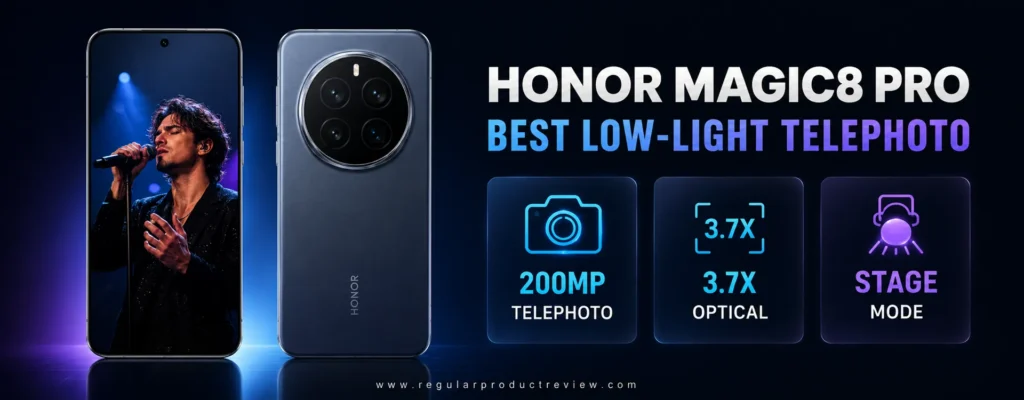
The official HONOR Magic8 Pro product page and specification sheet confirm the triple rear cameras and 4K120 support. There is no official US model, so readers should weigh the camera benefits against the easier ownership offered by phones in our flagship phone category and best Android phones list.
🌃 Night Telephoto Hardware
| Camera | Specification | Intended Strength |
|---|---|---|
| Main | 50MP Ultra Night camera | General low light, streets, interiors |
| Ultrawide | 50MP | Cityscapes, architecture, groups |
| Telephoto | 200MP, 1/1.4-inch, f/2.6, 3.7x, OIS | Stage, portraits, distant night detail |
| Front | 50MP | Selfies and creator capture |
| Video | Up to 4K120 in supported settings | High-frame-rate action and slow motion |
The telephoto’s relatively large sensor is the key. Long phone lenses usually struggle at night because their apertures are darker and sensors are smaller than the main camera. HONOR increases sensor area and combines it with stabilization and processing. This does not make the 3.7x camera equal to the main lens in darkness, but it improves the chances of a usable result at events, illuminated streets, and indoor venues.
AiMAGE Night, Stabilization, and Stage Modes
HONOR’s computational engines address different failure points. Night processing aims to recover detail and color from low light. Stabilization attempts to reduce hand movement. Portrait processing separates people and preserves skin. Stage Mode is tuned for complex venue lighting and distant performers.
These modes can help, but marketing names should not replace photographic judgment. Stabilization corrects camera motion, not subject motion. A singer walking across a stage or a child moving indoors can blur even if the background is sharp. The solution is a faster shutter or more light not simply stronger OIS.
The phone’s CIPA 6.5 stabilization claim is an internal mobile-camera rating context and should not be compared casually with every dedicated-camera standard without identical methodology. What matters is the real ability to frame and capture at 3.7x. Hold the phone with both hands, tuck elbows inward, exhale gently, and take several frames.
Low-Light Portrait Technique
The 3.7x telephoto creates flattering facial perspective, but it also demands distance and light. At night, place the subject near a soft storefront, window, or streetlamp rather than relying on background ambience. Turn the face slightly toward the light and keep the background farther away. This produces natural depth before portrait software adds blur.
HONOR’s Portrait Engine can improve texture and depth in difficult conditions. Disable or reduce beauty adjustments if authentic skin texture matters. Many phones apply regional beauty defaults, and an imported device may arrive with settings that differ from US expectations.
High-Resolution Telephoto and Cropping
The 200MP mode is best reserved for daylight or well-lit static subjects. In low light, a binned output combines pixels to improve noise performance and is usually the better choice. High-resolution files also require more storage and can take longer to process.
For architectural details, signs, and landscapes, 200MP can provide crop flexibility. For moving performers, use the standard mode and burst. A technically lower-resolution image with a clean expression is more valuable than a huge file containing motion blur.
Video Capabilities
The Magic8 Pro supports 4K120 capture in specified rear-camera modes. As with every phone, high frame rate reduces exposure time per frame and needs more light. Use it for short, bright action sequences. Standard 4K60 is more practical for stage events, and 4K30 is better when light is very limited.
Audio can be the weak link at concerts because high sound pressure overwhelms small microphones. If the event allows recording and sound matters, use a compatible external microphone or capture a separate audio source. Always respect venue rules and performers’ rights.
US Import Limitations
HONOR does not offer an official US model, carrier certification, or standard domestic warranty. Confirm the exact global SKU, network bands, Android services, eSIM, Wi-Fi calling, return location, and update policy. A phone that works in a city may lose coverage on a rural trip if key low-frequency bands are absent.
The risk is especially relevant to event photographers who depend on immediate delivery. If mobile data, messaging, or cloud upload fails, camera quality becomes irrelevant. Samsung, Google, Apple, and OnePlus are safer for paid assignments in the US.
Budget-conscious readers can explore camera phones under $500 and budget phone recommendations before accepting import complexity.
Expert Tip: For a stage subject, expose for the face not the black background. A slight negative exposure adjustment often preserves colored spotlights, skin detail, and costume texture better than an aggressively bright night mode.
HONOR Magic8 Pro Pros and Cons
| Pros | Cons |
|---|---|
| Large 200MP stabilized telephoto | No official US support |
| Strong low-light and stage focus | AI night processing can look heavy |
| Useful 3.7x portrait perspective | Subject motion remains a challenge |
| 50MP main and ultrawide | Regional software and beauty defaults vary |
| 4K120 video support | Import returns and repairs are inconvenient |
| High-resolution crop potential | Extreme modes require substantial storage |
Buy it if: Your main subjects are concerts, stages, night portraits, and illuminated city detail and you can manage the import trade-offs.
Skip it if: You need guaranteed US network features, domestic warranty service, or the cleanest professional video workflow.
Bottom Line: The HONOR Magic8 Pro is the best low-light telephoto specialist in this ranking. It is compelling camera hardware, but US photographers should treat it as an enthusiast import rather than a universal daily-driver recommendation.
Sony Xperia 1 VIII | Best Flagship for Manual Photography
Photography Rating: 8.5/10
Award: 🎞️ Best Manual Camera Workflow on a Phone
The Sony Xperia 1 VIII appeals to photographers who already understand shutter speed, exposure compensation, subject tracking, focal length, and color profiles. It retains a physical shutter button, offers Alpha-inspired camera controls, supports microSD cards up to 2TB, and includes a 3.5mm headphone jack. Sony also introduces a much larger telephoto sensor and an AI Camera Assistant that proposes creative interpretations without removing the manual foundation.
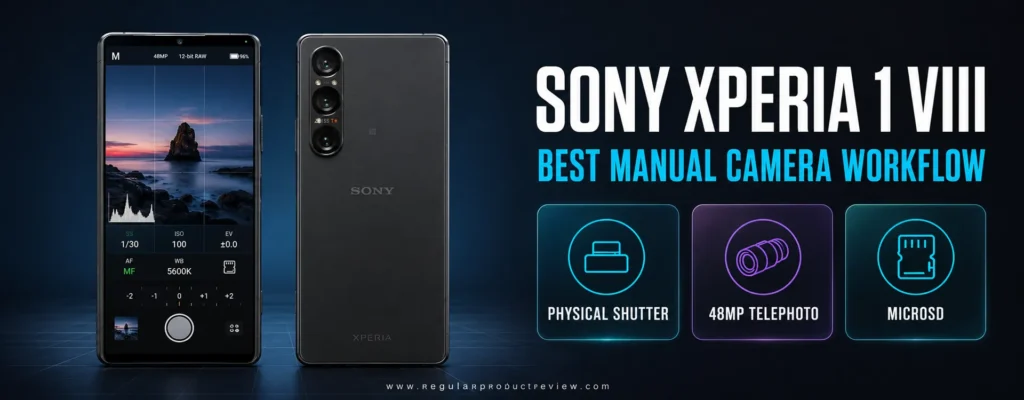
Sony’s official Xperia 1 VIII page lists the new 1/1.56-inch telephoto sensor, Snapdragon 8 Elite Gen 5 platform, and two-day battery claim under its test conditions. The phone is not officially sold in the US and carries a €1,499 regional launch price, so compare it with the domestic models in our premium smartphone guide and flagship phone category.
For an independent photography-industry perspective on the launch, see DPReview’s Xperia 1 VIII announcement coverage.
🎚️ Why Experienced Photographers Like Xperia
Sony’s interface draws from its Alpha camera design language. That familiarity can reduce friction for someone who already uses Sony mirrorless bodies. Exposure controls, tracking concepts, shutter-button behavior, and deliberate capture feel more camera-centric than the simplified interfaces found on many phones.
The physical shutter key is especially useful. A half-press can support focus behavior, while a full press captures without requiring the photographer to reach across the screen. It also gives a stable landscape grip and lets the camera launch quickly. Physical feedback matters in cold weather, bright sun, or moments when the display is hard to see.
Xperia 1 VIII Camera Profile
| Camera Area | Key Detail | Best Use |
|---|---|---|
| Main | 48MP effective high-resolution sensor and wide lens | Everyday work, low light, documentary images |
| Ultrawide | 48MP-class capture | Landscapes, interiors, dramatic perspective |
| Telephoto | New 48MP-class system with 1/1.56-inch sensor | Portraits, detail, improved low-light reach |
| Capture control | Physical shutter and Alpha-inspired interface | Manual exposure and decisive moments |
| Storage | microSD expansion up to 2TB | Long shoots, offline backups, large video libraries |
| Audio | 3.5mm headphone jack and improved speakers | Monitoring and multimedia production |
Sony says the telephoto sensor is roughly four times larger than the preceding design. A larger sensor should improve light capture and detail potential, but telephoto results still depend on the optical implementation, shutter speed, and processing. The main benefit is giving the long camera a stronger base rather than asking software to rescue a tiny sensor.
AI Camera Assistant Without Abandoning Control
The AI Camera Assistant analyzes the subject and scene, then suggests four creative directions combining color, exposure, bokeh, and lens choice. This can help a photographer see alternatives, but it is not a substitute for intent. A suggestion may be aesthetically attractive while misrepresenting the actual light or mood.
Use the assistant as a sketchbook. Compare its direction with your own interpretation, then adjust parameters. Photographers who want a completely automatic camera will find Google’s Pixel easier. The Xperia is more rewarding when the user enjoys deciding why the image should look a particular way.
Manual Exposure and Motion
Manual control is most useful when automation makes the wrong compromise. A cyclist in shade may require a faster shutter than the phone selects. A neon sign may require lower exposure to retain color. A waterfall may benefit from deliberate motion blur if the phone is stabilized and an ND filter is available.
However, phone manual mode does not provide all the freedom of a dedicated camera. Apertures are generally fixed, small sensors show noise quickly at high ISO, and computational processing may be reduced in pro modes. The photographer must choose between a clean multi-frame automatic image and a more editable but noisier single exposure.
Color, Display, and Sony Ecosystem
Sony’s strength lies in a coherent media ecosystem. Photographers using Alpha cameras, Sony headphones, and professional monitors may appreciate familiar color concepts and file handling. The Xperia screen is designed for serious media viewing, but a phone display is not a substitute for a calibrated editing monitor. Ambient light and adaptive display settings can mislead color decisions.
For critical editing, disable overly vivid display modes, work away from colored ambient light, and verify the final file on a known display. A beautiful OLED can make any image look richer than it will appear on a client’s office monitor or a print.
microSD: A Rare Professional Advantage
Expandable storage is unusually valuable for a camera phone. A photographer can carry multiple cards, offload files without internet access, and separate projects physically. Cards are not infallible, so use reputable media, format it in the device, and maintain a second backup. Do not remove a card while the phone is writing video.
The headphone jack is similarly practical. Wired monitoring avoids Bluetooth delay and battery dependence. Whether a particular recording app supports the desired audio routing should still be tested before production.
US Import Reality
Sony’s decision not to provide a standard US release changes the recommendation. Confirm the exact model’s bands and carrier behavior. VoLTE, 5G, emergency calling, visual voicemail, Wi-Fi calling, and eSIM are not guaranteed simply because the phone accepts a SIM. Repairs may require overseas shipping, and regional firmware can affect updates.
For most American buyers, the iPhone 17 Pro Max offers a safer pro-video ecosystem, while the Galaxy S26 Ultra provides more convenient still-photo versatility. Our best camera phone guide and Android phone hub cover those alternatives.
Expert Tip: Manual mode is not automatically “professional.” Use it when you can identify the automatic setting that needs correction. If automation already protects motion, highlights, and color, a computational image may be the stronger file.
Sony Xperia 1 VIII Pros and Cons
| Pros | Cons |
|---|---|
| Physical shutter button | No official US release |
| Alpha-inspired manual interface | €1,499 regional price is difficult to justify |
| Large new telephoto sensor | Automatic processing is less effortless than Pixel |
| microSD expansion up to 2TB | Repair and carrier compatibility uncertainty |
| 3.5mm headphone jack | Narrow enthusiast appeal |
| Useful integration for Sony camera users | AI suggestions may not suit documentary accuracy |
Buy it if: You already think like a photographer, value physical controls and removable storage, and want a phone that complements a Sony-oriented workflow.
Skip it if: You want the easiest automatic results, a domestic warranty, broad carrier support, or the best camera value per dollar.
Bottom Line: The Xperia 1 VIII is the best phone for manual photography enthusiasts, not the best universal camera phone. Its controls are thoughtful, but import status and high price restrict it to a dedicated niche.
HUAWEI Pura 90s Pro Max | Best Creative Camera Hardware
Photography Rating: 8.3/10
Award: 🌈 Best Flagship for Creative Aperture Control
The HUAWEI Pura 90s Pro Max combines a 50MP main camera with a physical f/1.4–f/4.0 variable aperture, a 40MP ultrawide, and a 200MP 4x telephoto. It also includes a True-to-Colour Camera 2.0, optical stabilization on the main and telephoto modules, and a 100x digital zoom ceiling. The hardware offers creative options that most phones simulate entirely through software.
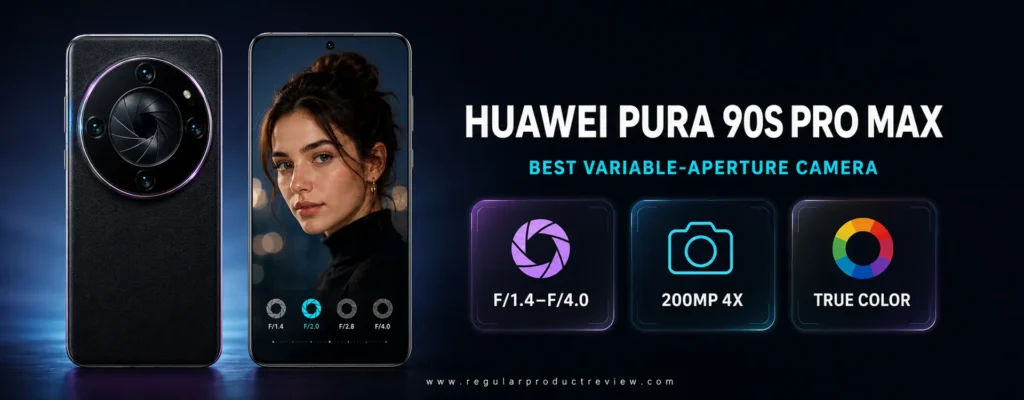
Huawei’s official Pura 90s Pro Max specifications confirm the aperture range and rear-camera layout. Yet this is the most difficult phone in the guide for a US buyer: there is no official domestic channel, standard Google Mobile Services are absent, carrier compatibility is uncertain, and app availability can require compromises. Review our best camera phones and best flagship phones before considering it.
🌀 Variable Aperture: What It Actually Changes
| Aperture Position | Practical Effect | Example Use |
|---|---|---|
| Near f/1.4 | More light and shallower optical depth | Night scenes, close subjects, portraits |
| Middle range | Balance of light and depth | Everyday objects, food, environmental portraits |
| Near f/4.0 | Greater depth of field and potentially cleaner edge rendering | Groups, documents, architecture, close-ups requiring more focus depth |
A physical variable aperture changes how much light enters and how much of the scene appears acceptably sharp. On a phone sensor, the depth difference is subtler than on a full-frame camera, but it remains useful. A close product shot at f/1.4 may blur part of the object naturally, while f/4.0 can keep more of it in focus without relying on computational depth maps.
The narrower aperture also allows a slower shutter under the same ISO in bright conditions, though the range is not enough to replace a strong ND filter for cinematic daylight video. Diffraction can reduce fine detail at very small apertures, so the best position depends on subject distance and light not a belief that higher or lower f-numbers are always superior.
Camera Hardware Summary
| Camera | Official Specification | Best Use |
|---|---|---|
| Main | 50MP, f/1.4–f/4.0, OIS | Variable depth, low light, general photography |
| Ultrawide | 40MP, f/2.2 | Landscapes, interiors, architecture |
| Telephoto | 200MP, f/2.6, OIS, 4x optical | Portraits, travel detail, distant subjects |
| Color system | True-to-Colour Camera 2.0 | White-balance and spectral-scene assistance |
| Zoom | Up to 100x digital | Identification and occasional utility |
The 200MP telephoto gives the phone substantial crop potential at its native 4x view. In daylight, it can frame portraits and distant details with high resolution. At night, the standard binned output is more sensible than forcing a huge file. As with other extreme zoom claims, 100x should be treated as a utility mode rather than a fine-detail guarantee.
Color and Difficult Light
Huawei emphasizes the True-to-Colour Camera 2.0, designed to improve color perception across complex lighting. Mixed light is one of the hardest problems in mobile photography. A restaurant may combine warm tungsten bulbs, cool window light, and colored signage; the phone must decide which object should look neutral.
No system can make every mixed source neutral simultaneously. Good processing preserves plausible skin while allowing the environment to retain its character. Photographers should capture RAW where supported and necessary, but remember that the computational file may have better local corrections than the unprocessed data.
Portraits and Close Subjects
The variable aperture gives two creative paths. Use a wider setting when the subject is close and the background should soften naturally. Stop down when several people need to remain sharp or when a product has meaningful depth. Then decide whether portrait-mode blur adds anything. Artificial blur on top of real optical separation can become excessive.
The 4x telephoto is the better facial perspective when working distance allows. Use the main camera for an environmental portrait that shows location, and the telephoto for a tighter expression. Matching exposure between the two will create a more coherent series.
The Google Services and App Problem
For a US buyer, software is the decisive limitation. Huawei devices do not ship with standard Google Mobile Services. That affects Google Play, Google Photos integration, some authentication flows, Android Auto expectations, banking apps, workplace management, and apps that depend on Google APIs. Alternative stores and workarounds may exist, but they can change, introduce security concerns, or fail after updates.
Professional photographers should list every critical app before buying: camera control, cloud backup, Lightroom, client delivery, two-factor authentication, banking, airline tools, rideshare, messaging, and device management. If even one cannot be supported reliably, the phone should not be the primary work device.
US cellular compatibility, warranty service, and repairs add further uncertainty. Huawei’s camera hardware may be excellent, but this guide ranks a phone as a complete ownership tool. That is why it sits tenth despite distinctive photographic engineering.
Our Android phone recommendations and best Android phones for students illustrate safer ecosystem choices, even when their camera hardware is less exotic.
Editorial Insight: Camera quality cannot compensate for a broken delivery workflow. If you cannot install, authenticate, back up, edit, and transmit reliably, the device is a secondary camera not a professional phone.
HUAWEI Pura 90s Pro Max Pros and Cons
| Pros | Cons |
|---|---|
| Physical f/1.4–f/4.0 variable aperture | No standard Google Mobile Services |
| High-resolution 200MP 4x telephoto | No official US sales or warranty |
| Strong creative depth control | App compatibility requires careful verification |
| Dedicated color-sensing system | Carrier and emergency-feature uncertainty |
| OIS on main and telephoto cameras | Workarounds can change after updates |
| IP68/IP69 durability claims by region | Poor choice as a primary US work phone |
Buy it if: You want unusual camera hardware, understand Huawei’s ecosystem, and plan to use it as a secondary creative device in a supported region.
Skip it if: You depend on Google services, US carriers, banking apps, Android Auto, domestic repairs, or a low-maintenance professional workflow.
Bottom Line: The Pura 90s Pro Max offers the most interesting variable-aperture hardware in this group. Its software and US ownership limitations are so significant that only informed enthusiasts should consider importing it.
How to Choose the Best Flagship Phone for Photography
A flagship purchase should begin with photographs, not specifications. Review your last six months of images and identify what failed. Were subjects too far away? Did indoor movement blur? Did skin look unnatural? Did video stabilization break while walking? Did storage fill during a trip? The answer defines the camera feature that deserves your money.
This section translates technical language into buying decisions. For alternatives at different budgets, compare our camera phone category, camera phones under $300, camera phones under $500, and camera phones under $1,000.
🔍 Sensor Size Matters More Than Megapixels-Until It Does Not
Megapixels describe output resolution, not total image quality. A 200MP sensor can support detailed daylight capture and aggressive cropping, but a smaller sensor with strong optics and processing may produce a cleaner standard image. Pixel size, sensor area, lens aperture, readout speed, stabilization, and multi-frame processing all interact.
High-resolution modes work best with abundant light and limited movement. A landscape at noon can benefit; a running child indoors usually will not. Default binned modes combine adjacent pixels and use computational stacking to improve dynamic range and noise. Keep the camera in its standard mode unless you have a specific reason to capture maximum resolution.
📏 Focal Length Is the Most Useful Specification
Focal length determines perspective and framing. The following equivalents are approximate creative categories:
| Equivalent Range | Visual Character | Best Subjects |
|---|---|---|
| 13–16mm | Very wide, exaggerated foreground | Architecture, interiors, landscapes |
| 23–28mm | Natural wide documentary view | Everyday scenes, groups, travel |
| 45–55mm | Neutral perspective | Food, products, environmental portraits |
| 70–100mm | Flattering compression | Portraits, events, details |
| 120–230mm | Strong reach and compression | Concerts, wildlife, distant architecture |
A native lens at the desired focal length usually outperforms a heavy digital crop. Samsung’s 3x and 5x system is versatile; Apple’s 4x is portrait friendly; OPPO’s 10x is unmatched for native reach; Xiaomi’s 75–100mm optical range is designed for controlled portrait framing.
🌙 Low-Light Photography Requires Motion Awareness
Manufacturers often describe night performance using brightness. Photographers should think about time. A longer exposure gathers more light but increases the chance that hands, faces, leaves, and vehicles move. Optical stabilization reduces camera shake; it does not freeze the subject.
For people, prioritize a fast capture and direct light. For static buildings, use Night mode and support the phone. For night telephoto, shoot around illuminated subjects and capture multiple frames. The best low-light phone balances exposure duration, noise, focus, and processing rather than making every scene look like daytime.
🎯 Autofocus and Shutter Response
Autofocus reliability is difficult to summarize with one specification. Sensor focus coverage, subject-recognition models, lens movement, light level, and camera software all matter. A fast processor cannot compensate for a lens that hunts in darkness, while strong subject detection cannot rescue motion blur from a slow shutter.
Parents and pet owners should prioritize Pixel, Samsung, or OnePlus for fast computational capture. Concert photographers should consider vivo or HONOR if they accept import risks. Always use burst capture for unpredictable motion and review the eyes at full resolution.
🎥 Video: Choose the Workflow, Not the Biggest Number
8K recording sounds superior to 4K, but it increases storage, heat, editing requirements, and rolling-shutter visibility. Most creators will get better results from well-exposed 4K30 or 4K60 with strong stabilization and good audio. Use 4K120 for short slow-motion clips in bright conditions.
Choose Apple when ProRes, Log, timecode, accessories, and editing compatibility are central. Choose Samsung for broad mode flexibility. Choose OnePlus for high-frame-rate HDR value. Choose OPPO, vivo, or Xiaomi only when their specialist optics justify regional workflow risk.
🎨 RAW, ProRAW, Log, and Computational Formats
RAW retains more sensor-level flexibility, but it can reveal noise, lens shading, and optical corrections that the processed image hides. Apple ProRAW combines computational data with a flexible DNG workflow. Android implementations differ by camera and app. Before assuming every lens supports full RAW, verify the exact mode.
Log video preserves a flatter tone curve for grading. It is not a “better color” switch. Underexposed Log footage becomes noisy, and an incorrect transform can ruin skin tone. Standard HDR video is more appropriate for immediate social publishing.
Expert Tip: Capture a processed file and a RAW file of the same deliberate scene. If your edit cannot surpass the computational version, use the smaller, faster standard format until the scene genuinely demands RAW.
🧠 AI Photography: Useful, but Define the Boundary
AI can recognize subjects, merge exposures, reduce noise, extend zoom, remove reflections, select expressions, and generate missing pixels. Some of these functions are conventional computational photography; others create content that was not recorded. The boundary matters in journalism, contests, legal documentation, insurance, science, and client work.
Keep originals, label generative edits where appropriate, and review contest or publication rules. A beautiful image can be ethically sound when its creative process is transparent.
💾 Storage and Backup Planning
Photography flagships should start at 256GB for most serious users. Choose 512GB if you shoot regular 4K video, ProRAW, high-resolution bursts, or travel without a laptop. A 1TB model suits extended production, but it is expensive and still not a backup.
Use a 3-2-1 mindset where practical: maintain the working copy, a second local or external copy, and one off-device/cloud copy. Sony’s microSD support is useful, while iPhone and Android flagships can transfer to compatible USB-C storage. Test the workflow before travel.
🔋 Battery, Heat, and Charging
Camera use is power intensive. Bright displays, GPS, stabilization, 5G uploads, and high-resolution encoding create heat. Large batteries in OnePlus, OPPO, vivo, and Xiaomi are valuable, but the phone may still throttle during extended recording in summer.
Do not charge under a pillow, in direct sun, or inside a sealed hot vehicle. Remove a thick case if the manufacturer recommends it during sustained high-load capture. For paid work, run a full-duration test at the expected resolution and ambient temperature.
🛡️ US Network, Warranty, and Repair Checklist
For an official US model, confirm unlocked status, storage, return window, protection plan, and carrier promotions. For an import, verify all of the following before payment:
- Exact regional model number and supported cellular bands
- 5G, VoLTE, Wi-Fi calling, visual voicemail, and emergency behavior
- Physical SIM and eSIM support on your carrier
- Google Play, Android Auto, banking, authentication, and work apps
- Warranty location, repair turnaround, and parts availability
- Return shipping address, restocking fee, import tax, and refund currency
- Bootloader, ROM, OTA update, language, notification, and DRM status
A marketplace listing that says “unlocked” answers only one small part of that checklist.
💰 Price and Value Strategy
Flagship launch prices are rarely the final prices. Samsung, Google, Apple, and OnePlus offer trade-ins and carrier promotions, but bill-credit deals can require expensive plans and multi-year commitments. Compare the total service cost, not just the advertised monthly phone payment.
An older supported flagship may be a better camera purchase than a new midrange phone because it retains better optics, stabilization, video features, and processing. Our best budget phones and budget Android phones for everyday use can help establish whether premium camera features are worth the difference.
Pullquote: The smartest camera-phone purchase is the model whose best native focal length matches your most frequent subject and whose network, apps, storage, and warranty will not interrupt the work.
Flagship Camera Phone Comparison by Photography Style
There is no single winner for every photographer. This use-case comparison converts the rankings into practical choices. It also distinguishes optical strengths from software strengths and official US ownership from enthusiast imports. For broader context, compare our best flagship phones, best premium smartphones, and best camera phones.
🧭 Best Phone by Photography Scenario
| Photography Style | Best Choice | Runner-Up | Why the Winner Fits |
|---|---|---|---|
| All-around US photography | Samsung Galaxy S26 Ultra | Google Pixel 11 Pro XL | Broad 1x/3x/5x range, strong video, domestic support |
| Professional video | Apple iPhone 17 Pro Max | Samsung Galaxy S26 Ultra | ProRes, Log, stabilization, accessories, editing workflow |
| Family and pets | Google Pixel 11 Pro XL | OnePlus 15 | Fast computational capture, face priority, faster Night Sight |
| Long-range travel | OPPO Find X9 Ultra | Samsung Galaxy S26 Ultra | Native 10x optics plus a large 3x portrait sensor |
| Portraits | vivo X300 Ultra | Xiaomi 17 Ultra | 200MP ZEISS telephoto and portrait-focused rendering |
| Concerts and stage | vivo X300 Ultra | HONOR Magic8 Pro | Telephoto reach, stage tools, accessory options |
| Manual photography | Sony Xperia 1 VIII | Xiaomi 17 Ultra | Physical shutter, Alpha-style controls, microSD |
| Camera-like handling | Xiaomi 17 Ultra | Sony Xperia 1 VIII | Grip, filter adapter, mechanical telephoto zoom |
| Low-light telephoto | HONOR Magic8 Pro | OPPO Find X9 Ultra | Large stabilized 200MP 3.7x system and night processing |
| Best value with US support | OnePlus 15 | Google Pixel 11 Pro | Triple 50MP system, 4K120, large battery at $899.99 |
| Variable aperture creativity | HUAWEI Pura 90s Pro Max | Xiaomi 17 Ultra | Real f/1.4–f/4.0 aperture adjustment |
👨👩👧 Best for Parents, Pets, and Everyday Motion
Choose the Google Pixel 11 Pro XL when you want the camera to make decisions quickly. Face-oriented processing, a faster Night Sight pipeline, and straightforward editing tools make it suitable for unpredictable family life. The OnePlus 15 is the lower-priced alternative, especially for bursts and long days away from a charger.
The Galaxy S26 Ultra is more versatile, but its many modes can tempt the user to adjust instead of capture. Set favorite focal lengths in advance and leave the camera in standard Photo mode for unpredictable motion.
🧳 Best for Travel Photography
For US travelers, the Galaxy S26 Ultra is the sensible winner. It provides ultrawide, main, 3x, and 5x views; supports mainstream US connectivity; and can be repaired more easily after the trip. For experienced importers, the OPPO Find X9 Ultra offers extraordinary 10x reach for mountains, wildlife, architecture, and distant details.
International travelers must also consider roaming and eSIM. An imported phone with uncertain band support may fail exactly where the long lens is most useful. Camera hardware should not outrank navigation, emergency calling, and reliable data.
Our foldable phone category can appeal to travelers who want a large editing display, but conventional flagships typically offer stronger camera hardware. The best foldables for productivity are better when on-device editing and multitasking matter more than maximum sensor quality.
🙂 Best for Portrait Photography
The vivo X300 Ultra is the portrait specialist. Its high-resolution ZEISS telephoto, style options, and longer-lens accessories create a flexible people-photography toolkit. The Xiaomi 17 Ultra is close behind because its mechanical optical range around 75–100mm lets the photographer refine perspective without jumping between fixed cameras.
US buyers who do not want an import should choose the Galaxy S26 Ultra’s 3x camera or the iPhone 17 Pro Max’s 4x view. The iPhone also maintains reliable skin tone in video, while Pixel excels when the subject will not hold still.
🏟️ Best for Sports and Concerts
Sports and concerts require different compromises. Outdoor sports benefit from bright light and long reach; OPPO’s native 10x system is powerful when the photographer can support it. Indoor concerts benefit from a large stabilized telephoto and stage-aware processing; vivo and HONOR are designed for that environment.
OnePlus is the practical US value choice for recreational sports because its burst-oriented processing and long battery life reduce missed moments. Samsung is the best high-end US choice because 3x and 5x lenses cover both closer action and distant detail.
Do not assume a gaming phone is automatically the best sports camera. Performance hardware can support fast processing, but autofocus, lens aperture, sensor readout, and image tuning matter more. Compare our gaming phone hub and best gaming phones if camera and gameplay share equal priority.
🎬 Best for YouTube, Reels, and Commercial Video
The iPhone 17 Pro Max wins for production because the surrounding ecosystem is mature. It supports high-quality internal formats, external accessories, monitoring, timecode-related workflows, and established editing pipelines. The 18MP front camera and Dual Capture also simplify solo production.
Samsung is the best Android hybrid, especially for creators who want 8K reframing or 4K120. OnePlus delivers excellent value with 4K120 Dolby Vision and O-Log. OPPO, vivo, and Xiaomi may provide more unusual lenses, but a creator should test codec compatibility and thermal limits before relying on an imported device for paid work.
🌄 Best for Landscape and Architecture
The Xiaomi 17 Ultra’s large main sensor and 50MP ultrawide make it compelling for deliberate landscape photography. OPPO offers a strong 14mm ultrawide and high-resolution main camera. Samsung remains the best practical option because it combines a detailed main sensor with broad focal coverage and reliable US ownership.
Architecture photographers should check ultrawide corner detail, distortion correction, and perspective. Keep the phone level when possible, leave extra room for vertical correction, and use the main camera when the ultrawide stretches edges excessively.
🐦 Best for Wildlife and Distant Subjects
The OPPO Find X9 Ultra is the optical winner because 230mm-equivalent native reach changes what can be framed. Its optional 300mm teleconverter extends that role. vivo’s 400mm-equivalent accessory can go farther, but the kit requires deliberate setup.
For spontaneous US wildlife trips, Samsung’s 5x camera is more dependable as a complete phone. Digital 30x, 100x, or 120x views can help observe a subject, but fine feather and fur detail may be reconstructed. Maintain distance, respect wildlife, and never approach an animal merely to compensate for limited optics.
💵 Best Camera Value by Budget Tier
| Budget Position | Recommended Phone | Buying Logic |
|---|---|---|
| Around $900 | OnePlus 15 | Best new US flagship value for photo, video, and battery |
| Around $1,200 | iPhone 17 Pro Max | Best production ecosystem and high resale potential |
| Around $1,300 | Galaxy S26 Ultra | Best all-around lens range and support |
| Around $1,300 | Pixel 11 Pro XL | Best automated still-photography experience |
| Above $1,300/import | OPPO, vivo, Xiaomi, HONOR, Sony, Huawei | Buy only for a specific optical or workflow advantage |
Prices change, and trade-in promotions can obscure the actual cost. Readers with a strict ceiling should compare budget phones under $200 and Android phones under $300 before assuming a flagship is required.
Expert Recommendation: For most US buyers, shortlist Samsung, Apple, Google, and OnePlus first. Add an import model only when you can name the exact photograph its specialist lens will enable and the exact ownership compromises you are willing to accept.
Flagship Photography Phone FAQs and Final Verdict
The final decision should be simple: match the phone to your dominant subject, preferred operating system, editing workflow, and tolerance for import risk. The questions below address the technical and ownership issues that most often cause buyer regret. For related recommendations, explore the camera phone hub, flagship phone hub, Android phone hub, and Apple iPhone hub.
❓ Frequently Asked Questions
What is the best flagship phone for photography overall?
The Samsung Galaxy S26 Ultra is the best overall choice for most US photographers. It combines a 200MP main camera, a 50MP ultrawide, useful 3x and 5x telephoto cameras, strong photo and video modes, official carrier support, domestic warranty service, and a mature accessory ecosystem. OPPO and vivo can beat it in specialized telephoto work, while Apple wins professional video and Pixel wins effortless computational capture. Samsung earns the overall award because it has the fewest total compromises.
Which flagship phone takes the best professional video?
The Apple iPhone 17 Pro Max is the best professional video phone in this guide. ProRes, Log, reliable stabilization, coherent lens color, extensive microphones and rigs, external-storage workflows, and mature editing support make it easier to integrate into paid production. Samsung and OnePlus provide excellent high-frame-rate options, but Apple’s end-to-end ecosystem is the deciding advantage.
Which phone has the best zoom camera?
The OPPO Find X9 Ultra has the strongest native long-range hardware because it includes a 50MP 230mm-equivalent 10x optical telephoto. It also has a large 200MP 70mm portrait telephoto for the midrange. US buyers must import it, so the Galaxy S26 Ultra is the safer zoom recommendation when network support, warranty, and repair access matter.
Is 200MP better than 50MP for phone photography?
Not automatically. A 200MP sensor can capture more daylight detail and provide crop flexibility, but lens sharpness, sensor size, stabilization, light, processing, and subject motion determine the final result. A well-tuned 50MP camera can outperform a 200MP camera in low light or motion. Use maximum-resolution modes for bright, stable scenes and standard binned modes for everyday photography.
Which phone is best for portraits?
The vivo X300 Ultra is the strongest portrait specialist because of its 200MP ZEISS telephoto, portrait styles, stage-oriented processing, and optional long-lens accessories. The Xiaomi 17 Ultra is excellent for photographers who prefer deliberate 75–100mm optical framing. US buyers who avoid imports should use the Galaxy S26 Ultra’s 3x lens or the iPhone 17 Pro Max’s 4x telephoto.
Which camera phone is best for night photography?
For general night photography, the large main cameras in Samsung, Xiaomi, OPPO, and Pixel are excellent foundations. For distant low-light subjects, the HONOR Magic8 Pro is the specialist because of its large stabilized 200MP 3.7x camera and dedicated night/stage processing. The best night result still depends on subject motion, support, and direct light; no night mode can freeze a moving person with a long exposure.
Should I shoot RAW on a flagship phone?
Shoot RAW when you plan to edit white balance, highlight recovery, noise, and color deliberately. Use the computational JPEG or HEIF output for action, family moments, and fast sharing. Phone RAW files may show more noise and require optical correction because they do not always contain the same multi-frame processing as the finished image. Capture both formats for important static scenes until you know which workflow produces better results for you.
Do I need 8K video?
Most users do not. Well-exposed 4K30 or 4K60 is easier to store, edit, stabilize, and deliver. 8K can help with cropping and reframing in good light, but it consumes storage rapidly and may increase heat or rolling shutter. Use it for short, deliberate shots rather than default recording.
Is 4K120 useful on a phone?
Yes, for short slow-motion clips of sports, dance, water, wildlife, or product movement in strong light. At 120fps, each frame receives less light, so indoor footage can become noisy. It also creates large files and heat. For normal-speed video, 4K30 or 4K60 is more efficient.
Can a flagship phone replace a mirrorless camera?
It can replace a camera for travel snapshots, social content, family documentation, street photography, and situations where portability is essential. It cannot fully match a larger sensor, interchangeable lenses, controlled flash, sustained burst performance, physical viewfinder, long-lens subject isolation, or professional thermal reliability. Many photographers will use both: the phone for immediacy and the dedicated camera for maximum control and image quality.
Are imported OPPO, vivo, Xiaomi, HONOR, Sony, or Huawei phones safe to buy in the US?
They can be usable, but they are not low-risk purchases. Verify the exact regional model, LTE/5G bands, VoLTE, Wi-Fi calling, eSIM, emergency behavior, Google services, banking apps, DRM, return location, warranty, repair parts, and OTA updates. Do not rely on the words “unlocked” or “global ROM.” Use an imported phone as a secondary device unless you have confirmed every critical workflow.
Why is the Huawei ranked last despite impressive hardware?
The ranking evaluates the complete phone, not just the camera module. The Pura 90s Pro Max has a compelling variable aperture and high-resolution telephoto, but it lacks standard Google Mobile Services, official US sales, domestic warranty support, and predictable app/carrier compatibility. Those limitations can prevent editing, backup, navigation, authentication, or delivery, making it unsuitable as a primary US work phone.
Which storage capacity should a photographer choose?
Choose at least 256GB for serious photo use. Select 512GB if you regularly capture ProRAW, high-resolution bursts, 4K60, or 4K120 video. One terabyte is useful for extended production, but it does not replace backup. Transfer completed projects and maintain an off-device copy.
Which phone is the best value for photography?
The OnePlus 15 is the best value flagship in this guide. Its $899.99 launch price includes three 50MP rear cameras, a stabilized 3.5x telephoto, 4K120 Dolby Vision, O-Log, a 32MP autofocus front camera, a 7,300mAh battery, and official US sales. Pixel offers easier computational photography, but OnePlus provides more hardware value per dollar.
Should I buy a current flagship or a discounted older flagship?
A discounted older flagship can be excellent if it retains strong cameras, stabilization, enough storage, and several years of software support. Check battery health, warranty, carrier compatibility, and remaining update life. Avoid paying new-flagship money for aging hardware simply because a marketplace listing is scarce.
🏁 Final Ranking and Buying Verdict
| Final Rank | Phone | Score | Decisive Strength | Main Reason to Avoid |
|---|---|---|---|---|
| 1 | Samsung Galaxy S26 Ultra | 9.4/10 | Best complete US camera system | Size, price, processed rendering |
| 2 | Apple iPhone 17 Pro Max | 9.3/10 | Best professional video workflow | Cost and storage demands |
| 3 | Google Pixel 11 Pro XL | 9.2/10 | Best computational point-and-shoot | New-release uncertainty at publication |
| 4 | OPPO Find X9 Ultra | 9.1/10 | Native 10x optical reach | Import-only US ownership |
| 5 | vivo X300 Ultra | 9.0/10 | Portrait and concert telephoto | Regional software and warranty |
| 6 | Xiaomi 17 Ultra | 8.9/10 | Camera-like controls and large main sensor | Import complexity and bulk |
| 7 | OnePlus 15 | 8.7/10 | Best price-to-feature balance | Less consistent processing than leaders |
| 8 | HONOR Magic8 Pro | 8.6/10 | Low-light telephoto hardware | No official US channel |
| 9 | Sony Xperia 1 VIII | 8.5/10 | Manual controls and microSD | High price and niche import status |
| 10 | HUAWEI Pura 90s Pro Max | 8.3/10 | Variable-aperture creativity | Google, carrier, and app limitations |
Our Expert Recommendation
For the majority of US buyers, choose the Samsung Galaxy S26 Ultra. It is the best balance of optical range, still quality, video flexibility, software maturity, warranty service, carrier support, and accessory availability. A photographer can take it on a family trip, a city photo walk, a concert, or a client social shoot without rebuilding the rest of the mobile workflow.
Choose the iPhone 17 Pro Max when video is the primary deliverable. Its capture formats and production ecosystem save more time after the shutter press than any isolated specification suggests. Choose the Pixel 11 Pro XL when the priority is an effortless still-photo success rate, but remember that it is newly launched and early firmware can evolve.
Choose the OnePlus 15 when value and battery life matter. It provides enough photographic and video capability for most creators while keeping the launch price below the other official US flagships. For many buyers, the money saved is better spent on lighting, a microphone, a compact tripod, backup storage, or travel.
Only import OPPO, vivo, Xiaomi, HONOR, Sony, or Huawei when their specialist capability solves a clearly defined need. OPPO is for true long reach; vivo is for portraits and stages; Xiaomi is for camera-like handling; HONOR is for night telephoto; Sony is for manual control; Huawei is for variable-aperture experimentation. None is a casual replacement for a fully supported US phone.
Final Verdict: The Galaxy S26 Ultra is our Best Overall Flagship Phone for Photography. The iPhone 17 Pro Max is the professional-video winner, the Pixel 11 Pro XL is the point-and-shoot winner, and the OnePlus 15 is the value winner. Specialist imports can deliver extraordinary optics, but only informed buyers should accept their ownership risks.
📲 Before You Buy
Confirm the current price, exact storage tier, model number, carrier support, return window, and warranty. Then choose based on your most-used native focal length not the largest digital-zoom number.