

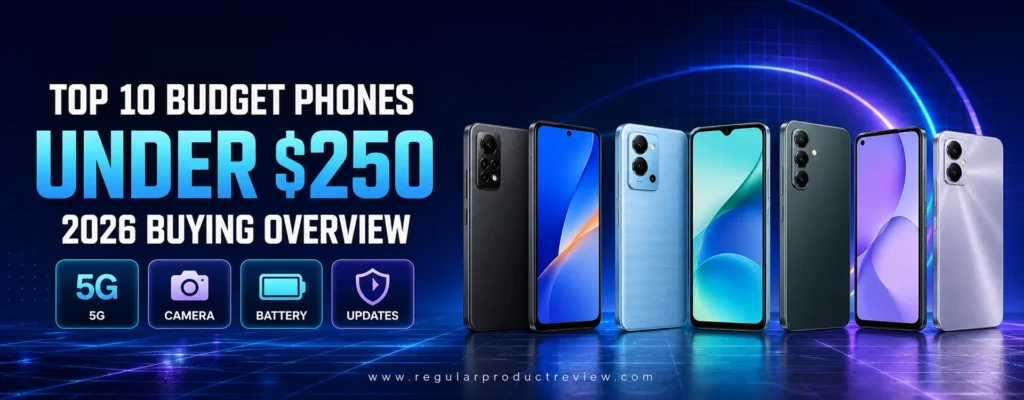
Best Budget Phones Under $250 in 2026: Expert Shortlist and Buying Strategy
Buying a capable smartphone for less than $250 is no longer an exercise in accepting the first discounted handset a carrier places on a shelf. The strongest models in this price class now offer bright OLED or fast-refresh LCD displays, 5G connectivity, large batteries, usable cameras, contactless payments, expandable storage, and security policies that can keep the device relevant for several years. The challenge is that no single phone delivers every premium feature at this price.
The best budget phones under $250 in 2026 divide into three distinct groups. New unlocked phones provide the cleanest purchasing experience and the most carrier freedom. Carrier-priced devices can deliver more hardware for less money, but their advertised discounts may require activation, a qualifying plan, number transfer, or months of service before unlocking. Refurbished flagships offer superior cameras and processing power, yet battery condition and seller quality become part of the buying decision.
This guide separates those categories instead of pretending that a $120 prepaid phone, a $249 unlocked Android handset, and a renewed former flagship are equivalent purchases. We evaluated what each model does best, where its compromises become visible, and the maximum price at which it still deserves a recommendation.
Editorial Price Rule: Every phone in this guide must cost $250 or less before sales tax at the time of purchase. A trade-in credit, long installment agreement, or gift card does not reduce the real device price for ranking purposes. Carrier activation discounts are identified separately.
Shoppers who want a broader view of the category can begin with our budget phone hub or compare the next price tier in our guide to the best Android phones under $300. Those pages help clarify whether saving the final $50 is worthwhile for your workload.
Quick Summary: Which Phone Under $250 Should You Buy?
The Samsung Galaxy A17 5G is our best overall recommendation when it is available at or below the price ceiling. Its Full HD+ Super AMOLED display, optical image stabilization, expandable storage, and long update commitment form the most balanced package. It is not a gaming powerhouse, but it avoids more serious weaknesses than most competitors.
The Motorola Moto G (2026) is the alternative for buyers who value a large battery, smooth 120Hz scrolling, comfortable design, and a relatively clean Android interface. Its display resolution and limited physical memory keep it behind Samsung, while discount-dependent pricing means buyers must check the final total carefully.
Choose the TCL 60 XE NXTPAPER 5G if eye comfort, document reading, or reduced screen glare matters more than camera consistency. Its NXTPAPER mode creates a distinctive paper-like viewing experience, and its 120Hz Full HD+ panel is unusually ambitious for the money.
The NUU B30 Pro 5G is the specification leader. Twelve gigabytes of physical RAM, 256GB of storage, a 120Hz AMOLED display, and a 108MP main camera look more like midrange hardware. The trade-off is a shorter brand track record for updates, accessories, resale value, and nationwide service support.
For buyers who prioritize long software support at a lower street price, the older Samsung Galaxy A16 5G remains relevant. The Moto G Play (2026) and TCL K32 5G cover basic communication and prepaid use, while the BLU Bold K50 5G targets shoppers who want AMOLED, 256GB of storage, and 33W charging without paying a mainstream-brand premium.
Two refurbished options complete the list. A renewed Google Pixel 8a is the camera specialist, and a renewed Apple iPhone 13 is the most compelling iOS choice. Both are recommended only when the unlocked device, seller warranty, return window, and battery condition satisfy the safeguards explained in their individual sections.
Top 10 Budget Phones Under $250 Compared
| Rank | Phone | Best For | Purchase Type | Display Highlight | Battery | Safe Buy Price |
|---|---|---|---|---|---|---|
| 1 | Samsung Galaxy A17 5G | Best overall | New, unlocked or carrier | 6.7-inch FHD+ AMOLED, 90Hz | 5,000mAh | $250 or less |
| 2 | Motorola Moto G (2026) | Battery and everyday value | New, sale-dependent | 6.7-inch LCD, 120Hz | 5,200mAh | $249 or less |
| 3 | TCL 60 XE NXTPAPER 5G | Reading and eye comfort | New, unlocked | 6.78-inch FHD+ NXTPAPER, 120Hz | 5,010mAh | $249 or less |
| 4 | NUU B30 Pro 5G | RAM and storage | New, unlocked | 6.7-inch FHD+ AMOLED, 120Hz | 5,000mAh | $249.99 or less |
| 5 | Samsung Galaxy A16 5G | Updates on a tighter budget | New, unlocked or carrier | 6.7-inch FHD+ AMOLED, 90Hz | 5,000mAh | $199 or less |
| 6 | Motorola Moto G Play (2026) | Basic 5G and prepaid plans | New, carrier or sale | 6.7-inch LCD, 120Hz | 5,200mAh | Preferably $199 or less |
| 7 | TCL K32 5G | Lowest practical 5G price | New, carrier-focused | 6.75-inch HD+ LCD | 5,010mAh | $140 or less |
| 8 | BLU Bold K50 5G | AMOLED and 256GB storage | New, unlocked | 6.7-inch FHD+ AMOLED, 120Hz | 5,000mAh | $199 or less |
| 9 | Google Pixel 8a | Best refurbished camera | Refurbished, unlocked | 6.1-inch OLED, 120Hz | 4,492mAh | $250 or less |
| 10 | Apple iPhone 13 | Best refurbished iPhone | Refurbished, unlocked | 6.1-inch OLED | Up to 19-hour rated video playback | $250 or less |
Prices move quickly, especially around prepaid promotions and renewed inventory. The “safe buy price” is an editorial ceiling, not a promise that every configuration will remain available at that price.
Our 2026 Evaluation Method: What Matters Below $250
We did not rank phones by megapixels, processor names, or advertised memory alone. Our evaluation combines verified manufacturer specifications, current US pricing, carrier compatibility, software-support commitments, independent real-world review findings, and the practical compromises a buyer will notice after the return period ends.
Each phone was assessed across seven decision areas:
- ⚡ Everyday performance: App launches, web browsing, messaging, navigation, video calls, and light multitasking matter more than synthetic peak scores.
- 🖥️ Display usability: Resolution, refresh rate, brightness, OLED contrast, outdoor readability, and touch response were considered together.
- 📷 Camera reliability: We favor dependable autofocus, stabilization, natural processing, and usable video over an inflated sensor count.
- 🔋 Battery and charging: Capacity, chipset efficiency, charging speed, charger requirements, and battery-health risk all affect ownership.
- 🛡️ Software longevity: Promised operating-system upgrades, security patches, bloatware, and update consistency influence long-term value.
- 📡 US connectivity: 5G/LTE band support, unlocked status, eSIM or physical SIM options, Wi-Fi generation, NFC, and carrier restrictions were checked where available.
- 💵 Real cost: Activation fees, mandatory plans, seller condition, storage configuration, warranty, and accessories were included in the value judgment.
This is a comparative editorial review, not a claim that every retail sample was laboratory-tested by our team. Where hands-on observations from reputable reviewers informed a conclusion, we cross-checked them against official specifications rather than presenting marketing claims as measured results.
Expert Insight: At this price, software support, storage capacity, carrier compatibility, and screen quality usually improve the ownership experience more than a secondary 2MP camera or virtual-RAM number.
New, Carrier-Discounted, or Refurbished: Understand the Price
| Purchase Route | Main Advantage | Main Risk | What to Verify |
|---|---|---|---|
| New unlocked | Freedom to change carriers; straightforward warranty | Higher upfront price | US model number, bands, warranty, return period |
| Carrier promotion | Lowest initial cost | Plan requirements, activation fees, lock period | Total service cost and unlock policy |
| Refurbished | Better camera and processor for the money | Battery wear and variable repair quality | Battery health, parts warnings, warranty, return window |
| Used private sale | Potentially the lowest price | Minimal protection and uncertain history | IMEI status, account locks, damage, battery health |
An advertised “free phone” can cost more than an unlocked handset when an expensive plan is required. Conversely, a prepaid deal can be excellent if you already want that carrier’s service. Add the device price, activation fee, required first month, and any minimum-service obligation before comparing totals.
If your priority is photography, see our broader camera phone recommendations and camera phones under $300. Mobile gamers should compare these entry-level chipsets with the options in our gaming phones under $300 guide before assuming a 120Hz display guarantees high frame rates.
Minimum Specifications We Recommend in 2026
For a primary Android phone, 4GB of physical RAM is the absolute floor; 6GB or 8GB provides noticeably more breathing room. Virtual RAM uses slower storage and should never be counted as equivalent to real memory. Aim for at least 128GB of storage unless a lower-priced 64GB phone supports microSD expansion and your apps are modest.
A Full HD+ display is preferable for reading and video, although a good HD+ panel can remain acceptable on a low-cost prepaid device. A 5,000mAh-class battery is common, but charging speed and processor efficiency determine whether capacity translates into convenience. NFC matters if you use tap-to-pay, while a headphone jack and microSD slot may be more valuable than wireless charging for this audience.
For longevity, choose a phone with a documented update policy rather than vague promises. Samsung and Google lead this list in support duration. Motorola, TCL, NUU, and BLU can offer strong hardware value, but buyers should expect less certainty about major Android upgrades on some models.
Learn More: Why we do not rank by virtual RAM
Virtual RAM reserves part of the phone’s internal storage for memory overflow. It may reduce how often a background app fully reloads, but storage is much slower than physical RAM and cannot transform a 4GB phone into a true 8GB or 12GB device. Our tables list physical memory first and label expansion features separately.
Samsung Galaxy A17 5G Review: Best Overall Phone Under $250
Editorial Score: 8.8/10
Award: 🏆 Best Overall Budget Phone Under $250
The Samsung Galaxy A17 5G earns first place because it combines the features that affect daily use most: a sharp AMOLED display, optical image stabilization, expandable storage, broad US availability, and an unusually long support promise. Samsung introduced the US model in January 2026, positioning it at the top edge of this guide’s budget. That price matters. At $250 or less, the A17 5G is a balanced purchase; above the ceiling, buyers should compare discounted midrange devices instead.
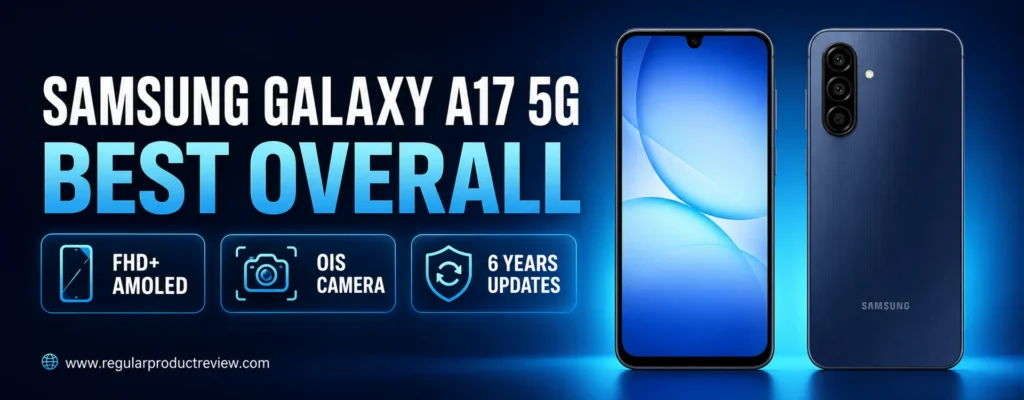
Samsung’s 6.7-inch Full HD+ Super AMOLED panel is the centerpiece. Text appears cleaner than on the HD+ displays common in this class, black levels are excellent, and the 90Hz refresh rate makes scrolling feel smoother than a conventional 60Hz screen. A waterdrop-style front-camera notch looks less contemporary than a punch-hole cutout, but the display quality is more important than the shape of the interruption.
The Exynos 1330 processor and 4GB of memory are designed for routine workloads rather than demanding games. Messaging, maps, streaming, mobile banking, email, and a few open apps should be comfortable. Heavy browser sessions and rapid switching between large games will expose the memory limit. Samsung’s RAM Plus feature cannot replace physical RAM, so users should keep unnecessary background applications and animations under control.
Galaxy A17 5G Key Specifications
| Specification | Samsung Galaxy A17 5G |
|---|---|
| Display | 6.7-inch FHD+ Super AMOLED, 90Hz |
| Processor | Samsung Exynos 1330 |
| Memory and storage | 4GB RAM, 128GB storage |
| Expansion | microSD support up to 2TB |
| Rear cameras | 50MP main with OIS, 5MP ultrawide, 2MP macro |
| Front camera | 13MP |
| Battery | 5,000mAh |
| Charging | Up to 25W wired; adapter may be sold separately |
| Durability | IP54 splash and dust resistance, Gorilla Glass Victus |
| Software commitment | Six OS generations and six years of security updates |
| Weight | Approximately 192g |
The 50MP primary camera includes optical image stabilization, a meaningful advantage over many low-cost competitors. OIS helps reduce hand movement during slower exposures and makes handheld video less jittery. Daylight images should provide pleasing color and enough detail for social sharing. The 5MP ultrawide offers creative flexibility but has limited resolution, while the 2MP macro is more of an occasional experiment than a reason to buy the phone.
Low-light photography remains constrained by the small sensor and budget image pipeline. Night mode can brighten a scene, but moving subjects may blur and fine textures can look processed. The camera is best used with the main lens, clean glass, a steady grip, and deliberate exposure control. Buyers who rank photography above warranty and new-device condition should read the Pixel 8a section later in this guide.
Battery capacity is a familiar 5,000mAh, which should comfortably support a mixed day for many users. Heavy 5G navigation, gaming, high screen brightness, and hotspot use will reduce runtime. The 25W charging ceiling is adequate rather than class-leading, and a compatible power adapter may need to be purchased separately.
The update policy is the decisive long-term advantage. Samsung promises six generations of Android upgrades and six years of security updates. A low-cost device may feel slow before that window ends, but the commitment still improves security, app compatibility, resale confidence, and the likelihood that the phone remains useful as a backup device.
Samsung Galaxy A17 5G Pros and Cons
| Pros | Cons |
|---|---|
| Sharp FHD+ Super AMOLED display | Only 4GB of physical RAM in the base US configuration |
| OIS on the 50MP main camera | Secondary cameras are modest |
| Six OS generations and six years of security support | 25W charging is not especially fast |
| 128GB storage with microSD expansion | No wireless charging |
| IP54 rating and tougher front glass | Performance is not intended for demanding games |
| Broad accessory and service availability | Full value depends on staying at or below $250 |
Who Should Buy the Galaxy A17 5G?
Choose it if you want one new phone for communication, streaming, school, banking, photography, and everyday work without gambling on a refurbished seller. It particularly suits buyers who keep phones for several years and value a predictable security-update schedule.
Avoid it if gaming performance, fast charging, or extensive multitasking is your priority. The NUU B30 Pro offers more memory and storage, while a refurbished Pixel 8a delivers more sophisticated camera processing.
Expert Tip: Confirm the US model, 128GB storage, unlocked status, and final checkout price. International Galaxy variants may use different network bands or warranty terms even when the product name appears identical.
Samsung’s official Galaxy A17 5G page confirms the core display, battery, storage, and support details. Buyers comparing Samsung with other Android brands can explore our Android phone hub and our guide to the best budget Android phones for everyday use.
Buy it if: You want the safest all-around new Android phone at the $250 ceiling.
Skip it if: You need more than 4GB of physical RAM or flagship-level low-light photography.
Price Alert: Buy at $250 or less. Do not count a trade-in credit as a lower retail price.
Motorola Moto G (2026) Review: Best Battery-Focused Everyday Value
Editorial Score: 8.5/10
Award: 🔋 Best Balance of Battery Life and Smooth Scrolling
The Motorola Moto G (2026) offers a practical alternative to Samsung’s AMOLED-first approach. Its strengths are a large 5,200mAh battery, 30W charging, a smooth 120Hz display, expandable storage, and a grippy vegan-leather finish. The phone feels designed for people who spend long days messaging, navigating, streaming, and listening rather than chasing benchmark records.
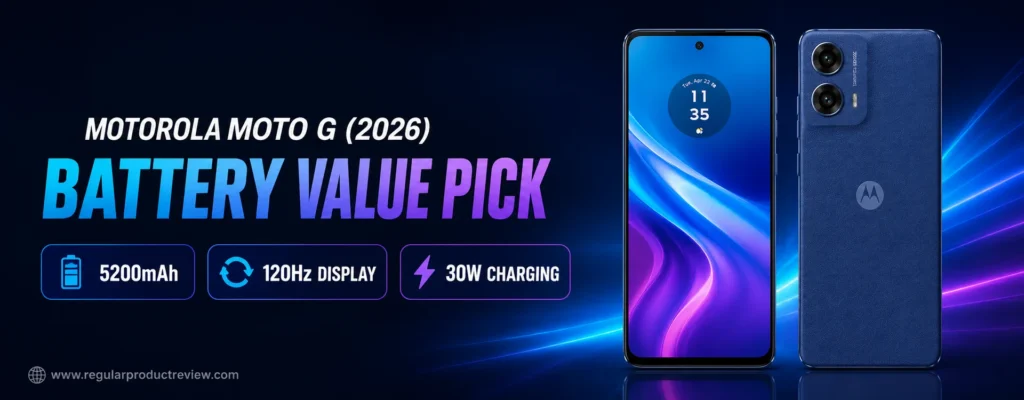
Pricing requires special attention. Motorola launched the model at a price that fit comfortably in this category, but US pricing changed during 2026 and retailer promotions now determine whether it qualifies. We recommend the Moto G only when the unlocked or appropriately carrier-compatible configuration costs $249 or less with no unwanted service obligation.
The 6.7-inch screen refreshes at up to 120Hz, making scrolling and supported animations look fluid. Its HD+ resolution is the compromise. Video and social content remain enjoyable, but small text and fine interface elements are not as crisp as on the Full HD+ panels of the Samsung Galaxy A17, TCL NXTPAPER, NUU B30 Pro, or BLU Bold K50.
Moto G (2026) Key Specifications
| Specification | Motorola Moto G (2026) |
|---|---|
| Display | 6.7-inch HD+ LCD, up to 120Hz |
| Processor | MediaTek Dimensity 6300 |
| Memory and storage | 4GB physical RAM, 128GB storage |
| Expansion | microSD support up to 1TB |
| Rear cameras | 50MP main plus dedicated macro camera |
| Front camera | 32MP |
| Battery | 5,200mAh |
| Charging | Up to 30W wired |
| Durability | IP52 water-repellent design, Gorilla Glass 3 |
| Software at launch | Android 16 |
The Dimensity 6300 brings efficient 5G performance to an inexpensive platform. It handles calls, navigation, social feeds, email, music, and casual games well enough, although the 4GB physical-memory limit is easy to reach. Motorola promotes RAM Boost, but that feature borrows storage and should be treated as a background-app aid, not real additional RAM.
The 50MP main camera is most dependable outdoors or near a window. Motorola’s processing generally favors bright, share-ready results. Fine detail drops as light decreases, and the macro sensor has limited everyday value. The 32MP selfie camera is unusually high-resolution on paper, yet sensor size, focus behavior, processing, and lighting matter more than the number alone. Use portrait mode cautiously around hair and glasses, where inexpensive depth mapping can make mistakes.
The 5,200mAh battery is a convincing reason to choose this phone. Many moderate users should reach the end of a day with room to spare, and conservative users may stretch farther. Thirty-watt charging is faster than several Samsung and TCL rivals, though actual charging speed depends on a compatible adapter and thermal conditions.
Motorola’s software is visually close to standard Android and includes useful gestures such as quick camera access. The company’s budget update commitments have historically been less extensive than Samsung’s, so buyers should verify the current US support statement before assuming the phone will receive many major Android versions.
Motorola Moto G (2026) Pros and Cons
| Pros | Cons |
|---|---|
| Large 5,200mAh battery | HD+ resolution is soft on a 6.7-inch screen |
| Smooth 120Hz refresh rate | Only 4GB of physical RAM |
| Useful 30W charging | Long-term update policy trails Samsung |
| 128GB storage with microSD expansion | Macro camera adds little value |
| Comfortable vegan-leather finish | Price can move above the guide’s limit |
| Headphone-friendly budget design | No premium water-resistance rating |
The official Moto G (2026) product page should be checked for the current unlocked price and configuration. If your workload includes demanding games, compare it with our best gaming phones under $300 and the broader gaming phone collection. Those guides explain why a high-refresh display alone does not guarantee stable gaming performance.
Editorial Insight: The Moto G is a strong daily companion when discounted, but the Galaxy A17 is the better long-term choice at the same price because its display resolution and update commitment are stronger.
Buy it if: Battery life, 120Hz scrolling, expandable storage, and comfortable handling matter most.
Skip it if: You read small text for hours, keep many apps open, or demand a long documented update window.
Price Alert: Purchase only when the final device cost is $249 or less. Recalculate the total if activation or plan requirements apply.
TCL 60 XE NXTPAPER 5G Review: Best Phone for Reading and Eye Comfort
Editorial Score: 8.4/10
Award: 📖 Best Budget Display for Reading
The TCL 60 XE NXTPAPER 5G is the most distinctive phone in this ranking. Instead of competing only on processor speed or camera resolution, it changes how the display feels during long reading sessions. TCL’s NXTPAPER technology uses a matte, glare-reducing surface and dedicated viewing modes intended to resemble paper more closely than a glossy smartphone panel.
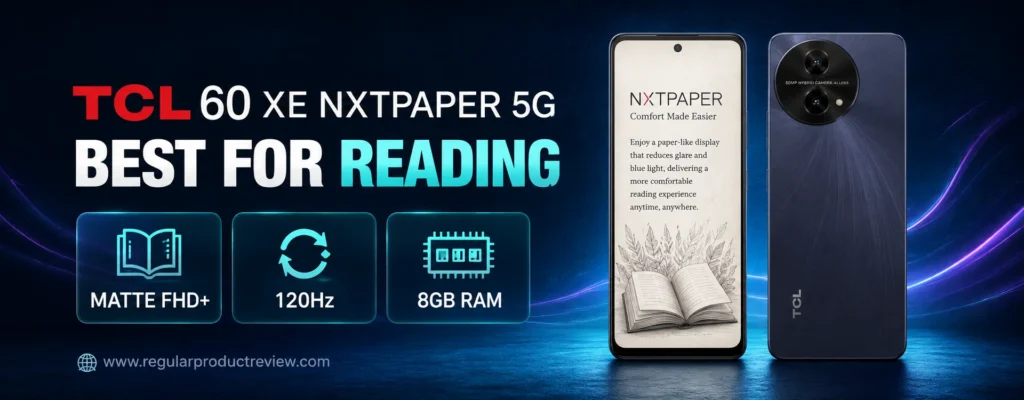
The physical NXTPAPER Key can switch among standard color, color-paper, and ink-paper experiences. The last mode reduces visual distractions and can help when reading articles, PDFs, notes, or ebooks. It does not turn the phone into a true E Ink reader: the panel remains an LCD, consumes more power than E Ink while static, and cannot match the weeks-long endurance of a dedicated ereader. Its advantage is flexibility you still have a full Android phone when reading ends.
TCL 60 XE NXTPAPER 5G Key Specifications
| Specification | TCL 60 XE NXTPAPER 5G |
|---|---|
| Display | 6.78-inch FHD+ NXTPAPER LCD, up to 120Hz |
| Touch response | Up to 240Hz touch sampling |
| Processor | MediaTek octa-core 5G platform |
| Memory and storage | 8GB physical RAM, 128GB or 256GB by configuration |
| Expansion | microSD support up to 2TB |
| Rear cameras | 50MP main, 5MP ultrawide, 2MP depth, macro support |
| Front camera | 32MP |
| Battery | 5,010mAh |
| Charging | 18W wired |
| Software | Android 15 at launch |
| Connectivity | 5G, NFC, Wi-Fi 5, Bluetooth 5.3 |
The Full HD+ resolution is welcome on a 6.78-inch screen. Text is clearer than on similarly sized HD+ competitors, and 120Hz refresh capability keeps scrolling smooth. The matte texture slightly changes perceived contrast and sharpness compared with a glossy OLED. Buyers who want deep blacks and maximum cinematic punch may prefer the Samsung, NUU, or BLU options; readers working under bright lights may prefer TCL’s reduced reflections.
Eight gigabytes of physical RAM gives the phone better multitasking headroom than most mainstream models under $250. TCL may advertise another 8GB of virtual expansion, but the physical amount is the meaningful figure. Storage varies by seller, so confirm whether the listing includes 128GB or 256GB before comparing prices.
The 50MP main camera performs best in good light, with the ultrawide adding practical framing flexibility. Camera processing is not as consistent as Google’s refurbished Pixel option, and the additional low-resolution sensors should not drive the purchase. The 32MP front camera is helpful for video calls and social content in favorable lighting.
Battery capacity is slightly above 5,000mAh, but the large display and high refresh rate can consume energy quickly. Using adaptive refresh behavior, moderate brightness, and paper-oriented modes should improve endurance. Charging at 18W is relatively slow for a battery this size, so short top-ups are less effective than on the Moto G or BLU Bold K50.
TCL’s official unlocked version has been promoted below $250, making it one of the few genuinely unusual devices that still fits the limit without a trade-in. Carrier compatibility remains a checkpoint. Confirm the exact model supports your operator’s bands and activation requirements, especially if you use an MVNO.
TCL 60 XE NXTPAPER 5G Pros and Cons
| Pros | Cons |
|---|---|
| Matte NXTPAPER display reduces distracting reflections | Not a true E Ink screen |
| FHD+ resolution and 120Hz refresh rate | 18W charging is slow |
| 8GB of physical RAM | Camera consistency trails Pixel and Samsung |
| microSD expansion up to 2TB | Update policy is less reassuring than Samsung’s |
| Dedicated NXTPAPER Key and reading modes | Matte finish slightly softens visual punch |
| NFC included for compatible payments | Large body may be uncomfortable one-handed |
The official TCL 60 XE NXTPAPER 5G page lists the current configuration and price. Students comparing note-taking and study devices should also visit our best Android phones for students and best budget Android phones for everyday use.
Expert Recommendation: Select the TCL for its display behavior, not its camera count. If you rarely read on your phone, a brighter AMOLED model provides a more conventional media experience.
Buy it if: You read for long periods, dislike glossy reflections, and want 8GB of physical RAM.
Skip it if: Fast charging, compact dimensions, or the strongest low-light camera is essential.
Price Alert: The unlocked phone is compelling at $249 or less, and especially attractive near $200. Confirm storage capacity before checkout.
NUU B30 Pro 5G Review: Best Performance, RAM, and Storage Value
Editorial Score: 8.3/10
Award: ⚡ Best Hardware Specification Package Under $250
The NUU B30 Pro 5G is for shoppers who study specification sheets and wonder why mainstream brands still pair inexpensive phones with 4GB of RAM. NUU equips this model with 12GB of physical memory, 256GB of storage, a 120Hz Full HD+ AMOLED display, and a 108MP primary camera. At its official sale price of $249.99, it offers the most ambitious hardware combination in this guide.
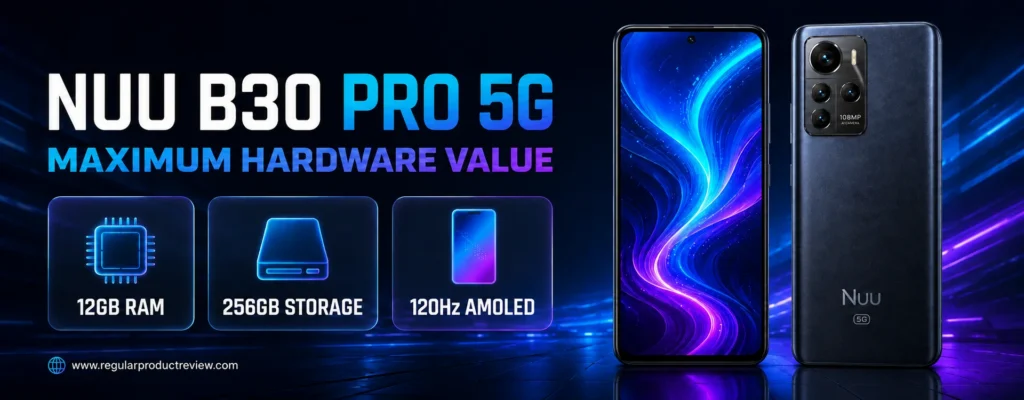
Those impressive numbers require context. NUU does not have Samsung’s update reputation, Google’s computational photography, Apple’s accessory ecosystem, or Motorola’s retail reach. A buyer is exchanging some confidence in long-term software support and resale value for substantially more memory and storage today. That can be a smart trade for power users on a strict budget, but it should be deliberate.
NUU B30 Pro 5G Key Specifications
| Specification | NUU B30 Pro 5G |
|---|---|
| Display | 6.7-inch FHD+ AMOLED, 120Hz |
| Processor | MediaTek 5G octa-core platform, up to 2.6GHz |
| Memory | 12GB physical RAM |
| Storage | 256GB |
| Rear cameras | 108MP main, 8MP secondary, 2MP auxiliary |
| Front camera | 32MP |
| Battery | 5,000mAh |
| Security | In-display fingerprint reader |
| Network | Factory-unlocked 5G model; verify carrier support |
The AMOLED panel gives video, photographs, and dark interfaces strong contrast, while Full HD+ resolution keeps text crisp. A 120Hz refresh rate makes the interface feel responsive even when the processor is not flagship-grade. Because the refresh rate can increase battery demand, users who prioritize endurance can select a lower setting when available.
Twelve gigabytes of physical RAM is the B30 Pro’s clearest advantage. It gives Android more space for browser tabs, document editors, social apps, navigation, and background audio without reloading as aggressively as a 4GB device. The 256GB internal drive also reduces dependence on cloud storage. It is a particularly useful combination for travelers, gig workers, and students who keep offline media or large course files.
The processor is capable of everyday multitasking and moderate gaming, but memory capacity should not be confused with graphics speed. Visually demanding titles may require reduced detail settings, and sustained sessions can introduce heat or performance throttling. The phone is still a better multitasking candidate than most entries here, yet a gaming-focused model above $300 can deliver a stronger GPU and better cooling.
The 108MP label describes sensor resolution, not guaranteed image quality. In daylight, pixel-binned photos can preserve useful detail and allow modest cropping. Indoors, processing quality, shutter speed, sensor size, and stabilization matter more. NUU’s camera may produce attractive results with patient framing, but a refurbished Pixel 8a remains more reliable for moving subjects, difficult skin tones, HDR, and night scenes.
NUU sells unlocked devices for US networks, but compatibility should be verified by exact model and carrier. Some operators restrict features such as Wi-Fi calling or visual voicemail even when basic LTE and 5G service works. Enter the IMEI into the carrier’s checker after receiving the phone and before the return window closes.
NUU B30 Pro 5G Pros and Cons
| Pros | Cons |
|---|---|
| 12GB of physical RAM | Update duration is not as strong or transparent as Samsung’s |
| 256GB of built-in storage | Camera processing trails Google’s |
| FHD+ 120Hz AMOLED display | Accessory selection is limited |
| 108MP main camera provides daylight detail | Resale value may be lower |
| Factory-unlocked positioning | Carrier-specific features require verification |
| In-display fingerprint reader | Less extensive retail and repair network |
The official NUU B30 Pro page confirms its core memory, display, camera, and battery specifications. Buyers deciding between raw hardware and mainstream support can compare our Android phones under $500 and flagship Android phone guide to see what a larger budget adds.
Editorial Insight: The B30 Pro is the specification champion, but the Galaxy A17 is the lower-risk long-term recommendation. Choose based on whether immediate multitasking or future update certainty matters more.
Buy it if: You want 12GB of real RAM, 256GB of storage, AMOLED contrast, and unlocked flexibility.
Skip it if: You prioritize a long written update policy, abundant cases, or the strongest repair network.
Price Alert: Buy at the official $249.99 or lower price. Above $250, it leaves this guide and faces stronger midrange competition.
Samsung Galaxy A16 5G Review: Best Long-Term Support for Less
Editorial Score: 8.1/10
Award: 🛡️ Best Software-Support Value Below $200
The Samsung Galaxy A16 5G remains worth considering even after the Galaxy A17 arrived. Retailers and carriers frequently reduce older models, and the A16 preserves many of the qualities that make Samsung’s budget line dependable: a large Full HD+ AMOLED display, expandable storage, a 5,000mAh battery, broad accessory support, and six generations of operating-system upgrades.
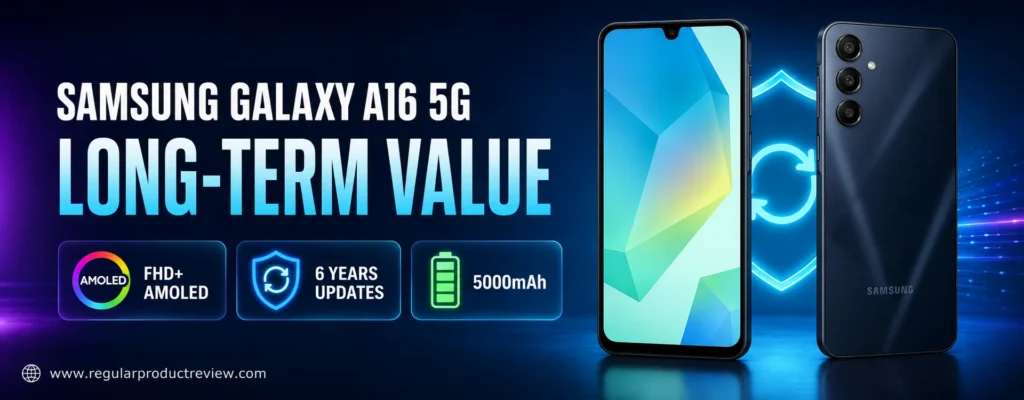
The value depends on the discount. At the same price, buy the newer A17 because it adds optical stabilization and a tougher front surface. The A16 becomes compelling when it costs around $150 to $199, particularly for a family member, student, secondary line, or buyer who values updates more than benchmark performance.
Samsung Galaxy A16 5G Key Specifications
| Specification | Samsung Galaxy A16 5G |
|---|---|
| Display | 6.7-inch FHD+ Super AMOLED, 90Hz |
| Processor | Exynos 1330 in the US unlocked model |
| Memory and storage | 4GB RAM, 128GB storage |
| Expansion | microSD support up to 1.5TB |
| Rear cameras | 50MP wide, 5MP ultrawide, 2MP macro |
| Front camera | 13MP |
| Battery | 5,000mAh |
| Charging | Up to 25W wired |
| Durability | IP54 on the US model |
| Software commitment | Six OS generations and six years of security updates |
The 6.7-inch panel remains excellent for the price. AMOLED contrast improves movies and dark-mode interfaces, Full HD+ resolution keeps documents legible, and 90Hz scrolling feels more polished than 60Hz. The phone is large, however, and one-handed typing can be awkward for users with smaller hands.
Everyday performance is adequate rather than fast. The processor can support communications, banking, navigation, school portals, streaming, and light photo editing. Four gigabytes of RAM limits sustained multitasking, so switching among a game, video call, camera, and many browser tabs can trigger app reloads. Closing unused apps and keeping internal storage from filling completely helps maintain responsiveness.
Samsung’s camera application is mature and easy to navigate. The 50MP main sensor captures satisfactory daylight images, while the 5MP ultrawide is useful for architecture and group scenes when light is abundant. Unlike the A17, the A16’s main camera lacks OIS, making steady technique more important at night. The macro camera is low resolution and should be viewed as a bonus.
The 5,000mAh battery should cover a normal day for many users. Charging reaches 25W with a compatible USB Power Delivery adapter, which is not always included. Wireless charging is absent. Samsung’s official support documentation confirms 128GB of internal storage and microSD expansion up to 1.5TB, useful for photographs and downloaded media even though many apps must remain on internal storage.
The six-generation update promise is exceptional at a discounted price. It does not guarantee that performance will feel new throughout the entire period, but it keeps the device within a supported security window longer than most inexpensive rivals.
Galaxy A16 5G Pros and Cons
| Pros | Cons |
|---|---|
| FHD+ Super AMOLED display | No OIS on the main camera |
| Long software-support commitment | 4GB RAM restricts multitasking |
| 128GB plus microSD expansion | Large body is not ideal one-handed |
| Reliable mainstream ecosystem | Charging adapter may cost extra |
| Useful 5MP ultrawide camera | Gaming performance is modest |
| Often discounted by US carriers | Carrier promotions may include lock conditions |
Samsung documents the Galaxy A16 5G storage, battery, and charging details on its US support site. Before choosing an older model, compare it with the newer options in our best Android phones under $300 and the lower-cost picks in our best budget phones under $200.
Expert Tip: A carrier’s low headline price is worthwhile only if you already want the plan. Check activation fees, minimum service, autopay conditions, and the published unlock policy.
Buy it if: You find a new US model below $200 and want AMOLED quality plus long support.
Skip it if: The A17 costs only slightly more or you need OIS and better low-light consistency.
Price Alert: Target $199 or less. At $220 to $250, the Galaxy A17 is usually the smarter purchase.
Motorola Moto G Play (2026) Review: Best Basic 5G Phone for Prepaid Buyers
Editorial Score: 7.9/10
Award: 📡 Best Straightforward Prepaid 5G Pick
The Motorola Moto G Play (2026) focuses on the basics: dependable communication, a large screen, 5G connectivity, long battery potential, expandable storage, and a familiar Android experience. It is less ambitious than the regular Moto G, but carrier promotions can make it attractive for a first smartphone, backup line, rideshare device, or family member with modest needs.
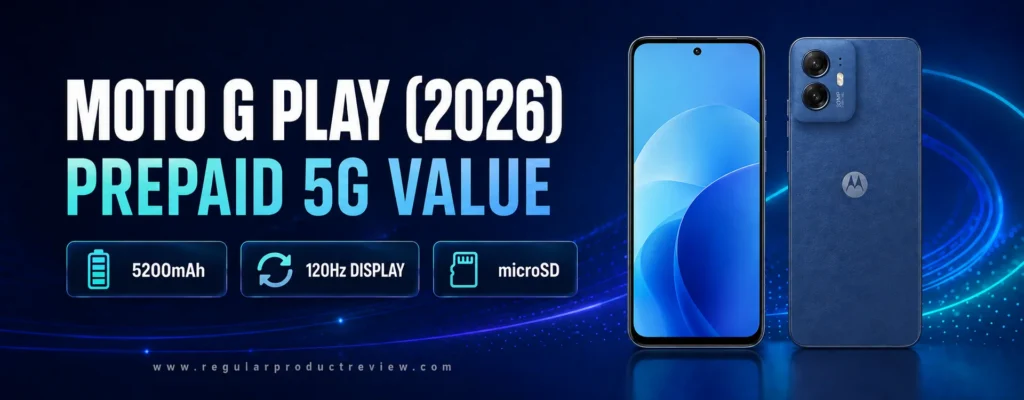
Its qualification is price-sensitive. Motorola’s US pricing shifted in 2026, and an unlocked unit at the upper edge of $250 is difficult to recommend beside the Galaxy A17 or NUU B30 Pro. The Moto G Play makes sense at roughly $140 to $199, or through a carrier whose service you already intend to use.
Moto G Play (2026) Key Specifications
| Specification | Motorola Moto G Play (2026) |
|---|---|
| Display | 6.7-inch HD+ LCD, up to 120Hz |
| Processor | MediaTek Dimensity 6300 |
| Memory | 4GB physical RAM plus RAM Boost option |
| Storage | 64GB on the unlocked reference configuration |
| Expansion | microSD support up to 1TB |
| Rear camera | 32MP main |
| Front camera | 8MP |
| Battery | 5,200mAh |
| Charging | Up to 18W wired |
| Durability | IP52 water-repellent design, Gorilla Glass 3 |
| Software at launch | Android 16 |
The same Dimensity 6300 platform used by the regular Moto G gives the Play model competent entry-level 5G behavior. Calls, messaging, audio streaming, light browsing, maps, and video should run acceptably. Physical RAM remains 4GB; advertising that combines RAM Boost with physical memory can make the device sound more capable than it is. Large games and frequent app switching are not its intended workload.
The 6.7-inch 120Hz screen scrolls smoothly, but HD+ resolution looks less precise than Full HD+. That compromise is acceptable at a deep prepaid discount and harder to justify near $250. The large panel is useful for video, navigation, and accessibility settings, although the phone can feel cumbersome in a small pocket.
The 32MP rear camera is a simple system without the flexibility of an ultrawide lens. In bright conditions it can produce usable family photographs, receipts, listings, and social images. Indoor movement and night scenes reveal slower capture and reduced detail. The 8MP front camera is adequate for video calls with good front lighting.
Battery life is the highlight. A 5,200mAh cell paired with a modest display resolution and efficient processor should deliver reassuring endurance. Charging at 18W is slower than the regular Moto G’s 30W, so overnight charging is more convenient than a rushed midday refill.
Sixty-four gigabytes of built-in storage is restrictive in 2026. After the operating system and updates, the remaining space can disappear quickly. A microSD card helps with photographs, video, music, and documents, but it does not provide the same performance or app flexibility as larger internal storage. Some carrier variants may differ, so verify the exact listing rather than assuming all Moto G Play models are identical.
Moto G Play (2026) Pros and Cons
| Pros | Cons |
|---|---|
| Efficient 5G processor | Only 64GB storage in the reference version |
| Large 5,200mAh battery | HD+ resolution |
| Smooth 120Hz refresh capability | 18W charging is relatively slow |
| microSD expansion | Basic single-main-camera experience |
| Comfortable Motorola software | Limited physical RAM |
| Frequent prepaid promotions | Value collapses near the $250 ceiling |
Verify specifications on Motorola’s official Moto G Play (2026) support page. Shoppers prioritizing the lowest possible cost should compare our budget phones under $150 and budget phones under $200 before accepting a restrictive carrier plan.
Editorial Price Alert: This phone is a value pick only when the handset discount is real. Add the required service cost before comparing it with an unlocked phone.
Buy it if: You need inexpensive 5G, long battery potential, microSD expansion, and simple Android software.
Skip it if: You can afford the Galaxy A17 or need 128GB storage, a sharp display, and stronger cameras.
Price Alert: Aim for $199 or less. At $249.99, buy only if a specific carrier feature or availability issue leaves no better option.
TCL K32 5G Review: Best Ultra-Cheap 5G Phone for Essential Use
Editorial Score: 7.3/10
Award: 💵 Best Low-Cost Carrier Phone
The TCL K32 5G is not trying to imitate a premium device. It is a practical communications tool built around a large screen, modern 5G connectivity, a substantial battery, expandable storage, and an aggressively low carrier price. For someone who needs calls, texts, authentication apps, maps, email, and occasional video, that focus can be more useful than paying for capabilities they will not use.
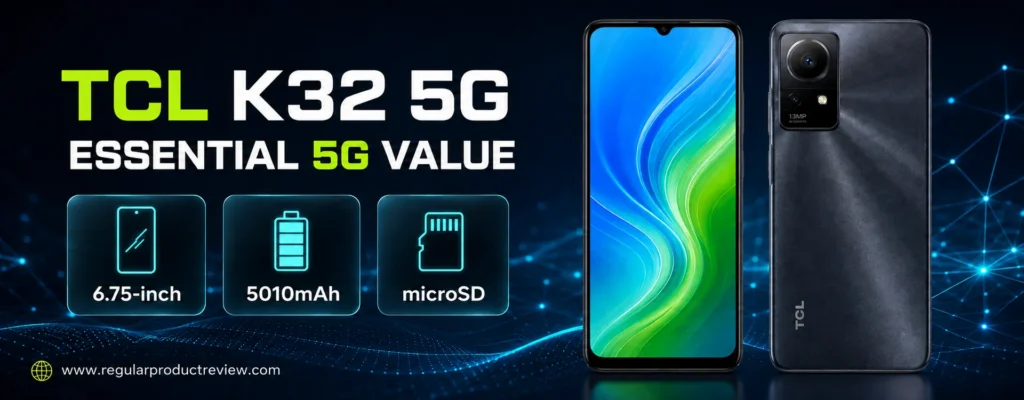
The K32 launched around $120, while current carrier list prices and promotions can move the total between free-with-conditions and roughly $140. At that level, it competes with basic LTE phones and used devices rather than the $249 leaders. It should not be judged against the Galaxy A17 on camera quality or screen resolution; it should be judged on whether it covers essential tasks without creating an expensive service obligation.
TCL K32 5G Key Specifications
| Specification | TCL K32 5G |
|---|---|
| Display | 6.75-inch HD+ NXTVISION LCD |
| Processor | Qualcomm Snapdragon 4s Gen 2 |
| Memory | 4GB RAM |
| Storage | 64GB |
| Expansion | microSD support up to 2TB |
| Rear camera | 13MP hybrid camera system |
| Front camera | 5MP |
| Battery | 5,010mAh |
| Software | Android 15 at launch |
| Sales model | Carrier-focused US availability |
The Snapdragon 4s Gen 2 is an entry-level chip intended for efficient connectivity rather than intensive creation or gaming. Everyday tasks should remain reasonable when apps are opened one at a time. Heavy webpages, large spreadsheets, high-resolution video editing, and demanding games are outside the phone’s comfort zone.
Its 6.75-inch HD+ screen provides a large canvas for navigation, streaming, and enlarged text. Pixel density is modest, so small fonts and high-resolution images will look softer than on Full HD+ competitors. TCL’s NXTVISION tuning aims to improve color and contrast, but it does not provide the matte NXTPAPER treatment of the more expensive 60 XE model.
The 13MP rear camera is suitable for utility photography: documents, package labels, daytime family snapshots, and marketplace listings. It is not designed for detailed night photography or smooth high-end video. The 5MP front camera benefits greatly from a well-lit face and a stable connection during video calls.
A 5,010mAh battery paired with a modest processor and HD+ display should provide solid endurance. Actual results depend on network strength; a phone constantly searching for 5G in a weak area can consume power much faster. Sixty-four gigabytes of storage is the bigger daily limitation. A microSD card can hold media and documents, but users should leave internal space free for updates and app caches.
The K32 is strongly tied to carrier distribution. That can simplify setup for the intended network, but shoppers must understand unlocking conditions. A low handset price is not automatically a bargain if the required plan costs $20 more each month than a comparable MVNO. Over one year, that service difference can exceed the price of a better unlocked phone.
TCL K32 5G Pros and Cons
| Pros | Cons |
|---|---|
| Very low acquisition price | 64GB internal storage |
| 5G connectivity | HD+ display lacks fine detail |
| Large 5,010mAh battery | Cameras are strictly basic |
| microSD expansion up to 2TB | Limited multitasking headroom |
| Large screen for maps and text | Carrier locks and plan terms may apply |
| Suitable as a backup or first phone | Not appropriate for demanding games or creation |
The official TCL K32 5G page provides the baseline specifications, while carrier pages should be used to confirm activation and unlocking terms. Compare it with our best budget phones under $100 and best budget phones under $150 to understand when an even cheaper model is sufficient.
Expert Tip: Check the carrier’s coverage map at home, work, school, and frequently traveled routes. A low-cost 5G phone cannot compensate for weak local service.
Buy it if: You need essential smartphone functions, 5G, and a big battery at the lowest practical price.
Skip it if: You store many apps, take frequent night photos, or want an unlocked phone for easy carrier switching.
Price Alert: Target $140 or less for the handset, then calculate activation and required service separately.
BLU Bold K50 5G Review: Best AMOLED Phone with 256GB Storage
Editorial Score: 8.0/10
Award: 🌈 Best Display-and-Storage Combination from an Independent Brand
The BLU Bold K50 5G packages several desirable features into a sleek unlocked phone: a 6.7-inch Full HD+ AMOLED display, 120Hz refresh rate, 256GB of internal storage, a MediaTek Dimensity 6300 processor, a 5,000mAh battery, and 33W charging. It is designed for buyers who want a premium-looking screen and generous local storage without moving into the $300-to-$500 tier.
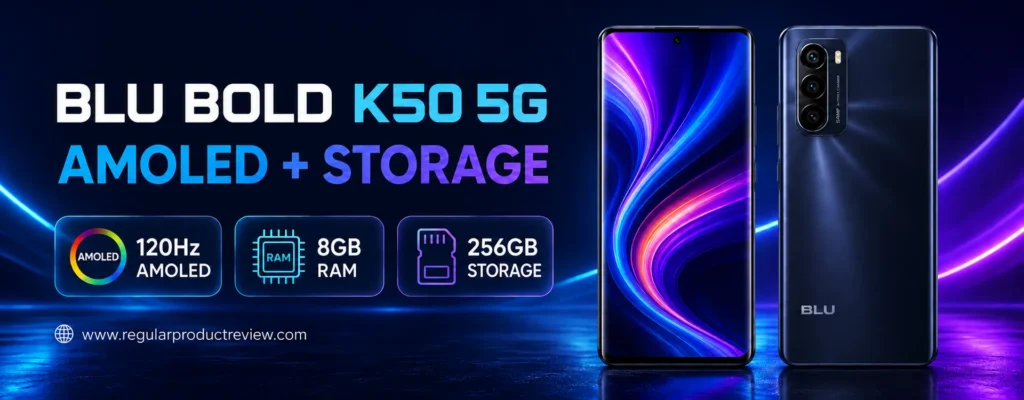
BLU’s value proposition resembles NUU’s: more hardware for the dollar, balanced by less certainty around long-term Android upgrades, accessories, trade-in value, and local repair options. The K50 can be a satisfying purchase for an informed buyer, but it should not be selected solely because its marketing combines physical and extended memory into one large number.
BLU Bold K50 5G Key Specifications
| Specification | BLU Bold K50 5G |
|---|---|
| Display | 6.7-inch FHD+ 3D AMOLED, 120Hz |
| Processor | MediaTek Dimensity 6300 |
| Physical memory | 8GB RAM |
| Storage | 256GB |
| Extended memory | Up to 16GB virtual expansion advertised |
| Main rear camera | 64MP |
| Auxiliary cameras | 2MP macro and 2MP depth |
| Battery | 5,000mAh |
| Charging | Up to 33W wired |
| Network position | US unlocked 5G device; compatibility must be verified |
The display is the reason the phone feels more expensive than a conventional entry-level handset. AMOLED technology provides deep black levels and strong contrast, Full HD+ resolution keeps text sharp, and 120Hz motion makes feeds and interface transitions smoother. The curved-edge presentation looks polished, though curved glass can reflect light at the sides and may be more vulnerable to impact than a flat panel. A protective case is a sensible first purchase.
The Dimensity 6300 is a capable budget 5G chip for streaming, social apps, messaging, maps, and casual gaming. Eight gigabytes of physical RAM gives it a healthier multitasking foundation than the 4GB Samsung and Motorola base models. BLU may promote additional Xtra RAM, but that is storage-backed virtual memory. It can help with app retention in limited situations and should not be treated as sixteen more gigabytes of genuine RAM.
With 256GB built in, the K50 suits users who download playlists, record video, keep work files offline, or install many games. The storage advantage is more tangible than an extra low-resolution camera. Buyers should still maintain free capacity because Android updates, application caches, and camera processing work best when the drive is not nearly full.
The 64MP main camera can capture detailed daylight images, but the 2MP macro and depth sensors add limited value. Without Google’s sophisticated image processing or Samsung’s more mature camera pipeline, challenging HDR and night scenes may be inconsistent. Use the main camera, avoid digital zoom, tap the subject to focus, and take more than one frame when the moment matters.
Battery capacity matches most rivals at 5,000mAh. The 33W charging support is a meaningful convenience and faster on paper than the Samsung, TCL, and Pixel choices in this guide. Actual speed depends on the included or compatible adapter, temperature, screen activity, and the remaining state of charge.
Carrier compatibility is the critical pre-purchase check. “Unlocked” means the phone is not tied to one operator; it does not guarantee every frequency band, activation whitelist, Wi-Fi Calling implementation, or visual-voicemail feature works on every network. Confirm the model on your carrier’s compatibility tool and test calling, data, messaging, hotspot, voicemail, and NFC before the return period ends.
BLU Bold K50 5G Pros and Cons
| Pros | Cons |
|---|---|
| FHD+ 120Hz AMOLED display | Long-term update policy is not a category leader |
| 8GB of physical RAM | Camera processing can be inconsistent |
| Spacious 256GB storage | 2MP auxiliary cameras add little practical value |
| Useful 33W charging | Smaller accessory and repair ecosystem |
| Efficient Dimensity 6300 5G platform | Curved display can be harder to protect |
| Factory-unlocked sales model | Carrier features require model-level verification |
Review the current configuration on the official BLU Bold K50 page. Before accepting a smaller brand’s support trade-off, compare the mainstream choices in our Android phone collection and the higher-tier options in our best Android phones under $500.
Expert Recommendation: Treat the K50 as an AMOLED-and-storage specialist. If the seller cannot state the warranty, US model, and return policy clearly, choose a mainstream alternative.
Buy it if: You want a vivid 120Hz AMOLED display, 8GB of real RAM, 256GB of storage, and 33W charging.
Skip it if: Guaranteed multi-year updates, easy repairs, or consistently strong camera processing are more important.
Price Alert: Target $199 or less from a seller with a clear US warranty and return window. Near $250, the NUU B30 Pro or Galaxy A17 is the stronger value.
Google Pixel 8a Refurbished Review: Best Camera Phone Under $250
Editorial Score: 8.7/10
Award: 📷 Best Refurbished Phone for Photography
The Google Pixel 8a is the best photographic option in this guide when a reputable refurbished example falls below $250. It brings a 120Hz OLED display, the Tensor G3 processor, optical stabilization, Google’s computational photography, useful call-screening tools, and a long update commitment that most new phones at this price cannot match.
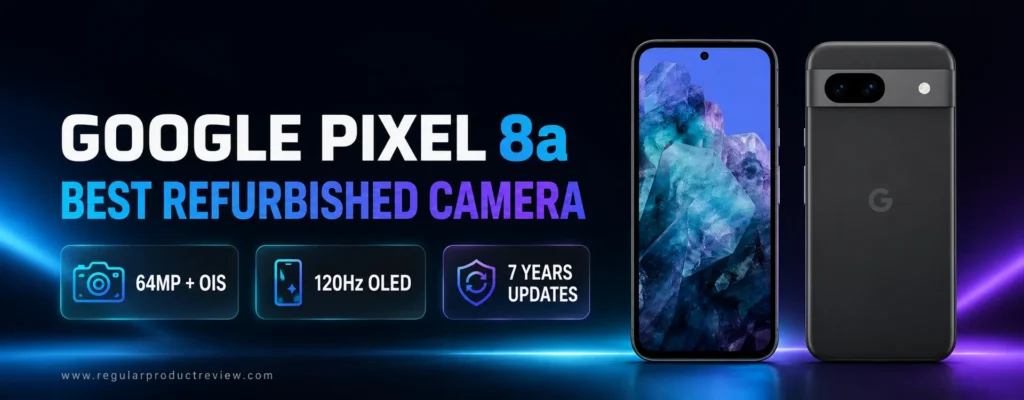
This is not a recommendation to buy an inaccurately described marketplace device. Google’s own refurbished price may remain above the limit, while third-party market prices vary by storage, color, cosmetic grade, carrier status, and seller. In August 2026, secondary-market trackers showed starting prices near the low $200s, making sub-$250 examples plausible rather than guaranteed.
Google Pixel 8a Key Specifications
| Specification | Google Pixel 8a |
|---|---|
| Display | 6.1-inch FHD+ OLED, up to 120Hz |
| Processor | Google Tensor G3 with Titan M2 security chip |
| Memory and storage | 8GB RAM, 128GB or 256GB storage |
| Rear cameras | 64MP wide with OIS, 13MP ultrawide |
| Front camera | 13MP ultrawide |
| Battery | 4,492mAh typical capacity |
| Charging | Wired charging plus Qi wireless charging |
| Durability | IP67 dust and water resistance |
| Software support | Seven years of OS, security, and Feature Drop updates from launch |
| Purchase type in this guide | Refurbished or pre-owned, unlocked |
Google’s official specifications list a 6.1-inch Actua OLED display with 1080 × 2400 resolution and Smooth Display up to 120Hz. It is smaller than every new Android phone in this ranking, making one-handed use easier. Gorilla Glass 3 is older than the glass on many premium devices, so a case and screen protector remain prudent.
The Tensor G3 is substantially more capable than entry-level chips for photo processing, speech recognition, security, and machine-learning features. It is not the coolest or most efficient gaming processor, and sustained demanding play can generate heat. For ordinary use, 8GB of physical RAM and Google’s clean interface provide better app retention and responsiveness than most new sub-$250 models.
Photography is the defining advantage. The 64MP main camera has OIS, the 13MP ultrawide is genuinely useful, and Google’s HDR processing handles bright skies, shaded faces, and mixed indoor lighting well. Features such as Night Sight, Magic Eraser, Photo Unblur, Best Take, and Real Tone can improve difficult shots, though automated edits should be reviewed rather than assumed perfect.
Video quality, stabilization, autofocus, and audio capture are also more dependable than on most budget-first handsets. The Pixel does not offer a telephoto camera, and digital zoom cannot replace optical reach. Even so, a healthy Pixel 8a is the best choice here for parents, travelers, creators on a small budget, and anyone who wants reliable point-and-shoot results.
The refurbished condition changes the battery discussion. A 4,492mAh battery was adequate when new, but age, heat exposure, fast-charge habits, and cycle count affect current capacity. Google states that Pixel 8a batteries are designed to retain up to 80 percent capacity for about 1,000 charge cycles under appropriate conditions. That is a design target, not proof of the battery in a particular used phone.
Refurbished Pixel 8a Buying Checklist
- Confirm the phone is carrier-unlocked and the IMEI is clean.
- Require at least a 30-day return window; 90 days is better.
- Prefer a seller warranty of six months or longer.
- Ask whether the battery was tested or replaced and what standard was used.
- Inspect the USB-C port, cameras, microphone, speakers, display, fingerprint reader, Wi-Fi, Bluetooth, and cellular radio immediately.
- Confirm there is no persistent device-management enrollment or account lock.
- Avoid listings that use only stock photographs and vague condition labels.
Google Pixel 8a Pros and Cons
| Pros | Cons |
|---|---|
| Best camera processing in this guide | Sub-$250 pricing generally requires refurbished condition |
| Compact 120Hz OLED display | Battery health varies by unit |
| 8GB RAM and strong Tensor G3 performance | No microSD card slot |
| Long remaining update runway | Tensor can run warm under sustained load |
| IP67 and wireless charging | Repair history may be unknown |
| Excellent voice and photo software features | Charger is not included with many listings |
Use Google’s official Pixel hardware specification page for model details and a market tracker such as Swappa’s Pixel 8a price page to judge whether a listing is realistic. Photography-focused buyers can continue with our best camera phones of 2026 and camera phones under $500.
Editorial Insight: A refurbished flagship is not automatically better value than a new budget phone. The Pixel wins on camera and processing only when condition, battery, unlock status, warranty, and seller quality are all acceptable.
Buy it if: Camera reliability, compact size, clean Android, and long support outweigh the comfort of buying new.
Skip it if: You need expandable storage, a guaranteed fresh battery, or simple walk-in warranty service.
Price Alert: Pay $250 or less for an unlocked 128GB unit with a meaningful return policy. Never sacrifice seller protection to save ten dollars.
Apple iPhone 13 Refurbished Review: Best iPhone Under $250
Editorial Score: 8.5/10
Award: 🍎 Best Refurbished iPhone for Everyday Use
The Apple iPhone 13 is the strongest iOS option that can realistically reach this guide’s price limit through the refurbished market. Its A15 Bionic processor remains responsive, the 6.1-inch OLED display is sharp, the dual-camera system produces consistent photographs and excellent video, and Apple’s ecosystem offers broad accessory, repair, and app support.
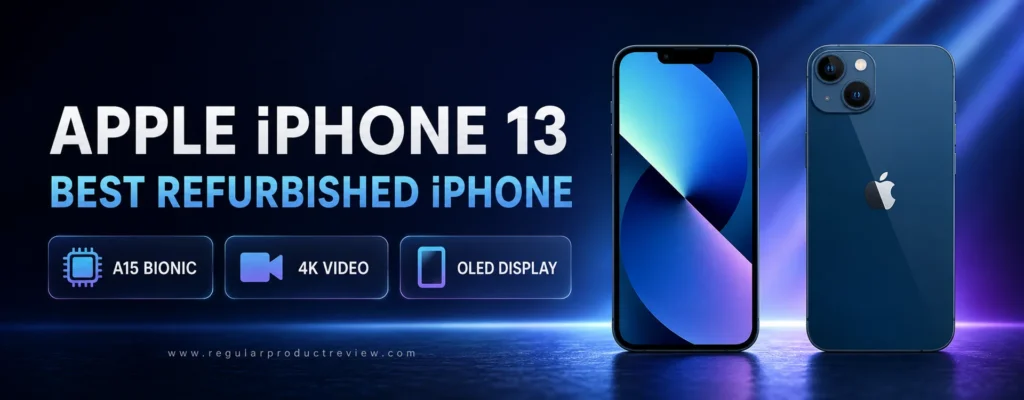
A sub-$250 iPhone 13 is not new retail inventory. Price guides and refurbishers occasionally place unlocked 128GB units around the upper edge of this budget, but condition and battery health vary. Buyers should reject any listing that hides the carrier status, storage capacity, parts history, or return policy.
Apple iPhone 13 Key Specifications
| Specification | Apple iPhone 13 |
|---|---|
| Display | 6.1-inch Super Retina XDR OLED, 2532 × 1170, 60Hz |
| Processor | Apple A15 Bionic |
| Storage | 128GB, 256GB, or 512GB; no microSD |
| Rear cameras | 12MP wide with sensor-shift OIS, 12MP ultrawide |
| Front camera | 12MP TrueDepth |
| Video | Up to 4K at 60fps with Dolby Vision HDR |
| Durability | IP68 rating when intact; prior repairs can affect sealing |
| Charging | Lightning, Qi wireless charging, MagSafe support |
| Weight | 174g |
| Purchase type in this guide | Refurbished or pre-owned, preferably unlocked |
The 6.1-inch OLED panel remains attractive for photographs, video, reading, and messaging. Its limitation is a 60Hz refresh rate, so animations do not look as fluid as on 90Hz or 120Hz Android competitors. Touch response and color management are still polished, and the compact width is easier to handle than the large 6.7-inch budget devices.
Apple’s A15 Bionic gives the iPhone 13 substantial performance headroom. It handles productivity, social media, photography, editing, games, and multitasking with more confidence than entry-level Android processors. Performance can be reduced by heat or a degraded battery, so a short functional test is important.
The camera system is a major strength. Both rear lenses are useful, the main camera includes sensor-shift stabilization, and Apple’s video capture remains particularly consistent. Skin tones, autofocus transitions, microphone quality, and stabilization are dependable for family clips and social production. Night mode works on both rear cameras, although the phone lacks a telephoto lens and newer computational features found on current flagships.
Battery condition is the decisive variable. In iOS, open Settings, Battery, then Battery Health & Charging. We prefer at least 85 percent maximum capacity for a purchase near $250. A lower reading is not automatically unsafe, but a future battery replacement should be included in the total cost. Also check Settings, General, About for an “Unknown Part” or parts-and-service message.
Apple’s Activation Lock must be disabled before ownership transfers. The seller should erase the device and remove it from their Apple Account. Never pay for a phone that still displays another person’s account during setup. Verify the IMEI is not financed, lost, stolen, or blocked and confirm the carrier-lock field says “No SIM restrictions” if you need an unlocked phone.
Refurbished iPhone 13 Buying Checklist
- Confirm 128GB or greater storage and the exact model identifier.
- Prefer at least 85 percent battery health or budget for replacement.
- Verify Activation Lock is off and setup reaches the normal welcome screen.
- Check for display discoloration, touch dead zones, camera shake, and microphone problems.
- Review Parts and Service History for non-genuine or unknown components.
- Test Face ID, speakers, Lightning port, Wi-Fi, Bluetooth, cellular service, and MagSafe.
- Require a written return window and seller warranty.
Apple iPhone 13 Pros and Cons
| Pros | Cons |
|---|---|
| Fast A15 Bionic processor | Under-$250 units are refurbished or used |
| Consistent cameras and excellent video | Battery health varies |
| Sharp, compact OLED display | 60Hz refresh rate |
| Strong accessory and repair ecosystem | Lightning instead of USB-C |
| IP68 design when seals are intact | No expandable storage |
| Long app compatibility and resale appeal | Unknown repair history can create risk |
Apple maintains the official iPhone 13 technical specifications, while a refurbisher price guide such as Back Market’s iPhone 13 pricing page can provide market context. Compare it with our Apple iPhone hub and best iPhone for most people before deciding whether an older model meets your needs.
Expert Recommendation: At the same $250 price, choose the iPhone 13 for iOS, video, ecosystem integration, and compact performance. Choose the new Galaxy A17 for a fresh battery, microSD support, 90Hz display, and simpler warranty coverage.
Buy it if: You want iOS, excellent video, strong performance, and a compact design at the lowest realistic cost.
Skip it if: You dislike battery uncertainty, need USB-C or microSD, or want a new-device warranty.
Price Alert: Pay $250 or less for an unlocked 128GB unit with acceptable battery health and a documented return policy.
How to Choose the Best Phone Under $250: Complete 2026 Buying Guide
The right phone under $250 is not necessarily the model with the longest specification list. It is the one whose strengths match your daily workload and whose weaknesses you can live with for the intended ownership period. This section turns the comparison into a repeatable buying process.
Step 1: Define the Total Budget, Not the Advertised Price
Start with the amount that leaves your account during the first month. Include the phone, tax, activation fee, required service, charger, case, screen protector, shipping, and any mandatory insurance. If a carrier requires three months of service before unlocking, compare that total with the cost of an unlocked handset and your preferred plan.
Trade-in credits deserve similar scrutiny. A $100 credit for a working phone is not free money if that device could be sold elsewhere or kept as a backup. Monthly bill credits can also disappear when service is canceled early. For this guide, a phone qualifies only when its direct device cost is $250 or less without relying on a trade-in.
Money-Saving Insight: A $150 phone on a $60 plan costs more after one year than a $250 unlocked phone on a comparable $30 plan. Service price can matter more than handset price.
Our budget phone category organizes options by use case, while the best budget phones under $200 guide can help buyers who want room in the budget for accessories.
Step 2: Match the Phone to Your Workload
| User Type | Minimum Priority | Best Match in This Guide |
|---|---|---|
| General everyday user | Reliable updates, 128GB, good display | Samsung Galaxy A17 5G |
| Heavy multitasker | 8GB or more physical RAM | NUU B30 Pro 5G |
| Long-form reader | FHD+ matte display | TCL 60 XE NXTPAPER 5G |
| Battery-first commuter | 5,200mAh and practical charging | Motorola Moto G (2026) |
| Mobile photographer | OIS and strong image processing | Refurbished Google Pixel 8a |
| iOS user | Healthy battery and unlocked status | Refurbished iPhone 13 |
| Basic prepaid user | Low total cost and good coverage | TCL K32 5G |
| Media collector | 256GB or microSD expansion | BLU Bold K50 or NUU B30 Pro |
If the phone is for banking, authentication, work email, or medical portals, prioritize security updates over camera extras. If it is a secondary travel device, network compatibility and battery endurance may dominate. For a child or student, repair cost, case availability, parental controls, and replacement risk can matter more than peak performance.
Step 3: Understand Processors Without Chasing Benchmarks
Processor names can be confusing because a newer entry-level chip may not beat an older flagship. The Pixel 8a’s Tensor G3 and iPhone 13’s A15 Bionic provide the most processing headroom in this list, but both are refurbished at this price. Among new devices, the NUU B30 Pro’s higher-tier MediaTek platform and generous RAM make it attractive for multitasking, while Dimensity 6300 phones provide efficient basic 5G performance.
Synthetic scores are useful only when interpreted with memory, storage speed, cooling, and software. A phone can score well for a short test and slow during a long game. Another can have a modest chip but feel smooth because its software is light and its storage has space available.
For normal use in 2026, expect an under-$250 phone to handle messaging, HD streaming, maps, email, banking, video calls, and casual games. Do not expect sustained flagship gaming, rapid 4K editing, desktop-class multitasking, or years of unchanged speed.
Step 4: Treat Physical RAM and Virtual RAM Differently
Four gigabytes of physical RAM supports focused use but can reload apps frequently. Eight gigabytes is a comfortable target, and twelve gigabytes is exceptional at this price. Virtual RAM uses internal storage as overflow and is much slower. Marketing such as “4GB + 8GB RAM Boost” describes 4GB of real memory, not 12GB of equal-performance RAM.
The operating system also matters. iOS manages memory differently from Android, so comparing RAM numbers across platforms is not meaningful by itself. Evaluate how the device performs in the apps you actually use.
Step 5: Buy Enough Internal Storage
Android and iOS consume a portion of advertised storage before personal files are added. App caches, offline maps, downloaded music, message attachments, and system updates can fill a 64GB phone quickly. For a primary device, 128GB is the sensible baseline. Choose 256GB if you record video, install large games, or keep years of media locally.
MicroSD support is valuable for photos, music, documents, and video. It does not fully replace internal storage because many applications, security-sensitive files, and system components remain internal. Use a reputable card with an appropriate speed rating, back up important files, and avoid counterfeit high-capacity cards.
Step 6: Choose the Right Display Technology
OLED and AMOLED screens illuminate pixels individually, producing deep blacks and strong contrast. LCD panels use a backlight and can still look good, particularly when color tuning and brightness are competent. Resolution determines fine detail, while refresh rate determines how often the image updates.
A 120Hz HD+ screen may scroll more smoothly than a 60Hz Full HD+ screen, but the Full HD+ panel renders text more sharply. Battery consumption increases with brightness and refresh rate. Adaptive or 90Hz modes often provide the best balance.
The TCL NXTPAPER display is a special case. Its matte finish and reading modes reduce glare and visual stimulation, but users who prefer saturated video may favor AMOLED. There is no universal winner; select for the environment where you spend the most screen time.
Step 7: Evaluate Cameras by Useful Features
Megapixels describe resolution, not complete image quality. Sensor area, lens aperture, autofocus, optical stabilization, shutter speed, HDR processing, color science, and software determine whether a camera produces a good photograph. A stable 12MP or 50MP camera can outperform an unstable 108MP system in difficult light.
Optical image stabilization is especially valuable for indoor photos and video. An ultrawide camera is more useful than a low-resolution macro or depth sensor for most people. Telephoto cameras are rare below $250. Digital zoom crops the main image and loses detail.
For parents, pets, and moving subjects, autofocus and processing speed matter more than maximum resolution. The refurbished Pixel 8a is the strongest still-camera choice, while the iPhone 13 is excellent for video. Among new phones, the Galaxy A17’s OIS gives it an important advantage.
Photography-first shoppers should compare our camera phone hub and best camera phones under $1,000 to understand what optical zoom, larger sensors, and higher-end stabilization add.
Step 8: Estimate Real Battery Life
Battery capacity is measured in milliamp-hours, but a larger number does not guarantee longer runtime. Display size, resolution, refresh rate, signal strength, processor efficiency, temperature, background syncing, and application behavior all matter. A 5,000mAh phone on weak 5G can drain faster than a smaller device on stable Wi-Fi.
Charging wattage is a maximum, not a constant rate. Phones reduce power as the battery fills and when temperature rises. A compatible adapter and cable are required, and some manufacturers do not include the adapter. Wireless charging is uncommon in new phones under $250; the refurbished Pixel and iPhone are the exceptions in this guide.
For refurbished devices, battery health is part of the purchase price. An inexpensive phone that immediately needs a replacement battery is not truly inexpensive. Prefer sellers that state a minimum capacity and provide a meaningful warranty.
Step 9: Check US Carrier Compatibility Before Opening Accessories
US networks use a mix of low-band, mid-band, and high-band frequencies. A phone may connect to 5G while missing the band that provides the best coverage in your area. Carrier certification also affects Wi-Fi Calling, emergency features, visual voicemail, hotspot behavior, and activation.
Use the carrier’s IMEI checker whenever possible. For a new unlocked device without an available IMEI, compare the exact US model number with the carrier’s supported-device list. Do not rely on a listing that says only “global unlocked.” International variants may lack US bands, eSIM behavior, warranty coverage, or emergency-call certification.
MVNOs run on larger host networks but can use different activation rules and data-priority policies. Ask the MVNO which model numbers it supports rather than assuming compatibility from the host carrier alone.
Step 10: Read the Software-Update Promise
An update policy has two components: major operating-system upgrades and security patches. Major upgrades add platform features and compatibility changes. Security updates address vulnerabilities. A phone with fewer Android upgrades but regular security patches can remain useful, while an abandoned device becomes a poor place for sensitive accounts.
Samsung’s six-generation commitment makes the Galaxy A17 and A16 standouts. Google’s seven-year Pixel policy gives a refurbished Pixel 8a a long remaining runway from its 2024 launch. Apple does not publish an identical year count for every iPhone, but its older devices generally receive broad app and operating-system support; buyers should still evaluate the remaining life rather than assuming indefinite updates.
Smaller brands can offer exceptional hardware but less predictable major-version support. If you replace phones every two years, that compromise may be acceptable. If you plan to keep the device for five years, documented support deserves greater weight.
Step 11: Inspect Durability and Repairability
An IP rating describes controlled dust and water testing, not permanent waterproofing. IP54 protects against limited dust ingress and splashes; IP67 and IP68 provide stronger immersion resistance under specified laboratory conditions. Water resistance can decline after impact, aging, or repair, and liquid damage may not be covered by warranty.
A case protects corners and camera lenses, while a screen protector reduces scratch risk. Before buying, check whether reputable cases and replacement screens are actually available. A lesser-known phone can be inexpensive initially and costly to repair if parts are scarce.
For refurbished devices, assume factory seals may have been disturbed unless the refurbisher documents resealing and testing. Do not deliberately expose any used phone to water.
Step 12: Avoid Common Budget-Phone Traps
- Do not count virtual RAM as physical RAM.
- Do not assume “unlocked” means full compatibility with every US carrier.
- Do not buy a 64GB phone without planning storage management.
- Do not treat a 2MP macro or depth sensor as a premium camera.
- Do not compare a carrier promotional price with an unlocked price before adding plan costs.
- Do not assume a refurbished battery is new.
- Do not buy an international model solely because the price is lower.
- Do not ignore the return window while testing cellular activation and camera functions.
- Do not expect a charger in every box.
- Do not pay above $250 merely because a listing was included in this guide at an earlier price.
Learn More: A 15-minute phone inspection routine
After setup, place a call, send a text, load a webpage on cellular data, connect to Wi-Fi and Bluetooth, test every camera, record and replay audio, play sound through both speaker channels, charge through the port, inspect the screen at low brightness, and verify the fingerprint or face unlock. Check storage, model number, carrier status, software-update page, and warranty registration. Complete these tests before discarding packaging or missing the return deadline.
Buyers who can increase their ceiling should compare the best premium smartphones worth buying in 2026 and the best flagship phones of 2026. Those categories add stronger cameras, faster chips, better water resistance, and longer high-performance life, but they are unnecessary for many everyday users.
Budget Phone FAQ: Answers Before You Spend $250
These answers address the questions that most often create expensive mistakes in the affordable smartphone market. Product prices, carrier promotions, and software policies can change, so verify the exact listing and model number at checkout.
1. What is the best budget phone under $250 in 2026?
The Samsung Galaxy A17 5G is the best overall new phone under $250 for most US buyers. Its Full HD+ AMOLED display, 50MP main camera with OIS, 128GB storage, microSD expansion, 5,000mAh battery, and six-generation update commitment create the most balanced package.
The answer changes by priority. The refurbished Pixel 8a has the best camera, the NUU B30 Pro has the most RAM and storage, the TCL 60 XE NXTPAPER is best for reading, and the Moto G (2026) emphasizes battery capacity and smooth scrolling.
2. Can a phone under $250 last three or four years?
Yes, if it has a documented update policy, enough storage, a healthy battery, and performance suited to your workload. The Galaxy A17 and A16 have unusually long support commitments for the price. A refurbished Pixel 8a also has substantial update life remaining from its 2024 launch.
Physical wear, storage pressure, battery aging, and increasingly demanding apps can affect usable life before official support ends. A case, reasonable charging habits, free storage space, and prompt security updates improve the odds of reaching four years.
3. Is 4GB of RAM enough for an Android phone in 2026?
Four gigabytes is enough for focused basic use: messaging, calls, maps, music, banking, one or two browser tabs, and light video. It is not comfortable for aggressive multitasking. Apps may reload when switching, and large games can leave little memory for background services.
Six or eight gigabytes is a better target for a primary phone. The TCL NXTPAPER and BLU Bold K50 provide 8GB of physical memory, while the NUU B30 Pro offers 12GB. Ignore marketing that adds virtual RAM to physical RAM as if both were equal.
4. Is 64GB of storage still usable?
It is usable for a light user who streams media, installs relatively few apps, and moves photographs to a microSD card or cloud service. It is restrictive for games, offline video, long-term photo libraries, and heavy messaging attachments. System files and updates consume part of the advertised capacity.
For a primary phone, 128GB is the preferred minimum. If you choose the 64GB Moto G Play or TCL K32, add a reputable microSD card for media and keep several gigabytes of internal space free.
5. Do I need 5G on a budget phone?
You do not need 5G for calls, messages, music, navigation, or HD video, but a 5G-capable phone is sensible for a multi-year purchase because carriers continue shifting network capacity. Low-band 5G often improves coverage consistency, while mid-band can deliver much faster data in supported areas.
The label alone is not enough. The phone must support the relevant bands and carrier certification. A strong LTE connection can be more useful than weak or incompatible 5G.
6. Which phone under $250 has the best camera?
A reputable refurbished Google Pixel 8a provides the strongest still-camera experience, thanks to OIS, capable sensors, fast HDR processing, Night Sight, and Google’s computational photography. The refurbished iPhone 13 is particularly strong for video.
Among new phones, the Galaxy A17 5G is the best balanced camera choice because its main sensor includes OIS and its 5MP ultrawide adds a useful perspective. Remember that lighting and technique can matter more than megapixel count.
7. Which affordable phone has the best battery life?
The Moto G (2026) and Moto G Play (2026) have the largest listed capacities in this guide at 5,200mAh. Their efficient processors and HD+ screens can support strong endurance. The TCL, Samsung, NUU, and BLU models also sit around 5,000mAh.
There is no universal runtime winner without controlled testing. Signal strength, refresh rate, brightness, applications, background synchronization, temperature, and battery health can change results substantially.
8. Which phone is best for students?
The Galaxy A17 is the strongest general student option because it combines a readable Full HD+ screen, long updates, 128GB storage, microSD support, and mainstream service availability. The TCL 60 XE NXTPAPER is better for students who spend hours reading PDFs and online articles, while the NUU B30 Pro suits heavier multitasking and offline storage.
Students on a tighter budget can compare our best Android phones for students in 2026 and best iPhone for students for platform-specific guidance.
9. Are prepaid carrier phone deals worth it?
They can be excellent when the carrier offers good coverage and you already want its plan. They are less attractive when activation fees, premium plan requirements, slow unlock eligibility, or poor local coverage erase the handset savings.
Compare the total over the period you must keep service. Read the carrier’s written unlock policy and retain proof of purchase. A carrier deal should be treated as a service bundle, not a simple phone price.
10. What does “unlocked” really mean?
An unlocked phone is not software-restricted to one carrier. It does not automatically support every US frequency band or carrier-specific feature. A global unlocked model may connect to basic LTE while lacking optimal 5G, Wi-Fi Calling, visual voicemail, or emergency features.
Check the exact model number and use the carrier’s IMEI compatibility tool. If an online seller cannot identify the regional model, the discount is not worth the uncertainty.
11. Is a refurbished flagship better than a new budget phone?
A refurbished flagship usually offers a faster processor, better cameras, stronger materials, and premium features such as wireless charging. A new budget phone offers a fresh battery, clearer warranty, known ownership history, and often expandable storage.
Choose refurbished when you can evaluate seller reputation, battery standard, repair history, return policy, and unlock status. Choose new when reliability and predictable support are more valuable than peak performance.
12. What battery health is acceptable on a refurbished phone?
For an iPhone priced near $250, we prefer at least 85 percent maximum capacity. Some refurbishers guarantee 80 percent, which can be functional but provides less reserve. Android phones do not always expose a comparable percentage, so ask what diagnostic standard the seller uses.
Include the cost of a battery replacement in the decision. A $225 phone that soon needs a $90 service is effectively a $315 purchase.
13. Is AMOLED better than LCD?
AMOLED provides deeper blacks, stronger contrast, and potential power savings with dark content. LCD can offer natural color, avoid some low-brightness flicker concerns, and cost less. Panel quality varies, so technology alone does not determine brightness, accuracy, or durability.
For video and dark-mode use, the Galaxy, NUU, and BLU AMOLED panels are attractive. For extended reading under reflective light, TCL’s matte NXTPAPER LCD may be more comfortable.
14. Is a 120Hz screen important on a cheap phone?
A 120Hz screen makes scrolling and supported animation look smoother. It does not improve processor speed, camera quality, network performance, or the frame rate of a game the chipset cannot render. High refresh can also use more battery.
Choose Full HD+ resolution first if you read fine text, then consider refresh rate. A well-tuned 90Hz AMOLED panel can provide a better overall experience than a soft 120Hz HD+ LCD.
15. Does a 108MP camera beat a 50MP camera?
Not necessarily. Most high-resolution phone sensors combine neighboring pixels for a smaller final image. Sensor size, lens quality, stabilization, autofocus, processing, and shutter behavior determine the result. A 50MP camera with OIS and mature HDR can outperform an unstable 108MP camera at night.
Use megapixels as one specification, not a quality score. Compare full-resolution samples only after checking focus consistency and processing.
16. Do any phones under $250 support wireless charging?
Wireless charging is rare on new phones in this price class. The refurbished Pixel 8a supports Qi charging, while the refurbished iPhone 13 supports Qi and MagSafe. The new Samsung A-series, Motorola, TCL, NUU, and BLU models in this guide rely on wired charging.
Wireless charging adds convenience but generates more heat and is usually slower. It should not outweigh battery health, update support, or storage capacity for most budget buyers.
17. Which phone is best for gaming below $250?
The refurbished iPhone 13 has the strongest raw gaming processor here, followed by the refurbished Pixel 8a for many Android titles. Among new phones, the NUU B30 Pro combines capable processing, 12GB RAM, and a 120Hz AMOLED screen. Game compatibility and thermal behavior still vary.
Players interested in sustained performance should review our gaming phone category and best gaming phones under $500. A dedicated gaming phone can add better cooling, touch controls, and faster charging.
18. Should I buy an international phone model?
Usually not for a primary US line unless you have verified every relevant band, certification, warranty term, and software feature. International variants can be cheaper or include more memory, but they may lack carrier aggregation, eSIM support, Wi-Fi Calling, emergency features, or official repair coverage.
A seller’s claim that a phone “works in the USA” may refer only to basic calls and data. The exact US model is the safer choice.
19. When should I spend more than $250?
Increase the budget if you need a telephoto camera, high-end gaming, faster sustained performance, better water resistance, desktop-style video output, premium haptics, or a longer usable life without performance frustration. The $300-to-$500 range often adds 6GB to 8GB of RAM, stronger processors, brighter displays, and more reliable cameras.
Compare our best camera phones under $500 and best Android phones under $500 before increasing the budget. Spend more only when the upgrade solves a specific need.
20. What should I do immediately after buying a budget phone?
Install all system and security updates, set a strong PIN, enable biometric access, activate device-finding tools, configure cloud or local backups, review app permissions, and add emergency information. Test calls, messages, cellular data, Wi-Fi, Bluetooth, cameras, microphone, speakers, charging, NFC, and navigation during the return window.
Register the warranty, save the receipt, photograph the device condition, and record the IMEI somewhere secure. Add a case and screen protector before daily use.
Final Verdict: The Best Budget Phone Under $250 for Every Buyer
The Samsung Galaxy A17 5G is our top recommendation for most people shopping below $250 in 2026. It does not have the largest RAM capacity, fastest charging, or most advanced camera processor, but its Full HD+ AMOLED display, stabilized main camera, expandable storage, durable everyday design, mainstream support network, and six-generation software promise form the most complete new-phone package.
The Motorola Moto G (2026) takes second place when discounted below the limit. Its 5,200mAh battery, 30W charging, smooth display, and comfortable software make it an appealing daily driver. Its HD+ resolution, 4GB memory, and changing price prevent it from replacing Samsung at the top.
The TCL 60 XE NXTPAPER 5G is the smartest specialist choice. Readers, students, commuters, and users sensitive to glare receive a genuinely different screen experience, along with 8GB of physical RAM and expandable storage. It is less compelling for shoppers who simply want cinematic AMOLED contrast.
The NUU B30 Pro 5G wins the specification contest with 12GB RAM, 256GB storage, a 120Hz AMOLED display, and a 108MP main camera. It is the right choice for a technically confident buyer who accepts a smaller support ecosystem in exchange for more immediate hardware.
The discounted Samsung Galaxy A16 5G remains the sensible longevity pick below $200. The Moto G Play (2026) covers straightforward prepaid use, and the TCL K32 5G is the most economical route to essential 5G functions. The BLU Bold K50 5G appeals to display and storage enthusiasts willing to verify carrier support carefully.
Refurbished buyers have two excellent alternatives. The Google Pixel 8a offers the strongest still-camera system and long software runway, while the Apple iPhone 13 combines responsive performance, polished video, and iOS ecosystem access. Neither should be purchased without a clean IMEI, acceptable battery condition, an unlocked status, and a meaningful return policy.
Our Final Top 10 Ranking
| Position | Product | Final Recommendation | Ideal Buyer |
|---|---|---|---|
| 1 | Samsung Galaxy A17 5G | Best overall new phone | Most shoppers |
| 2 | Motorola Moto G (2026) | Best battery-focused alternative | Commuters and streamers |
| 3 | TCL 60 XE NXTPAPER 5G | Best reading display | Students and readers |
| 4 | NUU B30 Pro 5G | Best RAM and storage | Multitaskers |
| 5 | Samsung Galaxy A16 5G | Best discounted support value | Long-term budget users |
| 6 | Motorola Moto G Play (2026) | Best basic prepaid Motorola | Light users |
| 7 | TCL K32 5G | Best ultra-cheap 5G phone | Backup and first-phone buyers |
| 8 | BLU Bold K50 5G | Best independent-brand AMOLED | Media collectors |
| 9 | Google Pixel 8a refurbished | Best camera | Photography-first buyers |
| 10 | Apple iPhone 13 refurbished | Best iOS choice | Budget Apple users |
The numerical order reflects overall purchasing confidence for a general US buyer, not raw capability. The Pixel 8a and iPhone 13 would rank higher on camera and processing power, but refurbished condition introduces battery, repair, and seller variables that new phones avoid.
Best Pick by Priority
| Your Main Priority | Choose This Phone | Why |
|---|---|---|
| Safest overall purchase | Samsung Galaxy A17 5G | Balanced hardware and long support |
| Maximum physical RAM | NUU B30 Pro 5G | 12GB RAM and 256GB storage |
| Reading comfort | TCL 60 XE NXTPAPER 5G | Matte display and paper modes |
| Battery-first use | Motorola Moto G (2026) | 5,200mAh and 30W charging |
| New phone below $200 | Samsung Galaxy A16 5G | AMOLED and extended updates |
| Lowest basic 5G cost | TCL K32 5G | Essential features around $120 to $140 |
| Best refurbished photos | Google Pixel 8a | OIS and Google image processing |
| Best refurbished video | Apple iPhone 13 | Stable 4K capture and mature processing |
Final Expert Recommendation: Buy the Samsung Galaxy A17 5G at $250 or less if you want the fewest compromises. Choose a specialist only when its defining advantage Pixel photography, NXTPAPER reading, NUU multitasking, Motorola battery, or iPhone video directly matches your daily use.
Before checkout, revisit our best budget Android phones for everyday use for broader Android context or compare the best flagship phones of 2026 to see which premium features you would actually gain by spending more. Buyers considering Apple should review our best iPhones of 2026 before selecting an older refurbished model.
The most important final step is simple: verify the exact model, condition, carrier compatibility, warranty, return window, and current price. A phone that met this guide’s limit during our August 2026 check may move above it tomorrow. When that happens, keep the $250 ceiling and choose the next best option instead of overpaying for yesterday’s recommendation.