

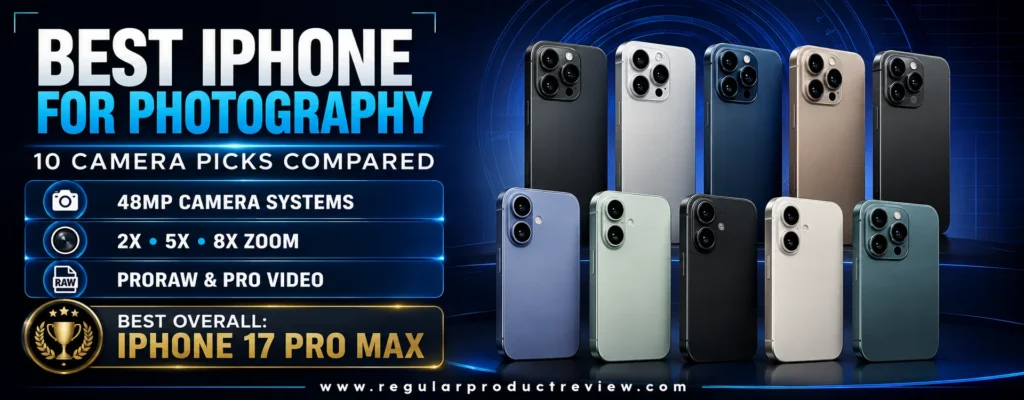
Best iPhone for Photography — The Complete Camera Shortlist
The best iPhone for photography is not automatically the most expensive model. The right choice depends on what you photograph, how much equipment you want to carry, whether you edit RAW files, and how often you use optical zoom. A parent documenting family life needs fast, dependable results. A travel photographer may prioritize a lighter body and useful focal lengths. A creator producing paid work may need ProRAW, Log video, high-capacity storage, and reliable external recording.
Apple’s current range makes that decision more nuanced than it first appears. The iPhone 17 Pro and iPhone 17 Pro Max offer the most complete camera systems, including three 48MP rear cameras, an optical-quality 8x option, ProRAW, ProRes RAW, Apple Log 2, and sophisticated stabilization. The regular iPhone 17 delivers a capable 48MP Main and 48MP Ultra Wide system for substantially less. The thin iPhone Air places portability ahead of lens variety, while the iPhone 17e focuses on a strong single-camera experience at the lowest new-iPhone price in this guide.
Older Pro models remain relevant when bought carefully. The iPhone 16 Pro and 16 Pro Max still provide 48MP Main and Ultra Wide cameras, a 5x Telephoto, ProRAW, and 4K Dolby Vision recording at up to 120 fps. The iPhone 15 Pro Max introduced Apple’s 5x tetraprism camera, while the smaller iPhone 15 Pro retains a useful 3x lens for portraits. These models no longer represent Apple’s newest direct-sale Pro lineup, so their condition, battery health, warranty, and actual discount matter as much as their camera specifications.
This guide treats an iPhone as a photographic tool, not a status symbol. If you want to compare Apple’s full ecosystem before narrowing the camera choice, visit our Apple iPhone buying hub. Readers who are open to other platforms should also examine our best camera phones guide for a broader view of zoom hardware, computational processing, and manual controls.
📸 Editorial Insight: Camera quality is a system, not a megapixel contest. Lens selection, sensor size, stabilization, image processing, capture speed, file formats, battery life, storage, and ergonomics all affect whether a phone helps you make better photographs.
Quick Summary: Our 10 Photography Picks
The iPhone 17 Pro Max is our best overall choice because it combines Apple’s strongest camera array with the largest screen, longest Pro-model battery rating, and up to 2TB of storage. Choose the smaller iPhone 17 Pro if you want essentially the same rear-camera capability in a body that is easier to handle for street photography and long shooting sessions.
The regular iPhone 17 is the most balanced recommendation for many people. Its dual 48MP rear system covers wide, 2x, Ultra Wide, and macro work without the Pro models’ price or weight. The iPhone Air is a specialist travel pick for photographers who prize an extremely thin, light device and can live without an Ultra Wide or dedicated Telephoto. The iPhone 17e is the sensible entry point for simple 1x and 2x photography when buying new.
For discount hunters, the iPhone 16 Pro Max and iPhone 16 Pro deliver serious hybrid photo-video features, provided the price is meaningfully below the current 17 Pro family. The iPhone 15 Pro Max remains attractive for refurbished 5x photography, and the iPhone 15 Pro is a compact 3x portrait option. The iPhone 16 Plus completes the list as a large-screen, long-endurance everyday camera with Ultra Wide and macro capability.
Smart Comparison Table
| Rank | iPhone | Photography Award | Rear Camera Reach | ProRAW | Best Buying Route | Editor Rating |
|---|---|---|---|---|---|---|
| 1 | iPhone 17 Pro Max | 🏆 Best Overall | 13mm to 200mm optical-quality options | Yes | New from Apple or authorized retailer | 9.7/10 |
| 2 | iPhone 17 Pro | 🎒 Best Compact Pro | 13mm to 200mm optical-quality options | Yes | New from Apple or authorized retailer | 9.6/10 |
| 3 | iPhone 17 | ⭐ Best for Most Photographers | 13mm, 26mm, and 52mm options | No | New from Apple or authorized retailer | 9.1/10 |
| 4 | iPhone Air | ✈️ Best Lightweight Travel Pick | 26mm and 52mm options | No | New from Apple or authorized retailer | 8.5/10 |
| 5 | iPhone 17e | 💰 Best Affordable New iPhone | 26mm and 52mm options | No | New from Apple or authorized retailer | 8.3/10 |
| 6 | iPhone 16 Pro Max | 🎬 Best Previous-Gen Pro Max Value | 13mm to 120mm | Yes | Certified refurbished or trusted retailer | 9.2/10 |
| 7 | iPhone 16 Pro | 🧭 Best Previous-Gen Compact Pro | 13mm to 120mm | Yes | Certified refurbished or trusted retailer | 9.1/10 |
| 8 | iPhone 15 Pro Max | 🔭 Best Refurbished 5x Value | 13mm to 120mm | Yes | Certified refurbished | 8.9/10 |
| 9 | iPhone 15 Pro | 👤 Best Refurbished 3x Portrait Pick | 13mm to 77mm | Yes | Certified refurbished | 8.7/10 |
| 10 | iPhone 16 Plus | 🔋 Best Everyday Battery Pick | 13mm, 26mm, and 52mm options | No | New clearance or certified refurbished | 8.6/10 |
Why Trust This Guide?
Our ranking is based on photography outcomes rather than launch excitement. We examined Apple’s official technical documentation for lens equivalents, aperture, stabilization, image formats, video modes, storage, display size, weight, and stated battery performance. We then mapped those capabilities to real photographic jobs such as portraits, travel, family events, low-light scenes, macro subjects, sports from the sidelines, social video, and professional post-production.
We also separate current retail status from technical merit. Apple’s current iPhone shopping page is the reference point for models sold new by Apple, while older Pro devices are evaluated as refurbished or reseller purchases. If your priority is a premium phone beyond the Apple ecosystem, our flagship phone collection explains where current high-end alternatives fit.
No phone camera behaves identically in every scene, and firmware can refine processing over time. For that reason, ratings reflect the whole ownership proposition rather than a single synthetic score. We avoid inventing lab results and clearly distinguish official specifications from editorial judgments about handling, value, and intended use.
How We Evaluated Photography Performance
| Evaluation Area | Weight | What We Looked For |
|---|---|---|
| Image quality and consistency | 25% | Detail, color, highlight handling, skin tones, and dependable auto processing |
| Lens versatility | 20% | Useful focal lengths, true optical options, Ultra Wide, macro, and Telephoto access |
| Low-light capability | 15% | Stabilization, aperture, Night mode support, and practical handheld performance |
| Video and creator tools | 15% | Dolby Vision, frame rates, Log, ProRes, external recording, audio, and stabilization |
| Handling and endurance | 10% | Weight, screen, battery, controls, and comfort during extended shooting |
| Editing flexibility | 10% | ProRAW, high-resolution capture, Photographic Styles, storage, and transfer speed |
| Price and availability | 5% | Current US price, condition risk, warranty, and value against newer options |
Our methodology favors balance. A device does not win simply because it has the longest zoom or the highest resolution. The iPhone Air, for example, has a capable 48MP Main camera and excellent portability but loses points for lacking Ultra Wide and true Telephoto lenses. The iPhone 16 Pro remains powerful, yet its value depends on a real discount because the newer 17 Pro provides a more advanced camera system.
How the Final 10 Were Selected
We began with iPhones that remain realistically obtainable in the United States through Apple, authorized retailers, carrier inventory, or reputable certified-refurbished channels. We excluded models whose camera experience or remaining support value is too compromised for a photography-first recommendation at typical prices. We also avoided filling the list with near-duplicates unless a different body size, lens, or buying route created a clear use case.
Budget is relative in Apple’s ecosystem. Shoppers seeking a much lower entry price may prefer the options in our budget phone collection, while photographers who care more about a dedicated camera than iOS integration should compare our best flagship phones for photography. Within this iPhone-only guide, every award identifies a specific reason to buy instead of merely rearranging the same specifications.
iPhone 17 Pro Max — Best Overall iPhone for Photography
Award: 🏆 Best Overall iPhone for Photography
Editor Rating: 9.7/10
Best For: Professional creators, wildlife and event shooters, long-form video, and maximum battery endurance
The iPhone 17 Pro Max is the strongest all-around camera iPhone because it combines Apple’s most versatile rear-camera system with the larger 6.9-inch display, longer stated battery life, and storage options reaching 2TB. Its three 48MP rear cameras cover the Main, Ultra Wide, and Telephoto roles, while the processing pipeline supports both dependable automatic results and files designed for serious editing.
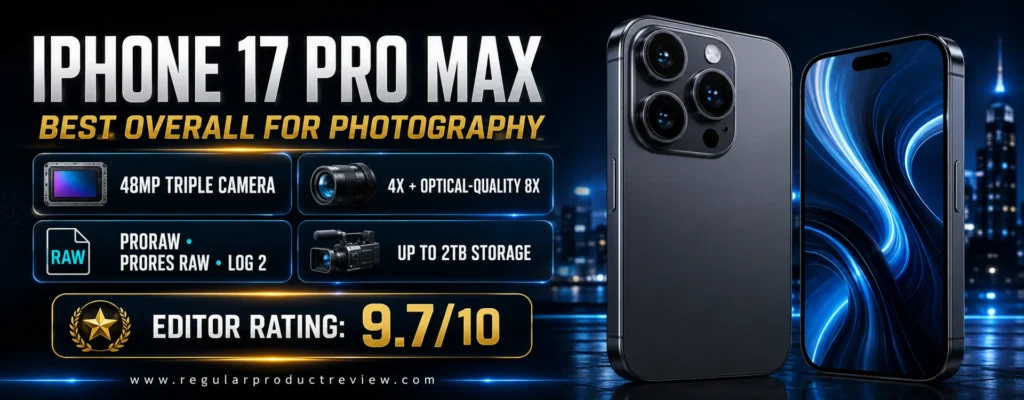
The key upgrade is not simply “more zoom.” Its 48MP Telephoto provides a native 4x perspective at 100mm and an optical-quality 8x option at 200mm. That range helps isolate architectural details, compress landscapes, frame stage performances, and photograph distant subjects without immediately falling back to aggressive digital enlargement. The Main camera also supplies 1x and optical-quality 2x framing, while the Ultra Wide handles tight interiors, dramatic foregrounds, and 48MP macro work.
For professional hybrid work, the Pro Max supports Apple ProRAW, ProRes, ProRes RAW, Apple Log 2, ACES workflows, genlock, and external recording. Those tools do not guarantee cinematic results, but they remove many technical ceilings for creators who understand exposure, storage management, color grading, and synchronized multi-camera production. Apple’s official iPhone 17 Pro specifications document the complete capture formats and recording modes.
The trade-offs are size, weight, and price. At roughly 233 grams, it is less discreet than smaller models and can become tiring on a compact stabilizer. Before paying the premium, compare it with our best iPhones overview to decide whether the larger body improves your workflow.
iPhone 17 Pro Max Camera Specifications
| Specification | Details |
|---|---|
| Main camera | 48MP, 24mm, f/1.78, second-generation sensor-shift OIS |
| Ultra Wide | 48MP, 13mm, f/2.2, 120-degree field of view, macro |
| Telephoto | 48MP, 100mm 4x, f/2.8, tetraprism stabilization and autofocus |
| Extended framing | Optical-quality 2x at 48mm and 8x at 200mm |
| Digital zoom | Up to 40x for still photos |
| Front camera | 18MP Center Stage with autofocus |
| Pro photo formats | Apple ProRAW, HEIF, JPEG, and DNG workflows |
| Pro video | ProRes RAW, Apple Log 2, ProRes, ACES, genlock, external recording |
| Storage | 256GB to 2TB |
| Display and weight | 6.9-inch OLED; approximately 233g |
Where the iPhone 17 Pro Max Excels
The large display is useful when checking focus, judging edge distractions, trimming video, and reviewing a client’s selects in the field. Its rated video playback endurance is higher than the smaller Pro, which matters when navigation, cellular uploading, Bluetooth audio, and sustained camera use compete for the same battery. The 2TB ceiling also reduces the pressure to offload large ProRes or ProRes RAW files during a demanding production day.
Portrait photographers gain several practical focal lengths. The 2x view is comfortable for environmental portraits, 4x offers stronger compression, and 8x can create striking detail studies when light is adequate and camera movement is controlled. Macro shooters receive high-resolution capture through the Ultra Wide camera, although good lighting remains important because very close subjects can cast shadows across the lens.
Limits to Understand Before Buying
An optical-quality crop is not identical to a separate full-resolution lens at every marked focal length. The 8x option draws on the center of the 48MP Telephoto sensor, so light, subject motion, and stabilization still affect detail. Digital zoom beyond that point is useful for identification or emergency framing, but it should not be treated as equivalent to optical capture. Photographers considering Android’s strongest zoom systems should review our premium smartphone guide before committing to iOS.
🎯 Expert Recommendation: Buy the iPhone 17 Pro Max when the large screen, longest Pro battery rating, 8x reach, and high-capacity storage solve real workflow problems. Choose the smaller 17 Pro if you want the same core rear-camera system with easier one-handed handling.
Verdict: This is the best iPhone camera for professionals and demanding enthusiasts, provided its bulk and price fit the assignment.
iPhone 17 Pro — Best Compact Pro Camera iPhone
Award: 🎒 Best Compact Pro Camera iPhone
Editor Rating: 9.6/10
Best For: Street photography, travel, documentary work, and creators who dislike oversized phones
The iPhone 17 Pro delivers essentially the same rear-camera toolkit as the Pro Max in a smaller 6.3-inch body. That makes it a particularly strong choice for photographers who shoot for hours, carry a second camera, or prefer a phone that disappears into a jacket pocket. The smaller device is still a premium, substantial handset, but its roughly 206-gram weight is easier to manage than the Pro Max on walks, gimbals, and compact rigs.
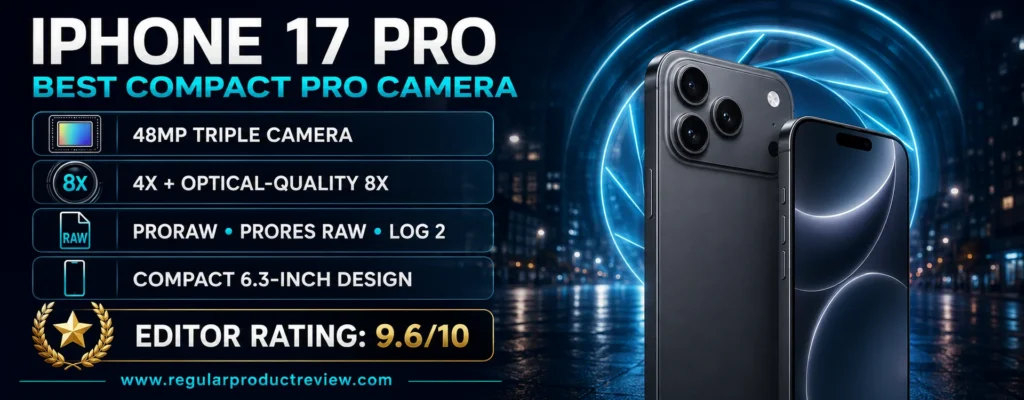
Its three 48MP cameras cover Main, Ultra Wide, and 4x Telephoto capture, with optical-quality 2x and 8x framing available from sensor crops. The result is a practical set of perspectives for food, street scenes, portraits, interiors, macro subjects, and distant details. Apple’s official iPhone 17 Pro technical specifications confirm that the smaller Pro retains the newer 200mm-equivalent option and advanced professional formats available on the Max.
Video creators receive 4K Dolby Vision at up to 120 fps on the Main camera, ProRes RAW, Apple Log 2, genlock, external recording, and four studio-quality microphones. Apple has also expanded Final Cut Camera controls for supported Pro workflows, allowing creators to work with features such as open-gate capture and timecode where applicable. These capabilities turn the phone into a credible B-camera or compact production tool, though storage media, heat, power, and audio monitoring still need planning.
The main compromise is shorter battery life than the Pro Max and a smaller screen for judging footage. If you want a lighter everyday choice without ProRAW or a long Telephoto, our best iPhone for most people guide provides useful context.
iPhone 17 Pro Camera Specifications
| Specification | Details |
|---|---|
| Main camera | 48MP, 24mm, f/1.78, second-generation sensor-shift OIS |
| Ultra Wide | 48MP, 13mm, f/2.2, 120-degree view, 48MP macro |
| Telephoto | 48MP, 100mm 4x, f/2.8, tetraprism OIS and autofocus |
| Extended framing | Optical-quality 2x at 48mm and 8x at 200mm |
| Front camera | 18MP Center Stage with autofocus |
| Photo tools | ProRAW, latest Photographic Styles, Smart HDR 5, Night mode portraits |
| Video tools | 4K120 Dolby Vision, ProRes RAW, Apple Log 2, ACES, genlock |
| Storage | 256GB to 1TB |
| Display and weight | 6.3-inch OLED; approximately 206g |
| Apple launch price | From $1,099 in the United States |
Handling Advantage for Real Photography
Smaller dimensions can improve image-making in ways a specification table cannot show. The 17 Pro is easier to hold low to the ground, raise above a crowd, or keep steady while using the on-screen shutter. It also attracts less attention than a large phone with a bulky rig, which benefits documentary and street work where discretion matters.
The Camera Control offers rapid access to exposure, depth, zoom, lenses, Styles, and tone. It takes practice to avoid accidental adjustments, but a familiar setup can reduce menu hunting. Photographers who prefer a clean screen can also use the Action button, volume controls, or supported accessories to trigger capture.
What the Smaller Pro Gives Up
Battery endurance is the clearest sacrifice. Apple’s stated video playback figure is lower than the Pro Max, and sustained high-resolution recording can drain any phone quickly. A compact USB-C power bank is sensible for long events. The smaller screen also provides less room for timelines and detailed image review, though many photographers will prefer editing on an iPad or computer anyway. If sustained gaming performance shares equal priority with photography, compare our best gaming phones before deciding.
💡 Expert Tip: The iPhone 17 Pro is the smarter Pro purchase when you value camera access and comfort more than maximum screen area. Camera parity means the smaller body is not a second-tier photography choice.
Verdict: The iPhone 17 Pro is the best compact iPhone for professional photography, matching the flagship camera range while improving portability.
iPhone 17 — Best iPhone Camera for Most People
Award: ⭐ Best iPhone Camera for Most People
Editor Rating: 9.1/10
Best For: Families, travelers, social creators, macro beginners, and everyday photographers
The iPhone 17 occupies the most useful middle ground in Apple’s current range. It costs less than the Pro devices yet includes a 48MP Main camera, a 48MP Ultra Wide camera, optical-quality 2x capture, macro photography, and an 18MP Center Stage front camera. For people who want strong photographs without managing RAW files or carrying an oversized handset, this combination is unusually complete.
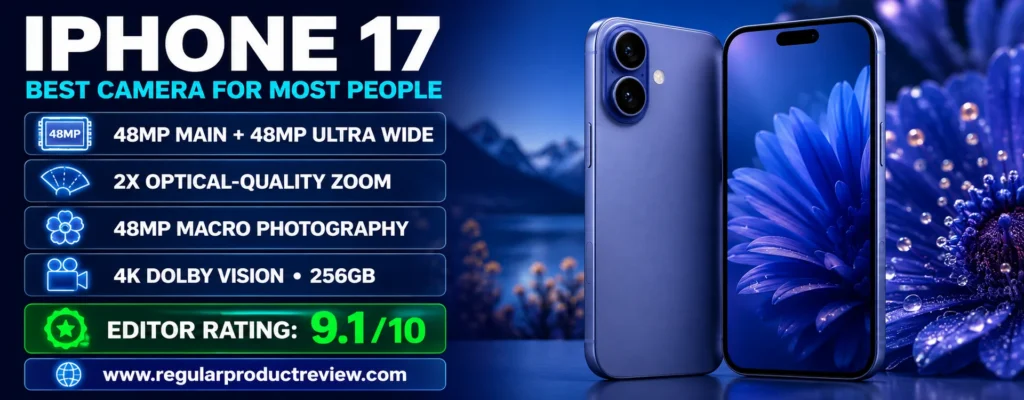
The Main camera handles most scenes with a bright f/1.6 aperture, sensor-shift stabilization, and 24MP or 48MP output. Its 2x mode uses the central portion of the Main sensor to create a tighter 52mm-equivalent view that is useful for portraits, food, pets, and architectural details. The official iPhone 17 specifications also document a 13mm Ultra Wide that focuses close enough for 48MP macro photography.
The regular model also records 4K Dolby Vision at up to 60 fps, Cinematic mode up to 4K30, Action mode up to 2.8K60, macro video, spatial video, and simultaneous front-and-rear Dual Capture. The missing professional features matter to some buyers: there is no Apple ProRAW, dedicated long Telephoto, ProRes RAW, or Apple Log 2. Yet many users will value the simpler workflow and smaller files more than those specialist tools.
Apple lists the iPhone 17 from $799 with 256GB of storage, giving it more practical starting capacity for photo libraries than older 128GB base models. Students balancing camera quality with cost can compare our best iPhones for students.
iPhone 17 Camera Specifications
| Specification | Details |
|---|---|
| Main camera | 48MP, 26mm, f/1.6, sensor-shift OIS |
| 2x option | 12MP optical-quality framing at 52mm |
| Ultra Wide | 48MP, 13mm, f/2.2, 120-degree view |
| Macro | 48MP macro photo support |
| Front camera | 18MP Center Stage with autofocus |
| Photo processing | Photonic Engine, Deep Fusion, Smart HDR 5, latest Photographic Styles |
| Video | 4K Dolby Vision up to 60 fps; Cinematic, Action, macro, spatial, Dual Capture |
| ProRAW | No |
| Storage | 256GB or 512GB |
| Starting price | $799 at launch in the United States |
Why It Is the Practical Sweet Spot
The iPhone 17 covers the perspectives most people use daily. The 1x camera is ready for family moments, the 2x view creates cleaner portraits than a very wide lens, the Ultra Wide fits groups and landscapes, and macro mode adds creative range. Its 120Hz display and strong outdoor brightness also make composing and reviewing images more comfortable in motion or sunlight.
Photographic Styles provide control over tone and color without forcing a RAW workflow. That is valuable for users who publish directly from the phone and want a recognizable look. Styles should still be used with restraint because extreme settings can make mixed lighting or skin tones harder to correct later.
Reasons to Move Up to a Pro
Choose a Pro model if you regularly photograph performances, field sports, wildlife, or distant travel details. The iPhone 17’s digital zoom cannot replace a dedicated 4x Telephoto. Professionals who need wide editing latitude should also prioritize ProRAW, while filmmakers planning graded multi-camera productions benefit from Log, ProRes RAW, and synchronization tools. Buyers cross-shopping lower-cost devices can use our best Android phones under $500 to compare camera variety and ecosystem trade-offs.
✅ Editorial Pick: For most buyers, spending the difference on travel, lighting, a compact tripod, storage, or printing may improve the final body of work more than upgrading to a Pro phone.
Verdict: The iPhone 17 is the best iPhone for everyday photography, combining two high-resolution rear cameras with sensible storage and a manageable price.
iPhone Air — Best Lightweight iPhone for Travel Photography
Award: ✈️ Best Lightweight iPhone for Travel Photography
Editor Rating: 8.5/10
Best For: Minimalist travelers, street shooters, hikers, and creators prioritizing a thin carry
The iPhone Air approaches photography from a different direction. Instead of maximizing lens count, it places a capable 48MP Fusion Main camera inside an exceptionally thin 5.64mm body weighing about 165 grams. For travelers who walk all day, carry a dedicated camera, or want the lightest possible premium iPhone, that reduction in bulk can matter more than a third rear lens.
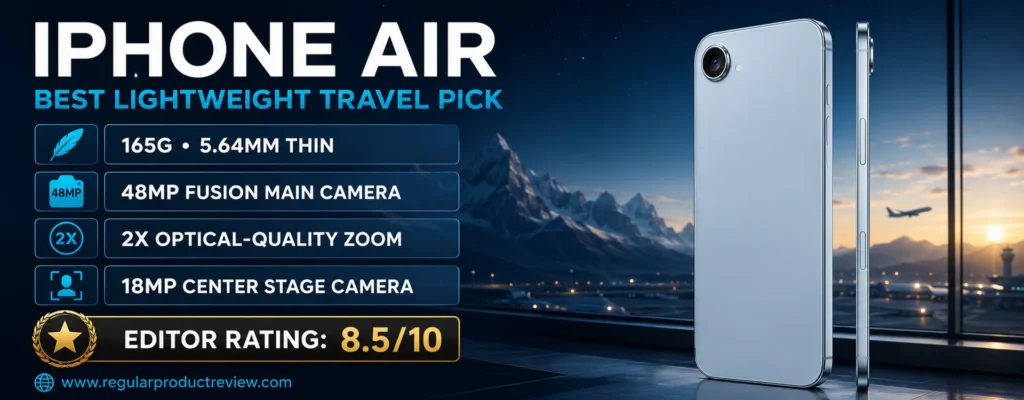
Its single rear camera captures at 26mm and supplies an optical-quality 2x view at 52mm. The f/1.6 aperture and sensor-shift stabilization support dependable everyday results, while Apple’s computational processing handles HDR, portraits, night scenes, and Photographic Styles. Apple’s iPhone Air technical specifications document the 18MP Center Stage front camera used for travel diaries, flexible-orientation selfies, group framing, and Dual Capture video.
The limitation is fundamental: there is no Ultra Wide camera, no macro mode, and no dedicated Telephoto. You cannot step backward through a wall to photograph a small hotel room, and a digital crop cannot recreate the perspective of a true wide lens. Likewise, distant landmarks or wildlife will reveal the limits of 10x digital zoom much sooner than the 17 Pro series.
At a starting price of $999, the Air is a design-led purchase rather than the strongest camera value. Travelers who want a broader lens kit should compare our camera phone category.
iPhone Air Camera Specifications
| Specification | Details |
|---|---|
| Rear camera | 48MP Fusion Main, 26mm, f/1.6 |
| Stabilization | Sensor-shift optical image stabilization |
| 2x option | 12MP optical-quality framing at 52mm |
| Ultra Wide or macro | Not available |
| Dedicated Telephoto | Not available |
| Front camera | 18MP Center Stage with autofocus |
| Video | 4K Dolby Vision up to 60 fps, Cinematic, Action, Dual Capture |
| ProRAW | No |
| Body | 5.64mm thin; approximately 165g |
| Storage and price | 256GB to 1TB; from $999 at launch |
The Portability Advantage
A phone that is comfortable to carry is more likely to be used. The Air’s low weight helps during long city walks, hikes, and event coverage where a photographer already has a mirrorless body and lenses. It can serve as a location-scouting tool, behind-the-scenes camera, social uploader, and backup wide-normal camera without adding much mass.
Its 6.5-inch OLED display provides generous space for composition and editing despite the slim chassis. The A19 Pro chip also supports responsive processing. However, demanding recording sessions still require realistic expectations about battery, heat, and storage, especially in direct sun.
Who Should Skip the Air?
Skip it if Ultra Wide landscapes, close-up macro subjects, or long-range portraits are central to your work. The regular iPhone 17 is cheaper and offers a more flexible dual-camera system, while the 17 Pro adds the serious Telephoto and professional formats. Those deciding between portability and flagship hardware can use our best flagship phones guide to compare competing premium designs.
🧳 Expert Tip: Pair the iPhone Air with a small USB-C power bank and use your feet deliberately. Its 1x and 2x options are strong for visual storytelling, but planning matters when there is no Ultra Wide safety net.
Verdict: The iPhone Air is the best light iPhone for travel photography, but its minimalist camera system demands clear priorities.
iPhone 17e — Best Affordable New iPhone Camera
Award: 💰 Best Affordable New iPhone Camera
Editor Rating: 8.3/10
Best For: First-time iPhone buyers, students, casual family photos, and simple social content
The iPhone 17e is the lowest-priced current model in this guide and the most straightforward way to buy a new iPhone with a 48MP Main camera. Starting at $599 with 256GB of storage, it focuses on the perspectives people use most: a standard 26mm view and an optical-quality 2x option at 52mm. That pairing is enough for everyday scenes, portraits, documents, food, pets, and travel details.
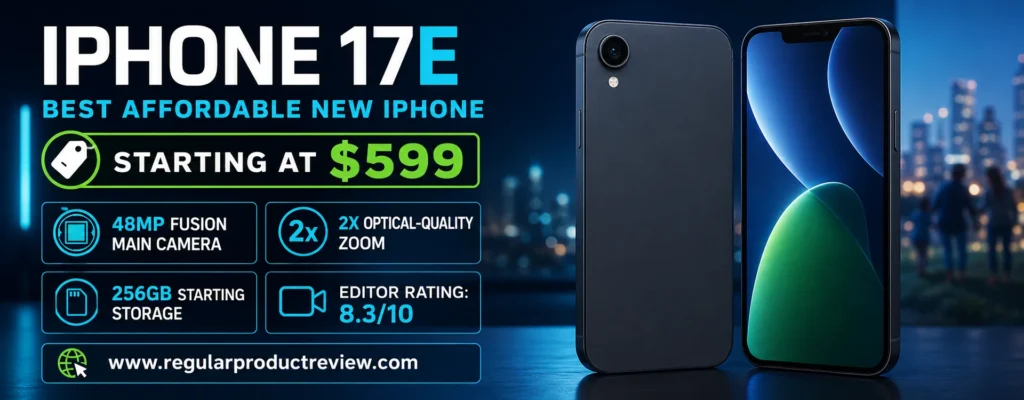
Its camera uses optical stabilization, a bright f/1.6 aperture, and Apple’s computational tools to produce consistent point-and-shoot images. The official iPhone 17e specifications confirm 24MP and 48MP high-resolution options, which provide more flexibility than older budget iPhones when cropping or printing. The familiar interface keeps shooting, editing, sharing, and backup approachable.
Cost savings appear in the missing lenses and creator features. The 17e has no Ultra Wide camera, no macro capability, no dedicated Telephoto, and no ProRAW. Its digital zoom reaches 10x, but image quality falls as enlargement increases. The front camera is also less advanced than the 18MP Center Stage system used by the iPhone 17, Air, and Pro family.
For buyers whose budget can stretch, the regular 17 is substantially more versatile. Before choosing, compare our affordable camera phones under $1,000 to see which higher-value lens combinations are available.
iPhone 17e Camera Specifications
| Specification | Details |
|---|---|
| Rear camera | 48MP Fusion Main, 26mm, f/1.6 |
| Stabilization | Optical image stabilization |
| 2x option | 12MP optical-quality framing at 52mm |
| Ultra Wide and macro | Not available |
| Dedicated Telephoto | Not available |
| Front camera | 12MP TrueDepth camera |
| Photo output | 24MP and 48MP high-resolution options |
| ProRAW | No |
| Storage | 256GB or 512GB |
| Starting price | $599 at launch in the United States |
What the 17e Does Well
The camera’s simplicity can be an advantage. New photographers are encouraged to pay attention to light, timing, background, and subject distance instead of switching among lenses without purpose. The 2x view is particularly helpful for portraits because it reduces the exaggerated facial perspective that can occur when a wide camera is held too close.
Starting at 256GB also gives casual shooters more breathing room for 4K clips, Live Photos, and offline albums. Storage still needs management, but the capacity is a more comfortable foundation than the 128GB entry points found on many older models.
When the Regular iPhone 17 Is Worth More
Pay more for the iPhone 17 if you routinely photograph landscapes, groups in tight spaces, flowers or small products, or yourself while moving. Its 48MP Ultra Wide, macro mode, and 18MP Center Stage front camera materially expand what you can capture. Our budget Android phone recommendations also show where rival models offer different hardware at similar prices.
💵 Editorial Price Check: Do not buy the 17e by looking only at the monthly carrier payment. Compare the total device cost, trade-in conditions, required plan, and the regular iPhone 17’s street price.
Verdict: The iPhone 17e is the best budget new iPhone for photography when a reliable Main camera matters more than lens variety.
iPhone 16 Pro Max — Best Previous-Generation Pro Max Value
Award: 🎬 Best Previous-Generation Pro Max Value
Editor Rating: 9.2/10
Best For: 5x photography, 4K120 video, refurbished value, and creators who do not need the newest 8x option
The iPhone 16 Pro Max remains a formidable photography device even though it is no longer Apple’s newest Pro Max. Its 48MP Fusion Main camera, 48MP Ultra Wide, and 12MP 5x Telephoto create a flexible 13mm-to-120mm system. Apple’s official iPhone 16 Pro Max specifications confirm high-resolution macro, Camera Control, ProRAW, and 4K Dolby Vision recording at up to 120 fps.
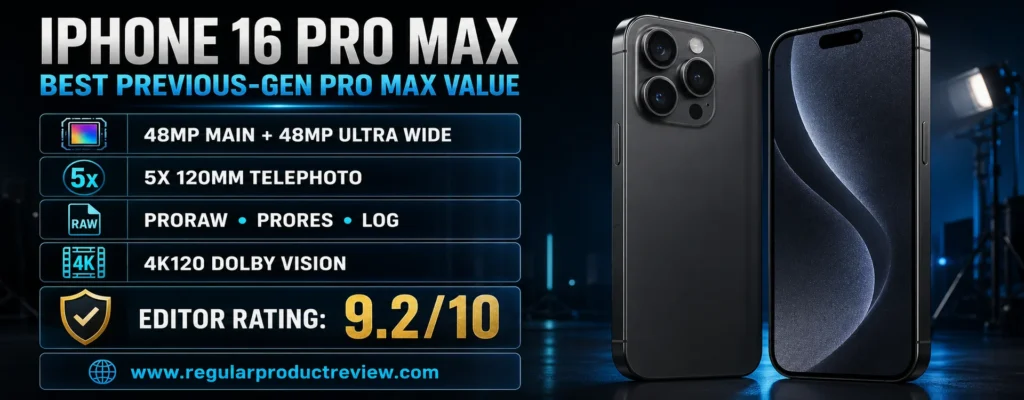
The 5x camera is especially useful for stage events, travel details, compressed landscapes, and candid portraits from a respectful distance. Unlike a digital crop from the Main camera, it uses a dedicated tetraprism Telephoto with autofocus and 3D sensor-shift stabilization. The 48MP Ultra Wide also represents a meaningful advantage over the 12MP Ultra Wide in the iPhone 15 Pro family, particularly in bright scenes and close-up work.
Video is another reason to consider it. The 16 Pro Max supports ProRes, Log recording, ACES, external recording, four studio-quality microphones, Audio Mix, and 4K120 capture on the Main camera. Its large display and strong battery rating are well suited to reviewing footage and covering long days, although sustained professional recording still benefits from external power and storage.
Value depends on the purchase channel. Apple no longer positions it as the current new Pro flagship, so a marketplace listing near iPhone 17 Pro Max pricing is not compelling. Use our flagship phone buying hub to compare the broader premium market before accepting a small discount.
iPhone 16 Pro Max Camera Specifications
| Specification | Details |
|---|---|
| Main camera | 48MP Fusion, 24mm, f/1.78, second-generation sensor-shift OIS |
| Ultra Wide | 48MP, 13mm, f/2.2, 120-degree view, 48MP macro |
| Telephoto | 12MP 5x, 120mm, f/2.8, tetraprism OIS and autofocus |
| Optical zoom range | 10x total from Ultra Wide to 5x |
| Digital zoom | Up to 25x for still photos |
| Front camera | 12MP TrueDepth with autofocus |
| Pro photo | Apple ProRAW, 48MP HEIF, latest-generation Photographic Styles |
| Pro video | 4K120 Dolby Vision, ProRes, Log, ACES, external recording |
| Display and weight | 6.9-inch OLED; approximately 227g |
| Buying route | Certified refurbished, clearance, or trusted authorized reseller |
Why the 5x System Still Works
The 120mm-equivalent view is long enough to create strong separation and compression without being so tight that subjects become difficult to find. For concerts and travel, it often represents a more forgiving focal length than 200mm. The Main camera’s optical-quality 2x option fills the gap for closer portraits, while the Ultra Wide handles interiors and establishing shots.
The 16 Pro Max also supports Night mode portraits through its LiDAR Scanner. Low-light Telephoto photography still requires care because the f/2.8 lens receives less light than the Main camera. When the scene becomes very dark, the phone may favor another camera or rely more heavily on computational processing.
Price Threshold and Purchase Risk
A meaningful discount is essential. Compare the final price with a new iPhone 17 Pro, not just the 17 Pro Max, because the newer smaller Pro provides the improved triple-48MP system and 8x option. Buyers should also review our best camera phones under $1,000 when the refurbished price approaches four figures.
🔎 Expert Tip: Check Settings for battery health and parts/service history immediately after receiving a used or refurbished iPhone. Test all focal lengths, stabilization, autofocus, flash, microphones, and USB-C transfer before the return window closes.
Verdict: The iPhone 16 Pro Max is the best older Pro Max for photography value when its 5x camera and creator tools come with a substantial, warranty-backed discount.
iPhone 16 Pro — Best Previous-Generation Compact Pro
Award: 🧭 Best Previous-Generation Compact Pro
Editor Rating: 9.1/10
Best For: Compact 5x photography, macro work, ProRAW editing, and discounted professional video
The iPhone 16 Pro corrected a major size-based compromise from the prior generation: it brought Apple’s 5x tetraprism Telephoto to the smaller Pro body. The official iPhone 16 Pro specifications document its 48MP Main, 48MP Ultra Wide, and 12MP 5x camera, a combination that remains highly capable for street, portrait, travel, product, and event work.
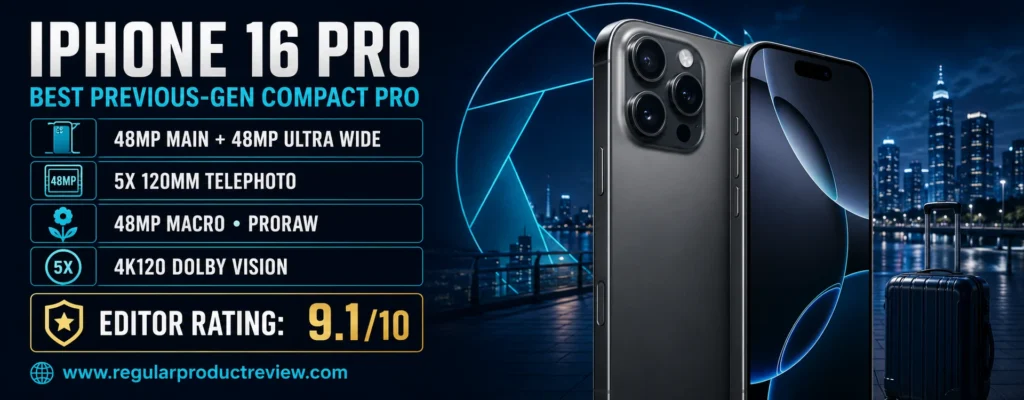
The 48MP Ultra Wide is a particular strength. It captures higher-resolution wide scenes and supports detailed macro photography, making the phone useful for architecture, interiors, flowers, textures, and small products. The Main camera supplies 24MP and 48MP capture plus an optical-quality 2x option, while ProRAW gives experienced editors greater control over white balance, tone, and detail.
Its professional video toolkit closely tracks the 16 Pro Max: 4K Dolby Vision at up to 120 fps on the Main camera, ProRes with external recording, Log, ACES, Audio Mix, and four microphones. USB 3 transfer up to 10Gb/s is valuable when moving large files to fast storage. The smaller battery, however, makes power planning more important during sustained recording.
The 16 Pro is no longer the current direct-sale Pro model, so the reason to buy is value rather than novelty. Our best premium smartphones guide helps establish whether a refurb price remains competitive across platforms.
iPhone 16 Pro Camera Specifications
| Specification | Details |
|---|---|
| Main camera | 48MP Fusion, 24mm, f/1.78, second-generation sensor-shift OIS |
| Ultra Wide | 48MP, 13mm, f/2.2, 120-degree view, macro |
| Telephoto | 12MP 5x, 120mm, f/2.8, tetraprism OIS and autofocus |
| Digital zoom | Up to 25x for photos |
| Front camera | 12MP TrueDepth with autofocus |
| Photo formats | HEIF, JPEG, DNG, Apple ProRAW |
| Video | 4K120 Dolby Vision, ProRes, Log, ACES, external recording |
| Transfer | USB 3 up to 10Gb/s with a compatible cable |
| Display and weight | 6.3-inch OLED; approximately 199g |
| Buying route | Certified refurbished or a trusted clearance seller |
A Strong Three-Camera Balance
The gap between 2x and 5x requires some reframing, but the endpoints are useful. The 2x crop works for half-body portraits and food, while 5x isolates details or distant subjects. The Ultra Wide adds dramatic perspective and close focus. Taken together, the system offers more creative options than the regular iPhone 17 despite the older front camera and processing generation.
Camera Control can speed access to exposure, depth, lens, zoom, and Styles after a learning period. Some photographers will still prefer on-screen controls because they show exact values more clearly. The best approach is to configure one repeatable method before an event instead of changing the interface under pressure.
16 Pro Versus 17 Pro
The newer 17 Pro moves to a 48MP Telephoto and extends optical-quality framing to 8x. It also adds the 18MP Center Stage front camera and newer professional video capabilities. If a Pro refurb exceeds the budget, compare the best camera phones under $500 instead of accepting a questionable device.
📐 Editorial Insight: A smaller phone can be a better camera if it stays in your hand instead of your bag. Evaluate comfort with a case attached, because grip thickness and button placement change the shooting experience.
Verdict: The iPhone 16 Pro is the best discounted compact iPhone for 5x photography, provided its refurb price is well below a new 17 Pro.
iPhone 15 Pro Max — Best Refurbished 5x Zoom iPhone
Award: 🔭 Best Refurbished 5x Zoom Value
Editor Rating: 8.9/10
Best For: Telephoto portraits, travel detail, ProRAW, and budget-conscious Pro Max buyers
The iPhone 15 Pro Max introduced Apple’s 120mm-equivalent 5x tetraprism camera, making it a landmark model for mobile Telephoto photography. Its 48MP Main camera, 12MP Ultra Wide, and 12MP 5x Telephoto still cover a practical range for portraits, landscapes, travel, and documentary work, as shown in Apple’s iPhone 15 Pro Max technical specifications. When refurbished pricing is disciplined, it can provide genuine Pro-camera utility without the expense of the newest generation.
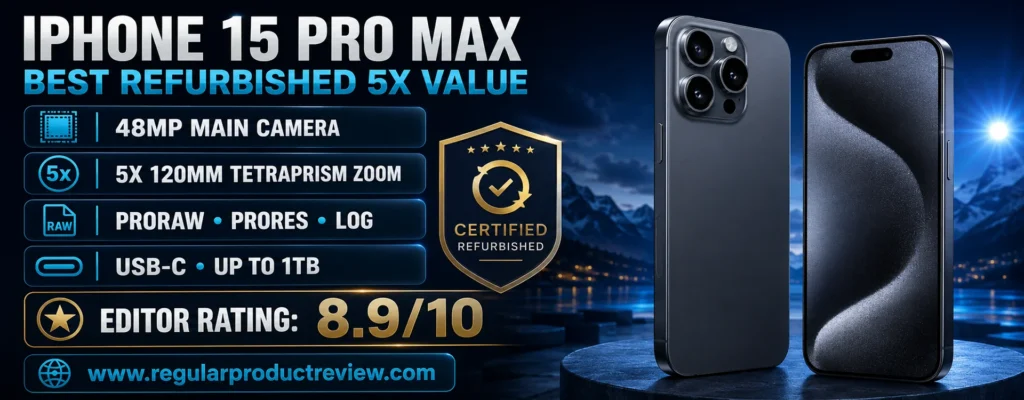
Its Main camera is especially flexible. Photographers can choose 24mm, 28mm, or 35mm default framing, capture 24MP everyday files, and use 48MP ProRAW or high-resolution HEIF when more detail is needed. The 2x option remains useful for portraits, while the 5x lens creates stronger compression and reach. LiDAR-assisted Night mode portraits add depth information in darker scenes.
The device also supports ProRes, Log video, ACES, external recording, and USB 3 transfers. It cannot match the 16 Pro Max’s 4K120 Dolby Vision or 48MP Ultra Wide, and it lacks the 17 Pro Max’s 48MP Telephoto, 8x option, and newer front camera. Still, its files remain suitable for demanding editing when exposure and technique are sound.
Because the phone is older, battery condition and repair history deserve close attention. Our best flagship Android phones can reveal whether a newer alternative offers better value at the same refurb price.
iPhone 15 Pro Max Camera Specifications
| Specification | Details |
|---|---|
| Main camera | 48MP, 24mm, f/1.78, second-generation sensor-shift OIS |
| Default Main framing | 24mm, 28mm, or 35mm options |
| Ultra Wide | 12MP, 13mm, f/2.2, macro support |
| Telephoto | 12MP 5x, 120mm, f/2.8, tetraprism stabilization |
| Digital zoom | Up to 25x for photos |
| Front camera | 12MP TrueDepth with autofocus |
| Pro photo | Apple ProRAW and 48MP HEIF |
| Pro video | ProRes, Log, ACES, external recording |
| Display and weight | 6.7-inch OLED; approximately 221g |
| Buying route | Certified refurbished with warranty preferred |
Why 120mm Remains Valuable
The 5x lens creates a distinctive visual language. It can pull mountain layers closer together, isolate a musician on stage, or capture a candid portrait without crowding the subject. Good light is important, and shutter timing matters with movement. For indoor action, the brighter Main camera and a closer position may produce a cleaner file.
Customizable Main-camera defaults are another practical feature. A 35mm view feels natural for environmental portraits and street scenes, while 28mm creates a moderate wide perspective. These settings crop the Main sensor rather than physically changing the lens, but they make composition more intentional at launch.
Refurbished Buying Standard
Prefer Apple Certified Refurbished or a retailer that clearly states battery policy, parts condition, warranty length, and return terms. Photographers with a strict ceiling should compare our camera phones under $500 rather than stretching for a worn Pro Max.
🛡️ Expert Recommendation: Treat the warranty as part of the price. A slightly more expensive certified device can be the better photographic tool if it removes uncertainty about the battery and camera repairs.
Verdict: The iPhone 15 Pro Max is the best refurbished iPhone for 5x photography when its condition and discount are both convincing.
iPhone 15 Pro — Best Refurbished iPhone for 3x Portraits
Award: 👤 Best Refurbished 3x Portrait iPhone
Editor Rating: 8.7/10
Best For: Portraits, street photography, compact ProRAW workflows, and creators who prefer 77mm framing
The iPhone 15 Pro is the only model in this selection built around Apple’s 3x 77mm-equivalent Telephoto rather than 5x or 4x. Apple’s official iPhone 15 Pro specifications confirm that focal length. A 77mm view is easier to use indoors, requires less working distance, and creates flattering compression for head-and-shoulders portraits.
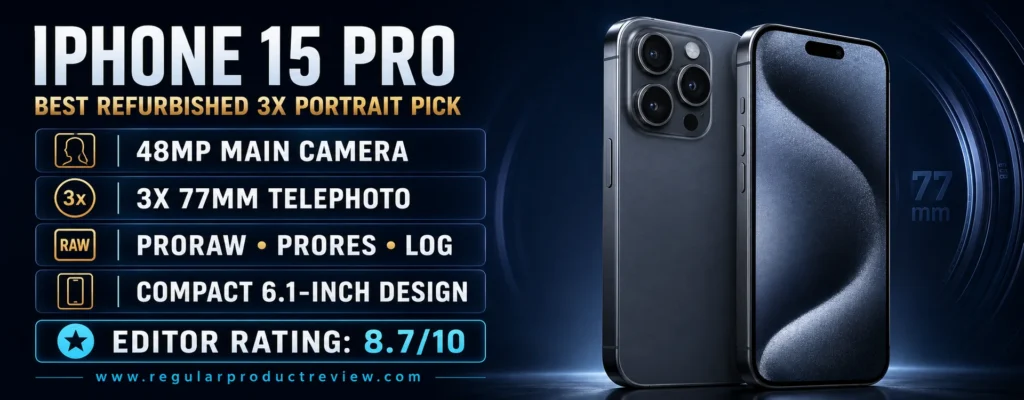
Its 48MP Main camera supports 24mm, 28mm, and 35mm default views, 24MP output, 48MP HEIF, and Apple ProRAW. The 12MP Ultra Wide covers interiors and macro subjects, while LiDAR enables Night mode portraits. The overall camera system lacks the 48MP Ultra Wide of the 16 and 17 Pro families, but it remains versatile for a small body.
Video capabilities include 4K Dolby Vision, Cinematic and Action modes, ProRes, Log, ACES, and external recording. USB 3 transfer is a major workflow advantage over older Lightning-equipped iPhones. The phone’s A17 Pro chip also supports current editing and capture applications, though battery condition can materially affect a refurbished unit’s field endurance.
Students who need one device for classes and creative work can compare our student-focused iPhone guide.
iPhone 15 Pro Camera Specifications
| Specification | Details |
|---|---|
| Main camera | 48MP, 24mm, f/1.78, second-generation sensor-shift OIS |
| Default Main framing | 24mm, 28mm, or 35mm |
| Ultra Wide | 12MP, 13mm, f/2.2, macro support |
| Telephoto | 12MP 3x, 77mm, f/2.8, OIS |
| Digital zoom | Up to 15x for photos |
| Front camera | 12MP TrueDepth with autofocus |
| Pro photo | Apple ProRAW and high-resolution HEIF |
| Video | ProRes, Log, ACES, external recording, 4K Dolby Vision |
| Display and weight | 6.1-inch OLED; approximately 187g |
| Buying route | Certified refurbished with documented warranty |
Why 3x Can Beat 5x for Portraits
A 77mm-equivalent lens creates a natural working distance in homes, studios, cafés, and city streets. It provides visible background compression without forcing the photographer across a large room. The 5x view is stronger for distant details, but the 3x lens can be more useful for frequent portraits and product details at moderate distances.
The Main camera’s 35mm default option pairs well with 3x. One view can establish a person in their environment, while the Telephoto captures a tighter expression. Keeping both perspectives in mind produces a more coherent visual sequence than random zooming.
The Age and Price Equation
The 15 Pro should be clearly cheaper than a refurbished 16 Pro. If you are not tied to iOS, examine our Android phone hub because some alternatives offer dedicated midrange Telephoto cameras.
👁️ Portrait Tip: Step back and use the 3x camera for facial portraits when light permits. The greater distance reduces wide-angle distortion and makes the background appear closer and softer.
Verdict: The iPhone 15 Pro is the best compact refurbished iPhone for portrait photography when 3x framing fits your style better than 5x reach.
iPhone 16 Plus — Best Battery-Life iPhone for Everyday Photography
Award: 🔋 Best Everyday Battery and Big-Screen Pick
Editor Rating: 8.6/10
Best For: Family trips, large-screen composition, casual macro, and long days away from an outlet
The iPhone 16 Plus pairs the regular iPhone 16 camera system with a large 6.7-inch display and stronger endurance than the smaller model. Its 48MP Fusion Main camera, optical-quality 2x option, and autofocus-equipped 12MP Ultra Wide cover everyday photography more effectively than a single-camera budget iPhone. Apple’s iPhone 16 and 16 Plus specifications document the macro capability and Camera Control that broaden its usefulness.
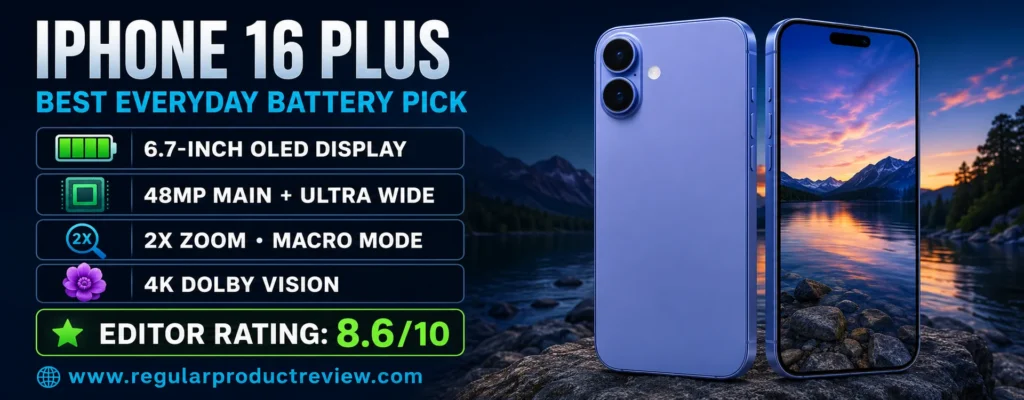
The Main camera’s f/1.6 aperture and sensor-shift stabilization support family scenes, travel, food, pets, and low-light snapshots. The 2x view produces a more portrait-friendly perspective, while the Ultra Wide fits groups and scenery. Macro mode is useful for flowers, crafts, and small details, although the 12MP Ultra Wide cannot match the higher-resolution macro files from the iPhone 17 or Pro models.
Video includes 4K Dolby Vision up to 60 fps, Cinematic mode up to 4K30, Action mode, macro video, spatial video, Audio Mix, and wind-noise reduction. It does not support ProRAW, ProRes, Log, or a dedicated Telephoto. This is an everyday camera built for dependable capture and sharing, not a professional production pipeline.
Availability and price require care because Apple currently markets the broader iPhone 16 family from $699 while inventory and configurations can vary. Families exploring lower-cost options can compare our budget phone category.
iPhone 16 Plus Camera Specifications
| Specification | Details |
|---|---|
| Main camera | 48MP Fusion, 26mm, f/1.6, sensor-shift OIS |
| 2x option | 12MP optical-quality framing at 52mm |
| Ultra Wide | 12MP, 13mm, f/2.2, autofocus |
| Macro | Supported through the Ultra Wide camera |
| Dedicated Telephoto | Not available |
| Front camera | 12MP TrueDepth with autofocus |
| Video | 4K Dolby Vision up to 60 fps, Cinematic, Action, macro, spatial |
| ProRAW and ProRes | Not supported |
| Display | 6.7-inch OLED |
| Buying route | Apple, clearance stock, carrier, or certified refurbished depending on configuration |
Big-Screen Composition and Review
The larger display makes it easier to spot a crooked horizon, distracting edge, missed expression, or unwanted reflection before leaving the scene. It also improves in-phone editing for users who do not carry a tablet. Screen size does not improve the camera sensor, but it can improve the decisions made around capture.
Longer endurance is equally practical. Navigation, screen brightness, cellular uploads, and repeated video clips can drain a phone quickly on travel days. The Plus body provides more battery headroom, though a compact charger remains wise for full-day events.
The Telephoto Limitation
The optical-quality 2x view is effective for moderate portraits, but digital zoom beyond that cannot reproduce the detail or compression of a true long lens. If performance and demanding games share priority with photography, compare our gaming phones under $700 before choosing the Plus.
🌤️ Expert Tip: Use the Ultra Wide in good light and keep the Main camera for darker scenes. The Main sensor and brighter aperture generally provide cleaner detail when illumination drops.
Verdict: The iPhone 16 Plus is the best large-screen iPhone for everyday photography and battery life, especially when found at a sensible price.
iPhone Photography Buying Guide — Choose the Right Camera System
Buying the best iPhone for photography starts with subjects, not specifications. A phone used for family life needs fast autofocus, reliable skin tones, manageable storage, and enough battery to stay ready. A wildlife or performance shooter needs genuine Telephoto reach. A filmmaker may care more about Log, external recording, audio, and thermal management than the still-photo zoom range. Define the work first, then pay for the tools that remove a real limitation.
Apple’s iPhone category guide is a useful place to compare non-camera considerations such as size, platform features, and everyday value. If photography is only one part of a wider premium-phone decision, our flagship phones for photography guide shows where competing systems may offer different zoom, sensor, or manual-control priorities.
1. Start With Focal Length, Not Digital Zoom
Focal length changes both framing and perspective. Apple’s 13mm-equivalent Ultra Wide fits interiors, large groups, and dramatic foregrounds. The 24mm or 26mm Main camera is the everyday workhorse. Optical-quality 2x options around 48mm or 52mm suit food, products, and environmental portraits. A 77mm 3x camera flatters faces at moderate working distance, while 100mm or 120mm Telephoto views isolate distant subjects and compress backgrounds. The 200mm-equivalent 8x option on the 17 Pro family is useful for details, stages, architecture, and some wildlife.
Do not treat every number in the zoom interface as a separate optical lens. Some marked focal lengths are high-quality crops from a 48MP sensor; others are digital enlargements that depend heavily on light, subject movement, processing, and final output size. A crop can be excellent for social media yet look fragile in a large print. Evaluate the native cameras and optical-quality crop points before being impressed by a maximum digital-zoom number.
| Subject | Most Useful Starting View | Recommended iPhones |
|---|---|---|
| Interiors and architecture | 13mm Ultra Wide | iPhone 17, 17 Pro/Max, 16 Pro/Max |
| Everyday family photos | 24mm or 26mm Main | All picks in this guide |
| Food and environmental portraits | 2x around 48mm or 52mm | All picks in this guide |
| Head-and-shoulders portraits | 3x to 4x | iPhone 15 Pro or 17 Pro/Max |
| Stage, travel details, compressed landscapes | 5x | iPhone 16 Pro/Max or 15 Pro Max |
| Distant details in good light | Optical-quality 8x | iPhone 17 Pro/Max |
| Flowers, textures, small products | Autofocus Ultra Wide macro | iPhone 17, 17 Pro/Max, 16 Pro/Max |
2. Understand 48MP Capture
A 48MP label does not mean every photograph should be saved at 48MP. Apple’s default processing often produces a lower-resolution file designed to balance detail, dynamic range, noise, and storage. High-resolution capture is most useful in bright or controlled light when the subject contains fine detail and the photographer expects to crop, retouch, or print.
Movement and low light can reduce the practical advantage. Smaller effective pixels and longer processing may expose subject motion, while noise reduction can erase delicate texture. A clean 24MP image with good timing and exposure is better than a 48MP file with blur. Use the higher setting deliberately for landscapes, architecture, products, artwork, or a portrait session with stable light.
The 17 Pro family’s triple-48MP design improves resolution consistency across the Main, Ultra Wide, and Telephoto cameras. Earlier Pro models combine a 48MP Main with lower-resolution Telephoto or Ultra Wide hardware. That difference matters most when cropping or matching detailed files across lenses; it matters less for modest web output.
3. Decide Whether Apple ProRAW Is Necessary
Apple ProRAW combines computational image data with the editing latitude of a DNG-based workflow. It can preserve more flexibility for recovering highlights, setting white balance, shaping local contrast, and applying a consistent color grade. It is valuable for professionals, enthusiasts, and difficult mixed-light scenes.
ProRAW also creates larger files and demands editing. A poorly exposed RAW file is not magically better than a polished HEIF. If your normal workflow is shoot, crop, apply a light filter, and share, the regular iPhone 17 may be more efficient. Its processed files require less storage and often look finished immediately.
Choose a Pro model when you know why you need RAW. The 17 Pro/Max, 16 Pro/Max, and 15 Pro/Max in this guide support ProRAW. The iPhone 17, Air, 17e, and 16 Plus do not. Photographers who want deeper manual control can use compatible third-party camera applications, but app support cannot add a missing physical lens or transform a non-Pro capture into the full ProRAW pipeline.
🧪 Editorial Insight: RAW is not a quality badge; it is a responsibility. It gives the editor more decisions, larger files, and more opportunities to improve—or mishandle—the image.
4. Match Low-Light Expectations to the Correct Lens
The Main camera is usually the safest choice after dark because it pairs a relatively bright aperture with the phone’s primary sensor and strongest processing. Ultra Wide and Telephoto cameras often collect less light. Night mode and stabilization help with static scenes, but they cannot fully freeze a moving child, pet, performer, or vehicle.
For moving subjects, seek more light, use the Main camera, move closer, and capture several frames. For static architecture, brace the phone, use a compact tripod, or rest it on a stable surface. Avoid extreme digital zoom at night because the combination of a small source image, subject movement, and heavy noise reduction produces soft detail.
LiDAR on Pro models helps depth-related tasks and enables Night mode portraits on supported generations. It does not turn darkness into daylight, and flattering portrait light remains valuable. A small LED panel or positioning the subject near a window can improve a photograph more than changing phones.
5. Choose Portrait Tools by Working Distance
Portrait photography is not only about artificial background blur. Perspective, camera distance, facial geometry, background placement, and light direction matter more. A 1x wide camera held close to a face can exaggerate the nearest features. Stepping back and using 2x, 3x, or 4x often creates a more natural result.
The iPhone 15 Pro’s 3x lens is useful indoors and in modest spaces. The iPhone 17 Pro family’s 4x lens offers stronger compression while remaining more flexible than a very long lens. A 5x camera works well outdoors, on stages, or where the photographer can step back. The 8x option can create striking tight details but may be too long for ordinary indoor portraits.
Current iPhones can record depth information for compatible portraits and let users adjust focus and blur after capture. Use the effect with moderation. Hair, glasses, translucent objects, and complex edges can reveal segmentation mistakes, so inspect the subject boundary before publishing.
6. Evaluate Ultra Wide and Macro as Separate Needs
An Ultra Wide camera is essential for some photographers and rarely used by others. It can create dramatic landscapes and fit tight spaces, but subjects near the edges may stretch. Keep important faces away from corners, hold the phone level for architecture, and correct converging lines carefully instead of accepting a distorted composition.
Macro capture depends on an autofocus-capable Ultra Wide system. The iPhone 17 and the recent Pro models support close focusing, while the single-camera Air and 17e do not. Macro requires patience: light can be blocked by the phone, tiny movements shift focus, and shallow working distances may disturb insects. A small continuous light and stable support can improve results.
If close-up product photography is a priority, the 48MP Ultra Wide on the iPhone 17, 16 Pro family, and 17 Pro family offers more cropping flexibility than older 12MP units. Still, the Main camera used from a slightly greater distance can produce better texture and perspective for many products.
7. Treat Video as a Complete Workflow
All current picks record strong 4K video, but professional production requires more than resolution. Consider frame rate, dynamic range, storage, transfer speed, color workflow, stabilization, microphone placement, monitoring, and power. The iPhone 17 Pro family offers the widest toolset with ProRes RAW, Apple Log 2, genlock, ACES support, and external recording. The 16 Pro family remains strong with 4K120 Dolby Vision, ProRes, Log, ACES, and external capture.
Regular iPhones are often the better choice for immediate social video. Dolby Vision, Cinematic mode, Action mode, spatial video, and Audio Mix can produce polished clips without a grading session. The iPhone 17’s Dual Capture also helps reaction videos, interviews, and travel diaries by recording front and rear perspectives together.
Do not record every moment in the largest format. High-bitrate files consume storage quickly, complicate backup, and increase editing demands. Set the format for the delivery target. A short graded commercial may justify ProRes RAW; a family clip or vertical post probably does not.
8. Storage Is Part of the Camera
Photography storage includes the phone, cloud backup, external media, and archive. A 256GB starting capacity is a comfortable baseline for active shooters, particularly when using 48MP files or 4K video. Professionals using ProRes or ProRes RAW should consider 512GB, 1TB, or the 2TB iPhone 17 Pro Max, while also budgeting for fast external storage.
Keep working space free. A nearly full phone can interrupt downloads, app updates, exports, and recording. Build a routine: ingest, verify the backup, organize, edit, export, and then clear confirmed duplicates or temporary files. Do not rely on a single cloud account as the only copy of paid work.
USB-C simplifies modern workflows. Pro models with high-speed USB 3 support can transfer large files much faster when paired with a compatible cable and drive; the included cable may not always provide the highest data rate. Test the full recording and transfer setup before a client assignment.
9. Screen Size, Weight, and Grip Affect Results
A larger display helps with manual focus aids, exposure judgment, editing, and client review. It also makes the phone heavier and less discreet. The 17 Pro Max offers the most generous current Pro canvas, while the 17 Pro is easier to carry. The Air is the lightest premium option but sacrifices camera variety.
Cases change the equation. A thin, slippery phone may be harder to hold than a slightly heavier model with a textured case. Check whether the case interferes with Camera Control, external lenses, filters, a tripod clamp, or a gimbal. A wrist strap or grip can prevent a costly drop around water, crowds, and steep terrain.
For long handheld video, balance matters as much as weight. A phone with a large camera plateau can sit differently in a gimbal. Calibrate the rig with the exact case, filter, microphone, and cable that will be used on the shoot.
10. Battery Life Must Be Planned, Not Assumed
Camera use is demanding. High screen brightness, navigation, 5G uploads, stabilization, computational processing, and 4K recording all consume power. Apple’s playback ratings help compare models under standardized conditions, but they are not a promise of continuous camera runtime.
The 17 Pro Max is the endurance leader among the current Pro pair, while the 16 Plus is a strong everyday option for buyers who do not need Pro formats. The 17 Pro and older compact Pro models benefit most from a pocketable power bank. When recording externally, account for whether the phone is also powering an accessory.
Heat can reduce brightness, pause charging, or affect sustained performance. Keep the phone out of direct sun when possible, remove unnecessary insulated accessories, and avoid leaving it in a hot vehicle. Never compromise weather sealing or electrical safety to force cooling.
11. Buy Older Pro Models With a Checklist
An older Pro iPhone can be a better photography purchase than a new base model, but only when condition and price are right. A repaired camera can introduce focus, stabilization, dust, or alignment problems. A degraded battery shortens field time. Cosmetic damage near a lens may suggest an impact even when the glass looks intact.
Before the return period expires, test every rear and front camera in bright and dim light. Photograph a detailed flat subject to check corner behavior, record while walking to inspect stabilization, and listen to each microphone. Review parts and service history, battery health, Face ID, flash, USB-C, wireless charging, buttons, and water-damage indicators where accessible.
Certified refurbishment with a documented warranty is preferable to a vague “renewed” label. Compare the total package rather than the sticker price. A newer regular iPhone with a full warranty can be the safer tool for a working photographer than an aging Pro bought from an unknown seller.
12. Set a Practical Budget for the Whole Kit
The phone is only one part of a mobile photography system. Reserve funds for a protective case, reliable charger, power bank, small tripod, clamp, microphone, storage, backup, editing software, and perhaps lighting. A base iPhone plus thoughtful accessories can outperform an expensive Pro used with no support.
Shoppers with much tighter budgets can start with our best Android phones under $300 and camera phones under $300. Those options will not reproduce the full Pro iPhone workflow, but they may leave money for education, travel, and lighting—the resources that often improve photography most.
🛒 Expert Recommendation: Buy the least expensive iPhone that covers your required focal lengths and file formats, then invest the remaining budget in access, practice, light, backup, and printing.
Photography Buyer Checklist
- Identify your three most common subjects.
- Decide whether 2x, 3x, 4x, 5x, or 8x reach is genuinely necessary.
- Confirm whether you need an Ultra Wide camera and macro autofocus.
- Choose ProRAW only if you will edit and store the files.
- Match video formats to your actual delivery workflow.
- Budget for enough internal and external storage.
- Compare stated battery life, size, and weight with your shooting day.
- Verify current Apple availability versus refurbished status.
- Inspect battery health, repair history, camera function, and warranty on older models.
- Compare total cost after carrier-plan requirements and trade-in terms.
Detailed iPhone Camera Comparison — Lenses, Formats, and Use Cases
The table below emphasizes photographic differences rather than general phone specifications. Apple’s official pages remain the final authority because regional configurations and software support can change. For a broader current lineup, consult our best iPhones guide.
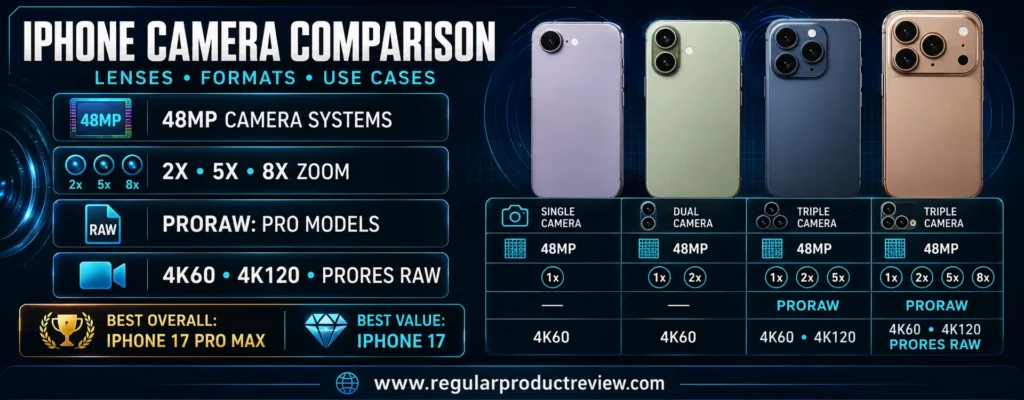
Photographers comparing iOS against top Android hardware should also review our camera phone hub. Some competitors prioritize very long optical zoom or extensive manual controls, while iPhones tend to emphasize consistency, video integration, third-party app support, and ecosystem workflow.
Rear Camera Hardware Comparison
| iPhone | Main | Ultra Wide | Telephoto | Optical-Quality Highlights | Macro |
|---|---|---|---|---|---|
| iPhone 17 Pro Max | 48MP, 24mm | 48MP, 13mm | 48MP, 100mm 4x | 2x and 8x crops; 16x total optical-quality range | Yes, 48MP |
| iPhone 17 Pro | 48MP, 24mm | 48MP, 13mm | 48MP, 100mm 4x | 2x and 8x crops; 16x total optical-quality range | Yes, 48MP |
| iPhone 17 | 48MP, 26mm | 48MP, 13mm | None | 2x from Main | Yes, 48MP |
| iPhone Air | 48MP, 26mm | None | None | 2x from Main | No |
| iPhone 17e | 48MP, 26mm | None | None | 2x from Main | No |
| iPhone 16 Pro Max | 48MP, 24mm | 48MP, 13mm | 12MP, 120mm 5x | 2x from Main; 10x total optical range | Yes, 48MP |
| iPhone 16 Pro | 48MP, 24mm | 48MP, 13mm | 12MP, 120mm 5x | 2x from Main; 10x total optical range | Yes, 48MP |
| iPhone 15 Pro Max | 48MP, 24mm | 12MP, 13mm | 12MP, 120mm 5x | 2x from Main | Yes, 12MP |
| iPhone 15 Pro | 48MP, 24mm | 12MP, 13mm | 12MP, 77mm 3x | 2x from Main | Yes, 12MP |
| iPhone 16 Plus | 48MP, 26mm | 12MP, 13mm | None | 2x from Main | Yes, 12MP |
Photography and Video Workflow Comparison
| iPhone | ProRAW | Highest Standout Video Capability | Front Camera Class | Workflow Character |
|---|---|---|---|---|
| iPhone 17 Pro Max | Yes | ProRes RAW, Apple Log 2, genlock, 4K120 Dolby Vision | 18MP Center Stage | Maximum professional flexibility and endurance |
| iPhone 17 Pro | Yes | ProRes RAW, Apple Log 2, genlock, 4K120 Dolby Vision | 18MP Center Stage | Pro capability in a smaller body |
| iPhone 17 | No | 4K60 Dolby Vision and Dual Capture | 18MP Center Stage | Fast capture-to-share workflow |
| iPhone Air | No | 4K60 Dolby Vision and Dual Capture | 18MP Center Stage | Minimalist, lightweight workflow |
| iPhone 17e | No | 4K Dolby Vision capture | 12MP TrueDepth | Simple 1x/2x photography |
| iPhone 16 Pro Max | Yes | 4K120 Dolby Vision, ProRes, Log, external recording | 12MP TrueDepth | Discounted high-end hybrid production |
| iPhone 16 Pro | Yes | 4K120 Dolby Vision, ProRes, Log, external recording | 12MP TrueDepth | Compact previous-generation Pro workflow |
| iPhone 15 Pro Max | Yes | ProRes, Log, ACES, external recording | 12MP TrueDepth | Refurbished 5x and RAW value |
| iPhone 15 Pro | Yes | ProRes, Log, ACES, external recording | 12MP TrueDepth | Compact 3x portrait and RAW workflow |
| iPhone 16 Plus | No | 4K60 Dolby Vision, Cinematic, Action, macro video | 12MP TrueDepth | Big-screen everyday capture and editing |
Best iPhone by Photography Style
| Photography Style | Best Choice | Strong Alternative | Why |
|---|---|---|---|
| Professional all-round work | iPhone 17 Pro Max | iPhone 17 Pro | Broadest lens and format set; Max adds endurance and storage |
| Street photography | iPhone 17 Pro | iPhone 15 Pro | Smaller bodies with useful portrait focal lengths |
| Family photography | iPhone 17 | iPhone 16 Plus | Fast everyday workflow, Ultra Wide, macro, and strong video |
| Travel with minimal weight | iPhone Air | iPhone 17 | Air is lightest; 17 adds the missing Ultra Wide |
| Portraits | iPhone 17 Pro | iPhone 15 Pro | 4x compression versus a more indoor-friendly 3x view |
| Distant detail | iPhone 17 Pro Max | iPhone 16 Pro Max | 8x optical-quality option versus dedicated 5x |
| Macro | iPhone 17 Pro | iPhone 17 | Both provide 48MP macro-capable Ultra Wide cameras |
| Refurbished Pro value | iPhone 16 Pro | iPhone 15 Pro Max | Newer three-camera system versus cheaper 5x body |
| Simple budget photography | iPhone 17e | Refurbished iPhone 15 Pro | New warranty and simplicity versus more lenses and RAW |
| Long everyday shooting | iPhone 16 Plus | iPhone 17 Pro Max | Large batteries; Pro Max adds professional camera tools |
Compact Decision Matrix
| If Your Priority Is… | Buy This | Avoid Paying Extra For… |
|---|---|---|
| The strongest complete system | iPhone 17 Pro Max | Portability you do not need |
| Pro cameras in a manageable body | iPhone 17 Pro | Pro Max screen and battery |
| Best balance of cost and lens variety | iPhone 17 | Pro formats you will never edit |
| Lowest weight | iPhone Air | Ultra Wide and Telephoto lenses you rarely use |
| Lowest current new-iPhone cost | iPhone 17e | A second camera you do not need |
| Discounted 5x plus 4K120 | iPhone 16 Pro or Pro Max | New-generation 8x reach |
| Affordable refurbished 5x | iPhone 15 Pro Max | Newer Ultra Wide resolution |
| Compact 3x portraits | iPhone 15 Pro | Longer Telephoto reach |
| Large screen and everyday endurance | iPhone 16 Plus | ProRAW and long zoom |
📊 Comparison Takeaway: The iPhone 17 Pro and Pro Max share the strongest camera system. The Max is better for battery, screen area, and storage; the smaller Pro is better for portability. The regular iPhone 17 is the value sweet spot when ProRAW and long Telephoto reach are unnecessary.
Best iPhone for Photography FAQ and Final Verdict
These answers focus on practical buying and capture decisions. Readers still deciding whether an iPhone is the right platform can begin with our best iPhone for most people.
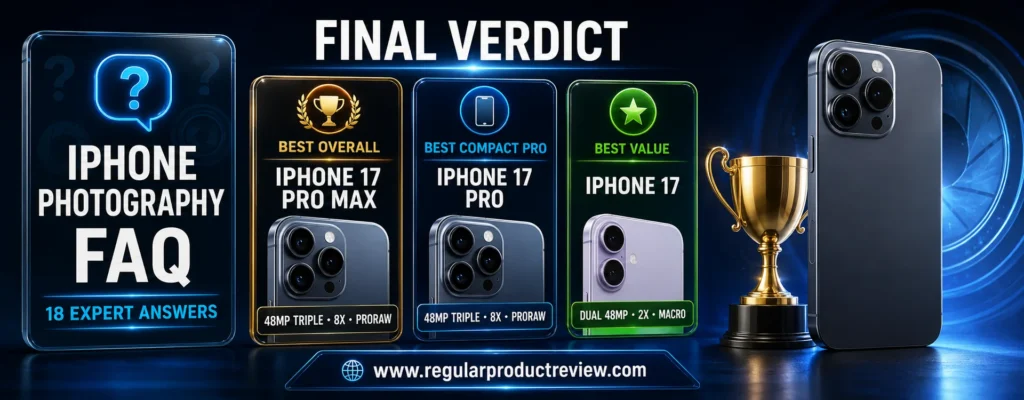
FAQ 1: Which iPhone has the best camera overall?
The iPhone 17 Pro Max is the best overall iPhone camera in this guide. It combines 48MP Main, Ultra Wide, and Telephoto cameras with optical-quality 2x and 8x framing, ProRAW, ProRes RAW, Apple Log 2, genlock, a large display, strong battery endurance, and up to 2TB of storage. The smaller iPhone 17 Pro provides the same core rear-camera system, so choose it when portability matters more than the Max body’s endurance and screen.
FAQ 2: Is the iPhone 17 Pro Max camera better than the iPhone 17 Pro?
Their core rear-camera hardware and professional formats are effectively the same. The Pro Max advantage is the shooting platform around those cameras: a larger display, longer stated video playback, and a higher 2TB storage ceiling. The iPhone 17 Pro is lighter and easier to hold. Image quality should not be the sole reason to choose the Max over the smaller Pro.
FAQ 3: Is the regular iPhone 17 good enough for serious photography?
Yes, for many photographers. It provides 48MP Main and Ultra Wide cameras, optical-quality 2x framing, macro photography, a strong front camera, and polished 4K Dolby Vision video. It lacks ProRAW and a dedicated Telephoto, so it is less suitable for heavy RAW editing, stage photography, distant wildlife, or professional color-managed video. For travel, family, food, social content, and everyday creative work, it is highly capable.
FAQ 4: Which iPhone is best for portrait photography?
The iPhone 17 Pro is the best all-around portrait choice because its 2x and 4x perspectives cover environmental and compressed portraits, while the 8x option supports tight details in adequate light. The refurbished iPhone 15 Pro deserves special consideration for indoor portraits because its 3x 77mm lens requires less working distance than a 5x or 8x view.
FAQ 5: Which iPhone is best for low-light photos?
The iPhone 17 Pro and 17 Pro Max offer the strongest complete low-light toolset, including a stabilized Main camera, Night mode, LiDAR-enabled Night mode portraits, and ProRAW. Nevertheless, the Main camera should usually be preferred after dark. Telephoto and Ultra Wide cameras collect less light, and no computational mode can fully freeze a rapidly moving subject without enough illumination.
FAQ 6: Which iPhone is best for zoom photography?
The iPhone 17 Pro family provides the longest useful range here, including a 4x 100mm Telephoto and an optical-quality 8x 200mm option. The iPhone 16 Pro/Max and 15 Pro Max have dedicated 5x 120mm cameras that remain excellent for performances, travel, and compressed landscapes. Maximum digital zoom should be treated as emergency reach, not equal-quality optical capture.
FAQ 7: Is 48MP always better than 24MP?
No. A 48MP file can preserve more detail in good light and gives additional cropping room, but it consumes more storage and can reveal motion or noise. A processed 24MP image often provides a better balance for handheld everyday photography. Use 48MP for controlled landscapes, architecture, products, artwork, or scenes where fine detail matters.
FAQ 8: Do I need Apple ProRAW?
You need ProRAW only if you plan to edit. It provides greater control over white balance, highlights, color, and local tone but generates larger files and requires a deliberate workflow. People who post quickly from the phone may prefer the efficient, polished HEIF output of the iPhone 17. Professionals and enthusiasts who grade images consistently should choose a Pro model.
FAQ 9: What is the best iPhone for macro photography?
The iPhone 17 Pro and Pro Max are the strongest macro options because their 48MP Ultra Wide camera supports close focusing and high-resolution capture. The regular iPhone 17 and 16 Pro family also provide 48MP macro capability. The iPhone Air and iPhone 17e lack an Ultra Wide camera and therefore do not offer the same macro mode.
FAQ 10: What is the best iPhone for travel photography?
Choose the iPhone 17 Pro when you want broad focal-length coverage without the Pro Max’s bulk. Choose the iPhone Air when weight is the top priority and 1x/2x photography is enough. The regular iPhone 17 is the best-value travel balance because it adds an Ultra Wide and macro camera while remaining less expensive than either premium option.
FAQ 11: Which iPhone is best for video creators?
The iPhone 17 Pro Max is the most complete video choice due to ProRes RAW, Apple Log 2, genlock, external recording, 4K120 Dolby Vision, strong battery endurance, and up to 2TB of storage. The iPhone 17 Pro offers the same essential production formats in a smaller body. Social creators who do not grade footage may prefer the regular iPhone 17 and its simpler Dolby Vision and Dual Capture workflow.
FAQ 12: Is an iPhone 16 Pro still worth buying for photography?
Yes, when the discount is substantial and the condition is excellent. It offers a 48MP Main, 48MP Ultra Wide, 5x Telephoto, ProRAW, 4K120 Dolby Vision, ProRes, and Log. It becomes poor value when priced close to a new iPhone 17 Pro, whose Telephoto, front camera, and professional video system are more advanced.
FAQ 13: Is the iPhone 15 Pro Max camera still good?
Yes. Its 48MP Main camera and 5x tetraprism lens remain useful for portraits, events, and travel. It also supports ProRAW, ProRes, Log, and external recording. The newer 16 and 17 Pro families improve the Ultra Wide, high-frame-rate video, and Telephoto system, so the 15 Pro Max should be purchased as a clearly discounted certified-refurbished option.
FAQ 14: Is the iPhone Air a good camera phone?
Its 48MP Main camera is strong for standard and 2x photography, and the light body is excellent for travel. However, the Air is not the best camera value because it lacks Ultra Wide, macro, and dedicated Telephoto cameras despite its premium price. Buy it for portability and design, not for maximum photographic versatility.
FAQ 15: What is the cheapest new iPhone with a good camera?
The iPhone 17e is the cheapest current new model in this guide, starting at $599 at launch with a 48MP Main camera and 256GB of storage. It provides useful 1x and optical-quality 2x views. The regular iPhone 17 costs more but adds a 48MP Ultra Wide, macro mode, and more advanced front camera, which may justify the upgrade for active photographers.
FAQ 16: How much iPhone storage does a photographer need?
256GB is a sensible baseline for enthusiasts who shoot 48MP images and 4K video. A professional using ProRAW, ProRes, or ProRes RAW should consider 512GB, 1TB, or 2TB plus fast external storage. Capacity does not replace backup. Maintain at least two verified copies of important paid or personal work.
FAQ 17: Can an iPhone replace a mirrorless camera?
It can replace one for many everyday assignments, social content, travel, family documentation, and some professional video roles. A mirrorless system still provides larger sensors, interchangeable lenses, physical controls, flash synchronization, longer optical lenses, and more predictable sustained operation. The better question is whether an iPhone covers the specific output, access, and reliability requirements of your work.
FAQ 18: Should I buy new or refurbished for photography?
Buy new when warranty, battery condition, and maximum useful life are the priorities. Buy refurbished when an older Pro model provides a needed Telephoto or RAW workflow at a meaningful discount. Choose a certified seller, inspect parts and service history, test every camera and microphone, and confirm return terms. A vague marketplace bargain is not worth risking an unreliable camera.
Final Verdict: Which iPhone Should Photographers Buy?
The iPhone 17 Pro Max is the best iPhone for photography when budget, size, and weight are secondary to capability. Its triple-48MP rear system covers Ultra Wide, Main, 4x Telephoto, optical-quality 2x, and optical-quality 8x perspectives. ProRAW supports detailed still-image editing, while ProRes RAW, Apple Log 2, ACES, genlock, and external recording make it the most complete mobile production platform in Apple’s range. The large screen, extended battery rating, and 2TB option further support demanding assignments.
The iPhone 17 Pro is a nearly equal photographic recommendation and may be the better camera in daily use. It retains the same core rear-camera system in a smaller, lighter body that is easier to carry, stabilize, and operate discreetly. Choose the Pro Max for endurance, review space, and maximum storage; choose the Pro for comfort. Do not pay for the larger phone under the assumption that its rear cameras are inherently superior.
For most buyers, the iPhone 17 offers the smartest balance. Its 48MP Main and Ultra Wide cameras cover everyday wide, 2x, landscape, group, and macro photography. It records polished Dolby Vision video and includes the versatile 18MP Center Stage front camera. The absence of ProRAW and a long Telephoto is meaningful, but many people will get more value from its lower price, lighter workflow, and 256GB starting storage.
The iPhone Air is a deliberate minimalist choice, not the camera-value winner. Buy it when an extremely thin, light premium phone will genuinely improve how often and how comfortably you shoot. The iPhone 17e is the affordable new option for dependable 1x and 2x photography. It is simple, well suited to everyday use, and easier to recommend when Ultra Wide, macro, and professional formats are unnecessary.
Older Pro models remain valuable only with the right buying discipline. The iPhone 16 Pro and 16 Pro Max are the strongest previous-generation alternatives because they combine 48MP Main and Ultra Wide cameras, a dedicated 5x lens, ProRAW, and 4K120 video. The iPhone 15 Pro Max is a compelling certified-refurbished 5x choice, while the iPhone 15 Pro provides a distinctive compact 3x portrait perspective. Check battery health, repair history, camera operation, warranty, and discount before accepting any older Pro deal.
Ultimately, the best camera is the one whose focal lengths, file formats, battery, storage, and body size match your work. A Pro model is justified when you will use Telephoto reach, RAW editing, professional video, or high-speed transfer. A regular model is often better when you need fast, consistent photographs ready to share. Compare the wider market in our best flagship phones guide, then invest time in light, timing, composition, editing, backup, and printing.
🏆 Final Recommendation: Choose the iPhone 17 Pro Max for maximum capability, the iPhone 17 Pro for the best compact professional experience, or the iPhone 17 for the strongest overall value.