

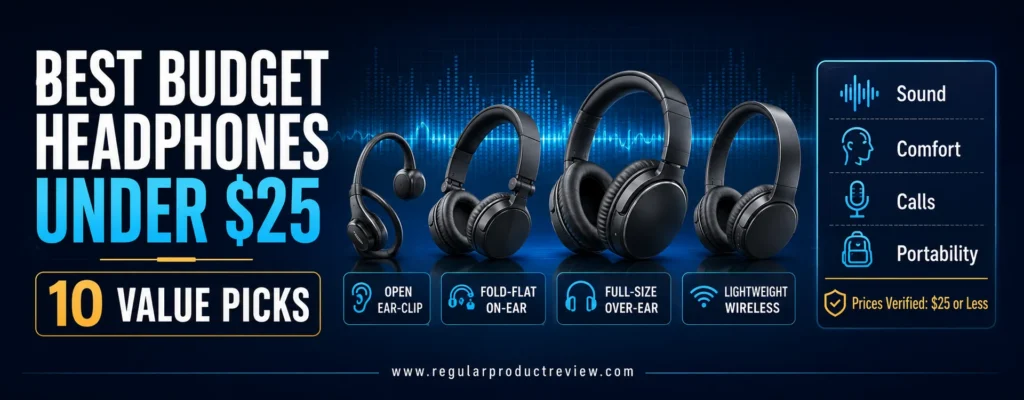
Best Budget Headphones Under $25 That Are Actually Worth Buying
Buying headphones for less than the cost of a restaurant meal can feel like a lottery. Product pages compete with giant driver numbers, “studio” labels, decorative gaming language, and promises of premium bass, yet the details that decide whether a pair is useful—fit, connection type, cable length, microphone support, and replacement options—are often buried. This guide narrows the field to ten budget headphones under $25 that serve a clear purpose instead of pretending to do everything.
The ceiling is strict: each recommended model had a verified U.S. list or selling price of $25 or less before tax and shipping when prices were checked on August 21, 2026. Discounts can disappear, colors can cost different amounts, and marketplace sellers can inflate old models. Treat the price shown here as a qualification point, then confirm the final total before ordering. Readers willing to move one tier higher should compare our broader best budget headphones guide rather than overpay for any pick on this page.
This is deliberately not a list of ten nearly identical wired headphones. The selection includes an open ear-clip model for sound quality, portable on-ear designs, full-size home headphones, a Bluetooth option, a USB call headset, an entry-level monitoring pair, and volume-limited kids headphones. That variety matters because “best” changes with the job. If wireless freedom is non-negotiable, our wireless headphones category explains the larger market and the compromises that disappear with a higher budget.
🎯 Quick Verdict: The Koss KSC75 is our best overall choice for listeners who put open, lively sound ahead of isolation. The Sony MDR-ZX110 is the easiest low-cost travel buy, while the JLab Rewind 2 Wireless is the strongest Bluetooth option at the limit. Choose by use case—not by the largest driver or longest frequency-range claim.
Editor’s Choice Snapshot
| Pick | Product | Award | Verified Price | Defining Strength | Main Trade-Off |
|---|---|---|---|---|---|
| 1 | Koss KSC75 | 🏆 Best Overall Sound | $24.99 | Airy, engaging open-back presentation | Almost no noise isolation |
| 2 | Sony MDR-ZX110 | ✈️ Best Portable Everyday Pick | $9.99 sale; $24.99 MSRP | Folds flat and works without charging | No microphone on standard version |
| 3 | Panasonic RP-HT161-K | 💰 Best Full-Size Value | $16.99 sale | Comfortable home-listening format | Long cable is awkward outdoors |
| 4 | JVC HA-RX330 | 🏠 Best for Home Listening | $24.95 | 40mm drivers and useful plug adapter | Not designed for compact travel |
| 5 | Koss UR20 | ☁️ Best Full-Size Comfort | $24.99 | Closed cushions and simple fit | Basic plastic construction |
| 6 | JLab Rewind 2 Wireless | 📶 Best Wireless | $24.99 | Bluetooth 5.4, multipoint, app EQ | Foam pads provide little isolation |
| 7 | Logitech H390 | 🎙️ Best for Calls | $24.99 | USB audio, boom mic, inline controls | Computer-focused, not phone-friendly |
| 8 | TASCAM TH-02 | 🎚️ Best for Beginner Recording | $21.99 | 50mm closed-back monitoring design | Fit and tonal balance are not reference-grade |
| 9 | JVC HA-S31M | 🎒 Best Compact Headphones With Mic | $24.95 | Flat-folding design and one-button remote | On-ear pressure varies by listener |
| 10 | JLab JBuddies Studio 2 Wired | 🧒 Best for Kids | $19.99 | Built-in 85dB volume limiter | Sized for ages six and older |
How to Read Our Editorial Scores
The ratings in this guide are editorial fit scores, not laboratory measurements. They reflect verified specifications, current price, use-case suitability, design limitations, connectivity, support, and the value delivered at a $25 ceiling. Manufacturer frequency-response ranges and battery claims are recorded as specifications, not converted into proof of superior sound.
We did not claim to have acoustically measured every unit. Where subjective performance matters, the language stays proportional: a model may be a smart value for casual listening without being “accurate,” “audiophile,” or suitable for mastering. For equipment intended to reveal finer tonal differences, visit our audiophile headphones section and expect a higher entry price.
What We Evaluated Before Recommending a Pair
| Evaluation Category | What We Examined | Why It Matters Under $25 |
|---|---|---|
| 🎵 Sound suitability | Driver design, enclosure, impedance, intended voicing, credible evidence | A useful tonal balance matters more than marketing numbers |
| ☁️ Comfort | Form factor, cushion material, weight, headband or clip design | Cheap headphones fail quickly if nobody wants to wear them |
| 🔌 Connectivity | 3.5mm, USB, Bluetooth version, microphone path, adapters | The wrong plug can make a bargain unusable |
| 🎙️ Communication | Boom or inline mic, controls, platform focus | Calls and classes need different priorities than music |
| 🧱 Practical durability | Cable routing, folding joints, replaceable pads, warranty | Low price does not excuse avoidable fragility |
| 💰 Value | Verified U.S. price, feature relevance, seller availability | The recommendation must remain inside the budget |
| 🎯 Buyer fit | Travel, home, school, kids, recording, or wireless use | A focused product can outperform a “do-everything” alternative |
The Minimum Standard for Inclusion
| Selection Requirement | Minimum Standard | Disqualifying Issue |
|---|---|---|
| Price | $25 or less before tax and shipping on August 21, 2026 | Only an unverified marketplace listing met the limit |
| Function | Clear benefit for at least one common use case | No defensible advantage beyond generic branding |
| Documentation | Official specifications or dependable retailer data available | Conflicting model identity or missing connection details |
| Usability | Standard connection or clearly explained compatibility | Proprietary limitation hidden from the buyer |
| Claims | Advantages can be explained without invented testing | Unsupported ANC, waterproofing, or “studio accuracy” claims |
💰 Price Alert: Do not pay more than $25 before tax and shipping for any model in this guide. Once a price rises above the ceiling, compare the current best headphones under $50 because better padding, stronger hinges, longer warranties, and more capable wireless designs become realistic.
Koss KSC75 Review — Best Overall Sound Under $25
Editorial Rating: 8.8/10
The Koss KSC75 wins this roundup by refusing to compete on the usual cheap-headphone battlefield. It does not use a bulky closed cup, glossy plastic headband, or exaggerated feature list. Instead, each lightweight driver clips over the ear and remains open to the room. That arrangement creates a more spacious, unconstrained character than most closed models at this price and makes instruments easier to follow in quiet surroundings.
Koss uses a titanium-coated diaphragm and lists a 15Hz–25kHz frequency range, 60-ohm impedance, and 101dB SPL sensitivity. Those figures describe the hardware but do not guarantee a preferred sound. The practical reason to buy is simpler: the KSC75 prioritizes clarity and openness rather than trying to manufacture impact through a sealed, bass-heavy cup. It is especially appealing for acoustic music, podcasts, older recordings, casual desktop listening, and low-pressure gaming where positional space matters more than isolation.
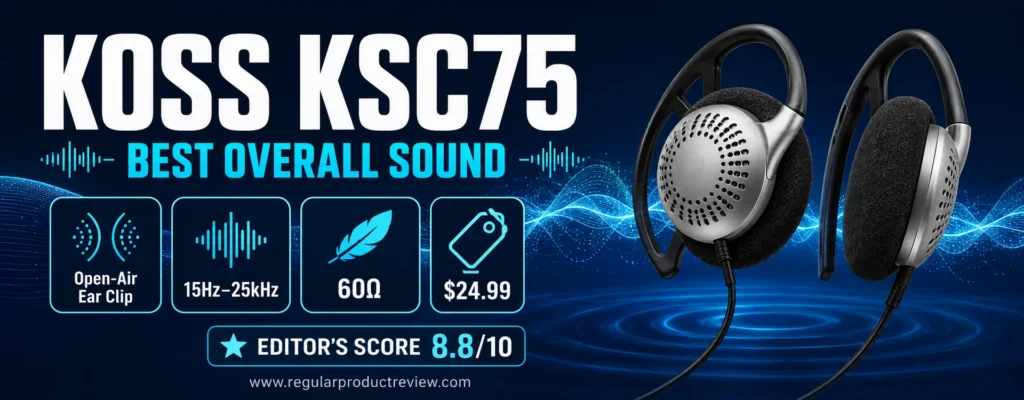
The same design creates its defining weakness. Open foam pads allow outside sound in and music out, so the KSC75 is a poor match for a bus, airplane, shared office, or quiet library. Bass also depends on placement and the small gap between the driver and ear. Listeners who expect the heavy low-end pressure of sealed headphones may find it lean, even if the midrange and treble are more revealing.
Fit is personal because the pivoting clips rest around the outer ear instead of distributing pressure through a headband. Many people enjoy the almost weightless sensation; others need time to position the clips or dislike contact behind the ear. The 4-foot dual-entry cable and 3.5mm plug are simple, but there is no microphone, inline remote, Bluetooth radio, or detachable cable. This is a sound-first tool for quiet listening, not a feature bundle.
| Award | Product | Why It Earned the Award | Best For | Overall Score |
|---|---|---|---|---|
| 🏆 Best Overall Sound | Koss KSC75 | Open-air clarity and an unusually spacious presentation at the price | Quiet rooms, music discovery, podcasts, casual gaming | 8.8/10 |
Koss KSC75 Key Specifications
| Feature | Verified Specification |
|---|---|
| 🎧 Design | Open-air ear-clip headphones |
| 🎵 Frequency response | 15Hz–25kHz, manufacturer rated |
| ⚙️ Impedance | 60 ohms |
| 🔊 Sensitivity | 101dB SPL/1mW |
| 🔌 Connection | 3.5mm, straight dual-entry 4-foot cable |
| 🎙️ Microphone | No |
| 🛡️ Warranty | Koss limited lifetime warranty |
| 💰 Verified price | $24.99 direct from Koss |
The specifications and current price are documented on the official Koss KSC75 product page. Buyers should still check whether their phone, tablet, or laptop retains a 3.5mm output; many newer mobile devices require a separate USB-C or Lightning adapter.
Listeners who like the KSC75’s value but need a conventional sealed cup can compare the current best budget headphones under $50, where the extra budget opens room for stronger pads, hinges, and isolation.
If you want stronger passive isolation or a conventional headband, the KSC75 is not the right kind of bargain. Compare the design priorities in our budget headphones hub before deciding whether openness is an advantage or a deal-breaker.
Sound, Comfort, and Real-World Use
The KSC75’s open construction is most valuable at a desk or in a private room. Voices remain clear, cymbals and strings have breathing space, and the presentation feels less trapped inside the head than many inexpensive closed models. It is also easier to hear a doorbell or another person speaking, which can be useful at home but unsafe to interpret as full environmental awareness near traffic.
There is little mechanical clamping force, yet the clips can create localized pressure. Adjust the pivot slowly and place each pad evenly instead of pulling the clip tight. Replacement foam pads are inexpensive, and changing worn foam can restore comfort, but modifications may alter sound and are outside this recommendation.
| ✅ Reasons to Buy | ⚠️ Things to Consider |
|---|---|
| Open, spacious sound for the money | Provides almost no isolation |
| Extremely light and easy to pack | Clip comfort depends on ear shape |
| Standard 3.5mm connection | No microphone or remote |
| Limited lifetime warranty | Dual-entry cable is not detachable |
Editor’s Recommendation: Choose the Koss KSC75 when sound quality in a quiet environment matters more than privacy, deep bass pressure, or call controls. Skip it for commuting, libraries, recording microphones, and any place where leakage could disturb other people.
Check the current Koss KSC75 price and confirm your device has a compatible 3.5mm output →
Sony MDR-ZX110 Review — Best Cheap Headphones for Travel
Editorial Rating: 8.5/10
The Sony MDR-ZX110 is the practical counterpoint to the Koss. It uses a familiar closed, on-ear layout, swivels flat for storage, and connects through a standard 3.5mm plug without batteries. At Sony’s current $9.99 sale price, it is one of the easiest recommendations for a backup pair, a school bag, an in-flight entertainment adapter, or a household device that still has an analog jack.
Its 30mm neodymium dynamic drivers and manufacturer-rated 12Hz–22kHz range are ordinary rather than revolutionary. The meaningful advantage is consistency of purpose: the headphones are light, compact, and simple. They deliver more perceived bass weight and less leakage than an open ear-clip design, though the small on-ear cushions cannot isolate like a well-sealed over-ear pair.
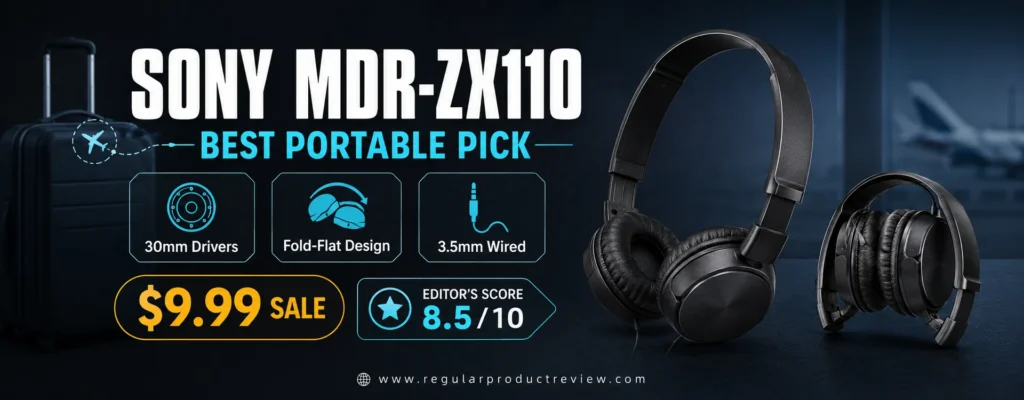
The standard MDR-ZX110 reviewed here has no microphone or inline remote. Sony sells similarly named variants, including the MDR-ZX110AP with call controls and the MDR-ZX110NC with active noise cancellation, so buyers should read the complete model code. A low price on one version does not transfer its features to another.
Long sessions reveal the limits of the compact construction. On-ear pads press against the outer ear, the headband has modest padding, and the lightweight plastic feels built to meet a price rather than survive careless twisting. The flat-folding cups help it travel, but they also add joints that should be handled deliberately.
| Award | Product | Why It Earned the Award | Best For | Overall Score |
|---|---|---|---|---|
| ✈️ Best Portable Everyday Pick | Sony MDR-ZX110 | Flat storage, passive simplicity, and a very low current sale price | Travel backup, students, casual listening | 8.5/10 |
Sony MDR-ZX110 Key Specifications
| Feature | Verified Specification |
|---|---|
| 🎧 Design | Closed-back, on-ear, swiveling cups |
| ⚙️ Driver | 30mm neodymium dynamic |
| 🎵 Frequency response | 12Hz–22kHz, manufacturer rated |
| ⚙️ Impedance | 24 ohms |
| 🔌 Connection | 3.5mm stereo mini plug |
| 🎙️ Microphone | No on standard MDR-ZX110 |
| 🔋 Battery | None required |
| 💰 Verified price | $9.99 sale; $24.99 MSRP at Sony |
Sony’s product page confirms the current price, driver size, connection, and standard model’s lack of a microphone in the official MDR-ZX110 specifications. Because promotions change, verify that the black or white version remains below the article’s $25 ceiling.
For a rechargeable alternative, compare current options in our best wireless headphones under $50 guide. Wireless models cost more because the budget must cover a battery, radio, microphone, controls, and charging hardware in addition to the acoustic parts.
Portability, Isolation, and Compatibility
The MDR-ZX110 folds flatter than any full-size model in this guide. That makes it easy to slide into a laptop sleeve, but it does not include the protective structure of a hard case. Store it where keys and charging bricks cannot crush the cups or pull the cable at an angle.
Passive attenuation is limited by the on-ear seal. It will soften some room noise, yet it cannot replace purpose-built active noise cancellation. Shoppers expecting a quiet airplane cabin should move to our noise-cancelling headphones category and plan for a much larger budget.
| ✅ Reasons to Buy | ⚠️ Things to Consider |
|---|---|
| Excellent current sale value | Standard version has no microphone |
| Swivels flat for bags and drawers | On-ear pads may tire sensitive ears |
| No charging or pairing required | Lightweight joints need careful handling |
| Easy to drive from common devices | Isolation is modest, not noise cancelling |
💰 Configuration Alert: This recommendation is for the MDR-ZX110. Do not assume that a listing includes the AP model’s microphone or the NC model’s active noise cancellation; confirm the suffix, plug, controls, and final price.
Editor’s Recommendation: Buy the Sony MDR-ZX110 as an inexpensive wired travel or backup pair. Choose a headset with a microphone if calls are part of the job, and choose over-ear cups if on-ear pressure bothers you.
Confirm the exact Sony model code and current under-$25 price before ordering →
Panasonic RP-HT161-K Review — Best Full-Size Headphones for the Money
Editorial Rating: 8.4/10
The Panasonic RP-HT161-K answers a simple question: how much conventional over-ear headphone can you buy for well under $25? At its verified $16.99 sale price, it provides full-size padded cups, a quick-adjust headband, dual 30mm neodymium drivers, and a 6.5-foot cable. It is designed for a couch, television, desktop, or family computer rather than a jacket pocket.
The larger format spreads contact around the ear instead of pressing directly on it, which many listeners prefer for movies and longer sessions. Panasonic also rates the headphones for up to 1000mW input and describes an XBS bass-oriented presentation. That power figure does not mean they need an amplifier, nor does it establish sound quality; it primarily indicates electrical input handling.
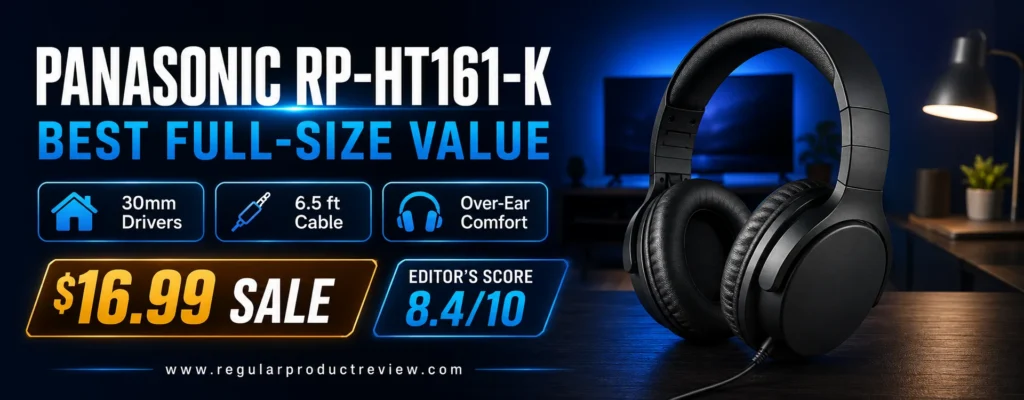
This is a home-value product, and its compromises follow that mission. The long cable is convenient when a television or tower PC sits farther away, but it can snag while walking. There is no folding mechanism, microphone, inline control, detachable lead, wireless mode, or premium case. The all-plastic construction also deserves ordinary care at the headband and cable entry points.
Availability is the larger buying caveat. Panasonic’s U.S. page showed the model as sold out when checked, even though the price remained listed. Authorized and major retailers may still carry it, but the final recommendation applies only to a new unit at $25 or less with a reasonable return policy. Do not pay collector-like pricing for an older basic design.
| Award | Product | Why It Earned the Award | Best For | Overall Score |
|---|---|---|---|---|
| 💰 Best Full-Size Value | Panasonic RP-HT161-K | Full-size comfort and a long home-friendly cable at a low verified price | TV, desktop, movies, casual music | 8.4/10 |
Panasonic RP-HT161-K Key Specifications
| Feature | Verified Specification |
|---|---|
| 🎧 Design | Full-size over-ear, closed format |
| ⚙️ Driver | Dual 30mm neodymium units |
| 🔊 Maximum input | 1000mW, manufacturer rated |
| 🔌 Cable | 6.5 feet, fixed |
| 🎙️ Microphone | No on RP-HT161-K |
| 🎛️ Controls | None |
| 💰 Verified price | $16.99 sale on Panasonic U.S. page |
| 📦 Availability note | Direct listing was sold out when checked |
The official Panasonic RP-HT161-K listing documents the full-size design, driver specification, cable length, and current direct price. Seller stock and shipping charges can change the actual value.
If you need more robust cushions, detachable cabling, or a better-documented sound target, see our best audiophile headphones under $100 rather than interpreting the word “XBS” as a guarantee of controlled bass.
Comfort, Cable Management, and Home Use
The RP-HT161-K makes the most sense when the listener remains seated. Its cable reaches comfortably from many entertainment setups, and the closed cups help keep movie dialogue more private than an open design. The pads are plush for the cost, but materials at this level can trap heat and compress with age.
For laptop use, coil excess cable loosely and secure it with a reusable tie. Do not wrap it tightly around the headband; repeated sharp bends near the plug or cup can damage internal conductors. Anyone who moves constantly between rooms should prioritize Bluetooth or a shorter portable cable.
| ✅ Reasons to Buy | ⚠️ Things to Consider |
|---|---|
| Full-size fit at a very low price | Direct Panasonic stock was unavailable when checked |
| Long cable suits television and desktop use | Cable is cumbersome for commuting |
| No batteries or software required | No mic, controls, or folding design |
| Padded cups avoid direct on-ear pressure | Basic materials need careful storage |
Readers seeking a purpose-built chat mic should compare the options in our gaming headsets section because an inexpensive music headphone plus a weak laptop microphone rarely produces consistent voice pickup.
Editor’s Recommendation: Choose the Panasonic RP-HT161-K for stationary listening when you find new stock at or below $25. Skip inflated third-party listings and choose a portable model if the 6.5-foot fixed cable would spend most of its life tangled in a bag.
Check seller stock, return terms, and the final Panasonic price before buying →
JVC HA-RX330 Review — Best Budget Headphones for Home Listening
Editorial Rating: 8.6/10
The JVC HA-RX330 earns its place by being unapologetically domestic. Its full-size around-ear cups, 40mm drivers, soft pads, and 9.8-foot cable belong beside a desktop, stereo receiver, keyboard, or television. The package even includes access to both a 3.5mm mini-jack and 6.3mm connection, making it easier to move between consumer electronics and older home-audio equipment.
JVC lists a 7Hz–21kHz frequency response, 32-ohm impedance, and 107dB sensitivity. These are manufacturer specifications, not evidence that the RX330 reaches sub-bass more accurately than every competitor. The useful differentiators are the larger driver, closed around-ear shape, and Deep Bass Port—features aimed at a fuller, more substantial home-listening presentation.
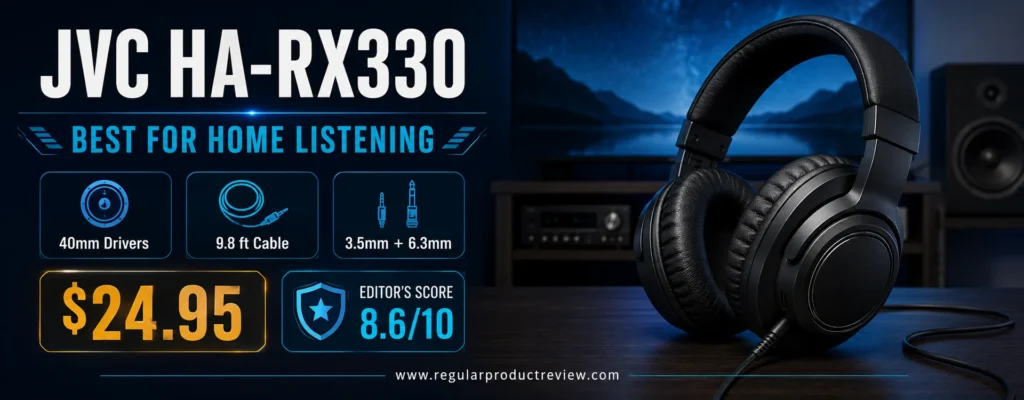
At 4.23 ounces without the cable, the headphone itself is lighter than its size suggests. The soft cushions can be more forgiving than small on-ear pads, especially for a movie or album. Still, “around ear” does not guarantee that every ear fits completely inside the opening, and inexpensive synthetic pads can become warm during extended sessions.
The long cord is both the reason to buy and the reason to skip. It gives a seated listener freedom to lean back, yet becomes excessive beside a phone or on public transit. There is no microphone, detachable cable, folding hinge, active noise cancellation, or portable case. This is a focused wired home headphone with a verified $24.95 price, not an all-purpose travel accessory.
| Award | Product | Why It Earned the Award | Best For | Overall Score |
|---|---|---|---|---|
| 🏠 Best for Home Listening | JVC HA-RX330 | Full-size 40mm design, long cable, and dual plug compatibility | TV, stereo, desktop, instruments | 8.6/10 |
JVC HA-RX330 Key Specifications
| Feature | Verified Specification |
|---|---|
| 🎧 Design | Closed, around-ear, full-size |
| ⚙️ Driver | 40mm ferrite dynamic |
| 🎵 Frequency response | 7Hz–21kHz, manufacturer rated |
| ⚙️ Impedance | 32 ohms |
| 🔊 Sensitivity | 107dB at 1kHz/1mW |
| 🔌 Cable | 9.8 feet, fixed |
| 🔗 Plugs | Gold-plated 3.5mm and 6.3mm compatibility |
| 💰 Verified price | $24.95 direct listing |
The official JVC HA-RX330 page confirms the driver, cable, plug, impedance, weight, and listed U.S. price. Confirm that an adapter is included in the specific retail package if the 6.3mm connection is important to you.
Listeners who are building a more revealing desktop setup should read our audiophile headphones guide before treating the RX330 as a monitoring reference. A wide published frequency range cannot describe tonal smoothness, channel matching, or distortion.
Where the HA-RX330 Fits Best
This model is most useful when cable reach and large cups matter more than portability. A television listener can sit farther from the screen, a student can connect to a desktop tower under a desk, and a beginner musician can use the larger plug with compatible gear. Because the cable is fixed, route it where chair wheels and pets cannot pull it.
The closed cups reduce leakage relative to the KSC75, but JVC does not market this model as an active noise-cancelling headphone. For commuting or engine noise, consult our best noise-cancelling headphones under $100 and budget for electronics designed to address low-frequency ambient sound.
| ✅ Reasons to Buy | ⚠️ Things to Consider |
|---|---|
| Large 40mm full-size design | Nearly 10-foot cable is travel-unfriendly |
| 3.5mm and 6.3mm connectivity | Fixed cable cannot be replaced easily |
| Lightweight for its physical size | No microphone or inline remote |
| Strong stationary-listening value | Published range does not prove accuracy |
Editor’s Recommendation: Buy the JVC HA-RX330 when your headphones will live near a television, desktop, receiver, or instrument. Pick the Sony MDR-ZX110 or JVC HA-S31M if folding portability matters more than cup size and cable reach.
Verify the JVC HA-RX330 package contents and current under-$25 price →
Koss UR20 Review — Best Comfortable Full-Size Pick Under $25
Editorial Rating: 8.3/10
The Koss UR20 takes a comfort-first route within the same price ceiling. It uses a conventional closed, full-size frame with leatherette cushions and a suspended-looking headband structure that spreads the headphone’s weight. The design is less compact than an on-ear travel model, but it can feel more natural when direct pressure on the outer ear is the main source of fatigue.
Koss positions the UR20 for music lovers and entry-level DJ or recording use. Its official specifications include a 30Hz–20kHz response, 32-ohm impedance, 97dB SPL sensitivity, and an 8-foot single-entry cable. Those figures suggest easy compatibility with common sources, while the cable length favors stationary work over pocket use.
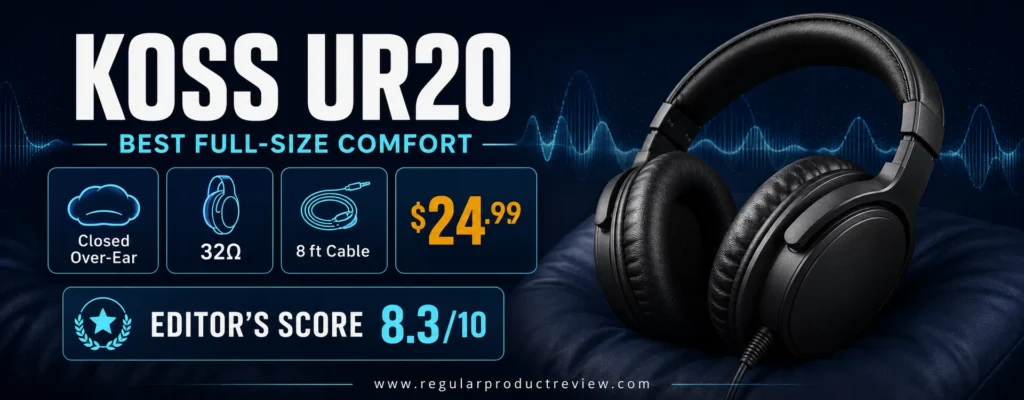
The word “noise isolating” on the product page refers to the passive effect of closed cushions, not electronic active noise cancellation. The seal will vary with head shape, glasses, hair, and pad wear. It can soften household distraction and reduce leakage, but buyers should not expect the cabin-quiet effect of a powered ANC system.
The UR20’s value also depends on realistic expectations about construction. It is a $24.99 plastic headphone with a fixed cable, not a modular studio investment. Koss does support its wired headphones with a limited lifetime warranty, which is unusual at this price, but warranty terms do not protect against every kind of accidental damage or eliminate shipping considerations.
| Award | Product | Why It Earned the Award | Best For | Overall Score |
|---|---|---|---|---|
| ☁️ Best Full-Size Comfort | Koss UR20 | Large closed cushions, straightforward fit, and long single-entry cable | Home study, music, basic monitoring | 8.3/10 |
Koss UR20 Key Specifications
| Feature | Verified Specification |
|---|---|
| 🎧 Design | Closed, full-size over-ear |
| 🎵 Frequency response | 30Hz–20kHz, manufacturer rated |
| ⚙️ Impedance | 32 ohms |
| 🔊 Sensitivity | 97dB SPL |
| 🔌 Cable | 8 feet, straight single-entry |
| 🎙️ Microphone | No |
| 🛡️ Warranty | Koss limited lifetime warranty |
| 💰 Verified price | $24.99 direct from Koss |
Full specifications and current pricing appear on the official Koss UR20 page. As with every fixed-cable model, a damaged lead can end the useful life of the headphone even when the cups and drivers remain intact, so avoid pulling from the cable itself.
The UR20 makes more sense than a gaming headset when you already own a separate microphone. If you need one device for voice chat, explore the best gaming headsets under $100 for boom-mic models with clearer platform support.
Comfort Versus Portability
Large cushions provide room around the ear, but the UR20 occupies far more bag space than the Sony or JVC portable picks. It neither folds flat nor removes its cable. For a dorm desk, family computer, or keyboard practice station, that is manageable; for a daily commute, it becomes unnecessary bulk.
Comfort is also not a universal spec. Head size changes clamp, ear shape changes pad contact, and leatherette can hold heat. Buyers sensitive to closed-cup warmth may prefer the ventilation of the KSC75 or compare lightweight options in our best budget headphones under $50 roundup.
| ✅ Reasons to Buy | ⚠️ Things to Consider |
|---|---|
| Full-size cushions avoid direct on-ear contact | Bulky and non-folding |
| Single-entry cable reduces desk clutter | Eight-foot cable is too long for mobile use |
| Closed design limits some leakage | Passive isolation only; no ANC |
| Limited lifetime warranty | Fixed cable and basic plastic build |
Editor’s Recommendation: Choose the Koss UR20 for a low-cost stationary setup when large cushions matter more than compact storage. Skip it if you need a microphone, a detachable lead, or a headphone that disappears into a small backpack pocket.
Review the Koss warranty terms and confirm the direct price before purchase →
JLab Rewind 2 Wireless Review — Best Bluetooth Headphones Under $25
Editorial Rating: 8.2/10
The JLab Rewind 2 Wireless is the outlier in this guide because it fits a surprisingly complete Bluetooth feature set into the $24.99 limit. It combines Bluetooth 5.4, 20+ hours of manufacturer-rated playtime, multipoint connection to two devices, AAC and SBC codecs, USB-C charging, app-based equalization, Google Fast Pair, and a lightweight retro frame.
That list is impressive only when the physical compromises are equally clear. At 56.8 grams, the Rewind 2 feels featherweight because it uses small foam-covered on-ear pads and a minimal headband. The pads breathe better than sealed leatherette, but they provide little passive isolation and can leak sound. The retro shape is functional nostalgia, not a substitute for robust hinges or plush over-ear comfort.
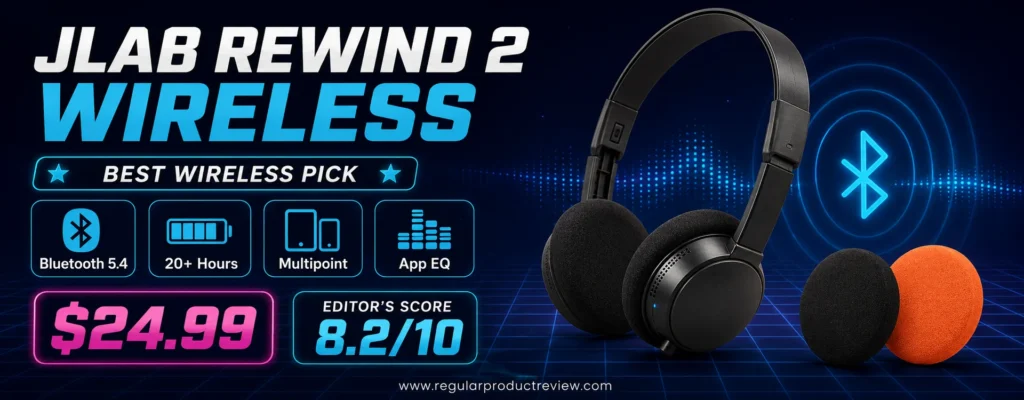
The built-in microphone supports basic calls, and JLab lists a one-mic environmental-noise-cancelling system. That refers to microphone processing, not ANC for the listener. The headphones do not create a quiet bubble around music, and call quality will still depend on wind, room noise, device software, and microphone position.
Battery figures also need attribution. JLab advertises 20+ hours and a 10-minute charge for up to three hours, but actual runtime changes with volume, codec, calls, app use, temperature, and battery age. There is no analog fallback listed, so a depleted battery stops playback until the headphones receive power.
| Award | Product | Why It Earned the Award | Best For | Overall Score |
|---|---|---|---|---|
| 📶 Best Wireless | JLab Rewind 2 Wireless | Modern Bluetooth, multipoint, app EQ, and USB-C at $24.99 | Phones, casual commuting, two-device users | 8.2/10 |
JLab Rewind 2 Wireless Key Specifications
| Feature | Verified Specification |
|---|---|
| 🎧 Design | Lightweight on-ear with foam pads |
| ⚙️ Driver | 36mm dynamic |
| 📶 Bluetooth | Version 5.4; SBC and AAC |
| 🔗 Multipoint | Yes, two-device connection |
| 🔋 Battery | 20+ hours claimed; 10 minutes for up to 3 hours |
| 🎙️ Microphone | One ECM mic with ENC processing |
| ⚖️ Weight | 56.8 grams |
| 💰 Verified price | $24.99 direct from JLab |
JLab documents the price, Bluetooth version, codecs, multipoint, weight, battery claim, microphone, and app support on the official Rewind 2 Wireless page. Features may require the current JLab app and compatible Android services.
For stronger build, deeper cushions, or active noise cancellation, the trade-offs change above this ceiling. Our best wireless headphones under $100 compares models with more budget allocated to acoustic sealing, batteries, and hardware controls.
Wireless Features That Matter—and Those That Do Not
Multipoint is the standout practical feature. A student can remain connected to a laptop and phone, or a home worker can switch between a meeting computer and mobile call without repairing every time. App EQ is useful for correcting preference, but it cannot create the physical isolation or sub-bass seal that open foam pads lack.
AAC can be helpful with compatible Apple devices, while SBC remains the universal baseline. Neither codec turns a $25 on-ear headphone into lossless studio equipment. Gamers should also note JLab’s listed latency figures and use Movie Mode where appropriate; competitive play is better served by a wired or dedicated low-latency headset from our gaming headset guide.
| ✅ Reasons to Buy | ⚠️ Things to Consider |
|---|---|
| Bluetooth 5.4 and multipoint | No listed analog wired fallback |
| App EQ and Google Fast Pair | Foam pads isolate very little |
| Exceptionally low weight | Built-in mic is for convenience, not broadcast |
| USB-C charging and quick-charge claim | Battery will age over time |
Editor’s Recommendation: Choose the JLab Rewind 2 Wireless when cable-free convenience, multipoint, and light weight matter most. Choose a wired pick if you want indefinite service without charging, lower latency, or easier long-term ownership.
Confirm that the JLab Rewind 2 remains $24.99 and review device compatibility →
Logitech H390 Review — Best Cheap USB Headset for Calls
Editorial Rating: 8.4/10
The Logitech H390 is not the best music headphone in this roundup; it is the best answer to a different problem. For $24.99, it combines plug-and-play USB digital audio, a left-side rotating boom microphone, 30mm drivers, an adjustable headband, leatherette on-ear cushions, and inline volume and mute controls. That focused package is more useful for meetings and classes than a better-sounding headphone with no reliable microphone.
USB bypasses the inconsistent analog headphone jacks and microphone inputs found on desktops and laptops. The headset presents itself as a digital audio device, so setup is usually straightforward on a supported Windows, macOS, or ChromeOS computer. Buyers must still select the right platform version: Logitech lists USB-A and USB-C choices, and the connector on the box should match the port available on the computer.
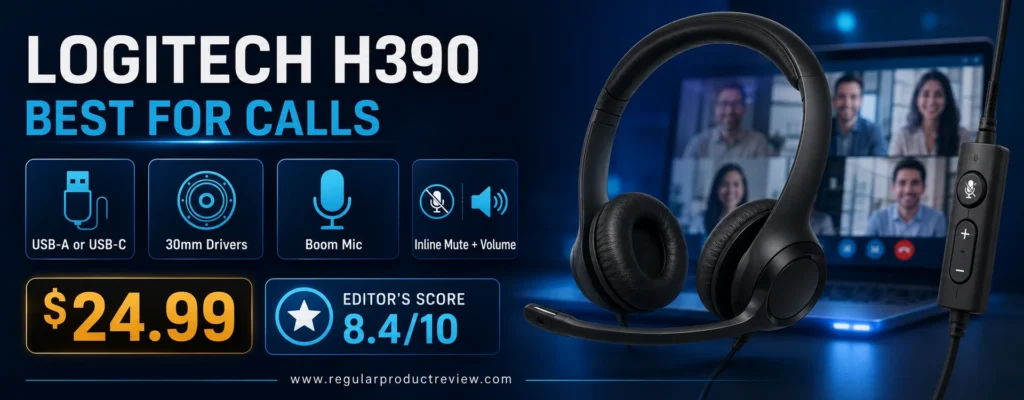
Logitech describes the microphone as noise cancelling, meaning it is designed to reduce some background sound in the captured voice. It does not cancel room noise for the wearer. Keyboard clicks, nearby conversation, fans, and reverberant rooms can still reach callers, especially when the boom sits too far from the mouth.
For music, the 30mm drivers are serviceable for background listening, spoken content, and training videos, but the lightweight on-ear frame prioritizes communication and convenience. The 1.9-meter fixed cable supports desk movement and the inline module provides immediate control, yet neither feature helps a phone without compatible USB audio support and the correct adapter.
| Award | Product | Why It Earned the Award | Best For | Overall Score |
|---|---|---|---|---|
| 🎙️ Best for Calls | Logitech H390 | Plug-and-play USB audio, positionable mic, and inline mute/volume controls | Meetings, remote classes, support calls | 8.4/10 |
Logitech H390 Key Specifications
| Feature | Verified Specification |
|---|---|
| 🎧 Design | Wired on-ear computer headset |
| ⚙️ Driver | 30mm |
| 🎙️ Microphone | Left-side rotating noise-reducing boom |
| 🎛️ Controls | Inline volume and mute |
| 🔌 Connection | Select USB-A or USB-C platform version |
| 📏 Cable | 1.9 meters |
| 🔋 Battery | None required |
| 💰 Verified price | $24.99 direct from Logitech |
The official Logitech H390 page confirms the current price, driver, cable, controls, and connector choices. Check operating-system recognition and port availability before purchase, particularly on tablets and phones.
People who divide time between meetings and music may prefer a general wireless headset at a higher price. The best wireless headphones guide covers models that can move between a computer and mobile device without remaining tethered to a desk.
Call Clarity, Controls, and Computer Compatibility
The H390’s mute switch is a meaningful usability feature. Instead of searching for an app control during a meeting, the wearer can make an immediate hardware change. The positionable boom also keeps the microphone closer to speech than a laptop’s distant built-in array, though good results still depend on placement and room acoustics.
This is not a console-first gaming headset. USB support varies between platforms, and surround-sound claims are not part of the recommendation. Players who need controller compatibility, a more flexible boom, or in-game/chat balancing should compare our gaming headsets category rather than assume every USB headset works everywhere.
| ✅ Reasons to Buy | ⚠️ Things to Consider |
|---|---|
| Dedicated boom mic for clearer voice capture | Music performance is secondary |
| Physical volume and mute controls | On-ear pads can create pressure |
| No charging or Bluetooth setup | USB version must match the device |
| Long cable suits a desk | Not universally compatible with phones or consoles |
Editor’s Recommendation: Buy the Logitech H390 for a computer-centered call or learning setup where mute access and a boom mic matter. Skip it for commuting, critical music listening, or a device that only provides a 3.5mm analog jack.
Choose the correct USB-A or USB-C H390 version and verify the final price →
TASCAM TH-02 Review — Best Cheap Headphones for Beginner Recording
Editorial Rating: 8.3/10
The TASCAM TH-02 is the most studio-shaped option in this guide. It uses a closed-back, folding over-ear design with 50mm drivers, a long 9.8-foot cable, 32-ohm impedance, and a snap-on 3.5mm-to-6.3mm adapter. At the verified $21.99 Sweetwater price, that package is useful for a first audio interface, digital piano, podcast desk, or bedroom recording setup.
Its advantage is connectivity and coverage, not guaranteed neutrality. TASCAM markets the TH-02 for recording and monitoring, but a “studio” label does not establish a flat frequency response. The manufacturer-rated 18Hz–22kHz range describes claimed extension, while independent listening and measurement conditions would be needed to determine tonal accuracy.
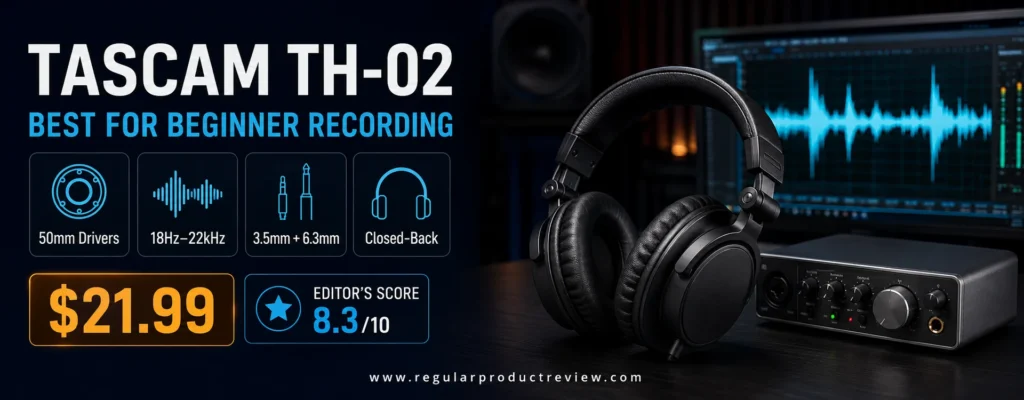
Closed cups are helpful around a live microphone because they leak less sound than an open model. The folding frame also makes storage easier than with some full-size alternatives. However, pad openings, clamp, and heat will suit some heads better than others, and the inexpensive plastic structure should be folded at its intended joints rather than twisted.
There is no microphone, inline remote, detachable cable, Bluetooth mode, or active noise cancellation. The long lead works well from an interface or keyboard but needs management at a small laptop desk. Beginners should view the TH-02 as an affordable monitoring and practice tool—not as proof that a mix will translate perfectly to speakers, cars, and other headphones.
| Award | Product | Why It Earned the Award | Best For | Overall Score |
|---|---|---|---|---|
| 🎚️ Best for Beginner Recording | TASCAM TH-02 | Closed 50mm format, long cable, and included 6.3mm adapter | Interfaces, keyboards, podcast monitoring | 8.3/10 |
TASCAM TH-02 Key Specifications
| Feature | Verified Specification |
|---|---|
| 🎧 Design | Closed-back, folding, over-ear |
| ⚙️ Driver | 50mm dynamic |
| 🎵 Frequency response | 18Hz–22kHz, manufacturer rated |
| ⚙️ Impedance | 32 ohms |
| 🔊 Sensitivity | 98dB ±3dB |
| 🔌 Cable | 9.8 feet; fixed |
| 🔗 Adapter | Snap-on 3.5mm to 6.3mm |
| 💰 Verified price | $21.99 at Sweetwater |
TASCAM documents the model and intended monitoring use on the official TH-02 page, while the current selling price and core specifications were confirmed through the Sweetwater TH-02 listing. Retail promotions and shipping can change the delivered total.
Creators who need a better-established monitoring tool should compare our best audiophile headphones under $200 and budget separately for an audio interface if the source lacks the necessary inputs and outputs.
Monitoring Value Without “Studio” Hype
The TH-02 can help a beginner hear a click track, check an edit, record a voice without loudspeaker spill, or practice an instrument quietly. Those are real jobs. Final EQ and balance decisions should still be checked on several playback systems because inexpensive closed headphones can emphasize or recess parts of the spectrum.
The included larger adapter adds practical value. Insert it only when equipment uses a 6.3mm socket, and remove it for ordinary 3.5mm devices. A loose stack of third-party adapters can stress the jack, so the fitted snap-on design is preferable when kept secure.
| ✅ Reasons to Buy | ⚠️ Things to Consider |
|---|---|
| Large 50mm closed-back design | “Studio” branding does not guarantee neutrality |
| Useful 3.5mm-to-6.3mm adapter | Long fixed cable needs desk management |
| Folding frame | No microphone or controls |
| Strong value for first monitoring setup | Fit and heat vary during long sessions |
Our audiophile headphones category explains why driver size and frequency range cannot replace controlled measurement, fit, and source matching when critical accuracy becomes the goal.
Editor’s Recommendation: Choose the TASCAM TH-02 for entry-level recording, keyboard practice, or interface monitoring when the price stays below $25. Do not rely on it as the only reference for a finished mix.
Check the retailer’s final TH-02 price, shipping charge, and return policy →
JVC HA-S31M Review — Best Compact Budget Headphones With a Mic
Editorial Rating: 8.1/10
The JVC HA-S31M fills the gap between a music-only portable headphone and a computer-only call headset. It is a lightweight wired on-ear model with a flat-folding swivel design, soft pads, and a one-button remote with microphone. At JVC’s listed $24.95 price, it suits a backpack, older phone, tablet, Chromebook, or laptop that still accepts a compatible 3.5mm headset plug.
JVC rates the headphone from 10Hz to 26kHz with 32-ohm impedance and neodymium drivers. The range is not a ranking metric, but the low impedance supports ordinary portable use without a dedicated amplifier. The inline microphone is the more important distinction because it allows basic calls without a boom extending from the cup.
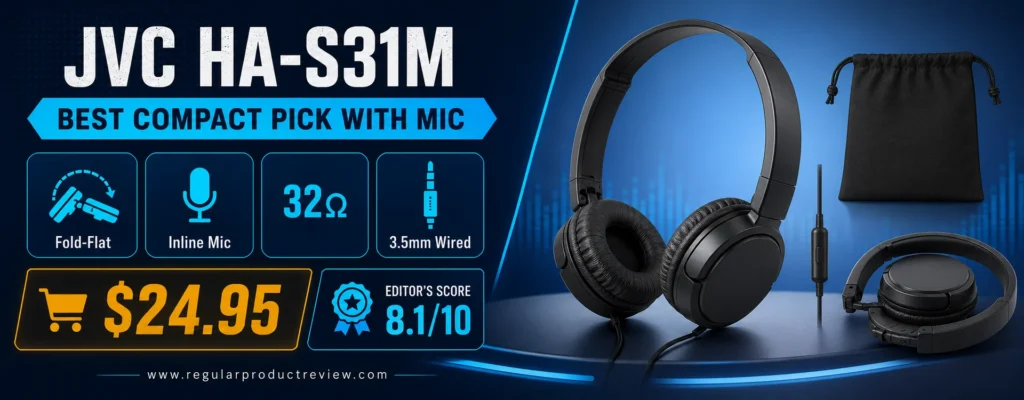
That mic is designed for convenience. Its location on the cable places it farther from the mouth than the Logitech H390’s boom, making voice level and background pickup more dependent on how the cable hangs. The single button may control play, stop, track changes, or calls on compatible devices, but exact behavior varies by operating system and app.
The HA-S31M folds flatter than the full-size home models and needs no charging. Its on-ear pads also mean pressure rests directly on the ear, and passive isolation remains moderate. The non-detachable cable is the likely long-term vulnerability, so store the headphone without sharp bends around the remote or plug.
| Award | Product | Why It Earned the Award | Best For | Overall Score |
|---|---|---|---|---|
| 🎒 Best Compact Headphones With Mic | JVC HA-S31M | Flat-folding portability plus a basic one-button mic/remote | School bags, phones with 3.5mm, casual calls | 8.1/10 |
JVC HA-S31M Key Specifications
| Feature | Verified Specification |
|---|---|
| 🎧 Design | Lightweight, fold-flat on-ear |
| 🧲 Magnet | Neodymium; one driver per ear |
| 🎵 Frequency response | 10Hz–26kHz, manufacturer rated |
| ⚙️ Impedance | 32 ohms |
| 🎙️ Microphone | Inline mic with one-button remote |
| 🔌 Connection | Wired 3.5mm headset plug |
| 🔋 Battery | None required |
| 💰 Verified price | $24.95 direct listing |
The official JVC HA-S31M specifications confirm the fold-flat design, remote and microphone, impedance, and current U.S. list price. Confirm headset-jack wiring and adapter compatibility for your specific device.
Students who want inexpensive study hardware can also compare the price tiers in our budget headphones guide. Spending more may add replaceable cables, better padding, or Bluetooth multipoint, but it is unnecessary when a simple wired connection already solves the problem.
Portable Calls and Device Compatibility
The 3.5mm headset plug is easiest with devices that combine headphones and microphone in one CTIA-style socket. Desktop towers with separate green headphone and pink microphone ports may need a splitter. Phones without analog audio require a USB-C or Lightning adapter that explicitly supports both output and microphone input.
If voice clarity matters more than portability, the Logitech H390 remains the better tool because its boom sits closer to the mouth. For chat-heavy gaming, our best gaming headsets under $100 explains the benefits of platform-certified connections, larger mics, and dedicated controls.
| ✅ Reasons to Buy | ⚠️ Things to Consider |
|---|---|
| Folds flat and weighs little | On-ear fit can create pressure |
| Inline microphone and one-button remote | Control functions vary by device |
| No charging required | Mic is less focused than a boom |
| Standard analog format | Many new phones need an adapter |
Editor’s Recommendation: Buy the JVC HA-S31M when you need compact wired headphones and occasional call support in one inexpensive package. Choose the Sony MDR-ZX110 if a mic is unnecessary, or the Logitech H390 for desk calls.
Confirm 3.5mm headset compatibility and the JVC price before ordering →
JLab JBuddies Studio 2 Wired Review — Best Kids Headphones Under $25
Editorial Rating: 8.0/10
The JLab JBuddies Studio 2 Wired is the only recommendation here designed specifically around children rather than merely offered in a small size. JLab lists it for ages six and older and builds in an 85dB volume limiter. At $19.99, it combines that safety-oriented output limit with adjustable pinch-free hinges, a folding on-ear frame, Cloud Foam cushions, and a wired connection that never needs charging.
The 40mm drivers, 32-ohm impedance, and 20Hz–20kHz manufacturer range are less important than the fit and limiter. Children are not miniature adults: a headband that sits securely and controls that do not encourage excessive output provide more practical value than oversized bass claims. The 139-gram weight also helps keep the headset manageable for school and home use.

The built-in MEMS microphone supports classes and calls without a boom. As with other cable mics, speech quality depends on cable position, background noise, and device compatibility. The headphones are wired, but the official specification table should be checked for the exact plug supplied with the current U.S. package if a tablet requires USB-C instead of analog audio.
An 85dB limiter is a useful guardrail, not permission for unlimited listening. Exposure risk depends on level and duration, and source devices can behave differently. The World Health Organization’s safe-listening guidance recommends keeping device volume below 60% of maximum, using well-fitted headphones, and taking listening breaks.
| Award | Product | Why It Earned the Award | Best For | Overall Score |
|---|---|---|---|---|
| 🧒 Best for Kids | JLab JBuddies Studio 2 Wired | Child-sized fit, 85dB limiter, foldability, and mic at $19.99 | Ages 6+, school, travel, learning apps | 8.0/10 |
JLab JBuddies Studio 2 Wired Key Specifications
| Feature | Verified Specification |
|---|---|
| 🎧 Design | Foldable on-ear, adjustable, ages 6+ |
| ⚙️ Driver | 40mm dynamic |
| 🔉 Volume limit | 85dB built-in limit |
| 🎙️ Microphone | One MEMS mic |
| ⚙️ Impedance | 32 ohms |
| ⚖️ Weight | 139 grams |
| 🔌 Connection | Wired |
| 💰 Verified price | $19.99 direct from JLab |
JLab provides the price, age guidance, limiter, microphone, dimensions, and driver information on the official JBuddies Studio 2 Wired page. Check color and connection variant because similar JBuddies wireless products cost more.
Families comparing general-purpose inexpensive options can visit our budget headphones category, but adult models should not be assumed to fit children or provide a dependable loudness limit.
Safe Listening, Fit, and School Use
Fit should be checked without forcing the headband inward. The pads should sit evenly, the hinge should not pinch hair or skin, and the cable should route away from chair wheels and walking paths. A child who repeatedly removes the headset may be signaling discomfort rather than refusing the activity.
For long classes, use speakers where appropriate and schedule quiet breaks. A limiter cannot compensate for continuous exposure or loud environmental noise that encourages the child to raise source volume. Parents seeking more isolation should compare higher-priced models in our noise-cancelling headphones guide but should never rely on ANC as a replacement for supervision and safe levels.
| ✅ Reasons to Buy | ⚠️ Things to Consider |
|---|---|
| Built-in 85dB limiter | Designed for ages six and older, not every child |
| Adjustable, foldable child-sized frame | Limiter does not replace breaks and supervision |
| Wired use avoids charging problems | Device may require an adapter |
| Integrated microphone for classes | Cable mic is sensitive to position |
Editor’s Recommendation: Choose the JLab JBuddies Studio 2 Wired for a child aged six or older when a volume limit, simple wired use, and school microphone matter. Confirm fit, connector type, and listening habits rather than choosing only by color.
Check the exact JBuddies wired variant and supervise safe listening →
How to Choose the Best Headphones Under $25 Without Wasting Money
The hardest part of shopping at this price is not finding products; it is separating useful compromises from false economy. A $20 headphone can be an excellent purchase when it performs one job reliably. It becomes expensive when the plug does not fit, the pads hurt after twenty minutes, the cable is wrong for the room, or the feature that motivated the purchase exists only in marketing copy.
Start with use rather than brand. Write down where the headphones will live, which device supplies audio, whether anyone needs a microphone, how long a typical session lasts, and how much outside sound must remain audible. That five-question filter eliminates most mismatches before frequency response, driver diameter, or star ratings enter the conversation.
Our broader best cheap headphones guide covers higher price tiers and alternative form factors. This section stays focused on extracting the best outcome from a strict headphones under 25 dollars ceiling.
Wired, USB, or Bluetooth: Pick the Connection First
A 3.5mm analog plug is still the simplest connection. It requires no pairing, battery, firmware, or app and normally works with laptops, controllers, audio interfaces, stereos, and older phones. New phones and some tablets removed the jack, however. Their adapters must contain the correct digital-to-analog hardware, and microphone support should be confirmed separately.
USB headsets such as the Logitech H390 include their own digital audio path. That can improve consistency on computers and enables convenient inline mute, but the product becomes less universal. USB-A and USB-C are physically different, console support varies, and a charging-only USB port or passive adapter may not carry audio.
Bluetooth removes the cable but adds a battery, radio, codec, controls, microphone, charging port, and software behavior to the bill of materials. Under $25, manufacturers must reduce cost elsewhere—often in pads, hinges, acoustic sealing, or wired backup. For a larger selection with fewer structural compromises, review our wireless headphones under $50 guide.
| Connection | Best When | Main Advantage | Primary Risk at This Price |
|---|---|---|---|
| 3.5mm analog | Device has a compatible jack | No battery, pairing, or latency concern | New phones may require an adapter |
| USB-A or USB-C | Calls happen on one computer | Digital audio and hardware controls | Limited cross-device compatibility |
| Bluetooth | Mobility is the priority | Cable-free use and possible multipoint | Battery aging and physical cost-cutting |
Open, On-Ear, and Over-Ear Designs Feel Completely Different
Open headphones allow air and sound to move through the driver enclosure. This can produce a wider, more natural sense of space, but it also allows environmental noise in and music out. The Koss KSC75 is excellent in a quiet room and inconsiderate in a library at high volume. Open does not mean waterproof, sport-certified, or automatically safe outdoors.
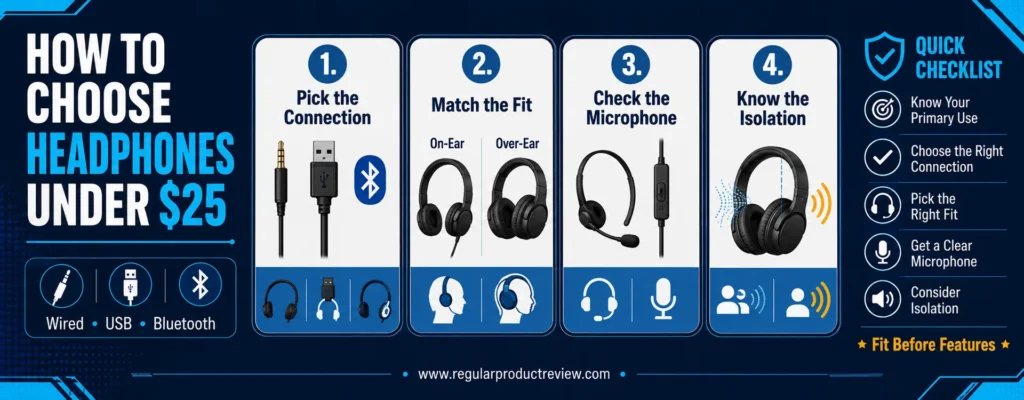
On-ear headphones rest on the outer ear. They are compact and light, but clamp pressure concentrates on a smaller area. Soft foam feels different from sealed leatherette: foam ventilates and leaks more, while leatherette may isolate better and grow warmer. Glasses, piercings, ear shape, and head width all affect comfort.
Over-ear headphones aim to surround the ear. They take more space and often use longer cables in this category, yet they can avoid direct ear pressure. “Over ear” on a product page does not guarantee that the pad opening is large enough for every listener, and budget pads may flatten over time.
Driver Size Is Not a Sound-Quality Score
This guide includes drivers from 30mm to 50mm, but the 50mm model is not automatically the winner. Driver material, diaphragm control, enclosure volume, damping, pad seal, tuning, distortion, and placement all interact. A well-implemented smaller driver can sound clearer and more balanced than a larger unit designed mainly for marketing impact.
The same caution applies to frequency response. A published 7Hz lower limit does not prove that usable, low-distortion bass reaches 7Hz at the listener’s ear. Manufacturers may use different test methods and tolerances, and many listings omit the allowable deviation completely. Use frequency range to confirm basic bandwidth, not to rank products across brands.
| Specification | What It Really Tells You | What It Does Not Prove | Practical Buying Use |
|---|---|---|---|
| Driver diameter | Physical size of the transducer | Detail, accuracy, or bass quality | Helps explain cup design, not ranking |
| Frequency range | Claimed operating bandwidth | Flatness or audible output at extremes | Confirm broad intended coverage only |
| Impedance | Electrical load at a given frequency | Required volume by itself | Pair with sensitivity and source capability |
| Sensitivity | Output under a stated input condition | Comfort or tonal quality | Helps estimate ease of driving |
| Maximum input | Power-handling limit | Loudness safety or sound quality | Relevant to powerful equipment, not phones |
Microphones: Inline Convenience Versus Boom-Mic Focus
An inline microphone hangs on the cable. It keeps the headphone compact and works well enough for a quick call in a quiet room, but distance from the mouth changes as the wearer moves. Clothing rub and cable contact can also transmit noise. One-button remotes may behave differently across Android, iOS, Windows, and individual apps.
A boom microphone places the capsule closer to speech. That improves the ratio between the user’s voice and room sound, making it the better format for frequent meetings, teaching, or team chat. The boom adds bulk and makes the headset look less natural outside a desk setting.
“Noise-cancelling microphone” does not mean the headphone has ANC. Microphone processing tries to reduce background sound sent to other people; active noise cancellation uses microphones and signal processing to reduce ambient sound heard by the wearer. Neither works perfectly, and neither label should be accepted without reading which side of the conversation it affects.
Buyers who need better call hardware should compare the microphone and platform details in our gaming headsets guide even if they do not play games; boom design, mute controls, and connector support are similar decision points.
How Much Isolation Can $25 Buy?
Passive isolation comes from physical sealing. Closed cushions can reduce some mid- and high-frequency noise, but performance changes with fit. Low engine rumble and HVAC noise are difficult to block passively, especially with lightweight on-ear pads.
Genuine ANC requires microphones, processing, power, and careful tuning. It is not a realistic baseline expectation for a durable $25 headphone. A product at this price may advertise microphone ENC, “noise isolating” pads, or a sealed cup; none is automatically equivalent to listener-side ANC.
If environmental noise is the primary problem, save for a purpose-built model from our best noise-cancelling headphones under $100 rather than buying multiple cheap pairs that never solve it.
⚠️ Buying Mistake to Avoid: Do not buy a sub-$25 headset because a listing includes the phrase noise cancelling. Identify whether the claim describes passive cushions, the call microphone, or true listener-side ANC—and expect true ANC to require a higher budget.
Comfort Cannot Be Predicted From Stars Alone
Headphones are wearable objects. A reviewer with a narrow head, small ears, no glasses, and a thirty-minute session can have a completely different experience from a listener with a wider head and two-hour class. Treat comfort reviews as evidence of possible issues, not a universal fit guarantee.
Look for adjustable headbands, swiveling cups, replaceable foam, reasonable weight, and a return window. On-ear pressure becomes more noticeable over time, while over-ear pads can trap heat. Ear clips eliminate headband clamp but shift pressure behind the ear.
When the pair arrives, test fit before discarding packaging. Wear it at normal listening level for a complete typical session. Stop if pressure becomes painful, if the headband creates a hot spot, or if maintaining the seal requires constant adjustment.
Durability and Repairability at a Very Low Price
Most headphones under $25 use plastic frames and fixed cables. Plastic is not inherently bad—it keeps weight and cost low—but thin folding joints should move only in their designed direction. A fixed cable is simple and cheap, yet difficult to replace when internal conductors fail near the plug.
Cable care has an outsized effect on lifespan. Pull the plug body, not the wire. Use loose coils rather than tight wraps. Keep chair wheels away from long studio cables, avoid hanging heavy adapters from a phone, and store folding cups flat without forcing the hinge.
Warranty matters, but read its scope. Koss’s limited lifetime policy is a differentiator for wired models, while JLab advertises a two-year warranty on current products. Return shipping, proof of purchase, excluded damage, and regional terms can affect whether a claim is worthwhile for a $20 item.
Kids Need Fit and Listening Limits, Not Extra Bass
For children, a volume-limited model is the appropriate starting point. The JBuddies Studio 2 Wired limits output to 85dB and is intended for ages six and older. Even then, the source device, adapter, content, duration, and fit deserve adult attention.
The WHO advises keeping device volume below 60% of maximum, taking breaks, and favoring well-fitted headphones. For online classes, speakers can be preferable where privacy and room conditions allow. Headphones should not remain on simply because a school day is long.
Parents should also check connector compatibility before a deadline. School Chromebooks may have 3.5mm combo jacks, newer tablets may use USB-C, and protective cases can block wide plugs. A small adapter can solve the physical connection only if it supports the required audio and microphone functions.
Must-Have Versus Nice-to-Have Features
| Feature | Must-Have When | Nice-to-Have When | Safe to Skip When |
|---|---|---|---|
| Microphone | Calls, classes, voice chat | Occasional phone use | Music-only listening |
| Fold-flat cups | Daily bag travel | Shared storage | Permanent desk setup |
| Long cable | TV, receiver, keyboard | Desktop under the desk | Phone or commute |
| Multipoint | Laptop and phone stay active | Shared home devices | One-device listening |
| Volume limiter | Child is the primary user | Sensitive adult listener | Supervised adult use |
| 6.3mm adapter | Interface, receiver, instrument | Legacy hi-fi equipment | Phone or modern laptop |
| Active noise cancellation | Frequent planes or loud commute | Busy office | Quiet home room |
When Spending More Is the Cheaper Decision
A strict budget is valid, but buying the wrong item twice costs more. Move above $25 when you need a detachable cable, replacement pads, dependable ANC, long wireless battery life, stronger hinges, low-latency gaming support, or a clearer boom microphone. Those features consume real manufacturing cost.
The jump does not need to be dramatic. Our best wireless headphones under $100 includes more mature Bluetooth designs, while the best audiophile headphones under $100 focuses on listening quality rather than app features.
Editorial Insight: The smartest sub-$25 purchase is often a specialist: an open Koss for quiet music, a Logitech for calls, a JVC for the television, or a JLab for a child. The worst value is a generic listing that promises wireless, ANC, gaming, studio accuracy, and premium comfort without documenting how any of those claims are delivered.
Budget Headphones Under $25 Compared by Sound, Comfort, Calls, and Use Case
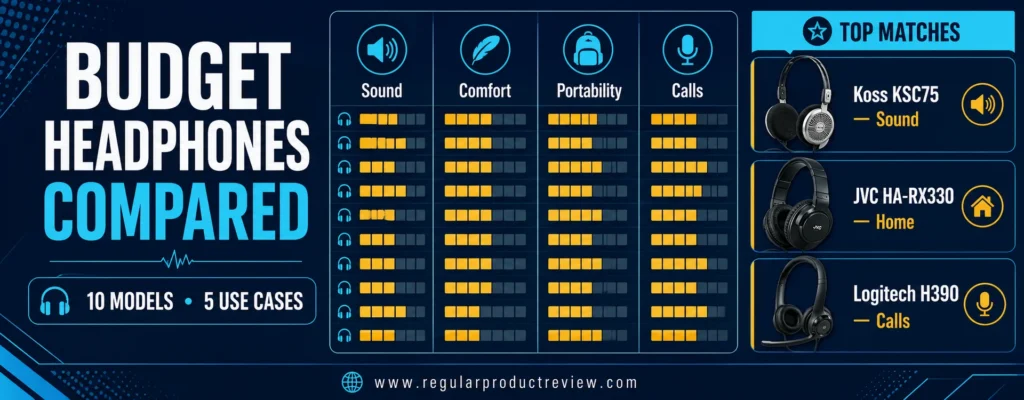
The ten products solve different problems, so a single overall ranking hides important context. The matrices below use the same editorial evidence standard described. Category scores are judgments about suitability at this price—not acoustic-lab measurements and not manufacturer claims converted into points.
If one model scores lower for portability, that does not make it a poor home headphone. Likewise, a high call score does not imply that the microphone is broadcast quality. Readers who need features beyond this ceiling can use our best budget headphones under $50 as the next comparison tier.
Core Specification Comparison
| Product | Format | Connection | Mic | Standout Feature | Editorial Rating |
|---|---|---|---|---|---|
| Koss KSC75 | Open ear-clip | 3.5mm | No | Titanium-coated open driver | 8.8/10 |
| Sony MDR-ZX110 | Closed on-ear | 3.5mm | No | Flat-swiveling cups | 8.5/10 |
| Panasonic RP-HT161-K | Closed over-ear | 3.5mm | No | 6.5-foot cable | 8.4/10 |
| JVC HA-RX330 | Closed over-ear | 3.5/6.3mm | No | 40mm drivers, 9.8-foot cable | 8.6/10 |
| Koss UR20 | Closed over-ear | 3.5mm | No | Large cushions, lifetime warranty | 8.3/10 |
| JLab Rewind 2 Wireless | Lightweight on-ear foam | Bluetooth 5.4 | Yes | Multipoint and app EQ | 8.2/10 |
| Logitech H390 | Closed on-ear headset | USB-A or USB-C version | Boom | Inline mute and volume | 8.4/10 |
| TASCAM TH-02 | Closed over-ear | 3.5/6.3mm | No | 50mm drivers and adapter | 8.3/10 |
| JVC HA-S31M | Closed on-ear | 3.5mm headset | Inline | Flat fold and one-button remote | 8.1/10 |
| JLab JBuddies Studio 2 Wired | Closed on-ear, kids | Wired | Inline | 85dB limiter | 8.0/10 |
Editorial Performance Matrix
| Product | Music Fit | Comfort Fit | Portability | Calls | Overall |
|---|---|---|---|---|---|
| Koss KSC75 | ★★★★★ 4.7/5 | ★★★★☆ 4.1/5 | ★★★★☆ 4.4/5 | ★☆☆☆☆ 1.0/5 | 8.8/10 |
| Sony MDR-ZX110 | ★★★★☆ 4.0/5 | ★★★☆☆ 3.7/5 | ★★★★★ 4.8/5 | ★☆☆☆☆ 1.0/5 | 8.5/10 |
| Panasonic RP-HT161-K | ★★★★☆ 4.0/5 | ★★★★☆ 4.2/5 | ★★☆☆☆ 2.2/5 | ★☆☆☆☆ 1.0/5 | 8.4/10 |
| JVC HA-RX330 | ★★★★☆ 4.3/5 | ★★★★☆ 4.2/5 | ★★☆☆☆ 2.0/5 | ★☆☆☆☆ 1.0/5 | 8.6/10 |
| Koss UR20 | ★★★★☆ 3.9/5 | ★★★★☆ 4.3/5 | ★★☆☆☆ 2.1/5 | ★☆☆☆☆ 1.0/5 | 8.3/10 |
| JLab Rewind 2 Wireless | ★★★★☆ 3.8/5 | ★★★★☆ 4.0/5 | ★★★★★ 4.8/5 | ★★★☆☆ 3.4/5 | 8.2/10 |
| Logitech H390 | ★★★☆☆ 3.3/5 | ★★★★☆ 3.8/5 | ★★☆☆☆ 2.4/5 | ★★★★★ 4.7/5 | 8.4/10 |
| TASCAM TH-02 | ★★★★☆ 3.9/5 | ★★★☆☆ 3.6/5 | ★★★☆☆ 3.0/5 | ★☆☆☆☆ 1.0/5 | 8.3/10 |
| JVC HA-S31M | ★★★★☆ 3.7/5 | ★★★☆☆ 3.5/5 | ★★★★★ 4.7/5 | ★★★☆☆ 3.4/5 | 8.1/10 |
| JLab JBuddies Studio 2 Wired | ★★★☆☆ 3.5/5 | ★★★★☆ 4.0/5 | ★★★★☆ 4.2/5 | ★★★☆☆ 3.3/5 | 8.0/10 |
The very low call scores for music-only wired models mean no microphone is included; they are not judgments about listening quality. An external mic can create a capable desktop combination, but it changes the budget and complexity.
Best Match by Buyer Priority
| Buyer Priority | Best Match | Why | Best Alternative |
|---|---|---|---|
| Sound in a quiet room | Koss KSC75 | Open, spacious presentation | JVC HA-RX330 |
| Lowest verified sale price | Sony MDR-ZX110 | $9.99 direct sale when checked | Panasonic RP-HT161-K |
| Television or stereo | JVC HA-RX330 | Long cable and dual plug sizes | Panasonic RP-HT161-K |
| Large cushions | Koss UR20 | Full-size closed fit | Panasonic RP-HT161-K |
| Bluetooth and two devices | JLab Rewind 2 Wireless | Multipoint and 20+ hour claim | Save for a stronger under-$50 model |
| Meetings and classes | Logitech H390 | Boom mic and hardware mute | JVC HA-S31M |
| First audio interface | TASCAM TH-02 | Closed cups and 6.3mm adapter | JVC HA-RX330 |
| Compact wired mic | JVC HA-S31M | Flat fold and inline remote | Logitech H390 |
| Child aged 6+ | JLab JBuddies Studio 2 Wired | 85dB limiter and child-size fit | None without checking age and limiter |
None of these models is our recommended solution for frequent flights or a consistently loud commute. For that problem, compare purpose-built options in our best noise-cancelling headphones under $200 and treat effective ANC as a separate feature class.
Compatibility Decision Matrix
| Product | 3.5mm Device | USB Computer | Bluetooth Device | Call Support | Compatibility Verdict |
|---|---|---|---|---|---|
| Koss KSC75 | ✅ Supported | ⚠️ Adapter may be needed | ❌ Not supported | ❌ No mic | Best for analog listening |
| Sony MDR-ZX110 | ✅ Supported | ⚠️ Adapter may be needed | ❌ Not supported | ❌ No mic | Portable analog backup |
| Panasonic RP-HT161-K | ✅ Supported | ⚠️ Adapter may be needed | ❌ Not supported | ❌ No mic | Stationary analog use |
| JVC HA-RX330 | ✅ Supported | ⚠️ Adapter may be needed | ❌ Not supported | ❌ No mic | Home gear flexibility |
| Koss UR20 | ✅ Supported | ⚠️ Adapter may be needed | ❌ Not supported | ❌ No mic | Home analog listening |
| JLab Rewind 2 Wireless | ❌ No analog mode listed | ✅ Bluetooth required | ✅ Supported | ✅ Built-in mic | Most flexible wireless pick |
| Logitech H390 | ❌ Not supported | ✅ Match USB version | ⚠️ Not Bluetooth | ✅ Boom mic | Best computer-call choice |
| TASCAM TH-02 | ✅ Supported | ⚠️ Adapter may be needed | ❌ Not supported | ❌ No mic | Interface and instrument use |
| JVC HA-S31M | ✅ Supported | ⚠️ Adapter may be needed | ❌ Not supported | ✅ Inline mic | Mobile analog communication |
| JLab JBuddies Studio 2 Wired | ⚠️ Confirm current plug | ⚠️ Adapter may be needed | ❌ Wired model | ✅ Integrated mic | Child-focused wired setup |
Comparison Takeaway: The Koss KSC75 leads on quiet-room music value, but the JVC HA-RX330 is the stronger full-size home tool. The Sony wins portable simplicity, the JLab Rewind 2 wins wireless features, and the Logitech H390 wins voice-call utility. There is no honest universal winner for all five jobs.
Budget Headphones Under $25 FAQ and Final Verdict
Can headphones under $25 actually sound good?
Yes, when expectations match the design. The Koss KSC75 can deliver engaging open sound in a quiet room, while the JVC HA-RX330 can provide satisfying full-size home listening. Neither offers the materials, consistency, isolation, or refinement expected from premium products. A focused inexpensive design can still be enjoyable.
What are the best budget headphones under $25 overall?
The Koss KSC75 is our overall choice for sound-focused listening because its open design creates unusual clarity and space at $24.99. It is not the best commuter model, call headset, or children’s headphone. The overall award reflects music value in a suitable environment, not dominance in every category.
Which cheap headphones have the best current price?
The Sony MDR-ZX110 was $9.99 direct from Sony when checked on August 21, 2026, below its $24.99 MSRP. Panasonic listed the RP-HT161-K at $16.99 but showed it sold out. Sale prices and stock can change, so compare the final checkout total with the current products in our budget headphones section.
Are wired headphones better than wireless headphones under $25?
Usually for simplicity and long-term service. A wired model spends its manufacturing budget on the frame, cable, pads, and drivers rather than a battery and Bluetooth hardware. Wireless is better when freedom from cables matters more than passive use, repairability, or latency. The JLab Rewind 2 is the notable Bluetooth option in this guide.
What are the best wireless headphones under $25?
The JLab Rewind 2 Wireless is our pick because it combines Bluetooth 5.4, multipoint, AAC/SBC, app EQ, Google Fast Pair, and a 20+ hour manufacturer claim at $24.99. Its foam pads provide little isolation, and no analog fallback is listed. For more choices, see our wireless headphones category.
Do any headphones under $25 have real active noise cancellation?
True, effective ANC is not a reasonable baseline at this price. Listings may use “noise isolating” for closed pads or “ENC” for the call microphone. Those are not the same as cancelling ambient sound for the wearer. Save for a documented ANC model if engine or commute noise is the primary issue.
Which headphones are best for Zoom, Teams, and online classes?
The Logitech H390 is the best desk choice because it has a positionable boom mic, USB digital audio, and physical volume and mute controls. Select the correct USB-A or USB-C version. The JVC HA-S31M is more portable, but its inline microphone is less focused and depends on a compatible 3.5mm headset input.
Can I use these headphones for gaming?
All analog music models can reproduce game audio through a compatible 3.5mm output. Voice chat requires a microphone, and platform support varies. The Logitech H390 is useful on compatible computers; the JVC HA-S31M supports basic analog chat on compatible combo jacks. Competitive console users should choose a platform-tested gaming headset.
Is a 50mm driver better than a 30mm driver?
Not automatically. Size influences the physical design, but tuning, damping, diaphragm control, enclosure, pad seal, placement, and distortion determine the result. The 50mm TASCAM TH-02 is not declared superior to every 30mm model simply because its driver is larger.
Does a wider frequency response mean better sound?
No. A 7Hz–21kHz label does not reveal how evenly the headphone reproduces audible frequencies, how much distortion occurs, or whether the measurement uses a meaningful tolerance. Compare use case, fit, enclosure, and credible evidence rather than sorting a shopping page by the largest range.
Which model is best for television watching?
The JVC HA-RX330 is the most convenient television choice because its 9.8-foot cable allows distance from the screen and its full-size cups suit stationary use. Confirm that the television provides analog audio or use an appropriate converter. The Panasonic RP-HT161-K is a lower-priced alternative with a 6.5-foot cable.
Which headphones are best for a beginner recording setup?
The TASCAM TH-02 is the most suitable starter because it uses a closed design, folds, and includes 3.5mm-to-6.3mm connectivity for many audio interfaces and instruments. It should not be the only reference for mixing. Check work on speakers and other headphones before finalizing it.
Are the Koss KSC75 good for commuting?
No, not for most commuters. Their open-air design admits outside sound and leaks music. The openness is an asset in a quiet room, but a liability on transit, in a library, or near other people. Choose a closed model for more privacy and physical attenuation.
Which headphones are most comfortable under $25?
The Koss UR20 is our full-size comfort pick because its cushions surround rather than press directly on many ears. Comfort remains individual: large heads, glasses, ear size, and heat sensitivity change the result. Buy from a seller with a reasonable return window and test for a full normal session.
Are the JLab JBuddies Studio 2 safe for children?
They include an 85dB limiter and are designed for ages six and older, which makes them safer-oriented than an unrestricted adult model. No headphone is risk-free at unlimited duration. Parents should control source volume, provide quiet breaks, check fit, and follow safe-listening guidance.
Do I need a headphone amplifier for these models?
Most buyers do not. The listed 24-, 32-, and 60-ohm models are intended for common consumer sources, though output varies by device. An amplifier will not repair poor fit or improve a mismatched use case, and excessive power can create unsafe levels or damage a driver.
Will a USB-C adapter make every wired headphone work with my phone?
No. An adapter must support digital audio conversion, and a headset with a microphone also needs input support. Passive USB-C-to-3.5mm adapters work only with devices that output analog audio through USB-C, which many phones do not. Check phone and adapter documentation before purchase.
How long should cheap headphones last?
There is no dependable universal lifespan. Care, folding frequency, cable strain, pad wear, battery cycles, and storage conditions matter more than the price tag alone. Wired models avoid battery aging, while Bluetooth models add a component that gradually loses capacity. A protective storage habit can be more valuable than cosmetic finish.
Should I buy refurbished headphones under $25?
Only when the discount is meaningful and hygiene, pad condition, cable integrity, battery health, return rights, and warranty are clearly addressed. At this low new-product ceiling, a refurbished unit often saves too little to justify uncertainty. Open-box stock from an authorized seller with easy returns is less risky than an anonymous marketplace listing.
When should I spend more than $25?
Spend more when you need effective ANC, dependable all-day wireless use, a detachable cable, replaceable pads, low-latency console support, stronger hinges, or a high-quality boom microphone. The next tier in our best wireless headphones under $100 offers room for better batteries and construction.
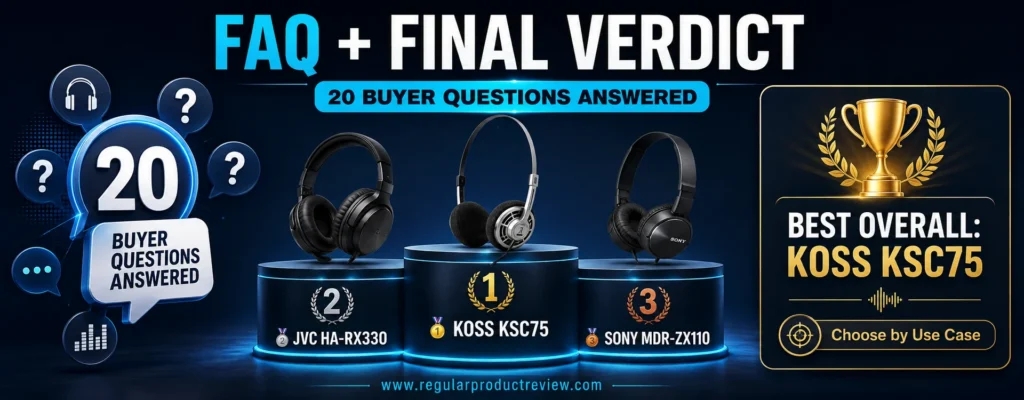
The Right $25 Headphone Is a Specialist
The Koss KSC75 takes first place because it provides the most distinctive listening benefit within the limit. Its open ear-clip design sounds less confined than typical bargain closed headphones and remains exceptionally light. That benefit only exists in the right context: a quiet room where leakage, isolation, microphone access, and heavy bass are not priorities.
The JVC HA-RX330 is our second-place choice and the better conventional home headphone. Its full-size cups, 40mm drivers, long cable, and 3.5mm/6.3mm flexibility make sense near a television, desktop, stereo, keyboard, or interface. It loses portability by design, but that is an honest trade rather than an accidental flaw.
The Sony MDR-ZX110 takes the final podium position for pure everyday value. Its current $9.99 direct sale price, flat-swiveling cups, and battery-free operation make it an excellent backup or travel pair. Remember that the standard ZX110 has no microphone and that Sony’s similarly named AP and NC variants are different products.
The category winners remain important. Choose the JLab Rewind 2 Wireless for Bluetooth and multipoint, the Logitech H390 for computer calls, the TASCAM TH-02 for a first monitoring setup, the JVC HA-S31M for portable wired calls, and the JLab JBuddies Studio 2 Wired for an age-appropriate 85dB-limited child design.
| Final Position | Product | Award | Ideal Buyer | Decisive Reason |
|---|---|---|---|---|
| 🥇 1st | Koss KSC75 | Best Overall Sound | Quiet-room music listener | Open presentation and exceptional sound value |
| 🥈 2nd | JVC HA-RX330 | Best for Home Listening | TV, desktop, stereo user | Full-size fit, long cable, dual plug sizes |
| 🥉 3rd | Sony MDR-ZX110 | Best Portable Everyday Pick | Student, traveler, backup buyer | Flat storage and very low verified sale price |
Final Expert Recommendation: Buy the Koss KSC75 if you can use an open headphone in a quiet space. Buy the JVC HA-RX330 for stationary full-size listening, or the Sony MDR-ZX110 for a portable battery-free backup. For calls, children, wireless use, or recording, choose the corresponding specialist instead of forcing the overall winner into the wrong job.
Prices in this article were checked for the U.S. market on August 21, 2026. Tax, shipping, color, seller, stock, and temporary promotions can change the final total. A product no longer qualifies for this guide when its checkout price before tax and shipping exceeds $25.
Compare the latest prices, confirm connector compatibility, and choose the under-$25 headphone built for your real listening routine →