

Wireless headphones are no longer defined by one specification. A pair can offer strong active noise cancellation yet feel uncomfortable after an hour, advertise high-resolution audio while the source device falls back to a basic codec, or quote long battery life under conditions that do not match everyday use. The best choice depends on how the headphones will be used and which devices will supply the audio.
The best wireless headphones in 2026 also fall into different ownership categories. Sony and Bose focus on broad travel and work use, AirPods Max 2 prioritizes integration with Apple devices, Sennheiser Momentum 4 emphasizes battery life and codec flexibility, and Sonos Ace makes its strongest case through compatible home-theater features. A single unexplained score cannot represent all of those priorities.
This five-model guide uses current official specifications, practical ownership differences, and clear limits on what manufacturer data can prove. Readers looking beyond premium over-ear models can also browse our complete wireless headphones category or compare wireless earbuds for 2026.
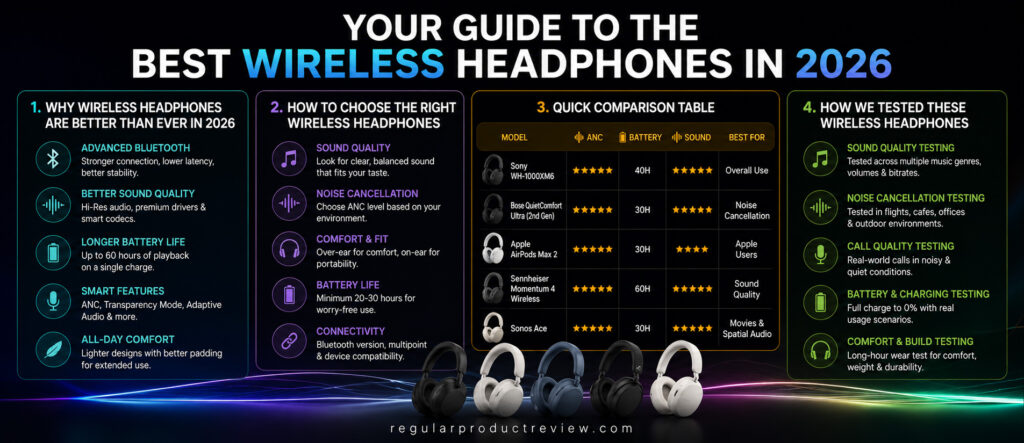
Important Model, Availability, and Evidence Note
This shortlist contains the Sony WH-1000XM6, Bose QuietComfort Ultra Headphones (2nd Gen), Apple AirPods Max 2, Sennheiser Momentum 4 Wireless, and Sonos Ace. By September 2026, Sennheiser also sells the newer Momentum 5 Wireless, and Sonos lists the newer Ace Ultra. The Momentum 4 and original Ace can still make sense at an appropriate price, but they should not be presented as each brand’s newest option.
Features can vary with firmware, source device, app version, region, and subscription or ecosystem requirements. A codec printed on a headphone specification sheet only works when the phone, computer, operating system, and audio source support the same path. Likewise, a manufacturer’s battery claim reflects stated laboratory conditions and will not predict every volume level, codec, call pattern, or ANC mode.
Prices and promotions change too quickly to support a permanent ranking. Check the exact model name, seller authorization, return window, warranty region, included cables, and current successor pricing before buying.
Quick Answer: Which Wireless Headphones Should You Choose?
The Sony WH-1000XM6 is the most balanced option in this comparison. It combines adaptive noise cancellation, multipoint Bluetooth, LDAC support, a 3.5mm input, a foldable design, and up to 30 hours of manufacturer-rated playback with noise cancellation on. That combination suits travelers and mixed-device users, but it does not establish that Sony has the best sound or ANC for every listener.
Choose the Bose QuietComfort Ultra Headphones (2nd Gen) when adjustable noise control, a relatively light 0.583-pound design, USB-C audio, and Bose’s travel-oriented feature set matter most. Choose AirPods Max 2 when H2-powered Apple features, Personalized Spatial Audio, and USB-C lossless/low-latency audio with compatible devices outweigh their 386.2g weight and 20-hour battery rating.
The Sennheiser Momentum 4 Wireless remains attractive for up to 60 hours with ANC, aptX Adaptive, and analog listening, especially when discounted against the newer Momentum 5. The Sonos Ace is the specialist choice for TV Audio Swap with a compatible Sonos soundbar; buyers should compare it with the newer Sonos Ace Ultra before paying full price.
Best Wireless Headphones 2026: Comparison at a Glance
| Headphones | Best fit in this shortlist | Bluetooth and codecs | Manufacturer battery claim | Weight | Main caution |
|---|---|---|---|---|---|
| Sony WH-1000XM6 | Balanced travel, work, and music use | Bluetooth 5.3; SBC, AAC, LDAC, LC3 | Up to 30 hours with NC on; 40 hours off | Approx. 8.96 oz / 254g | Fit and sound preference remain personal; no published water-resistance rating |
| Bose QuietComfort Ultra Headphones (2nd Gen) | Adjustable ANC and travel comfort | Bluetooth 5.4; Snapdragon Sound/aptX Adaptive support on compatible devices | Up to 30 hours; up to 23 with Immersive Audio | 0.583 lb / approx. 264g | USB-C lossless audio is limited to compatible 16-bit, 44.1/48kHz sources |
| Apple AirPods Max 2 | Apple-device integration | Bluetooth 5.3; lossless and ultra-low-latency audio via compatible USB-C connection | Up to 20 hours with ANC enabled | 386.2g | Heavy; some features require current Apple software and hardware |
| Sennheiser Momentum 4 Wireless | Long battery life and codec choice | Bluetooth 5.2; SBC, AAC, aptX, aptX Adaptive | Up to 60 hours via Bluetooth with ANC under stated conditions | Approx. 293g | Momentum 5 is now the current generation |
| Sonos Ace | Compatible Sonos home theater | Bluetooth 5.4; USB-C and compatible Snapdragon Sound aptX Lossless paths | Up to 30 hours with ANC or Aware mode | 312g | Strongest ecosystem feature requires a compatible Sonos soundbar; Ace Ultra is newer |
Comparison basis: The table reports manufacturer specifications, not one laboratory’s comparative results. Battery claims use different test conditions and should not be treated as directly equivalent.
How This Guide Was Researched
The product identities and factual specifications were checked against current manufacturer pages. Recommendations are limited to documented hardware, compatibility, and ownership differences. No star ratings are assigned because sound quality, ANC effectiveness, microphone clarity, comfort, and value cannot be responsibly reduced to invented scores without a disclosed repeatable test protocol.
The comparison considers:
- Audio paths: Bluetooth codecs, USB audio, analog input, and source-device requirements.
- Noise control: documented ANC, transparency/aware modes, and adaptive features without claiming measured attenuation.
- Power: manufacturer-rated playback conditions, charging time, and quick-charge claims.
- Ownership: weight, folding or case design, multipoint support, replaceable parts, apps, and ecosystem restrictions.
- Lifecycle: whether the model remains current or has a newer successor that changes its value proposition.
For the site’s broader standards, see the review methodology and editorial policy. Readers who care primarily about isolation should also consult the dedicated noise-cancelling headphones guide.
What Matters When Comparing Wireless Headphones?
Sound quality needs a source and a preference
Driver size alone does not determine sound quality. Tuning, enclosure design, digital processing, fit, ear shape, volume, codec, recording, and personal preference all affect what a listener hears. Manufacturer language such as “high fidelity” describes positioning; it is not a substitute for level-matched listening or independent frequency-response measurements.
ANC claims need controlled comparison
Active noise cancellation often performs differently against steady low-frequency noise, voices, wind, and sudden sounds. An adaptive system can react to the environment, but its presence does not prove that one model reduces more noise than another. Controlled measurements and a practical return policy are more useful than an unexplained five-star ANC score.
Battery figures are conditional
ANC mode, spatial audio, codec, volume, calls, temperature, firmware, and age affect runtime. Sony quotes separate figures with noise cancellation on and off; Bose separates standard and Immersive Audio use; Apple lists listening time with ANC; Sennheiser states its Momentum 4 condition; Sonos includes ANC or Aware mode. Those figures should be read in context rather than ranked as identical tests.
Weight alone cannot establish comfort
Weight matters, but headband shape, clamp, pad depth, glasses, hair, heat, and head size can matter more. A heavier headphone may distribute pressure well, while a lighter one may still create a hotspot. Try the fit or buy from a seller with a clear return window if long sessions are important.
Codec support must exist at both ends
LDAC and aptX-family features require a compatible source. Apple devices typically prioritize the Apple audio path rather than aptX or LDAC, and wired USB-C capabilities can differ from Bluetooth capabilities. For gaming or video editing, a cable or platform-specific low-latency mode may be more dependable than ordinary Bluetooth.
Calls and gaming need separate evidence
Microphone count does not reveal voice quality in wind or traffic, and “low latency” is not a universal number. Recent controlled tests should state the firmware, connected device, codec, app, and environment. Competitive players may be better served by a dedicated wireless gaming headset with a proprietary USB link.
1. Sony WH-1000XM6
Selection: Best Balanced Option in This Shortlist
The Sony WH-1000XM6 official specifications document a closed over-ear design with a 30mm driver, adaptive noise-cancellation features, multipoint connection, a detachable 3.5mm cable, and Bluetooth 5.3. The supported Bluetooth formats are SBC, AAC, LDAC, and LC3; the Bluetooth version should not be listed as 5.4.
Sony rates continuous music playback at up to 30 hours with noise cancellation on and 40 hours with it off. Those figures are manufacturer maxima rather than measured results from this article. Sony also lists approximately 3.5 hours for a full USB charge, while the product page advertises rapid charging for time-sensitive use.
At approximately 8.96 ounces (about 254g), the WH-1000XM6 is considerably lighter than AirPods Max 2 and Sonos Ace. The foldable design, case, wired input, and multipoint support strengthen its travel credentials. However, sound preference, ear-cup fit, microphone behavior, and real ANC performance still require listening or controlled third-party evidence.
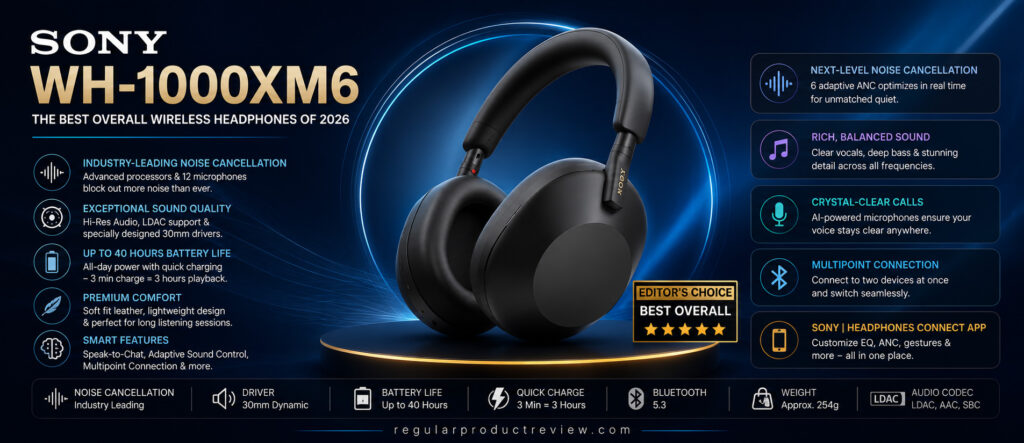
Key specifications
| Feature | Official Sony WH-1000XM6 specification |
|---|---|
| Design | Closed, over-ear, foldable |
| Driver | 30mm / 1.18-inch dynamic driver |
| Bluetooth | Version 5.3 |
| Codecs | SBC, AAC, LDAC, LC3 |
| Multipoint | Yes |
| Battery | Up to 30 hours NC on; up to 40 hours NC off |
| Full charge | Approx. 3.5 hours by USB |
| Wired input | Detachable stereo mini cable; passive operation supported |
| Weight | Approx. 8.96 oz / 254g |
Practical strengths
- Broad codec support, including LDAC and LC3
- Multipoint connection and analog wired option
- Foldable travel design with carrying case
- Lighter than several premium alternatives in this article
- Separate, clearly stated NC-on and NC-off battery claims
Important compromises
- No water-resistance rating is listed in Sony’s specification page
- LDAC and LC3 availability depends on the source device and software
- Touch controls and adaptive behavior will not suit every buyer
- Official specifications do not prove comparative sound, ANC, or call quality
Who should buy it?
Choose the WH-1000XM6 when one pair needs to cover flights, commuting, office calls, music, and multiple devices. It is the easiest general-purpose recommendation in this five-model group, provided the fit and sound profile suit the listener.
Bottom line
Sony offers the broadest balance here, but “best overall” should be read as a use-case judgment—not a claim that it wins every measured category.
2. Bose QuietComfort Ultra Headphones (2nd Gen)
Selection: Best Fit for Noise-Control-Focused Travel
The Bose QuietComfort Ultra Headphones (2nd Gen) combine adjustable ANC, Aware mode with ActiveSense, CustomTune, Bose Immersive Audio, on-head detection, and Bluetooth 5.4. Bose also supports Snapdragon Sound’s aptX Adaptive features on compatible source devices; buyers should confirm device support rather than assume the codec is active.
Bose lists up to 30 hours of battery life, or up to 23 hours with Immersive Audio, and a 15-minute quick charge for approximately three hours. The headphone itself weighs 0.583 pounds, approximately 264g; the heavier 1.061-pound number on the page refers to the entire product system, not just the headphones.
USB-C audio is a meaningful second-generation feature, but Bose specifies compatible 16-bit audio at 44.1kHz or 48kHz. Calling it “lossless” should not be expanded into an unsupported high-resolution claim. The same caution applies to ANC: Bose markets this as its best noise cancellation, while a cross-brand winner requires matched independent measurements.
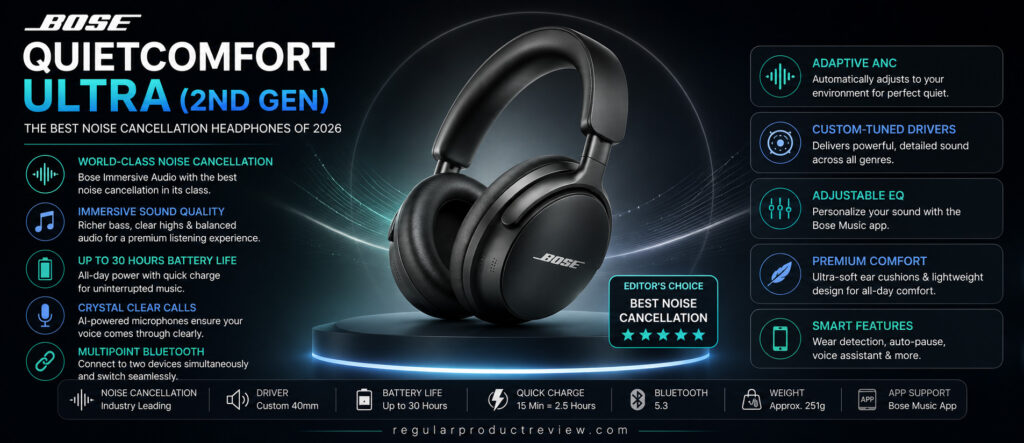
Key specifications
| Feature | Official Bose QuietComfort Ultra Headphones (2nd Gen) specification |
|---|---|
| Fit | Around-ear, circumaural |
| Noise control | Adjustable ANC, Aware mode, ActiveSense |
| Bluetooth | Version 5.4; 30ft listed range |
| Compatible codec feature | Snapdragon Sound aptX Adaptive on supported devices |
| USB audio | 16-bit, 44.1kHz or 48kHz from compatible sources |
| Battery | Up to 30 hours; up to 23 hours with Immersive Audio |
| Quick charge | 15 minutes for approx. 3 hours |
| Full charge | Approx. 3 hours |
| Weight | 0.583 lb / approx. 264g |
Practical strengths
- Adjustable ANC and Aware/ActiveSense controls
- Relatively light design for a premium over-ear model
- USB-C digital audio plus included analog cable
- Immersive Audio and Cinema Mode for supported content
- Physical multifunction control plus capacitive volume strip
Important compromises
- Immersive Audio reduces the quoted battery maximum
- aptX Adaptive features require compatible Snapdragon Sound hardware
- USB-C lossless support is not the same as unrestricted hi-res playback
- Comparative ANC and microphone superiority cannot be inferred from the feature list
Who should buy it?
Choose Bose when frequent travel and adjustable noise control are higher priorities than the longest possible battery life or the broadest codec list. Fit should still be tried, because the QuietComfort name cannot guarantee comfort for every head shape.
Bottom line
The second-generation Bose is the most travel-and-ANC-focused option here, while Sony remains more flexible for buyers who value LDAC, LC3, and a broader mixed-use package.
3. Apple AirPods Max 2
Selection: Best Fit for Current Apple Ecosystems
The AirPods Max 2 technical specifications confirm an H2 headphone chip in each ear cup, an Apple-designed dynamic driver, Active Noise Cancellation, Adaptive Audio, Transparency mode, Conversation Awareness, Voice Isolation, Adaptive EQ, and Personalized Spatial Audio with dynamic head tracking. These are the actual second-generation AirPods Max introduced in 2026, not the 2024 USB-C revision of the first generation.
AirPods Max 2 uses Bluetooth 5.3—not 5.4—and Apple rates it for up to 20 hours of listening with ANC enabled, not 30 hours. Five minutes of charging provides around 1.5 hours. The headphone weighs 386.2g, making weight and fit especially important during long sessions.
Apple lists lossless audio and ultra-low-latency audio through USB-C under compatible conditions. That wired capability should not be described as lossless Bluetooth. AirPods Max 2 can work as standard Bluetooth headphones with non-Apple products, but Apple notes that functionality may be limited; the value case is strongest for buyers already using current iPhone, iPad, Mac, Apple TV, or Vision Pro software.
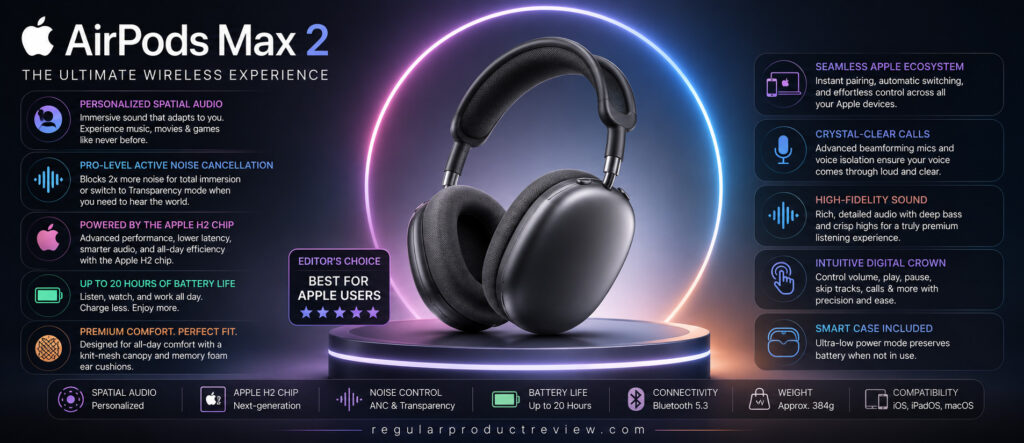
Key specifications
| Feature | Official AirPods Max 2 specification |
|---|---|
| Audio system | Apple-designed dynamic driver; custom high-dynamic-range amplifier |
| Chip | H2 headphone chip in each ear cup |
| Noise features | ANC, Adaptive Audio, Transparency, Conversation Awareness |
| Spatial audio | Personalized Spatial Audio with dynamic head tracking |
| Bluetooth | Version 5.3 |
| USB-C audio | Lossless and ultra-low-latency audio with compatible hardware/software |
| Battery | Up to 20 hours with ANC enabled |
| Quick charge | 5 minutes for around 1.5 hours |
| Weight | 386.2g |
Practical strengths
- Deep integration with current Apple devices and software
- Adaptive Audio, Conversation Awareness, and Personalized Spatial Audio
- USB-C lossless and ultra-low-latency wired paths
- Physical Digital Crown and listening-mode button
- Replaceable magnetic ear cushions
Important compromises
- Heaviest headphone in this comparison
- Shorter manufacturer battery claim than Sony, Bose, Sennheiser, and Sonos
- Full feature set depends on compatible Apple hardware and current software
- Smart Case protects battery state but provides limited physical coverage
Who should buy it?
Choose AirPods Max 2 when Apple-device switching, Spatial Audio, Siri features, and USB-C audio matter enough to justify the weight and price. Readers comparing the surrounding devices can use our best iPhones in 2026 guide.
Bottom line
AirPods Max 2 is the clearest ecosystem choice, not the universal choice. Android- and Windows-first buyers should compare feature limitations carefully.
4. Sennheiser Momentum 4 Wireless
Selection: Best Battery-Focused Value When Discounted
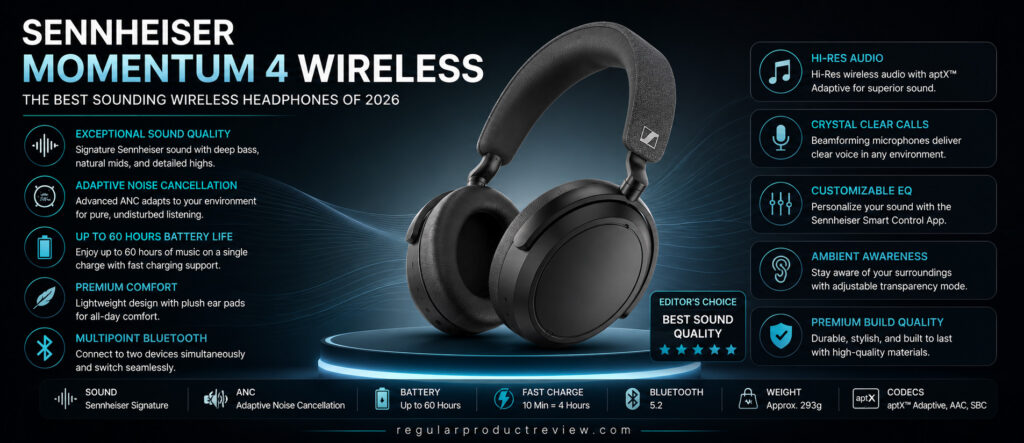
The Sennheiser Momentum 4 Wireless uses a 42mm dynamic transducer, hybrid adaptive ANC, Bluetooth 5.2, and SBC, AAC, aptX, and aptX Adaptive. Its Bluetooth version should not be listed as 5.4. Multipoint can keep two active connections, and the package includes USB charging and an analog 2.5mm-to-3.5mm cable.
Sennheiser rates the battery for up to 60 hours of Bluetooth music playback with ANC under its stated condition. A full charge takes approximately two hours, and five minutes can provide up to four hours. These are manufacturer claims; volume, source, codec, calls, temperature, and battery age can change actual runtime.
Momentum 4 remains useful for buyers who want long battery life and aptX Adaptive, but the Momentum 5 Wireless is now the current generation. The newer model adds updated connectivity and ANC features, so Momentum 4 should be recommended primarily when its selling price creates a meaningful value advantage.
Key specifications
| Feature | Official Momentum 4 Wireless specification |
|---|---|
| Driver | 42mm dynamic transducer |
| Noise control | Hybrid adaptive ANC and Transparency mode |
| Bluetooth | Version 5.2, Class 1 |
| Codecs | SBC, AAC, aptX, aptX Adaptive |
| Multipoint | Two active connections |
| Battery | Up to 60 hours via Bluetooth with ANC under stated conditions |
| Charging | Approx. 2 hours full; 5 minutes for up to 4 hours |
| Analog option | Included 2.5mm-to-3.5mm cable |
| Weight | Approx. 293g |
Practical strengths
- Longest manufacturer battery claim in this group
- aptX Adaptive, AAC, and analog listening options
- Sound Personalization and adjustable EQ in the companion app
- Multipoint support for two active devices
- Replacement pads and accessories are documented by the manufacturer
Important compromises
- It is no longer Sennheiser’s current Momentum generation
- Bluetooth 5.2 is older than the other models listed here
- Maximum battery life is conditional, not an independently measured result
- Sound and ANC preference still need listening or controlled comparison
Who should buy it?
Choose Momentum 4 when battery life, codec flexibility, and current discount matter more than owning the newest generation. Listeners prioritizing a more studio-oriented approach can also explore our audiophile headphones guide.
Bottom line
Momentum 4 is the value-sensitive sound-and-battery pick in this list. Compare its price directly with Momentum 5 before buying.
5. Sonos Ace
Selection: Best Fit for Compatible Sonos Home Theater
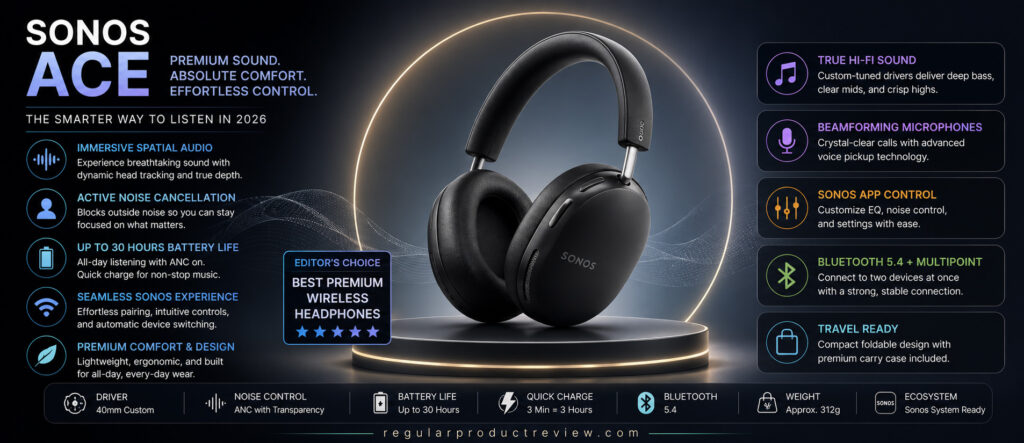
The Sonos Ace user guide documents a custom 40mm driver in each ear cup, Bluetooth 5.4, ANC, Aware mode, wear detection, adjustable EQ, and multipoint connection to two Bluetooth devices. Sonos also supports lossless audio through USB-C or compatible Snapdragon Sound aptX Lossless hardware. Compatibility conditions matter; the presence of the format does not make every Bluetooth connection lossless.
Sonos rates its 1,060mAh battery for up to 30 hours of listening or 24 hours of calling with ANC or Aware mode enabled. Rapid charging provides up to three hours from three minutes at an empty battery, while a full charge can require up to three hours under the current user-guide conditions. At 312g, it is lighter than AirPods Max 2 but heavier than Sony and Bose.
TV Audio Swap is the reason to choose the original Ace over more general Bluetooth headphones. It can move television audio from a compatible Sonos soundbar to the headphones, with setup, Wi-Fi, app, software, and product requirements. Sonos now lists the newer Ace Ultra, so the original Ace is most persuasive when discounted or when its documented feature set is sufficient.
Key specifications
| Feature | Official Sonos Ace specification |
|---|---|
| Driver | Custom 40mm dynamic driver in each ear cup |
| Noise control | ANC and Aware mode |
| Bluetooth | Version 5.4 |
| Multipoint | Two Bluetooth devices |
| Lossless paths | USB-C or compatible Snapdragon Sound aptX Lossless device |
| Battery | Up to 30 hours listening or 24 hours calling with ANC/Aware enabled |
| Charging | 3 minutes for up to 3 hours; full charge can require up to 3 hours |
| Weight | 312g |
| Home theater | TV Audio Swap with compatible Sonos soundbars and software |
Practical strengths
- TV Audio Swap for supported Sonos home-theater setups
- USB-C and compatible aptX Lossless audio paths
- Multipoint for two Bluetooth devices
- Physical Content Key and noise-control button
- Replaceable magnetic ear cushions
Important compromises
- The most distinctive feature depends on compatible Sonos hardware and software
- Original Ace is no longer the newest Sonos over-ear model
- 312g weight may matter during extended use
- Standard Bluetooth use does not provide the full Sonos ecosystem advantage
Who should buy it?
Choose Sonos Ace when private television listening through an existing compatible Sonos soundbar is a genuine priority. For ordinary commuting and office use, compare its current price and fit against Sony and Bose before deciding.
Bottom line
Sonos Ace is a specialist home-theater option rather than the strongest general recommendation. Its value depends heavily on the equipment already in the buyer’s home.
Wireless Headphones Buying Guide
1. Define the main listening environment
Flights and trains emphasize ANC, battery life, portability, and wired fallback. Office work adds multipoint and microphone concerns. Home listening may prioritize comfort and sound personalization. Television use can make platform-specific features such as Sonos TV Audio Swap or Apple Spatial Audio more valuable.
2. Verify the exact model generation
Names can be deceptively similar. AirPods Max 2 is different from the first-generation USB-C revision, Bose has first- and second-generation QuietComfort Ultra models, and both Sennheiser and Sonos now sell successors to products preserved in this article. Confirm the model name and number on the retailer page and packaging.
3. Match codecs to the source device
Buying LDAC or aptX Adaptive headphones does not help when the source cannot transmit that codec. Check the phone or computer, operating system, app, and streaming-quality setting. Apple users should pay particular attention to Apple-supported paths, while some Android phones expose a wider codec selection.
4. Separate Bluetooth, USB, and analog behavior
A headphone may support high-quality USB-C audio but use a different Bluetooth codec. Analog cables can also operate in active or passive modes with different processing. Confirm whether ANC, microphone use, EQ, and spatial features remain available in the intended connection mode.
5. Read battery footnotes
Compare ANC-on figures with ANC-on figures, and check whether spatial audio is enabled. Manufacturer maxima are useful for planning, but they are not a promise. Charging claims can also depend on battery state, cable, charger, temperature, and whether the headphones are being used.
6. Treat comfort as a return-policy decision
Specification tables cannot predict pressure around glasses, ear-pad heat, or headband hotspots. Weight narrows the risk but does not settle it. For expensive headphones, a legitimate seller and clear return period can be more valuable than a small temporary discount.
7. Check repair and replacement options
Ear cushions are wear items, batteries lose capacity, and cables disappear. Check whether the manufacturer sells pads and other parts, publishes support documents, and provides service in the buyer’s region. Long ownership value depends on more than launch-day features.
8. Decide whether over-ear is necessary
Over-ear headphones can offer strong isolation and long battery life, but they occupy more space and may feel hot. Compact noise-cancelling earbuds may be more practical for exercise or light travel, while budget wireless headphones can cover basic commuting without premium pricing.
Wireless Audio Terms Explained
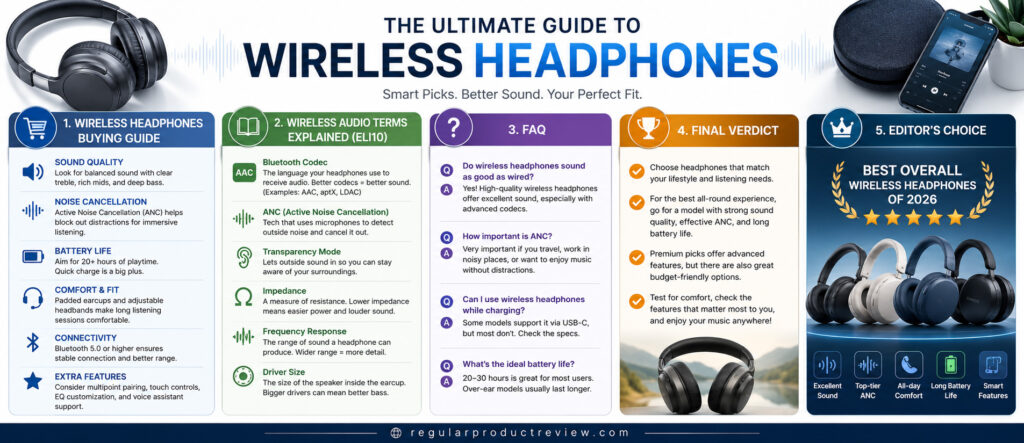
Active Noise Cancellation (ANC)
Microphones detect surrounding sound and the headphone generates an opposing signal to reduce part of it. Performance varies by frequency, seal, wind, processing, and listener. ANC cannot remove every sound and should not replace situational awareness where safety matters.
Transparency or Aware mode
External microphones deliberately feed surrounding sound into the ear cups. The aim is awareness without removing the headphones. Naturalness and wind handling require listening tests; the feature name alone does not show quality.
Multipoint Bluetooth
Multipoint allows the headphones to maintain connections with more than one source, commonly a phone and computer. Switching behavior can vary by firmware and by whether a call, notification, or media stream takes priority.
LDAC
LDAC is a Bluetooth audio codec supported by Sony and compatible source devices. Its higher transmission modes require matching hardware and settings, and radio conditions can affect stability. It is not available on every phone or computer.
aptX Adaptive and aptX Lossless
These Qualcomm codec paths require compatible hardware and software at both ends. aptX Lossless describes operation under qualifying conditions; it should not be assumed merely because the headphones support Snapdragon Sound.
Spatial Audio
Spatial processing attempts to position sound around the listener and may include head tracking. Results depend on the content, application, source device, headphone implementation, and personal preference. It is different from ordinary stereo soundstage.
USB audio
USB-C can carry digital audio as well as charging power, but capability is product-specific. Bose lists 16-bit 44.1/48kHz support, Apple lists lossless and ultra-low-latency USB-C audio under compatible conditions, and Sonos offers a documented USB-C lossless path.
Frequently Asked Questions
Which are the best wireless headphones overall in 2026?
There is no universal winner. In this five-model shortlist, Sony WH-1000XM6 provides the broadest balance of travel features, codecs, multipoint, battery life, and wired flexibility. Buyers focused on Apple integration, Sonos television audio, maximum quoted battery life, or Bose noise-control features may reasonably choose differently.
Which headphones are best for active noise cancellation?
Sony and Bose both provide advanced adaptive noise-control systems, but this research-based guide does not claim a measured cross-brand winner. Use recent independent attenuation measurements that cover low bass, voices, treble, and wind, then confirm comfort and return terms.
Which headphones have the longest battery life here?
Sennheiser quotes up to 60 hours for Momentum 4 under its stated Bluetooth-and-ANC condition. This is the highest manufacturer figure in the table, not a matched real-world result. Momentum 5 is now available and should be compared at current prices.
Are AirPods Max 2 only for Apple users?
No. They can operate as Bluetooth headphones with non-Apple devices, but Apple states that functionality may be limited. Their strongest reasons to buy—H2 features, Apple-device integration, Personalized Spatial Audio, and supported USB-C capabilities—are most valuable inside the Apple ecosystem.
Can wireless headphones be used for gaming?
Yes, but ordinary Bluetooth can introduce noticeable latency. Platform-specific low-latency modes, compatible aptX Adaptive implementations, USB-C audio, analog cables, or proprietary USB transmitters may perform differently. Competitive players should confirm the exact connection path before buying.
Does a larger driver mean better sound?
No. Driver size is only one design parameter. Tuning, distortion, enclosure, seal, processing, volume, and preference matter. Compare controlled measurements and listen at matched volume when possible.
Are expensive wireless headphones always worth it?
No. Premium pricing may buy stronger materials, ANC, microphones, apps, or ecosystem features, but only if those benefits match the buyer’s use. Readers with a strict budget can start with our wireless headphones under $50 guide.
Should I buy Momentum 4 or Sonos Ace at full launch price in late 2026?
Compare them directly with their successors first. Momentum 5 and Sonos Ace Ultra are now listed by their manufacturers. The older models can remain sensible at a discount, but their value depends on current price, support, and the exact features required.
Final Verdict
The best wireless headphones of 2026 are the pair that matches the listener’s devices and priorities. Sony WH-1000XM6 is the balanced pick in this shortlist. Bose QuietComfort Ultra Headphones (2nd Gen) suits buyers focused on adjustable noise control and travel. AirPods Max 2 makes the strongest case inside a current Apple ecosystem.
Sennheiser Momentum 4 Wireless remains compelling for its quoted battery life and codec flexibility when discounted, but Momentum 5 is now the current generation. Sonos Ace is most distinctive for TV Audio Swap with compatible Sonos soundbars, while Ace Ultra is the newer alternative.
Before purchasing, confirm the model generation, supported audio path, battery conditions, warranty region, replacement parts, and return policy. Sound, comfort, ANC, and microphone performance should be validated through transparent independent tests or personal listening—not through unexplained star scores.