

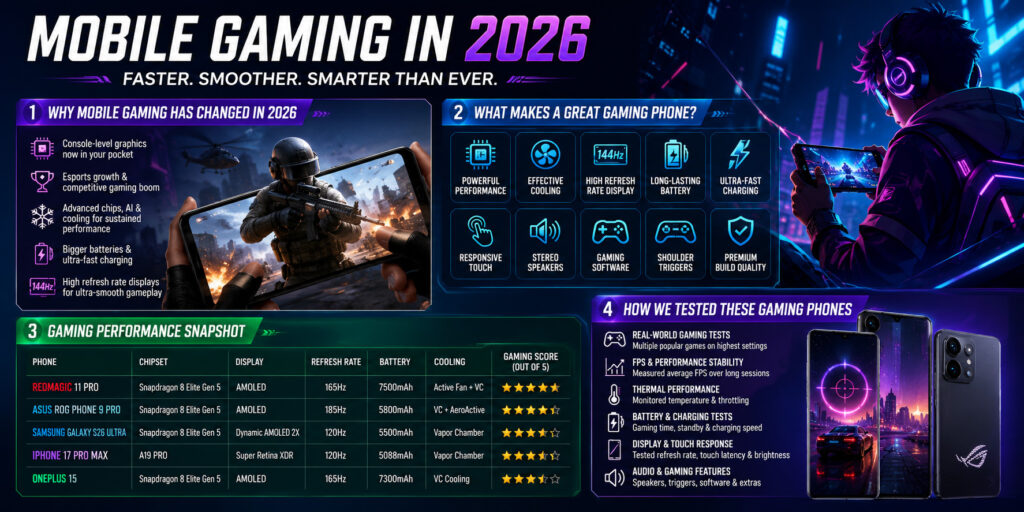
Mobile gaming in 2026 covers far more than short casual sessions. Competitive shooters, open-world RPGs, racing games, emulators, cloud gaming, and console-style releases can all place sustained pressure on a phone’s processor, graphics core, cooling system, battery, display, and controls. A device that posts a high peak benchmark score is not automatically the best gaming phone for a long session.
The best gaming phones in 2026 also serve different buyers. REDMAGIC and ROG models prioritize active cooling, touch triggers, game dashboards, and bypass charging. Samsung, Apple, and OnePlus take a broader flagship approach, balancing gaming with cameras, productivity, durability, software, and carrier compatibility. Neither approach is universally better.
This guide compares the REDMAGIC 11 Pro, ASUS ROG Phone 9 Pro, Samsung Galaxy S26 Ultra, iPhone 17 Pro Max, and OnePlus 15 using verifiable specifications, practical differences, and clear limitations. For more options organized by budget, see our complete gaming phone guides.
Important Availability and Game-Support Note
Phone specifications can change by country, carrier, color, and memory configuration. Charging speed is a particularly important example: the OnePlus 15 supports 80W wired charging in its U.S. specification, while some other regional versions advertise a higher figure. Network bands, physical SIM support, included chargers, warranty coverage, and software features may also differ.
High refresh rate does not mean every game renders at that frame rate. The display, operating system, game developer, graphics setting, temperature, and power mode all have to support the target. A 165Hz or 185Hz screen can still be useful for interface motion and compatible titles, but it cannot force an unsupported game to run at 165 or 185 frames per second.
Prices and promotions change frequently, so this article does not use a short-lived discount to justify a recommendation. Compare the exact model code, seller, warranty region, return window, and included accessories at checkout.
Quick Answer: Which Gaming Phone Should You Choose?
The REDMAGIC 11 Pro is the most specialized gaming phone in this group. Its Snapdragon 8 Elite Gen 5 platform, active fan, liquid-cooling hardware, 520Hz shoulder touchpads, 7,500mAh battery, and 3.5mm audio jack make it the clearest fit for a buyer who puts gaming ahead of camera versatility and mainstream carrier convenience.
The ASUS ROG Phone 9 Pro remains attractive for AirTriggers, Game Genie, dual USB-C ports, a headphone jack, and the optional or bundled AeroActive Cooler. It is an older Snapdragon 8 Elite generation than several phones here, however, so availability, remaining software-support life, and price deserve extra attention in 2026.
Choose the Samsung Galaxy S26 Ultra when gaming is only one part of a premium Android workload. The iPhone 17 Pro Max is the natural choice for buyers committed to iOS and Apple’s game ecosystem. The OnePlus 15 offers the most appealing balance of a 7,300mAh battery, 165Hz-capable display, fast charging, and conventional flagship design—provided the exact regional charging specification meets your expectations.
Gaming Phone Comparison at a Glance
| Phone | Best fit in this shortlist | Processor | Display | Battery and charging | Gaming-specific controls | Main caution |
|---|---|---|---|---|---|---|
| REDMAGIC 11 Pro | Dedicated mobile gaming | Snapdragon 8 Elite Gen 5 | 6.85-inch AMOLED, 2688×1216, up to 144Hz | 7,500mAh; 80W wired and up to 80W wireless | 520Hz shoulder touchpads, GameSpace, active fan | 230g; camera and support priorities differ from mainstream flagships |
| ASUS ROG Phone 9 Pro | Controls and accessories | Snapdragon 8 Elite | 6.78-inch AMOLED, 1–120Hz LTPO; up to 165Hz in system settings and 185Hz in Game Genie | 5,800mAh; 65W wired, up to 15W wireless | AirTriggers, Game Genie, dual USB-C | Older chipset generation; check price and support window |
| Samsung Galaxy S26 Ultra | All-round Android flagship | Snapdragon 8 Elite Gen 5 for Galaxy | 6.9-inch QHD+ Dynamic AMOLED 2X, 1–120Hz | 5,000mAh typical; up to 60W wired and 25W wireless | Game Booster software; no shoulder triggers | Less specialized than a dedicated gaming phone |
| iPhone 17 Pro Max | iOS gaming and creator use | Apple A19 Pro | 6.9-inch Super Retina XDR OLED, up to 120Hz | Apple quotes up to 39 hours of video playback; fast wired and up to 25W wireless charging | iOS game features; no shoulder triggers | No published gaming-runtime figure; charging is slower than several Android rivals |
| OnePlus 15 | Battery-focused everyday Android gaming | Snapdragon 8 Elite Gen 5 | 6.78-inch LTPO, 2772×1272, 1–120Hz adaptive and up to 165Hz in gaming | 7,300mAh; 80W wired and 50W wireless on the cited model | Gaming software and dedicated touch-response hardware; no physical triggers | Maximum refresh and charging vary by title or region |
Comparison basis: These are manufacturer-listed specifications, not results from a single independent laboratory. Battery capacity cannot predict gaming runtime by itself, and cooling hardware cannot establish measured temperature or sustained FPS without matched testing.
How This Guide Was Researched
This is a specification- and research-based comparison, not a claim that all five phones were benchmarked side by side. Official product pages establish what each phone contains, while the recommendations are limited to what those specifications reasonably support. Where sustained FPS, temperature, or gaming runtime matters, consult repeatable independent tests of the exact retail model.
The comparison considers five areas:
- Performance platform: processor generation, graphics architecture, memory, storage, and game-specific hardware.
- Thermal design: active fan, vapor chamber, liquid-cooling components, external coolers, and bypass-charging support.
- Display and controls: resolution, adaptive refresh range, maximum gaming refresh, touch features, shoulder triggers, and audio connectivity.
- Power system: documented capacity, regional wired/wireless charging, and whether manufacturer runtime claims represent video rather than gaming.
- Ownership fit: weight, water resistance, cameras, software age, network compatibility, warranty, and daily usability.
We do not convert these specifications into invented decimal scores. See our review methodology and editorial policy for the standards used across the site.
What Makes a Good Gaming Phone in 2026?
Sustained performance matters more than a short peak
A modern flagship processor creates performance headroom, but the phone must manage heat and power over time. Clock speed, ambient temperature, case design, brightness, network activity, game version, graphics settings, and charging state can all change the result. When sustained FPS matters, consult repeatable independent tests of the exact retail model instead of assuming that two phones with the same chipset perform identically.
Cooling design needs context
An internal fan and a large vapor chamber can help move heat, yet their presence does not prove a specific surface temperature. Active cooling may also introduce dust, fan noise, and additional power use. Passive flagships are usually simpler and better sealed, but they may use more conservative performance limits. The right choice depends on session length and tolerance for gaming-focused hardware.
Display refresh and game FPS are different
A 120Hz, 144Hz, 165Hz, or 185Hz panel describes what the display can accept under supported conditions. It is not a promise that every title runs at the same FPS. Resolution, touch latency, brightness, PWM behavior, color, aspect ratio, and accidental-touch rejection can matter as much as the maximum number.
Battery capacity is only one part of endurance
Large 7,300–7,500mAh batteries provide useful capacity, but display brightness, refresh rate, modem use, game load, cooling fans, temperature, and software optimization determine runtime. Manufacturer video-playback figures should never be compared directly with gaming time. Bypass charging can reduce unnecessary battery cycling during desk-based sessions when the manufacturer supports it.
Controls, audio, and ergonomics shape long sessions
Shoulder touchpads can free thumbs in shooters, while dual USB-C ports make landscape charging easier. A 3.5mm jack remains valuable for predictable wired latency. Weight and width also matter: a powerful phone that feels tiring after an hour may be a poor fit even when its specification sheet looks impressive.
1. REDMAGIC 11 Pro
Selection: Best Dedicated Gaming Phone in This Shortlist
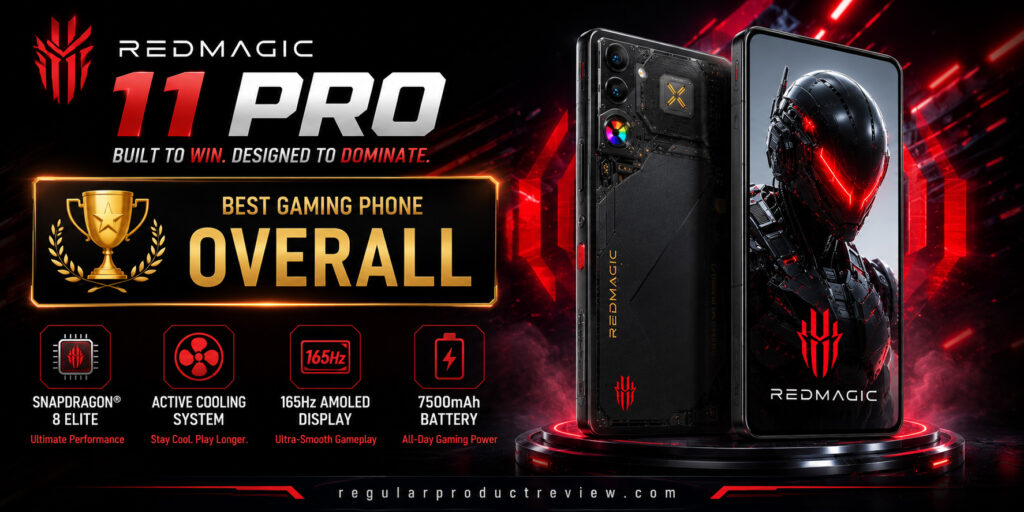
The REDMAGIC 11 Pro is the most gaming-focused device among these five phones. It combines Qualcomm’s Snapdragon 8 Elite Gen 5 with REDMAGIC’s RedCore R4, an active 24,000 RPM fan, a 13,116mm² vapor chamber, liquid-metal thermal material, and a circulating liquid-cooling system. Those are meaningful hardware differences from a conventional flagship, although only controlled third-party tests can quantify the performance advantage.
REDMAGIC lists a 6.85-inch AMOLED display with a 2688×1216 resolution, maximum 144Hz refresh rate, up to 3,000Hz single-point touch sampling, and 360Hz multi-finger sampling. Its shoulder touchpads have a separate 520Hz sampling specification, which should not be confused with either the screen refresh rate or the screen’s peak touch-sampling figure.
The 7,500mAh battery is the largest documented capacity in this comparison, and both wired and wireless charging are rated up to 80W. Battery capacity is not a measured gaming-runtime result, but it gives the phone substantial energy storage. REDMAGIC also retains a 3.5mm jack, stereo speakers, USB 3.2 Gen 2 with DisplayPort output, and a customizable GameSpace key.
Key specifications
| Feature | Official REDMAGIC 11 Pro specification |
|---|---|
| Processor | Snapdragon 8 Elite Gen 5, up to 4.6GHz; RedCore R4 |
| Display | 6.85-inch AMOLED, 2688×1216, up to 144Hz, 1,800-nit listed peak |
| Memory | 12GB, 16GB, or 24GB LPDDR5T |
| Storage | 256GB, 512GB, or 1TB UFS 4.1 Pro |
| Cooling | AquaCore system, 24,000 RPM fan, 13,116mm² vapor chamber, liquid metal and flowing liquid cooling |
| Battery | 7,500mAh |
| Charging | 80W wired; up to 80W wireless |
| Controls | 520Hz shoulder touchpads; customizable Magic Key |
| Audio and ports | Stereo speakers, 3.5mm jack, USB 3.2 Gen 2 with DisplayPort |
| Weight and protection | 230g; IPX8 water-resistance rating under stated laboratory conditions |
Gaming strengths
- Dedicated thermal hardware designed for sustained loads
- Shoulder touchpads and detailed GameSpace controls
- Large battery and fast wired/wireless charging
- Headphone jack and landscape-friendly gaming features
- Up to 24GB RAM and 1TB storage
Important compromises
- Heavy at 230g before adding a case or controller
- Active airflow adds fan noise and a separate dust path
- IPX8 is a water-resistance rating, not a conventional IP68 dust-and-water claim
- Camera system is less versatile than the Samsung or iPhone systems in this group
- Carrier support, warranty handling, and long-term updates should be confirmed for the buyer’s market
Who should buy it?
Choose the REDMAGIC 11 Pro when competitive mobile gaming, controls, cooling hardware, and battery capacity matter more than having the most versatile camera or the broadest carrier-store availability. Buyers should also know that REDMAGIC now lists a newer 11S Pro; compare current price and support before treating the 11 Pro as the automatic purchase.
Bottom line
Among the products in this article, the REDMAGIC 11 Pro has the clearest dedicated-gaming design. That makes it our specialist pick, not proof that it achieves the highest FPS in every game or condition.
2. ASUS ROG Phone 9 Pro
Selection: Best for Gaming Controls and Accessories
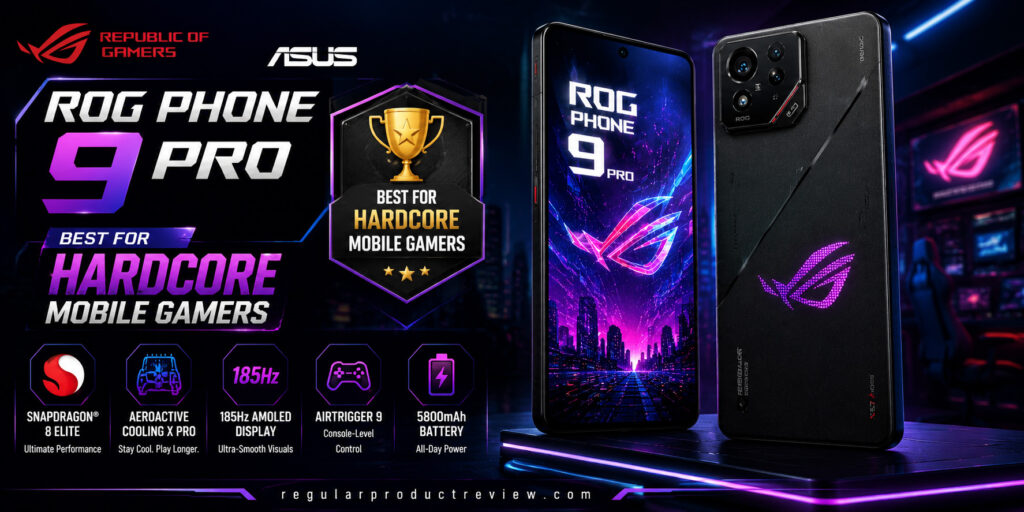
The ASUS ROG Phone 9 Pro approaches gaming through controls, software, audio, and accessories. Its AirTriggers can be mapped to in-game actions, while Game Genie includes macros, key mapping, crosshair tools, bypass charging, background mode, touch-edge blocking, and other controls. The Pro Edition also includes an AeroActive Cooler X Pro; package contents can differ for the standard Pro.
Its Snapdragon 8 Elite and Adreno 830 remain powerful, but they are one generation behind the Snapdragon 8 Elite Gen 5 used by several newer 2026 choices. That does not make the ROG Phone 9 Pro slow. It means buyers should compare its actual selling price, software-support horizon, and game compatibility against newer phones instead of ranking it from the ROG name alone.
The display specification needs careful wording. ASUS lists LTPO operation from 1–120Hz, a maximum of 165Hz in system settings, and up to 185Hz through Game Genie. The 185Hz figure is not a universal frame-rate guarantee. It depends on ASUS software and supported games.
Key specifications
| Feature | Official ROG Phone 9 Pro specification |
|---|---|
| Processor | Snapdragon 8 Elite, up to 4.3GHz; Adreno 830 |
| Display | 6.78-inch 2400×1080 AMOLED; 1–120Hz LTPO, up to 165Hz system / 185Hz Game Genie |
| Memory | 16GB LPDDR5X; 24GB on Pro Edition |
| Storage | 512GB UFS 4.0; 1TB on Pro Edition |
| Battery | 5,800mAh typical |
| Charging | Up to 65W wired; up to 15W Qi wireless |
| Controls | AirTriggers and Game Genie tools |
| Cameras | 50MP main with gimbal OIS, 13MP ultrawide, 32MP 3× telephoto |
| Audio and ports | Stereo speakers, 3.5mm jack, two USB-C ports |
| Weight and protection | 227g; IP68 |
Gaming strengths
- Flexible AirTrigger mapping and mature gaming software
- Two USB-C ports improve landscape charging and accessory placement
- Headphone jack for straightforward wired audio
- Optional/bundled AeroActive cooling support
- Bypass charging can be useful for long plugged-in sessions
Important compromises
- Older processor generation than the REDMAGIC 11 Pro, S26 Ultra, and OnePlus 15
- 185Hz depends on Game Genie and supported content
- 227g body is substantial
- Premium price is harder to justify when newer devices are close in cost
- Remaining Android and security-update period should be checked before purchase
Who should buy it?
The ROG Phone 9 Pro makes sense for an enthusiast who will actually use AirTriggers, Game Genie, a second USB-C port, bypass charging, and the AeroActive accessory ecosystem. A casual player who mainly wants a normal flagship may get better long-term value elsewhere.
Bottom line
This is the controls-and-accessories pick, not the newest chipset pick. In 2026, buy it only after confirming a competitive price, official regional warranty, and an acceptable remaining support window.
3. Samsung Galaxy S26 Ultra
Selection: Best All-Round Android Flagship for Gaming
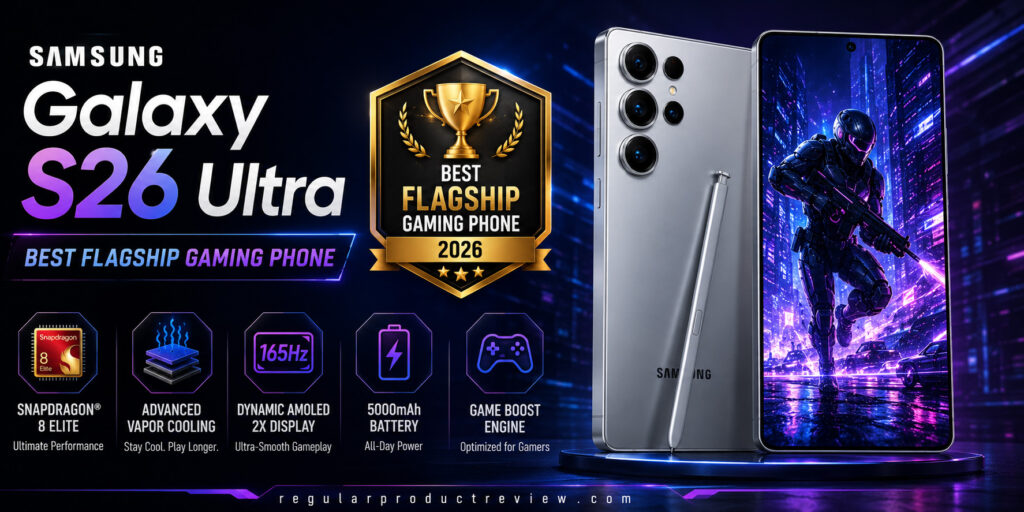
The Samsung Galaxy S26 Ultra is built as a mainstream flagship rather than a dedicated gaming phone. Samsung uses the Snapdragon 8 Elite Gen 5 for Galaxy, a redesigned vapor chamber, and thermal interface material intended to spread heat across a larger area. These design claims support its position as a capable gaming flagship, but they do not replace independent temperature and FPS measurements.
The 6.9-inch QHD+ Dynamic AMOLED 2X display operates from 1–120Hz and has a manufacturer-listed peak brightness of 2,600 nits. It cannot match the higher maximum refresh modes of REDMAGIC, ROG, or OnePlus, and it lacks shoulder triggers. Its advantage is breadth: a high-resolution display, S Pen, extensive camera system, wireless charging, mainstream carrier availability, and a familiar productivity ecosystem.
Samsung lists a typical 5,000mAh battery, up to 60W wired charging, and up to 25W wireless charging. The company says a compatible 60W setup can reach about 75% in around 30 minutes under its conditions. That is a charging claim, not evidence of a particular gaming runtime.
Key specifications
| Feature | Official Galaxy S26 Ultra specification |
|---|---|
| Processor | Snapdragon 8 Elite Gen 5 for Galaxy |
| Display | 6.9-inch QHD+ Dynamic AMOLED 2X, adaptive 1–120Hz, 2,600-nit listed peak |
| Memory and storage | 12GB with 256GB/512GB; up to 16GB with 1TB in listed configurations |
| Cooling | Redesigned vapor chamber with dedicated thermal interface material |
| Battery | 5,000mAh typical; 4,855mAh rated minimum |
| Charging | Up to 60W wired and 25W wireless |
| Cameras | 200MP main, 50MP ultrawide, 10MP 3× telephoto, 50MP 5× telephoto |
| Controls | Game software and touchscreen controls; no shoulder triggers |
| Weight | 214g |
| Software | Android 16 with One UI 8.5 at launch |
Gaming strengths
- Current flagship processor with a redesigned cooling system
- Sharp 120Hz QHD+ screen with strong outdoor-brightness specification
- Broad carrier, accessory, service, and trade-in availability
- Strong cameras and productivity features alongside gaming
- Faster charging than the previous Ultra generation
Important compromises
- No active fan or physical/capacitive shoulder triggers
- 120Hz maximum is lower than specialist gaming-phone modes
- High resolution can increase GPU load when a game renders above FHD+
- S Pen and camera hardware add cost that gaming-only buyers may not value
- Actual sustained performance still needs matched independent testing
Who should buy it?
Choose the Galaxy S26 Ultra if you want one premium Android phone for gaming, photography, productivity, travel, and daily communication. Readers who care more about camera output than triggers can also compare our best camera phones of 2026 and flagship phone guide.
Bottom line
The S26 Ultra is the best all-round Android fit in this shortlist. Dedicated gaming phones remain more focused, but Samsung offers the broadest combination of gaming-capable hardware and mainstream flagship features.
4. iPhone 17 Pro Max
Selection: Best iPhone for Gaming in This Comparison
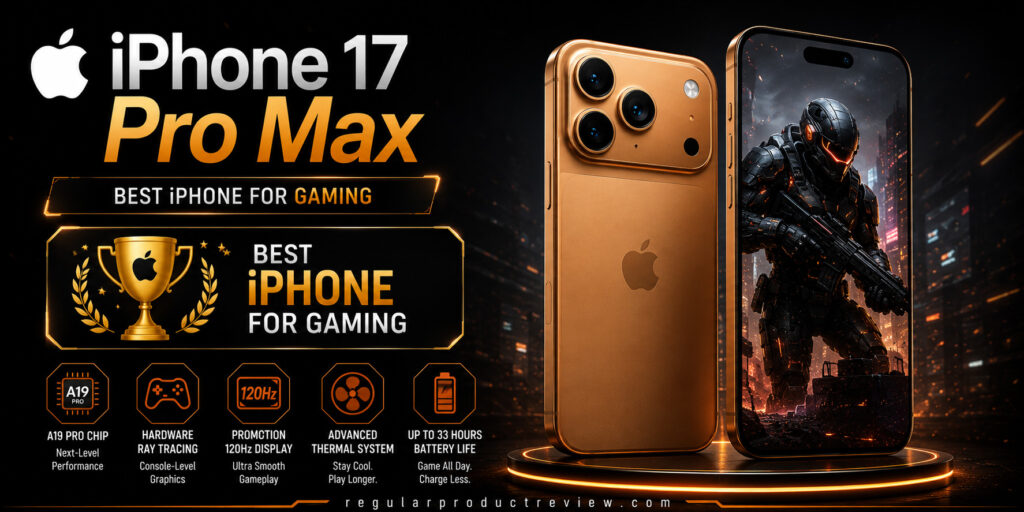
The iPhone 17 Pro Max pairs Apple’s A19 Pro with a 6-core CPU, 6-core GPU, hardware-accelerated ray tracing, and a vapor-chamber thermal design. Apple does not publish the same type of gaming dashboard, shoulder controls, or touch-sampling marketing used by dedicated gaming-phone brands. Its appeal comes from the iOS game library, device-specific optimization, controller support, display consistency, video capability, and long-term ecosystem fit.
The 6.9-inch Super Retina XDR OLED panel has a 2868×1320 resolution and adaptive ProMotion refresh up to 120Hz. That is sufficient for compatible high-frame-rate games, but the game itself must support the target. The iPhone has no built-in shoulder triggers, headphone jack, or second USB-C port.
Apple does not list a battery capacity in mAh on its technical page, so this guide does not invent one. It quotes up to 39 hours of local video playback and up to 35 hours streamed for the Pro Max under Apple’s conditions. Those numbers cannot be translated into gaming hours. Apple says a compatible 40W-or-higher adapter can charge the phone to 50% in around 20 minutes, while MagSafe and Qi2 wireless charging reach up to 25W.
Key specifications
| Feature | Official iPhone 17 Pro Max specification |
|---|---|
| Processor | A19 Pro; 6-core CPU, 6-core GPU, 16-core Neural Engine |
| Display | 6.9-inch OLED, 2868×1320, adaptive ProMotion up to 120Hz |
| Storage | 256GB, 512GB, 1TB, or 2TB |
| Cooling | Vapor-chamber thermal design |
| Battery claim | Up to 39 hours local video or 35 hours streamed; not a gaming-runtime claim |
| Charging | Up to 50% in about 20 minutes with compatible 40W+ wired setup; MagSafe/Qi2 up to 25W |
| Cameras | Three 48MP rear cameras; 18MP Center Stage front camera |
| Controls | Touchscreen and supported controllers; no shoulder triggers |
| Weight and protection | 233g; IP68 |
| Connectivity | USB 3 up to 10Gb/s, Wi-Fi 7, Bluetooth 6 |
Gaming strengths
- A19 Pro platform and hardware-accelerated ray tracing
- Large 120Hz OLED with high listed outdoor brightness
- Strong controller and Apple ecosystem integration
- Up to 2TB storage for large games and media
- Excellent creator-oriented camera, video, and audio capabilities
Important compromises
- No gaming triggers, bypass-charging dashboard, or active fan
- Apple does not provide a gaming-specific battery-runtime claim
- 233g weight is the highest in this group after REDMAGIC
- Wired charging is less aggressive than OnePlus, REDMAGIC, or ROG
- Game availability and graphics options differ from Android
Who should buy it?
The iPhone 17 Pro Max is the straightforward choice for someone already invested in iOS who wants a large display, high-end games, controller support, long storage options, and premium camera/video tools in the same phone. Browse the site’s Apple iPhone section if ecosystem features matter more than dedicated gaming controls.
Bottom line
It is the strongest iOS choice within this list, but that does not make it the fastest phone in every cross-platform game. App optimization, graphics settings, heat, and the specific test procedure still determine the result.
5. OnePlus 15
Selection: Best Battery-Focused Everyday Gaming Flagship
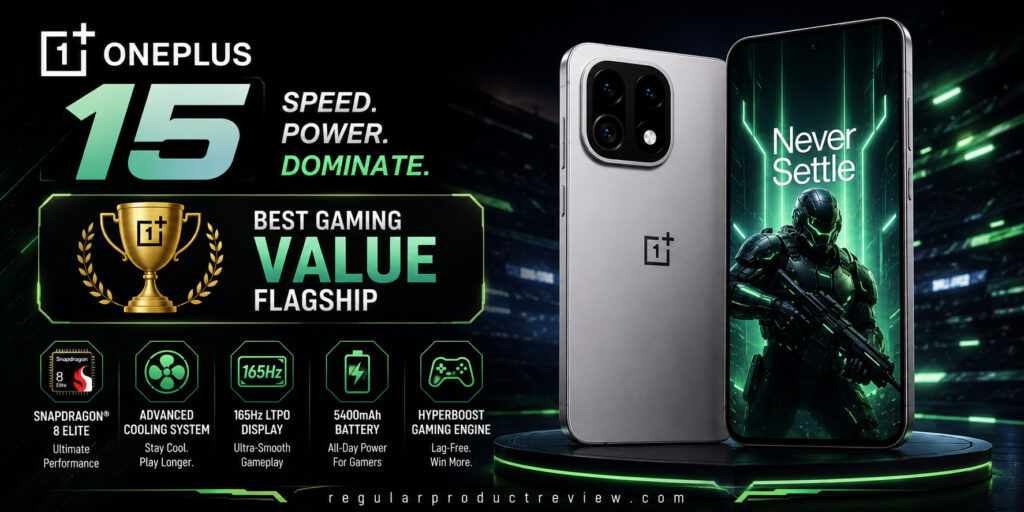
The OnePlus 15 occupies the middle ground between a gaming phone and a conventional flagship. It uses the Snapdragon 8 Elite Gen 5, a dedicated touch-response chip, a separate Wi-Fi chip, and gaming software designed to support high-frame-rate play without adding shoulder buttons or an internal fan.
Its 6.78-inch LTPO display has a 2772×1272 resolution, adaptive 1–120Hz operation, and a maximum 165Hz gaming mode. The qualifier matters: 165Hz applies in gaming under supported conditions, not to every title. The phone’s 3,200Hz instant touch figure is also a specialized sampling claim, not the normal display refresh rate.
The 7,300mAh battery is close to REDMAGIC’s capacity while fitting a more conventional body. Regional charging differences need explicit treatment. The official U.S. specification lists 80W SUPERVOOC wired and 50W AIRVOOC wireless charging; 120W wired claims refer to other versions and should not be copied into a U.S.-focused recommendation.
Key specifications
| Feature | Official OnePlus 15 specification used here |
|---|---|
| Processor | Snapdragon 8 Elite Gen 5, up to 4.608GHz; Adreno 840 |
| Display | 6.78-inch 2772×1272 LTPO; 1–120Hz adaptive, up to 165Hz in gaming |
| Memory | 12GB or 16GB LPDDR5X Ultra/Ultra+ |
| Storage | 256GB or 512GB UFS 4.1 |
| Battery | 7,300mAh typical |
| Charging | 80W SUPERVOOC wired; 50W AIRVOOC wireless |
| Gaming hardware | Dedicated touch-response and Wi-Fi chips; no shoulder triggers |
| Cameras | 50MP main, 50MP ultrawide, 50MP telephoto in the global family |
| Weight | 211g or 215g, finish dependent |
| Software | OxygenOS 16 based on Android 16 |
Gaming strengths
- Current flagship processor and gaming-oriented auxiliary chips
- Large 7,300mAh battery
- Up to 165Hz in supported gaming scenarios
- Fast wired and wireless charging in the cited model
- Lighter than REDMAGIC, ROG, Samsung, and iPhone in listed finishes
Important compromises
- No shoulder triggers or active fan
- 165Hz mode is not universal across games
- Regional versions may use different charging specifications
- Performance software cannot guarantee a specific FPS or surface temperature
- Camera priorities differ from Samsung and Apple despite the triple 50MP hardware
Who should buy it?
Choose the OnePlus 15 if you want a large battery, fast charging, a high-refresh gaming mode, and a normal flagship design rather than RGB lighting or built-in triggers. Shoppers working with a strict limit should compare current models in our gaming phones under $500 and gaming phones under $300 guides instead.
Bottom line
The OnePlus 15 is the balanced battery-and-charging pick. Its strongest case comes from documented hardware and regional specifications—not an unsupported claim that it stays cool or holds a certain FPS for hours.
Gaming Phone Buying Guide
1. Start with your actual game library
List the games you play, their supported operating systems, maximum frame-rate options, storage needs, controller support, and whether your account or purchases can move between devices. A phone’s 165Hz screen adds limited value if your favorite title is capped at 60 or 90 FPS on that model.
2. Look beyond the processor name
The chipset establishes a performance class, but it does not determine the final result. Cooling, firmware, power limits, memory, storage speed, resolution, case, ambient temperature, and game version all matter. For serious comparison, use recent independent tests that show the exact game build, graphics preset, frame-rate graph, temperature, and session length.
3. Decide whether you need active cooling
An internal fan can improve airflow during sustained loads, while a clip-on cooler can add thermal headroom without living inside the phone. Both approaches add noise, bulk, power use, or accessory cost. Casual players may prefer the simplicity and sealing of a mainstream flagship.
4. Treat refresh rate and touch sampling separately
Refresh rate describes how often the screen updates. Touch sampling describes how often it checks for input, and brands may quote a short peak or single-point figure rather than a sustained multi-touch rate. Compare like with like and confirm that your game supports the advertised refresh mode.
5. Check charging by region
Do not assume a global charging number applies to every unit. Verify the local model, voltage support, included adapter, cable requirements, wireless standard, and whether full speed works while gaming. Bypass charging can be useful at a desk because it powers the system while reducing unnecessary battery charging, but implementation differs by brand.
6. Consider ergonomics before a long session
The phones in this guide weigh roughly 211–233g. A case, controller, cooler, or cable adds more. Check width, button placement, camera bump, edge shape, accidental-touch behavior, and whether landscape speakers or charging ports are obstructed.
7. Match audio to the way you play
REDMAGIC and ROG retain 3.5mm jacks; the other models generally rely on USB-C, wireless audio, or speakers. Competitive players should examine end-to-end latency, microphone quality, spatial cues, and comfort. Our guides to gaming earbuds and gaming headsets can help with the accessory side.
8. Do not ignore cameras, updates, and service
A dedicated gaming phone may be excellent at play yet less convenient for photography, long-term updates, carrier support, or local repair. A mainstream flagship may cost more because it includes features you use outside games. Choose the total ownership package, not only the benchmark headline. For lower-cost general-use Android options, browse the Android phone section.
Gaming Terms Explained Simply
FPS and refresh rate
FPS is the number of frames a game renders each second. Refresh rate is the number of times the display can update each second. A 144Hz display can show up to 144 distinct frames per second only when the game and system actually produce and permit them.
Frame pacing
Two sessions can average the same FPS but feel different. Evenly delivered frames look smoother than a sequence with frequent spikes and pauses. A frame-time graph reveals this better than one average number.
Thermal throttling
When internal temperature or power reaches a limit, the phone may reduce processor speed to protect itself. This can lower FPS during a long session. The behavior varies by firmware, ambient temperature, case, charging state, and game.
Vapor chamber
A vapor chamber spreads heat over a larger area so the chassis can dissipate it. Size and marketing language alone do not reveal surface temperature, comfort, or performance. The surrounding thermal design still matters.
Bypass charging
Supported phones can route power toward the system while minimizing battery charging during play. This may reduce battery heat and cycling, but the feature, limits, and behavior depend on the manufacturer.
Touch sampling
Touch sampling measures how frequently the digitizer checks for input. A quoted “instant” or single-point peak should not be treated as the normal multi-finger rate. It is also different from display refresh rate.
Frequently Asked Questions
Which is the best gaming phone overall in 2026?
Among the five phones compared in this article, the REDMAGIC 11 Pro is the most specialized for gaming because it combines active cooling, touch triggers, gaming software, a 7,500mAh battery, and a headphone jack. The Galaxy S26 Ultra is a better all-round Android flagship, while the iPhone 17 Pro Max is the better fit for an iOS-only buyer. REDMAGIC’s newer 11S Pro should also be considered before purchase.
Which phone has the best cooling system?
The REDMAGIC 11 Pro has the most elaborate manufacturer-documented cooling hardware here, including a fan, vapor chamber, liquid metal, and flowing liquid cooling. That does not establish the lowest measured temperature without a controlled comparison. ROG’s optional AeroActive cooler is another strong specialist approach.
Which mainstream flagship is best for gaming?
The Galaxy S26 Ultra offers the broadest Android flagship package, including a current Snapdragon platform, 120Hz QHD+ screen, redesigned vapor chamber, strong cameras, and mainstream service availability. The OnePlus 15 is more attractive when battery capacity, charging, and a 165Hz-capable gaming mode matter more. Compare price and local support.
Is the iPhone 17 Pro Max good for gaming?
Yes. Its A19 Pro, 120Hz OLED, vapor chamber, controller support, and iOS game ecosystem make it capable. It lacks the triggers, active fan, bypass-charging dashboard, and very fast charging of specialist Android gaming phones, so “good” does not mean best for every player.
Which gaming phone has the best battery life?
Battery life cannot be ranked reliably from capacity alone. REDMAGIC has the largest listed battery here at 7,500mAh, followed by OnePlus at 7,300mAh. Actual gaming runtime depends on the game, brightness, refresh rate, network, cooling, power mode, temperature, and software. Use matched battery tests instead of translating video-playback claims into gaming hours.
Do I really need a dedicated gaming phone?
Probably not if you play casually, value cameras and long mainstream support, or use a controller only occasionally. Dedicated hardware makes more sense for long sessions, competitive shooters, trigger mapping, landscape charging, bypass charging, and thermal accessories.
Which phone is best for PUBG Mobile or Call of Duty: Mobile?
There is no permanent universal answer because supported frame-rate modes change with game and firmware updates. REDMAGIC and ROG offer useful trigger and gaming-dashboard features; Samsung, iPhone, and OnePlus offer strong flagship platforms. Check the current graphics/FPS options for the exact model and region before buying.
Final Verdict
The best gaming phones of 2026 are not interchangeable. REDMAGIC 11 Pro is the most purpose-built option in this shortlist, with active cooling, shoulder controls, a large battery, and gaming-focused ports and software. ASUS ROG Phone 9 Pro remains compelling for its AirTriggers, dual USB-C layout, Game Genie tools, and cooler ecosystem, though its older chipset generation makes price and support especially important.
Samsung Galaxy S26 Ultra is the all-round Android choice for someone who wants gaming, cameras, productivity, service availability, and a premium display in one device. iPhone 17 Pro Max is the natural iOS recommendation, pairing A19 Pro performance with a large 120Hz OLED and a strong creator ecosystem. OnePlus 15 provides the most balanced Android alternative for buyers prioritizing battery capacity, fast charging, and a high-refresh gaming mode without dedicated-gaming styling.
Choose the exact phone that fits your games, region, carrier, accessories, and non-gaming priorities. Verify supported FPS modes, charging specifications, warranty, software support, and current price; then consult controlled independent tests for sustained performance and temperature. That process is more reliable than an unexplained star score or a claim that one model is the universal choice.