

Cheap earbuds have improved, but the compromises moved
Spending less than $25 on best wireless earbuds no longer means accepting a disposable-sounding novelty. Several current models offer USB-C charging, usable battery life, water resistance, app-based equalization, or even basic active noise cancellation. The catch is that no single pair delivers all of those things equally well. At this price, the buying decision is less about chasing the longest feature list and more about choosing the compromise you will notice least.
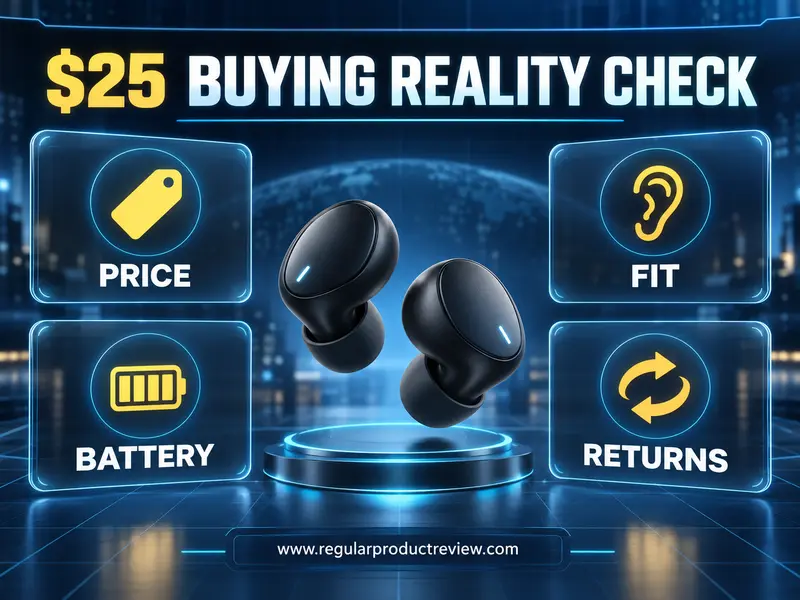
That distinction matters because specifications can be misleading. A claimed 30 or 35 hours usually combines multiple recharges from the case; it is not continuous listening time. “ENC” normally describes microphone processing for calls, not noise cancellation in your ears. “Waterproof” may really mean an IPX4 or IPX5 splash-resistance rating, which does not authorize swimming or submersion. And an attractive $19.99 price may be a one-week sale on a product whose normal price sits above the topic’s ceiling.
We built this guide around those practical traps. The JLab Go Pop+ wins overall because its official U.S. price fits the budget without requiring a coupon, while its app, ambient-listening mode, AAC support, and long claimed battery life make it unusually complete. The JLab Go Pop ANC becomes the more ambitious choice when its sale price remains under $25. The soundcore P20i is the better fit for listeners who value strong bass and unusually flexible app EQ, while the TOZO A1 prioritizes a very light shell. The JVC Gumy Mini takes the opposite approach to app-heavy earbuds: simple controls, three onboard sound modes, and a compact design.
This is a research-led comparison, not a claim that our editors physically lab-tested these exact retail samples. We checked manufacturer pages, technical specifications, manuals, included accessories, warranty or return information where available, and current U.S. pricing. We then compared each model against the same decision factors: fit, usable battery structure, connection features, call hardware, water resistance, controls, support, and price stability. Readers who want broader context can start with our wireless earbuds guide, while deal hunters may also want the wider best budget earbuds roundup.
Most importantly, a $25 earbud should be easy to replace—but it should not feel designed to become e-waste. Buy from a seller with a clear return path, test every ear tip immediately, verify that both buds charge reliably, and keep the packaging until the return window closes. Those steps protect you more than a decorative list of codecs. If you can spend more for stronger microphones, better quality control, or genuinely effective ANC, use our verified premium earbuds category to compare what the extra money changes.
Quick summary: match the earbud to the compromise
| Pick | Best for | Price status when checked | Main advantage | Main compromise |
|---|---|---|---|---|
| JLab Go Pop+ | Most shoppers | $24.99 official | Complete feature set without waiting for a sale | No ANC; only IPX4 |
| JLab Go Pop ANC | Commuters on a deal | $19.99 official sale | Real ANC, ambient mode, multipoint | Regular price can exceed $25 |
| soundcore P20i | Bass and EQ fans | $24.99 retailer sale | 10mm drivers and 22 app presets | No transparency mode or ANC |
| TOZO A1 | Small ears and light fit | $19.99 after official coupon | 3.7g per bud, IPX5, AAC/SBC | Coupon-dependent; basic mic system |
| JVC Gumy Mini HA-A6T | Simple everyday use | $19.99 retailer sale | Straightforward operation, three sound modes | SBC only; no companion app |
Fast answer: Choose the JLab Go Pop+ if you want the safest all-around purchase under $25. Choose the Go Pop ANC only while its checkout price remains below the cap. Pick the P20i for bass and app tuning, the TOZO A1 for a lighter in-ear feel, or the JVC Gumy Mini if you prefer simplicity over software.
Smart comparison table
| Model | Earbud / total claimed playtime | Water rating | App | Ambient sound | ANC | Bluetooth | Best-fit profile |
|---|---|---|---|---|---|---|---|
| JLab Go Pop+ | Up to 9 / 35 hrs | IPX4 | Yes | Yes | No | 5.3 | Feature-rich daily pair |
| JLab Go Pop ANC | Up to 7.5 / 24+ hrs; 6 / 20 hrs with ANC | IP55 | Yes | Yes | Yes | 5.4 | Commute and shared spaces |
| soundcore P20i | Up to 10 / 30 hrs | IPX5 | Yes | No | No | 5.3 | Bass-first listening |
| TOZO A1 | Up to 7 / 32 hrs | IPX5 | Yes | No | No | 5.3 | Smaller ears and light carry |
| JVC Gumy Mini HA-A6T | Up to 7.5 / 23 hrs | IPX4 | No | No | No | 5.1 | Simple music and podcasts |
Battery figures are manufacturer maximums and normally vary with volume, calls, signal strength, EQ, and other conditions.
Why trust this guide
Our first rule is price integrity. A model does not qualify merely because it once appeared in a holiday sale. We recorded the price path used for eligibility and labeled whether it was an official everyday price, official promotion, coupon, or retailer sale. That makes this guide easier to audit and prevents a $39 earbud from quietly masquerading as a permanent under-$25 option. For readers comparing other price bands, our budget-earbuds category explains where spending a little more begins to change the experience.
Our second rule is claim discipline. We distinguish passive isolation, call-noise processing, and active noise cancellation instead of treating every “noise” label as equivalent. The same principle applies to battery figures: earbud runtime and case-assisted total are shown separately whenever the manufacturer provides both. If noise reduction matters more than the strict budget, compare this list with our dedicated noise-cancelling earbuds guide.
Testing methodology: what was—and was not—tested
This article uses a structured evidence review rather than pretending to offer first-hand laboratory results. We reviewed official product pages, manuals, support documentation, current U.S. listings, and the features needed for everyday ownership. Each candidate was checked in six evidence buckets: price qualification, fit indicators, battery structure, connectivity, durability, and support or return risk.
We did not assign fabricated decibel-reduction numbers, frequency-response scores, latency measurements, or microphone ratings. Those require controlled equipment and repeatable physical testing. Instead, we use cautious language: a 10mm driver may support fuller bass output, but driver diameter alone does not prove sound quality; an IPX5 rating indicates stronger water-jet resistance than IPX4, but neither is permission to swim. Gamers who need measured latency should use a specialized gaming earbuds guide rather than assume ordinary Bluetooth buds are competitive-grade.
Selection methodology: why five products made the cut
We started with a wider market scan and removed models that were above $25 when checked, out of stock with no credible U.S. purchase path, unclear about model revision, or supported only by untraceable marketplace claims. We then selected five products that solve meaningfully different problems. Two JLab models remain because they occupy different price states and use cases: the Go Pop+ is the stable-price all-rounder; the Go Pop ANC is a sale-dependent feature play.
The final order weights ownership value, not the number of logos on the box. We prioritized fit options, per-charge battery life, clear controls, app usefulness, sweat resistance, warranty or returns, and honest price accessibility. Sports-focused readers should still compare retention designs in our sports earbuds category, because none of these low-cost picks uses a full ear-hook.
JLab Go Pop+: Best Wireless Earbuds Under $25 Overall
Price badge: 🟢 Stable under the cap — $24.99 from JLab when checked
Ideal buyer: Someone who wants one inexpensive pair for music, podcasts, calls, errands, and light workouts.
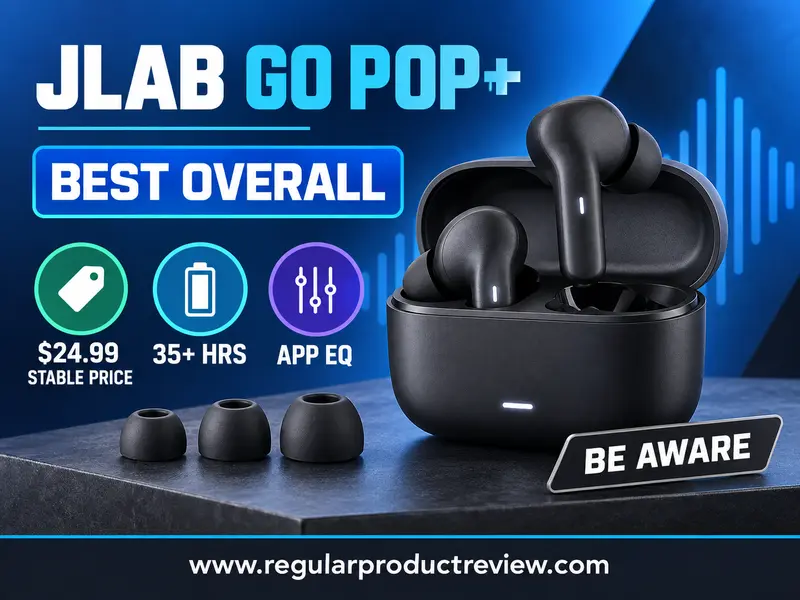
The JLab Go Pop+ is the easiest recommendation in this group because the value does not depend on a lightning deal. Its official price was $24.99 when checked, leaving no coupon arithmetic and no awkward “technically under budget today” caveat. That matters in an evergreen guide: a reader can follow the recommendation without discovering that the qualifying price vanished overnight.
The feature mix is unusually coherent for the money. JLab lists up to nine hours from the earbuds and 35 total with the case, Bluetooth 5.3, AAC and SBC codecs, Google Fast Pair, independent use of either bud, and an integrated USB-C charging cable. The JLab app adds custom EQ and touch-control mapping instead of forcing users to accept a single factory tuning.
Go Pop+ also includes Be Aware mode, which uses the microphones to pass outside sound into the earbuds. That is useful at a checkout counter or when walking near traffic, though it is not a substitute for removing an earbud in a genuinely hazardous situation. The IPX4 rating covers sweat and incidental splashes, not submersion or aggressive rinsing.
Its main limitation is not hidden: there is no active noise cancellation. A secure ear-tip seal can reduce steady background sound passively, but it will not behave like premium ANC on an airplane. If that feature is essential, check the next pick or browse our best noise-cancelling earbuds for models with a larger performance budget.
Why it earns the top position
At this level, reliability of the purchase decision counts as a feature. Go Pop+ combines a stable qualifying price with app support, an ambient mode, familiar codec compatibility, and a two-year limited warranty. None of those guarantees perfect long-term durability, but the package is easier to understand and support than an anonymous marketplace model with dramatic claims and no clear documentation.
The 6mm driver is smaller than the P20i’s 10mm unit, yet driver size alone cannot rank sound. What matters here is that the app gives the listener a practical way to reduce bass, lift voices, or create a custom curve. If you want to explore more mainstream options before deciding, the site’s wireless earbuds category provides a broader starting point.
Feature card
| Attribute | JLab Go Pop+ detail | What it means in practice |
|---|---|---|
| Battery | Up to 9 hours; 35 total | Strong claimed endurance for commuting and school |
| Quick charge | 10 minutes for 1 hour | Useful when the case was forgotten overnight |
| Charging | Integrated USB-C cable | One less cable to carry, but the fixed lead cannot be replaced separately |
| Water resistance | IPX4 | Fine for sweat and splashes; not swimming |
| App | Custom EQ and controls | More adaptable than fixed-preset-only competitors |
| Awareness | Be Aware mode | Lets outside sound in electronically |
| Warranty | Two years limited | Better documented support than many ultra-cheap rivals |
The tradeoffs that should decide the purchase
Buy it if: you want the broadest set of daily-use features without monitoring sales; you value app control; you use Android and appreciate Fast Pair; or you tend to forget a separate charging cable.
Skip it if: you need genuine ANC, expect low-latency wireless for competitive gaming, want a fully waterproof design, or dislike an integrated cable that cannot be swapped if damaged. Competitive players should compare purpose-built options in our gaming earbuds category.
Pros
- Official price fits the budget without a promotional code
- Up to 35 hours of manufacturer-rated total playtime
- App-based EQ and control customization
- Be Aware mode and Google Fast Pair
- AAC and SBC support
- Two-year limited warranty
Cons
- No active noise cancellation
- IPX4 is splash-resistant, not waterproof for immersion
- Fixed charging lead is convenient but not replaceable
- Touch controls can be easier to trigger accidentally than physical buttons
Best setup for better sound
Start with the largest ear tip that seals comfortably without pressure. Play spoken audio and lightly press each earbud inward; if bass and voice body increase dramatically, the existing tip is probably too small. Then use the app to begin with a balanced preset before boosting bass. Heavy low-frequency EQ can mask vocals and consumes some headroom, so small adjustments usually sound cleaner.
For outdoor training, keep Be Aware mode on and volume moderate, but do not rely on electronics alone near vehicles. Runners who need stronger physical retention should look at the hook and wing options in our best sports earbuds guide.
Bottom line: The Go Pop+ is not the most spectacular model here; it is the one with the fewest purchasing complications. That makes it the best budget wireless earbud under $25 for most buyers.
JLab Go Pop ANC: Best Cheap Noise-Cancelling Earbuds—When on Sale
Price badge: 🟡 Sale-dependent — $19.99 official sale; regular price shown above $25
Ideal buyer: A commuter or student who wants basic ANC and multipoint without increasing the budget.

Go Pop ANC is the outlier in this roundup: it offers actual active noise cancellation at a price usually associated with passive-only earbuds. JLab specifies a feed-forward ANC system, a Be Aware transparency mode, Bluetooth 5.4, multipoint pairing, Google Fast Pair, and app-adjustable sound and controls. At the $19.99 promotional price displayed when checked, the feature-per-dollar ratio is exceptional.
That does not mean it should be described like a $200 travel earbud. Feed-forward ANC uses exterior microphones to identify surrounding noise, but budget implementations generally have less processing sophistication and fewer microphones than premium hybrid systems. Expect the greatest benefit with steady low-frequency sound—fans, HVAC hum, or some transit rumble—not silence, and not complete removal of nearby speech.
Battery life also needs two sets of numbers. JLab lists more than 24 total hours with ANC off, including up to 7.5 hours from the earbuds. With ANC active, the claim falls to about 20 total hours and six hours from the earbuds. Those are sensible numbers for the category, but real runtime will vary with volume, call time, connection conditions, and feature use.
The IP55 rating is more protective than the IPX4 ratings on several rivals because the first digit indicates some dust protection and the second covers water jets. Even so, the charging case should stay dry, and neither sweat resistance nor an IP code makes the earbuds suitable for a pool.
The decisive warning is price. JLab’s page showed a higher crossed-out price, so Go Pop ANC qualifies only while the live checkout price remains under $25. If the sale ends, buy the Go Pop+ or use our budget earbuds hub to find a current alternative rather than stretching the definition of this guide.
ANC without marketing fog
There are three different noise features on this product. ANC reduces some sound heard by the wearer. Be Aware intentionally brings environmental sound in. ENC/DNS call processing aims to make the wearer’s voice clearer to the person on the other end. They solve different problems, and the presence of one does not imply the strength of another.
The Go Pop ANC uses 10mm dynamic drivers, AAC and SBC codecs, two MEMS microphones, and app-based custom EQ. The combination gives it more tuning and connection flexibility than many sub-$25 options. For a category-wide explanation of cancellation tiers, read our noise-cancelling earbuds category.
Daily-use scorecard
| Scenario | Expected fit | Reason |
|---|---|---|
| Bus or office fan | Good for the price | Steady noise is the easiest ANC target |
| Busy café voices | Limited | Speech changes rapidly and remains difficult |
| Two-device workday | Very good | Multipoint can reduce manual switching |
| Outdoor awareness | Useful with care | Be Aware helps, but removing a bud is safer near traffic |
| Gym use | Good | IP55 earbuds resist sweat; fit still depends on ear shape |
| Long flight | Backup-grade | Battery is adequate, ANC is not premium-class |
Who should buy it—and who should not
Buy it if the promotional price is $24.99 or less, you regularly move between a laptop and phone, and reducing steady background hum matters more than maximum battery life. Multipoint is the sleeper feature: it can improve everyday convenience more often than budget ANC does.
Do not buy it under this topic if the price has returned above $25. Also skip it if your priority is high-fidelity codecs, class-leading calls in wind, or airplane-grade cancellation. Those are legitimate reasons to step up to the products in our premium earbuds category, not reasons to pretend this bargain model can do everything.
Pros
- Active noise cancellation at a rare sub-$25 sale price
- Multipoint, Google Fast Pair, and Bluetooth 5.4
- IP55-rated earbuds
- App-based custom EQ and controls
- AAC and SBC support
- Integrated USB-C charging cable
Cons
- Eligibility depends on the current sale
- ANC is basic feed-forward, not premium hybrid cancellation
- Shorter battery life with ANC enabled
- Only two microphones total limits expectations for difficult calls
Price-check protocol
Before clicking buy, ignore the crossed-out number and check the final item price for your selected color. Promotional pricing can vary by color, seller, membership, or location. Do not count tax or optional shipping against the editorial $25 equipment ceiling, but do compare the delivered cost—free shipping on a $24.99 product may be a better real purchase than a $19.99 product with a large delivery fee.
If the sale disappears, the correct response is to wait or select another model, not to rewrite the budget after the fact. Our wider best budget earbuds guide is designed for that moving-price reality.
Bottom line: At $19.99, Go Pop ANC is the most feature-dense deal here. Above $25, it is no longer eligible—and the Go Pop+ becomes the cleaner recommendation.
soundcore P20i: Best Under-$25 Earbuds for Bass and App EQ
Price badge: 🟡 Retailer-sale dependent — $24.99 at Target when checked; regular price shown as $39.99
Ideal buyer: A listener who wants energetic bass and more EQ choices than most entry-level earbuds provide.
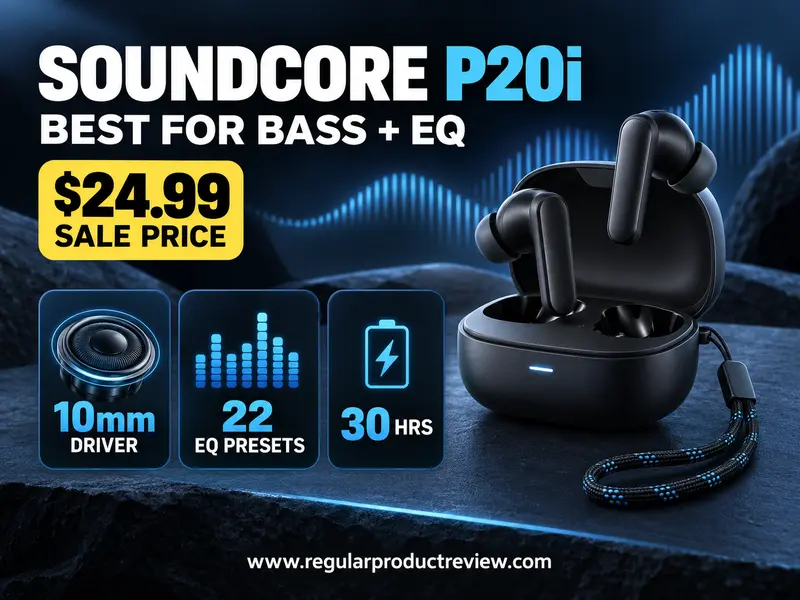
The soundcore P20i makes its case with two things buyers can understand immediately: large-for-the-class 10mm dynamic drivers and a companion app with 22 EQ presets. Neither specification guarantees great sound by itself, but together they give bass-oriented listeners more room to tailor the result than a fixed-tuning model. The app also allows control customization and includes a sound-emitting “Find My Earbuds” function for a misplaced bud nearby.
Battery claims are competitive: up to 10 hours from one charge and 30 hours with the case, plus two hours of playback from a 10-minute top-up. The earbuds support Bluetooth 5.3, single-bud use, USB-C charging, and an IPX5 water-resistance rating. Two microphones work with an AI algorithm for calls, though buyers should still expect wind and loud public spaces to challenge a two-mic system.
The compromise is its stripped-back ambient toolkit. P20i does not offer ANC or a proper transparency mode. Its closed in-ear fit can passively soften outside noise, which is useful indoors but can reduce situational awareness outside. If hearing the environment matters, the Go Pop+ is the more convenient pick; if isolation is the goal, fit and ear-tip seal become critical.
Why “10mm” is not a sound-quality score
A larger driver can move more air, but tuning, enclosure design, seal, distortion, and digital processing all shape what reaches the eardrum. The P20i is marketed around powerful bass, so listeners who prefer neutral vocals should plan to use the app. Start with a balanced or less bass-heavy preset, then compare at matched volume; louder almost always sounds more impressive in a quick test.
That adjustment potential is why the P20i ranks above many anonymous “deep bass” earbuds. You are not locked into one aggressive curve. Readers comparing the broader category can use our best wireless earbuds guide for models with stronger transparency, ANC, or microphone systems.
Practical specifications
| Feature | Manufacturer / retailer claim | Buying interpretation |
|---|---|---|
| Driver | 10mm dynamic | Supports a bass-forward design; not proof of accuracy |
| Battery | Up to 10 hours; 30 total | Strong claim, but calls and volume reduce runtime |
| Fast charge | 10 minutes for 2 hours | Best quick-charge claim in this shortlist |
| EQ | 22 presets in app | Valuable for reducing or reshaping bass |
| Calls | Two mics with AI processing | Suitable for quiet-to-moderate settings, not guaranteed in wind |
| Water rating | IPX5 | Good for sweat and rain splashes; do not submerge |
| Awareness | Single-bud mode only | No electronic transparency mode |
Ownership wins and friction points
The compact case has an attached lanyard, a small touch that makes sense for inexpensive earbuds likely to live on a backpack or key hook. Single-bud mode can extend practical listening time and restores some environmental awareness. USB-C means one common charging standard rather than an obsolete connector.
On the other hand, app value depends on continued software compatibility. Install the soundcore app, update firmware if offered, choose a control layout, and then confirm that the earbuds retain settings without keeping unnecessary permissions enabled. If you would rather avoid another app entirely, the JVC pick later in this guide is simpler. The site’s earbuds section can also help you compare app-free alternatives.
Pros
- Strong bass potential from 10mm drivers
- 22 app EQ presets and customizable controls
- Up to 10 hours per charge and 30 total
- Excellent manufacturer-rated quick charging
- IPX5 sweat and splash resistance
- Compact case with lanyard
Cons
- Under-$25 status depends on a retailer sale
- No ANC or electronic transparency mode
- Bass-forward default may not suit vocal or acoustic listeners
- Two-mic call system should not be oversold for noisy streets
Best use case
P20i makes the most sense for gym playlists, pop, hip-hop, electronic music, podcasts adjusted with EQ, and buyers who enjoy experimenting in an app. Its IPX5 rating makes it a reasonable exercise option, but the stem design lacks a wing or hook. If your ears eject ordinary buds while running, compare secure-fit models in our sports earbuds category.
It is less compelling for commuters who explicitly want ANC, pedestrians who rely on transparency mode, or people who never want to create an app account. It may work for casual mobile games, but ordinary Bluetooth latency and the absence of a dedicated low-latency mode make it a poor promise for ranked competitive play; see our best gaming earbuds for the right feature set.
Bottom line: Buy the P20i at $24.99 or less if app EQ and satisfying bass matter most. If the price rises, do not pay the regular $39.99 price under the logic of an under-$25 guide.
TOZO A1: Best Lightweight Wireless Earbuds for Small Ears
Price badge: 🟡 Coupon-dependent — $29.99 official price with a displayed $10 code when checked
Ideal buyer: Someone who finds ordinary true-wireless shells bulky or uncomfortable.
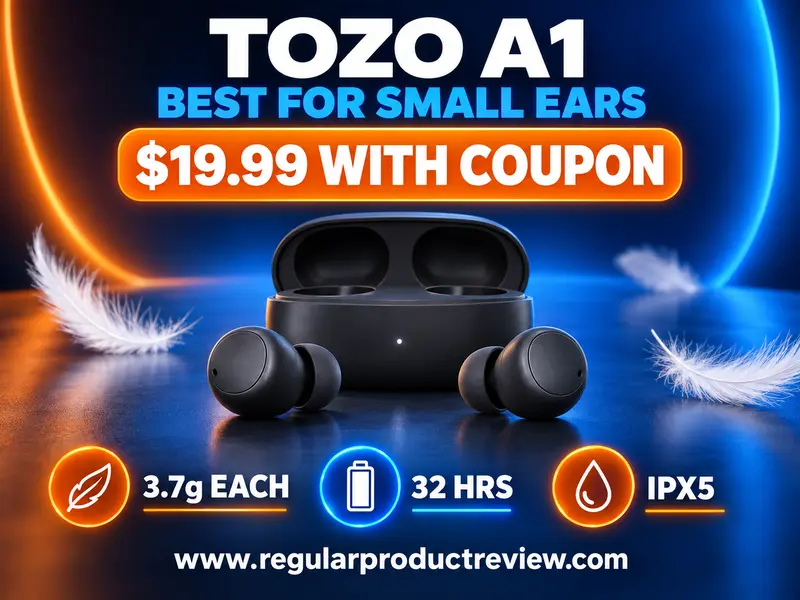
Fit failure is the fastest way to waste $25. An earbud can have excellent app features and still sound thin, fall out, or hurt after 20 minutes if its shell is too large. TOZO’s A1 addresses that problem directly: the company lists each earbud at 3.7 grams and positions the body as a compact, lightweight design.
The small shell does not force unusually short battery claims. TOZO rates the A1 for up to seven hours from one charge and 32 hours with the case at 50% volume using AAC under its stated conditions. Bluetooth 5.3, AAC/SBC support, USB-C charging, and an IPX5 earbud rating cover the expected daily basics.
The 6mm dynamic driver and manufacturer-described bass enhancement suggest a lively rather than studio-neutral target. Fortunately, current TOZO material promotes app-based EQ presets and community EQ options. As always, the safest approach is to begin near neutral, establish a proper seal, and make small changes rather than immediately maximizing the bass slider.
Calls are a secondary use case. Retail listings may describe “AI noise-cancelling mic” features, but that is not the same as ANC for listening, and TOZO’s own core specification table does not turn the A1 into a conference headset. In a quiet room it should cover a quick call; in traffic, wind, or a crowded station, expectations should remain modest.
The fifth issue is pricing. TOZO’s official page showed $29.99 and a $10 promotional code when checked. That produces an eligible $19.99 item price if the code applies, but it makes the A1 a conditional recommendation. Verify the discount in the cart before purchasing; do not assume the banner will remain active.
Finally, “small ears” is not a universal anatomical category. Low weight and a small shell improve the odds, but nozzle angle, concha shape, and tip size still matter. Buy from a seller with a clear return policy, and test all included tips before deciding. For more fit-oriented choices, browse our broader wireless earbuds hub.
Fit-first checklist
- Insert the smallest tips first, then move up only if bass is weak or the seal breaks.
- Rotate each bud slightly backward rather than pushing it deeper.
- Speak, chew, and walk for five minutes; discomfort often appears with jaw movement.
- Compare left and right seals separately—ears are not always symmetrical.
- Stop if you feel sharp pressure; “secure” should not mean painful.
The A1’s 3.7g-per-ear weight is helpful during longer sessions, but the only fit test that matters is your own. If a wing or hook is necessary, our best sports earbuds roundup covers designs built around retention rather than minimal shell size.
Numbers worth knowing
| Specification | TOZO A1 |
|---|---|
| Earbud weight | 3.7g each, manufacturer-listed |
| Driver | 6mm dynamic |
| Codecs | AAC, SBC |
| Battery | Up to 7 hours / 32 hours with case |
| Battery test condition disclosed | AAC, default setting, 50% volume |
| Bluetooth | 5.3 |
| Charging | USB-C; about 2 hours listed for buds and case |
| Water resistance | IPX5 for earbuds |
The honest advantages and limitations
Pros
- Very light 3.7g earbud weight
- Compact design better suited to smaller ears
- AAC and SBC support
- Up to 32 hours of total claimed playtime
- IPX5-rated earbuds
- App EQ adds useful tuning flexibility
Cons
- Requires the displayed coupon to qualify from the official store
- No listening ANC or transparency mode
- Microphone performance is not the primary reason to buy
- Smaller shell does not guarantee a secure fit for every ear
- Two-hour charging is ordinary rather than fast
Choose it over the others when…
Choose A1 over P20i when physical lightness matters more than a larger driver and quick-charge speed. Choose it over Go Pop+ when IPX5 is more important than Be Aware mode or a stable no-coupon price. Choose it over JVC when AAC and app EQ matter more than onboard simplicity.
Skip it if you want true multipoint, an ambient mode, meaningful ANC, or a purchase that qualifies without entering a code. Our best budget earbuds guide may surface a better live deal if the A1 coupon has expired.
Bottom line: TOZO A1 is the fit specialist of the group. Its low weight is a real design distinction, but its under-$25 recommendation lasts only as long as the coupon does.
JVC Gumy Mini HA-A6T: Best Simple Earbuds Without App Dependence
Price badge: 🟡 Retailer-sale dependent — $19.99 at Best Buy when checked; $29.95 official list price
Ideal buyer: Someone who wants compact true-wireless earbuds with uncomplicated onboard features.
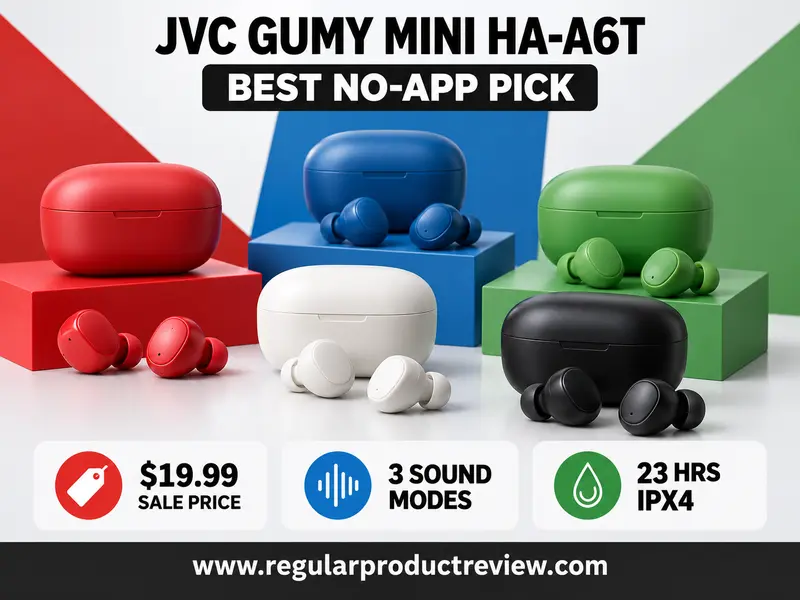
The JVC Gumy Mini earns a place here by declining to turn a low-cost earbud into a software project. It offers three onboard sound modes—Normal, Bass, and Clear—along with touch controls, auto power and connection behavior, single-ear use, and voice-assistant compatibility. There is no companion app to install before changing a basic sound profile.
JVC specifies up to 7.5 hours from the earbuds and 23 hours total with the case. A 15-minute charge is rated for 85 minutes of playback. Those numbers trail the longer claims from JLab and TOZO, but they remain practical for daily errands, school, or an office shift when the case is available.
The compact earbuds weigh about 3.9 grams each and include small, medium, and large silicone tips. IPX4 protection covers sweat and splashing, while Bluetooth 5.1 and SBC provide a basic connection stack. This is not the choice for codec collectors or people who want multipoint; it is the choice for straightforward use.
Price is again conditional. JVC’s official U.S. price was $29.95, while Best Buy showed $19.99 when checked. That makes the Gumy Mini eligible as a retailer-sale pick, not a permanent under-$25 recommendation. If it returns to list price, the Go Pop+ offers more current features for less.
Simplicity can be an advantage
App control is valuable when it works, but it also adds updates, permissions, account friction, and eventual compatibility risk. JVC’s three sound modes live on the earbuds. “Clear” can improve perceived speech intelligibility, “Bass” adds low-end emphasis, and “Normal” is the safest starting point. These are presets, not a fully adjustable equalizer.
That approach suits a spare pair, a first true-wireless purchase, or a gift for someone who does not want another app. For a wider range of straightforward choices, visit our earbuds buying hub and compare the essentials rather than marketing counts.
Snapshot: what you get and what you give up
| You get | You give up |
|---|---|
| 3.9g compact earbuds | Companion-app EQ |
| Three onboard sound modes | AAC or higher-bitrate codec choices |
| Up to 7.5 hours per charge | Longest total battery in the group |
| 15-minute quick charge | Multipoint switching |
| IPX4 protection | ANC and transparency mode |
| Single-ear use | Newer Bluetooth features |
Best listeners and situations
The “Clear” preset makes the Gumy Mini appealing for podcasts, audiobooks, language lessons, and spoken navigation. Its compact size also helps if a bulky stem or shell presses against your outer ear. The earbuds can be used individually, which is useful at a desk or while waiting for announcements.
They are less suitable for shoppers who want strong app control, automatic switching between a laptop and phone, or electronic awareness outdoors. They also rely on SBC, so iPhone users do not get the AAC path offered by JLab and TOZO. Codec alone does not determine enjoyment, but it is a meaningful technical difference.
If your main use is competitive mobile gaming, the simple Bluetooth connection and lack of a dedicated low-latency mode are poor reasons to choose it. Our competitive gaming earbuds guide explains why a 2.4GHz dongle or verified low-latency mode can matter more than a “gaming” EQ label.
Pros
- Compact, lightweight 3.9g-per-bud design
- Three sound modes work without an app
- Up to 7.5 hours from one charge
- IPX4 sweat and splash resistance
- Either earbud can be used alone
- Established manufacturer documentation and manual
Cons
- Qualifies only at the retailer sale price
- SBC is the only listed codec
- No ANC, transparency mode, or multipoint
- Shorter case-assisted total than most rivals here
- Bluetooth 5.1 is functional but older than competing implementations
The final fit check
Begin with Normal mode and the medium tip, then change one variable at a time. If bass is weak on both sides, try a larger tip before selecting Bass mode. If speech sounds muffled despite a good seal, switch to Clear. This order prevents EQ from compensating for a mechanical fit problem.
For workouts, IPX4 is adequate for ordinary sweat, but dry the earbuds before returning them to the case. If exercise is the primary use, explore our sports earbuds category for models with more deliberate stability systems.
Bottom line: The JVC Gumy Mini is the best no-app option in this shortlist at $19.99. At its $29.95 list price, it no longer belongs in an under-$25 ranking.
Detailed Buying Guide: The Under-$25 Earbud Field Manual
1. Treat the price ceiling as a checkout test
“Under $25” should mean the product price for a new, complete pair is $24.99 or less at the time of purchase. A coupon is acceptable only if it is publicly available and actually applies in the cart. A used, open-box, membership-locked, or region-specific price should not be presented as the default. Taxes vary by location; shipping does not change the product’s category, but it does change the smarter purchase.
This guide labels stable and conditional prices because ultra-budget audio changes quickly. If every conditional pick rises above the ceiling, start with the regularly qualifying Go Pop+ or check the live options in our budget-earbuds category.
2. Fit is the first audio specification
A sealed in-ear earbud needs an airtight-enough fit to reproduce bass and provide passive isolation. If the tip is too small, low frequencies escape and the earbud sounds thin. If it is too large, it can create pressure, pain, and a shallow unstable fit. The right tip should remain secure while speaking and walking without requiring force.
Do a simple seal comparison: play a familiar voice recording, then gently press each earbud inward without changing volume. A dramatic increase in bass usually means the tip is not sealing. Change sizes before using EQ. Buyers who consistently struggle with in-ear seals may prefer an open-ear design, though suitable models rarely fall below $25; compare form factors through our wireless earbuds guide.
3. Understand the three meanings of “noise cancelling”
Passive isolation is the physical reduction created by the ear tip and shell. It requires no battery and mainly depends on seal. Active noise cancellation (ANC) uses microphones and signal processing to reduce some ambient sound heard by the wearer. Environmental noise cancellation (ENC) or AI call processing tries to improve the voice sent to the caller. ENC does not quiet the listener’s world.
Under $25, passive isolation is common, call processing is frequently advertised, and competent ANC is rare. The Go Pop ANC is notable because it offers true ANC on sale, but its feed-forward system should not be compared casually with premium hybrid designs. For a deeper explanation and stronger options, use our noise-cancelling earbuds hub.
4. Read battery claims as two different numbers
The number on the front of the box is usually total playtime after recharging the earbuds in the case. The more useful number for a flight, shift, or study session is earbud playtime on one charge. In this list, the claimed single-charge figures range from about 6 hours with ANC enabled to 10 hours under manufacturer conditions.
Actual runtime can fall because of high volume, calls, weak signal, frequent controls, EQ, ANC, cold weather, and battery age. A practical planning rule is to expect less than the maximum and use quick-charge claims as backup, not certainty. If long sessions are the priority, the Go Pop+ and P20i have the strongest published single-charge figures here.
5. Driver size is descriptive, not a ranking
The P20i and Go Pop ANC use 10mm dynamic drivers, while Go Pop+, TOZO A1, and JVC Gumy Mini use 6mm-class drivers. A bigger diaphragm can support bass output, but it does not automatically produce cleaner bass, more accurate mids, or better treble. Tuning, enclosure volume, seal, distortion, and digital processing matter at least as much.
Choose based on the sound controls you can actually use. P20i offers many app presets, both JLab models allow app customization, TOZO promotes app EQ, and JVC keeps three modes onboard. Readers looking for higher-performance audio rather than lowest cost should compare our premium earbuds guide instead of shopping by millimeters.
6. Codec labels need context
SBC is the universal baseline for Bluetooth audio. AAC is particularly relevant to Apple devices and is also supported on many Android phones, though implementation varies. None of these picks is built around advanced high-bitrate codecs, and that is reasonable at $25: the physical driver, tuning, fit, and recording quality are more likely to define the result.
JLab Go Pop+, Go Pop ANC, and TOZO A1 list AAC and SBC. JVC lists SBC. P20i listings emphasize app EQ rather than an advanced codec story. Do not buy an earbud solely because a marketplace title contains “HD sound”; look for an actual supported-codec specification.
7. Multipoint is different from remembering devices
Most earbuds can remember several paired devices but connect to only one at a time. Multipoint means maintaining active connections with two devices so a phone call can interrupt laptop audio without manual repair. The Go Pop ANC explicitly includes multipoint, making it the strongest workday pick here.
Multipoint behavior is not identical across brands; media handoff may pause before switching, and two simultaneous audio streams are generally not mixed. If this feature is essential, confirm it in the manufacturer documentation instead of assuming Bluetooth 5.3 or 5.4 includes it automatically. Our best wireless earbuds roundup contains higher-priced models with more mature switching systems.
8. IP ratings protect against conditions, not every accident
In an IP code, the first digit concerns solids such as dust; an “X” means the product was not given a published solids-protection rating, not that it necessarily has zero protection. The second digit concerns water. IPX4 covers splashing, while IPX5 covers water jets under defined test conditions. IP55 includes both limited dust-ingress protection and water-jet protection.
Ratings in this article apply to the earbuds unless specifically stated otherwise. Charging cases are usually more vulnerable because exposed contacts and ports can retain moisture. Wipe sweat away, let the buds dry, and never charge wet contacts. For training-first choices with more secure hardware, see our best sports earbuds.
9. Microphone counts are not call-quality guarantees
More microphones can provide more information for beamforming or noise reduction, but microphone placement, algorithms, wind handling, and connection quality determine the result. The P20i and both JLab picks describe two-mic or processed call systems; none should be sold as a professional call-center headset.
For an honest home test, record a voice memo in a quiet room, near a fan, and while walking outside. Keep the phone in the same place and speak at the same level. Listen for clipped consonants, pumping volume, and wind overload. If calls are mission-critical, use a retailer with easy returns and test during the first few days.
10. Touch controls versus physical feedback
Touch panels avoid pressing an earbud deeper into the canal, but they can register accidental taps while adjusting fit. Physical buttons provide clearer feedback but may create pressure. In either case, verify that volume, track, call, and awareness controls can be arranged in a way you remember.
App-supported JLab and soundcore models are strongest for remapping. JVC’s appeal is that its basic modes work without a phone app. Shoppers seeking a specialized low-latency control scheme should consult our gaming earbuds category rather than equate customizable taps with gaming readiness.
11. App support is useful—and a dependency
An app can provide EQ, firmware updates, control mapping, lost-bud sound, and awareness settings. It may also request permissions, require an account, or stop supporting an older model later. Install from the official app store, review permissions, update firmware with both buds charged, and do not grant location or background access unless a feature you want requires it.
After setup, confirm whether settings remain stored on the earbuds. If they do, you may not need the app running. Buyers who want zero software dependency should favor JVC’s onboard modes or explore other simple choices through our earbuds hub.
12. Returns and warranty matter more at the bottom of the market
Low-cost electronics can have greater unit-to-unit variation, and earbud fit is inherently personal. A documented 30-day return policy can be more valuable than a questionable extra feature. Test charging, left/right balance, microphones, controls, and battery behavior before discarding the box.
JLab advertises two-year limited warranty coverage and 30-day returns on its direct product pages. TOZO lists a 30-day money-back guarantee and warranty information. Retailer purchases follow the retailer’s policy, which may differ from the manufacturer’s. Read the policy before buying—especially for opened in-ear products, where hygiene exclusions can apply.
13. Avoid counterfeit and revision confusion
Ultra-cheap listings may combine old and new versions under one page. Confirm the exact model number, Bluetooth version, charging connector, battery claims, and app compatibility. A title that says “2026 upgraded” is not meaningful without a distinct model identifier or manufacturer documentation.
Buy from the manufacturer or an authorized retailer when possible. If a marketplace seller uses stock photos, has a newly created profile, or offers a price far below every other seller, the small savings may not justify the risk. For higher-value purchases, our premium earbuds category uses the same model-verification principle with even more emphasis on warranty validity.
14. Hearing safety still applies to cheap earbuds
Price does not limit sound pressure. A poor seal can tempt listeners to raise volume, while bass-heavy tuning can encourage further increases in noisy environments. Use the lowest volume that keeps speech and music clear, take breaks, and avoid trying to overpower traffic or machinery with volume.
ANC can sometimes support safer listening by reducing the need to turn music up, but budget ANC is not certified hearing protection. Do not use consumer earbuds in place of appropriate protective equipment around power tools, firearms, industrial machinery, or other hazardous noise.
Product Comparison Tables: See the Tradeoffs at a Glance
Price and eligibility table
| Rank | Model | Observed qualifying price | Price type | What to verify before buying |
|---|---|---|---|---|
| 1 | JLab Go Pop+ | $24.99 | Official current price | Selected color remains $24.99 |
| 2 | JLab Go Pop ANC | $19.99 | Official sale | Sale remains active; final item price ≤ $24.99 |
| 3 | soundcore P20i | $24.99 | Target sale | Retailer price and stock in your location |
| 4 | TOZO A1 | $19.99 after code | Official coupon | $10 code applies in cart |
| 5 | JVC Gumy Mini HA-A6T | $19.99 | Best Buy sale | Exact HA-A6T model and sale price |
Price was checked on September 14, 2026 and can change. If a deal expires, do not force the model into the budget. Recheck our budget earbuds hub or the broader wireless earbuds category for a currently eligible alternative.
Feature matrix
| Feature | Go Pop+ | Go Pop ANC | P20i | TOZO A1 | JVC Gumy Mini |
|---|---|---|---|---|---|
| App EQ | ✅ | ✅ | ✅ | ✅ | — |
| Onboard presets | ✅ | ✅ | Via app | Via app | ✅ |
| ANC | — | ✅ | — | — | — |
| Ambient / transparency | ✅ | ✅ | — | — | — |
| Multipoint | — | ✅ | — | — | — |
| AAC | ✅ | ✅ | Not emphasized | ✅ | — |
| Single-bud use | ✅ | ✅ | ✅ | ✅ | ✅ |
| Fast Pair | ✅ | ✅ | — | — | — |
| USB-C | Integrated | Integrated | Cable | Cable | Cable |
Battery and durability matrix
| Model | Single-charge claim | Total claim | Quick charge | Earbud IP rating |
|---|---|---|---|---|
| JLab Go Pop+ | Up to 9 hrs | 35 hrs | 10 min = 1 hr | IPX4 |
| JLab Go Pop ANC | Up to 7.5 hrs; 6 with ANC | 24+ hrs; 20 with ANC | 10 min = 1 hr | IP55 |
| soundcore P20i | Up to 10 hrs | 30 hrs | 10 min = 2 hrs | IPX5 |
| TOZO A1 | Up to 7 hrs | 32 hrs | Not a standout claim | IPX5 |
| JVC Gumy Mini | Up to 7.5 hrs | 23 hrs | 15 min = 85 min | IPX4 |
Manufacturer battery ratings use controlled conditions and are not cross-brand laboratory measurements. A 35-hour number does not prove that one product will always outlast a 32-hour rival in real use.
Decision table by buyer type
| If this describes you… | Buy this | Why | Second choice |
|---|---|---|---|
| “I want the least complicated all-round value.” | JLab Go Pop+ | Stable qualifying price, app, ambient mode | TOZO A1 |
| “I need some relief from commute hum.” | JLab Go Pop ANC | Only true ANC pick here | Go Pop+ for passive seal |
| “I want bass and lots of EQ presets.” | soundcore P20i | 10mm driver and 22 presets | Go Pop ANC |
| “Most earbuds feel too heavy or bulky.” | TOZO A1 | 3.7g compact buds | JVC Gumy Mini |
| “I do not want another companion app.” | JVC Gumy Mini | Three onboard sound modes | Go Pop+ after one-time setup |
| “I play competitive mobile games.” | None by default | No verified ultra-low-latency system | See competitive gaming picks |
| “I run hard and need locked-in retention.” | None universally | No ear-hook; anatomy determines fit | See sports earbuds |
What an extra $25–$50 usually buys
Moving above this price band can deliver stronger microphone arrays, more consistent ANC, better transparency, multipoint without deal hunting, wear sensors, wireless charging, better case construction, and clearer replacement-part support. It does not guarantee better fit or tuning, so the same seal and return-policy checks still apply.
If those improvements solve a real problem, increasing the budget is rational. If you only need podcasts at the gym or a backup pair for a bag, the under-$25 models here may be enough. Compare the next tier in our best wireless earbuds guide and use the premium-earbuds hub only when its upgrades match your priorities.
Frequently Asked Questions
1. What are the best wireless earbuds under $25 overall?
The JLab Go Pop+ is the best overall choice in this guide because its $24.99 official price qualified without a coupon when checked. It combines app EQ, customizable controls, Be Aware mode, AAC/SBC, Google Fast Pair, up to nine hours per charge, and a two-year limited warranty. If its price changes, recheck the current options in our best budget earbuds roundup.
2. Can earbuds under $25 actually sound good?
Yes, if “good” means enjoyable, clear enough for everyday listening, and suited to your preferred tuning. Proper fit matters more than many specification differences. This tier will not consistently match premium detail, spatial accuracy, microphones, or ANC, but models with app EQ can be adjusted significantly. For higher-end sound and features, compare our best premium earbuds.
3. Do any wireless earbuds under $25 have real ANC?
The JLab Go Pop ANC offers real feed-forward active noise cancellation and qualified at its $19.99 sale price when checked. Its ANC should be treated as modest help against steady background noise, not premium silence. If cancellation is your top priority, explore our noise-cancelling earbuds category instead of choosing solely by price.
4. Is ENC the same as active noise cancellation?
No. ENC, DNS, or AI microphone noise reduction generally processes the voice sent during calls. ANC reduces some environmental sound heard by the wearer. Sellers sometimes place both under the word “noise cancelling,” so read the description carefully. Our best noise-cancelling earbuds guide focuses on the listening feature.
5. Which cheap wireless earbuds are best for small ears?
The TOZO A1 is our small-ear pick because each bud is listed at only 3.7 grams and the shell is designed to be compact. The JVC Gumy Mini is also light at about 3.9 grams per earbud. Neither can guarantee fit, so use the smallest suitable tip and buy from a seller with returns. More form factors appear in our wireless earbuds hub.
6. Which model has the best battery life?
By manufacturer claim, JLab Go Pop+ leads total runtime at up to 35 hours, while soundcore P20i leads single-charge runtime at up to 10 hours. Those figures are not independent lab results and may use different test conditions. Volume, calls, app features, and battery age affect the result.
7. Which under-$25 earbuds are best for bass?
The soundcore P20i is the most direct bass pick because it uses 10mm drivers, is marketed for powerful bass, and provides 22 EQ presets. Start with a balanced preset and compare at the same volume before adding more low end. Bass-focused buyers can also survey the wider best wireless earbuds list.
8. Are these earbuds good for phone calls?
They are reasonable for casual calls in quiet or moderately noisy spaces, but none should be treated as a professional boom-mic headset. Wind and traffic are difficult for low-cost two-mic systems. Record test clips during the return window. If calls dominate your day, spending more on a model with a stronger microphone array may be worthwhile.
9. Are budget earbuds good for running?
They can be, provided the fit stays secure. IPX4 or IPX5 protects against ordinary sweat and splashes, but none of these designs uses a full ear-hook. Ear shape determines stability. Serious runners should compare hook and wing designs in our sports earbuds category.
10. Can I swim with IPX5 earbuds?
No. IPX5 does not mean submersible, and Bluetooth performs poorly through water. Keep the charging case dry and let sweaty earbuds dry before charging. For fitness choices, read the rating details rather than relying on the word “waterproof”; our best sports earbuds guide explains use-case differences.
11. Are these earbuds good for gaming?
They are acceptable for casual games where a small audio delay is not critical. None is the default recommendation for competitive play because ordinary Bluetooth may add noticeable latency and these models lack a verified 2.4GHz dongle. See our gaming earbuds category for the right connection features.
12. Do these earbuds work with iPhone and Android?
Yes, they use standard Bluetooth profiles. Android-specific conveniences such as Google Fast Pair may not carry over to iPhone. AAC support can be useful on Apple devices; Go Pop+, Go Pop ANC, and TOZO A1 list AAC, while JVC lists SBC.
13. Do I need a companion app?
No model here requires an app for basic Bluetooth listening. Apps add EQ, control mapping, firmware updates, and lost-bud functions on compatible models. JVC Gumy Mini is the clearest app-free choice because its Normal, Bass, and Clear modes are onboard. More simple models can be compared through our earbuds hub.
14. Is Bluetooth 5.4 automatically better than 5.3 or 5.1?
Not in every audible way. Newer versions can support efficiency and connection improvements, but the manufacturer’s implementation and the source device matter. Bluetooth version alone does not prove better sound, lower latency, or multipoint. Judge the specific features documented for the model.
15. How long should $25 wireless earbuds last?
There is no reliable universal lifespan. Battery wear, sweat exposure, charging habits, case contacts, drops, and quality control all matter. Keep contacts clean and dry, avoid extreme heat, and do not store the battery completely empty for long periods. A strong warranty and return policy improve the odds of a satisfactory ownership experience.
16. Should I buy an unknown brand with more features?
Only if you can verify the exact model, seller, safety information, return policy, and support. A long marketplace title is not evidence of performance. Established documentation is why the picks here outrank cheaper products with larger claim lists. Our budget-earbuds category uses the same support-first filter.
17. Is a $19.99 sale earbud better than a permanent $24.99 model?
Not necessarily. A sale can produce extraordinary value, but a stable-price model is easier to recommend and replace. Compare features and delivered cost, then confirm the sale at checkout. In this guide, Go Pop ANC is the stronger feature deal at $19.99, while Go Pop+ is the safer evergreen purchase.
18. When should I spend more than $25?
Spend more when you need dependable calls in noise, stronger ANC, better transparency, low-latency gaming, secure sport hooks, higher-quality materials, or longer support. Do not spend more merely for a larger driver number. Start with our premium earbuds category or competitive gaming earbuds guide based on the problem you are solving.
Final verdict: one safe pick, four specialists
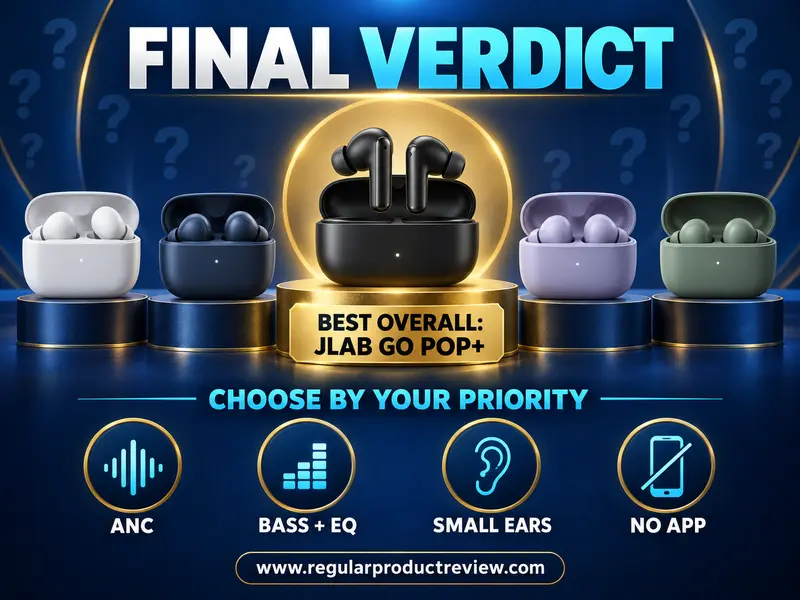
The JLab Go Pop+ is our recommendation for most people. It meets the price ceiling at its official current price, covers the most important daily features, and avoids deal dependency. Its lack of ANC is honest and manageable for buyers who mainly want music, podcasts, light calls, and gym use.
Buy the JLab Go Pop ANC instead if the official checkout price remains under $25 and modest noise reduction plus multipoint will improve your commute. Choose the soundcore P20i for bass and flexible EQ, the TOZO A1 for the lightest listed earbud body, or the JVC Gumy Mini for uncomplicated onboard controls. Every conditional pick should be rechecked before purchase; when the price crosses $25, it leaves this ranking.
That price discipline is more useful than declaring one cheap earbud perfect. If none matches your fit or feature priorities, browse the complete wireless earbuds category and the current best budget earbuds roundup rather than buying the first heavily advertised listing.
Final buying rule: At this price, prioritize fit → return policy → single-charge battery → controls → sound tuning → extras. A comfortable, returnable earbud with honest specifications is a better value than a feature-packed pair you cannot wear.
That was amazing
Hi,how are you