

Best Premium Earbuds of 2026 Tested and Reviewed for Every Listener
Premium earbuds have stopped being miniature versions of ordinary Bluetooth headphones. The strongest models in 2026 are personal audio systems built around adaptive processing, multiple microphones, wireless charging, device-aware software, spatial sound, advanced Bluetooth codecs, and fit calibration. Some can suppress the mechanical drone of a flight while preserving an announcement. Others can switch between a laptop and phone, retransmit audio from an airplane screen, track a workout, or optimize their response for the shape of your ear.
That sophistication also makes the category harder to shop. A $300 pair can be outstanding with one phone and surprisingly limited with another. A model praised for spectacular bass may be less convincing for acoustic music. The most aggressive active noise cancellation can introduce pressure or make transparency sound processed. Battery figures that look comparable may have been measured with different codecs, volume levels, spatial modes, and noise-control settings.
This guide identifies the best premium earbuds of 2026 by matching ten distinct products to ten distinct buyer priorities. The Sony WF-1000XM6 earns our overall recommendation because it combines mature noise control, detailed sound, broad codec support, useful multipoint, and platform-neutral software. Bose remains the specialist choice for maximum isolation. Apple and Samsung dominate inside their own ecosystems. Technics, Bowers & Wilkins, and Sennheiser make stronger cases for listeners who put tuning and codec flexibility ahead of ecosystem convenience.
Readers who want a wider view of the category can start with our wireless earbuds hub or compare these flagship choices with the broader best wireless earbuds of 2026 guide. This page is intentionally narrower: every selected model is positioned as a premium purchase, and every recommendation must justify its price with a meaningful advantage.
Editorial Testing Note: “Tested & Reviewed” refers to a consistent evidence-led evaluation framework covering sound architecture, noise control, microphones, fit, battery behavior, connectivity, software, ownership costs, official specifications, and documented real-world use. We do not present invented laboratory measurements or claim that every unit was physically measured in one in-house lab. Manufacturer battery and performance claims are identified as such and should not be treated as directly comparable laboratory results.
Quick Summary: Our 2026 Premium Earbud Winners
If you want one dependable answer, buy the Sony WF-1000XM6. It is the most complete all-platform package in this guide and asks for fewer compromises than the specialist alternatives. The Bose QuietComfort Ultra Earbuds (2nd Gen) are better when the first priority is reducing cabin, train, HVAC, or office noise. The Apple AirPods Pro 3 are the most coherent choice for an iPhone owner, while the Samsung Galaxy Buds4 Pro unlock their most valuable high-resolution and intelligence features with a recent Galaxy device.
For sound-first buyers, the Technics EAH-AZ100 offers an unusually balanced combination of low-distortion reproduction, three-device multipoint, LDAC, LC3, and long battery life. The Bowers & Wilkins Pi8 sounds luxurious and its retransmitting case solves a genuine travel problem, but it is expensive and gives up battery endurance. The Sennheiser Momentum True Wireless 4 remains a strong personalization pick because its codec roster and sound-tuning tools are unusually complete.
The JBL Tour Pro 3 is the cleverest travel and desk companion thanks to its touchscreen transmitter case. The Google Pixel Buds Pro 2 are the natural fit for Pixel users who value Gemini, secure comfort, and Find Hub integration. The Bang & Olufsen Beoplay Eleven is the indulgent design choice: beautifully made, pleasing to use, and hard to defend on value alone.
| Award | Product | Editor Rating | Best For | Key Reason to Buy | Main Trade-Off |
|---|---|---|---|---|---|
| 🏆 Best Overall | Sony WF-1000XM6 | 9.4/10 | Most premium buyers | Excellent balance of sound, ANC, calls, codecs, and app support | Premium $329.99 MSRP |
| 🔇 Best Noise Cancellation | Bose QuietComfort Ultra Earbuds (2nd Gen) | 9.3/10 | Flights, commuting, focus | Class-leading isolation and secure stability-band fit | Six-hour earbud battery |
| 🍎 Best for iPhone | Apple AirPods Pro 3 | 9.2/10 | Apple ecosystem users | Seamless controls, excellent ANC, health and hearing features | Best features are Apple-dependent |
| 📱 Best for Samsung Galaxy | Samsung Galaxy Buds4 Pro | 9.1/10 | Galaxy phone owners | 24-bit/96kHz SSC, Adaptive ANC 2.0, IP57 | Premium audio features are ecosystem-gated |
| 🎼 Best Balanced Audiophile Pick | Technics EAH-AZ100 | 9.3/10 | Music, work, multiple devices | Magnetic-fluid driver, LDAC, three-device multipoint | App depth takes time to learn |
| 💎 Best Luxury Sound | Bowers & Wilkins Pi8 | 9.0/10 | Detail-focused listeners and travelers | Carbon-cone driver and retransmitting case | Shorter total battery life |
| 🎛️ Best Sound Personalization | Sennheiser Momentum True Wireless 4 | 8.9/10 | Listeners who like to tune | Sound Personalization and broad codec support | Bulky case and aging industrial design |
| 🧳 Best Smart Charging Case | JBL Tour Pro 3 | 8.9/10 | Travel, laptops, shared devices | Touchscreen case doubles as wireless transmitter | Large, heavy case |
| ✨ Best for Pixel and Gemini | Google Pixel Buds Pro 2 | 8.8/10 | Pixel owners and Android AI users | Compact fit, Tensor A1, excellent Google integration | SBC/AAC limit codec enthusiasts |
| 🪞 Best Luxury Design | Bang & Olufsen Beoplay Eleven | 8.7/10 | Materials, style, service | Aluminum-and-glass construction with refined sound | $599 price is difficult to justify |
Our Top Recommendation in One Sentence
Expert Recommendation: Choose the Sony WF-1000XM6 for the strongest all-round premium experience; choose Bose for the quietest commute, AirPods Pro 3 for an Apple-first life, Galaxy Buds4 Pro for a Samsung-first life, or Technics EAH-AZ100 when sound and multi-device flexibility outrank brand ecosystem.
How We Evaluated Premium Wireless Earbuds
Our scoring model rewards performance that remains useful after the novelty wears off. A smart case is valuable only if it reduces friction. A high-resolution codec matters only when the source device supports it and the connection remains stable. Spatial audio matters when it improves film, game, or live-content immersion not merely because it appears on a specification sheet.
| Evaluation Area | Weight | What We Looked For |
|---|---|---|
| Sound quality and tuning | 25% | Tonal balance, detail, bass control, vocal realism, dynamics, EQ flexibility, codec options |
| ANC and transparency | 20% | Low-frequency reduction, speech suppression, wind behavior, natural awareness, adjustment smoothness |
| Comfort and build | 15% | Pressure distribution, tip options, security, weight, controls, materials, water/dust resistance |
| Calls and connectivity | 15% | Voice pickup, wind rejection, multipoint, pairing, connection reliability, laptop behavior |
| Battery and charging | 10% | Earbud endurance, case reserves, quick charge, Qi support, feature-related battery penalties |
| Software and ecosystem | 10% | App stability, customization, finding tools, spatial features, updates, cross-platform parity |
| Long-term value | 5% | Price, warranty, serviceability, accessory availability, feature durability |
The scores are comparative, not scientific absolutes. A 9.0 product is not universally superior to an 8.9 product; it is a better overall package under our weighting. If your personal weighting puts sound quality at 50 percent and ANC at 5 percent, the Technics or Bowers & Wilkins may outrank Sony or Bose for you.
What “Premium” Should Actually Deliver in 2026
A premium price should buy more than polished plastic. We expect flagship true wireless earbuds to provide a convincingly secure fit, strong passive sealing, competent adaptive ANC, a usable transparency mode, clear calls, mature controls, current Bluetooth support, and an app that does not feel unfinished. Wireless charging, a robust find-my-device function, multipoint, and meaningful EQ are not mandatory in every specialist product, but missing features must be offset by exceptional performance elsewhere.
Sound is equally dependent on the complete signal path. Apple’s AAC implementation can sound excellent despite lacking LDAC or aptX. Samsung’s highest-quality SSC mode requires compatible Galaxy hardware. aptX Lossless needs a compatible Snapdragon Sound source and favorable radio conditions. Sony’s LDAC can prioritize fidelity or connection stability. Buying the most impressive codec label without checking your phone is one of the easiest ways to overspend.
Editorial Insight: The best premium earbud is not the model with the longest feature list. It is the model whose fit, codec, controls, and ecosystem align with the devices and environments you use every day.
Premium Earbuds Price Bands: What to Expect
| Typical US Price | What the Category Usually Offers | What to Question Before Buying |
|---|---|---|
| $200–$249 | Mature ANC, good microphones, ecosystem integration, wireless charging on many models | Are key features restricted to one phone brand? |
| $250–$349 | Flagship processing, stronger sound architecture, better materials, richer codec support | Does the improvement justify $100 over a discounted older flagship? |
| $350–$449 | Audiophile tuning, specialized drivers, transmitter cases, premium construction | Are battery life and ANC competitive, or is most of the price going toward sound and design? |
| $500 and above | Luxury materials, brand service, distinctive industrial design | Is the purchase about performance, craftsmanship, or both? |
Prices move frequently. We use official US list prices or official prices observed during the August 2026 editorial update, then judge value against the wider premium market. A temporary discount can change the recommendation. For shoppers who decide these flagships are more than they need, our budget earbuds section and best budget earbuds of 2026 roundup cover less expensive alternatives.
Who This Guide Is For
This comparison is designed for commuters, frequent flyers, remote workers, students, creators, and music enthusiasts who use earbuds often enough to notice comfort, connection, and microphone differences. It is also for buyers moving from an older flagship and wondering whether newer processing, LE Audio, spatial features, or smarter cases represent a practical upgrade.
It is not a recommendation to spend $300 merely because the category exists. If you listen occasionally in a quiet room, a good midrange pair may satisfy you. If you compete in mobile games, prioritize a dedicated low-latency mode and check our gaming earbuds hub before treating a music-first flagship as a gaming device. If every session is a run or gym workout, wing support and moisture resistance may matter more than lossless codecs; our sports earbuds hub addresses that use case directly.
Sony WF-1000XM6 Review Best Overall Premium Earbuds of 2026
Award: 🏆 Best Overall Premium Earbuds
Editor Rating: 9.4/10
Typical Official US Price at Review: $329.99 MSRP
The Sony WF-1000XM6 is our best overall choice because it behaves like a mature flagship rather than a showcase for one spectacular feature. Sony combines effective adaptive noise cancellation, a clearer and more spacious tuning, strong call processing, a compact wireless-charging case, two-device multipoint, and codec support that serves both mainstream and high-resolution listeners. It works with Android and iOS through the Sony Sound Connect app, so buyers are not forced into one phone family to receive the basic premium experience.
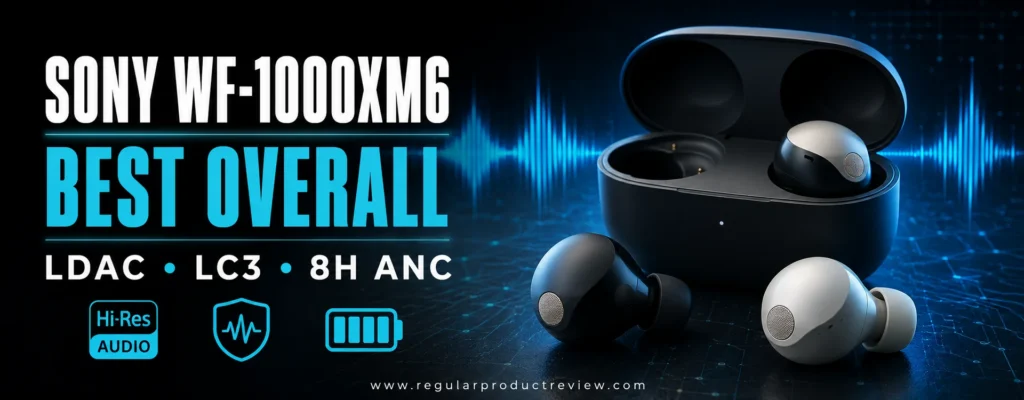
Sony’s official US specifications list a 0.33-inch driver, Bluetooth 5.3, SBC, AAC, LDAC, and LC3 support, along with up to eight hours of playback with noise cancellation enabled and up to twelve hours with it disabled. The earbuds are IPX4 rated. Sony also retains DSEE Extreme for upscaling compressed sources and adds a faster QN3e noise-cancelling processor. You can verify the current configuration and compatibility on the official Sony WF-1000XM6 product page.
Sony WF-1000XM6 Key Specifications
| Specification | Official Detail |
|---|---|
| Driver | 0.33-inch dynamic driver |
| Bluetooth | 5.3 |
| Codecs | SBC, AAC, LDAC, LC3 |
| ANC | Adaptive active noise cancellation with QN3e processor |
| Battery | Up to 8 hours ANC on; up to 12 hours ANC off |
| Multipoint | Yes, two devices |
| Charging | USB-C and wireless charging |
| Water resistance | IPX4 earbuds |
| Earbud weight | Approximately 0.23 oz each with medium tip |
| App | Sony Sound Connect for Android and iOS |
Sound Quality: Detailed Without Becoming Clinical
The WF-1000XM6 is tuned for broad appeal but does not rely on exaggerated bass to create excitement. Low frequencies have enough mass for hip-hop, electronic music, and movie effects, yet the midrange remains intelligible. Vocals sit forward enough to be emotionally present, acoustic instruments retain texture, and the upper range has more air than many warmer consumer earbuds.
LDAC is the relevant option for compatible Android devices. It can transmit more data than SBC or AAC, but the audible benefit depends on the recording, streaming tier, phone implementation, wireless conditions, and listening level. In a crowded station, choosing a stable connection can sound better than forcing the highest bitrate and enduring dropouts. iPhone owners will use AAC; the earbuds remain attractive on iOS because the tuning, ANC, calls, and app controls do not disappear.
Sony’s EQ and listening-profile tools give the user room to correct the sound without rebuilding it. Bass can be strengthened for workouts, vocal presence can be lifted for podcasts, and high frequencies can be softened for fatigue-sensitive listeners. The default profile is coherent enough that adjustment is optional.
Noise Cancellation and Transparency
Sony attacks both steady low-frequency noise and more irregular environmental sound. Engine hum, ventilation, road rumble, and the dense wash of a busy office are substantially reduced when the tips seal correctly. The system is adaptive, but it does not constantly draw attention to its adjustments. Quick Attention remains useful when someone speaks to you: touching the configured control lowers audio and admits outside sound without requiring removal.
Fit is part of ANC performance. Sony’s noise-isolation tips can seal extremely well, but their texture and expansion feel different from standard silicone. Buyers should run the app’s tip-fit check and should not assume the same size is correct in both ears. Poor sealing reduces bass and ANC simultaneously, often leading owners to blame the electronics for a mechanical fit problem.
Transparency is clear enough for a store counter, transit announcement, or short conversation. Apple still makes awareness feel more invisible, and Bose can create a more dramatic contrast between Quiet and Aware modes, but Sony offers the better all-round balance.
Calls, Comfort, and Daily Reliability
Sony markets the WF-1000XM6 as its best call-quality earbud to date. The updated processing is most valuable outside, where microphones must distinguish a voice from wind, traffic, and nearby conversation. No sealed true-wireless earbud makes a storm sound like a quiet studio, but speech remains more usable than on many sound-first luxury rivals.
The refined shape distributes pressure more evenly than older bulbous designs. An IPX4 rating is enough for sweat and light rain, not submersion. Touch controls are responsive, wear detection works as expected, and the compact case is easy to pocket. Two-device multipoint suits a workday built around a laptop and phone, although codec and multipoint combinations can affect stability.
Battery and Ownership Experience
Eight advertised hours with ANC is competitive, and wireless charging makes desk use painless. Actual endurance falls with higher volume, intensive processing, calls, and demanding codecs. The case is not a reason to choose Sony by itself, but it is compact, conventional, and less cumbersome than JBL’s smart display case.
The Sound Connect app is powerful but dense. Owners willing to explore it receive adaptive behavior, EQ, codec-related settings, fit assistance, firmware updates, and control customization. Owners who want a nearly invisible setup may prefer AirPods with an iPhone or Galaxy Buds with a Samsung phone.
| Pros | Cons |
|---|---|
| Excellent balance of sound, ANC, calls, and comfort | $329.99 MSRP is higher than several ecosystem rivals |
| SBC, AAC, LDAC, and LC3 support | Sony app can feel crowded |
| Eight-hour ANC battery claim | IPX4 is adequate rather than class-leading |
| Two-device multipoint | Noise-isolation tips will not suit every ear |
| Wireless charging and compact case | Maximum LDAC quality can be less stable in congested areas |
| Useful on both Android and iOS | No specialized transmitter case |
Buy it if: You want the best high-end wireless earbuds for mixed devices and care about sound, ANC, calls, and customization in roughly equal measure.
Skip it if: Maximum noise suppression matters more than everything else, or you want the deepest Apple- or Samsung-specific integration.
Expert Tip: Start with the fit test and default sound for several days before changing the EQ. A secure seal produces a larger improvement in bass and ANC than an aggressive software adjustment.
Bose QuietComfort Ultra Earbuds (2nd Gen)-Best ANC for Travel and Focus
Award: 🔇 Best Premium Noise-Cancelling Earbuds
Editor Rating: 9.3/10
Official US List Price: $299
The Bose QuietComfort Ultra Earbuds (2nd Gen) are the right premium purchase when silence is the feature you are actually buying. Bose’s CustomTune calibration, stability-band design, adaptive ActiveSense behavior, and refined Quiet/Aware modes make this pair exceptionally effective on aircraft, trains, buses, and in open offices. The second generation also fixes a notable convenience omission by including wireless charging in the standard case.
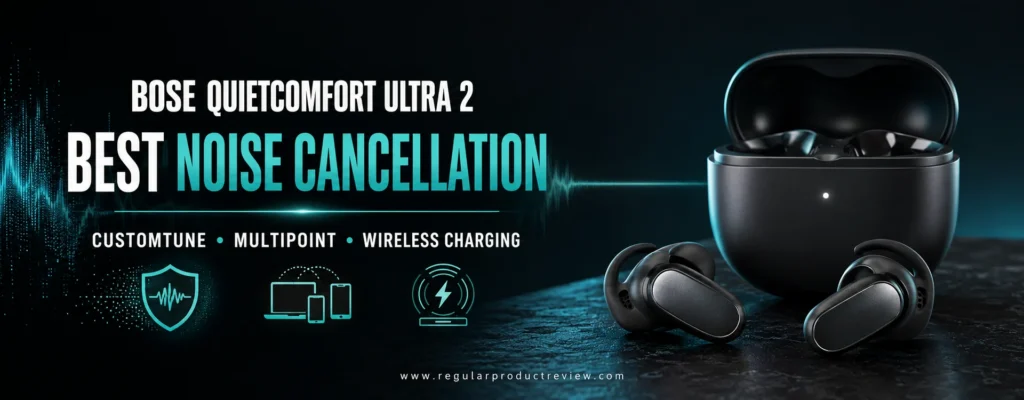
The official Bose launch information lists up to six hours of playback with Immersive Audio disabled, up to four hours with it enabled, and three additional full charges from the case. A 20-minute quick charge can provide up to two hours of playback under Bose’s stated test conditions. Bluetooth 5.3, two-device multipoint, AAC, SBC, and aptX Adaptive are supported. See the official Bose QuietComfort Ultra Earbuds (2nd Gen) page for current US availability and colors.
Bose QuietComfort Ultra Earbuds (2nd Gen) Key Specifications
| Specification | Official Detail |
|---|---|
| ANC | Bose CustomTune with Quiet, Aware, and custom modes |
| Bluetooth | 5.3 |
| Codecs | SBC, AAC, aptX Adaptive |
| Battery | Up to 6 hours; up to 4 hours with Immersive Audio |
| Case reserve | Up to three additional full charges |
| Quick charge | 20 minutes for up to 2 hours |
| Multipoint | Yes, two devices |
| Charging | USB-C and wireless charging |
| Fit system | Three tip sizes and three stability-band sizes |
| Microphones | Eight-microphone system with AI-assisted noise suppression |
Why Bose Still Leads for Noise Cancellation
ANC performance is not a single number. Low-frequency engine noise, human speech, clattering dishes, wind, and sudden transients require different strategies. Bose is particularly effective at creating a quiet foundation across the frequencies that dominate travel. The result is not total silence, but it lowers the environmental floor enough that music, podcasts, or work audio remain intelligible at a safer, less fatiguing volume.
CustomTune plays a central role. When inserted, the earbuds use a calibration process to adapt audio and noise cancellation to the user’s ear. The practical benefit is consistency: the system is less dependent on a generic acoustic model. ActiveSense in Aware mode handles sudden loud events more smoothly, so transparency can remain useful without letting a passing siren or train-brake squeal overwhelm the content.
If your buying decision revolves around isolation, explore our dedicated noise-cancelling earbuds category and the broader best noise-cancelling earbuds of 2026 comparison. Those pages include alternatives at different prices; this Bose recommendation is specifically the premium specialist.
Sound: Immersive, Full, and Easy to Enjoy
Bose uses a rich, polished signature that works immediately with pop, rock, podcasts, and films. Bass has weight, vocals are clean, and treble avoids unnecessary sharpness. This is not the most analytical tuning in the guide. Technics reveals microdetail with more restraint, and Bowers & Wilkins creates a more luxurious sense of texture. Bose instead aims for an engaging presentation that stays pleasant during a long flight.
The app provides a three-band EQ. That is adequate for broad tonal changes but less surgical than the systems from Sennheiser or Bowers & Wilkins. aptX Adaptive benefits compatible Snapdragon devices, while AAC keeps iPhone playback straightforward. Immersive Audio can widen the presentation, but it reduces the stated battery life from six hours to four. Use it selectively for films or live recordings rather than leaving it enabled by habit.
Fit, Stability Bands, and Long-Session Comfort
Bose separates the acoustic seal from external stability. The silicone tip seals the ear canal, while a removable stability band contacts the outer ear. With three sizes of each, there are nine combinations. This is valuable because an earbud can seal correctly yet still shift while walking; the band adds security without requiring a deep insertion.
The housing is not the smallest in this guide, and users with very small ears may prefer the Pixel Buds Pro 2. However, weight is well distributed when the correct band is installed. The controls can be disabled in the app, a thoughtful option for anyone who triggers commands while adjusting hair, a hat, or the earbuds themselves.
Microphones, Multipoint, and Battery Reality
The second-generation model uses AI-assisted noise suppression with its eight microphones to improve voice isolation. It performs well in routine street and office conditions, although microphone quality still depends on wind angle, fit, and the calling platform. Multipoint allows simultaneous connection to a phone and laptop, removing a major friction point for remote workers.
Six hours is the obvious weakness. It covers many commutes and domestic flights, but Sony, Technics, and Sennheiser provide more headroom. The case compensates with three full charges, and wireless charging is finally built in. Buyers planning eight-hour continuous listening sessions should consider whether a short charging break is realistic.
| Pros | Cons |
|---|---|
| Outstanding real-world ANC | Six-hour battery is merely average |
| Natural, useful Aware mode | Immersive Audio cuts battery to four hours |
| Nine tip-and-band fit combinations | Three-band EQ is limited |
| Improved call processing | Larger housings than the smallest rivals |
| Multipoint and wireless charging | Best value depends on sale pricing |
| aptX Adaptive for compatible devices | Not the most neutral audiophile tuning |
Buy it if: You travel frequently, work near persistent noise, or want premium noise-cancelling earbuds that make isolation the first priority.
Skip it if: Continuous battery endurance, compact size, or detailed manual EQ matters more than maximum quiet.
Pullquote: For aircraft cabins and noisy commutes, the Bose advantage is not a decorative specification it changes how loudly you need to listen and how tired you feel afterward.
Apple AirPods Pro 3 Review-The Premium Earbuds iPhone Users Should Buy
Award: 🍎 Best Premium Earbuds for iPhone
Editor Rating: 9.2/10
Official US Launch Price: $249
The Apple AirPods Pro 3 is the most integrated earbud experience in the guide. It pairs instantly, moves naturally among Apple devices, exposes controls inside the operating system, works with Find My, delivers polished adaptive audio, and adds heart-rate sensing during workouts. Hearing Test, Hearing Aid, and Hearing Protection features give the product a health-oriented dimension that conventional premium earbuds do not fully match.
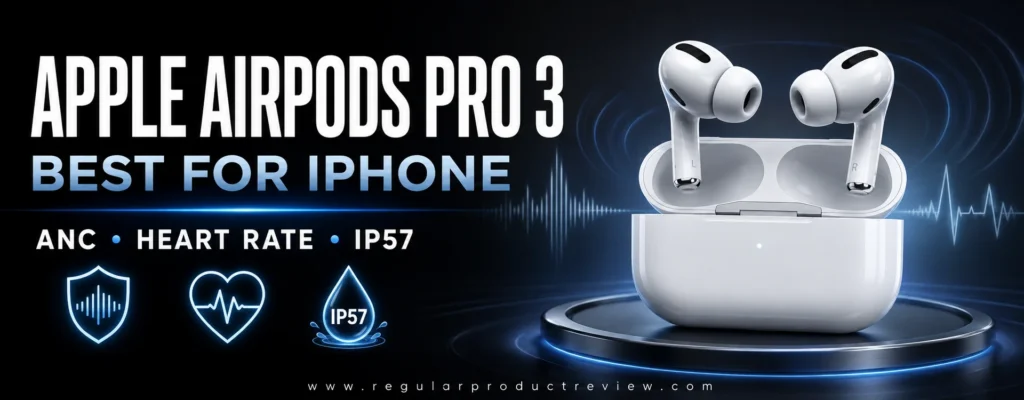
Apple states up to eight hours of listening with ANC enabled, up to 7.5 hours with Spatial Audio and head tracking, and up to 6.5 hours while heart-rate sensing is active during workouts. The MagSafe USB-C case increases total ANC listening time to 24 hours and can charge from MagSafe, an Apple Watch charger, Qi, or USB-C. The earbuds carry an IP57 dust-, sweat-, and water-resistance rating. Full details and regional feature requirements are available in the official AirPods Pro 3 technical specifications.
Apple AirPods Pro 3 Key Specifications
| Specification | Official Detail |
|---|---|
| Processor | Apple H2 |
| Bluetooth | 5.3 |
| Battery | Up to 8 hours with ANC; up to 24 hours with case |
| Spatial battery | Up to 7.5 hours with Spatial Audio and head tracking |
| Workout battery | Up to 6.5 hours with heart-rate sensing |
| Charging | USB-C, MagSafe, Qi, Apple Watch charger |
| Resistance | IP57 earbuds |
| Ear tips | Five sizes: XXS, XS, S, M, L |
| Health features | Heart rate, Hearing Test, Hearing Aid, Hearing Protection |
| Finding | Find My-compatible case speaker and location features |
Ecosystem Experience: The Real Reason to Buy AirPods
AirPods Pro 3 is not the codec enthusiast’s choice. Apple does not ask users to select LDAC bitrates or confirm Snapdragon Sound compatibility. It controls the source, operating system, earbuds, spatial pipeline, and device switching, then turns that control into consistency. Pairing, battery status, control customization, Find My, Siri, and Automatic Switching require less setup than most cross-platform alternatives.
That integration has a cost: Android users receive basic Bluetooth audio but lose much of the experience that justifies the price. They should buy Sony, Bose, Technics, or another platform-neutral model. Even within Apple’s ecosystem, current software and compatible hardware may be required for particular hearing, translation, fitness, or spatial features.
ANC, Transparency, and Adaptive Audio
Apple claims substantially stronger active noise cancellation than earlier AirPods Pro generations. More important than the marketing multiplier is the complete noise-control experience. ANC reduces commuting and office noise effectively, Transparency remains unusually natural, and Adaptive Audio can move between isolation and awareness without making the listener micromanage modes.
Conversation Awareness lowers media and emphasizes nearby voices when the wearer begins speaking. This is excellent at a coffee counter and less useful if you sing along or talk to yourself, so it should be treated as an option rather than an unquestioned default. The upgraded five-size tip selection, including XXS, makes a correct seal possible for more ears.
Sound Quality and Spatial Audio
The redesigned acoustic architecture delivers deeper, better-controlled bass and a wider presentation than the previous generation while retaining clear vocals. Adaptive EQ uses inward-facing microphones to adjust playback for fit and ear geometry. The result is polished rather than overtly analytical: recordings sound coherent without exposing every flaw.
Personalized Spatial Audio and dynamic head tracking are most convincing with films, television, and well-produced immersive music. Head tracking can feel unnecessary for conventional stereo listening, and it consumes additional battery. Apple’s strength is that spatial audio is integrated across devices and content services rather than added as a disconnected effect.
Fitness and Hearing Features
Heart-rate sensing uses optical and motion sensors to support workouts in Apple’s Fitness ecosystem. It will not make the AirPods a replacement for every sports watch, but it reduces the number of devices a casual exerciser needs. IP57 resistance is stronger than the IPX4 protection of many rivals, though no water-resistance rating is a permanent guarantee against sweat, salt, detergents, or wear.
Hearing Test and Hearing Aid features are potentially important, but availability, regulatory status, age requirements, and device compatibility vary by region. Users with suspected hearing loss should treat earbuds as a consumer health tool, not a substitute for professional assessment.
Calls, Controls, and Battery
Voice Isolation and Apple’s microphone processing keep calls intelligible in common environments. Stem controls are easier to locate than flat touch panels, especially while moving. Eight hours with ANC is a meaningful improvement for long workdays, even though the 24-hour total with case is lower than some rivals’ headline totals. The case’s charging flexibility and Find My speaker make ownership less stressful.
| Pros | Cons |
|---|---|
| Best-in-class Apple ecosystem integration | Android experience loses major features |
| Strong ANC with natural transparency | No user-selectable high-resolution Bluetooth codec |
| Up to eight hours with ANC | Some features require current Apple hardware/software |
| Heart-rate sensing and IP57 resistance | Spatial and fitness modes reduce battery |
| Hearing and safe-listening features | 24-hour total ANC battery is not category-leading |
| Excellent Find My and charging support | White-only aesthetic remains limiting |
Buy it if: You use an iPhone every day and want premium sound, excellent ANC, fitness sensing, hearing features, and the least complicated ownership experience.
Skip it if: You use Android, need multipoint behavior across unrelated platforms, or prioritize LDAC/aptX codec choice.
Expert Tip: AirPods Pro 3 makes the most sense as an ecosystem purchase. Before buying, confirm that your iPhone model, operating-system version, country, and Apple services support the specific health or translation feature you want.
Samsung Galaxy Buds4 Pro Review Best Premium Earbuds for Galaxy Phones
Award: 📱 Best Premium Earbuds for Samsung Galaxy
Editor Rating: 9.1/10
Typical US Premium Tier: Approximately $249 at launch-class pricing; verify current Samsung US offers
The Samsung Galaxy Buds4 Pro is the strongest choice for owners of recent Galaxy phones because Samsung uses ecosystem control in the same way Apple does: it connects the source, codec, interface, AI features, spatial processing, and device switching. The headline feature is Samsung Seamless Codec support for up to 24-bit/96kHz audio on compatible Galaxy hardware. A revised two-way speaker system, dual amplifiers, Adaptive ANC 2.0, and IP57 durability make this more than a software accessory.
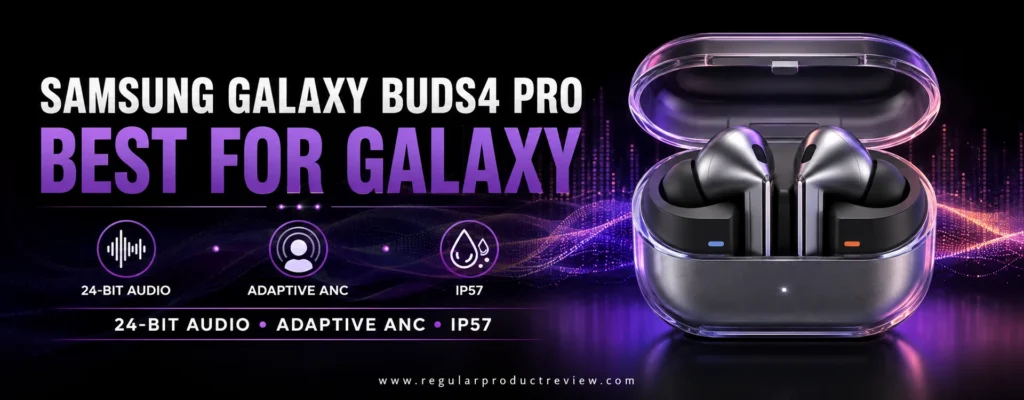
Samsung lists up to six hours of music playback with ANC enabled and up to 26 hours including the case. With ANC disabled, those claims rise to seven hours and 30 hours. Each earbud weighs 5.1 grams, and the earbuds carry an IP57 rating. Samsung’s official US page explains its high-resolution audio, DNN-assisted calls, Galaxy pairing, and compatibility conditions on the Galaxy Buds4 Pro product page.
Samsung Galaxy Buds4 Pro Key Specifications
| Specification | Official Detail |
|---|---|
| Speaker system | Enhanced two-way woofer and tweeter with dual amplifiers |
| Premium codec | Samsung Seamless Codec up to 24-bit/96kHz on compatible Galaxy devices |
| ANC | Adaptive ANC 2.0 |
| Battery, ANC on | Up to 6 hours; up to 26 hours with case |
| Battery, ANC off | Up to 7 hours; up to 30 hours with case |
| Earbud weight | 5.1 g each |
| Resistance | IP57 earbuds |
| Calls | Super Wideband/HD Voice support with DNN noise reduction |
| Pairing | Enhanced Galaxy pairing and Quick Panel integration |
| Charging | USB-C; wireless-charging availability may vary by configuration/market |
Sound Quality: A More Refined Galaxy Signature
The two-way driver design separates low- and high-frequency duties, while dual amplifiers give each section more independent control. In practical listening terms, bass has physical energy without overwhelming vocals, treble is cleaner, and dense pop or orchestral arrangements retain more separation than a basic single-driver earbud.
The 24-bit/96kHz figure is not a universal Bluetooth capability. It depends on Samsung Seamless Codec, compatible Galaxy hardware, appropriate settings, and suitable source material. Pairing the Buds4 Pro with a non-Samsung Android phone or iPhone removes part of the reason to buy them. They will still play audio, but the product is priced around the complete Galaxy experience.
Adaptive ANC 2.0 and Ambient Awareness
Samsung’s updated adaptive system processes changing environments in real time. It is effective against transit rumble, office ventilation, and surrounding chatter, although Bose remains the specialist for maximum isolation. The advantage is integration: mode changes, voice behavior, and Galaxy interface controls feel like parts of one system.
Ambient mode is useful for commuting and quick conversation. Voice-focused features can adjust behavior when the wearer speaks, but preferences differ. Some users appreciate automatic switching; others prefer predictable manual control. The Galaxy Wearable interface should be used to disable automation that interrupts music unexpectedly.
Calls, Galaxy Intelligence, and Device Control
HD Voice, Super Wideband calling, and deep-neural-network noise reduction are designed to preserve speech while suppressing background sound. The complete call improvement depends on compatible phones, networks, and apps, so the microphone should not be judged by the presence of an AI label alone. In favorable conditions, voices sound full and intelligible; in strong wind, physical microphone exposure remains a limitation.
Recent Galaxy devices expose pairing and controls in the Quick Panel. Samsung Find, Bixby wake-up, and ecosystem switching add convenience for users with a Galaxy phone, tablet, television, or laptop. This is where the Buds4 Pro separates itself from platform-neutral earbuds: the experience becomes increasingly valuable as the number of Samsung devices grows.
Comfort, Durability, and Battery
At 5.1 grams per earbud, the Buds4 Pro is light enough for extended listening. Three tip sizes are included, which is standard but less accommodating than Apple’s five-size selection or Bose’s tip-and-band combinations. IP57 protects against dust and limited freshwater immersion under test conditions, making Samsung one of the better options for commuting and workouts. The rating applies to the earbuds, not an invitation to swim with them.
Six hours with ANC is acceptable but not exceptional. The 26-hour total gives several recharge cycles, and most users will return the buds to the case between sessions. Heavy callers should expect lower endurance than music playback claims.
| Pros | Cons |
|---|---|
| Excellent integration with recent Galaxy devices | Best codec and features are Samsung-dependent |
| 24-bit/96kHz SSC support on compatible hardware | Six-hour ANC battery trails Sony and Technics |
| Refined two-way speaker architecture | Only three standard tip sizes |
| Adaptive ANC 2.0 | iPhone users should look elsewhere |
| IP57 durability and light 5.1 g weight | Feature behavior varies with phone, app, and region |
| Strong calls and Samsung Find support | Premium value falls outside the Galaxy ecosystem |
Buy it if: You own a recent Galaxy phone and want premium Android earbuds that feel native to Samsung’s software and device ecosystem.
Skip it if: You plan to switch phone brands soon, use an iPhone, or want the longest continuous ANC battery.
Editorial Insight: Galaxy Buds4 Pro is not the universal Android winner; it is the Samsung ecosystem winner. That distinction should determine the purchase.
Technics EAH-AZ100 Review Best Audiophile Earbuds for Work and Music
Award: 🎼 Best Balanced Audiophile Earbuds
Editor Rating: 9.3/10
Official US Launch Class: Approximately $299.99; check current authorized-retailer pricing
The Technics EAH-AZ100 is the most persuasive choice for a listener who wants refined sound without giving up the practical features required for work. Its magnetic-fluid driver is designed to reduce distortion and improve control, while the software supports LDAC, LC3, Dolby Atmos optimization, Auracast, Voice Focus AI, wireless charging, and multipoint connection with as many as three devices. Most premium earbuds force a choice between audiophile ambition and office convenience; Technics makes fewer compromises.
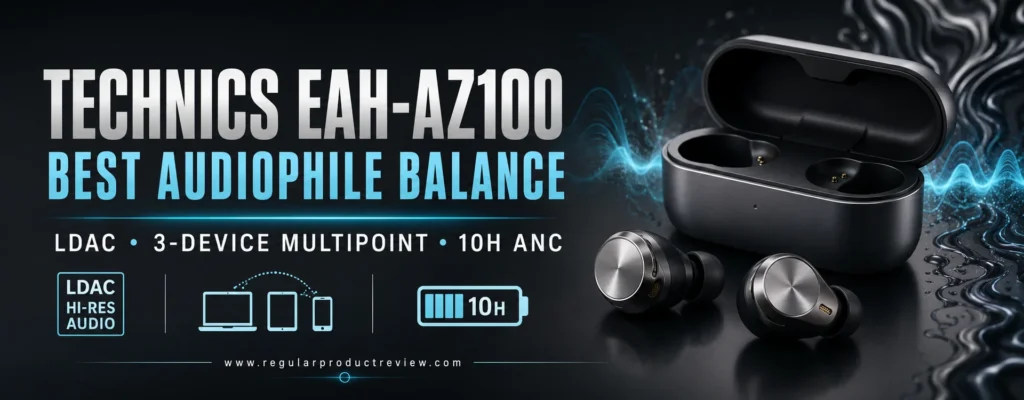
Panasonic’s official material states up to ten hours of playback with advanced noise cancellation enabled and up to 28 hours including the case under its AAC-based test conditions; using LDAC can shorten those figures. The earbuds weigh approximately 5.9 grams each and carry IPX4 splash resistance. Five earpiece sizes help achieve a dependable seal. For feature and ownership information, consult the official Panasonic support overview for the Technics EAH-AZ100.
Technics EAH-AZ100 Key Specifications
| Specification | Official Detail |
|---|---|
| Driver | Proprietary magnetic-fluid dynamic driver |
| Premium codec support | LDAC; LC3/LE Audio support |
| Spatial features | Dolby Atmos optimization and head-tracking support on compatible devices/content |
| ANC | Full adaptive digital hybrid noise cancelling |
| Battery | Up to 10 hours with ANC using AAC; LDAC use reduces endurance |
| Multipoint | Up to three devices; behavior varies with codec settings |
| Charging | USB-C and Qi wireless charging |
| Resistance | IPX4 earbuds |
| Earbud weight | Approximately 5.9 g each |
| Fit | Five earpiece sizes: XS, S, M, ML, L |
Magnetic-Fluid Driver: More Than a Marketing Phrase
In a conventional dynamic driver, the diaphragm, voice coil, magnet, suspension, and enclosure must work together while minimizing unwanted movement. Technics places a magnetic fluid containing magnetic particles in the driver gap. The intended result is more controlled motion and lower distortion, particularly where bass energy can make a small driver sound loose.
The audible character is composed rather than theatrical. Bass reaches low but stops cleanly, which lets kick drums, bass guitar, and synth lines remain distinct. The midrange is transparent enough for vocals and strings, while treble reveals recording detail without making every imperfect master unpleasant. Compared with Bose, the Technics sounds less deliberately warm. Compared with Pi8, it is less overtly luxurious but more neutral and flexible.
LDAC gives compatible Android users a high-data-rate option. iPhone users receive AAC and can still enjoy the driver, tuning, ANC, and app, but they do not receive LDAC. LC3 and LE Audio support improve future-facing compatibility, while Auracast can receive compatible broadcast audio where the infrastructure exists. These features matter more for a multi-year purchase than a fashionable spatial preset.
Three-Device Multipoint: A Genuine Productivity Advantage
Many premium earbuds support two-device multipoint. Technics can maintain connections with as many as three devices, useful for someone moving among a work laptop, personal phone, and tablet. The feature is not magic: source priority, active calls, apps, and codecs can complicate switching. Panasonic notes that some LDAC and three-device combinations carry restrictions, so users should choose their connection configuration deliberately.
For a typical workday, two-device multipoint with a laptop and phone is the most stable setup. A third connection is valuable when a tablet regularly enters the workflow. The benefit is fewer trips into Bluetooth menus, not simultaneous mixing of three audio streams.
ANC, Voice Focus AI, and Conversation Mode
Full adaptive hybrid ANC adjusts to the ear and environment. It reduces steady commuting noise effectively and handles office ambience without the strong pressure sensation some users experience from more aggressive systems. Bose is still the better choice if maximum isolation defines the purchase, while Technics offers the stronger sound-and-productivity balance.
Voice Focus AI targets both sides of a call: it attempts to isolate the wearer’s speech and reduce distracting sound that reaches the listener from the far end. Performance depends heavily on seal because the system uses microphones and speech detection in a tightly integrated way. Panasonic’s support guidance explicitly recommends checking the earpiece fit if voice detection is weak.
One-touch Conversation Mode pauses music and emphasizes voices through transparency. Wear sensors pause playback when an earbud is removed and prevent accidental touch input. Those details make the product feel designed for repeated daily use rather than a specification contest.
Comfort, Controls, Battery, and App Design
The contour-fit housing is smaller and lighter than the previous flagship. Five tip sizes, including an intermediate ML option, make it easier to balance left and right ears. The touch controls are customizable, and the app exposes extensive ANC, ambient, EQ, connection, and control settings. That depth is powerful but may overwhelm a user who wants a one-screen experience.
The ten-hour ANC claim is excellent for a premium model. LDAC, spatial processing, call time, loud playback, and difficult wireless conditions can reduce it. Qi charging is included, and a short-charge feature adds useful emergency playback. IPX4 covers ordinary sweat and rain, but Samsung and Apple provide more reassuring IP57 ratings for dusty or wet environments.
| Pros | Cons |
|---|---|
| Exceptionally balanced, low-distortion sound | App has a learning curve |
| Up to ten-hour ANC battery claim | IPX4 is modest for a 2026 flagship |
| Multipoint for up to three devices | Some codec/multipoint combinations are restricted |
| LDAC, LC3, LE Audio, and Auracast support | No aptX family support |
| Strong call and conversation features | Spatial support depends on source and content |
| Five tip sizes and Qi charging | Retail pricing varies by seller |
Buy it if: You want audiophile wireless earbuds that can also manage a serious multi-device workday.
Skip it if: You prefer the simplest app, need IP57 protection, or use a Galaxy/iPhone ecosystem deeply enough to value native integration more than codec flexibility.
Expert Recommendation: The EAH-AZ100 is the quiet overachiever of this list. It is less fashionable than some luxury rivals, but its combination of sound, battery, calls, and three-device connectivity is unusually rational.
Bowers & Wilkins Pi8 Review Luxury Earbuds with a Brilliant Transmitter Case
Award: 💎 Best Luxury Earbuds for Sound Quality
Editor Rating: 9.0/10
Official US List Price: Approximately $399 at launch; verify current finish and promotion
The Bowers & Wilkins Pi8 is a sound-first luxury earbud with one practical feature that almost justifies the indulgence by itself: the charging case can retransmit audio from a USB-C or 3.5mm source to the earbuds. Connect the case to an airplane entertainment socket, gym machine, handheld console, or computer, and it becomes a wireless bridge. That transforms the Pi8 from a beautifully tuned accessory into a uniquely capable travel tool.
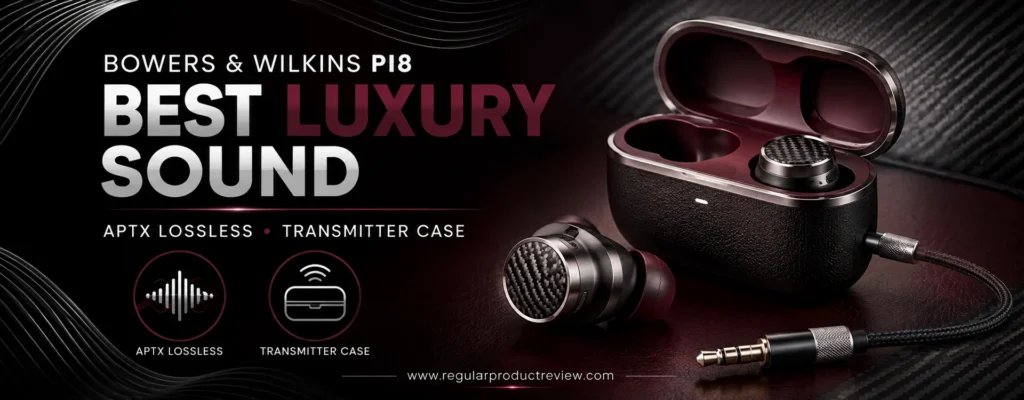
Each earbud uses a 12mm carbon-cone driver, dedicated DSP and amplifier/DAC architecture, and Bluetooth 5.4. The supported codec list includes SBC, AAC, aptX Classic, aptX Adaptive, and aptX Lossless. Bowers & Wilkins claims up to 6.5 hours from the earbuds with ANC enabled and another 13.5 hours from the case. IP54 protection covers the earbuds, and wireless charging is included. The complete official specification is available on the Bowers & Wilkins Pi8 US product page.
Bowers & Wilkins Pi8 Key Specifications
| Specification | Official Detail |
|---|---|
| Driver | 12mm carbon cone |
| Bluetooth | 5.4 |
| Codecs | SBC, AAC, aptX Classic, aptX Adaptive, aptX Lossless |
| ANC | Active noise cancellation |
| Battery | Up to 6.5 hours with ANC; 13.5 additional hours from case |
| Multipoint | Yes |
| Case input | USB-C and 3.5mm audio retransmission |
| Charging | USB-C and wireless charging |
| Resistance | IP54 earbuds |
| Weight | 7 g per earbud; 46 g case |
Sound Signature: Rich Detail with Physical Authority
The Pi8 presents music with a sense of density and scale that smaller, more utilitarian earbuds can lack. Bass is powerful but textured, the midrange has body, and high-frequency detail is explicit without becoming thin. The 12mm carbon-cone driver is intended to remain rigid and controlled, preserving transients and reducing distortion as the diaphragm moves.
This tuning flatters well-recorded jazz, acoustic music, rock, and high-resolution pop. It also exposes differences among masters and streaming quality more clearly than a casual listener may want. The five-band EQ and TrueSound mode provide useful adjustment, but the core reason to buy the Pi8 is the driver and acoustic presentation not an endlessly configurable app.
aptX Lossless can provide CD-quality lossless transmission when the source, earbuds, content, radio environment, and Snapdragon Sound chain all support it. It is adaptive, so the connection can reduce data rate when conditions deteriorate. iPhone users receive AAC rather than aptX Lossless; the Pi8 still sounds excellent, but buyers should understand that “24-bit” language does not mean every phone sends the same signal.
The Case That Solves Airplane and Laptop Audio
The retransmission case is not a touchscreen novelty. A supplied 3.5mm-to-USB-C cable connects legacy analog outputs to the case, while USB-C can handle compatible digital sources. The case then transmits to the earbuds using aptX Adaptive. This is useful on a flight where the entertainment system has no Bluetooth pairing, or with a work computer that has unreliable Bluetooth administration.
JBL’s Tour Pro 3 case offers a broader control interface and similar transmitter logic. Bowers & Wilkins prioritizes compactness and sound. Choose Pi8 when the case is an audio bridge first; choose JBL when the case should also be a screen-based remote.
ANC, Comfort, Calls, and Battery Trade-Offs
ANC is competent and reduces steady environmental sound, but it is not the category leader. The Pi8 is designed around sound quality rather than maximum isolation, and transparency is useful rather than invisible. If quiet is the first priority, Bose provides a stronger value at a lower list price.
At seven grams each, the earbuds are heavier than Samsung, Google, or Technics. Their sculpted shape distributes that weight reasonably well, but small ears should try them before committing. Four tip sizes broaden fit options. Three microphones per earbud handle telephony and ANC; call quality is acceptable for work but does not dominate noisy-street comparisons.
The 6.5-hour ANC figure and 20-hour combined total are the weakest parts of the ownership story. The case charges wirelessly and a 15-minute charge can provide up to two hours, but long-haul travelers may still need to top up during a journey.
| Pros | Cons |
|---|---|
| Superb, textured, high-resolution sound | Expensive at approximately $399 |
| aptX Lossless and aptX Adaptive | Only 20 hours total claimed with ANC scenario |
| USB-C/3.5mm retransmitting case | ANC trails Bose and Sony |
| Premium materials and finishes | Seven-gram earbuds may feel large |
| Multipoint and wireless charging | iPhone cannot use aptX codecs |
| IP54 protection | Calls are good, not class-leading |
Buy it if: Sound quality, premium construction, and an airplane-friendly transmitter case justify a higher price.
Skip it if: Battery endurance, strongest ANC, compact fit, or price-to-feature value matters more than tonal refinement.
Editorial Insight: The Pi8’s case is not a gimmick. For frequent flyers, it can replace a separate Bluetooth transmitter and remove one of true wireless audio’s most annoying travel limitations.
Sennheiser Momentum True Wireless 4 Best Earbuds for Personalized Sound
Award: 🎛️ Best Premium Earbuds for Sound Personalization
Editor Rating: 8.9/10
Official Launch Price: $299.95; current promotions may be lower
The Sennheiser Momentum True Wireless 4 remains relevant in 2026 because it supports a broader set of listening configurations than most competitors. The 7mm TrueResponse driver is paired with Sound Personalization, adjustable EQ, hybrid adaptive ANC, Bluetooth 5.4, LE Audio readiness, Auracast support through the platform roadmap, and codecs spanning SBC, AAC, aptX, aptX Adaptive/Lossless, and LC3.
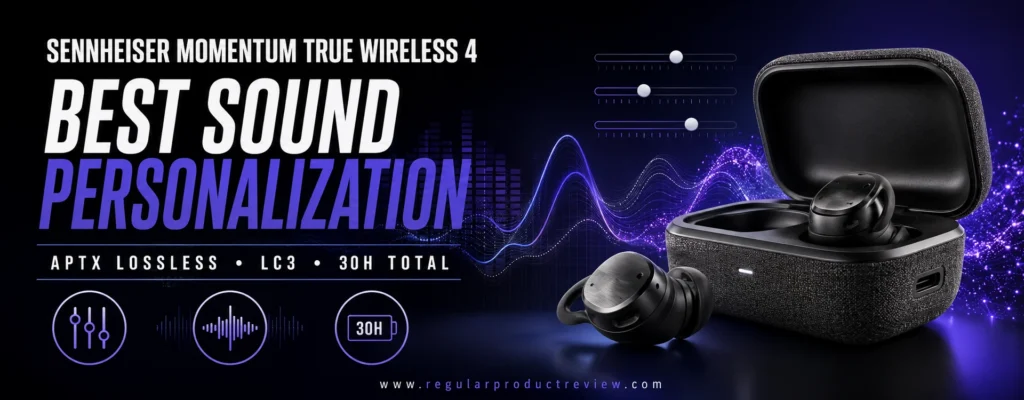
Sennheiser claims up to seven hours with ANC enabled, 7.5 hours with it disabled, and up to 30 hours including the charging case. Qi wireless charging and USB-C are available, and the earbuds carry an IP54 rating. The official Momentum True Wireless 4 product page lists the current specification and regional variants.
Sennheiser Momentum True Wireless 4 Key Specifications
| Specification | Official Detail |
|---|---|
| Driver | 7mm TrueResponse dynamic driver |
| Bluetooth | 5.4 Class 1 |
| Codecs | SBC, AAC, aptX, aptX Adaptive/Lossless, LC3 |
| ANC | Hybrid adaptive ANC |
| Battery | Up to 7 hours ANC on; up to 30 hours with case |
| Multipoint | Yes |
| Charging | USB-C and Qi wireless charging |
| Resistance | IP54 earbuds |
| Earbud weight | Approximately 6.2 g each |
| App | Sennheiser Smart Control for iOS and Android |
Sound Personalization Is the Headline Feature
Traditional EQ asks a user to understand frequency bands. Sound Personalization instead guides the listener through preferences and builds a tailored profile. This approach is valuable for people who know that the default sound is not quite right but cannot translate “the vocal feels buried” into a precise equalizer move.
The underlying tuning is full and musical. Bass carries weight, midrange timbre is natural, and treble has enough detail for cymbals and room ambience. Sennheiser’s driver is smaller than the one in Pi8, but driver diameter alone does not determine quality. Enclosure design, diaphragm behavior, DSP, seal, and tuning matter more than a single number.
Advanced users can choose more manual control, while casual owners can accept the generated profile. This makes MTW4 one of the few earbuds that serves both groups without forcing either into an unsuitable interface.
Codec Breadth and Future-Facing Connectivity
The codec list is unusually inclusive. iPhone owners receive AAC. Compatible Android and Snapdragon Sound devices can use aptX Adaptive or Lossless, and LC3 supports the LE Audio direction of travel. The presence of a codec is not proof that every source will activate it; phone hardware, operating system, firmware, developer settings, and content all matter.
Bluetooth 5.4 and multipoint support make the earbuds practical for laptop-and-phone use. Sennheiser’s connection reliability is improved over earlier generations, though complicated multi-device environments can still expose switching delays. Firmware should be updated before judging stability.
ANC, Transparency, Fit, and Calls
Hybrid adaptive ANC is effective for everyday commuting and office use. It is not as forceful as Bose and can leave more mid-frequency chatter audible, but the seal and sound quality allow comfortable listening without excessive volume. Transparency is functional and adjustable, though Apple’s pass-through feels more natural.
The square-edged case and faceted earbud design look substantial rather than delicate. Ear fins help security, and IP54 resistance covers dust and splashes. Comfort depends on choosing the correct combination of tips and fins; the housings can feel large in smaller conchas.
Three microphones per earbud support beamforming and ANC. Calls are clear in moderate environments, while strong wind or dense traffic can make the sound more processed. Sennheiser is a music-first recommendation, not the first call-center choice.
Battery and Long-Term Value
Seven hours with ANC is competitive, and 30 hours with the case is sufficient for several days of mixed use. Qi charging makes the case easy to maintain. The biggest value question is age: by 2026, MTW4 is often discounted, and its price should be compared with newer Sony, Samsung, and Technics models. At a meaningful discount, it becomes more attractive; at full launch price, Technics offers a stronger all-round package.
| Pros | Cons |
|---|---|
| Excellent Sound Personalization | Housings and case feel bulky |
| Broad codec support including aptX Lossless and LC3 | ANC is below Bose’s level |
| Musical, detailed tuning | Transparency is good rather than exceptional |
| Bluetooth 5.4, multipoint, and Qi charging | Calls can sound processed in wind |
| IP54 resistance and secure fins | Full-price value has weakened with age |
| Up to 30 hours with case | Best results require app setup and firmware updates |
Buy it if: You want best earbuds for sound quality that can adapt to your preferences instead of imposing one fixed signature.
Skip it if: You need the smallest housings, the strongest ANC, or a completely effortless app-free experience.
Expert Tip: If the MTW4 is discounted well below its launch price, it can be one of 2026’s smartest premium buys. Compare the final price, not the original MSRP.
JBL Tour Pro 3 Review Best Smart-Case Earbuds for Flights and Laptops
Award: 🧳 Best Smart Charging Case
Editor Rating: 8.9/10
Official US Launch Price: Approximately $299.95–$349.95 depending on market timing; verify current JBL US pricing
The JBL Tour Pro 3 is the product for buyers who believe a charging case should do more than store batteries. Its touchscreen Smart Charging Case controls playback, noise modes, spatial settings, timers, equalizer behavior, and other functions without reaching for a phone. More importantly, the case can connect to USB-C or analog audio sources and retransmit sound to the earbuds an advantage on flights, gym equipment, handheld consoles, and restricted work computers.
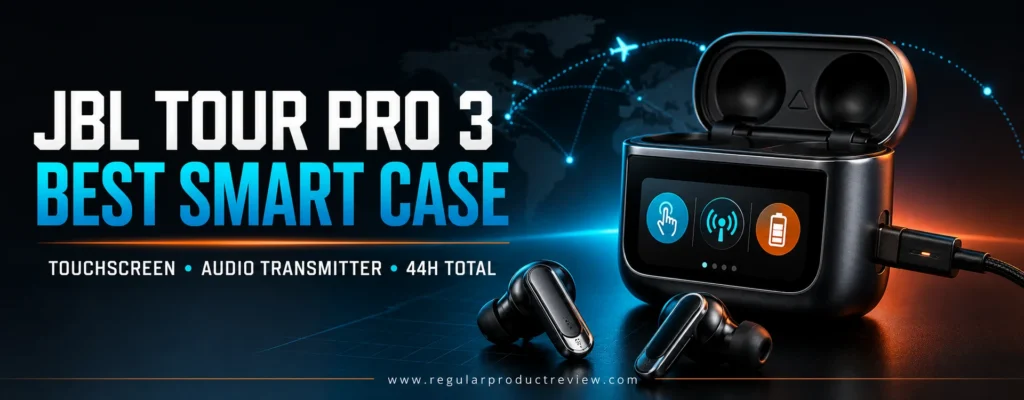
JBL uses a dual-driver architecture with a 10.2mm dynamic driver and a balanced-armature driver. The earbuds support True Adaptive Noise Cancelling 2.0, JBL Spatial 360 with head tracking, six microphones, Bluetooth 5.3, and LE Audio capability. JBL lists up to 11 hours with ANC off, up to eight hours with ANC on, and up to 44 total hours in the most favorable stated configuration. See the official JBL Tour Pro 3 specifications for current details.
JBL Tour Pro 3 Key Specifications
| Specification | Official Detail |
|---|---|
| Drivers | 10.2mm dynamic plus 5.1 x 2.8mm balanced armature |
| ANC | True Adaptive Noise Cancelling 2.0 |
| Bluetooth | 5.3 with LE Audio support |
| Microphones | Six total |
| Battery | Up to 8 hours ANC on; up to 11 hours ANC off |
| Maximum total | Up to 44 hours under JBL’s stated ANC-off conditions |
| Case | Touchscreen Smart Charging Case with audio retransmission |
| Case weight | Approximately 71.8 g |
| Earbud weight | Approximately 5.6 g each |
| Spatial audio | JBL Spatial 360 with head tracking |
The Smart Case Is Useful When It Reduces Phone Dependence
A case screen can become unnecessary duplication. JBL avoids that problem in two ways. First, it exposes quick controls when a phone is in a bag, charging, locked by workplace policy, or connected to another source. Second, the case acts as an audio transmitter. The latter is the more important feature because it expands the range of devices that can use the earbuds.
On a flight, connect the case to the seat-back system. At a gym, connect it to a treadmill display. At a desk, use USB-C to bypass a troublesome Bluetooth stack. The case becomes a bridge and remote. Bowers & Wilkins offers a similar transmitter function in a smaller, simpler case; JBL adds the screen and a more feature-rich interface.
The cost is size and weight. At roughly 71.8 grams before counting the earbuds, the case is substantially heavier than minimalist alternatives. It occupies more pocket space and has more electronics that must remain updated and charged.
Dual-Driver Sound and Customization
The dynamic driver handles the low-frequency foundation, while the balanced armature focuses on upper detail. The sound is energetic, spacious, and tailored for modern music. Bass is strong but can be adjusted through the JBL Headphones app. Vocals remain clear, and the dedicated high-frequency driver adds crispness.
This is not the most neutral audiophile presentation. Technics is more disciplined, and Pi8 offers richer texture. JBL is fun, highly adjustable, and especially effective for movies. Personi-Fi can build a profile based on hearing preferences, while Spatial 360 and head tracking create a larger cinematic field. Head tracking should be disabled when it becomes distracting or consumes battery without improving the content.
ANC, Calls, and Connection Flexibility
True Adaptive Noise Cancelling 2.0 continually recalibrates. It performs well on flights and commutes, though Bose still removes more of the environmental bed. JBL’s advantage is the ability to control ANC from the case and use wired-source retransmission at the same time.
Six microphones and JBL’s call-processing algorithm aim to isolate speech. Call performance is strong in offices and routine outdoor conditions; wind can still reduce naturalness. Google Fast Pair and Microsoft Swift Pair make setup convenient across Android and Windows, while multipoint serves mixed-device workflows.
Gamers should distinguish low latency from competitive-grade latency. LE Audio and the transmitter case can improve synchronization with compatible sources, but console support varies and Bluetooth microphones may behave differently from wired or 2.4GHz gaming headsets. Our best gaming earbuds of 2026 guide focuses specifically on that requirement.
Battery, Comfort, and Ownership
Up to eight hours with ANC is good, and the case provides substantial reserve power. The earbuds are moderately light and include multiple tip options. Their design is conventional enough for daily use, while the case remains the divisive element: invaluable for a frequent traveler, unnecessary for someone who always controls audio from a phone.
The display adds a user-interface layer that JBL must maintain. Firmware updates matter. Buyers should also use a protective pocket because a scratched screen is more visually annoying than a mark on an ordinary case.
| Pros | Cons |
|---|---|
| Smart case controls audio without a phone | Case is large and heavy |
| USB-C/analog audio retransmission | Touchscreen is unnecessary for some users |
| Energetic dual-driver sound | Not the most neutral tuning |
| Up to eight-hour ANC battery claim | ANC trails Bose at the extreme |
| Strong customization and spatial options | More features create more setup complexity |
| Fast Pair, Swift Pair, and multipoint | Launch pricing can approach audiophile models |
Buy it if: You fly often, connect to many source types, or want a case that acts as both controller and Bluetooth transmitter.
Skip it if: Pocketability, simplicity, and neutral sound matter more than case-based features.
Pullquote: JBL Tour Pro 3 is the rare smart-case earbud whose best feature is not the screen it is the ability to make almost any headphone output wireless.
Google Pixel Buds Pro 2 Review Best Premium Earbuds for Pixel and Gemini
Award: ✨ Best Premium Earbuds for Pixel Phones
Editor Rating: 8.8/10
Official US Launch Price: $229
The Google Pixel Buds Pro 2 is the compact, comfortable, intelligence-first choice for Pixel owners. Google’s Tensor A1 chip powers Silent Seal 2.0 noise cancellation, dedicated audio processing, Gemini interaction, Clear Calling support, and conversation-aware features. A twist-to-adjust stabilizer lets the same earbud feel relaxed at a desk or more secure while moving.
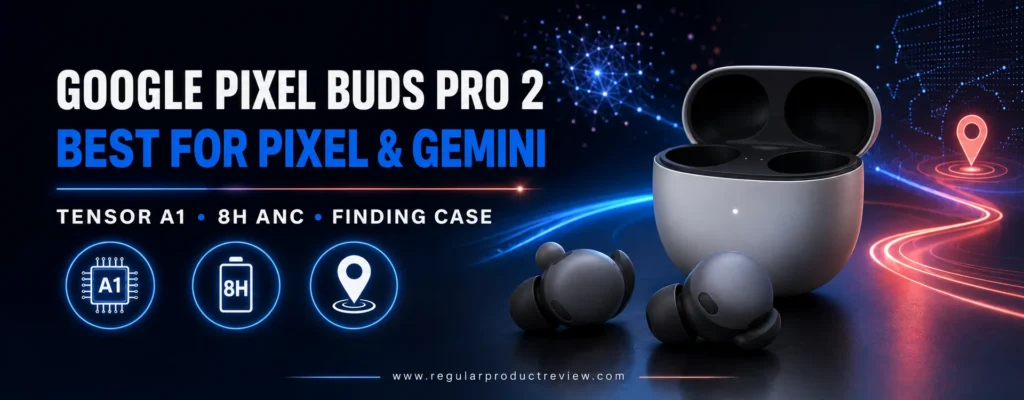
Google states that the second-generation design is 24 percent lighter and 27 percent smaller than the original Pixel Buds Pro. Battery life reaches up to eight hours with ANC and up to 30 hours including the case. A 15-minute case charge can provide up to three hours. The case has a speaker for finding, and the earbuds support multipoint and spatial audio with head tracking on compatible devices. Google explains the architecture and feature conditions in its official Pixel Buds Pro 2 introduction.
Google Pixel Buds Pro 2 Key Specifications
| Specification | Official Detail |
|---|---|
| Processor | Google Tensor A1 |
| Driver | 11mm dynamic driver |
| ANC | Silent Seal 2.0 with adaptive processing |
| Battery | Up to 8 hours ANC on; up to 30 hours with case |
| Quick charge | 15 minutes for up to 3 hours |
| Multipoint | Yes |
| Fit | Twist-to-adjust stabilizer and four tip sizes |
| AI | Gemini and Gemini Live features on compatible devices/accounts |
| Finding | Ringing case speaker and Google finding integration |
| Spatial | Spatial audio with head tracking on compatible Pixel hardware/content |
Comfort Is the Pixel Buds Pro 2 Superpower
Premium earbuds often chase stronger ANC by increasing shell size and seal pressure. Google instead reduced the housing and added a stabilizer that can be rotated to change security. For sedentary use, the earbud can rest with less outer-ear pressure. For walking or exercise, a twist braces it more firmly.
Four tip sizes improve the chance of a proper seal, and the lower weight makes long sessions less fatiguing. Fit remains personal; a stabilizer can create a pressure point in one ear while disappearing in another. The design should be purchased from a seller with a clear return policy if you have had difficulty with winged earbuds.
Tensor A1, ANC, and Adaptive Features
Tensor A1 processes noise-control and music paths separately, allowing ANC calculations without forcing the music signal through the same processing bottleneck. Google claims twice the noise cancellation of the first Pixel Buds Pro. In everyday use, the second generation is better at reducing traffic, ventilation, and café noise, though Bose remains the stronger pure isolation tool.
Software updates have expanded Adaptive Audio, loud-noise protection, head gestures, and Gemini behavior. That update path is part of the value, but it also means the exact feature set can depend on firmware, Pixel model, Android version, language, country, account eligibility, and rollout timing. Buyers should not assume a feature demonstrated at a launch event is universally active on day one.
Sound, Calls, and Codec Limitations
The 11mm driver delivers warm, full bass and clear vocals. A high-frequency chamber helps treble remain smooth. The tuning is accessible and works well with podcasts, pop, and video. Google provides EQ controls, but the product is less attractive to codec enthusiasts because it relies on standard SBC/AAC-class compatibility rather than LDAC or aptX Lossless.
That limitation does not make the earbuds sound poor. Codec quality is one part of the path, and Google’s processing, driver, fit, and source integration matter. It does mean that an Android audiophile with a library of lossless music may prefer Technics, Sony, Sennheiser, or Pi8.
Clear Calling improves what the Pixel user hears by reducing noise from the far end, while earbud microphones and processing work on the wearer’s voice. Calls are reliable in normal conditions, and Gemini interaction benefits from voice recognition tuned for mobile use. Strong wind remains difficult.
Gemini, Find Hub, and Battery
Hands-free Gemini is the central ecosystem advantage. It can assist with messages, directions, reminders, and conversational tasks when the phone and account support the required services. Whether that matters depends on the buyer. Someone who rarely uses a voice assistant should not pay for potential; someone already using Gemini throughout the day will find the earbuds a natural extension.
The ringing case speaker is a simple but valuable feature. Finding only an earbud is frustrating; finding the case is often the real problem. Eight-hour ANC battery and 30-hour total endurance are competitive, while the three-hour quick-charge claim is excellent.
| Pros | Cons |
|---|---|
| Small, light, highly comfortable design | No LDAC or aptX Lossless |
| Eight-hour ANC and 30-hour total battery claims | Best AI features depend on Google ecosystem |
| Twist-to-adjust stabilizer | ANC is below Bose’s maximum isolation |
| Tensor A1 and useful Gemini integration | Feature availability varies by region and rollout |
| Multipoint and ringing case | Audiophile tuning options are less extensive |
| Strong value at $229 launch price | iPhone users lose the core experience |
Buy it if: You own a Pixel phone and want secure comfort, intelligent assistance, reliable ANC, and a case that is easier to find.
Skip it if: High-resolution Bluetooth codecs or platform-neutral parity are essential.
Expert Tip: Buy Pixel Buds Pro 2 for the fit and Google integration you can use today. Treat future AI features as a bonus, not the foundation of the purchase.
Bang & Olufsen Beoplay Eleven Review Best Luxury-Design Earbuds
Award: Best Premium Earbuds for Luxury Design
Editor Rating: 8.7/10
Current Official US Price Observed: $599
The Bang & Olufsen Beoplay Eleven is the least rational and most emotionally coherent recommendation in the guide. It combines aluminum, toughened glass, polished surfaces, refined industrial design, a 9.2mm driver, improved ANC, wind-focused microphone engineering, multipoint, Qi charging, and IP57 protection. The buyer is paying for tactile quality, brand service, and design as much as measurable audio performance.
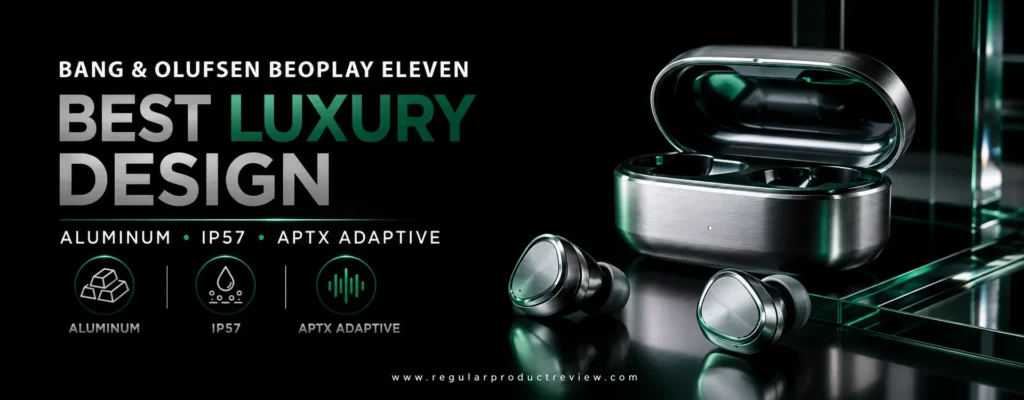
Bang & Olufsen lists up to six hours with ANC and AAC, up to eight hours without ANC, up to 20 hours including the case with ANC, and up to 28 hours without it. Bluetooth 5.2 supports SBC, AAC, and aptX Adaptive. Each earbud weighs approximately six grams, while the case weighs about 53 grams. Check current colors, price, warranty, and trial terms on the official Beoplay Eleven US page.
Bang & Olufsen Beoplay Eleven Key Specifications
| Specification | Official Detail |
|---|---|
| Driver | 9.2mm neodymium dynamic driver |
| Bluetooth | 5.2 |
| Codecs | SBC, AAC, aptX Adaptive |
| ANC | Adaptive ANC with improved low-frequency cancellation |
| Battery | Up to 6 hours ANC on; up to 20 hours with case |
| Multipoint | Up to two devices |
| Charging | USB-C and Qi wireless charging |
| Earbud resistance | IP57 |
| Case resistance | IP54 in listed product documentation |
| Materials | Aluminum, toughened glass, polymer, silicone |
Design and Materials: The Primary Value Proposition
Most premium earbuds are plastic because plastic is light, radio-transparent, durable, and economical. Bang & Olufsen uses aluminum and glass to create an object that feels closer to jewelry. The surfaces, case action, finish options, and restrained logo treatment are the reasons someone considers Beoplay Eleven after seeing the price.
Luxury materials do not automatically improve comfort. At six grams, the earbuds are not unusually heavy, but their shape still must match the wearer. Silicone tips in four sizes and an included foam option improve fit flexibility. The IP57 earbud rating and IP54 case rating are unusually reassuring for a luxury product, although saltwater, cosmetics, and cleaning chemicals can still damage seals or finishes.
The battery design is intended to support service replacement under evolving sustainability requirements, but it is not presented as an easy user-removable cell. Buyers should confirm local service processes and costs instead of interpreting “replaceable” as DIY repair.
Sound: Refined, Warm, and Spacious
The 9.2mm driver produces substantial low-frequency energy, smooth mids, and a polished top end. Bang & Olufsen favors an elegant, rich presentation over clinical neutrality. The Beosonic interface lets users move through tonal preferences without confronting a traditional graphic equalizer, which suits the design-led ownership experience.
Pi8 reveals more explicit detail and supports aptX Lossless. Technics is more neutral and costs much less. Beoplay Eleven remains compelling when the user wants sound and object design to feel equally considered. aptX Adaptive improves performance with compatible devices, while AAC supports Apple playback. There is no codec advantage that explains the $599 price by itself.
ANC, Wind Guard, and Call Quality
Bang & Olufsen claims ANC performance is substantially improved over the earlier Beoplay EX, particularly at low frequencies. It reduces travel and office noise effectively but does not dethrone Bose. Transparency is more natural than before, and Wind Guard uses the microphone inlet and filtering strategy to protect calls and awareness from gusts.
Six MEMS microphones support beamforming. Voice pickup is clear in moderate noise, and wind handling is a priority rather than an afterthought. Still, a luxury price cannot defeat physics: turbulent air directly around an earbud microphone will affect calls.
Connectivity, Battery, and Luxury Ownership
Two-device multipoint, Google Fast Pair, Microsoft Swift Pair, Made for iPhone support, and an Apple Watch interface create broad compatibility. Bluetooth 5.2 is older on paper than the 5.4 radios in several rivals, but version numbers do not predict connection quality alone. Firmware, antenna design, source hardware, and radio congestion matter.
Six hours with ANC and 20 hours total are weak at this price. Wireless charging helps, and a 20-minute top-up can provide roughly 1.75 hours under stated conditions. The ownership proposition instead includes finish quality, a 30-day trial, and up to three years of warranty coverage when the applicable terms are met.
| Pros | Cons |
|---|---|
| Exceptional materials and industrial design | $599 official US price is extremely high |
| Refined, rich sound | Six-hour ANC and 20-hour total battery |
| IP57 earbuds and IP54 case | ANC cannot match Bose despite the price |
| Multipoint, Fast Pair, Swift Pair, and MFi | No aptX Lossless or LDAC |
| Qi charging and strong wind focus | Value depends heavily on design appreciation |
| Service-oriented luxury ownership | Battery replacement requires service, not simple DIY |
Buy it if: You want luxury earbuds that feel like a design object and accept that craftsmanship, materials, and brand service are part of the price.
Skip it if: You judge value primarily by ANC, battery life, codec breadth, or price-to-performance.
Pullquote: Beoplay Eleven is not the performance-per-dollar winner. It is the choice for someone who wants premium audio hardware to feel as considered as a watch, pen, or piece of jewelry.
Premium Earbuds Buying Guide How to Choose the Right Flagship Pair
The best buying decision begins with the phone, computers, and environments already in your life. Earbuds are not isolated audio components; they are wearable endpoints in a larger system. A technically superior codec that your phone cannot transmit adds no value. A brilliant ANC system cannot compensate for a housing that hurts after 40 minutes. A beautiful app cannot rescue unstable switching between the two devices you use every day.
Use the following order: fit, platform compatibility, primary environment, sound preference, calls, battery, durability, and price. That sequence prevents feature marketing from displacing the factors that determine daily satisfaction.
1. Start with Your Phone Ecosystem, Not the Earbud Brand
| Your Primary Device | Best First Choice | Strong Cross-Platform Alternative | Key Compatibility Question |
|---|---|---|---|
| iPhone | Apple AirPods Pro 3 | Sony WF-1000XM6 or Bose QC Ultra 2 | Do you value Apple-only hearing, fitness, switching, and Find My features? |
| Samsung Galaxy | Samsung Galaxy Buds4 Pro | Technics EAH-AZ100 or Sony WF-1000XM6 | Does your Galaxy model support the advertised SSC and AI features? |
| Google Pixel | Google Pixel Buds Pro 2 | Sony WF-1000XM6 or Technics EAH-AZ100 | Will you use Gemini, Pixel spatial audio, and Google finding tools? |
| Snapdragon Android | Technics EAH-AZ100, Pi8, or Sennheiser MTW4 | Sony WF-1000XM6 | Does the phone support LDAC, aptX Adaptive, or Snapdragon Sound? |
| Windows plus phone | Technics EAH-AZ100 or JBL Tour Pro 3 | Sony, Bose, or Sennheiser | Is reliable multipoint or a USB transmitter more important? |
| Mixed household devices | Sony WF-1000XM6 | Bose QC Ultra 2 | Which features remain available on both Android and iOS? |
AirPods can connect to Android, and Galaxy Buds can connect to an iPhone or non-Galaxy computer. That basic compatibility does not make them platform-neutral. The buying question is not “Will audio play?” It is “Which controls, codecs, updates, finding tools, spatial modes, and health features remain available?”
Sony, Bose, Technics, Sennheiser, JBL, Bowers & Wilkins, and Bang & Olufsen provide apps on both Android and iOS. Feature parity still varies, but these models are safer for someone who changes phone brands frequently.
2. Fit Determines Sound, ANC, Comfort, and Safety
A correct seal is the foundation of premium earbud sound quality. When the tip does not close the ear canal consistently, bass leaks away, ANC loses effectiveness, and the listener raises the volume to compensate. A tip that is too large can create pressure and pain; a tip that is too small can loosen while talking or walking.
Follow this fitting process:
- Begin with the manufacturer’s medium tips, then test each ear separately.
- Insert the earbud using the recommended rotation rather than forcing it straight inward.
- Play a bass-rich track at moderate volume. If bass changes when you press the housing gently, the seal is unstable.
- Use the app’s fit test when available, but treat physical comfort as equally important.
- Try a different size in the left and right ear if necessary.
- Wear the final combination for at least an hour before deciding.
- Recheck after walking, speaking, smiling, and wearing glasses or a hat.
Foam tips can improve sealing and isolation but require compression, take longer to insert, collect debris, and need periodic replacement. Silicone is easier to clean and often lasts longer. Sony’s specialized isolation tips sit between conventional foam and silicone experiences, while Bose’s stability bands add support outside the canal.
Expert Tip: If an earbud receives excellent ANC reviews but sounds thin in your ears, investigate the seal before changing the EQ or returning the product. Fit can change perceived performance more than a firmware setting.
3. Understand ANC Without Believing a Single Marketing Number
Active noise cancellation combines microphones, digital signal processing, a stable acoustic seal, and an inverse signal designed to reduce external sound at the eardrum. It performs best with steady, predictable noise such as an aircraft engine, train rumble, bus vibration, or air conditioner. Speech and sudden metallic sounds change quickly and are harder to suppress completely.
Premium systems add adaptive behavior. They can account for leakage, environment, wind, or the wearer’s ear. That does not guarantee a better experience. An adaptive algorithm that changes too visibly can make the background pump or shift. The best implementations adjust without drawing attention.
Choose Bose if maximum low-frequency and travel isolation is the priority. Sony is the balanced alternative. Apple and Samsung are strongest when their adaptive behavior is integrated with the matching phone. Technics provides quieter listening without sacrificing its more neutral sound-first identity.
ANC also supports safer habits. The World Health Organization’s safe-listening guidance notes that listening risk is affected by level, duration, and exposure frequency, and recommends a good fit plus noise cancellation to reduce the need for excessive volume in noisy places.
4. Transparency Mode Should Sound Natural, Not Merely Loud
Transparency uses external microphones to reproduce the environment through the drivers. Poor systems sound hissy, amplify wind, exaggerate high frequencies, or make the wearer’s own voice feel blocked. Better systems preserve spatial cues and allow conversation without removal.
Apple offers the most natural overall awareness in this group. Bose provides refined Aware behavior with ActiveSense for sudden sounds. Sony, Samsung, and Technics are highly usable and configurable. No transparency mode should replace situational judgment around traffic, platforms, construction, or cycling.
For outdoor training, a secure fit and awareness behavior may matter more than maximum ANC. Compare products designed around movement in our best sports earbuds of 2026 guide before using a luxury sound-first model for every workout.
5. Decode Bluetooth Codecs Before Paying for Them
Bluetooth codecs package audio for wireless transmission. The source and earbuds must support the same codec; otherwise they fall back to a common option. A codec label describes capability, not guaranteed audible quality.
| Codec | Common Strength | Common Limitation | Relevant Picks in This Guide |
|---|---|---|---|
| SBC | Universal baseline compatibility | Efficiency and quality vary by implementation | All models |
| AAC | Strong integration with Apple devices; widely supported | Android implementation can vary | All models or nearly all mainstream picks |
| LDAC | High-data-rate, high-resolution option on compatible Android devices | Maximum quality can be less stable in crowded radio environments | Sony WF-1000XM6, Technics EAH-AZ100 |
| Samsung Seamless Codec | High-resolution Galaxy ecosystem path | Requires compatible Samsung devices and settings | Galaxy Buds4 Pro |
| aptX Adaptive | Dynamically balances quality, connection, and latency | Requires compatible source hardware | Bose, Pi8, Sennheiser, Beoplay Eleven |
| aptX Lossless | Can deliver CD-quality lossless audio under compatible conditions | Entire Snapdragon Sound chain and favorable RF conditions required | Pi8, Sennheiser MTW4 |
| LC3 / LE Audio | Efficient next-generation audio with broadcast and accessibility potential | Support remains device-, software-, and rollout-dependent | Sony, Technics, Sennheiser, JBL |
Qualcomm describes aptX Lossless as an adaptive capability intended to reach CD-quality 16-bit/44.1kHz lossless transmission when the source and radio conditions permit it. The official Qualcomm aptX overview is useful, but buyers should check the phone manufacturer’s codec list as well.
LE Audio is a broader platform change, not simply a “better sounding” checkbox. The Bluetooth SIG says it introduces LC3-based audio, hearing-aid support, multi-stream capabilities, and Auracast broadcast audio. Read the Bluetooth SIG’s LE Audio explanation for the underlying direction. A product may contain compatible hardware yet require future firmware, phone support, or local broadcast infrastructure for a specific feature.
Editorial Insight: A well-tuned AAC earbud with a stable seal can sound better than a poorly fitted aptX Lossless earbud. Codec choice refines a good system; it does not create one.
6. Match Sound Signature to Music and Listening Style
Sound preference is personal, but vocabulary helps:
| Sound Preference | What It Usually Means | Best Match from This Guide |
|---|---|---|
| Balanced and versatile | Bass, mids, and treble share attention | Sony WF-1000XM6, Technics EAH-AZ100 |
| Warm and immersive | Fuller bass and lower mids, relaxed highs | Bose QC Ultra 2, Beoplay Eleven |
| Detailed and luxurious | Texture, separation, spacious imaging | Bowers & Wilkins Pi8 |
| Personalized | Guided tuning or extensive adjustment | Sennheiser MTW4, JBL Tour Pro 3 |
| Energetic and cinematic | Strong bass, crisp attack, spatial features | JBL Tour Pro 3, Galaxy Buds4 Pro |
| Ecosystem-optimized | DSP and content integration matter most | AirPods Pro 3, Galaxy Buds4 Pro, Pixel Buds Pro 2 |
Do not evaluate sound with one dramatic track. Use familiar recordings across several genres: a vocal-focused song, acoustic instruments, dense rock or orchestral material, a bass-heavy track, a podcast, and a film scene. Keep volume matched as closely as possible when comparing. Louder usually seems better during a short demonstration.
EQ is most effective when used gently. A one- or two-step change can correct a preference; extreme boosts may reduce headroom, create distortion, or amplify fatigue. Save separate profiles for commuting, focused music, and speech when the app permits it.
7. Check Microphone Performance for Your Actual Calls
Earbud microphones are far from the mouth. They must distinguish speech from wind, traffic, keyboard clicks, reverberation, and nearby voices. Beamforming and AI noise suppression improve that task, but aggressive processing can make speech thin or robotic.
Test calls in the applications you use. A microphone can behave differently in cellular calls, Zoom, Teams, FaceTime, WhatsApp, and voice notes because each platform applies its own processing. Also test one-earbud mode if you use it. Some systems assign microphones or battery load differently when only one side is active.
For an office-centered buyer, Technics’ multipoint and Voice Focus AI are compelling. Sony provides the strongest balanced call-and-music package. Bose improves noisy-environment voice isolation. Apple, Samsung, and Google gain reliability through their matching phone ecosystems.
8. Read Battery Claims Like a Test Engineer
Manufacturer battery figures are useful for understanding a product’s ceiling, not for ranking products with decimal precision. Test variables include:
- Playback volume and sound-pressure level
- ANC, transparency, or adaptive mode
- Spatial audio and head tracking
- Heart-rate or health sensing
- Codec and bitrate
- Equalizer and personalization processing
- Temperature and battery age
- Call time versus music playback
- Radio distance and interference
Compare the “ANC on” earbud figure first, then the total with case. Earbud endurance determines continuous use; case capacity determines how often you need a wall outlet. A 40-hour total does not help during an eight-hour flight if the earbuds themselves last five hours.
Wireless charging is a convenience, not a performance feature. It makes top-ups easier at a desk or nightstand but generates more heat and can be slower than USB-C. Quick charging is more valuable for forgotten batteries: Google’s 15-minute three-hour claim, Sony’s competitive top-up behavior, and Bose’s 20-minute two-hour claim can rescue a commute.
9. Multipoint, Automatic Switching, and Transmitter Cases Are Different
Bluetooth multipoint holds connections with two or more devices and switches according to playback or call priority. Automatic ecosystem switching uses an account or operating-system layer to move among devices. Audio retransmission uses the charging case as a new wireless source for a wired input.
These features solve different problems:
- Choose multipoint for a Windows laptop and phone.
- Choose Apple/Samsung ecosystem switching for multiple devices from one brand.
- Choose Pi8 or JBL Tour Pro 3 for airplane screens and wired outputs.
- Choose three-device Technics multipoint for a phone, laptop, and tablet workflow.
Multipoint can conflict with high-bitrate codecs or introduce unexpected source priority. If music pauses whenever a dormant laptop wakes, disable multipoint temporarily or change the device list in the app.
10. Consider Durability Beyond the IP Rating
An IP rating describes controlled dust and water tests, not every accident. The first digit covers solids; the second covers water. An X means that a specific dimension was not rated, not necessarily that no protection exists. IPX4 generally covers splashes. IP54 adds dust protection. IP57 provides stronger dust and temporary freshwater immersion protection under the stated test standard.
Ratings normally apply to earbuds, not the case. Soap, saltwater, chlorinated water, sweat residue, oils, cosmetics, steam, and physical wear can affect seals. Dry earbuds before placing them in the case, clean tips according to the manufacturer’s instructions, and never use compressed air in microphone or vent openings.
11. Think About Repair, Batteries, Tips, and Warranty
True wireless earbuds contain small batteries exposed to heat and repeated charge cycles. Capacity declines with age. Before buying, check:
- Warranty duration and accidental-damage exclusions
- Replacement earbud and case availability
- Cost and availability of official tips
- Whether a lost single side can be paired to the existing set
- Battery service policy
- Firmware support history
- Return policy for fit-related dissatisfaction
Beoplay Eleven’s serviceable battery direction is notable, but service intervention and regional terms matter. For every model, keeping the charging contacts clean and avoiding prolonged high-temperature storage can reduce avoidable deterioration.
12. Decide Whether Spatial Audio Matters to You
Spatial audio can improve film dialogue placement, immersive music, live performances, and games. Head tracking keeps the perceived stage anchored as the listener turns. Some people find that effect cinematic; others find it unnatural for music.
Do not let spatial capability outweigh core stereo performance. Verify compatible phone, app, subscription, and content. Also check battery penalties: Bose drops from a stated six hours to four with Immersive Audio, while Apple quotes a smaller reduction when Spatial Audio and head tracking are active.
13. Gaming Latency Requires a Separate Decision
Premium music earbuds can play games, but Bluetooth latency varies by codec, phone, operating system, and title. LC3 and aptX Adaptive can improve synchronization on compatible devices. JBL’s transmitter case may create a more controlled path. None of that guarantees tournament-grade microphone behavior or universal console support.
If gaming is a major purchase reason, prioritize verified low-latency modes, dongle support, microphone routing, and console compatibility over music marketing. A dedicated 2.4GHz gaming earbud can outperform a more expensive Bluetooth flagship in latency.
14. Use a Simple Decision Checklist Before Checkout
| Question | If “Yes,” Prioritize |
|---|---|
| Do I use an iPhone and Apple services daily? | AirPods Pro 3 |
| Do I own a recent Samsung Galaxy phone? | Galaxy Buds4 Pro |
| Is maximum silence my first requirement? | Bose QC Ultra Earbuds (2nd Gen) |
| Do I want the best all-platform balance? | Sony WF-1000XM6 |
| Do I connect to three devices and care deeply about sound? | Technics EAH-AZ100 |
| Do I need airplane-screen retransmission with luxury sound? | Bowers & Wilkins Pi8 |
| Do I like guided sound personalization? | Sennheiser MTW4 |
| Do I want a touchscreen transmitter case? | JBL Tour Pro 3 |
| Do I use Pixel and Gemini heavily? | Pixel Buds Pro 2 |
| Are materials and luxury design part of the pleasure? | Beoplay Eleven |
Before paying, verify the exact model number, color, official or authorized seller, return window, included tips and cables, warranty region, current price, and the compatibility of the feature that matters most. Counterfeit premium earbuds are common on marketplaces, and an unusually low price is not a bargain if the serial number, battery, warranty, or firmware cannot be trusted.
Premium Earbuds FAQ Answers Before You Spend $250 or More
1. What are the best premium earbuds of 2026 overall?
The Sony WF-1000XM6 is our best overall recommendation because it balances sound quality, adaptive ANC, call performance, comfort, LDAC and LC3 support, multipoint, wireless charging, and Android/iOS app compatibility. Bose is better for maximum noise cancellation, while Technics may be better for a sound-first buyer with several devices.
2. Which premium earbuds have the best noise cancellation?
The Bose QuietComfort Ultra Earbuds (2nd Gen) is our top ANC pick. Its CustomTune calibration, Quiet mode, stability-band fit, and refined Aware/ActiveSense behavior work especially well for flights, trains, offices, and persistent low-frequency noise. Sony WF-1000XM6 is the stronger all-round alternative.
3. Are AirPods Pro 3 worth buying for Android?
Usually not. AirPods Pro 3 can play Bluetooth audio from Android, but much of their value comes from Apple-specific pairing, Find My, device switching, Siri, fitness, hearing, spatial, and operating-system integration. Sony, Bose, Technics, or Pixel Buds Pro 2 will normally provide a more complete Android experience.
4. Are Galaxy Buds4 Pro good with non-Samsung Android phones?
They can function as wireless earbuds, but important advantages including the highest Samsung Seamless Codec mode and parts of the Galaxy intelligence experience depend on compatible Samsung hardware and software. Buy them primarily for a recent Galaxy phone, not as the universal Android default.
5. Do LDAC and aptX Lossless make a big audible difference?
They can improve fidelity in a compatible signal chain, especially with high-quality recordings and careful listening. The difference is not guaranteed or equally audible to everyone. Fit, tuning, driver performance, mastering, volume matching, and wireless stability often matter more. aptX Lossless also depends on compatible Snapdragon Sound hardware and favorable radio conditions.
6. Which premium earbuds are best for sound quality?
Choose Technics EAH-AZ100 for balanced, low-distortion sound and practical flexibility; Bowers & Wilkins Pi8 for a rich, detailed luxury presentation; or Sennheiser Momentum True Wireless 4 for guided personalization and broad codec choice. Sony WF-1000XM6 is the easiest sound-quality recommendation for mixed priorities.
7. Which earbuds are best for long flights?
Bose QC Ultra 2 provides the strongest isolation, but its six-hour earbud battery may require a charging break. Sony WF-1000XM6 combines excellent ANC with an eight-hour claim. JBL Tour Pro 3 and Bowers & Wilkins Pi8 can retransmit audio from an airplane entertainment socket, removing the need for a separate adapter.
8. What is the difference between multipoint and automatic switching?
Multipoint maintains Bluetooth connections to multiple sources and changes based on playback or call priority. Automatic switching often uses a shared brand account or operating system, as Apple and Samsung do. Multipoint is better for mixed brands; ecosystem switching can feel smoother among devices from one family.
9. Can premium earbuds replace hearing aids?
Not automatically. AirPods Pro 3 includes regulated or health-oriented hearing features in supported regions and configurations, but eligibility and capability vary. Anyone with suspected hearing loss, tinnitus, pain, discharge, dizziness, or sudden changes should seek qualified medical or audiology care rather than self-diagnosing through consumer earbuds.
10. How long should premium earbuds last?
With careful use, the hardware can function for several years, but small lithium-ion batteries gradually lose capacity. Heat, frequent full cycles, moisture, dirty charging contacts, and long periods stored empty can accelerate deterioration. Firmware support, replaceable tips, case availability, and service policy determine whether the product remains practical after the battery ages.
11. Is IP57 safe for swimming?
No. IP57 describes controlled dust and temporary freshwater immersion testing, not swimming motion, saltwater, chlorine, soap, steam, or permanent waterproofing. Manufacturer warranties may exclude liquid damage. Use dedicated swim headphones designed for submerged playback if swimming is the goal.
12. Which premium earbuds are best for workouts?
AirPods Pro 3 combines IP57 protection, heart-rate sensing, five tip sizes, and strong iPhone fitness integration. Galaxy Buds4 Pro also offers IP57 protection and a light build for Galaxy users. Pixel Buds Pro 2 has a useful twist stabilizer. For repeated training, compare sport-specific hooks, wings, controls, and sweat policies rather than assuming the most expensive model is best.
13. Should I buy premium earbuds or over-ear headphones?
Choose earbuds for pocketability, exercise, discreet calls, and easy daily carry. Choose over-ear headphones for potentially longer continuous battery life, a larger physical sound presentation, and less ear-canal pressure. Over-ear ANC can also be more comfortable on a very long flight, while earbuds are easier to sleep or move in.
14. Are transmitter charging cases worth it?
Yes for frequent travelers and users of wired-only sources. JBL Tour Pro 3 and Bowers & Wilkins Pi8 can turn an airplane screen, gym console, or compatible USB source into wireless audio. If every source you use already has reliable Bluetooth, the additional case electronics may add cost and bulk without improving your routine.
15. How can I make ANC work better?
Clean the tips and vents according to the manual, test several tip sizes, insert each earbud using the recommended rotation, run the app’s fit calibration, update firmware, and confirm that ANC not adaptive transparency is selected. Even a small seal leak can reduce bass and low-frequency cancellation.
16. When is a discounted older flagship the smarter buy?
An older flagship is attractive when it receives current firmware, replacement tips remain available, the battery is new rather than used, and the discount is large enough to offset missing features. Sennheiser MTW4 can be compelling below launch price. Avoid used earbuds with unknown battery health unless the seller offers a meaningful warranty and hygiene policy.
17. How much should I spend on premium earbuds?
For most buyers, $229 to $329 is the sensible premium range. That includes strong options from Google, Apple, Samsung, Bose, Sony, Technics, and Sennheiser. Spending $399 or more makes sense when a specific sound signature, transmitter case, material quality, or luxury ownership experience matters not merely because the price is higher.
18. Where should I buy expensive earbuds?
Buy from the manufacturer or an authorized US retailer with a clear return window, valid regional warranty, and straightforward single-earbud or case support. This is especially important for fit. Avoid marketplace listings that combine specifications from different generations or offer a price too low to support authenticity.
Final Verdict Which Premium Earbuds Should You Buy in 2026?
The Sony WF-1000XM6 is the best premium earbud for the largest number of buyers. Its $329.99 MSRP is substantial, but the package is coherent: detailed sound, effective ANC, improved calls, eight-hour advertised ANC battery, multipoint, wireless charging, LDAC, LC3, and usable apps on Android and iOS. It does not require an iPhone, Galaxy, or Pixel to make sense.
The universal winner is not automatically your winner. Choose the Bose QuietComfort Ultra Earbuds (2nd Gen) if removing travel and office noise matters more than battery endurance or surgical EQ. Choose AirPods Pro 3 if an iPhone, Apple Watch, Mac, Find My, Fitness, and hearing features already define your digital life. Choose Galaxy Buds4 Pro if a recent Samsung phone can unlock SSC high-resolution audio, Galaxy controls, and ecosystem intelligence.
The Technics EAH-AZ100 is our strongest enthusiast recommendation. It sounds controlled and natural, lasts longer than many rivals, and can stay connected to as many as three devices. It is the model most likely to satisfy someone who alternates between serious listening and serious work. The Bowers & Wilkins Pi8 provides the richer luxury sound and a clever transmitter case, while the Sennheiser Momentum True Wireless 4 is the better route for listeners who want guided personalization and a comprehensive codec roster.
Choose JBL Tour Pro 3 when the charging case needs to become a screen, remote, and wired-source transmitter. Choose Pixel Buds Pro 2 for compact comfort and useful Gemini integration at a comparatively restrained premium price. Choose Beoplay Eleven only after accepting that its aluminum-and-glass design, finish, service, and emotional appeal not raw performance per dollar are the justification.
Final Award Board
| Buyer Priority | Final Recommendation | Why It Wins |
|---|---|---|
| Best overall | Sony WF-1000XM6 | Fewest compromises across platforms and listening situations |
| Best ANC | Bose QC Ultra Earbuds (2nd Gen) | Strongest specialist isolation and stable fit system |
| Best iPhone experience | Apple AirPods Pro 3 | Deepest Apple integration plus fitness and hearing features |
| Best Galaxy experience | Samsung Galaxy Buds4 Pro | SSC, Adaptive ANC 2.0, and native Galaxy controls |
| Best sound/work balance | Technics EAH-AZ100 | Magnetic-fluid driver, long battery, and three-device multipoint |
| Best luxury sound | Bowers & Wilkins Pi8 | Carbon-cone detail and audio-retransmitting case |
| Best personalization | Sennheiser MTW4 | Guided tuning and broad codecs |
| Best smart case | JBL Tour Pro 3 | Touchscreen controls and wired-source retransmission |
| Best Pixel experience | Google Pixel Buds Pro 2 | Compact fit, Tensor A1, Gemini, and finding tools |
| Best luxury design | Beoplay Eleven | Premium materials, finish, and ownership experience |
Our Buying Advice by Budget
At roughly $229 to $249, Pixel Buds Pro 2, AirPods Pro 3, and Galaxy Buds4 Pro can deliver excellent value when paired with their matching ecosystems. Around $299, Bose, Technics, Sennheiser, and JBL compete on specialized strengths. At $329.99, Sony asks more but offers the best platform-neutral balance. At $399 and above, Pi8 and Beoplay Eleven should be treated as deliberate luxury purchases rather than automatic upgrades.
Buy only after confirming fit, device compatibility, and the exact feature you intend to use. A secure $249 earbud that integrates with your phone is a better purchase than a $599 model that hurts, drops its best codec, or requires daily reconnection.
For ongoing category updates, new releases, and premium alternatives, visit our premium earbuds hub. Prices and firmware features can change after publication, so compare the current official listing before checkout.
Final Expert Recommendation: Buy the Sony WF-1000XM6 if you want one premium pair to handle music, travel, calls, and mixed devices. Move to Bose, Apple, Samsung, Technics, Pi8, Sennheiser, JBL, Pixel, or Bang & Olufsen only when that model’s specialized advantage clearly matches your routine.