

Choosing among the best Android phones under $500 in 2026 is less about finding one phone that wins every category and more about deciding which compromises you can live with. At this price, you can get a bright OLED display, capable cameras, reliable 5G, and years of software support. What you usually give up is a flagship telephoto system, the fastest processor, premium materials, or all four at once.
This updated guide keeps the original five products and their order, but corrects several specifications and adds a clearer price-and-availability test. That matters because two of these phones only narrowly fit a $500 limit, one usually costs more than $500 unless discounted, and another was not officially launched for mainstream U.S. retail. Readers with a tighter ceiling may also want our guides to Android phones under $300 or budget Android phones for everyday use.
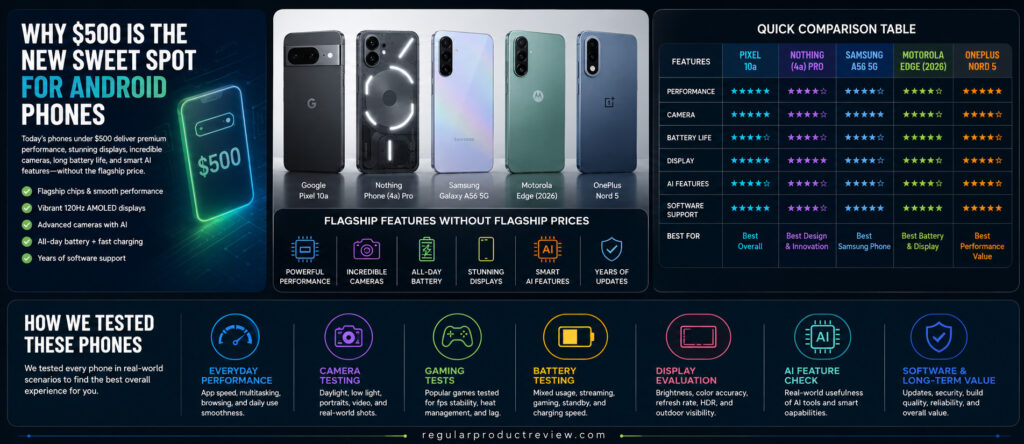
Price scope used in this guide: “Under $500” means the phone’s advertised device price before sales tax, optional accessories, activation fees, financing interest, trade-in credits, or a required service plan. A temporary sale or open-box offer qualifies only while its actual checkout price remains below $500. Prices checked September 7, 2026.
Quick answer: which phone should you buy?
For most buyers who want a new, officially supported phone, the Google Pixel 10a is the clearest overall recommendation. Its $499 starting price is only one dollar below the limit, but it combines a manageable 6.3-inch display, dependable computational camera features, wireless charging, IP68 protection, and seven years of updates.
The Nothing Phone (4a) Pro is the more adventurous alternative. It has a larger 144Hz display and a dedicated periscope camera, and Nothing’s U.S. store listed the 8GB/128GB model at $449 when this update was prepared. The Samsung Galaxy A56 5G remains attractive for buyers who prefer Samsung’s software and long support policy, although its original $499.99 starting price leaves essentially no room below the budget.
The final two need stronger warnings. The Motorola Edge (2026) was listed at $599.99 new and unlocked by Best Buy, so it is a sale/open-box pick—not a regular under-$500 phone. The OnePlus Nord 5 offers excellent global-market performance hardware, but it was not launched as a normal U.S. retail model; importing it can complicate network compatibility, warranty service, returns, and charger support.
| Phone | Best suited to | Verified price position | Main compromise |
|---|---|---|---|
| Google Pixel 10a | Most buyers; camera software and long support | Starts at $499 from Google | Limited price headroom; 8GB RAM |
| Nothing Phone (4a) Pro | Design, large display, optical zoom | $449 sale / $499 previous price on Nothing U.S. when checked | IP65 rather than IP67/IP68 |
| Samsung Galaxy A56 5G | Samsung users and long-term ownership | Launched from $499.99 | Older chipset; no wireless charging |
| Motorola Edge (2026) | Compact display and telephoto, but only on discount | $599.99 new unlocked when checked; some open-box offers were lower | Not normally under $500; only two promised Android OS upgrades |
| OnePlus Nord 5 | Performance-focused import buyers | Import pricing may fall below $500; no standard U.S. launch | Network, warranty and support uncertainty |
How this guide was researched
This is an editorial comparison, not a claim that every phone was physically lab-tested by our team. We cross-checked manufacturer specification pages, launch information, official store listings, and a major retailer listing, then compared the features that materially affect ownership: total price, network support, camera hardware, battery and charging, durability, storage, and update policy. Our broader process is explained in the site’s review methodology and editorial policy.
Manufacturer battery-life and gaming figures come from controlled conditions and should not be treated as guaranteed real-world results. Similarly, a high megapixel count does not automatically produce a better photo. Image processing, sensor size, lens quality, stabilization, lighting, and the photographer’s technique all matter. We therefore avoid invented scores, star ratings, and unverified day-to-day performance claims.
1. Google Pixel 10a — best overall Android phone under $500
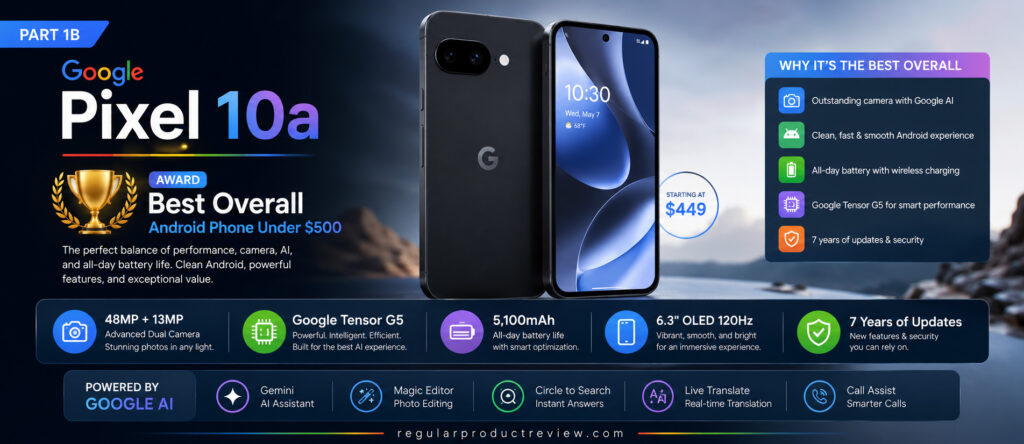
The Pixel 10a is the most balanced choice here because it fits the budget without depending on an import seller, trade-in, or open-box condition. Google lists the Pixel 10a from $499, so the base model qualifies by one dollar before tax. If $500 is a strict total-at-checkout limit, remember that sales tax and a separately purchased charger or case can push the final cost higher.
Corrected key specifications
| Specification | Google Pixel 10a |
|---|---|
| Display | 6.3-inch Actua pOLED, 1080 × 2424, adaptive 60–120Hz |
| Processor | Google Tensor G4 with Titan M2 security coprocessor |
| Memory and storage | 8GB RAM; 128GB or 256GB |
| Rear cameras | 48MP wide with OIS/EIS; 13MP ultrawide |
| Front camera | 13MP |
| Battery | 5,100mAh typical; Qi wireless charging |
| Charging | Up to 50% in about 30 minutes with a compatible 45W USB-C PPS charger or higher, according to Google |
| Protection | Gorilla Glass 7i; IP68 |
| Software | Launched with Android 16; seven years of OS, security and Pixel Drop updates |
The most important correction is the processor: the Pixel 10a uses Tensor G4, not Tensor G5. Google’s official Pixel 10a specification page also confirms the 6.3-inch 60–120Hz display, 5,100mAh typical battery, 48MP-and-13MP rear-camera pair, and seven-year update commitment.
Why it earns the top position
The Pixel’s advantage is the way its features fit together. The 6.3-inch screen is easier to hold than the 6.7- and 6.83-inch panels on several rivals, while 120Hz capability keeps scrolling smooth. Wireless charging is uncommon in this group, and IP68 protection is stronger on paper than the IP65 rating of the Nothing Phone (4a) Pro. The camera system lacks a dedicated telephoto lens, but Google’s processing features—such as Night Sight, Best Take, Photo Unblur, and Magic Eraser—make the phone a practical point-and-shoot option.
Tensor G4 is designed around Google’s camera, security, and on-device AI features rather than winning raw benchmark comparisons. For ordinary communication, navigation, photography, streaming, and productivity, that balance makes sense. Demanding gamers who prioritize sustained frame rates over camera processing should look at the Nord 5, with the import caveats discussed later, or consult our broader best gaming phones of 2026 guide.
The seven-year support window is the strongest long-term reason to choose the Pixel. It does not guarantee that every future feature will arrive or perform identically, but it gives the phone a longer official update horizon than most midrange alternatives. Buyers who keep a device for four or five years should value that more than a small difference in charging speed.
What to know before buying
The base configuration has 8GB of RAM and 128GB of storage, and there is no microSD slot. The 256GB version starts above the article’s $500 ceiling, so users who keep many 4K videos or large games should check their current storage use before ordering. Charging is also less aggressive than Nothing, Motorola, or OnePlus, and Google does not include every accessory a buyer may expect.
Best for: buyers who want a compact all-rounder, reliable official support, camera-focused software, wireless charging, and a long update policy.
Skip it if: you need optical telephoto zoom, expandable storage, the fastest possible charging, or more than 128GB while staying below $500.
2. Nothing Phone (4a) Pro — best for design and optical zoom
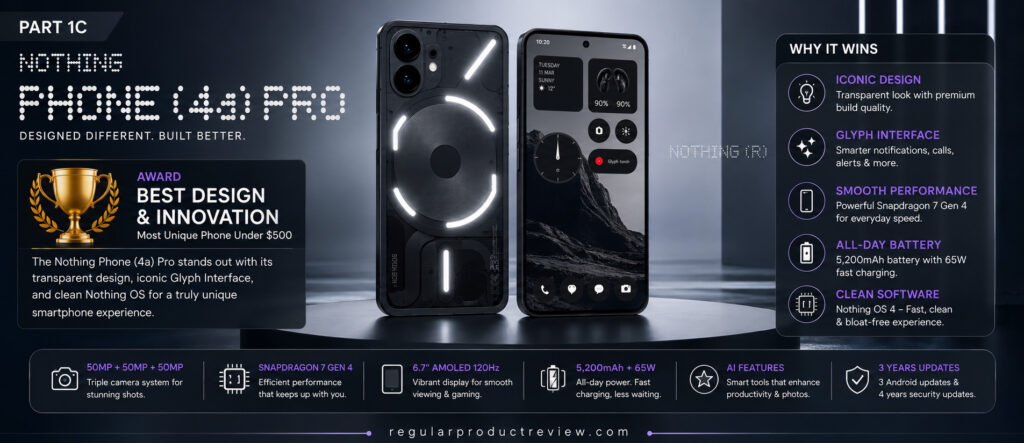
The Nothing Phone (4a) Pro offers the most distinctive hardware in this list. Its transparent-inspired design and Glyph lighting will appeal to some buyers and feel unnecessary to others, but the practical attraction is the combination of a large 144Hz AMOLED display and a dedicated 50MP periscope camera. When checked, Nothing’s U.S. store listed the 8GB/128GB model at $449, reduced from $499. Because promotions can end without notice, verify the price at checkout rather than treating $449 as permanent.
Corrected key specifications
| Specification | Nothing Phone (4a) Pro |
|---|---|
| Display | 6.83-inch flexible AMOLED, 1260 × 2800, adaptive 144Hz |
| Processor | Qualcomm Snapdragon 7 Gen 4 |
| Memory and storage | 8GB/128GB on the referenced U.S. listing; other variants vary by market |
| Rear cameras | 50MP Sony main camera with OIS, 50MP periscope with 3.5× optical zoom, plus ultrawide |
| Front camera | 32MP |
| Battery | 5,080mAh in the U.S.; 5,400mAh is listed for India only |
| Charging | 50W wired; 7.5W reverse wired |
| Protection | Gorilla Glass 7i; IP65 |
| Software | Nothing OS; support period and feature availability should be checked for the exact region |
Several original figures required correction. The phone uses a Snapdragon 7 Gen 4, a 5,080mAh battery in the U.S., and 50W charging—not a 5,200mAh battery and 65W charging. Nothing also specifies a 144Hz adaptive refresh rate rather than 120Hz. The periscope provides 3.5× optical zoom and 7× in-sensor zoom; the advertised 140× figure is digital “ultra zoom,” not 140× optical magnification.
Where the Nothing Phone stands out
The 6.83-inch display gives games, video, maps, and split-screen work plenty of room. Its 144Hz ceiling is higher than the 120Hz panels on the Pixel and Samsung, although many apps and games will not use the maximum refresh rate continuously. Higher refresh rates can also increase power consumption, so adaptive behavior and the user’s settings matter more than the headline number alone.
The camera layout is unusually versatile for the price. A dedicated periscope lens provides real framing options for portraits, landmarks, stage events, and distant subjects. That is a meaningful hardware difference from the Pixel 10a and Galaxy A56, which rely more heavily on cropping for distant subjects. Still, extreme digital zoom should be treated as a convenience for identification or experimentation, not as a substitute for close-range optical detail. Readers prioritizing photography can compare more options in our camera phones under $500 guide.
Nothing OS keeps a recognizable Android foundation while using the company’s dot-matrix visual style and Glyph controls. That design can reduce notification checking if you configure useful Glyph patterns, but it is not automatically more productive than a normal notification system. The Essential AI tools may also change through software updates, so they should be a secondary reason to buy—not the only one.
What to know before buying
IP65 means protection against dust and water jets under specified test conditions; it is not the same as the IP67 or IP68 immersion ratings of Samsung and Google. Water resistance can also diminish with wear, and liquid damage terms vary by warranty. The phone’s size is another tradeoff: at 6.83 inches, it will not suit buyers looking for a compact device.
Check the exact storage configuration, carrier compatibility, return policy, and warranty shown on the U.S. listing before payment. A third-party retailer may price a different storage model higher than Nothing’s own store.
Best for: buyers who want a large, fast display, distinctive styling, and a true periscope camera without moving to flagship pricing.
Skip it if: you need compact dimensions, IP68 protection, wireless charging, or a conventional-looking interface.
3. Samsung Galaxy A56 5G — best for Samsung software and long support
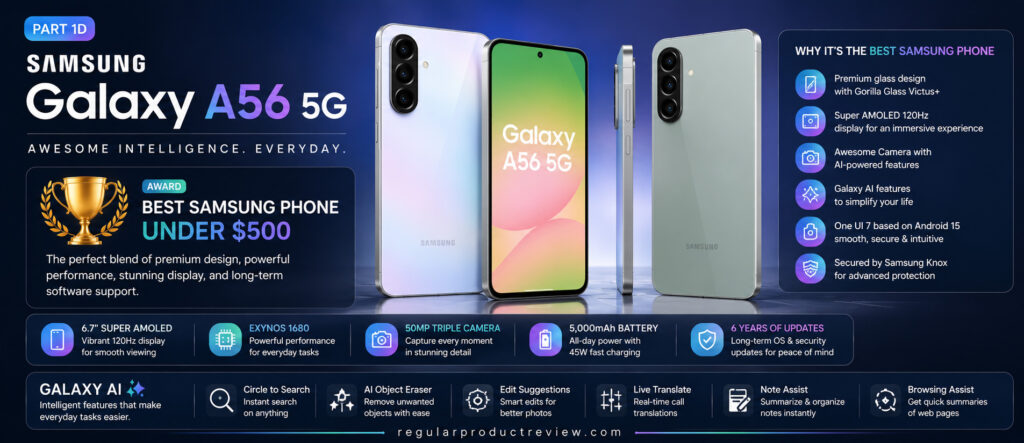
The Galaxy A56 5G is a sensible choice for people already comfortable with Samsung’s interface, accessories, service network, and ecosystem. Samsung announced it in 2025, so it is not the newest A-series generation in September 2026. That does not make it a poor phone, but it means the value depends heavily on current stock and price. Samsung’s U.S. launch information placed it at $499.99, technically below $500 before tax by one cent.
Corrected key specifications
| Specification | Samsung Galaxy A56 5G |
|---|---|
| Display | 6.7-inch FHD+ Super AMOLED, 120Hz, up to 1,200 nits high-brightness mode |
| Processor | Samsung Exynos 1580 |
| Memory and storage | Configuration varies by market; U.S. announcement referenced 128GB and 256GB options |
| Rear cameras | 50MP main, 12MP ultrawide, 5MP macro |
| Front camera | 12MP |
| Battery | 5,000mAh |
| Charging | Up to 45W wired |
| Protection | Gorilla Glass Victus+; IP67 |
| Software support | Up to six Android/One UI generations and six years of security updates |
The major correction is the chipset: the Galaxy A56 uses the Exynos 1580, not an Exynos 1680. Samsung’s official U.S. launch announcement confirms the 6.7-inch display, $499.99 starting price, IP67 rating, and six-generation/six-year update commitment.
Why the A56 still makes sense
The 6.7-inch AMOLED display is well suited to streaming, reading, and multitasking. The combination of Gorilla Glass Victus+ and IP67 protection provides reassuring specifications for an upper-midrange phone, although neither eliminates the need for a case or sensible handling. The 5,000mAh battery is conventional for the class, and 45W charging is a useful upgrade over older A-series models.
Samsung’s strongest differentiator is continuity. If you use a Galaxy Watch, Galaxy Buds, SmartThings devices, Samsung Notes, or Quick Share, the A56 fits naturally into that environment. The update promise also makes it easier to justify buying an older model at a meaningful discount. Six generations of OS upgrades do not mean six years of identical speed or battery condition, but they reduce the risk of early software abandonment.
The rear system covers wide, ultrawide, and macro photography but lacks a dedicated telephoto camera. The 50MP main sensor is the one to prioritize in lower light; the macro camera is better treated as an occasional creative tool than as a core reason to buy. Anyone who regularly photographs children, pets, concerts, or distant subjects may prefer the Pixel’s processing or the Nothing Phone’s periscope zoom.
What to know before buying
The A56 launched at the very edge of this budget. Since a newer Galaxy A57 is available in 2026, compare its real checkout price with discounted A56 inventory rather than assuming the older model is automatically cheaper. Avoid paying close to original MSRP if a newer model with longer remaining support is available for similar money.
There is no wireless charging, and the large 6.7-inch body is less pocket-friendly than the Pixel 10a or Motorola Edge (2026). Storage and RAM combinations differ across regions, so confirm the model number rather than copying a specification from an overseas listing.
Best for: Samsung users who value a familiar interface, long software support, durable display materials, and IP67 protection.
Skip it if: you want optical zoom, wireless charging, a compact phone, or the newest A-series model at roughly the same price.
4. Motorola Edge (2026) — a sale-only pick, not a regular under-$500 phone
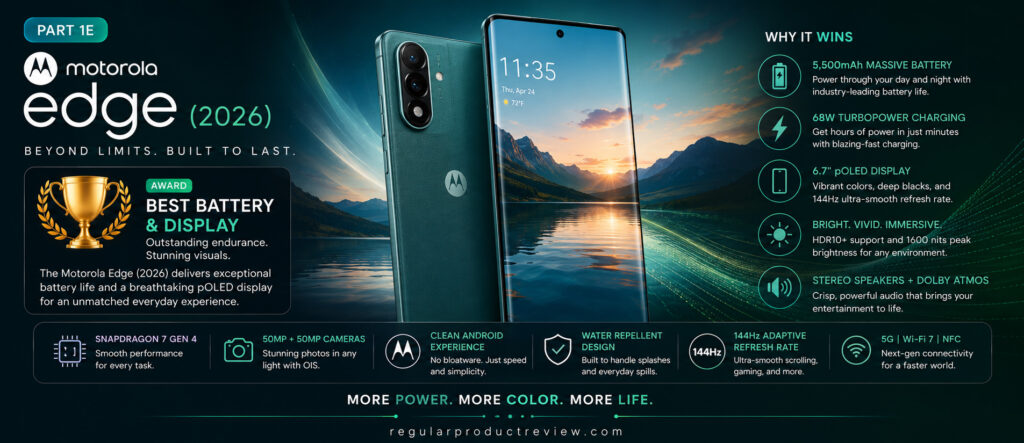
The Motorola Edge (2026) remains in its original fourth position, but it needs the clearest price correction in the article. Best Buy listed the new unlocked 128GB model at $599.99 when checked. Open-box options sometimes appeared below $500, but those prices depend on condition, location, and inventory. Therefore, this phone belongs in an under-$500 guide only when a verifiable sale or open-box checkout price is below the limit.
Corrected key specifications
| Specification | Motorola Edge (2026) |
|---|---|
| Display | 6.3-inch 1.5K Extreme AMOLED, 120Hz |
| Processor | MediaTek Dimensity 7450 |
| Memory and storage | 8GB LPDDR5X RAM; 128GB storage |
| Rear cameras | 50MP main, 50MP ultrawide, dedicated 3× optical telephoto |
| Front camera | 50MP |
| Battery | 5,000mAh |
| Charging | 60W wired; 15W wireless |
| Protection | Gorilla Glass 7i; IP68/IP69 |
| Software | Android 16 at launch; two guaranteed Android OS upgrades |
The earlier specification set substantially overstated or misidentified the hardware. Motorola’s official Edge (2026) specifications list a Dimensity 7450, 6.3-inch 120Hz display, 8GB/128GB configuration, 5,000mAh battery, 60W wired charging, and 15W wireless charging. It does not use a Snapdragon 7 Gen 4, 6.7-inch 144Hz screen, 12GB/256GB configuration, or 5,500mAh battery.
Why it can be attractive on a genuine discount
The Edge combines a relatively compact 6.3-inch display with a versatile three-camera layout. A dedicated 3× optical telephoto is especially useful for portraits and distant framing, while wireless charging is uncommon in this price bracket. The IP68/IP69 ratings and Gorilla Glass 7i also look strong on a specification sheet.
Motorola’s near-stock Android presentation may appeal to users who dislike heavier interfaces. The Dimensity 7450 is a midrange processor, so the Edge should be considered for balanced daily use rather than purchased on the assumption that it matches a flagship gaming phone. For sustained gaming, thermal behavior and game-specific optimization matter as much as the processor name.
The principal long-term compromise is software support. Motorola promises only two Android OS upgrades for this model, which is much shorter than Google’s seven-year commitment and Samsung’s six-generation policy. A large discount can compensate for that limitation; a $599.99 price cannot within the scope of this guide.
How to judge a sub-$500 offer
Best Buy’s Motorola Edge (2026) listing showed the new phone at $599.99 when checked, with lower “more options” or open-box prices varying by availability. Before buying, confirm that the reduced price is for the 2026 model—not the visually similar Edge (2025)—and check condition, battery/return terms, included accessories, warranty status, and whether activation is required.
Best for: buyers who find a legitimate sub-$500 offer and want a compact 120Hz display, optical telephoto, wireless charging, and strong water-resistance ratings.
Skip it if: the new price remains above $500, you plan to keep the phone for many OS generations, or an open-box warranty is unclear.
5. OnePlus Nord 5 — best performance option for informed import buyers
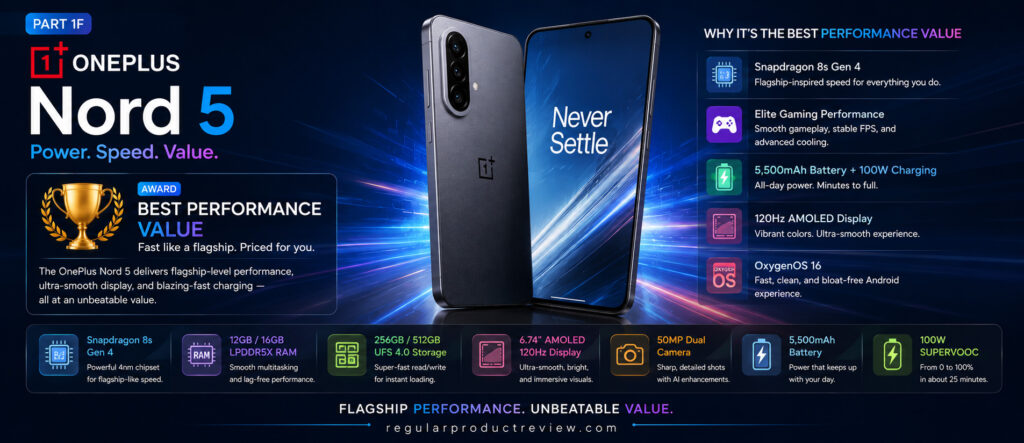
The OnePlus Nord 5 has the strongest performance-oriented specification sheet in this group, but it is not a straightforward recommendation for a buyer in the United States. OnePlus launched the Nord 5 in Europe and other global markets rather than through normal U.S. retail channels. That means a sub-$500 listing is usually an import, with risks that a low headline price may not show.
Corrected key specifications
| Specification | OnePlus Nord 5 global model |
|---|---|
| Display | 6.83-inch 1.5K AMOLED, up to 144Hz |
| Processor | Qualcomm Snapdragon 8s Gen 3 |
| Memory and storage | 8GB or 12GB LPDDR5X; 256GB or 512GB, depending on market |
| Rear cameras | 50MP Sony LYT-700 main with OIS; 8MP ultrawide |
| Front camera | 50MP with autofocus |
| Battery | Up to 6,800mAh on the referenced global page; capacity varies by region |
| Charging | 80W wired with bypass charging support |
| Software support | Four Android version upgrades and six years of security support, per OnePlus global materials |
| U.S. position | Import-only rather than a standard official retail recommendation |
The chipset is Snapdragon 8s Gen 3, not Snapdragon 8s Gen 4. OnePlus’s official global Nord 5 page confirms the 144Hz AMOLED display, 6,800mAh battery on that regional page, 80W charging, 50MP front and main cameras, and four-version/six-year support statement. Some regional variants have a smaller battery, so the seller’s exact model number and regional specification page must match.
Why performance-focused buyers notice it
Snapdragon 8s Gen 3 and LPDDR5X memory give the Nord 5 more performance headroom than the conventional midrange processors in several rivals. The 144Hz display and bypass charging are useful gaming features: bypass charging can feed power from the charger while reducing the need to cycle the battery during supported use. OnePlus publishes controlled gaming claims, but actual frame rate and temperature depend on the game version, graphics settings, room temperature, network, case, and software build. We do not convert manufacturer lab figures into an independent performance guarantee.
The 6,800mAh battery on the global page is unusually large, though buyers must verify regional capacity. The camera system is less versatile than the Nothing Phone’s because it lacks a periscope lens, but the 50MP autofocus selfie camera can be useful for video calls and group photos. For a wider set of performance-first options, see our guide to gaming phones under $500.
Import risks are part of the price
The Verge’s Nord 5 launch coverage reported that the phone was not coming to the U.S. A product page loading on a localized website is not the same as an official local sale with a local model, warranty, return channel, and full carrier certification.
Before importing, obtain the exact model number and compare its LTE/5G bands with your carrier. Confirm VoLTE, Wi-Fi calling, eSIM, 5G access, emergency calling, charger plug, warranty region, repair options, return shipping, customs duty, and sales tax. A $430 import can become worse value than a $499 Pixel if a missing band weakens coverage or an overseas return is expensive. Also avoid seller language such as “global ROM” unless you understand whether the device is a true factory global model or a converted regional unit.
Best for: experienced import buyers who verify bands, warranty, software region, and total landed cost, and who prioritize performance, display speed, battery capacity, and fast charging.
Skip it if: you want normal U.S. carrier support, simple warranty service, reliable trade-in eligibility, or a low-risk purchase from an authorized local channel.
Detailed buying guide for Android phones under $500
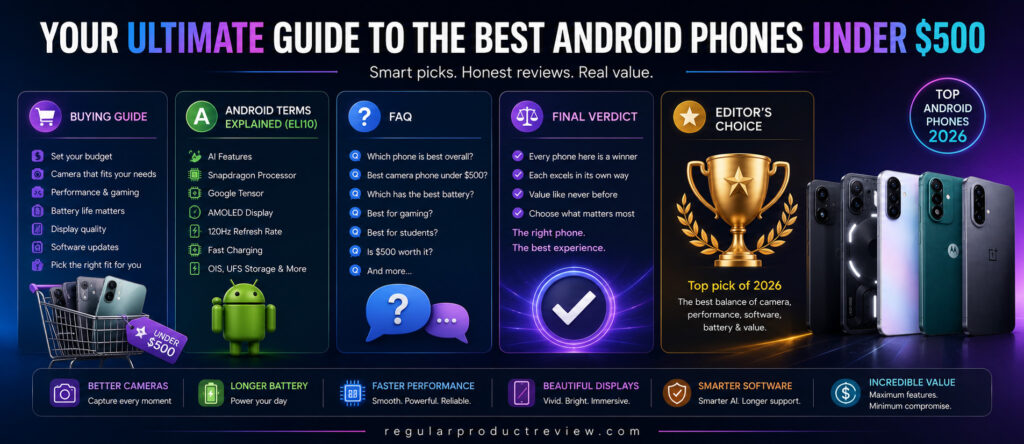
1. Treat the checkout price—not the marketing price—as the budget
A monthly payment can make an expensive phone look inexpensive. Compare the full device price after any required activation, plan commitment, trade-in, or bill-credit schedule. Trade-in value is not a universal discount because it depends on owning and surrendering another device. For this guide, Pixel 10a and Galaxy A56 qualify at their starting prices, Nothing qualifies at the checked official-store price, Motorola qualifies only on an actual sub-$500 offer, and Nord 5 qualifies only as a carefully evaluated import.
If $500 is an absolute household budget, leave room for tax, a case, screen protector, and charger. A $450 phone with the accessories you need can be a safer target than a $499.99 phone with no headroom.
2. Verify network compatibility before specifications
An impressive camera or processor is irrelevant if the phone lacks the bands and carrier features you need. This is especially important for imported devices. Match the exact model number—not just the product name—to your carrier’s compatibility checker. Verify LTE and 5G bands, VoLTE, Wi-Fi calling, eSIM, visual voicemail, hotspot policies, and emergency-service support.
Officially sold unlocked models are generally easier to activate, but “unlocked” alone does not guarantee every network feature. Carrier-sold models can offer better activation confidence but may use long bill-credit promotions or include software you do not want.
3. Choose cameras by focal length and use case
For everyday snapshots and low-effort processing, Pixel 10a is the safest choice in this group. For true optical reach, Nothing Phone (4a) Pro and Motorola Edge (2026) have dedicated telephoto hardware. Samsung offers a dependable wide-and-ultrawide combination but no telephoto lens, while Nord 5 emphasizes its main and selfie cameras.
Do not compare cameras by total megapixels alone. Look for optical stabilization on the main lens, a useful ultrawide, autofocus where it matters, realistic skin tones, and consistent processing between lenses. If video is important, verify resolution, frame rate, stabilization, microphone behavior, and storage needs for the exact model.
4. Match performance to the work you actually do
Messaging, navigation, social apps, banking, streaming, and casual photography do not require a flagship processor. Pixel’s Tensor G4 focuses on Google’s software stack; Exynos 1580, Snapdragon 7 Gen 4, and Dimensity 7450 are midrange platforms; Snapdragon 8s Gen 3 offers the most raw headroom here.
For gaming, check whether your specific titles support 120Hz or 144Hz, because a high-refresh panel cannot force every game to run at the same frame rate. Storage matters too: 128GB can fill quickly with large games and 4K video. Our best Android phones for students guide may be more useful when school apps, durability, and cost control matter more than peak speed.
5. Read battery claims as estimates
Battery capacity is useful context, not a complete endurance score. Display brightness, signal strength, refresh rate, camera use, navigation, background apps, temperature, and battery age all change runtime. Manufacturer endurance figures come from defined test conditions and should not be presented as guaranteed daily results.
Charging speed also requires the right adapter and protocol. A “50W” or “80W” label may require the manufacturer’s charger, while USB Power Delivery performance can be lower. Wireless charging adds convenience but wastes more energy as heat than a good cable and is available only on some phones in this list.
6. Value update support and repairability
Google’s seven-year Pixel policy and Samsung’s six-generation/six-year promise are strong reasons to keep those phones on a shortlist. OnePlus states four Android versions and six years of security for the Nord 5 global model, while Motorola promises only two Android OS upgrades for Edge (2026). Count remaining support from the product’s release timeline, not from the day you buy old inventory.
Also check battery replacement cost, local repair availability, parts, warranty transfer rules for open-box units, and whether an imported model can be serviced locally. Long software support is valuable only if the phone remains practical to repair and its battery can be maintained.
Frequently asked questions
What is the best Android phone under $500 in 2026?
For most buyers, the Google Pixel 10a is the strongest all-round choice because its base model is officially priced at $499, it has IP68 protection and wireless charging, and Google promises seven years of updates. Nothing Phone (4a) Pro is better if a large display and optical zoom matter more. The best choice still depends on storage, size, carrier, and current checkout price.
Are all five phones normally sold below $500?
No. Pixel 10a and Galaxy A56 only narrowly fit at their base launch prices. Nothing Phone (4a) Pro was below the limit on Nothing’s official U.S. store when checked. Motorola Edge (2026) was $599.99 new at Best Buy and belongs here only when a real sale or open-box offer falls below $500. OnePlus Nord 5 is primarily an import consideration for U.S. buyers.
Which phone has the best camera?
“Best” depends on the subject. Pixel 10a is the easiest recommendation for point-and-shoot processing. Nothing Phone (4a) Pro has the most useful optical zoom hardware. Motorola Edge (2026) also provides a 3× telephoto when it is genuinely discounted below $500. Samsung and OnePlus cover common wide and ultrawide shooting but do not offer the same optical reach.
Which is best for gaming?
On specifications, OnePlus Nord 5 leads with Snapdragon 8s Gen 3 and a 144Hz display. However, its import risks can outweigh that advantage. Nothing Phone (4a) Pro is the simpler officially sold alternative with a Snapdragon 7 Gen 4 and 144Hz screen. Actual gaming results vary by title, settings, cooling, network, and software.
Which phone gets updates for the longest?
Google promises seven years of OS, security, and Pixel Drop updates for Pixel 10a. Samsung promises up to six Android/One UI generations and six years of security updates for Galaxy A56. Compare policies from each phone’s release date and read the regional terms before buying.
Is a sale price under $500 enough to recommend a phone?
Not by itself. Confirm that the discount does not require a trade-in, premium service plan, long bill-credit agreement, or activation. For open-box devices, check condition, return window, battery status, warranty, and included accessories. For imports, include shipping, tax, customs, network limitations, and return cost.
Should I buy 128GB or 256GB?
Choose 256GB if you keep a phone for several years, download large games, record substantial 4K video, or store media offline. A well-managed 128GB phone can be sufficient for streaming and cloud-based use, but Pixel 10a’s 256GB version exceeds this article’s starting budget. Check your current phone’s used storage and add room for future apps and system updates.
Final verdict
The Google Pixel 10a is our most defensible overall pick among the best Android phones under $500 in 2026. It fits at $499 before tax, offers a compact 120Hz-capable display, useful camera software, wireless charging, IP68 protection, and the longest update commitment in this group.
Choose the Nothing Phone (4a) Pro if you prefer a larger 144Hz display, distinctive design, and optical zoom. Choose the Galaxy A56 5G when Samsung’s interface, ecosystem, and six-generation support matter most—but compare its discounted price with the newer A57 before paying near launch MSRP.
Treat the Motorola Edge (2026) as a conditional bargain only when the actual price falls below $500; at $599.99, it does not meet the article’s budget. Treat the OnePlus Nord 5 as an import specialist’s choice rather than a mainstream U.S. recommendation. Its performance hardware is appealing, but band support, warranty, regional software, and total landed cost must be verified first.
No single ranking can replace those checks. Start with your carrier, firm total budget, preferred phone size, storage requirement, and expected ownership period; then choose the model whose documented tradeoffs fit those needs.