

Choosing among the best iPhones in 2026 is less about finding one universal winner and more about matching the right model to your priorities. The five models covered here include a large Pro phone, a smaller Pro, a balanced standard model, a thin and light Air, and a lower-cost 17e. Their differences matter most in camera flexibility, screen size, battery rating, weight, and price.
There is also a timing question: should you buy an iPhone now or wait for an iPhone 18? As of September 7, 2026, Apple’s current iPhone lineup lists the iPhone 17 Pro, iPhone Air, iPhone 17, iPhone 17e, and iPhone 16. Apple has not announced an iPhone 18, so its specifications, price, models, and release date are not confirmed. This guide therefore evaluates products you can verify today and treats iPhone 18 only as a wait-or-buy decision.
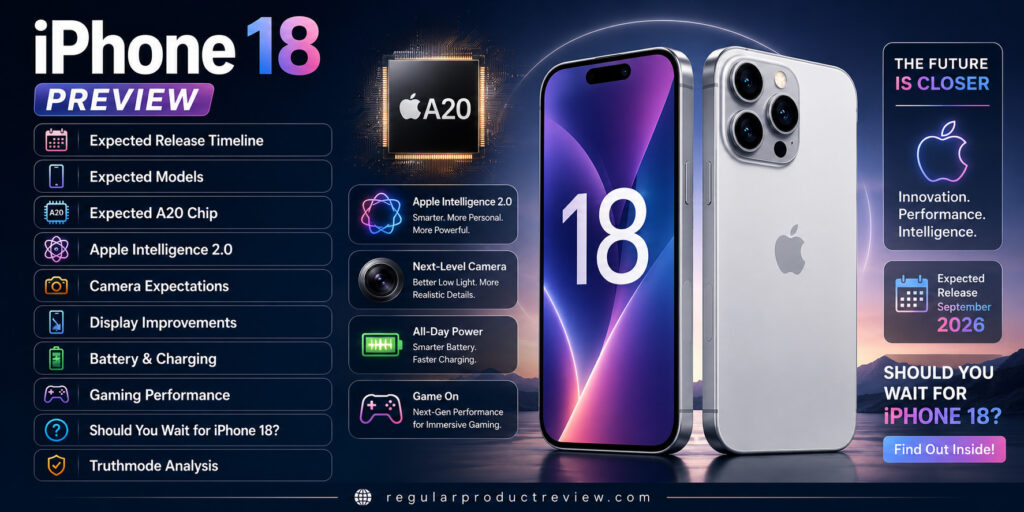
Quick answer
- Choose iPhone 17 Pro Max if you want the largest Pro display, Apple’s longest published battery rating in this group, and the full Pro camera system.
- Choose iPhone 17 Pro if you want the same core Pro camera capabilities in a smaller and lighter phone.
- Choose iPhone 17 if you want the most balanced combination of 120Hz display, two useful rear camera perspectives, performance, and size.
- Choose iPhone Air if thinness and low weight matter more than having Ultra Wide and dedicated Pro telephoto cameras.
- Choose iPhone 17e if you want a current A19 iPhone at a lower entry price and can accept a simpler display and camera system.
Readers who want a broader shortlist can also see our guide to the best iPhone for most people. For cross-platform alternatives, compare the best flagship phones before committing to iOS.
Should you buy an iPhone 17 now or wait for iPhone 18?
Buy now when your present phone is unreliable, its battery disrupts your day, or you need a better camera or current security support. The iPhone 17 family is available, documented, and easy to compare using Apple’s published specifications.
Waiting is reasonable when your current phone still works well and buying the newest generation is more important to you than upgrading immediately. But do not base the decision on rumored chips, camera hardware, pricing, or launch calendars. None of those details is official at the time of this update.
Buy now if
- your current device no longer meets your daily needs;
- repair costs are difficult to justify;
- you need the camera, storage, display, or battery characteristics of a current model;
- you have found a price you are comfortable paying after comparing the total cost.
Wait if
- your current phone remains fast, secure, and dependable;
- you are not under time pressure;
- you prefer to compare a future announcement with today’s models before spending.
Quick iPhone comparison
| Model | Best suited to | Display | Rear-camera flexibility | Apple’s video-playback rating |
|---|---|---|---|---|
| iPhone 17 Pro Max | Large-screen Pro users | 6.9-inch OLED, ProMotion up to 120Hz | 48MP Main, Ultra Wide, and Telephoto system | Up to 39 hours |
| iPhone 17 Pro | A smaller Pro phone | 6.3-inch OLED, ProMotion up to 120Hz | Same listed Pro camera system | Up to 33 hours |
| iPhone 17 | Most everyday buyers | 6.3-inch OLED, ProMotion up to 120Hz | 48MP Main and 48MP Ultra Wide | Up to 30 hours |
| iPhone Air | Thin and light design | 6.5-inch OLED, ProMotion up to 120Hz | Single 48MP Fusion camera; optical-quality 2x option | Up to 27 hours |
| iPhone 17e | Lower-cost current iPhone | 6.1-inch OLED; Apple does not list ProMotion | Single 48MP Fusion camera; optical-quality 2x option | Up to 26 hours |
Important: Apple’s video-playback figures are controlled ratings, not a promise of your personal screen-on time. Network strength, brightness, camera use, games, background activity, and battery age all change real-world endurance. Prices and promotions also change, so verify the final price and return terms before ordering.
How we researched and compared these iPhones
This version does not present undocumented hands-on testing as fact. The comparison uses Apple’s current model pages and technical specifications, then interprets measurable differences for common buying needs. We considered:
- display size, refresh-rate features, brightness, and weight;
- processor tier and storage choices;
- rear-camera hardware and supported capture formats;
- Apple’s published video-playback and charging figures;
- features omitted from less expensive models;
- likely ownership fit rather than an invented decimal score.
Our recommendations are editorial judgments, not laboratory results. For more detail about how the site handles evidence, corrections, and commercial relationships, read the review methodology and editorial policy.
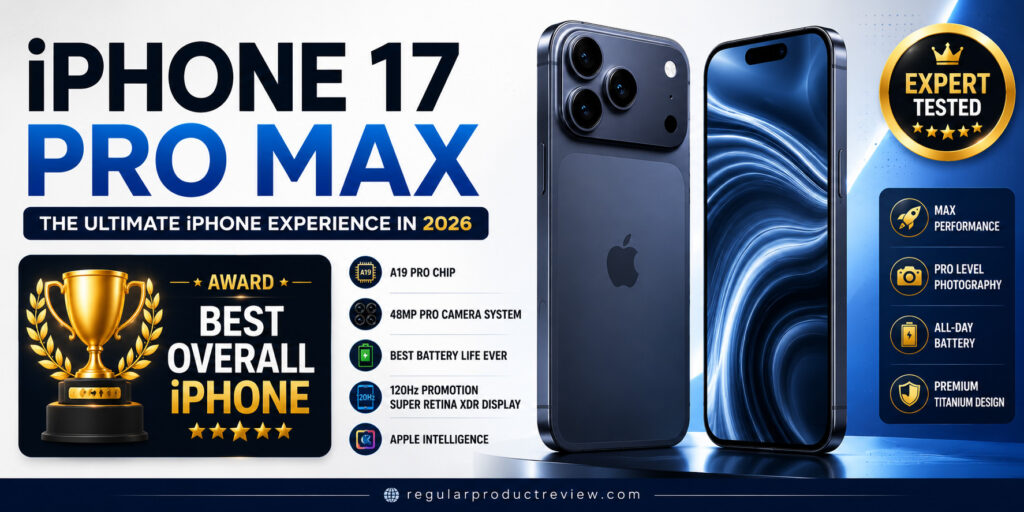
1. iPhone 17 Pro Max
The iPhone 17 Pro Max is the strongest fit for someone who wants Apple’s largest current Pro phone. Its 6.9-inch display provides more room for video, photo editing, games, and reading, while Apple rates it for up to 39 hours of video playback—the highest published figure among the five models here.
What stands out
Apple’s iPhone 17 Pro technical specifications list the A19 Pro chip and a 48MP Pro Fusion camera system comprising Main, Ultra Wide, and Telephoto cameras. The Telephoto provides a native 4x perspective and an optical-quality 8x option. This is materially more flexible than the one-camera systems on iPhone Air and iPhone 17e, especially when you frequently shoot distant subjects, portraits, macro images, or ProRAW.
The display supports Always-On and ProMotion with adaptive refresh rates up to 120Hz. Apple lists a weight of 233 grams, so the larger screen and battery capability come with a real ergonomic tradeoff. Buyers with smaller hands should try the phone in person or compare it directly with the 206-gram iPhone 17 Pro.
Key specifications
| Feature | Verified detail |
|---|---|
| Display | 6.9-inch Super Retina XDR OLED; ProMotion up to 120Hz |
| Chip | A19 Pro |
| Rear cameras | 48MP Main, 48MP Ultra Wide, 48MP Telephoto |
| Front camera | 18MP Center Stage |
| Video playback | Up to 39 hours |
| Weight | 233g |
| Charging | Apple says up to 50% in 20 minutes with a 40W-or-higher wired adapter under its test conditions |
Strengths and compromises
Strengths: the broadest camera toolkit in this comparison, the largest display, Pro video formats, and the highest Apple-rated video playback. It is a sensible choice for frequent mobile video work or anyone who deliberately wants the biggest iPhone.
Compromises: it is heavier, physically larger, and typically more expensive than the standard and e models. Those costs are difficult to justify if your routine is mainly calls, messaging, browsing, and casual photos.
Bottom line: choose the Pro Max for its size, battery rating, and camera flexibility—not because a large phone is automatically better for everyone. Photography-focused buyers may also want our wider best camera phones comparison.
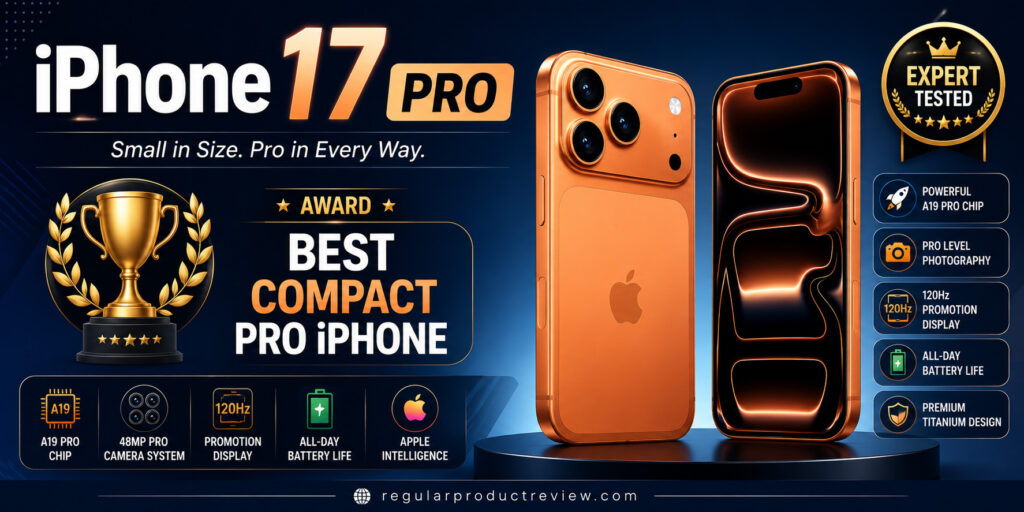
2. iPhone 17 Pro
The iPhone 17 Pro keeps the same listed A19 Pro chip and Pro Fusion camera system while reducing the display to 6.3 inches and weight to 206 grams. It is the more practical Pro choice for people who want the camera hardware without carrying the largest body.
Where it differs from Pro Max
The main difference is not processing power or camera layout; it is physical size and battery rating. Apple rates the 17 Pro for up to 33 hours of video playback versus up to 39 hours for Pro Max. That six-hour difference is an Apple test result, not a guaranteed personal runtime, but it clearly shows the direction of the tradeoff.
The smaller screen is easier to hold and pocket, yet it still supports Always-On and ProMotion up to 120Hz. Creators also retain ProRAW, ProRes, ProRes RAW, Apple Log 2, and the three-camera system. Those features add genuine value only when your workflow uses them.
Key specifications
| Feature | Verified detail |
|---|---|
| Display | 6.3-inch Super Retina XDR OLED; ProMotion up to 120Hz |
| Chip | A19 Pro |
| Rear cameras | 48MP Main, 48MP Ultra Wide, 48MP Telephoto |
| Front camera | 18MP Center Stage |
| Video playback | Up to 33 hours |
| Weight | 206g |
| Charging | Up to 50% in 20 minutes with a 40W-or-higher wired adapter under Apple’s conditions |
Strengths and compromises
Strengths: the Pro camera and video features in a more manageable body, a bright 120Hz display, and lower weight than Pro Max.
Compromises: less screen area and a lower battery rating than Pro Max. It still carries a premium that everyday users may not benefit from.
Bottom line: buy the 17 Pro when camera versatility matters and you prefer a smaller phone. If gaming is the main priority, compare thermal design, accessories, and platform choice in our best gaming phones guide rather than relying on chip branding alone.
3. iPhone 17
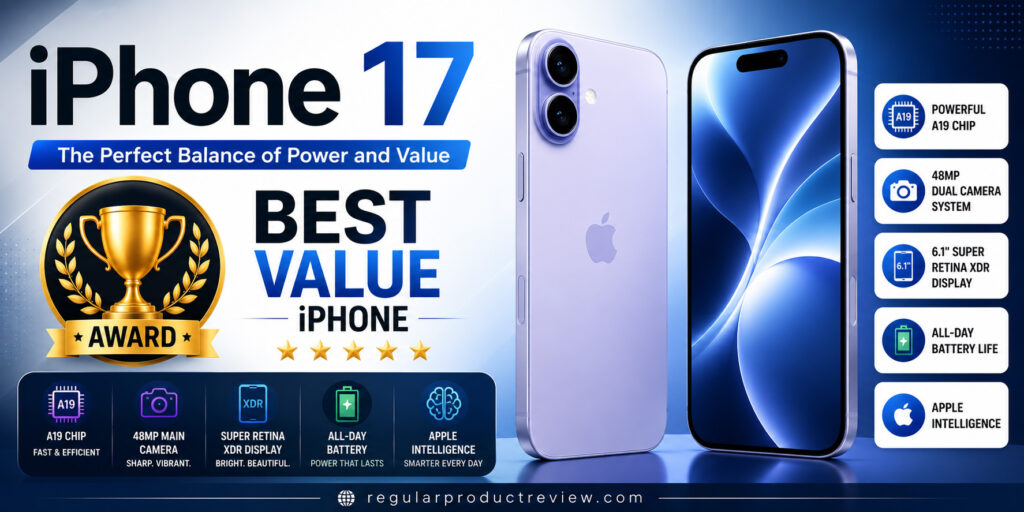
For most people comparing the best iPhones in 2026, the regular iPhone 17 offers the clearest balance. It has the A19 chip, a 6.3-inch OLED display with ProMotion up to 120Hz, and two rear camera perspectives without the size and specialist features of the Pro Max.
Why it is the balanced choice
Apple’s iPhone 17 specifications list a 48MP Fusion Main camera and a 48MP Fusion Ultra Wide. The Main camera also enables an optical-quality 2x option. That combination covers everyday wide, standard, 2x, and Ultra Wide framing, although it cannot reproduce the longer telephoto reach or Pro formats of the Pro models.
At 177 grams, it is lighter than both Pro phones. The display includes Always-On, ProMotion up to 120Hz, and up to 3000 nits peak outdoor brightness under Apple’s specified conditions. Apple rates video playback at up to 30 hours.
Key specifications
| Feature | Verified detail |
|---|---|
| Display | 6.3-inch Super Retina XDR OLED; ProMotion up to 120Hz |
| Chip | A19 |
| Rear cameras | 48MP Main and 48MP Ultra Wide; optical-quality 2x from Main |
| Front camera | 18MP Center Stage |
| Storage | 256GB or 512GB |
| Video playback | Up to 30 hours |
| Weight | 177g |
Strengths and compromises
Strengths: a smoother 120Hz display, useful dual-camera coverage, lower weight, and the same starting storage capacity of 256GB listed for this generation.
Compromises: no dedicated Pro telephoto camera and no ProRAW/ProRes-focused package. A19 is not the A19 Pro, although that distinction may be unimportant for ordinary apps, navigation, social media, and streaming.
Bottom line: the iPhone 17 is the safest recommendation for a buyer who does not already know they need a Pro camera or the Air’s thin design. Students should still compare storage needs, repair coverage, and total price using our iPhone guide for students before buying.
4. iPhone 17 Air (officially iPhone Air)
The product retained from the original article as “iPhone 17 Air” is officially named iPhone Air by Apple. Correct naming matters because “iPhone 17 Air” is not the name shown on Apple’s product or specification pages.
What the Air prioritizes
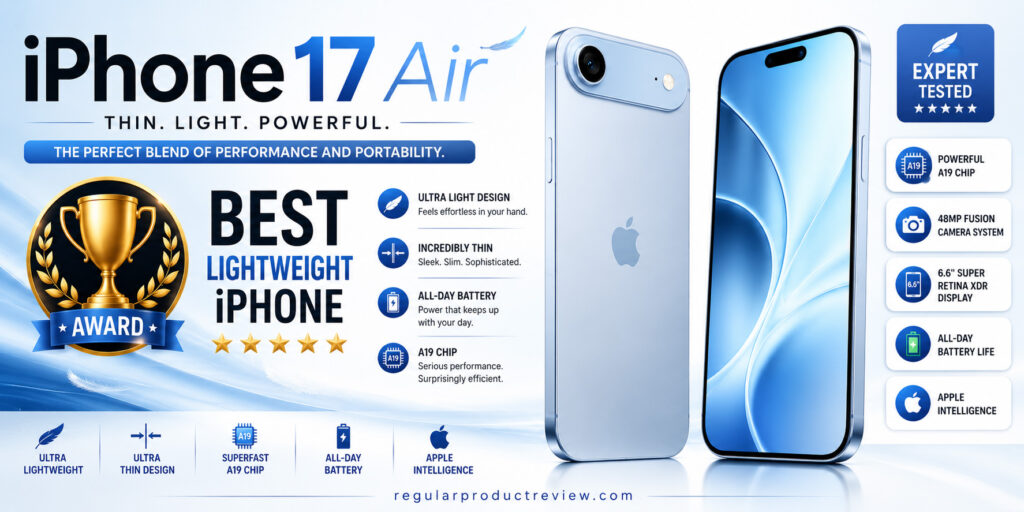
The official iPhone Air specifications list a 5.64mm body, 165g weight, a 6.5-inch OLED display, and A19 Pro chip with a 5-core GPU. It is thinner and lighter than the other models in this list while still providing ProMotion up to 120Hz.
The design tradeoff appears most clearly in the camera system. iPhone Air has one 48MP Fusion Main camera, which can also produce an optical-quality 2x view. It does not offer the dedicated Ultra Wide and Telephoto cameras included together on the Pro models. If you routinely shoot group photos in tight rooms, landscapes at very wide angles, macro images, or distant subjects, that limitation matters more than the thin body.
Key specifications
| Feature | Verified detail |
|---|---|
| Official product name | iPhone Air |
| Display | 6.5-inch Super Retina XDR OLED; ProMotion up to 120Hz |
| Chip | A19 Pro with 5-core GPU |
| Rear camera | 48MP Fusion Main; optical-quality 2x option |
| Front camera | 18MP Center Stage |
| Video playback | Up to 27 hours; up to 40 hours with Apple’s separate iPhone Air MagSafe Battery |
| Size and weight | 5.64mm thick; 165g |
Strengths and compromises
Strengths: exceptionally thin and light construction, a large 120Hz display, and current-generation Apple silicon.
Compromises: the single rear camera is less versatile than iPhone 17’s dual system or the Pro triple system. Apple’s listed 27-hour video-playback rating also trails iPhone 17, 17 Pro, and 17 Pro Max. Apple states that iPhone Air uses eSIM and is not compatible with physical SIM cards, so check carrier support before purchase.
Bottom line: choose iPhone Air because you value lightness and thinness every day. Choose iPhone 17 instead if broader camera coverage and a higher standalone battery rating matter more.
5. iPhone 17e
The iPhone 17e is the lower-cost route into Apple’s current A19 generation. It keeps the essential iPhone experience but removes or simplifies several features found higher in the lineup. That makes it a value decision rather than a smaller version of the regular iPhone 17.
What you get—and what you give up
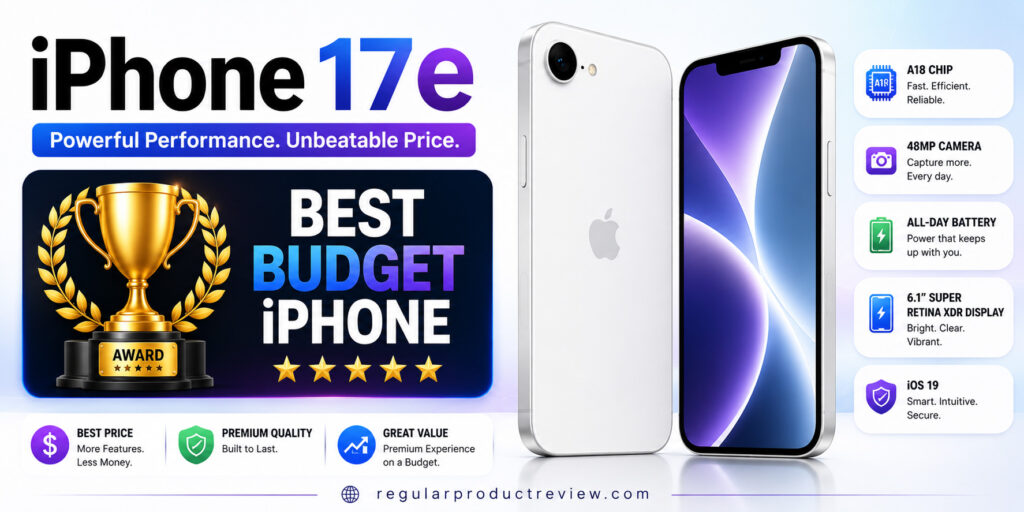
Apple’s iPhone 17e specifications list a 6.1-inch OLED display, A19 chip with a 4-core GPU, 256GB or 512GB storage, and one 48MP Fusion rear camera with an optical-quality 2x option. The front camera is 12MP TrueDepth, not the 18MP Center Stage camera used by the other four models in this article.
Apple does not list ProMotion or Always-On display for iPhone 17e. It also lacks an Ultra Wide camera. These are important omissions for readers moving down from a Pro iPhone or comparing it with the regular iPhone 17.
The battery claim is more straightforward: Apple rates it for up to 26 hours of video playback. MagSafe and Qi2 wireless charging are supported up to 15W. As with iPhone Air, Apple says the listed model uses eSIM and does not accept a physical SIM, so regional carrier compatibility deserves a check.
Key specifications
| Feature | Verified detail |
|---|---|
| Display | 6.1-inch Super Retina XDR OLED; ProMotion not listed |
| Chip | A19 with 4-core GPU |
| Rear camera | 48MP Fusion Main; optical-quality 2x option |
| Front camera | 12MP TrueDepth |
| Storage | 256GB or 512GB |
| Video playback | Up to 26 hours |
| Wireless charging | MagSafe and Qi2 up to 15W |
Strengths and compromises
Strengths: current A19 platform, 256GB starting storage, OLED display, MagSafe, and a 48MP Main camera at the lowest position in this five-model shortlist.
Compromises: no Ultra Wide camera, no listed ProMotion or Always-On display, a different front camera, and a lower GPU core count than iPhone 17. Shoppers with a strict budget can also compare older models in our guide to refurbished iPhones under $400, while checking seller warranty, battery health, activation lock, and return policy.
Bottom line: buy the 17e when price and core iPhone features matter more than display smoothness and camera range. If a discounted iPhone 17 is close in total cost, its Ultra Wide camera, 120Hz ProMotion display, and 18MP Center Stage front camera justify a careful comparison.
iPhone 18 preview: what is actually confirmed?
As of September 7, 2026, Apple has not announced iPhone 18. The company’s current iPhone page does not provide an iPhone 18 product page, technical specifications, price, release date, or confirmed model list.
That means claims about an A20 or 2nm processor, a split release schedule, an “iPhone 18 Air,” camera apertures, battery gains, or a foldable model should not be presented as settled product information. Rumors may help enthusiasts follow an industry story, but they cannot tell a buyer what Apple will ship or what it will cost.
A practical wait-or-buy framework
- Need a phone now: compare the current models and buy the one that meets your needs at an acceptable total price.
- Current phone still works: waiting for Apple’s next official announcement costs little except time.
- Worried about immediate obsolescence: choose from present features; a future launch does not remove the camera, display, or performance you bought.
- Buying around a rumor: pause. Wait until Apple publishes a product page and technical specifications.
Apple has announced broader next-generation Apple Intelligence features, but feature availability can vary by language, region, hardware, and software version. Those software announcements should not be converted into unsupported iPhone 18 hardware claims.
iPhone buying guide
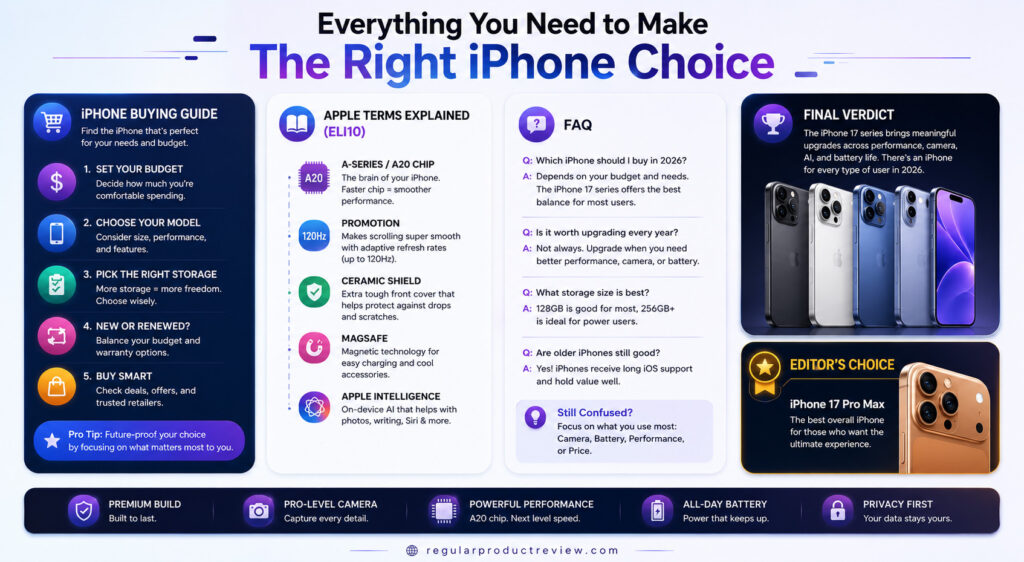
1. Set a total budget
Compare the phone, required storage, tax, carrier terms, AppleCare or other coverage, accessories, and any financing cost. A monthly payment can make two phones look similarly priced even when their total costs differ. Promotions also change, so verify the final checkout price rather than relying on a static article figure.
2. Choose the camera range you will use
- A single Main camera is enough for everyday photos and optical-quality 2x framing on iPhone Air and 17e.
- Add an Ultra Wide with iPhone 17 when you often photograph buildings, interiors, large groups, or broad landscapes.
- Choose a Pro model when longer telephoto reach, macro, ProRAW, or Pro video formats are part of your actual workflow.
More lenses are useful only when they solve a real shooting need. Compare other platforms in our camera phones section if photography is the primary reason for upgrading.
3. Decide on size before performance tier
The Pro and Pro Max use the same listed chip and camera system, but their weight and screen size differ. Similarly, iPhone Air’s main advantage is how it feels to carry. If possible, handle the models in a store with a case attached; dimensions on a table cannot fully communicate comfort.
4. Interpret battery numbers correctly
Apple’s video-playback ratings allow like-for-like comparison within its test method. They do not predict every owner’s day. Navigation, weak cellular signal, outdoor brightness, recording video, gaming, and background syncing can use power much faster than local video playback.
5. Check Apple Intelligence availability
All five models in this guide support Apple Intelligence, but individual features can depend on language, region, and the installed iOS version. Review Apple’s current availability notes before buying for one specific AI feature. Do not assume that every announced capability is active everywhere on day one.
6. Think about storage and ownership length
Photos, 4K video, downloaded games, and offline media consume storage quickly. Cloud storage can help but adds an ongoing cost and does not replace adequate local space for every workflow. If you keep phones for several years, leave room for growth rather than choosing capacity only from today’s usage.
Which iPhone should you choose?
| If your main priority is… | Start with… | Why |
|---|---|---|
| Maximum screen and Apple-rated battery | iPhone 17 Pro Max | 6.9-inch display and up to 39 hours video playback |
| Pro cameras in a smaller body | iPhone 17 Pro | Same listed Pro camera system at 206g |
| The best balance for most buyers | iPhone 17 | 120Hz display, dual cameras, 177g weight |
| Thin and light design | iPhone Air | 5.64mm and 165g |
| Lower-cost current generation | iPhone 17e | A19, OLED, 256GB starting storage, simpler hardware |
Frequently asked questions
What is the best iPhone in 2026 for most people?
The iPhone 17 is the most balanced starting point. It provides a 120Hz ProMotion OLED display, Main and Ultra Wide cameras, A19 chip, and a lower weight than either Pro model. The “best” choice changes if you need long telephoto reach, the largest screen, the thinnest body, or the lowest entry cost.
Which iPhone has the best battery life in this list?
By Apple’s published video-playback rating, iPhone 17 Pro Max leads at up to 39 hours. Actual endurance depends on use and settings.
Is iPhone 17 Air a real Apple product name?
Apple’s official name is iPhone Air. This article retains “iPhone 17 Air” in the section heading only to correct the original wording and help readers recognize the product being discussed.
Is iPhone 17e better than iPhone 17?
It is less expensive, not universally better. iPhone 17 adds ProMotion up to 120Hz, an Ultra Wide rear camera, an 18MP Center Stage front camera, and a higher Apple video-playback rating. The 17e is appropriate when those differences do not justify the extra cost.
Should I wait for iPhone 18?
Wait if your current phone works well and you want to compare the next official announcement. Buy a current model if you need a dependable replacement now. Apple has not confirmed iPhone 18 details as of this update.
Are the battery figures real-world screen-on-time results?
No. They are Apple’s published video-playback ratings. This guide does not convert them into unsupported personal-use or screen-on-time claims.
Do all these iPhones support Apple Intelligence?
Yes, Apple lists Apple Intelligence for all five. Specific features and languages can vary by device, region, and software version.
Final recommendation
The iPhone 17 is the most sensible default among the best iPhones in 2026 because it combines a 120Hz display, useful dual cameras, current performance, and manageable weight. Choose iPhone 17 Pro for Pro camera capability in a smaller format, or iPhone 17 Pro Max for the largest screen and highest Apple-rated video playback. Choose iPhone Air for thinness and low weight, and iPhone 17e when lowering the purchase price matters more than having every display and camera feature.
Most importantly, buy from confirmed specifications and your present needs. If waiting for iPhone 18 is easy, wait for Apple’s announcement—not for a rumor. If you need a phone now, the five choices covered here are already clearly differentiated.