


Best Wireless Headphones Under $50: Quick Verdict, Top Picks, and Selection Method
Finding genuinely good wireless headphones under $50 is less about chasing the longest feature list and more about identifying which compromises will not interfere with the way you listen. At this price, one model may deliver outstanding battery life but use a basic microphone. Another may provide comfortable over-ear cushions yet omit app-based equalization. A third may offer active noise cancellation only while discounted. The right purchase therefore depends on whether your priority is music, calls, commuting, workouts, children’s listening, or a dependable backup pair.
This guide evaluates ten current models that can be purchased for $50 or less in the United States at the time of review, or that regularly reach the price ceiling through an official promotion. We treat the price cap as a hard buying rule: taxes and optional protection plans are excluded, but the headphone itself should cost no more than $49.99. If a sale-dependent recommendation rises above that amount, skip it and wait. Shoppers with a little more flexibility should compare our broader best wireless headphones under $100 guide, while readers who want the lowest-cost options across wired and wireless designs can visit our budget headphones hub.
The ten selections cover more than one form factor. Most are traditional on-ear or over-ear headphones, but the Koss BT232i uses secure ear clips for walking and exercise. That variety matters because a headband that feels comfortable at a desk may be inconvenient during a run, while a compact on-ear model can become tiring during a long flight. We assessed each model according to the job it performs best rather than pretending that one inexpensive headphone is perfect for everyone.
Editorial Price Rule: A model qualifies for this article only when its current selling price is $50 or less. The Sony WH-CH520, JBL Tune 520BT, and OneOdio Focus A5 can move above the limit when promotions end. Confirm the final product price before checkout and do not let a temporary badge override the $50 ceiling.
Quick Summary: The Best $50 Wireless Headphones at a Glance
The Philips TAH4209 is our best overall value because it combines a modern Bluetooth connection, multipoint pairing, app-adjustable sound, low-lag mode, a foldable 55-hour design, and clear everyday usability without relying on premium extras. The soundcore H30i is the battery specialist, offering an advertised 70 hours, 40mm drivers, app EQ, and multipoint support in a light on-ear chassis. Availability can vary, so purchase it only from an authorized US seller at or below the limit.
For mainstream brand support, the JBL Tune 520BT and Sony WH-CH520 are the most polished choices when discounted. JBL emphasizes energetic bass, a strong companion app, 57-hour endurance, and fast charging. Sony provides a lighter, more balanced presentation, DSEE processing, multipoint connectivity, and exceptionally clear controls. Neither includes a wired listening mode, which matters if you want to connect to an airplane seat or continue listening after the battery dies.
The JLab Studio Pro Wireless is the comfort-focused over-ear choice. Its Cloud Foam cushions, 50-plus-hour battery, foldable build, and simple onboard EQ modes make it easy to recommend for home study or casual office use. The Edifier W600BT is a cleaner, less feature-heavy over-ear alternative with 40mm drivers, multipoint, 30-hour battery life, and an included 3.5mm cable.
Listeners who want studio and DJ flexibility should consider the OneOdio A70, which supports Bluetooth, 3.5mm and 6.35mm connections, music sharing, and an advertised 72-hour battery. The OneOdio Focus A5 is the only true ANC-focused model in the list, but it qualifies only at the observed $49.99 promotional price. For children, the Belkin SoundForm Mini offers an 85dB volume cap, durable construction, wired backup, and a two-year warranty. The Koss BT232i fills the workout niche with secure SportClip earpieces, sweat resistance, and an 18-plus-hour battery.
Our Ten Recommended Models
| Rank | Product | Best For | Design | Advertised Battery | ANC | Wired Backup | Buy-Under Price |
|---|---|---|---|---|---|---|---|
| 1 | Philips TAH4209 | Best overall balance | On-ear | Up to 55 hours | No | No | $49.99 |
| 2 | soundcore H30i | Battery life and app EQ | On-ear | Up to 70 hours | No | Yes | $39.99 |
| 3 | JBL Tune 520BT | Bass and app experience | On-ear | Up to 57 hours | No | No | $49.99 |
| 4 | Sony WH-CH520 | Calls and lightweight comfort | On-ear | Up to 50 hours | No | No | $49.99 |
| 5 | JLab Studio Pro Wireless | Over-ear comfort | Over-ear | 50+ hours | No | No | $40.00 |
| 6 | Edifier W600BT | Simple balanced over-ear use | Over-ear | Up to 30 hours | No | Yes | $49.99 |
| 7 | OneOdio A70 | DJ and wired versatility | Over-ear | Up to 72 hours | No | Yes | $49.99 |
| 8 | OneOdio Focus A5 | ANC on a strict sale budget | Over-ear | Up to 75 hours | Yes | No | $49.99 sale |
| 9 | Belkin SoundForm Mini | Children and distance learning | On-ear | Up to 30 hours | No | Yes | $32.99 |
| 10 | Koss BT232i | Walking and light workouts | Ear-clip | 18+ hours | No | No | $34.99 |
Battery figures in the table are manufacturer claims and can decrease with higher volume, calls, low-latency modes, ANC, weak radio conditions, or cold temperatures. We do not equate a longer number with better overall quality. Comfort, tuning, connection stability, microphone behavior, charging convenience, and replacement support matter just as much.
How We Evaluated These Budget Bluetooth Headphones
This article uses a research-led editorial evaluation rather than presenting manufacturer claims as controlled laboratory results. We checked current US product pages, official manuals, listed prices, warranty terms, connection features, driver information, charging standards, and public support documentation. Price and stock were reviewed on August 15, 2026, but both can change without notice.
Our scoring logic gives the greatest weight to practical sound quality and comfort, followed by connection reliability, battery endurance, microphone usefulness, controls, portability, warranty support, and value at the stated price. Features receive credit only when they improve real use. A companion app is valuable when its equalizer can correct a bass-heavy tuning; it is less important when the app adds little beyond a battery indicator.
We also distinguish active noise cancellation from passive isolation. Thick over-ear pads can reduce some higher-frequency chatter, but they do not electronically cancel low-frequency engine or HVAC noise. Only the OneOdio Focus A5 in this list advertises hybrid ANC. Readers who regularly fly or commute through loud environments should compare our noise-cancelling headphones category and our best noise-cancelling headphones under $100 before accepting the limitations of a sub-$50 model.
What $50 Can—and Cannot—Buy
Modern cheap Bluetooth headphones can provide excellent endurance, USB-C charging, multipoint pairing, usable microphones, app EQ, and comfortable padding. What they rarely provide is premium structural rigidity, replaceable batteries, advanced spatial audio, consistent ANC across frequencies, high-end codecs on every model, or broadcast-quality call microphones. Plastic hinges and synthetic cushions are normal in this category. They are not automatically bad, but buyers should open the headband gently and avoid leaving the headphones in a hot vehicle.
Gaming is another boundary. A low-lag mode can improve video synchronization, yet ordinary Bluetooth usually cannot match a dedicated 2.4GHz USB dongle for competitive play and two-way voice chat. For PC or console gaming, use our gaming headsets category and best gaming headsets under $100 to compare models designed around latency and boom microphones.
Expert Recommendation: Start with fit and use case, then compare sound features. A comfortable $35 headphone with stable multipoint can be more useful than a $50 model with stronger bass but painful clamp force. Buy the Philips TAH4209 for balance, the JLab Studio Pro for over-ear comfort, the OneOdio Focus A5 for sale-priced ANC, or the Belkin SoundForm Mini for a child.
Philips TAH4209 Review: Best Overall Wireless Headphones Under $50
Award: Best Overall Balance
Recommended Price: $49.99 or less
The Philips TAH4209 earns the top position because its feature set is unusually coherent for the price. Instead of relying on one headline number, it combines a lightweight folding design, 32mm drivers, Dynamic Bass control, app support, multipoint connectivity, clear-call processing, low-lag video mode, USB-C charging, and up to 55 hours of advertised playback. That balance makes it an easy default for students, commuters, office listeners, and anyone who wants dependable Bluetooth headphones under 50 dollars without a complicated setup.
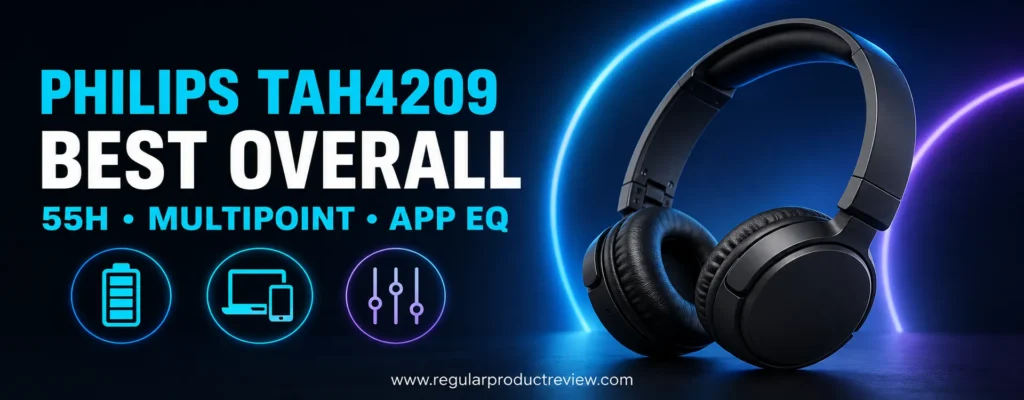
Philips describes the tuning as natural, with Dynamic Bass available through the Philips Headphones app. That distinction is useful. Some inexpensive headphones permanently boost the low end, causing male voices and kick drums to blend together. The TAH4209 lets listeners add bass when they want more impact at low volume without making every podcast or acoustic recording unnecessarily thick. Its 32mm drivers are smaller than the 40mm units used in several competitors, but driver diameter alone does not determine fidelity. Enclosure design, damping, tuning, seal, and digital processing all influence the result.
The on-ear fit keeps the chassis compact. Soft memory-foam pads angle against the ears, and the headband folds for travel. On-ear pressure is personal, however. Listeners who wear glasses or dislike pressure directly on the outer ear may prefer the JLab Studio Pro or Edifier W600BT. The Philips design is more portable than those over-ear models, but it will not isolate outside sound as effectively.
Philips TAH4209 Key Specifications
| Specification | Detail |
|---|---|
| Headphone style | Wireless on-ear, foldable |
| Drivers | 32mm dynamic |
| Bluetooth | Bluetooth 5.3 |
| Multipoint | Yes |
| Battery | Up to 55 hours |
| Charging | USB-C; about 2 hours full charge |
| Quick charge | 15 minutes for up to 2 hours |
| App | Philips Headphones app |
| Sound feature | Dynamic Bass |
| Low-lag mode | Yes |
| Microphone | Built-in microphone for calls |
| Wired audio | No listed analog input |
| ANC | No |
The official Philips TAH4209 product information confirms the 55-hour claim, two-hour USB-C charge, quick-charge function, app integration, and foldable construction. Actual runtime depends on volume and call use, so treat 55 hours as a best-case ceiling rather than a guaranteed result.
Everyday Sound, Calls, and Video
The TAH4209 is best approached as an everyday headphone rather than an audiophile tool. Its strengths are intelligible vocals, enjoyable bass, uncomplicated controls, and enough adjustment to suit mainstream playlists. Dynamic Bass is most useful at low listening levels, where human hearing perceives less bass and treble. At louder settings it can become excessive, so the neutral or standard preset is a better starting point.
The low-lag setting helps align dialogue with video, though it does not transform Bluetooth into a zero-latency gaming connection. For YouTube, streaming services, and casual mobile games, it is a worthwhile inclusion. Competitive players should still choose a USB-dongle headset from our gaming headset recommendations. For music-first shoppers willing to spend more for resolution and imaging, the audiophile headphones category explains which upgrades actually affect fidelity.
Multipoint is one of the Philips model’s most valuable features. It can remain paired to a phone and laptop, making it easier to move from a work video to an incoming call. The feature does not mean that both sources play simultaneously; it manages switching between them. Connection behavior can still vary by operating system, but the workflow is more convenient than manually disconnecting one source every time.
Comfort and Practical Limitations
At this price, the build is primarily plastic. That keeps weight down but calls for sensible handling. Fold the earcups using the intended joints, store them without heavy objects pressing on the headband, and wipe synthetic pads after warm-weather use. The headphone has no advertised water-resistance rating, so it is not our first choice for sweat-heavy exercise.
The absence of a 3.5mm jack is the main functional compromise. If the battery is empty, or if you want to connect to a legacy entertainment system, the Philips cannot fall back to an analog cable. The Edifier W600BT, OneOdio A70, soundcore H30i, and Belkin SoundForm Mini are better choices for wired backup. There is also no ANC, which is expected at this price but relevant for travel.
| Pros | Cons |
|---|---|
| Strong all-round feature mix | On-ear pressure may bother some listeners |
| Up to 55 hours of battery life | No analog wired mode |
| Multipoint and Bluetooth 5.3 | No active noise cancellation |
| App EQ and Dynamic Bass | Plastic build needs careful handling |
| Foldable and easy to carry | Not intended for heavy sweat exposure |
| Low-lag mode improves video use | Microphone is for routine calls, not recording |
Expert Tip: Use the standard sound profile for podcasts and vocals, then enable Dynamic Bass only when a track sounds thin at a safe volume. This produces a cleaner result than leaving maximum bass enhancement active for every source.
Buy it if: You want the most complete combination of portability, battery life, multipoint, app control, and mainstream sound below $50.
Skip it if: You need over-ear cushions, ANC, a 3.5mm input, or a dedicated low-latency gaming dongle.
The TAH4209 sits between the simplest budget headphones and more advanced wireless headphones, which is exactly why it leads this price-specific roundup.
soundcore H30i Review: Best Battery Life Under $50
Award: Best for Multi-Day Battery Life
Recommended Price: $39.99 or less
The soundcore H30i is built around endurance. Its advertised 70-hour battery, five-minute fast charge for up to four hours of playback, Bluetooth 5.3 connection, 40mm drivers, multipoint support, wired AUX option, and companion-app equalizer create a feature-rich package for commuters and students who dislike frequent charging. At approximately 183 grams, it is also light enough to disappear into a backpack.
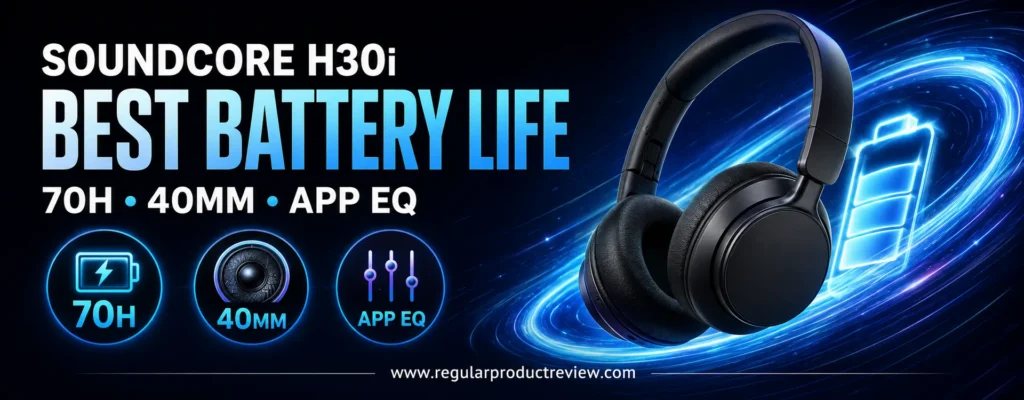
There is an important availability warning. Soundcore’s US product page has periodically shown the H30i as sold out, while authorized retailers continue to carry it. Buy only from a seller with a clear return policy and keep the price below the article’s ceiling. A scarce product is not automatically worth more; above $50, alternatives with over-ear comfort or ANC become more competitive.
soundcore H30i Key Specifications
| Specification | Detail |
|---|---|
| Headphone style | Wireless on-ear, foldable |
| Drivers | 40mm dynamic |
| Bluetooth | Bluetooth 5.3 |
| Bluetooth range | Up to 49 feet under ideal conditions |
| Multipoint | Yes |
| Battery | Up to 70 hours |
| Charging time | About 2 hours |
| Quick charge | 5 minutes for up to 4 hours |
| Weight | Approximately 183g |
| App | soundcore app with EQ and presets |
| Wired mode | Yes, AUX |
| ANC | No |
The official H30i guide lists the 800mAh battery, 40mm drivers, 20Hz–20kHz response, Bluetooth 5.3, and 70-hour playtime. Manufacturer battery testing normally uses controlled volume and content, so heavy bass, maximum loudness, and long calls can reduce real runtime.
Bass-Forward Sound with Useful App Control
Out of the box, H30i emphasizes bass. That can make pop, hip-hop, electronic music, and action movies sound lively, but it may also give lower mids more weight than listeners seeking a neutral presentation want. The soundcore app is therefore a central part of the product, not a decorative extra. Its presets and custom EQ let users reduce low frequencies, bring vocals forward, or soften treble according to preference.
The headphone does not support active noise cancellation. Its pads provide ordinary passive reduction, and the on-ear shape leaves more environmental sound audible than a well-sealed over-ear design. That can be an advantage when walking in a quiet area, but it is not a substitute for situational awareness near traffic. If low-frequency noise control matters, compare the Focus A5 in Part 9 and our broader noise-cancelling headphones guide.
Bluetooth multipoint improves daily productivity. A student can leave the H30i connected to a laptop for a lecture while keeping a phone ready for calls. Controls are physical, which is usually more predictable than touch gestures on low-cost hardware. The AUX input adds another layer of flexibility: it can connect to older laptops, handheld consoles, and seatback systems, and it remains useful if the battery is depleted.
Portability, Clamp, and Long-Session Comfort
The H30i’s low weight reduces headband fatigue, but the pads rest directly on the ears. Some listeners find this cooler and less bulky than an over-ear design; others feel soreness after an hour or two. Head size, glasses, and ear shape determine the outcome. Because comfort cannot be derived from a specification sheet, buy from a retailer that permits returns after a careful indoor fit check.
The folding mechanism and detachable pads are practical, yet the structure remains budget plastic. Avoid twisting one earcup independently or stretching the headband beyond its normal range. Carrying it in a soft pouch prevents cosmetic scratches, while a hard case offers better hinge protection.
| Pros | Cons |
|---|---|
| Class-leading 70-hour claim | US direct stock can be inconsistent |
| Five-minute fast charge | On-ear pressure is not ideal for everyone |
| 40mm drivers and powerful bass | No ANC |
| Strong app EQ options | Bass-heavy default tuning may need adjustment |
| Multipoint and Bluetooth 5.3 | Mostly plastic construction |
| AUX input provides wired backup | No premium codec is central to the value proposition |
Editorial Insight: Battery anxiety should not push you to overpay for uncertain inventory. The H30i is an excellent budget wireless headphone at roughly $30–$40; it becomes less compelling if a reseller moves it above $50.
Buy it if: You prioritize maximum battery life, app EQ, strong bass, multipoint, and wired backup.
Skip it if: You need an over-ear fit, strong passive isolation, or confirmed direct-from-manufacturer availability.
For alternatives at a slightly higher budget, see the best wireless headphones under $100 guide. For strictly inexpensive choices, our best budget headphones under $50 page provides additional context.
JBL Tune 520BT Review: Best Bass and Companion App Experience
Award: Best for Energetic Bass
Recommended Price: $49.99 or less
The JBL Tune 520BT is one of the easiest mainstream recommendations when its official price falls below $50. JBL listed it at $39.95 during our August 2026 price check, down from $59.95. It combines 33mm drivers, JBL Pure Bass tuning, Bluetooth 5.3, multipoint, Voice Aware for calls, app-based equalization, a foldable 157-gram chassis, up to 57 hours of battery life, and a five-minute speed charge that can add up to three hours.
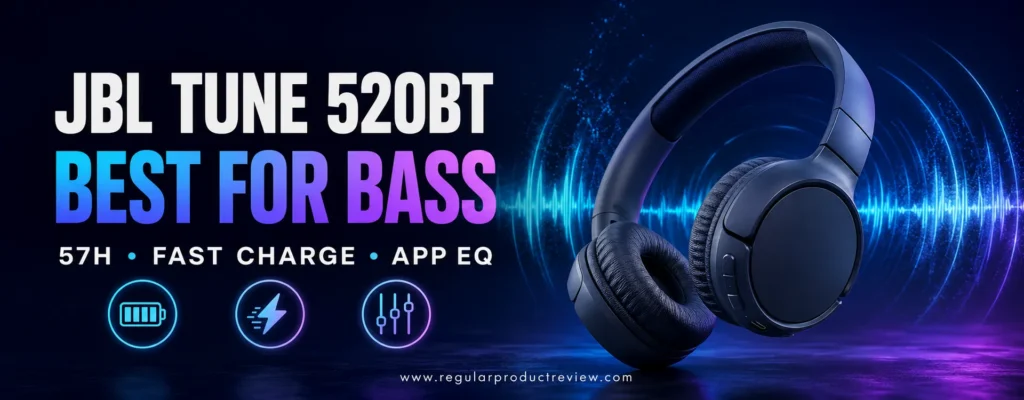
Unlike unfamiliar marketplace models that compete through exaggerated specifications, the Tune 520BT offers a mature app, accessible warranty support, clear documentation, and predictable physical controls. That ecosystem is part of the value. It does not make the headphone premium, but it reduces friction for users who want to adjust EQ, check settings, or find official support without hunting through generic manuals.
JBL Tune 520BT Key Specifications
| Specification | Detail |
|---|---|
| Style | Wireless on-ear, foldable |
| Drivers | 33mm dynamic |
| Bluetooth | Bluetooth 5.3 |
| Multipoint | Yes |
| Battery | Up to 57 hours |
| Full charge | About 2 hours |
| Quick charge | 5 minutes for up to 3 hours |
| Weight | 157g / 5.54oz |
| App | JBL Headphones app with EQ |
| Calls | One microphone, Voice Aware |
| Wired playback | No |
| ANC | No |
The official JBL Tune 520BT page documents the current sale price, 57-hour claim, quick charging, multipoint, Voice Aware, and app customization. Because the regular price exceeds $50, shoppers should treat it as a deal-based recommendation and wait when the promotion disappears.
Sound Character and EQ Strategy
“Pure Bass” is an accurate description of the intended personality. The Tune 520BT favors impact and warmth rather than strict neutrality. Modern pop and beat-driven music sound energetic, and low-volume listening retains a satisfying foundation. Dense recordings can become congested if bass is increased too aggressively in the app, so the best starting point is the default setting followed by small adjustments.
Podcasts and calls remain intelligible, but listeners who want a more relaxed or mid-focused presentation may prefer the Sony WH-CH520. The JBL app gives the Tune 520BT an advantage over products with fixed tuning, and it allows users to create a more balanced response without replacing the headphone. EQ cannot correct every acoustic limitation, but it can meaningfully improve tonality.
Voice Aware lets users hear more or less of their own voice during calls. This reduces the sealed-off feeling that can cause people to speak too loudly. The single built-in microphone is acceptable for a quiet room and routine mobile calls, but wind, café noise, and keyboard sounds can still compete with speech. For daily meetings in noisy environments, a boom-mic headset remains the safer tool.
Design, Travel, and Missing Wired Mode
At 157 grams, the Tune 520BT is lighter than most over-ear competitors. The earcups fold flat, and the padded headband helps distribute pressure. As with every on-ear model, long-session comfort varies. The cushions are soft, but the clamp may become noticeable for listeners with larger heads or glasses.
The most significant omission is a 3.5mm input. USB-C is for charging, not general wired audio. That means the headphone cannot connect to an analog airplane system and cannot continue playing when the battery is empty. Its long endurance makes that failure unlikely in ordinary use, but travelers should still know the limitation.
| Pros | Cons |
|---|---|
| Fun, powerful bass | Regular price is above the article limit |
| Excellent 57-hour battery claim | No 3.5mm wired playback |
| Fast charging and USB-C | No ANC |
| JBL app with useful EQ | On-ear fit may fatigue sensitive ears |
| Multipoint and modern Bluetooth | Single-mic calls weaken in noisy areas |
| Lightweight, foldable design | Bass emphasis is not neutral |
Expert Tip: If voices sound recessed, reduce the lowest EQ bands slightly instead of boosting treble sharply. Cutting excess bass often restores vocal clarity without making cymbals or consonants harsh.
Buy it if: You want recognizable JBL bass, long battery life, multipoint, and a well-developed app at a verified sub-$50 sale price.
Skip it if: You require analog audio, ANC, over-ear cushions, or neutral tuning without adjustment.
The Tune 520BT is a strong affordable option within our wireless headphones collection. Buyers focused on deeper isolation should instead explore noise-cancelling headphones under $200, where the jump in ANC performance is substantial.
Sony WH-CH520 Review: Best Lightweight Headphones for Calls
Award: Best Lightweight Choice for Calls and Daily Carry
Recommended Price: $49.99 or less
The Sony WH-CH520 is the refined everyday option in this roundup. Sony’s official US store listed it at $38 during our price check, although its regular $69.99 price sits above the article’s limit. At the promotional price, the combination of a 5.2-ounce on-ear design, up to 50 hours of battery life, multipoint, DSEE processing, customizable EQ, Google Fast Pair, Swift Pair, quick charging, and clear physical controls is difficult to ignore.
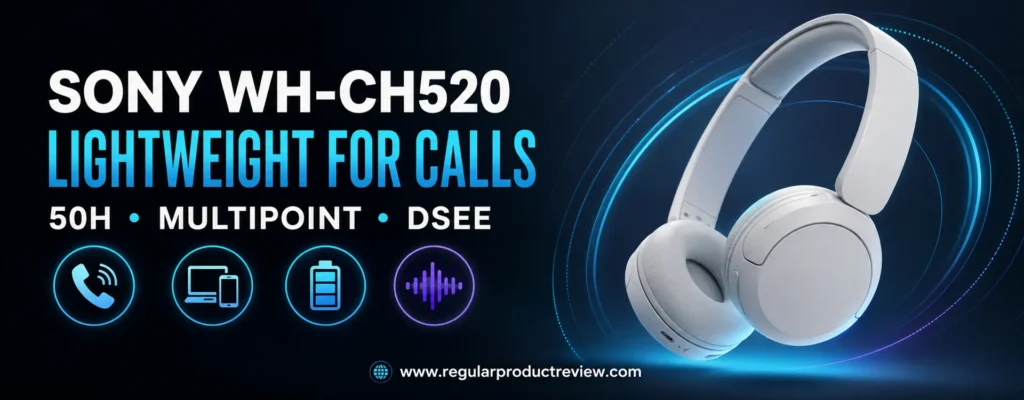
Sony has tuned the WH-CH520 for broad appeal rather than maximum bass impact. It still has low-frequency warmth, but vocals generally receive more space than they do on aggressively bass-forward budget models. The result suits podcasts, streaming, background music, and calls. Buyers who want heavier impact can increase bass through the Sony Sound Connect app, while those who favor speech can reduce the low end.
Sony WH-CH520 Key Specifications
| Specification | Detail |
|---|---|
| Style | Wireless on-ear |
| Weight | Approximately 5.2oz / 147g |
| Bluetooth | Bluetooth 5.2 |
| Multipoint | Yes |
| Battery | Up to 50 hours |
| Quick charge | 3 minutes for up to 90 minutes |
| App | Sony Sound Connect |
| Sound processing | DSEE |
| Pairing features | Google Fast Pair and Windows Swift Pair |
| Microphone | Built-in microphone with call noise reduction processing |
| Wired playback | No |
| ANC | No |
Sony documents the sale price, battery claim, multipoint, DSEE, app customization, and call features on the official WH-CH520 product page. The separate Sony WH-CH520 specifications confirm its closed on-ear design and approximately 5.2-ounce weight.
Call Quality and Productivity
No $50 Bluetooth headphone produces studio-grade voice, but the WH-CH520 is one of the more credible options for quiet rooms. Its microphone and processing keep speech understandable during routine calls, and multipoint allows the headphone to remain available to both a laptop and phone. That is useful for remote work, online classes, and people who frequently move between meetings and mobile calls.
Background noise remains a limitation. A nearby fan may be reduced, but traffic, wind, or overlapping café voices can still intrude. The microphone is integrated into an earcup, far from the mouth, so it lacks the consistent proximity of a boom mic. If calls dominate your day, a purpose-built headset from our gaming and communication headset section may produce more dependable speech than a music-first headphone.
Fast Pair helps Android users locate and reconnect the headphone, while Swift Pair reduces friction on compatible Windows computers. These convenience features rarely appear on a printed driver specification, yet they affect the ownership experience every day. Sony’s app also gives the product a more polished setup path than many inexpensive rivals.
Comfort, Battery, and Sound Trade-Offs
The WH-CH520’s extremely low weight is its defining comfort advantage. Soft pads and an adjustable headband reduce bulk, and the headphone is easy to wear around the neck. It does not fold inward as compactly as some rivals, so it occupies more bag space than its weight suggests. On-ear pressure can also create soreness during long sessions, especially with glasses.
The 50-hour claim is sufficient for several days of ordinary use, and a three-minute charge can provide up to 90 minutes in an emergency. There is no audio input, however. When the battery is empty, listening stops. Sony also omits ANC and a premium Bluetooth codec focus at this tier. DSEE attempts to restore some information lost in compressed music, but it cannot turn a low-bitrate source into lossless audio.
| Pros | Cons |
|---|---|
| Extremely light and easy to wear | Regular price exceeds $50 |
| Clear, adaptable everyday sound | No wired audio option |
| Useful call quality in quiet rooms | No ANC |
| Up to 50 hours plus quick charge | On-ear pressure varies by listener |
| Multipoint, Fast Pair, and Swift Pair | Not the most compact folding design |
| Strong app and EQ support | Busy environments challenge the microphone |
Editorial Price Alert: The WH-CH520 belongs in this guide only while it costs $49.99 or less. Do not pay its full $69.99 price merely because the model is familiar; the under-$100 market contains stronger over-ear alternatives.
Buy it if: You want lightweight comfort, mainstream app support, balanced daily sound, multipoint, and routine call reliability.
Skip it if: You need a cable, ANC, over-ear isolation, or guaranteed sub-$50 pricing every day.
Sony buyers comparing other price levels can start with our best wireless headphones guide. Shoppers who value isolation more than weight should study our noise-cancelling headphones category.
JLab Studio Pro Wireless Review: Best Over-Ear Comfort Under $50
Award: Best for Comfortable Over-Ear Listening
Recommended Price: $40.00
The JLab Studio Pro Wireless is an uncomplicated answer for listeners who dislike on-ear pressure. Its Form-Fit earcups surround the ears, while Cloud Foam cushions and a padded adjustable headband spread pressure across a larger area. JLab pairs that comfort-focused design with more than 50 hours of advertised playback, foldable earcups, physical controls, voice-assistant access, three onboard EQ modes, a built-in microphone, USB-C charging, a two-year limited warranty, and a stable $40 official price.
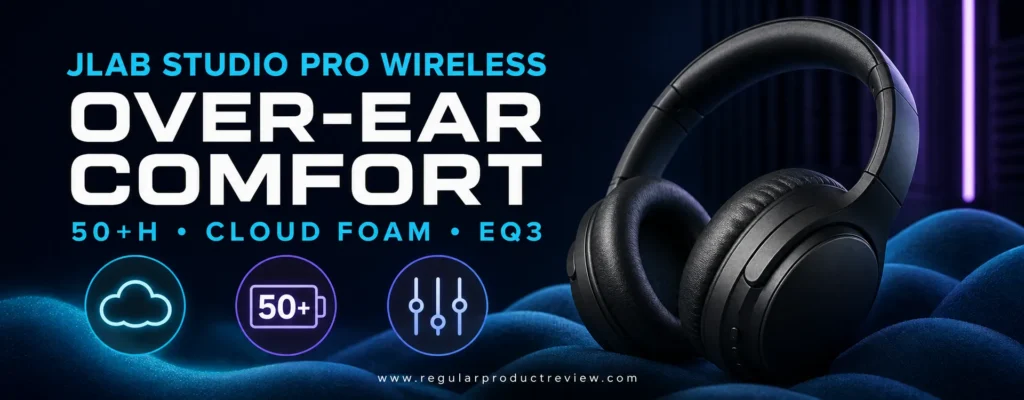
This model is not the ANC version. JLab also sells Studio Pro ANC variants at higher prices, and marketplace listings can combine their names. Confirm that the product page says Studio Pro Wireless and do not assume it includes active cancellation. Its over-ear pads provide passive isolation, which helps in a quiet office or bedroom but does not electronically suppress engines or air-conditioning hum.
JLab Studio Pro Wireless Key Specifications
| Specification | Detail |
|---|---|
| Style | Wireless over-ear, foldable |
| Battery | 50+ hours |
| EQ | JLab Signature, Balanced, Bass Boost |
| Comfort | Form-Fit earcups and Cloud Foam cushions |
| Controls | Physical earcup buttons |
| Microphone | One MEMS microphone with ENC/DNS processing |
| Charging | USB-C |
| Voice assistant | Supported |
| Wired playback | No listed analog input on this version |
| ANC | No |
| Warranty | Two-year limited warranty |
| Official price checked | $40.00 |
The official JLab Studio Pro Wireless page confirms the price, 50-plus-hour rating, Cloud Foam design, EQ3 modes, foldability, microphone arrangement, and two-year warranty.
Comfort Is the Main Upgrade
The Studio Pro’s greatest advantage is not a codec or a dramatic bass claim; it is physical space around the ears. Over-ear cushions can feel less pinching than on-ear pads, particularly during long study sessions or desk work. They may also retain more heat, and users with large ears can still experience contact with the inner fabric. A fit test remains important.
Cloud Foam is soft, but synthetic leather will age with sweat, oils, and heat. Wipe the cushions with a barely damp microfiber cloth and let them dry before storage. Do not saturate foam or use harsh cleaning chemicals. A little routine care can delay peeling and odor, common failure points for inexpensive headphones.
The folding chassis improves storage, although it introduces hinge points that deserve careful handling. Fold one side at a time and avoid grabbing the earcups when lifting the headphone from a bag. The materials do not feel luxurious, but the two-year warranty is stronger than the one-year coverage common in this category.
Three EQ Modes Without App Dependence
JLab’s EQ3 system cycles among Signature, Balanced, and Bass Boost modes directly from the controls. Signature is the lively default, Balanced reduces emphasis for speech and mixed genres, and Bass Boost adds weight for beat-driven music. The advantage is independence: there is no need to install an account-based app just to alter tonality. The disadvantage is limited precision. Users cannot shape individual frequency bands as they can in the JBL, Sony, soundcore, or Philips apps.
Sound is enjoyable rather than analytical. The Studio Pro works well for casual streaming, podcasts, and background music, but it is not the right choice for mixing or critical mastering despite the word “Studio” in its name. Buyers seeking detail, imaging, and tonal accuracy should use our audiophile headphones guide to understand what additional budget buys.
Its microphone is serviceable for calls from a quiet desk. JLab lists a single MEMS microphone with environmental-noise and DNS processing, but one distant mic cannot fully separate speech from a noisy room. A headset with a boom microphone remains better for customer support, streaming, or competitive multiplayer chat.
| Pros | Cons |
|---|---|
| Comfortable over-ear shape | No ANC |
| 50+ hours of battery life | No listed wired playback on the wireless version |
| Simple three-mode EQ | EQ is less precise than app-based controls |
| Foldable for storage | Synthetic cushions may become warm |
| Stable $40 official price | Microphone is best in quiet settings |
| Two-year limited warranty | Not intended for critical studio monitoring |
Expert Recommendation: Choose the Studio Pro Wireless when physical comfort matters more than advanced software. Its spacious pads and straightforward controls make it a better desk companion than many feature-heavy on-ear rivals.
Buy it if: You want an affordable over-ear fit, long battery life, easy EQ presets, and reassuring warranty coverage.
Skip it if: You need ANC, analog wired use, detailed EQ, water resistance, or a professional boom microphone.
The Studio Pro is one of the most practical entries in our budget headphones collection. If you can spend more for cancellation, compare it with the choices in best noise-cancelling headphones under $100.
Edifier W600BT Review: Best Simple Over-Ear Headphones with AUX
Award: Best Minimalist Over-Ear Design
Recommended Price: $49.99 or less
The Edifier W600BT is for buyers who want fewer layers between pairing and listening. It uses 40mm neodymium drivers, Bluetooth 5.1, an over-ear shape, soft pads, up to 30 hours of advertised playback, a built-in microphone, two-device connection, and an included 3.5mm cable. There is no ANC, elaborate spatial mode, or mandatory software. That simplicity can be refreshing for users who value reliable fundamentals.
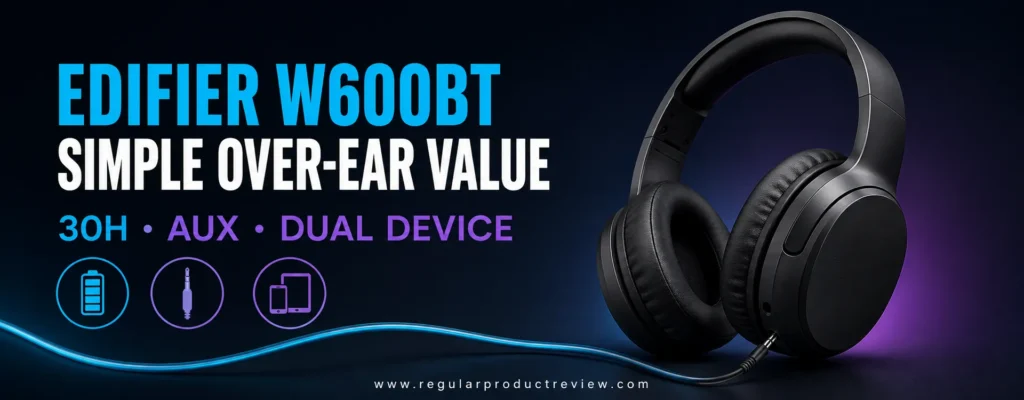
Edifier has a long history in affordable speakers and headphones, and the W600BT follows the company’s understated approach. Its matte finish looks more restrained than brightly branded budget alternatives. The design is appropriate for office calls, homework, television, podcasts, and casual music, provided that buyers accept the absence of more advanced customization.
Edifier W600BT Key Specifications
| Specification | Detail |
|---|---|
| Style | Wireless over-ear |
| Drivers | 40mm NdFeB dynamic |
| Bluetooth | Bluetooth 5.1 |
| Two-device connection | Yes |
| Battery | Up to 30 hours |
| Microphone | Built-in microphone |
| Wired mode | Yes, included 3.5mm cable |
| Ear pads | Soft over-ear pads |
| ANC | No |
| App EQ | Not a central feature of this model |
| Recommended maximum price | $49.99 |
The official Edifier W600BT page lists Bluetooth 5.1, 40mm drivers, 30-hour playback, dual-device support, the built-in microphone, and included analog cable.
Balanced Usability Instead of Feature Chasing
The W600BT’s 40mm drivers deliver a full-bodied presentation with enough low-end presence for mainstream music and video. Its tuning is not clinically neutral, but it avoids making one novelty feature the entire identity. Voices remain usable for podcasts, and the over-ear seal provides modest passive reduction of room noise.
The headphone’s analog cable is a major advantage over the Philips, JBL, Sony, and JLab models. Wired mode allows connection to desktops, older audio players, handheld consoles, and airplane systems. It also keeps the headphone useful when the battery is empty. Bluetooth microphones generally stop functioning through a basic stereo AUX cable, so do not assume wired mode preserves call control.
Dual-device connection serves a role similar to multipoint: it reduces manual pairing when moving between a phone and laptop. The exact handoff can depend on which source is actively playing and whether a call arrives. Pause one source before starting the other for the cleanest transition.
Battery, Comfort, and Ownership
Thirty hours is the shortest headband-headphone claim in this list, but it remains enough for several workdays. Battery figures beyond 50 hours are convenient, yet they do not matter if a headphone is uncomfortable or the tuning is wrong. The W600BT’s more modest endurance is acceptable because wired playback provides a fallback.
Soft over-ear pads are suitable for long sessions, although they can trap heat. Clamp force and earcup depth vary by head shape, and a large ear may contact the inner surface. The integrated design looks clean but appears less compact than folding on-ear models. This is better treated as a home, office, or backpack headphone than a pocketable travel accessory.
Price and retailer availability can vary. Buy from Edifier or an authorized seller, confirm that the package includes the audio cable, and verify the return policy. Avoid listings that call the W600BT “active noise cancelling”; Edifier’s official specification does not list ANC for this model.
| Pros | Cons |
|---|---|
| Comfortable over-ear design | Only 30-hour claim versus longer rivals |
| 40mm drivers and enjoyable everyday sound | No ANC |
| Bluetooth plus 3.5mm wired mode | Limited sound customization |
| Connects with two devices | Not highly compact |
| Simple, understated styling | Pads can become warm |
| Wired fallback extends practical life | Availability differs across retailers |
Editorial Insight: A 3.5mm jack is still valuable. It makes a budget headphone compatible with more sources, removes latency for video editing or casual gaming, and prevents an empty battery from ending a listening session.
Buy it if: You want a straightforward over-ear headphone with wired backup, dual-device support, and no app dependence.
Skip it if: You need ANC, highly customizable EQ, maximum portability, or the longest available battery.
The W600BT offers a clean alternative to feature-heavy wireless headphones. For a more sound-focused step up, explore our best audiophile headphones under $200.
OneOdio A70 Review: Best Wireless Headphones for DJ and Wired Flexibility
Award: Best for Bluetooth, Studio, and DJ Connections
Recommended Price: $49.99 or less
The OneOdio A70, also marketed as the Fusion A70, stands apart through connection flexibility. It supports Bluetooth 5.2, a standard 3.5mm connection, a 6.35mm studio/DJ connection through its included dual-duty cable, Shareport audio sharing, 40mm drivers, a foldable over-ear chassis, and up to 72 hours of advertised wireless playback. OneOdio listed the A70 at $44.99 during our review, with a regular price of $49.99.
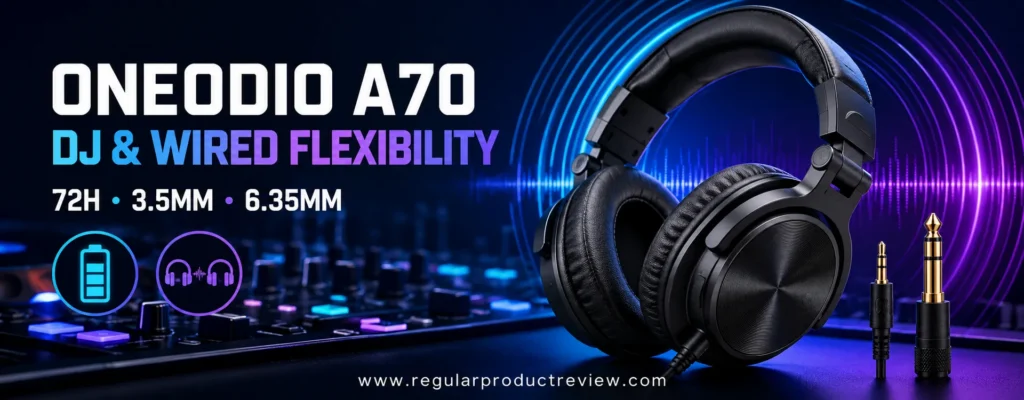
This is the strongest choice for someone who moves between a phone, laptop, audio interface, digital piano, mixer, and home stereo. Most inexpensive Bluetooth headphones treat wired mode as an emergency backup; the A70 makes it part of the product’s identity. That does not make it a professional reference monitor, but it broadens compatibility beyond normal consumer listening.
OneOdio A70 Key Specifications
| Specification | Detail |
|---|---|
| Style | Wireless over-ear, foldable |
| Drivers | 40mm dynamic |
| Bluetooth | Bluetooth 5.2 |
| Battery | Up to 72 hours |
| Analog connections | 3.5mm and 6.35mm |
| Shareport | Yes, for sharing audio with another headphone |
| Frequency response | Manufacturer-listed 20Hz–40kHz |
| Impedance | 32 ohms |
| Included cables | 3.5mm inline-mic cable and dual-duty coiled cable |
| ANC | No |
| Warranty | Two years listed by OneOdio |
| Official price checked | $44.99 |
The official OneOdio A70 page confirms the $44.99 sale price, 72-hour playtime, Bluetooth and wired connections, 40mm drivers, Shareport, included cables, and two-year warranty.
Why the Two-Cable System Matters
The included 3.5mm cable connects to ordinary phones with a headphone jack, laptops, controllers, and portable players. The coiled 6.35mm/3.5mm cable is more useful around studio interfaces, keyboards, amplifiers, and DJ equipment. A coiled section provides reach without leaving the full cable loose on a desk.
Wired playback removes Bluetooth codec delay, making it preferable for timing-sensitive instrument practice, basic monitoring, and video work. It also bypasses the internal battery. The A70’s high advertised frequency-response ceiling should not be interpreted as proof of accurate sound; a 40kHz number is outside normal adult hearing and says little about how evenly the audible range is reproduced.
Shareport allows another wired headphone to connect and receive the same audio, useful for watching a movie or previewing a track together. It is a niche feature, but unlike many software extras, it solves a clear problem without requiring an app.
Sound, Comfort, and DJ Expectations
The A70 favors a lively, bass-presenting sound suitable for casual DJ cueing, electronic music, movies, and everyday playback. It is not a calibrated studio monitor. Mixing decisions made on any single budget headphone should be checked on speakers and other headphones because peaks or dips in the tuning can hide problems in a recording.
Large over-ear pads improve isolation relative to on-ear models, but there is no ANC. The substantial earcups and folding hardware add bulk. Padding can support longer sessions, although heat buildup and clamp force depend on the wearer. Rotating joints are convenient for single-ear monitoring but create more moving parts than a minimalist design.
The battery claim is excellent, and wired mode ensures that the headphone remains functional after depletion. OneOdio lists a two-year warranty and 30-day trial, useful assurances at this price. Confirm these terms on the seller used for purchase because marketplace coverage may differ from buying direct.
| Pros | Cons |
|---|---|
| 3.5mm and 6.35mm wired compatibility | Larger and heavier than on-ear picks |
| Up to 72 hours of wireless playback | No ANC |
| Useful Shareport audio sharing | Tuning is not reference-neutral |
| Foldable over-ear design | More hinges and moving parts |
| Included studio-friendly cables | Wireless microphone is only routine quality |
| Strong value at $44.99–$49.99 | Specification numbers do not guarantee accuracy |
Expert Tip: Use Bluetooth for convenience and the wired cable for instrument practice, DJ cueing, or any task where timing matters. Wired mode is the A70’s most important advantage—not merely an accessory in the box.
Buy it if: You need one affordable headphone for Bluetooth listening, 3.5mm devices, 6.35mm equipment, and shared audio.
Skip it if: You want compact portability, true neutral monitoring, ANC, or the lightest possible fit.
The A70 is a versatile bridge between our budget headphone recommendations and more specialized audiophile headphones. Gamers who need a boom mic should instead compare gaming headsets under $100.
OneOdio Focus A5 Review: Best Noise-Cancelling Headphones Under $50 on Sale
Award: Best Sale-Price ANC Value
Recommended Price: $49.99 or less
The OneOdio Focus A5 is the most ambitious headphone in this guide. At the $49.99 promotional price observed during our review, it combines hybrid active noise cancellation, a transparency mode, Bluetooth 5.4, LDAC support, 40mm drivers, multipoint pairing, and a battery claim of up to 75 hours with ANC switched off. Those features normally belong to a more expensive tier, which is precisely why the price condition matters.

This is not our unconditional best overall pick. Its standard price can sit above the article’s ceiling, and discount availability can change without notice. The Focus A5 earns a place because it gives price-conscious commuters a credible way to obtain wireless headphones with active noise cancellation under $50 when the right sale appears. Readers who cannot find it at or below $49.99 should choose a non-ANC model in this guide or compare our noise-cancelling headphones under $100.
OneOdio Focus A5 Key Specifications
| Specification | Detail |
|---|---|
| Style | Wireless over-ear |
| Drivers | 40mm dynamic |
| Bluetooth | Bluetooth 5.4 |
| Noise control | Hybrid ANC and transparency mode |
| Claimed ANC depth | Up to 45dB under manufacturer conditions |
| Codec highlight | LDAC support on compatible devices |
| Battery | Up to 75 hours with ANC off; up to 45 hours with ANC on |
| Quick charge | 10 minutes for up to 10 hours |
| Multipoint | Yes |
| Approximate weight | 9.3 ounces |
| Analog audio | No 3.5mm input listed on the reviewed configuration |
| Price checked | $49.99 promotional price |
OneOdio’s official Focus A5 product page lists the sale price, hybrid ANC, transparency mode, LDAC, 40mm drivers, long battery life, fast charging, Bluetooth 5.4, and adaptive noise-control features. Retail packaging and firmware can change, so verify the current listing before checkout.
How Useful Is the Focus A5’s ANC?
Budget ANC is best at reducing steady low-frequency sounds such as bus engines, aircraft-cabin rumble, air conditioners, and ventilation systems. It is less effective against nearby speech, keyboard clicks, dishes, and sudden high-frequency sounds. The Focus A5 follows that pattern: activating ANC can make a commute or study session feel calmer, but it does not create silence.
The advertised “up to 45dB” figure is a laboratory-style maximum, not a promise that every frequency will be reduced by that amount. Fit, glasses, hair, head shape, seal, firmware, and the noise itself all influence results. That nuance is important because a large dB number can look more definitive than it really is.
Transparency mode uses the microphones to pass environmental sound through. It is useful when ordering coffee, listening for an announcement, or walking through a station. It should not replace situational awareness near traffic, and the processed sound may feel less natural than simply removing an earcup.
LDAC, Sound Quality, and Connection Priorities
LDAC can carry a higher Bluetooth data rate from compatible Android phones than the basic SBC codec, but a codec is only one part of audio quality. The recording, streaming setting, driver tuning, ear-pad seal, and hearing all matter. iPhones do not transmit LDAC, so Apple users should not buy the Focus A5 solely for that badge.
The tuning is energetic rather than studio-neutral. Bass has enough presence for commuting and pop music, while app-based or source EQ can help users who want a cleaner midrange. The stronger reason to choose this model is its package of ANC, battery life, and connectivity—not a promise that it will outperform every wired audiophile headphone.
Multipoint is valuable for hybrid work because the headset can remain connected to a laptop and phone. As with many Bluetooth devices, switching behavior can vary by app and operating system. If an online meeting is mission-critical, join a few minutes early and confirm that the correct microphone and output are selected.
Comfort, Battery, and Ownership Trade-Offs
The over-ear fit distributes pressure across larger pads, but the approximately 9.3-ounce body is heavier than the Sony WH-CH520 and JBL Tune 520BT. ANC electronics, larger cups, and padding explain some of that difference. People sensitive to heat may prefer a lighter on-ear model for long indoor sessions.
Up to 75 hours with ANC off and up to 45 hours with it active are strong manufacturer claims. Real runtime will decline at louder volumes and may vary with LDAC, calls, temperature, and switching between noise modes. The 10-minute quick-charge claim is especially practical for travel, although it assumes a suitable power source and a healthy battery.
| Pros | Cons |
|---|---|
| Hybrid ANC at a qualifying sale price | Regular price may exceed $50 |
| Transparency mode for short interactions | ANC cannot eliminate voices or sudden sounds |
| LDAC on compatible Android devices | LDAC is not supported by iPhone |
| Long battery claims with fast charging | Heavier than the lightest on-ear picks |
| Bluetooth 5.4 and multipoint | Sound is consumer-tuned, not reference-neutral |
| Strong commuter feature set | Current stock and discounts can fluctuate |
Price Alert: The Focus A5 belongs in this article only at $49.99 or less before tax and optional protection plans. Do not stretch the budget merely because a countdown timer labels a higher price as a deal.
Buy it if: You find the verified Focus A5 at $49.99 or less and want ANC, transparency, LDAC, and long battery life in one over-ear design.
Skip it if: The price exceeds $50, you need an ultralight headset, or you expect premium-class silence and microphone performance.
For more context on realistic ANC benefits, visit our noise-cancelling headphone guide and best noise-cancelling headphones roundup.
Belkin SoundForm Mini Review: Best Wireless Headphones Under $50 for Kids
Award: Best for Children, School, and Family Travel
Recommended Price: $32.99 or less
The Belkin SoundForm Mini is the specialist choice in this list. It is designed for children aged three and older, limits maximum output to 85dB, provides up to 30 hours of advertised battery life, includes a microphone, supports USB-C fast charging, and comes with a 3.5mm cable for wired devices. Belkin listed it at $32.99 when checked.
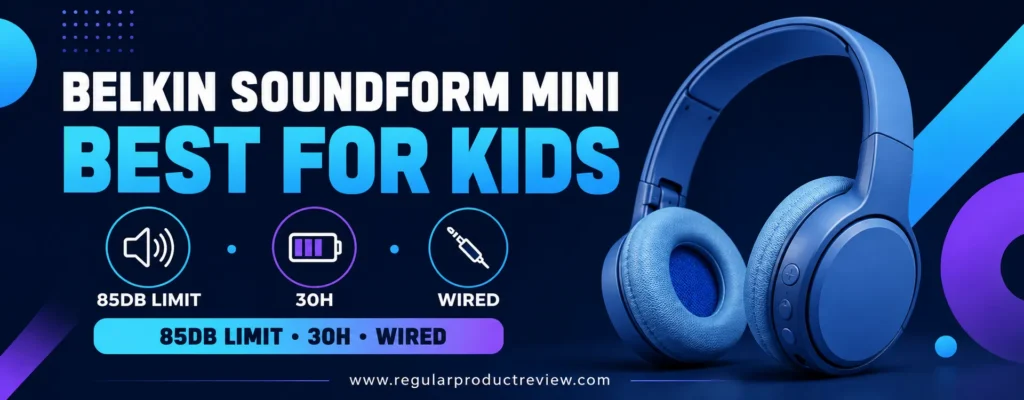
Children’s headphones should not be treated as scaled-down adult models. Fit, simple controls, durability, a manageable loudness ceiling, and compatibility with school equipment are more important than exaggerated bass or codec marketing. The SoundForm Mini addresses those priorities without forcing a parent to spend close to the full $50 budget.
Belkin SoundForm Mini Key Specifications
| Specification | Detail |
|---|---|
| Intended user | Children aged 3+ |
| Style | Wireless on-ear |
| Volume limit | 85dB maximum output claim |
| Battery | Up to 30 hours |
| Quick charge | 10 minutes for up to 3 hours |
| Charging | USB-C |
| Wired mode | Included 3.5mm cable |
| Microphone | Built in |
| Durability | Manufacturer tested for more than 3,000 uses |
| Controls | Child-friendly physical controls |
| Warranty | Two years |
| Official price checked | $32.99 |
The official Belkin SoundForm Mini page confirms the 85dB limit, 30-hour battery claim, microphone, USB-C charging, wired cable, durability testing, age guidance, and two-year warranty.
Why an 85dB Limit Helps: but Does Not Replace Supervision
A hardware volume ceiling reduces the risk that a child accidentally drives the headphone as loudly as a typical unrestricted adult model. It is a useful guardrail, not a guarantee of risk-free listening. Duration still matters, the source device may behave differently in wired mode, and the child should be able to hear a parent or teacher when necessary.
The World Health Organization’s safe-listening guidance recommends keeping personal-device volume below 60% of maximum and taking listening breaks. The National Institute on Deafness and Other Communication Disorders also explains that long or repeated exposure to sound at or above 85dBA can contribute to hearing damage. Parents should therefore combine the SoundForm Mini’s cap with reasonable session limits.
School, Tablet, and Travel Practicality
Bluetooth is convenient for a family tablet, phone, or modern laptop. The included 3.5mm cable expands compatibility to classroom Chromebooks, airplane entertainment systems, handheld players, and devices where Bluetooth is disabled. Wired support also prevents a forgotten charge from interrupting a lesson.
The built-in microphone is suitable for classroom calls and conversations in a reasonably quiet room. It cannot match a directional boom microphone, especially when siblings, fans, or televisions are audible nearby. Parents should test the microphone with the exact learning platform before an important remote class.
Belkin says the design has been tested for more than 3,000 uses, an encouraging durability claim for a product that may be folded into backpacks. No inexpensive plastic headphone is indestructible. Teaching a child to remove it with two hands, store it without crushing the headband, and unplug by gripping the connector can materially extend its life.
Comfort depends on head size. The on-ear cups are compact and child-oriented, but sensitive users may need breaks during long sessions. The colorful options make ownership more personal and reduce mix-ups when siblings use different pairs.
| Pros | Cons |
|---|---|
| 85dB volume-limiting design | Designed for children, not larger adult heads |
| Up to 30 hours of battery life | On-ear pressure can require breaks |
| Bluetooth and included 3.5mm cable | Microphone is basic in noisy rooms |
| USB-C quick charging | No ANC |
| Simple controls and multiple colors | A volume cap does not remove duration risk |
| Two-year warranty from an established brand | Wired-mode behavior should be supervised |
Expert Tip for Parents: Set a comfortable device-volume limit, schedule listening breaks, and periodically ask whether the child hears ringing or muffled sound. A safe-listening habit is more valuable than any single specification.
Buy it if: You need a child-size wireless headphone for school, travel, videos, and calls with a clear loudness safeguard.
Skip it if: The intended listener is an adult, needs over-ear isolation, or requires a high-quality boom microphone for noisy classes.
Families comparing lower-cost choices can browse our budget headphones category and best budget headphones under $50. Adults seeking a broader fit should start with our wireless headphones under $100.
Koss BT232i Review: Best Clip-On Wireless Headphones for Walking and Workouts
Award: Best Open, Sweat-Resistant Sports Alternative
Recommended Price: $34.99 or less
The Koss BT232i challenges the assumption that every affordable wireless headphone must use a headband. Its lightweight SportClip design rests around the ear, the small cushions sit near the ear opening, and a cable joins the two sides behind the neck. Koss lists sweat resistance, an inline microphone and remote, USB-C charging, three cushion sizes, and more than 18 hours of battery life for $34.99.
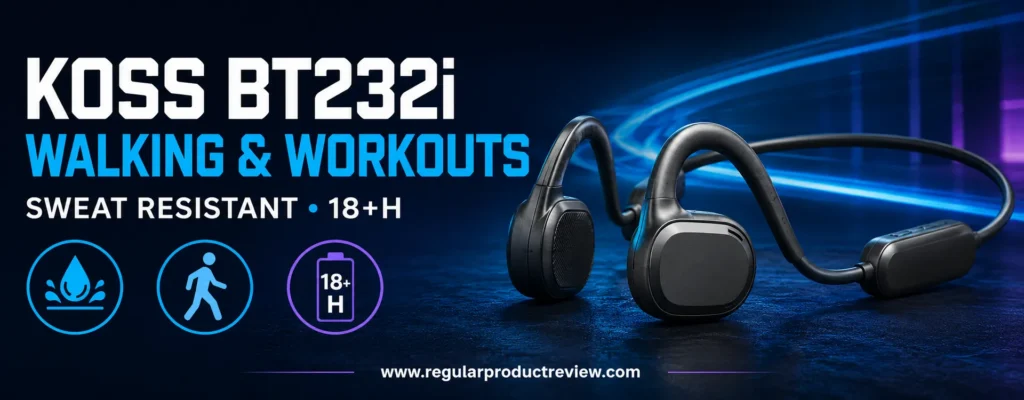
This design is appealing for walking, light workouts, warehouse shifts, gardening, and users who dislike a band across their hair. It does not isolate like a sealed over-ear headphone, which can be an advantage when environmental awareness matters. That same openness makes it a poor choice for aircraft cabins, loud gyms, and listeners who want powerful sub-bass.
Koss BT232i Key Specifications
| Specification | Detail |
|---|---|
| Style | Wireless ear-clip with behind-neck cable |
| Battery | More than 18 hours listed on the current product page |
| Charging | USB-C |
| Sweat resistance | Yes; no submersion rating listed |
| Controls | Inline remote and microphone |
| Fit options | Three cushion sizes |
| Frequency response | Manufacturer-listed 18Hz–20kHz |
| Sensitivity | Manufacturer-listed 104dB SPL |
| ANC | No |
| Warranty | One-year limited warranty |
| Official price checked | $34.99 |
The official Koss BT232i product page lists the current $34.99 price, 18-plus-hour battery claim, USB-C connection, SportClip fit, sweat resistance, inline controls, included cushion sizes, and warranty details.
Open Fit, Awareness, and Workout Use
The clips help stabilize the earpieces without squeezing the crown of the head. Because the design does not form a deep acoustic seal, outside sounds remain more audible than with closed over-ear headphones. That can help during a walk on a shared path, but the user must still lower volume, look around, and follow local safety rules near roads and bicycles.
Sweat resistance makes the BT232i better suited to exercise than ordinary padded headphones, yet Koss does not present it as a swimming product. Wipe the cushions and cable after use, allow the unit to dry before charging, and avoid exposing the USB-C port to moisture. Sweat resistance should never be interpreted as permission to rinse electronics under a tap.
The compact fit also avoids heat buildup around the entire ear. People who wear glasses may find clips either more comfortable or more awkward depending on frame thickness, so the return policy matters. Trying all three cushion sizes can improve stability and bass response.
Sound, Calls, and Battery Reality
The BT232i prioritizes mobility and awareness over deep isolation. Vocals, podcasts, and casual playlists are its natural territory. Bass will not feel as weighty as it does through a sealed 40mm over-ear model, particularly outdoors where ambient noise masks low frequencies. Raising volume to overpower a loud environment defeats the safety advantage; use a closed design in places where isolation is essential.
The inline microphone places controls within reach and is adequate for quick calls. Cable movement can transmit noise, and outdoor wind may reduce clarity. The current official page prominently lists more than 18 hours of playtime, enough for several workouts, though actual results depend on volume, calls, and battery age.
| Pros | Cons |
|---|---|
| Stable clip-on design without a headband | Limited isolation in noisy places |
| Sweat-resistant construction | Less deep bass than sealed over-ear models |
| More than 18 hours of claimed battery | Behind-neck cable may rub clothing |
| USB-C charging and inline controls | No ANC or app EQ |
| Three cushion sizes | Glasses can affect comfort |
| Useful environmental awareness | Not intended for swimming |
Safety Note: Awareness-friendly headphones do not make traffic predictable. Keep the level moderate, pause audio at crossings, and never let music replace visual attention.
Buy it if: You want a compact, sweat-resistant wireless option for walks, light exercise, podcasts, and users who dislike headbands.
Skip it if: You need strong isolation, cinematic bass, premium call quality, or an over-ear fit for travel.
The BT232i fills a different role from the conventional models in our wireless headphone collection. For enclosed headsets and dedicated microphones, compare our gaming headset guide and best gaming headsets under $100.
How to Choose Wireless Headphones Under $50 Without Buying Twice
The best low-cost headphone is not necessarily the one with the longest feature list. It is the one whose compromises match the way you listen. A student commuting by bus, a child attending online lessons, a pianist practicing at night, and an office worker switching between two devices need different designs. This buying guide turns the specifications into practical decisions.
Readers who want a wider market view can first explore our wireless headphones guide and best wireless headphones. Those pages include models beyond the strict $50 ceiling used here.
Start With the Wearing Style, Not the Brand
Over-ear headphones surround the ear with a larger pad. They usually provide fuller bass, more passive isolation, and better pressure distribution, but they occupy more bag space and can feel warm. JLab Studio Pro, Edifier W600BT, OneOdio A70, and Focus A5 fit this group.
On-ear headphones rest directly on the outer ear. Philips TAH4209, soundcore H30i, JBL Tune 520BT, and Sony WH-CH520 are lighter and easier to pack, but clamp and pad pressure become more noticeable during long sessions. A model that feels comfortable for 20 minutes may not remain comfortable through a three-hour study block.
Clip-on headphones avoid the headband and permit more outside sound. The Koss BT232i is useful for activity and awareness, but it cannot match the isolation or low-bass impact of a sealed over-ear model.
Children’s headphones should fit smaller heads, have understandable controls, and include loudness safeguards. The Belkin SoundForm Mini is chosen for that use, not because it produces the largest soundstage.
Fit Rule: If possible, buy from a seller with a straightforward return window. Head shape, glasses, earrings, hair, and sensitivity make comfort more personal than battery life or Bluetooth version.
Decide Whether Active Noise Cancellation Is Actually Necessary
Passive isolation comes from the ear pads and physical seal. Active noise cancellation uses microphones and signal processing to reduce selected external sounds. At this budget, ANC is most effective against steady rumbles and less effective against speech or sharp, changing noises.
If you study in a quiet bedroom, a comfortable closed over-ear model may be smarter than a discounted ANC model with weaker fit. If you commute daily on a bus or train, the OneOdio Focus A5 can be worth choosing when it remains below $50. Compare expectations with our noise-cancelling headphones category and best ANC headphones under $100.
ANC can also support safer listening by reducing the urge to overpower background noise with volume. It does not make high playback levels harmless. Some users feel cabin pressure or discomfort when ANC is active; transparency or normal mode should remain available.
Treat Battery Claims as Maximums, Not Schedules
Manufacturers test battery life under controlled conditions. Higher volume, frequent calls, colder weather, ANC, premium codecs, and an aging cell reduce runtime. A 50-hour claim does not mean every owner will receive exactly 50 hours.
For most people, 30 hours is already enough for several days. Quick charging can matter more than the difference between 55 and 70 hours. The Sony WH-CH520’s three-minute boost, JBL’s five-minute boost, and Focus A5’s longer rapid-charge claim can rescue a commute after a forgotten overnight charge.
Battery longevity is also an ownership issue. Heat and remaining at 0% for extended periods can accelerate wear. Charge with a reputable USB power source, keep moisture away from the port, and avoid leaving the headphone in a hot car.
Understand Bluetooth Versions, Codecs, and Multipoint
A newer Bluetooth version can improve power management and connection features, but the version number alone does not determine sound quality. Both the source and headphone must support a feature, and implementation matters. A stable Bluetooth 5.2 product can be more enjoyable than a poorly tuned Bluetooth 5.4 product.
The default SBC codec is widely compatible. AAC is common across Apple devices, while LDAC is an optional higher-bitrate codec associated with compatible Android hardware. High-bitrate streaming can consume more power and may be less stable in congested environments. It also cannot repair a low-quality source file or poor driver tuning.
Multipoint Bluetooth allows simultaneous connection to two source devices. It is excellent for moving between a work laptop and phone, although “simultaneous” usually means connected to both rather than playing two streams at once. Video, conferencing software, and phone calls can also fight for audio focus. Test the workflow before relying on it for a presentation.
Choose Wired Backup When Compatibility or Latency Matters
Bluetooth delay varies by phone, app, codec, and headphone. Video apps often compensate automatically; instruments, rhythm games, and live monitoring cannot always do so. Edifier W600BT and OneOdio A70 provide useful analog fallback, while the Belkin cable increases school-device compatibility.
A wired connection can keep the headphone useful when the battery is empty and may extend its service life after the internal cell loses capacity. Check whether the microphone works through the supplied cable; some analog cables carry audio only, while others include a mic and remote.
For competitive play and voice chat, a dedicated boom mic and predictable platform compatibility matter more than ordinary Bluetooth. Our gaming headset category and best gaming headsets address that separate use case.
Evaluate Microphones With Realistic Expectations
Sub-$50 headphones generally use small microphones built into an earcup or inline module. They can handle calls in a quiet room, but distance from the mouth and limited noise processing make voices thinner than through a good boom mic. Wind, fans, keyboards, and nearby speech are common problems.
Do not judge call quality from terms such as “ENC,” “AI,” or “clear calls” alone. Those labels describe processing goals, not a standardized performance level. Record a voice memo, call a friend, and test the meeting app you actually use. Laptop input settings sometimes remain assigned to the built-in microphone even after headphones connect.
Use Driver Size Carefully
Many models here use 30mm or 40mm dynamic drivers. A larger diameter can move more air, but it does not guarantee better bass, detail, imaging, or loudness. Enclosure design, damping, tuning, pad seal, amplifier behavior, and quality control all contribute.
Likewise, an extended frequency-response number does not demonstrate accuracy. Human hearing is usually discussed within approximately 20Hz to 20kHz, and hearing at the upper end commonly decreases with age. Focus on tonal balance, distortion, fit, and whether an app offers useful EQ.
Inspect Build Quality and Replacement Risk
Budget headphones usually use plastic hinges and synthetic ear-pad coverings. These materials can last for years when handled carefully, but pads will eventually compress or peel. Before buying, search for replacement pads, check whether the headband folds, and inspect where the charging port and buttons are placed.
A two-year warranty, as offered on several picks, is meaningful only when the seller is authorized and the buyer keeps proof of purchase. The FTC’s guide to federal warranty law explains important US warranty principles, but specific coverage still depends on the written warranty and seller. Marketplace descriptions should never override official terms.
Set a True $50 Checkout Limit
This guide defines the price as the headphone itself before sales tax. Shipping, required memberships, optional insurance, and imported-seller fees can erase the value. If a model costs $59.99 and comes with a coupon that cannot be applied to your account, it is not under $50 for you.
Sale prices also create false urgency. Compare the final cart price, return period, seller identity, warranty, and color-specific pricing. If a promotion ends, wait or choose another model rather than turning a $50 article into a $70 purchase.
A Simple Pre-Purchase Checklist
- Confirm that the final product price is $49.99 or less.
- Choose over-ear, on-ear, clip-on, or child-size fit deliberately.
- Verify whether ANC, multipoint, wired playback, and app EQ are truly included.
- Check the charging connector and whether a cable is supplied.
- Read the official warranty and authorized-seller conditions.
- Look for a return window that allows a genuine comfort test.
- Confirm the microphone works with the intended phone, PC, console, or meeting app.
- Treat battery, ANC-depth, and frequency-response figures as manufacturer claims.
- Check replacement-pad availability if long ownership matters.
- Keep volume moderate and take listening breaks.
Expert Recommendation: Spend first on fit and the one feature you will use every day. Battery, codec, and app extras cannot rescue a headphone that hurts after half an hour.
Wireless Headphones Under $50 Compared by Real-World Use Case
Specifications become useful only when connected to a task. The following comparisons identify which model makes the most sense for commuting, studying, calls, wired equipment, children, exercise, and long ownership. For additional choices above this ceiling, see our best wireless headphones under $100 and broader budget headphone guide.
Best Picks by Listening Priority
| Priority | Best Match | Why It Leads | Important Limitation |
|---|---|---|---|
| Best overall balance | Philips TAH4209 | 55-hour battery, multipoint, app EQ, low-lag mode, foldable fit | No ANC or wired mode |
| Longest simple battery | soundcore H30i | Up to 70 hours, app EQ, multipoint, AUX | US direct stock can be inconsistent |
| Bass and app control | JBL Tune 520BT | JBL Pure Bass, strong app, 57 hours, multipoint | Must be on sale under $50 |
| Lightweight calls | Sony WH-CH520 | Approximately 5.2 ounces, DSEE, app tools, multipoint | No wired mode or ANC |
| Over-ear comfort | JLab Studio Pro Wireless | Cloud Foam cups, 50-plus hours, EQ3 | No app or analog input |
| Simple wired fallback | Edifier W600BT | Bluetooth, dual-device connection, included 3.5mm cable | 30-hour claim trails leaders |
| Studio/DJ flexibility | OneOdio A70 | 3.5mm, 6.35mm, Shareport, 72-hour claim | Bulky and not reference-neutral |
| ANC on promotion | OneOdio Focus A5 | Hybrid ANC, transparency, LDAC, multipoint | Qualifies only at $49.99 or less |
| Children and school | Belkin SoundForm Mini | 85dB limit, child fit, cable, 30 hours | Not designed for adult heads |
| Walking and workouts | Koss BT232i | Sweat-resistant clip design and awareness-friendly fit | Weak isolation and lighter bass |
Best for Commuting and Public Transport
Choose the OneOdio Focus A5 if it is on sale and the route includes steady engine or rail noise. Hybrid ANC and transparency make it the only true noise-control specialist here. Choose the Philips TAH4209 when portability, app EQ, and predictable under-$50 value matter more than ANC.
The Koss BT232i is not ideal inside a loud bus because its open fit encourages volume increases. Conversely, its environmental awareness can make more sense for the walk between the station and home. Different stages of one commute can demand opposing designs.
Best for Work, Study, and Video Calls
The Sony WH-CH520 is easy to wear and switch between a laptop and phone, while app features and Voice Pickup processing support everyday calls. The JLab Studio Pro Wireless provides a roomier over-ear fit for focused work and avoids app dependence through hardware EQ presets.
None should be mistaken for an enterprise call-center headset. If microphone intelligibility is the central requirement, a wired USB headset with a boom mic may outperform all ten options. Background noise and room acoustics often matter more than branded microphone processing.
Best for Travel and Long Battery Life
The soundcore H30i, OneOdio A70, and Focus A5 publish the largest maximum battery claims in this group. The H30i is easier to pack, the A70 supports more wired sources, and the Focus A5 reduces steady travel noise. JBL and Philips sit close behind with smaller, foldable on-ear designs.
For aircraft entertainment, prioritize an analog cable. Bluetooth may not connect to the seat system without an adapter. The A70, W600BT, and SoundForm Mini provide direct wired options, although the Belkin is child-sized.
Best for Music, Bass, and Personal EQ
The JBL Tune 520BT is the natural choice for energetic bass and a mature companion app. The Philips TAH4209 adds a Dynamic Bass control and custom app tuning. The soundcore H30i also offers app EQ and a bass-forward presentation.
Listeners seeking neutrality should not assume that a budget wireless model will function as a reference monitor. The wired A70 increases connection flexibility, but its entertaining tuning remains different from a calibrated studio tool. Our audiophile headphone category and best audiophile headphones under $200 cover the next step toward sound-first products.
Best for Children, Exercise, and Shared Devices
The Belkin SoundForm Mini is the only pick deliberately built around a child’s fit and 85dB maximum-output claim. Its cable is valuable in school environments. The Koss BT232i is the exercise-oriented alternative because clips resist movement, sweat resistance addresses workouts, and its less-isolating design allows greater awareness.
The OneOdio A70 wins for sharing and unusual devices. Shareport sends the audio to a second wired headphone, and its 6.35mm connection works with equipment that ordinary Bluetooth models cannot serve.
What Changes When the Budget Reaches $100?
Moving from $50 to $100 can bring more consistent ANC, improved microphones, stronger hinges, better pads, broader codec support, or a more polished app. It does not guarantee all of those improvements in one product. A well-chosen $40 model can still be the better purchase for simple home use.
Upgrade only when you can name the limitation being solved: stronger commuter ANC, a clearer boom mic, larger adult over-ear cups, replaceable parts, or a specific codec. Our noise-cancelling headphones under $100 and gaming headsets under $100 make those trade-offs easier to examine.
Editorial Insight: There is no universal winner because “best” changes with fit, source device, noise level, and the task. The Philips is our broad recommendation; the other nine exist because a specialist can be better for a specific listener.
Frequently Asked Questions and Final Verdict on the Best Wireless Headphones Under $50
This final section answers the questions that most often decide whether an affordable wireless headphone becomes a satisfying purchase or a quick return. Readers who want to keep comparing can visit our best budget headphones under $50 and best wireless headphones under $100.
Frequently Asked Questions
What are the best wireless headphones under $50 overall?
The Philips TAH4209 is our best overall recommendation because it balances an official under-$50 price with up to 55 hours of battery life, Bluetooth 5.3, multipoint pairing, app EQ, Dynamic Bass, a low-lag mode, and a compact folding design. The soundcore H30i is a stronger battery-first alternative when available, while the JBL Tune 520BT is excellent for bass fans at its qualifying sale price.
Can wireless headphones under $50 sound good?
Yes. Affordable models can deliver enjoyable bass, clear vocals, sufficient detail for streaming, and useful EQ. Their compromises usually appear in pad materials, microphone consistency, refinement, spatial precision, ANC strength, or long-term repairability. Good sound at this price means a well-balanced experience for the intended listener, not identical performance to a premium studio or audiophile headphone.
Which sub-$50 wireless headphone has the best battery life?
Among our picks, the OneOdio Focus A5 advertises up to 75 hours with ANC off, the OneOdio A70 lists up to 72 hours, and the soundcore H30i lists up to 70 hours. These are manufacturer maximums measured under selected conditions. Volume, calls, ANC, codec choice, temperature, and battery age can produce shorter real-world results.
Do any wireless headphones below $50 include active noise cancellation?
The OneOdio Focus A5 includes hybrid ANC and qualifies when its final price is $49.99 or less. Budget ANC can reduce steady low-frequency rumble but will not erase nearby voices or sudden sounds. If the Focus A5 price rises, compare options in our best noise-cancelling headphones under $100 instead of overpaying.
Which model is best for phone calls and online classes?
The Sony WH-CH520 is a practical adult choice because it is light, supports multipoint, and includes Sony’s call-processing features. The Belkin SoundForm Mini is better suited to younger learners. Every built-in microphone performs best in a quiet room; a dedicated boom-mic headset is preferable when background noise or professional call clarity is the priority.
Are over-ear or on-ear headphones better under $50?
Over-ear models usually provide more surrounding comfort and passive isolation, while on-ear models are lighter and easier to carry. Neither is universally better. JLab Studio Pro suits listeners who want roomy cups; Sony WH-CH520 suits those who value low weight. Glasses, head size, heat sensitivity, and clamp tolerance should guide the final choice.
Can I use these headphones for gaming?
They can handle casual games, especially when a wired connection or low-lag mode is available. Standard Bluetooth can introduce delay, and built-in microphones lack the consistency of a boom mic. Competitive players and voice-chat users should compare our gaming headset category rather than choosing solely from a music-headphone list.
Which choice works after the battery dies?
The Edifier W600BT and OneOdio A70 provide useful analog wired playback, and the Belkin SoundForm Mini includes a school-friendly 3.5mm cable. Wired mode can preserve basic listening after battery depletion, although microphone and button behavior may differ from wireless operation. Verify cable functions for the exact device.
What is multipoint Bluetooth?
Multipoint keeps a headphone connected to two source devices, commonly a phone and laptop. Audio typically switches according to activity rather than playing both sources at once. Philips TAH4209, soundcore H30i, JBL Tune 520BT, Sony WH-CH520, Edifier W600BT, and Focus A5 are among the picks offering dual-device convenience.
Is LDAC essential for better sound?
No. LDAC can transmit at higher data rates from compatible Android sources, but driver tuning, fit, recording quality, EQ, and hearing remain decisive. The Focus A5 offers LDAC; iPhones do not transmit it. A stable SBC or AAC connection through a well-tuned headphone can be more satisfying than an unstable high-bitrate connection.
Are volume-limited children’s headphones completely safe?
No headphone can make unlimited listening completely safe. The Belkin SoundForm Mini’s 85dB cap is a useful safeguard, but parents should still manage duration, keep device volume reasonable, encourage breaks, and monitor wired use. Ringing, discomfort, or muffled hearing after listening is a reason to stop and seek appropriate professional advice if symptoms persist.
When should I spend more than $50?
Spend more when a specific need remains unsolved: stronger ANC for daily flights, a reliable boom microphone, more durable hinges, replaceable batteries or pads, premium codec support, or carefully tuned sound. Do not upgrade only for a larger specification number. Our best wireless headphones guide covers broader price tiers.
Final Ranking and Buying Decision
| Rank | Product | Final Award | Best Reason to Buy |
|---|---|---|---|
| 1 | Philips TAH4209 | Best Overall | Balanced features, battery, app control, and portable value |
| 2 | soundcore H30i | Best Battery Life | Up to 70 hours with app EQ and wired backup |
| 3 | JBL Tune 520BT | Best for Bass | Lively tuning, mature app, and 57-hour claim |
| 4 | Sony WH-CH520 | Best Lightweight Pick | Comfortable portability, multipoint, and useful call features |
| 5 | JLab Studio Pro Wireless | Best Over-Ear Comfort | Cloud Foam fit, simple EQ3, and 50-plus-hour claim |
| 6 | Edifier W600BT | Best Simple Wired Backup | Straightforward over-ear design with 3.5mm support |
| 7 | OneOdio A70 | Best Connection Flexibility | Bluetooth, 3.5mm, 6.35mm, and Shareport |
| 8 | OneOdio Focus A5 | Best ANC Sale Pick | Hybrid ANC, transparency, LDAC, and long runtime |
| 9 | Belkin SoundForm Mini | Best for Kids | Child-size fit, 85dB limit, cable, and 30 hours |
| 10 | Koss BT232i | Best for Walking and Workouts | Sweat-resistant clips and awareness-friendly fit |
The Philips TAH4209 wins because it asks the fewest buyers to accept the wrong compromise. Its 55-hour battery claim is already generous, the app adds meaningful control, multipoint supports everyday switching, and the folding on-ear chassis is convenient for school, work, and travel. Its omissions are clear: there is no ANC and no wired playback.
The soundcore H30i is the battery specialist, but buyers must confirm US stock and seller coverage. The JBL Tune 520BT is the music-first alternative for bass lovers, and the Sony WH-CH520 is the better lightweight choice for calls and all-day carrying. Over-ear listeners should look to JLab for uncomplicated comfort, Edifier for a conventional analog fallback, or OneOdio A70 for the widest equipment compatibility.
The Focus A5 is the most feature-rich deal only while its checkout price stays under $50. Belkin and Koss occupy narrower but important roles: child-safe listening habits and active, awareness-oriented use. Their lower ranking does not mean they are weak products; it reflects their specialist audience.
Expert Recommendation: Buy the Philips TAH4209 for the most balanced under-$50 package. Choose another finalist only when its defining strength—battery, ANC, wired connectivity, child fit, or workout stability—directly matches your daily routine.
Bottom Line: Are Wireless Headphones Under $50 Worth Buying?
Yes. The category now offers enough battery life, Bluetooth stability, app control, and ergonomic variety to satisfy everyday music, study, video, travel, and casual-call needs. The smartest purchases are honest about what this budget cannot consistently provide: premium ANC, broadcast-quality microphones, luxury materials, reference tuning, and guaranteed repairability.
Price discipline remains essential. Sale-dependent products should be purchased only when their final item price is $49.99 or less, and every buyer should verify stock, warranty, package contents, and return terms. A comfortable $35 headphone that handles the required devices is a better value than a painful $50 model with features that remain unused.
Choose by role, test comfort promptly, keep expectations grounded, and protect hearing with moderate volume and regular breaks. Following those principles makes the best wireless headphones under $50 not merely cheap alternatives, but sensible tools that can deliver years of useful listening.