

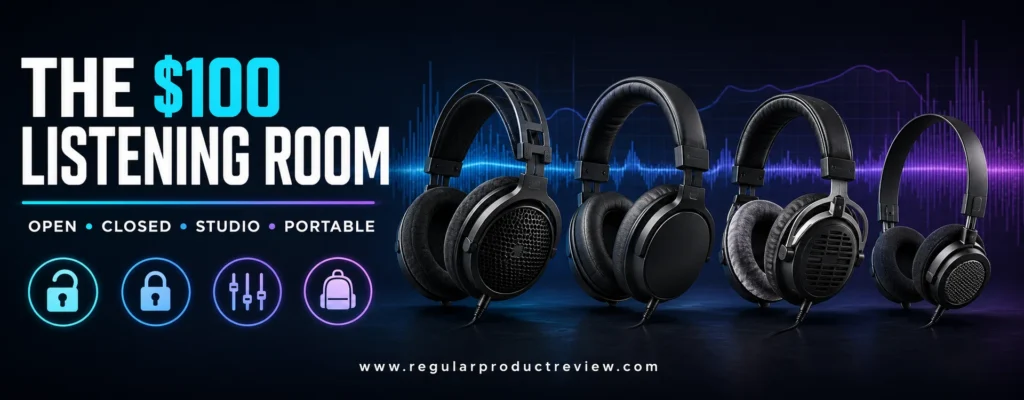
The $100 Listening Room-Where Real Hi-Fi Value Begins
Spending less than $100 on headphones no longer means choosing between exaggerated bass and brittle treble. The strongest models in this price class are designed around a more serious goal: revealing the character of a recording without burying it under wireless processing, aggressive sound effects, or fashionable tuning. They are often simple, wired, and visually understated. What they offer instead is the foundation of high-fidelity listening clear midrange, controlled bass, audible texture, stable imaging, and enough comfort to finish an album rather than merely sample it.
That distinction matters because “audiophile” is not a price tag. It describes an approach to sound. A good audiophile headphone should help a listener notice the room around a vocal, the decay of a cymbal, the placement of a guitar, and the difference between a tight kick drum and an artificially inflated low end. The best audiophile headphones under $100 cannot match the resolution, material quality, or scale of accomplished premium models, but they can deliver an honest and musically convincing experience that inexpensive lifestyle headphones frequently miss.
This guide is built for US buyers who want that experience without turning the purchase into an equipment hobby. Every recommended model is usable from common sources such as a laptop, USB-C dongle, desktop computer, audio interface, game controller, or compact digital audio player. A dedicated amplifier can improve headroom for a few selections, but none was chosen on the assumption that the reader already owns expensive source gear.
The list also avoids treating one sound signature as universally correct. Some listeners want the spacious presentation of an open-back headphone. Others need the isolation and stronger sub-bass presence of a closed design. Studio users may prioritize vocal intelligibility and repeatable positioning, while relaxed listeners may prefer a warmer balance that makes imperfect recordings easier to enjoy. Our broader audiophile headphones hub explains the category, while the best budget headphones guide covers more casual and feature-focused alternatives.
Editorial Insight: At this price, the smartest purchase is rarely the headphone with the longest specification sheet. It is the model whose acoustic design, fit, and tonal priorities match your room, music, and source.
Quick Winners: Best Budget Audiophile Headphones by Use Case
| Award | Headphone | Design | Editorial Score | Best Match |
|---|---|---|---|---|
| 🏆 Best Overall | Audio-Technica ATH-R30x | Open-back, over-ear | 9.1/10 | Balanced home listening and entry-level production |
| 🌐 Best Spacious Sound | Philips SHP9500 | Open-back, over-ear | 8.9/10 | Soundstage, comfort, acoustic and live recordings |
| 🎵 Best Musical Closed-Back | FiiO JT1 | Closed-back, over-ear | 8.8/10 | Energetic everyday listening with practical isolation |
| 🎚️ Best Studio Isolation | Sennheiser HD 280 Pro | Closed-back, over-ear | 8.7/10 | Tracking, editing, practice, and noisy rooms |
| 🔍 Best Open-Back Detail | OneOdio Monitor 80 | Open-back, over-ear | 8.6/10 | Detail-focused desktop listening |
| 🎒 Best Portable Studio Pick | Audio-Technica ATH-M30x | Closed-back, over-ear | 8.5/10 | Mobile recording and foldable monitoring |
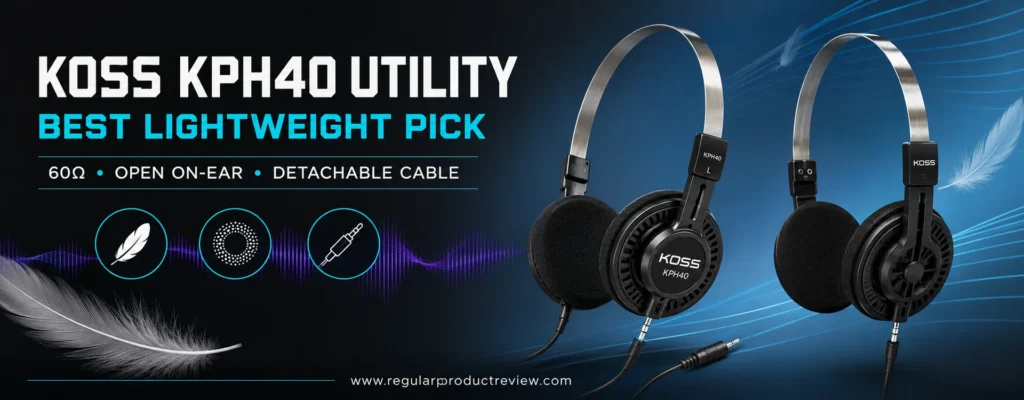
| 🪶 Best Lightweight Pick | Koss KPH40 Utility | Open, on-ear | 8.4/10 | Long casual sessions and low-power devices |
| 🎛️ Best Semi-Open Value | Samson SR850 | Semi-open, over-ear | 8.3/10 | Home studio learning and positional clarity |
| 🔧 Best for Easy Modding | Superlux HD681 EVO | Semi-open, over-ear | 8.2/10 | Pad experiments, EQ, and maximum performance per dollar |
| 🔊 Best for Bass Lovers | Monoprice Modern Retro | Closed-back, over-ear | 8.0/10 | Full, fun low end without wireless compression |
The Decision Map: Choose Before You Compare
| If your priority is… | Start with… | Why |
|---|---|---|
| Natural balance and low weight | Audio-Technica ATH-R30x | It combines reference-minded tuning with an unusually comfortable chassis |
| A wide, airy stage | Philips SHP9500 | Its large open cups create a convincing sense of space |
| Bass impact without abandoning detail | FiiO JT1 | It sounds fuller than most open models while retaining clean mids |
| Isolation for recording or shared spaces | Sennheiser HD 280 Pro | Its sealed cups and strong passive attenuation reduce distractions and bleed |
| A compact headphone for a laptop bag | Audio-Technica ATH-M30x | The folding frame is more travel-friendly than most studio designs |
| The least physical fatigue | Koss KPH40 Utility | Its minimal weight and low clamp make it disappear on the head |
| A first mixing practice headphone | Samson SR850 | The semi-open presentation exposes placement and upper-frequency detail |
| A cheap platform for pads and EQ | Superlux HD681 EVO | Its low entry price leaves room for inexpensive personalization |
How We Evaluated Headphones Without Inventing Lab Claims
This is an editorial buying guide, not a claim that every unit was measured in our own laboratory. Rankings were developed from official manufacturer specifications, current US pricing, design analysis, replaceability, source requirements, long-term ownership considerations, and patterns that appear consistently in reputable published measurements and reviews. For an independent comparison point, the RTINGS under-$100 over-ear guide provides standardized measurements, while its open-back versus closed-back explanation clarifies the acoustic trade-off.
We gave the greatest weight to six areas:
- Tonal balance: Whether bass, midrange, and treble work together rather than competing for attention.
- Detail and separation: How easily a listener can distinguish overlapping instruments, reverberation, and low-level texture.
- Imaging and soundstage: Whether sound sources occupy stable positions and whether the presentation feels appropriately spacious.
- Comfort and fit stability: Whether weight, clamp, pad shape, and heat allow extended listening.
- Build and ownership: Cable design, replaceable wear parts, foldability, warranty support, and likely durability.
- Value integrity: Whether the headphone earns its place below $100 at a normal or readily available US price, not through a rare used listing.
We did not award points for Bluetooth, active noise cancellation, microphones, spatial-audio modes, or companion applications. Those features can be useful, but they are not prerequisites for faithful music reproduction. Readers who prioritize wireless freedom should compare our wireless headphones category and wireless headphones under $100 before accepting the cable-first focus of this article.
What “Under $100” Means in This Guide
Prices move. A model qualifies when its new US street price is $99.99 or less at the time of editorial review, including stable manufacturer or authorized-retailer pricing. Temporary discounts are identified as such. Tax, shipping, bundles, replacement pads, and optional adapters are not included in the ceiling. If a listed model rises above $100, wait for a normal discount or choose the next recommendation rather than paying beyond the category’s purpose.
Learn More: Why wired headphones dominate this list
A wired design spends the budget on drivers, pads, frame, and acoustic tuning. A wireless headphone must also fund batteries, radio hardware, microphones, digital processing, controls, certification, and charging electronics. That does not make wireless products bad; it explains why a modest wired model can deliver more transparent sound for the same money. Wired headphones also avoid codec compatibility questions, battery aging, and latency.
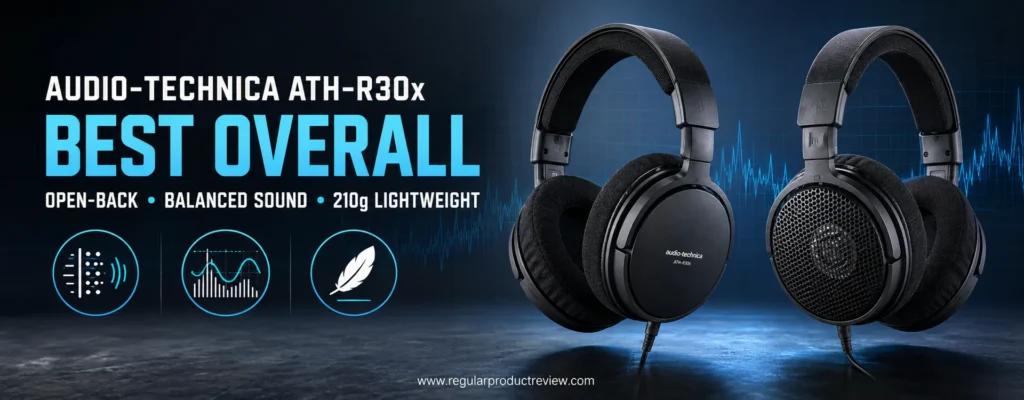
Audio-Technica ATH-R30x-Best Overall Audiophile Headphones Under $100
Overall Rating: 9.1/10
Award: 🏆 Best Overall
Best For: Balanced home listening, beginning producers, acoustic music, jazz, classical, and listeners who value comfort
The Audio-Technica ATH-R30x is the strongest all-around recommendation because it treats affordability as an engineering constraint rather than an excuse for novelty tuning. Its open-back architecture, 40mm drivers, low 210-gram weight, and reference-oriented balance address the qualities that matter most during long listening sessions. It is neither a bass cannon nor a treble spotlight. Instead, it aims for clear lows, transparent mids, and extended highs arranged across a believable stereo image.
That restraint gives the ATH-R30x unusually broad appeal. Vocals sit forward enough to follow lyrics without sounding detached from the band. Bass lines remain easy to trace, yet they do not obscure guitars or lower piano notes. Treble has enough energy to reveal percussion and room ambience, but the headphone is designed to avoid the relentless sharpness found in many inexpensive “detail” models. The result is a balanced open-back headphone that supports both pleasure listening and early production work.
Audio-Technica lists the ATH-R30x as an open-back reference model for home studio production, multimedia creation, and detailed everyday listening. The official ATH-R30x specifications confirm 36-ohm impedance, 92dB/mW sensitivity, a 15Hz–25kHz stated response, and a long fixed cable. Those figures indicate that a modern laptop, desktop interface, or competent dongle should reach useful levels, although a weak headphone jack may offer less headroom than it would with a more sensitive portable model.
ATH-R30x Sound Profile: Honest Without Becoming Sterile
The ATH-R30x’s low frequencies favor definition over spectacle. A double bass retains its woody attack, electric bass notes remain individually legible, and kick drums have shape rather than a single broad thump. Listeners moving from consumer wireless headphones may initially perceive less bass because the ATH-R30x does not rely on a heavy mid-bass shelf. After a few albums, the benefit becomes clear: the bass occupies its own layer instead of masking the lower midrange.
Midrange is the center of the presentation. Male and female vocals sound direct, guitars keep their harmonic texture, and dialogue is intelligible at moderate volume. This quality makes the headphone especially useful for singer-songwriter recordings, podcasts, film editing, and learning how a mix is assembled. The treble preserves air and articulation, though bright masters can still sound bright. A reference-minded headphone should expose that character rather than automatically smoothing every recording.
Imaging, Stage, and the Open-Back Advantage
The stage is open and realistic rather than artificially huge. Instruments extend beyond the center of the head, and left-to-right placement is easier to follow than on most inexpensive closed models. Depth is more modest than width, but the image does not collapse during dense passages. That stability supports orchestral music, small jazz ensembles, ambient tracks, and games where natural directional cues matter more than boosted effects.
Because sound passes through the earcups, the ATH-R30x provides virtually no isolation and leaks music into the room. It is a poor choice for commuting, libraries, shared offices, or recording a live microphone nearby. Buyers who need separation from household noise should compare noise-cancelling headphones under $100 or the closed-back selections later in this guide.
Comfort, Construction, and Daily Ownership
At approximately 210 grams without the cable, the ATH-R30x is much lighter than many full-size studio headphones. The new headband design distributes that mass gently, while the large cups avoid pressing directly on most ears. Heat buildup is limited by the open construction. These traits make it a strong candidate for two-hour albums, long editing sessions, and focused study.
The principal ownership compromise is the fixed three-meter cable. Its length is useful at a desk, mixing console, or keyboard, but cumbersome beside a phone. A cable tie solves the excess length; it does not solve future cable failure. The earpads and headpad are separately replaceable, which helps, but a detachable connector would have made the design more serviceable.
Audio-Technica ATH-R30x Key Specifications
| Specification | Detail |
|---|---|
| Acoustic design | Open-back, over-ear |
| Driver | 40mm dynamic |
| Frequency response | 15Hz–25kHz |
| Impedance | 36 ohms |
| Sensitivity | 92dB/mW |
| Weight | Approximately 210g without cable |
| Cable | Fixed 3.0m straight cable |
| Connector | 3.5mm with 6.3mm adapter |
| Microphone | No |
| Amplifier required | No, but a solid dongle or interface improves headroom |
ATH-R30x Pros and Cons
| Pros | Cons |
|---|---|
| Coherent, reference-minded tuning | No isolation and substantial sound leakage |
| Clear vocal and instrumental midrange | Fixed three-meter cable is inconvenient for portable use |
| Realistic imaging for the price | 92dB/mW sensitivity is not the easiest load in the list |
| Very light for a full-size headphone | Bass quantity may feel restrained to consumer-tuning fans |
| Replaceable pads and headpad | Minimal accessories beyond the adapter |
Expert Recommendation: Choose the ATH-R30x if you listen in a quiet room and want one inexpensive headphone that can support music discovery, basic production, and long sessions. Skip it if isolation, compact storage, or deep sub-bass impact is non-negotiable.
The ATH-R30x belongs beside more ambitious open models in our best audiophile headphones guide. Buyers who can extend the budget should also see the best audiophile headphones under $200 for detachable cables, stronger materials, and greater technical refinement.
Philips SHP9500-Best Open-Back Headphones Under $100 for Soundstage
Overall Rating: 8.9/10
Award: 🌐 Best Spacious Sound
Best For:Live recordings, acoustic music, gaming without a built-in mic, long home sessions, and listeners sensitive to clamp
The Philips SHP9500 remains a benchmark for affordable spaciousness. Its large 50mm drivers, broad fabric pads, low clamping pressure, and open metal grilles produce an experience that feels physically less confined than most headphones in this price class. Music is not projected as a narrow line between the ears; it has room to spread, breathe, and reveal the acoustic relationship between performers.
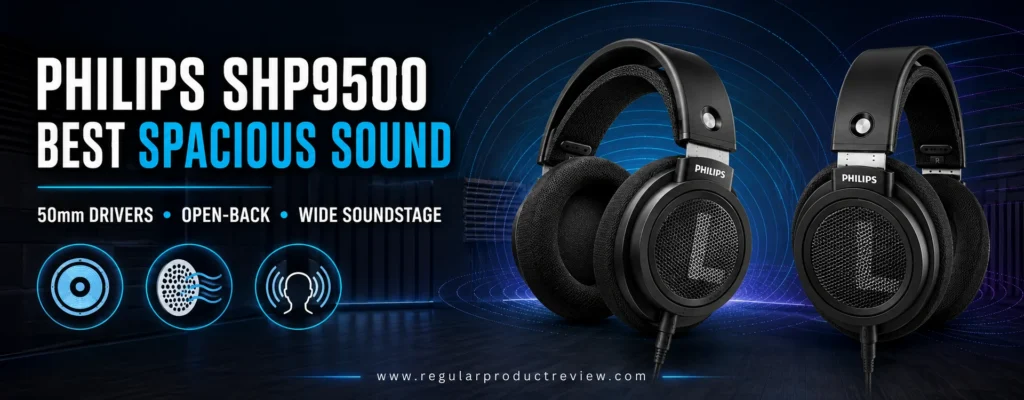
Philips describes the SHP9500 as a high-precision open-back headphone and lists a 12Hz–35kHz response, 32-ohm impedance, 101dB sensitivity, and a 320-gram product weight. The official Philips SHP9500 page also emphasizes breathable cushions and its double-layer headband. Those attributes explain why this older design continues to compete: it solves comfort and openness with simple mechanical choices rather than software.
Spacious Presentation Without Artificial Echo
The SHP9500’s defining strength is width. Stereo effects extend clearly, crowd ambience in a concert recording feels separate from the performers, and layered guitars occupy distinguishable positions. The stage is not the deepest available, and center images can feel less dense than on a good closed-back model, but the sense of openness is exceptional for the money.
Imaging is stable enough for locating instruments and competitive game cues, although this is not a gaming headset and has no microphone. A detachable 3.5mm cable makes it possible to add a compatible inline boom microphone, a flexibility the ATH-R30x cannot match. Readers building a dual-purpose setup can compare our gaming headsets under $100 and broader gaming headsets category before deciding whether integrated voice communication matters.
Tonal Character: Clear Mids, Airy Treble, Light Sub-Bass
The SHP9500 does not deliver the sealed pressure or sub-bass extension of a closed headphone. Electronic drops and cinematic rumbles sound leaner than bass enthusiasts expect. Mid-bass is present, however, and it stays sufficiently controlled to keep rhythm sections coherent. The relative lack of low-frequency weight lets vocals and strings remain uncovered.
Midrange clarity is very good. Speech, guitars, piano, and brass are easy to follow without a thick veil. Upper-midrange and treble energy add presence and air, but can expose sibilance in aggressive recordings. Listeners who are sensitive around cymbal and consonant regions may prefer the warmer FiiO JT1 or may use a small EQ reduction. The SHP9500 rewards good recordings and does not disguise poor mastering.
Comfort and Fit: Excellent for Larger Heads, Less Secure for Small Ones
The fabric-covered pads breathe well and distribute pressure across a large area. Clamp is gentle, which helps during long sessions and for glasses wearers. The trade-off is stability: people with smaller heads may find the fit loose, especially when leaning forward. The pads are also relatively shallow, so ear contact varies by anatomy.
Build quality is practical rather than luxurious. The steel-reinforced headband feels reassuring, while the exposed open grilles require basic care around dust, drinks, and travel. These headphones do not fold, and their wide frame consumes significant bag space. They are home headphones first.
Philips SHP9500 Key Specifications
| Specification | Detail |
|---|---|
| Acoustic design | Open-back, over-ear |
| Driver | 50mm neodymium dynamic |
| Frequency response | 12Hz–35kHz |
| Impedance | 32 ohms |
| Sensitivity | 101dB |
| Weight | Approximately 320g |
| Cable | Detachable 3.0m, 3.5mm at earcup |
| Connector | 3.5mm with 6.3mm adapter |
| Isolation | Essentially none |
| Amplifier required | No |
Philips SHP9500 Pros and Cons
| Pros | Cons |
|---|---|
| Expansive stage for the price | Limited sub-bass authority |
| Breathable pads and low clamp | Fit may be loose on smaller heads |
| Detachable standard 3.5mm cable | Treble can emphasize harsh recordings |
| Clear midrange and directional imaging | Large, non-folding chassis |
| Easy to drive from common sources | Open design leaks sound freely |
Pullquote: The SHP9500 is not the headphone for shutting out the world; it is the headphone for making a quiet room feel larger.
Buy the SHP9500 when you want wide-soundstage headphones under $100, have a private listening space, and value low clamp. Avoid it for commuting, shared bedrooms, vocal tracking, or bass-heavy listening at low volume. Buyers who need isolation can start with our noise-cancelling headphones category or compare the best noise-cancelling headphones under $200, recognizing that wireless ANC trades some wired simplicity for convenience.
FiiO JT1-Best Closed-Back Audiophile Headphones for Musical Impact
Overall Rating: 8.8/10
Award: 🎵 Best Musical Closed-Back
Best For: Pop, rock, hip-hop, electronic music, shared spaces, and listeners who want fuller bass without losing vocal clarity
The FiiO JT1, sold under FiiO’s JadeAudio value line in some markets, answers a common objection to budget audiophile headphones: neutral does not have to mean thin. It uses a large dynamic driver assembly with strong N52 magnets and a lightweight CCAW voice coil to deliver a lively, full-bodied presentation. The bass has more physical presence than the open-back leaders, yet the headphone preserves enough definition to keep melodies and vocals intelligible.
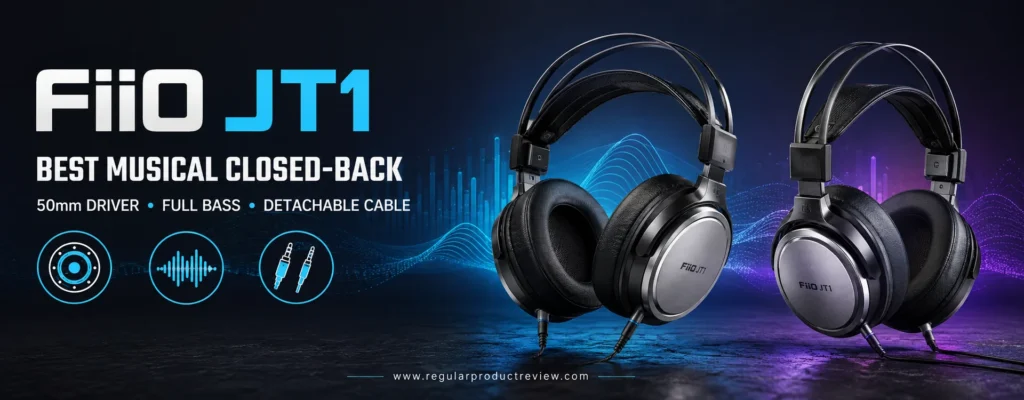
FiiO’s official JT1 launch information emphasizes natural, accurate sound and the motor structure behind the driver. More importantly for daily use, the closed cups provide meaningful passive isolation, the dual-entry cable is replaceable, and the comfortable suspension-style headband spreads weight better than many inexpensive closed designs.
Bass With Shape, Not Just Quantity
The JT1’s low end is elevated, which gives kick drums impact and electronic bass satisfying depth. It is not a strict studio-neutral response, and listeners seeking an analytical window may prefer the ATH-R30x. But the bass generally retains pitch and attack instead of collapsing into a monotone rumble. That makes the JT1 especially enjoyable for modern genres and lower-volume listening, where a perfectly flat headphone can feel less engaging.
The lower midrange has warmth, adding body to male vocals, cello, and electric guitars. Busy mixes can sound slightly denser than on the Philips, but the presentation is cohesive. Upper mids remain present enough for intelligibility, while the treble adds definition without making every cymbal the center of attention. The overall balance is better described as musical and warm-neutral than clinically flat.
Closed-Back Staging and Imaging
The JT1 cannot create the same outward openness as the SHP9500. Its stage sits closer and has more cup resonance, an expected consequence of a sealed design. Within that smaller space, images are organized convincingly. Lead vocals lock to the center, percussion occupies clear lateral positions, and low-frequency elements remain more anchored than on many bargain closed headphones.
This makes it useful for gaming and movies even though it is not sold primarily as a headset. Users who require a boom mic and game-chat controls should examine our best gaming headsets rather than assuming any audiophile headphone will be a complete gaming solution.
Comfort, Isolation, and Source Matching
The generously padded cups and suspension headband suit long sessions, although the closed construction traps more heat than the open picks. Seal is important: glasses or hair breaking the pad contact can reduce sub-bass and alter balance. Taking a minute to adjust the headband and seat the pads evenly pays an acoustic dividend.
The JT1 is easy enough to power from laptops, controllers, interfaces, and quality phone dongles. A dedicated amplifier is unnecessary for ordinary listening. More important is using a clean source with adequate volume control. Because the headphone has energetic bass, poorly designed outputs with high noise or channel imbalance can be more distracting during quiet passages.
FiiO JT1 Key Specifications
| Specification | Detail |
|---|---|
| Acoustic design | Closed-back, over-ear |
| Driver | 50mm dynamic with N52 magnet system |
| Frequency response | 15Hz–30kHz stated |
| Impedance | 32 ohms |
| Sensitivity | 103dB/mW stated |
| Tuning direction | Warm, full, and energetic |
| Cable | Detachable dual-entry cable |
| Connector | Dual 3.5mm at earcups; 3.5mm source plug |
| Isolation | Moderate passive isolation |
| Fit | Suspension headband with padded over-ear cups |
| Microphone | Cable/package can vary; verify seller listing |
| Amplifier required | No |
| Typical positioning | Music-first budget closed-back |
FiiO JT1 Pros and Cons
| Pros | Cons |
|---|---|
| Deep, enjoyable bass with useful definition | Less neutral than reference-oriented open models |
| Clear vocals despite the warm foundation | Closed cups can become warm during long sessions |
| Replaceable cable | Stage is more intimate than open-back competitors |
| Comfortable suspension-style headband | Package details can vary between sellers |
| Strong value for modern music | Large chassis is not especially portable |
Expert Tip: Do not judge the JT1’s bass before checking pad seal. An uneven seal can make one side sound lighter and can tempt unnecessary EQ.
Choose the JT1 if you want a closed-back audiophile headphone under $100 that prioritizes fun without surrendering structure. Skip it when you need strict tonal neutrality for mix decisions. For feature-heavy alternatives, see our best wireless headphones and best noise-cancelling headphones; both categories solve mobility and noise differently from a passive wired design.
Sennheiser HD 280 Pro—Best Studio Headphones Under $100 for Isolation
Overall Rating: 8.7/10
Award: 🎚️ Best Studio Isolation
Best For: Vocal tracking, instrument practice, editing, podcast production, shared apartments, and listeners who need passive noise reduction
The Sennheiser HD 280 Pro is not designed to flatter. It is a working closed-back headphone built to reduce external distraction, limit sound bleeding into microphones, and expose practical details during recording and editing. That utilitarian purpose explains its long coiled cable, folding cups, strong clamp, replaceable wear parts, and restrained styling. For the right user, those choices are strengths rather than inconveniences.
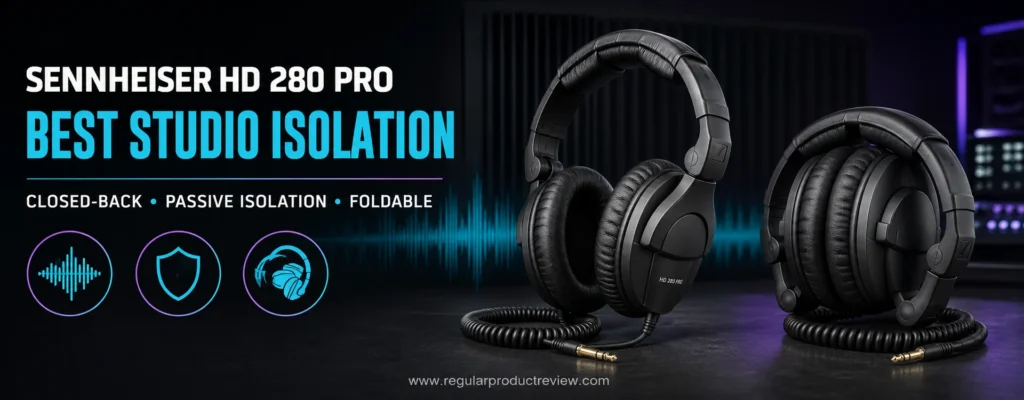
Current authorized US pricing places the HD 280 Pro at the top edge of this category. The Sennheiser HD 280 Pro product information and authorized US retailer listing identify its 64-ohm design, folding construction, substantial passive attenuation, and serviceable components. Buy only when the new price remains at or below $100 before tax.
Monitoring Balance: Controlled, Revealing, and Deliberately Unflashy
Bass extension is respectable, but impact is not inflated for entertainment. The HD 280 Pro makes it easier to hear whether a kick and bass guitar are colliding, whether a low note sustains too long, and whether background rumble has entered a recording. Its closed construction can create more low-frequency pressure than an open model, yet the tuning remains work-focused.
Midrange intelligibility is the star. Voice edits, breaths, consonants, guitar edges, and keyboard harmonics remain easy to inspect. The upper range can sound firm and dry, especially with bright interfaces or lean recordings. That character helps expose clicks and sibilance, but it may not be the most relaxing choice for listeners who want every album softened.
Isolation That Changes Where You Can Listen
Passive attenuation is the practical reason to choose the HD 280 Pro over an open-back headphone. Its seal reduces household chatter, computer-fan noise, and some street ambience without batteries or processing. It does not cancel deep engine rumble like good ANC, but it also introduces no ANC pressure sensation, electronic hiss, or battery dependency.
For recording, the closed cups reduce the chance that a click track or backing track will reach a live microphone. That makes the Sennheiser a more responsible studio choice than the ATH-R30x or SHP9500. For flights and public transportation, however, a purpose-built model from our noise-cancelling headphones hub may still be preferable.
Clamp, Heat, and Serviceability
The HD 280 Pro’s clamp is stronger than the open competitors. It contributes to isolation and a stable seal, but can fatigue sensitive listeners or people with larger heads. The padded headband and circumaural cushions help, and the fit often becomes more forgiving with regular use. Closed pads inevitably retain heat, so short breaks during long sessions are sensible.
Its folding and rotating parts improve storage but introduce more mechanical joints than a simple fixed frame. Handle the hinges with intention rather than throwing the headphone loosely into a bag. Replacement earpads, headband padding, and cable availability are meaningful advantages because these are the components most likely to wear during studio use.
Sennheiser HD 280 Pro Key Specifications
| Specification | Detail |
|---|---|
| Acoustic design | Closed-back, over-ear |
| Driver | Dynamic |
| Frequency response | 8Hz–25kHz stated |
| Impedance | 64 ohms |
| Passive attenuation | Up to approximately 32dB, frequency dependent |
| Weight | Approximately 285g without cable |
| Cable | Fixed coiled cable, approximately 3m extended |
| Storage | Folding and rotating earcups |
| Replaceable parts | Pads, headband padding, and cable |
| Amplifier required | Usually no; a capable interface or dongle is recommended |
Sennheiser HD 280 Pro Pros and Cons
| Pros | Cons |
|---|---|
| Strong passive isolation | Firm clamp may cause fatigue |
| Clear midrange for editing and tracking | Coiled cable is bulky outside a studio |
| Controlled bass supports practical monitoring | Presentation can feel dry for casual listening |
| Folding construction | Closed pads accumulate heat |
| Key wear components are replaceable | Price often sits exactly at the category ceiling |
Editorial Verdict: The HD 280 Pro is the tool pick. It wins when keeping noise out and sound in matters more than producing the widest or most romantic presentation.
Home listeners who want isolation without studio severity can compare our best budget headphones under $50 and budget headphones category. Choose the Sennheiser when your workflow includes microphones, instruments, editing, or a noisy room; choose an open model when immersion and breathable comfort matter more.
OneOdio Monitor 80-Best Detail-Focused Open-Back Headphones at $99.99
Overall Rating: 8.6/10
Award: 🔍 Best Open-Back Detail
Best For: Desktop listening, high-resolution libraries, listeners who enjoy a vivid top end, and buyers who value cable options
The OneOdio Monitor 80 occupies an unusual position: it reaches the $100 ceiling with an open-back design, a wide stated frequency range, folding joints, replaceable cables, and a generous accessory package. Rather than chasing a soft, universally agreeable balance, it delivers a vivid and revealing sound that draws attention to transient edges, stereo separation, and recording texture. That makes it engaging with well-produced acoustic and electronic material, but less forgiving of compressed or treble-heavy masters.
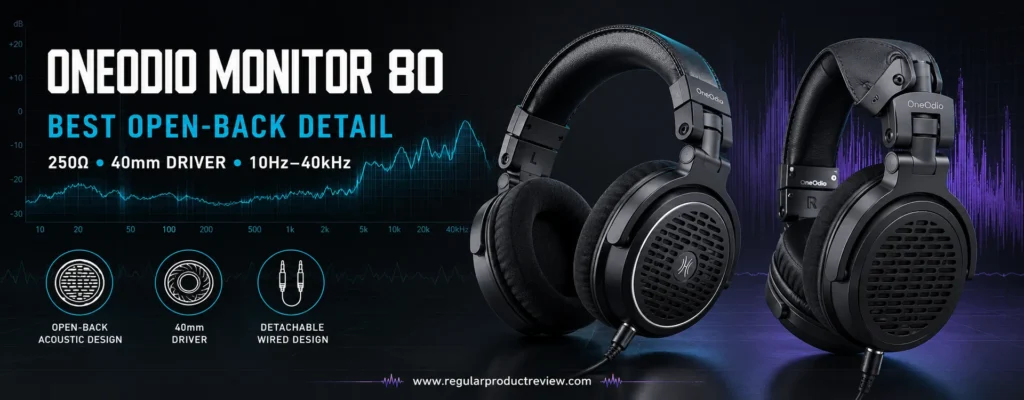
OneOdio lists the Monitor 80 at $99.99 and describes it as an open-back professional monitoring headphone with 40mm drivers and a 10Hz–40kHz stated response. The official Monitor 80 page is also the correct place to verify current US availability, package contents, and warranty terms. Because marketplace sellers sometimes shorten names or mix specifications between OneOdio models, match the listing to “Monitor 80,” not Monitor 60, Pro-10, or a wireless variant.
A More Forward Lens on Detail
The Monitor 80’s presentation is crisp. String attacks, hi-hat patterns, reverb tails, and small production effects are easy to notice. This can make familiar tracks feel newly illuminated. It can also make sibilant vocals and aggressively mastered rock tiring. The headphone is better for listeners who actively seek detail than for those who want a warm background companion.
Bass is present and reasonably extended for an open design, but it does not generate the sealed physical pressure of the FiiO JT1 or Monoprice Modern Retro. The midrange remains sufficiently open to prevent voices from disappearing, though the vivid upper region can shift attention away from lower vocal body. Careful pad seating and moderate volume improve balance.
Stage, Separation, and Desktop Use
The open cups provide a broad canvas, while the energetic treble sharpens perceived outlines around instruments. This combination helps separation in dense tracks and makes panning decisions obvious. Stage size is convincing, although the Philips sounds more effortlessly airy and the ATH-R30x presents a more natural tonal whole.
For desktop work, the Monitor 80’s multiple connection options are useful. It can integrate with common 3.5mm devices and larger studio connections without relying on a fragile single proprietary cable. Its 250-ohm impedance and 94dB ±3dB sensitivity make a capable audio interface or headphone amplifier a more meaningful requirement than they are for most picks here. The folding earcups are unusual for an open-back headphone, but folding does not make it commuter-friendly: leakage and lack of isolation remain fundamental acoustic properties.
Comfort and the Importance of Breaks
Large circumaural pads spread contact over a wide area, and the headband accommodates different head shapes. The assembly is bulkier than the featherweight Koss and ATH-R30x. Listeners sensitive to treble or heat may benefit from short breaks, which protect both comfort and attention during long critical sessions.
The frame offers more articulation than a simple fixed design, but moving joints should be handled gently. Fold the cups deliberately and store the headphone in its case instead of leaving torque on the hinges. Detachable cables reduce a common long-term failure risk and are a major ownership advantage at this price.
OneOdio Monitor 80 Key Specifications
| Specification | Detail |
|---|---|
| Acoustic design | Open-back, over-ear |
| Driver | 40mm dynamic |
| Frequency response | 10Hz–40kHz stated |
| Nominal impedance | 250 ohms |
| Sensitivity | 94dB ±3dB |
| Cable system | Detachable 3.5mm-to-3.5mm and 3.5mm-to-6.35mm cables |
| Storage | Folding, articulated earcups |
| Isolation | None for practical purposes |
| Sound direction | Detailed, vivid, and spacious |
| Microphone | No |
| Amplifier required | Recommended; verify the source can drive 250-ohm headphones |
OneOdio Monitor 80 Pros and Cons
| Pros | Cons |
|---|---|
| Strong perceived detail and separation | Treble can become tiring with bright recordings |
| Open, spacious presentation | No useful isolation and audible leakage |
| Detachable cable system | Bulkier than minimalist open designs |
| Folds for easier storage | Articulated joints require careful handling |
| Useful accessory value | Sits at the absolute price ceiling |
Expert Recommendation: Buy the Monitor 80 if your listening is active and detail-driven. If you want a smoother, more tonally relaxed all-rounder, the ATH-R30x or FiiO JT1 will be easier to live with.
The Monitor 80 can also serve listeners who play immersive single-player titles, but it is not a communications headset. For microphones and platform controls, use our gaming headset category and best gaming headsets under $100 as companion resources. For a step up in refinement, compare the models in our audiophile headphones under $200 guide.
Audio-Technica ATH-M30x-Best Foldable Studio Headphones Under $100
Overall Rating: 8.5/10
Award: 🎒 Best Portable Studio Pick
Best For: Field recording, student production, keyboards, audio interfaces, and buyers needing a closed, folding design
The Audio-Technica ATH-M30x earns its place by being practical. It is a compact closed-back monitoring headphone with a collapsible frame, moderate 220-gram weight, a familiar 47-ohm load, and tuning intended to preserve midrange definition. It does not attempt to create the huge stage of an open headphone or the indulgent bass of a consumer model. It focuses on giving students, musicians, and creators a repeatable view of a recording in places where open cups would be inappropriate.
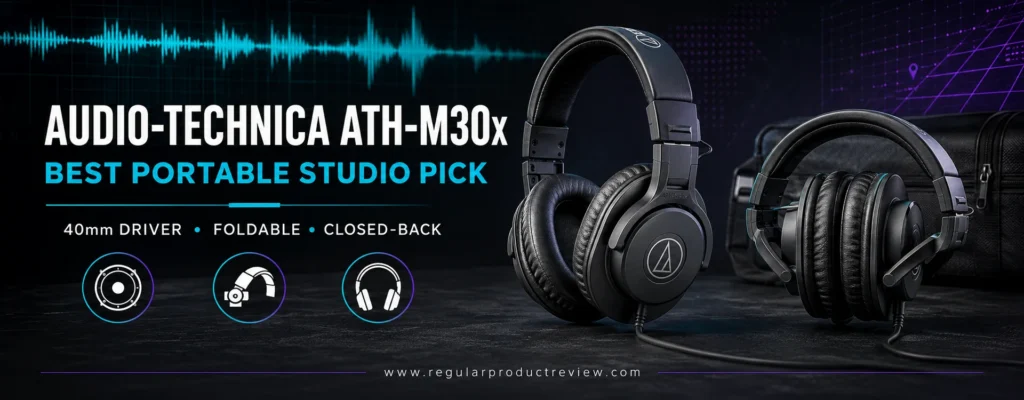
Audio-Technica’s official ATH-M30x specifications list 40mm drivers, a 15Hz–22kHz response, 96dB sensitivity, 47-ohm impedance, and a 220-gram weight without cable. Current authorized US pricing is typically well below the ceiling. That leaves budget room for a basic USB-C dongle, headphone stand, or replacement pads later.
Midrange First: Why the M30x Works for Creators
The ATH-M30x places useful emphasis on the frequency region where vocals, guitars, snare fundamentals, and many editing problems live. Spoken words remain intelligible, and arrangements are easier to dissect than on bass-dominant fashion headphones. Low frequencies have adequate punch, but the closed cups and tuning can make the bass more compact than luxurious.
Treble provides enough presence for detecting noise and transient detail without reaching the openness of the Monitor 80. The overall sound is somewhat narrow and studio-like, which is not automatically negative. When recording a keyboard, checking dialogue, or monitoring a microphone, consistency and isolation may be more valuable than cinematic scale.
Closed Imaging and Limited Soundstage
The stereo image is centered and organized, but the stage remains inside or near the head. Panned elements are easy to identify, while front-to-back depth is modest. For analytical work, this compactness can focus attention. For orchestral immersion or live albums, the Philips and ATH-R30x create a more convincing acoustic environment.
Gamers can use the ATH-M30x for clear directional information, but the fixed cable lacks an inline microphone and the earcups do not reproduce the wide field of purpose-built open options. Buyers who want a complete communications package should compare our best gaming headsets guide rather than paying separately for adapters and microphones.
Folding Design, Isolation, and Cable Reality
The earcups fold into the headband, and the included pouch protects against scratches. That makes the M30x easier to transport than most selections here. Passive isolation is useful for dorm rooms, field recording, and practice. The pads can become warm, and larger ears may touch the inner surfaces.
Its greatest limitation is the fixed three-meter straight cable. The length is appropriate for a console or interface, excessive for a phone, and impossible to replace without repair work. Coil the surplus loosely and secure it with a reusable tie; tight wrapping accelerates internal cable stress.
Audio-Technica ATH-M30x Key Specifications
| Specification | Detail |
|---|---|
| Acoustic design | Closed-back, over-ear |
| Driver | 40mm dynamic with CCAW voice coil |
| Frequency response | 15Hz–22kHz |
| Impedance | 47 ohms |
| Sensitivity | 96dB |
| Weight | 220g without cable |
| Cable | Fixed 3.0m straight cable, left exit |
| Storage | Collapsible; carrying pouch included |
| Connector | 3.5mm with 6.3mm adapter |
| Amplifier required | No for most interfaces and dongles |
Audio-Technica ATH-M30x Pros and Cons
| Pros | Cons |
|---|---|
| Useful midrange clarity | Fixed long cable limits portability |
| Folding frame and included pouch | Narrower stage than open-back rivals |
| Moderate weight | Pads can become warm and shallow for large ears |
| Good passive isolation for the price | Build uses extensive plastic |
| Sensible authorized-retailer pricing | Sound is more functional than luxurious |
Editorial Insight: The ATH-M30x is easier to recommend as a mobile work tool than as the most immersive music headphone. Its value comes from dependable monitoring behavior in imperfect environments.
Choose it for classes, recording, instruments, and compact storage. Choose the SHP9500 for stage, the JT1 for fuller entertainment tuning, or the HD 280 Pro for stronger isolation. Students comparing broader affordable options can explore the budget headphones hub and best budget headphones.
Koss KPH40 Utility-Best Lightweight Audiophile Headphones Under $50
Overall Rating: 8.4/10
Award: Best Lightweight Pick
Best For: Glasses wearers, long work sessions, portable players, warm climates, and listeners who prefer comfort over isolation
The Koss KPH40 Utility looks almost too simple to compete with full-size headphones. A thin stainless-steel headband holds two foam-covered on-ear drivers, and the detachable Utility cable connects to a conventional 3.5mm source. Yet this minimalist architecture is exactly why it works. There are fewer cup resonances, less physical mass, and little pressure trapping heat around the ears. The sound is open, warm, and coherent in a way that many more elaborate budget models fail to achieve.
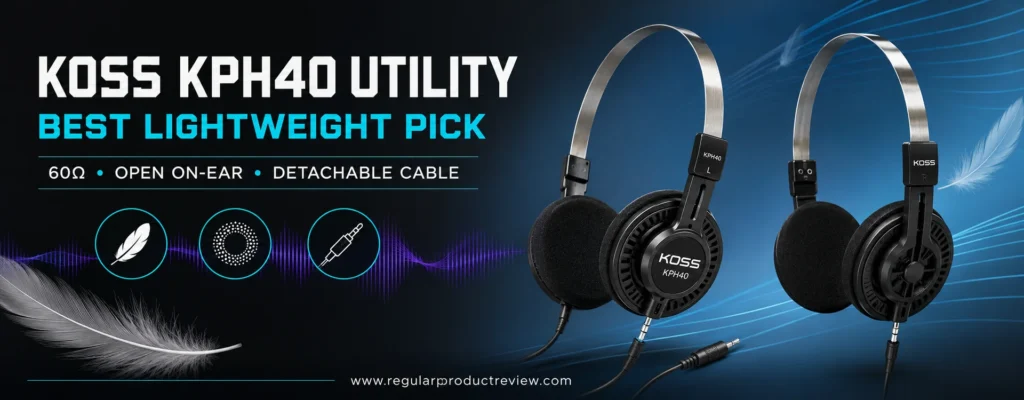
Koss lists the KPH40 Utility at $39.99 with 60-ohm impedance, 101dB SPL sensitivity, a 15Hz–25kHz stated range, and a 1.2-meter cable. The official KPH40 Utility page also shows the replaceable cable ecosystem. This modular connection supports an ordinary wired cord and optional adapters, though the value proposition is strongest when the standard cable is all you need.
Warm Coherence Instead of Hi-Fi Spectacle
The KPH40 does not chase extreme extension. Its bass is warm and rhythmic, with satisfying mid-bass punch but limited deepest sub-bass. Vocals sound natural and connected to instruments, making the headphone excellent for indie rock, soul, folk, jazz, podcasts, and older recordings. Treble is present enough for clarity but generally less aggressive than the Samson or OneOdio.
Resolution is good for the price, not miraculous. Dense orchestral or metal tracks can blend more than they do on the ATH-R30x. The Koss counters with timbral ease: instruments often sound believable even when microdetail is not fully separated. For many listeners, that musical continuity matters more than hearing every production artifact.
Open On-Ear Imaging
The KPH40 has an open feel but not the enormous stage of the Philips. Images are intimate, stable, and less boxed-in than typical sealed on-ear headphones. Vocals occupy a strong center, while guitars and percussion spread naturally to the sides. The presentation suits work and casual listening because it remains engaging without demanding constant analysis.
Open foam pads provide no useful noise isolation. People nearby can hear your music, and you can hear them. This is helpful for situational awareness at home but unsuitable for public transit, quiet offices, and recording around live microphones. Our wireless headphones under $100 guide offers more mobile feature sets, while the wireless headphones category explains the broader trade-offs.
Exceptional Comfort With On-Ear Caveats
The almost weightless frame places little load on the crown. Clamp can be adjusted by gently shaping the steel headband, and glasses usually cause fewer seal problems because there is no sealed over-ear pad. Foam does touch the ear directly, however. Some users prefer that breathability; others dislike any on-ear contact.
The simple construction feels less premium than it sounds. Foam pads are consumable items and should be replaced when they flatten or tear. The detachable Utility cord is valuable because cable failure does not retire the whole headphone. Koss’s support and long-running emphasis on serviceable products add confidence, but owners should still avoid crushing the thin frame in a bag.
Koss KPH40 Utility Key Specifications
| Specification | Detail |
|---|---|
| Acoustic design | Open, on-ear |
| Driver | Dynamic |
| Frequency response | 15Hz–25kHz stated |
| Impedance | 60 ohms |
| Sensitivity | 101dB SPL |
| Weight | Extremely light; manufacturer page emphasizes minimalist design |
| Cable | Detachable Koss Utility cord, 1.2m |
| Connector | 3.5mm with standard cord |
| Isolation | None |
| Amplifier required | No for most modern sources |
Koss KPH40 Utility Pros and Cons
| Pros | Cons |
|---|---|
| Exceptionally low wearing fatigue | Foam sits directly on the ears |
| Warm, coherent tonal balance | Little deep sub-bass extension |
| Detachable modular cable | No isolation and obvious leakage |
| Easy to use with common devices | Thin frame needs protection in a bag |
| Strong value at well below $50 | Less separation than full-size leaders |
Expert Recommendation: The KPH40 is the comfort-first choice for a quiet room. It is also an excellent second headphone for owners of a heavy closed model because it offers a completely different physical and acoustic experience.
If maximum affordability is the priority, compare the best budget headphones under $50. If long-term sound quality matters more than portable features, use our audiophile headphones category to understand what a future upgrade should improve.
Samson SR850-Best Semi-Open Studio Headphones for Learning Critical Listening
Overall Rating: 8.3/10
Award: 🎛️ Best Semi-Open Value
Best For: Home-studio beginners, keyboard practice, positional gaming, EQ learners, and buyers seeking maximum detail at a very low price
The Samson SR850 is a budget studio staple because it offers a large 50mm driver, semi-open cups, a self-adjusting headband, and a bright, spacious presentation for far less than most reference headphones. It is not the most tonally even product here, yet it can teach a new listener important skills: following panned elements, identifying sibilance, hearing reverb, and recognizing how upper-frequency energy changes perceived detail.
Samson’s official SR850 specifications list a 10Hz–30kHz response, 32-ohm impedance, 98dB sensitivity, 2.5-meter cable, and approximately 276-gram weight. Authorized US street pricing is often around $50 or less, making the SR850 one of the lowest-cost routes into a full-size semi-open studio headphone.
Bright Clarity With an EQ-Friendly Foundation
The SR850 emphasizes presence and treble. Cymbals, string harmonics, vocal consonants, and recording noise are easy to hear. That can create an immediate sense of resolution, but it can also make poorly mastered tracks sharp. The bass is cleaner than expected for the price, with more punch than many fully open models, though the deepest sub-bass is not its strength.
Midrange is relatively clear, but upper-frequency energy can make vocals feel thinner than on the Koss or FiiO. A modest EQ reduction in the bright region can make the SR850 more balanced without removing its spacious character. This is an ideal model for learning that “more treble” and “more detail” are related perceptions, not identical concepts.
Semi-Open Space and Directional Cues
The cups allow partial airflow, producing a stage wider than typical bargain closed headphones. Instrument positions and game cues are easy to locate. The image can be more diffuse than premium studio monitors, but it avoids the congested center common in low-cost sealed designs.
Semi-open does not mean semi-private. The SR850 leaks sound and admits room noise. It may reduce a small amount more exterior sound than the SHP9500, but not enough to recommend for commuting or microphone tracking. Gamers who need team chat should see the gaming headsets category and gaming headsets under $100.
Fit, Pads, and Build Expectations
The self-adjusting headband makes initial fit easy, while large circumaural pads distribute pressure. Clamp and pad texture can vary in comfort by head shape. The cups are large, the frame is not compact, and the fixed cable reinforces the desk-first identity.
Build quality is acceptable for the price but should not be confused with premium durability. The plastic frame, exposed suspension pieces, and fixed cable benefit from careful storage. Replacement or third-party pads can change comfort and frequency response; any pad swap should be treated as a tuning modification, not a purely cosmetic upgrade.
Samson SR850 Key Specifications
| Specification | Detail |
|---|---|
| Acoustic design | Semi-open, over-ear |
| Driver | 50mm dynamic, neodymium magnet |
| Frequency response | 10Hz–30kHz |
| Impedance | 32 ohms |
| Sensitivity | 98dB |
| Weight | Approximately 276g |
| Cable | Fixed 2.5m cable |
| Connector | 3.5mm with 6.3mm adapter |
| Headband | Self-adjusting suspension |
| Amplifier required | No |
Samson SR850 Pros and Cons
| Pros | Cons |
|---|---|
| Wide presentation at a very low price | Treble can sound sharp and fatiguing |
| Clear positional information | Fixed long cable |
| Full-size 50mm driver | Minimal isolation and substantial leakage |
| Easy to power | Large frame is poor for travel |
| Responds well to thoughtful EQ | Pads and plastic construction feel inexpensive |
Editorial Insight: Use the SR850 as a learning instrument. Listen at moderate volume, compare it with a warmer headphone, and make small EQ changes. That process teaches more about tonal balance than chasing specification-sheet bandwidth.
The SR850 is a sensible alternative to feature-first models in our best budget headphones guide and a starting point before considering the best audiophile headphones under $200. Buy it for stage and analytical energy; avoid it if you are treble-sensitive or need quiet-room privacy.
Superlux HD681 EVO-Best Mod-Friendly Audiophile Headphones on a Tiny Budget
Overall Rating: 8.2/10
Award: 🔧 Best for Easy Modding and EQ
Best For: Tinkerers, students, second systems, casual mixing practice, and buyers who want to experiment with pads and equalization
The Superlux HD681 EVO delivers the sort of performance that makes budget audio interesting. It is a semi-open, full-size headphone with 50mm drivers, detachable source cable, and a warm-vivid tuning that can be personalized through pads and EQ. Its construction is plainly inexpensive, but the acoustic foundation is capable enough to justify experimentation.
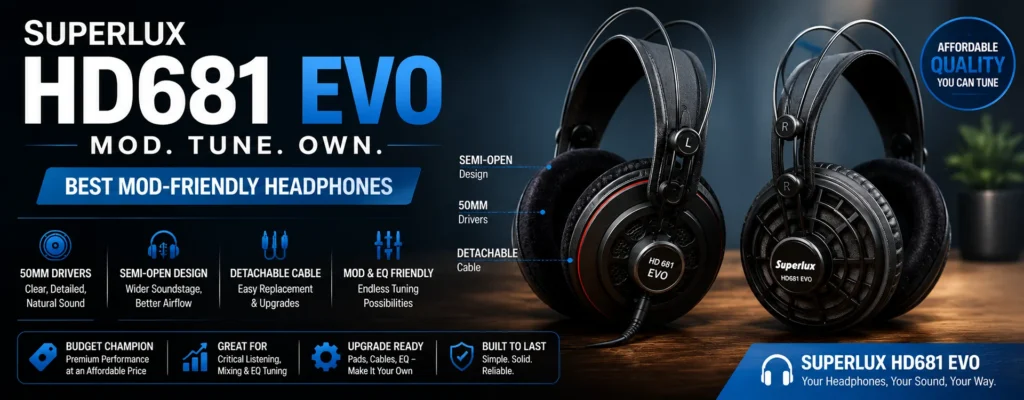
US buyers can find the HD681 EVO around the $30 range from established international music retailers; the current Superlux HD681 family listing provides a useful price and specification checkpoint. Independent measurements and analysis such as the RTINGS HD681 EVO review help explain both its strong value and its build limitations.
A Warmer Evolution With Treble Still in the Conversation
Compared with the leanest bargain studio models, the EVO supplies substantial bass. Kick drums have weight, bass guitars are easy to follow, and electronic music avoids the hollow quality of some open headphones. The warmth can slightly obscure lower-mid detail in dense tracks, but it also makes the headphone enjoyable without an amplifier.
Treble remains lively. Depending on fit, pad choice, and recording, it can sound crisp or sharp. The combination of strong bass and bright upper energy produces a broad, entertaining V-shaped tendency rather than strict neutrality. Vocals remain clear enough for ordinary listening, although the ATH-R30x and M30x offer more dependable midrange judgment.
Semi-Open Stage and Separation
The HD681 EVO creates more air than most closed headphones at its price. Stereo width is generous, and simple arrangements have distinct placement. Dense music exposes its limits: separation softens, and the tonal extremes can distract from the center. Those compromises are reasonable at the price and improve with careful EQ.
For games, the stage supports directional awareness, but there is no integrated microphone or platform control. A dedicated product from our best gaming headsets guide remains more convenient for multiplayer communication.
Why Pads and EQ Matter More Here
The EVO is often supplied with more than one pad option, depending on region and package. Pads alter the distance from ear to driver, seal, and absorption, so they can meaningfully change bass and treble. Velour-style material may breathe better but reduce seal; pleather-style pads may increase low-end pressure and heat. There is no universally correct choice.
EQ should begin with small moves. Lowering a bright peak by a few decibels is more reliable than applying dramatic boosts across the spectrum. Avoid boosting deep bass aggressively from a weak phone output, because digital gain and driver excursion can create distortion. The goal is comfort and balance, not turning a $30 headphone into a theoretical measurement target at any cost.
Superlux HD681 EVO Key Specifications
| Specification | Detail |
|---|---|
| Acoustic design | Semi-open, over-ear |
| Driver | 50mm dynamic |
| Impedance | Approximately 32 ohms |
| Sensitivity | Approximately 98dB SPL, retailer specification |
| Tuning direction | Warm bass with lively treble |
| Cable | Detachable at headphone via short lead/system design |
| Pads | Package may include multiple pad materials |
| Isolation | Low |
| Build | Lightweight plastic and suspension frame |
| Amplifier required | No |
Superlux HD681 EVO Pros and Cons
| Pros | Cons |
|---|---|
| Remarkable sound value near $30 | Flimsy materials and limited finish quality |
| Satisfying bass for a semi-open design | Bright treble may require EQ |
| Spacious presentation | Minimal isolation and audible leakage |
| Pad and EQ changes produce clear results | Fit and package contents can vary |
| Replaceable cable arrangement | Not a trustworthy neutral mixing reference out of the box |
Expert Recommendation: Buy the HD681 EVO as an affordable platform, not as a finished luxury product. Set realistic durability expectations, protect the frame, and use restrained EQ before spending on accessories.
If the lowest possible cost matters more than polish, compare our best budget headphones under $50 and full budget headphones collection. Listeners who do not enjoy adjusting pads or EQ should spend more on the ATH-R30x or FiiO JT1 instead.
Monoprice Modern Retro-Best Budget Audiophile Headphones for Bass Lovers
Overall Rating: 8.0/10
Award: 🔊 Best for Bass Lovers
Best For: Hip-hop, electronic music, movies, relaxed home listening, and buyers who want a large closed headphone for around $30
The Monoprice Modern Retro closes this ranking with a reminder that audiophile listening does not require emotionally neutral sound. This oversized closed-back headphone is built around generous low-frequency output, large pads, and a simple wired signal path. It is not the model for making final mastering decisions, but it can reveal bass texture and deliver physical musical impact without the codec losses, battery aging, or processing artifacts of a similarly priced wireless product.
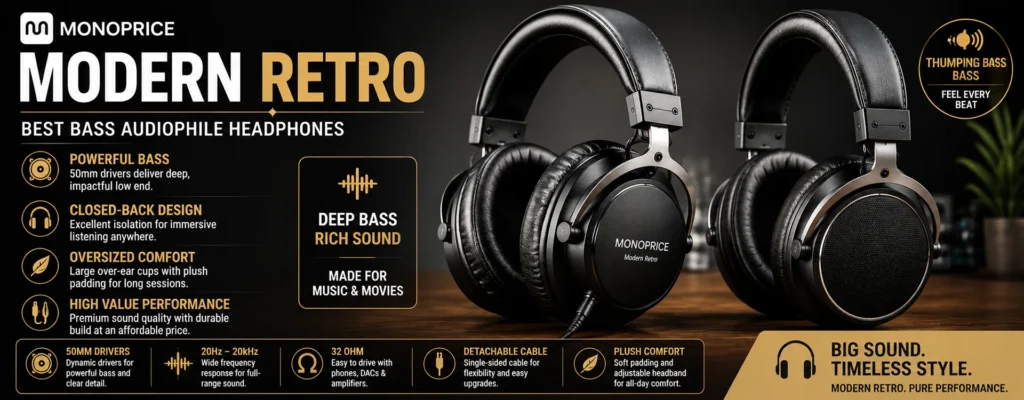
Monoprice currently lists the Modern Retro at $29.99. The official Monoprice Modern Retro page is the best reference for live US price, stock, and package details. The price is low enough to leave room for replacement pads, but buyers should listen with the stock configuration before modifying anything; pad swaps can transform bass quantity, stage, and treble balance.
Low-End Authority With a Relaxed Center
Bass is the central feature. Sub-bass extends with more authority than on the open and semi-open choices, while mid-bass gives drums and bass synths a large physical footprint. The presentation is entertaining and forgiving, particularly with contemporary genres and movies. Bass notes are not as tightly separated as on a more expensive reference headphone, yet the Modern Retro avoids the one-note boom of many novelty products.
The midrange sits farther back relative to the lows. Vocals remain intelligible but do not command the same attention they receive from the ATH-R30x or KPH40. Treble adds enough edge to prevent total darkness, though pad seal and fit can change the perceived balance substantially. Listeners who want vocal accuracy should choose another model; listeners who want a comfortable, cinematic wall of sound may enjoy this tuning more.
Closed-Back Scale and Imaging
Despite the sealed cups, the Modern Retro sounds larger than many compact closed headphones. Its physical cup volume and angled fit can create a broad left-right field. Image precision is adequate for music and movies rather than surgical. Layered orchestral recordings reveal less depth and organization than the open leaders, but electronic ambience and soundtrack effects can feel impressively expansive for the price.
The cups provide some passive isolation, though the large pads and variable seal prevent it from matching the HD 280 Pro. It is better for a shared room than the SHP9500, not ideal for airplanes or loud transit. Buyers prioritizing travel should examine our noise-cancelling headphones under $100 and noise-cancelling headphones category.
Big Comfort, Big Chassis, Fixed Cable
The circumaural pads are roomy, and clamp is generally manageable. The closed pads retain heat, while the very large frame makes the headphone unsuitable for a small bag. This is a couch, desk, or home-theater model not a discreet commuter accessory.
The long fixed cable is the clearest ownership weakness. It provides reach for home audio systems but cannot be replaced as easily as the FiiO or OneOdio cables. Store the cable in broad loops, avoid rolling chair wheels, and do not carry the headphone by the cord. The low purchase price makes repair economics difficult, so prevention matters.
Monoprice Modern Retro Key Specifications
| Specification | Detail |
|---|---|
| Acoustic design | Closed-back, over-ear |
| Driver | 50mm dynamic |
| Frequency response | 15Hz–25kHz stated |
| Impedance | 32 ohms |
| Sensitivity | 94dB ±3dB |
| Sound direction | Strong bass, relaxed mids, lively upper detail |
| Fit | Large circumaural pads |
| Cable | Fixed 3.0m cable |
| Connector | 3.5mm source connection; check package for adapter |
| Isolation | Light to moderate, seal dependent |
| Portability | Low; oversized and non-folding |
| Microphone | No |
| Amplifier required | No |
Monoprice Modern Retro Pros and Cons
| Pros | Cons |
|---|---|
| Deep, powerful bass at a remarkably low price | Bass is too elevated for neutral monitoring |
| Large, comfortable earcups | Recessed midrange compared with reference picks |
| Spacious impression for a closed design | Fixed cable |
| Easy to drive | Oversized frame is poor for travel |
| Excellent movie and modern-music value | Build and finish reflect the low cost |
Pullquote: The Modern Retro is the fun specialist a wired bass headphone that understands enjoyment is a valid form of fidelity when the listener knows the tuning is intentional.
Buy it when low-frequency scale matters more than strict neutrality. Skip it for vocal editing, classical balance, or portable use. Shoppers considering inexpensive wireless bass alternatives can compare the wireless headphones under $100 guide and our wider wireless headphone recommendations.
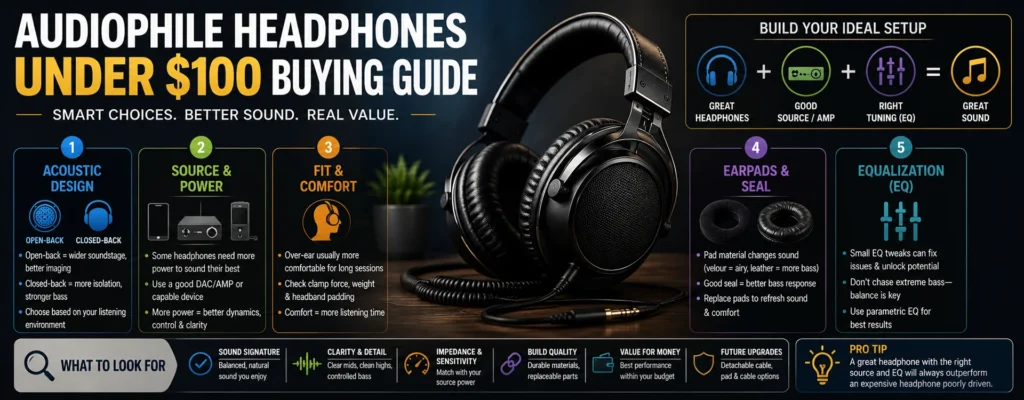
Build Your Under-$100 Hi-Fi System-A Buyer’s Guide That Starts With the Room
The headphone is only one part of the listening system. The room’s noise level, whether another person is nearby, the output device, the listener’s anatomy, and even the condition of the earpads can change the result more than a minor specification difference. This section turns those variables into a decision process so the final choice reflects how the headphone will actually be used.
Step 1: Decide Whether Sound Can Escape
Open-back headphones allow air and sound to pass through the rear of the driver. That reduces enclosed-cup reflections and often creates a more natural stage, but it also allows room noise in and music out. A partner across a quiet room may hear the song clearly. A microphone may capture the backing track. A passing vehicle or air conditioner may mask low-level musical details.
Closed-back headphones surround the rear of the driver with a sealed cup. They usually isolate better, retain more low-frequency pressure, and work in more environments. The enclosure can also introduce resonances, heat, and a narrower stage. Neither design is inherently more audiophile; each solves a different acoustic problem.
Semi-open headphones sit between those concepts mechanically, but not necessarily halfway in behavior. The Samson and Superlux still leak enough to disturb a quiet room and do not isolate enough for commuting. Treat them as home headphones with a slightly more contained presentation not as privacy solutions.
| Environment | Recommended design | Strongest pick here |
|---|---|---|
| Private, quiet room | Open-back | Audio-Technica ATH-R30x |
| Shared room at moderate volume | Closed-back | FiiO JT1 |
| Live microphone recording | Closed-back with strong seal | Sennheiser HD 280 Pro |
| Warm home office | Lightweight open/on-ear | Koss KPH40 Utility |
| Noisy commute or flight | Wireless ANC may be better | Consult our ANC guides |
| Late-night movie listening | Closed-back with fuller bass | Monoprice Modern Retro |
For deeper category comparisons, use the noise-cancelling headphones hub and audiophile headphones hub as complementary paths rather than assuming one technology replaces the other.
Step 2: Choose a Tonal Priority, Not a Marketing Adjective
Terms such as “crystal clear,” “high resolution,” and “studio quality” are not standardized sound signatures. Translate the purchase into priorities:
- Neutral or balanced: Bass, mids, and treble feel proportionate. Choose the ATH-R30x.
- Spacious and airy: Stage width and open ambience matter most. Choose the SHP9500.
- Warm and musical: Bass body and relaxed enjoyment matter. Choose the FiiO JT1 or KPH40.
- Analytical and bright: Transients and upper detail receive extra attention. Choose the Monitor 80 or SR850.
- Isolation-first monitoring: Speech, edits, and bleed control matter. Choose the HD 280 Pro.
- Bass-forward entertainment: Low-frequency impact is the goal. Choose the Modern Retro.
No label removes preference from the equation. A headphone can measure closer to a target and still be uncomfortable or poorly suited to the listener’s room. Conversely, a colored headphone can be the most satisfying choice when its coloration supports the music and use case.
Step 3: Understand Impedance and Sensitivity Together
Impedance, measured in ohms, describes how the headphone resists alternating current. Sensitivity describes how loudly it plays for a given electrical input. Impedance alone does not tell you whether a headphone is easy to drive. A low-impedance headphone with low sensitivity may need more current; a higher-impedance but sensitive model may reach adequate volume from common hardware.
Most selections here work from normal laptops, audio interfaces, game controllers, and competent USB-C dongles. The ATH-R30x’s 92dB/mW sensitivity means it benefits more from a healthy output than the 101dB Koss or Philips. The HD 280 Pro’s 64-ohm load is not extreme, but a weak phone adapter may offer less headroom than a desktop interface.
You need a better source when normal listening volume requires nearly maximum output, dynamic peaks sound compressed, bass loses control, or audible hiss and channel imbalance appear. You do not need an amplifier merely because an enthusiast forum says every wired headphone deserves one.
Expert Tip: Buy a headphone first. Use it with the clean sources you already own. Add a modest dongle or interface only when you can identify a real limitation. Spending half the headphone budget on an amplifier before listening reverses the value equation.
Step 4: Do Not Confuse Volume With Quality
A louder comparison often sounds more detailed and exciting, even when the devices are otherwise similar. When comparing two headphones, match perceived loudness as closely as possible and switch several times. Listen for bass pitch, vocal texture, cymbal decay, image stability, and comfort not only the immediate “wow” effect.
Keep listening levels moderate. The US National Institute on Deafness and Other Communication Disorders explains that noise exposure risk depends on both intensity and duration. Its guidance on noise-induced hearing loss and how loud is too loud is more important than any upgrade recommendation. Open headphones can tempt users to raise volume in noisy rooms; the safer response is to move, reduce the noise, or use an isolating design.
Step 5: Treat Fit as Part of Frequency Response
Headphone measurements use standardized fixtures, but real heads vary. Pad seal, ear shape, glasses, hair, headband position, and driver angle change the acoustic path. Closed headphones lose bass when the seal breaks. On-ear headphones change with pressure. Open headphones are less seal-dependent but still respond to pad compression and positioning.
Use this fit check after unboxing:
- Center each ear inside or beneath the pad as intended.
- Adjust both headband sides symmetrically.
- Play a familiar track with steady low bass.
- Press the cups gently toward the head.
- If bass changes dramatically, inspect glasses, hair, and pad seating.
- Move each cup slightly forward and backward to find the most even treble.
- Wear the headphone for at least thirty minutes before deciding on comfort.
Do not aggressively bend plastic headbands. Metal bands such as the KPH40’s can tolerate careful shaping, while molded frames may crack or permanently weaken.
Step 6: Evaluate Pads Before Blaming the Drivers
Pads are acoustic components and wear items. As foam compresses, the ear moves closer to the driver, seal changes, and treble or bass can shift. Used headphones with flattened pads may sound unlike a new review sample. Replacing pads can restore the intended balance, but third-party materials may create a different sound.
Velour and fabric generally breathe better and leak pressure. Pleather can seal more strongly and increase bass, but also traps heat. Hybrid pads try to balance those effects. There is no guaranteed upgrade material. If accuracy matters, begin with manufacturer replacement pads.
Step 7: Check Cable Design Against Your Desk
A fixed three-meter cable is sensible beside a mixing console and irritating beside a phone. A detachable cable is easier to replace, yet proprietary connectors can be costly or difficult to source. Standard 3.5mm earcup sockets, such as the Philips arrangement, are especially convenient. Dual-entry cables reduce shared internal wiring but add connectors to both cups.
Before buying, ask:
- Is the cable fixed or detachable?
- Is the earcup connector standard or proprietary?
- Is the cable straight or coiled?
- Can a replacement be purchased in the US?
- Does the source use 3.5mm, 6.3mm, USB-C, or an audio-interface output?
- Will a microphone be needed?
Cable “sound” should not be a budget priority. A properly functioning, correctly wired cable of sensible construction is enough. Spend on replacement pads, music, or a reliable source before boutique wire.
Step 8: Use EQ as a Fine Tool
Equalization can reduce a bothersome peak, restore a little bass lost to preference, or align two devices more closely. It cannot fix poor comfort, rattling drivers, severe channel imbalance, lack of isolation, or limited maximum output. Start with narrow problems and small changes.
A safe beginner workflow is:
- Listen for several days without EQ.
- Identify one repeatable issue across multiple recordings.
- Reduce the offending region by 2–3dB.
- Recheck at matched volume.
- Avoid large bass boosts unless enough digital headroom is available.
- Save the original profile for comparison.
The SR850 and HD681 EVO benefit most obviously from careful treble adjustment. The ATH-R30x generally requires less intervention. The JT1 and Modern Retro may benefit from a modest bass reduction for analytical listening, but their elevated low end is part of their intended appeal.
Step 9: Separate Music Listening From Production Claims
A headphone can be wonderful for music and imperfect for mixing. Mix decisions require translation: the result should work on speakers, earbuds, cars, and other headphones. No single $100 headphone guarantees that outcome. Beginners should cross-check with familiar speakers, reference tracks, and multiple playback systems.
Closed headphones are useful for tracking because they control bleed. Open headphones are useful for judging space because they reduce cup coloration. A small studio may reasonably own both a closed workhorse and an open second opinion. The combination of ATH-M30x plus KPH40 or HD 280 Pro plus ATH-R30x can be more informative than one feature-heavy wireless model.
Creators can also compare the best gaming headsets under $100 when microphone integration matters and the best budget headphones when strict audiophile priorities are secondary.
Step 10: Use a Five-Track Audition Instead of Random Skipping
Choose five familiar recordings with different demands:
| Track type | What to inspect |
|---|---|
| Sparse vocal recording | Natural voice tone, sibilance, room noise |
| Bass-led modern track | Sub-bass extension, pitch definition, masking |
| Dense rock or metal track | Separation, congestion, cymbal fatigue |
| Live acoustic performance | Stage, ambience, applause, image placement |
| Orchestral or soundtrack piece | Dynamic scaling, depth, layered positioning |
Use the same sections, match volume, and write short observations. Do not chase a headphone that wins every trait; identify which compromises disappear during actual enjoyment.
A Practical $100 Allocation
| Situation | Headphone budget | Accessory budget | Sensible allocation |
|---|---|---|---|
| Laptop has a clean 3.5mm jack | $80–$100 | $0–$20 | Buy the better-fitting headphone first |
| Phone has USB-C only | $70–$90 | $10–$20 | Add a reputable basic dongle |
| Home studio already has an interface | Full $100 | $0 | Use the interface headphone output |
| Pads wear quickly | $60–$80 | $20–$40 | Reserve money for official replacements |
| Unsure about open vs closed | $30–$50 each | $0 | Buy two complementary budget models |
Audiophile Headphones Under $100 FAQ-18 Straight Answers
The questions below address practical points that specifications and rankings cannot settle alone. For more category context, visit our best audiophile headphones guide and best audiophile headphones under $200.
1. Can headphones under $100 genuinely sound audiophile-grade?
Yes, if “audiophile-grade” means a serious focus on tonal balance, low distortion at normal levels, imaging, comfort, and recording detail. They will not offer every refinement of premium models. Materials may be simpler, cables may be fixed, and stage depth or microdetail may be limited. A well-chosen budget model can still provide an honest high-fidelity experience.
2. What is the best overall audiophile headphone under $100?
The Audio-Technica ATH-R30x is our best overall choice for quiet-room listening because it combines balanced tuning, realistic imaging, low weight, and manageable source requirements. Buyers who need isolation should choose the FiiO JT1 or Sennheiser HD 280 Pro instead.
3. Are open-back headphones always better for sound quality?
No. Open backs often sound more spacious and avoid some enclosure resonances, but they lose isolation and deep-bass pressure. A well-tuned closed headphone can provide excellent detail, stronger sub-bass, and more consistent listening in a noisy environment. The room determines which advantage matters.
4. Which model is best for bass?
The Monoprice Modern Retro offers the greatest bass quantity, while the FiiO JT1 provides a better balance between impact and overall clarity. Choose the Modern Retro for cinematic fun and the JT1 for a more versatile music-first system.
5. Which headphone is most comfortable for long sessions?
The Koss KPH40 Utility creates the least weight and heat, provided you tolerate on-ear foam. Among full-size models, the ATH-R30x is notably light and breathable. Fit remains personal, so buy from a retailer with a clear return policy.
6. Do I need a headphone amplifier?
Usually not for the models in this guide. A clean laptop jack, audio interface, or competent USB-C dongle is sufficient. Consider a stronger source only if normal listening requires near-maximum volume, dynamic peaks flatten, or the output produces noise and imbalance.
7. Will a USB-C dongle improve sound?
It can improve sound when the existing jack is noisy, weak, distorted, or absent. It will not automatically transform a competent source. A basic reputable dongle with sufficient output is usually more rational than an expensive portable amplifier for a sub-$100 headphone.
8. Which pick is best for mixing music?
The ATH-R30x is the most balanced open option for learning, while the HD 280 Pro is better for tracking and checking isolation-related problems. Neither should be the only reference. Use familiar tracks, speakers, and a second headphone to verify translation.
9. Which headphone is best for recording vocals?
The Sennheiser HD 280 Pro is the best option here because its closed cups and strong passive attenuation reduce backing-track bleed into the microphone. Open and semi-open headphones should not be used near a sensitive live mic when leakage matters.
10. Can these headphones work for gaming?
Yes. The SHP9500, ATH-R30x, Monitor 80, and SR850 provide useful directional cues. They lack integrated microphones, chat mixers, and console controls. Add a separate microphone only if the total setup remains simpler and cheaper than a suitable gaming headset.
11. Why are there no Bluetooth-first winners?
At this budget, wired designs can devote more cost to drivers, pads, and structure. They also avoid battery wear, codec negotiation, latency, and DSP dependence. Bluetooth may still be the better practical choice for commuting or calls; it simply optimizes a different set of priorities.
12. Does a wider frequency-response number mean better sound?
No. Stated bandwidth does not reveal tonal balance, distortion, channel matching, stage, comfort, or how the response was measured. Human hearing also does not turn a 40kHz upper specification into automatically superior audible detail. Use frequency range as a basic specification, not a ranking system.
13. Are 50mm drivers better than 40mm drivers?
Not inherently. Driver diameter influences design possibilities, but diaphragm material, motor strength, damping, enclosure, pad geometry, and tuning determine the final sound. The 40mm ATH-R30x can be more balanced than larger-driver competitors.
14. Should I replace the stock pads?
Replace pads when they are worn, uncomfortable, or damaged. Do not assume third-party pads are a neutral upgrade. Thickness, material, and opening size alter seal and driver distance, which can change bass and treble substantially. Keep the original pads for comparison.
15. Is buying used a good way to reach a higher tier?
It can be, but inspect pad condition, headband cracks, cable strain, channel balance, odors, and driver rattling. Budget for new pads. Used pricing and warranty protection vary, so this guide ranks products that qualify new rather than depending on uncertain secondhand deals.
16. Which headphone is best for glasses wearers?
The KPH40 avoids a sealed over-ear pad and usually interferes less with glasses. The SHP9500’s gentle clamp is another good option. Closed headphones may lose bass when thick temples break the pad seal, so fit testing is particularly important.
17. How long should these headphones last?
Life span depends on cable care, hinge design, pad replacement, storage, and usage. A detachable cable and available pads improve serviceability. Even fixed-cable models can last years when stored carefully, kept dry, and protected from chair wheels, pets, and abrupt yanks.
18. What is the smartest first upgrade after buying?
Improve the weakest real link. That may be official replacement pads, a clean $10–$20 dongle, better-quality music files or streaming settings, or a stand that protects the cable. Do not buy an amplifier, premium cable, or exotic accessory without identifying a specific audible or functional problem.
Final Verdict | Choose the Headphone That Fits Your Listening Life
The best audiophile headphones under $100 are not miniature versions of one ideal flagship. They are specialists built around different compromises. Open models trade privacy for air. Closed models trade some stage for isolation and bass pressure. Studio headphones emphasize useful information, while music-first models prioritize flow and impact. The right purchase is the compromise that disappears once the album starts.
The Audio-Technica ATH-R30x earns our overall award because its balance, imaging, low weight, and accessible price make it the most complete introduction to serious listening. It is the first choice for a quiet home setup. The Philips SHP9500 is the better option when a broad stage and low clamp matter most. The FiiO JT1 is the best all-purpose closed alternative for listeners who want energetic bass and shared-room practicality.
Creators should choose by workflow. The Sennheiser HD 280 Pro controls leakage during recording and reveals edit problems. The Audio-Technica ATH-M30x folds more easily for classes and field work. The OneOdio Monitor 80 supplies vivid detail for active desktop listening. Beginners on a tighter budget can learn with the spacious Samson SR850 or experiment with the Superlux HD681 EVO.
Comfort-first listeners should not underestimate the Koss KPH40 Utility. Its minimal mass and coherent tuning can produce more real listening hours than a technically impressive headphone that feels heavy. Bass fans who understand that neutrality is not their goal can buy the Monoprice Modern Retro and enjoy its large, cinematic presentation without apology.
Final Buyer Match Table
| Your situation | Buy this | The decisive reason |
|---|---|---|
| You want one balanced home headphone | Audio-Technica ATH-R30x | Best combination of tuning, imaging, comfort, and value |
| You want the widest-feeling presentation | Philips SHP9500 | Airy open cups and broad stereo scale |
| You need a musical closed design | FiiO JT1 | Bass impact with useful midrange clarity |
| You record voices or instruments | Sennheiser HD 280 Pro | Strong passive isolation and low bleed |
| You enjoy vivid microdetail | OneOdio Monitor 80 | Energetic, revealing desktop presentation |
| You need folding studio practicality | Audio-Technica ATH-M30x | Compact storage and useful monitoring mids |
| You dislike headphone weight | Koss KPH40 Utility | Minimal heat and physical fatigue |
| You are learning critical listening | Samson SR850 | Spacious, revealing sound at a low entry price |
| You want to experiment with EQ and pads | Superlux HD681 EVO | Cheap, responsive mod platform |
| You want maximum bass per dollar | Monoprice Modern Retro | Large low-frequency scale around $30 |
Final Expert Recommendation: Start with environment, then comfort, then tuning. If you listen alone in quiet, buy the ATH-R30x. If other people or microphones share the room, buy the FiiO JT1 or HD 280 Pro. If neither feels physically comfortable, choose the KPH40 and keep listening comfort is not a secondary specification.
Before ordering, confirm the current US price, seller authorization, exact model name, return policy, cable type, and included adapter. If the chosen headphone has risen above $100, wait for a normal discount or select the next match. Our audiophile headphones category and best audiophile headphones under $200 can help determine whether saving for the next tier is worthwhile.
Speaker sensitivity and impedance are two specifications worth checking before making a purchase.
Properly setting amplifier gain is important for getting clean sound from a car audio system.
There are many different ways to improve bass in a vehicle depending on the available space.
Car audio enthusiasts have many options when building a system for daily driving or serious sound.
Understanding speaker impedance is important before choosing an amplifier or subwoofer.
There are many different ways to improve bass in a vehicle depending on the available space.