

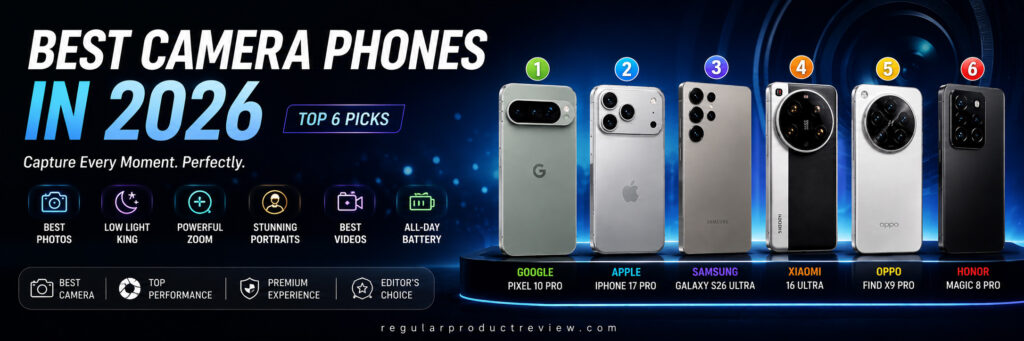
Finding a smartphone with an outstanding camera is more complicated than comparing megapixel counts. Sensor size, lens aperture, autofocus, optical stabilization, focal-length coverage, image processing, video formats, heat management, storage, and the camera app can all affect the result. A phone that is convenient for family photos may not be the best tool for long-form video, distant subjects, or manual shooting.
This guide examines five product names. Four are documented commercial models: Google Pixel 10 Pro, Apple iPhone 17 Pro, Samsung Galaxy S26 Ultra, and OPPO Find X9 Pro. The fifth name, Xiaomi 16 Ultra, could not be matched to an official Xiaomi global product page. Xiaomi officially documents the Xiaomi 15 Ultra and Xiaomi 17 Ultra, so the “16 Ultra” entry is included as a buyer warning—not as a purchase recommendation.
We reviewed official specification pages, launch information, camera hardware, manufacturer-documented recording modes, software support statements, regional availability, and practical ownership factors. We did not run the five phones through the same controlled photo and video tests. Therefore, statements about image quality are framed as hardware- and feature-based buying guidance rather than claims of measured superiority.
If you want a wider selection, see our camera-phone coverage and flagship phones for photography. Always compare current prices, exact model numbers, warranty coverage, storage, carrier compatibility, and return policies before buying.
📋 Quick Comparison Table
| Phone | Documented Camera Hardware | Research-Based Category Fit | Availability / Evidence Status |
|---|---|---|---|
| Google Pixel 10 Pro | 50MP wide, 48MP ultrawide, 48MP 5x telephoto; 42MP front | Google computational-camera tools and point-and-shoot convenience | Officially documented; verify that it still offers the best value against the current Pixel lineup |
| Apple iPhone 17 Pro | Three 48MP rear cameras; 18MP Center Stage front camera | The most extensive documented pro-video toolset among these products | Officially documented; pricing and storage choice materially affect value |
| Samsung Galaxy S26 Ultra | 200MP wide, 50MP ultrawide, 50MP 5x telephoto, 10MP 3x telephoto; 12MP front | Broad focal-length coverage and long-range composition | Officially documented; large body and premium price require consideration |
| Xiaomi 16 Ultra | No official specification page verified | None until the product identity is confirmed | Unverified model name; do not buy or recommend under this name |
| OPPO Find X9 Pro | 50MP wide, 50MP ultrawide, 200MP 3x telephoto, 2MP monochrome; 50MP front | High-resolution telephoto hardware and portrait-oriented modes | Official global model; U.S. buyers must verify seller, bands, warranty, and support |
Evidence boundary: Camera megapixels, focal lengths, recording modes, and battery figures come from manufacturer documentation. They do not prove which phone takes the “best” photo. A defensible image-quality ranking requires controlled, repeatable samples from the same scenes, settings, software versions, and reviewer.
🔬 How We Researched & Selected These Camera Phones
This page is a research- and specification-based guide. The phones were not tested together across daylight, low light, portrait, zoom, video, autofocus, battery, and software scenarios, so the article does not present those areas as measured results.
For this version, we used a research-based method:
- Confirmed that each product name corresponds to an official manufacturer page.
- Checked official camera resolutions, optical focal-length claims, stabilization, video modes, processor, display, storage, battery, and charging information.
- Distinguished optical zoom from “optical-quality,” hybrid, digital, AI-assisted, or manufacturer-branded zoom.
- Considered whether the phone is officially sold in the intended market or may require importing.
- Treated manufacturer battery-duration and image-quality statements as manufacturer claims, not independent findings.
- Removed unsupported star scores and decimal ratings.
- Kept recommendations conditional where controlled side-by-side testing is unavailable.
The site’s broader process is explained in our review methodology. For this page, the important limitation is simple: the comparison is based on documented hardware and features, not an undisclosed hands-on test.
📸 Photography Factors Considered
We considered sensor and lens coverage, autofocus, optical stabilization, macro capability, portrait controls, RAW or high-resolution capture, and manufacturer-described computational tools. These factors help identify use cases, but they cannot establish color accuracy, dynamic range, skin-tone rendering, shutter lag, or low-light quality without controlled samples.
🎥 Video Factors Considered
We compared supported resolutions and frame rates, stabilization features, HDR formats, professional codecs or log capture, external-recording options, microphone features, and storage implications. Supported specifications do not guarantee identical stabilization, thermal behavior, rolling shutter, or sustained recording time.
⚡ Everyday Ownership Factors
Camera buyers should also examine battery capacity, charging accessories, storage tiers, USB transfer speed, software-support period, repair options, warranty, and regional compatibility. High-bitrate video can consume storage quickly, and importing a phone can complicate bands, eSIM, warranty service, and updates.
✅ How to Read the Category Labels
The labels below describe the strongest documented reason to consider each product. They are not claims that one phone won a laboratory test. Buyers who need a definitive image-quality winner should compare full-resolution samples from trusted reviewers and, where possible, test the exact phone during the return period.
📸 Google Pixel 10 Pro
Research-Based Category Fit: Google Camera Tools and Point-and-Shoot Use
⭐ Overview
The Google Pixel 10 Pro combines a 50MP main camera, 48MP autofocus ultrawide, 48MP 5x telephoto, and 42MP autofocus front camera. Google also documents features such as Night Sight, Macro Focus, Real Tone, High-Res Portrait Mode, Pro controls, Camera Coach, and Pro Zoom up to 100x.
That combination gives the Pixel broad coverage for ordinary snapshots, portraits, macro subjects, group selfies, and distant framing. However, “up to 100x” is not the same as a 100x optical lens: Google identifies the physical telephoto as 5x optical and describes other ranges using optical-quality and computational processing.
The Pixel’s position here is a research-based category fit, not a measured image-quality win. Compare it with Google’s current phone lineup before paying full price because model availability and pricing change.
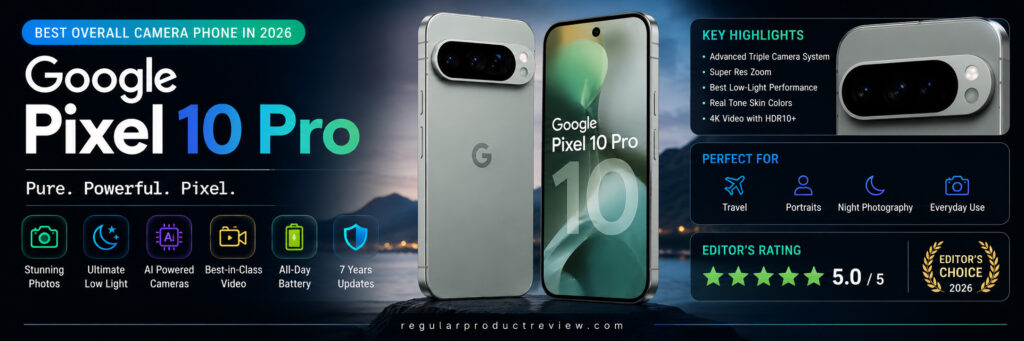
Official-source check: Google’s specification page documents the camera hardware, recording modes, battery, display, Tensor G5 processor, and seven-year OS/security/Pixel Drop update commitment. Feature availability can depend on region, account, language, and software version.
📋 Key Specifications
| Feature | Officially Documented Detail |
|---|---|
| Launch OS / Support | Android 16; seven years of OS, security, and Pixel Drop updates |
| Display | 6.3-inch 1280 × 2856 LTPO OLED, 1–120Hz |
| Processor | Google Tensor G5 with Titan M2 security coprocessor |
| Memory / Storage | 16GB RAM; storage availability varies by market |
| Rear Cameras | 50MP wide + 48MP autofocus ultrawide + 48MP 5x telephoto with OIS |
| Front Camera | 42MP autofocus ultrawide selfie camera |
| Video | Rear 8K at 24/30fps through Video Boost; 4K up to 60fps; front 4K up to 60fps |
| Battery / Charging | 4,870mAh typical; wired fast charging with compatible charger sold separately; Qi2/Pixelsnap up to 15W |
| Authentication | Fingerprint unlock and face unlock |
✅ Documented Advantages
- Three useful rear focal-length classes plus autofocus ultrawide macro capability
- 42MP autofocus front camera with a wide field of view
- Pro controls, RAW/high-resolution options, Night Sight, and portrait tools
- Optical stabilization on the wide and 5x telephoto cameras
- Long official software-support commitment
❌ Limitations and Checks
- 100x Pro Zoom relies heavily on processing beyond the 5x optical lens
- 8K recording uses Video Boost rather than ordinary fully on-device capture
- Charger is sold separately
- A previous-generation model can be poor value if priced close to a newer Pixel
- This guide did not independently measure color, HDR, autofocus, noise, or video stabilization
⚡ Camera Hardware and Expected Use
The 50MP main camera covers everyday framing, while the autofocus ultrawide adds group, landscape, and macro flexibility. The 5x OIS telephoto is the relevant hardware advantage for more distant subjects. Tensor G5 and Google’s camera software support multi-frame processing and editing features, but output preference remains subjective.
☀️ Daylight Photography
The documented wide, ultrawide, telephoto, autofocus, and HDR tools make the Pixel 10 Pro suitable on paper for travel, family, architecture, and street photography. This article does not claim measured superiority in detail or color. Compare original-resolution files—not compressed social-media uploads—if those differences matter to you.
🌙 Low-Light Photography
Google includes Night Sight, astrophotography, optical stabilization, and computational processing. Those tools are relevant to low-light work, but they do not guarantee blur-free subjects or natural-looking noise reduction. Moving children, pets, and people are more demanding than static night scenes.
👤 Portrait Photography
High-Res Portrait Mode, Real Tone, Portrait Light, and the main/telephoto cameras provide several portrait options. Edge detection, hair separation, skin tones, and background blur were not tested side by side for this guide.
🔭 Zoom Photography
The phone has a physical 5x telephoto camera. Google also advertises optical-quality steps and Pro Zoom up to 100x; those higher ranges involve cropping and computation. For wildlife, sports, or concerts, inspect samples at the exact magnification you expect to use.
🎥 Video Recording
Google documents 4K recording up to 60fps, 10-bit HDR, optical/electronic stabilization, Video Boost, and 8K through Video Boost. Creators should check whether cloud-assisted processing, upload time, storage, and supported regions fit their workflow. Our related guide to flagship phones for video editing covers broader creator considerations.
🤳 Selfie Camera
The 42MP front camera includes autofocus and a 103-degree ultrawide field of view, which can help with group framing. Actual skin-tone rendering and indoor detail were not measured here.
💻 Software Experience
The Pixel launched with Android 16 and carries a seven-year update commitment from Google. Camera features can evolve through updates, but some AI tools require supported languages, regions, accounts, or network access.
🔋 Battery Considerations
Google lists a 4,870mAh typical battery and manufacturer-tested “24+ hour” language. Treat that duration as a Google claim; screen brightness, signal, temperature, zoom, video resolution, and battery age can materially change runtime.
🧠 Camera Technology Explained (ELI10)
The Pixel camera works like taking several versions of a scene and using software to combine useful information from them. That can help with highlights, shadows, motion, and noise, but software cannot fully replace light, steady framing, or a longer physical lens.
👤 Who Should Consider It
- Buyers who prefer Google’s camera and editing tools
- Families and travelers who want wide, ultrawide, macro, and 5x options
- Users who value a long official update commitment
- People comfortable with computational photography
🚫 Who Should Avoid It
- Buyers who need more physical telephoto choices
- Creators who require fully local 8K capture
- Shoppers who can buy a newer Pixel for nearly the same price
- Anyone wanting a conclusion based on this site’s controlled camera testing
⚖️ Why It Is Included
Its documented triple-camera hardware, autofocus selfie camera, macro support, and long update policy make it a credible camera-focused option. The evidence supports consideration—not a universal 5/5 score.
🏁 Bottom Line
The Google Pixel 10 Pro is a reasonable research-based fit for buyers who prioritize Google’s camera software, a 5x telephoto, autofocus ultrawide macro, and long support. Confirm current price and compare it with newer Pixel models. No numerical rating is assigned because the phones were not tested under one documented protocol.
Best For: Google camera features, point-and-shoot convenience, macro, portraits, and buyers who value long software support.
🍎 Apple iPhone 17 Pro
Research-Based Category Fit: Most Extensive Documented Pro-Video Toolkit
⭐ Overview
The Apple iPhone 17 Pro has three 48MP rear cameras: a 24mm-equivalent main, 13mm ultrawide, and 100mm-equivalent 4x telephoto. Apple also documents an 18MP Center Stage front camera, ProRAW, Apple Log 2, ProRes and ProRes RAW, ACES support, Genlock, and 4K Dolby Vision recording at up to 120fps on the main camera.
Those specifications make it the clearest pro-video candidate among these products, especially for users already working with Apple devices and compatible editing software. That conclusion is based on the documented recording toolset; this guide did not measure stabilization, heat, battery drain, rolling shutter, autofocus transitions, or color accuracy.
The 17 Pro starts at 256GB, but high-bitrate ProRes/RAW footage can consume storage quickly. Creators should budget for storage, compatible USB-C media, microphones, cages, lights, and editing software rather than evaluating the phone alone.
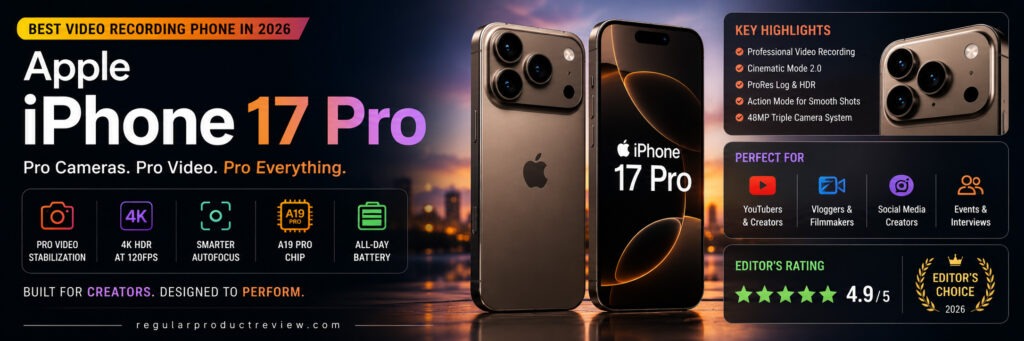
Official-source check: Apple’s technical specifications document the exact camera resolutions, focal-length claims, video formats, battery-duration claims, storage options, charging, and regional model differences.
📋 Key Specifications
| Feature | Officially Documented Detail |
|---|---|
| Launch OS | iOS 26 |
| Display | 6.3-inch 2622 × 1206 Super Retina XDR OLED; ProMotion up to 120Hz |
| Processor | Apple A19 Pro |
| Storage | 256GB, 512GB, or 1TB |
| Rear Cameras | 48MP main + 48MP ultrawide + 48MP 4x telephoto; 8x optical-quality option |
| Front Camera | 18MP Center Stage autofocus camera |
| Video | 4K Dolby Vision up to 120fps on the main camera; ProRes RAW, Apple Log 2, ACES, and Genlock support |
| Battery / Charging | Apple claims up to 33 hours video playback; fast-charge and MagSafe/Qi2 accessories sold separately |
| Protection / Security | IP68; Face ID |
✅ Documented Advantages
- Three 48MP rear cameras covering ultrawide, main, macro, and telephoto use
- Extensive video formats and professional workflow features
- USB 3 transfer support for compatible external recording workflows
- 18MP autofocus Center Stage front camera
- Multiple storage tiers and long-running iOS ecosystem support
❌ Limitations and Checks
- Premium purchase price and potentially high accessory/storage cost
- 8x is described as optical-quality; the dedicated telephoto lens is 4x
- ProRes RAW and 4K120 workflows require compatible storage and editing tools
- U.S. SIM configuration can differ from other regions
- This guide did not independently compare output with the other four entries
⚡ Camera Hardware and Expected Use
The iPhone 17 Pro’s advantage is not simply megapixels. Its documented value lies in consistent feature support across capture, transfer, and post-production: ProRAW for stills, Log/ProRes options for video, external recording, USB 3, ACES, and Genlock. Whether that workflow matters depends on the buyer.
☀️ Daylight Photography
All three rear cameras support high-resolution capture, giving users several framing options. Actual color, HDR, fine detail, and lens matching require identical scene comparisons, which were not performed here.
🌙 Low-Light Photography
Apple documents Night mode and optical stabilization. Low light still increases blur and noise, especially with moving subjects or smaller telephoto sensors. Manufacturer features should not be read as proof of the best night camera.
👤 Portrait Photography
Focus and Depth Control, Portrait Lighting, LiDAR-assisted capabilities, and multiple focal lengths provide a flexible portrait toolkit. Skin tones, edge separation, and bokeh preference remain subjective and were not scored.
🔭 Zoom Photography
The physical telephoto provides 4x optical zoom, while Apple describes 8x as optical-quality. Digital zoom reaches 40x for stills. Buyers who frequently shoot very distant subjects should compare full-resolution 10x, 20x, and higher samples with dedicated long-range alternatives.
🎥 Video Recording
The official specification is unusually broad: 4K Dolby Vision up to 120fps on the main camera, ProRes RAW, Apple Log 2, ACES, Genlock, external recording, four microphones, and USB 3 transfer. These features support professional workflows, but the buyer should confirm accessory compatibility and sustained recording requirements.
🤳 Selfie Camera
The 18MP Center Stage camera includes autofocus, 4K Dolby Vision up to 60fps, ultra-stabilized video, and Dual Capture. Actual indoor quality and skin-tone preference should be checked with current samples.
💻 Software Experience
iOS integrates capture, Photos, AirDrop, external storage, and third-party editing apps. This can be valuable to Apple users, while Android users may prefer a different file-management and customization model.
🔋 Battery Considerations
Apple claims up to 33 hours of video playback, but that is not a camera-recording runtime. 4K120, screen brightness, cellular upload, heat, and external accessories can reduce endurance substantially.
🧠 Camera Technology Explained (ELI10)
Think of the iPhone 17 Pro as a camera plus a small production pipeline. It can record in ordinary formats for quick sharing or in larger professional formats that preserve more editing flexibility. The professional modes are useful only if the rest of the workflow can handle them.
👤 Who Should Consider It
- Video creators who need Log, ProRes, external recording, or Genlock
- Existing Apple users who value ecosystem integration
- Buyers who want three high-resolution rear cameras
- Creators prepared to manage large files and accessories
🚫 Who Should Avoid It
- Shoppers seeking the lowest price
- Users who do not need professional recording formats
- Buyers who prefer Android customization
- Anyone who needs an independently verified camera winner from this article
⚖️ Why It Is Included
Among these products, the iPhone 17 Pro has the clearest manufacturer-documented professional video workflow. That supports a category-fit label, not a numerical quality score.
🏁 Bottom Line
The Apple iPhone 17 Pro is the strongest research-based video-workflow candidate here because of its documented Log, ProRes RAW, ACES, Genlock, external-recording, and 4K120 capabilities. Confirm storage and accessory costs before buying. No numerical rating is assigned.
Best For: Mobile filmmaking workflows, creator video, Apple ecosystem users, and buyers who will actually use the professional recording features.
📱 Samsung Galaxy S26 Ultra
Research-Based Category Fit: Broadest Documented Focal-Length Coverage
⭐ Overview
The Samsung Galaxy S26 Ultra combines a 200MP wide camera, 50MP ultrawide, 50MP 5x telephoto, 10MP 3x telephoto, and 12MP front camera. Samsung describes 2x and 10x positions as optical-quality, while 3x and 5x are the dedicated optical telephoto steps.
That distinction matters. Marketing names such as “100x Space Zoom” describe the full digital/computational range, not a 100x optical lens. The two telephoto cameras nevertheless provide more physical focal-length options than the Pixel 10 Pro, iPhone 17 Pro, or OPPO Find X9 Pro.
This makes the S26 Ultra a logical candidate for buyers who frequently frame architecture, travel details, stage events, or distant subjects. It remains a large, expensive phone, and this article does not claim that its 100x output beats every competitor.
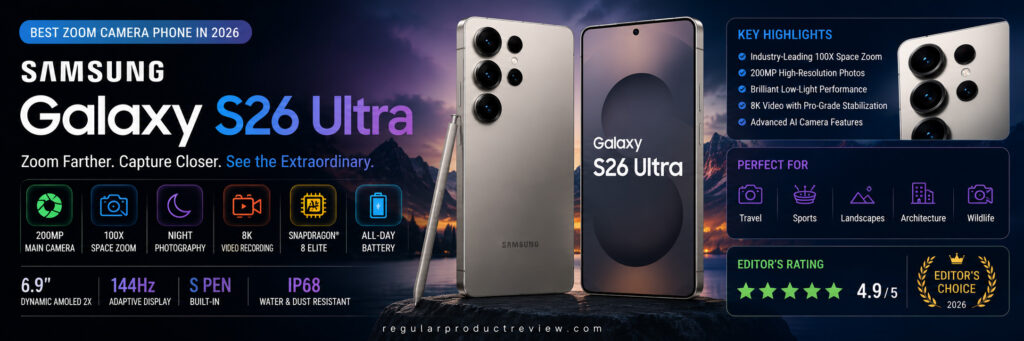
Official-source check: Samsung’s product and launch material documents the four rear cameras, optical versus optical-quality steps, Snapdragon 8 Elite Gen 5 for Galaxy, display, battery, charging, memory, and storage options.
📋 Key Specifications
| Feature | Officially Documented Detail |
|---|---|
| Software | Android with Samsung One UI; verify current version at purchase |
| Display | 6.9-inch QHD+ Dynamic AMOLED 2X, adaptive 1–120Hz |
| Processor | Snapdragon 8 Elite Gen 5 for Galaxy |
| Memory / Storage | 12GB/256GB, 12GB/512GB, or 16GB/1TB; availability varies |
| Rear Cameras | 200MP wide + 50MP ultrawide + 50MP 5x telephoto + 10MP 3x telephoto |
| Front Camera | 12MP |
| Video | Up to 8K30 and 4K120 on supported cameras/modes |
| Battery / Charging | 5,000mAh typical; up to 60W wired; adapter sold separately |
| Zoom Terminology | 3x and 5x optical; 2x and 10x optical-quality; digital Space Zoom up to 100x |
✅ Documented Advantages
- Four rear cameras with dedicated 3x and 5x telephoto lenses
- 50MP ultrawide and 200MP main-camera hardware
- QHD+ 120Hz display for framing and review
- 8K30 and 4K120 modes on supported configurations
- S Pen and Samsung productivity ecosystem may help annotation and editing
❌ Limitations and Checks
- Large body and premium price will not suit every buyer
- 10x is optical-quality, not a dedicated 10x optical lens
- 100x is digital/computational and should not be judged from the number alone
- High-resolution modes can create large files and may have mode limitations
- No controlled image-quality or stabilization comparison was performed here
⚡ Camera Hardware and Expected Use
The physical 0.6x, 1x, 3x, and 5x cameras offer substantial compositional flexibility. That is useful for switching between wide scenes, ordinary subjects, portraits, and distant details without relying immediately on extreme digital cropping.
☀️ Daylight Photography
The main and ultrawide cameras provide high-resolution modes, while the telephoto pair expands framing choices. Samsung’s processing preferences can change by mode and update; detail, saturation, HDR, and sharpening were not scored here.
🌙 Low-Light Photography
Samsung documents wider apertures and processing improvements, but low-light telephoto quality still depends on subject movement, focal length, stabilization, and available light. Review samples from the same software version before purchasing primarily for night events.
🔭 Zoom Photography
This is the clearest hardware reason to shortlist the S26 Ultra. The dedicated 3x and 5x lenses cover intermediate and longer views, with processing extending beyond them. Treat 10x and 100x as different quality categories from true optical capture.
👤 Portrait Photography
Multiple focal lengths can help photographers choose perspective and working distance. Portrait edge detection and skin tones were not tested; those results should be judged from full-resolution samples featuring varied hair, glasses, and lighting.
🎥 Video Recording
Samsung supports up to 8K30 and 4K120 in documented modes. Resolution alone does not establish rolling-shutter control, stabilization, heat, microphone quality, or lens-to-lens consistency, so video specialists should examine controlled footage.
🤳 Selfie Camera
The 12MP front camera supports Samsung’s processing and video features. Megapixel count should not be directly compared with the 18MP, 42MP, or 50MP figures on other phones because sensor, lens, processing, and output resolution differ.
💻 Software Experience
Samsung’s camera app includes many modes and controls. That range may appeal to advanced users but can feel dense to someone who wants only point-and-shoot operation. Software and AI features can vary by region and account.
🔋 Battery Considerations
Samsung lists a 5,000mAh typical battery and manufacturer-tested playback figures. Camera runtime will vary with zoom, 5G upload, display brightness, resolution, stabilization, temperature, and battery age.
🧠 Camera Technology Explained (ELI10)
Think of the S26 Ultra as carrying several fixed camera viewpoints in one phone. The 3x and 5x lenses are real optical viewpoints; the much larger zoom numbers use cropping and software to extend the view further, with increasing quality trade-offs.
👤 Who Should Consider It
- Buyers who value multiple physical focal lengths
- Travelers, event attendees, and architecture photographers
- Samsung users who want S Pen and One UI features
- Users comfortable with a large flagship phone
🚫 Who Should Avoid It
- Buyers who prefer compact phones
- Shoppers who do not need telephoto flexibility
- Anyone interpreting 100x as true optical zoom
- Buyers who need independently measured camera results from this page
⚖️ Why It Is Included
The dual-telephoto layout and four-camera rear system give it the broadest documented focal-length coverage among the verified phones here. That does not justify a universal numerical rating.
🏁 Bottom Line
The Samsung Galaxy S26 Ultra is the research-based zoom and focal-length candidate here. Its 3x and 5x optical cameras are the meaningful hardware points; 10x optical-quality and 100x Space Zoom require more caution. No numerical rating is assigned.
Best For: Buyers who need several physical focal lengths and are comfortable with a large, premium Samsung flagship.
📷 Xiaomi 16 Ultra
Unverified Product Name — Buyer Verification Required, Not Recommended
⭐ Overview
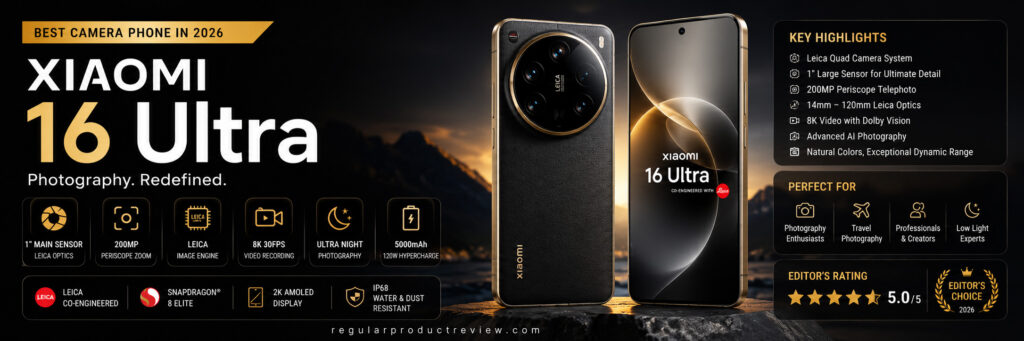
No corresponding official Xiaomi global product or specification page for Xiaomi 16 Ultra was verified during this review. Xiaomi’s official material documents the Xiaomi 15 Ultra and the later Xiaomi 17 Ultra.
Because the exact product identity is not established, claims about its display, processor, cameras, battery, manual controls, image quality, video, and software cannot be treated as facts. A marketplace listing using this name could be mislabeled, unofficial, or confused with another model.
This section is included to prevent readers from treating an unverified name as a buying recommendation.
📋 Key Specifications
| Feature | Verification Result |
|---|---|
| Official Product Identity | Not verified |
| Official Global Product Page | Not found for “Xiaomi 16 Ultra” |
| Camera Specifications | No verified specifications for this product name |
| Processor / Display / Battery | Not verified for this product name |
| Recommendation Status | Do not buy or recommend without an exact model number and matching official page |
| Possible Confusion | Xiaomi 15 Ultra or Xiaomi 17 Ultra |
✅ What Can Be Preserved
- The product name and image provide context for the buyer warning
- The section can help warn readers about ambiguous or inaccurate listings
- Official Xiaomi 15 Ultra and 17 Ultra pages are linked for comparison
❌ Critical Problems
- No verified official identity for Xiaomi 16 Ultra
- No defensible specifications or camera-performance claims
- No basis for a star rating or category award
- High risk of misleading readers or describing a different Xiaomi model
⚡ Camera Performance Status
No performance conclusion is appropriate until the product is identified. Do not transfer specifications from the Xiaomi 15 Ultra or Xiaomi 17 Ultra to a “16 Ultra” listing.
☀️ Daylight Photography
Not evaluated and not verifiable for this product name.
🌙 Low-Light Photography
Not evaluated and not verifiable for this product name.
🔭 Zoom Photography
Not evaluated and not verifiable for this product name.
👤 Portrait Photography
Not evaluated and not verifiable for this product name.
🎥 Video Recording
Not evaluated and not verifiable for this product name.
🤳 Selfie Camera
Not evaluated and not verifiable for this product name.
💻 Software Experience
Not verifiable. HyperOS version, region, languages, services, updates, and bands cannot be assumed without an exact official model.
🔋 Battery Life
Not verifiable. Do not rely on seller-provided capacity or charging claims unless they match an official Xiaomi page for the exact model number.
🧠 Why Product Identity Matters (ELI10)
A phone name is like the model number on a camera lens. If the name is wrong, every specification attached to it may belong to a different product. Confirm the model first; evaluate the camera second.
👤 Who Should Buy It
No reader should buy a phone under this unverified name.
🚫 Who Should Avoid It
Everyone should avoid listings that cannot provide an exact Xiaomi model number, official specification match, warranty, and return protection.
⚖️ Why It Is Included
The entry is included solely to warn readers about an unverified product name and prevent specifications from another Xiaomi model being attached to it.
🏁 Bottom Line
The Xiaomi 16 Ultra is not a valid recommendation in this article unless Xiaomi later provides an official page that exactly confirms the product. At the September 6, 2026 check, official material instead documented Xiaomi 15 Ultra and Xiaomi 17 Ultra. No rating or “best for enthusiasts” award is assigned.
Best For: None until the exact product identity is verified.
📱 OPPO Find X9 Pro
Research-Based Category Fit: High-Resolution Telephoto and Portrait Tools
⭐ Overview
The OPPO Find X9 Pro is a verified global phone with a 50MP main camera, 50MP ultrawide, 200MP 3x telephoto, 2MP monochrome camera, and 50MP autofocus front camera. OPPO also documents Hasselblad modes, portrait options, XPAN, Master mode, Pro Video, 4K120 rear recording, and 4K60 front recording.
Those specifications make portrait, travel, and medium-telephoto shooting plausible strengths. They do not prove natural skin tones, superior edge detection, or better autofocus than the other phones because no controlled sample set was supplied.
U.S. buyers require additional caution. The global specification lists broad bands, but seller warranty, carrier certification, Wi-Fi calling, eSIM behavior, parts, service, and return protection can still differ from an officially supported U.S. model.
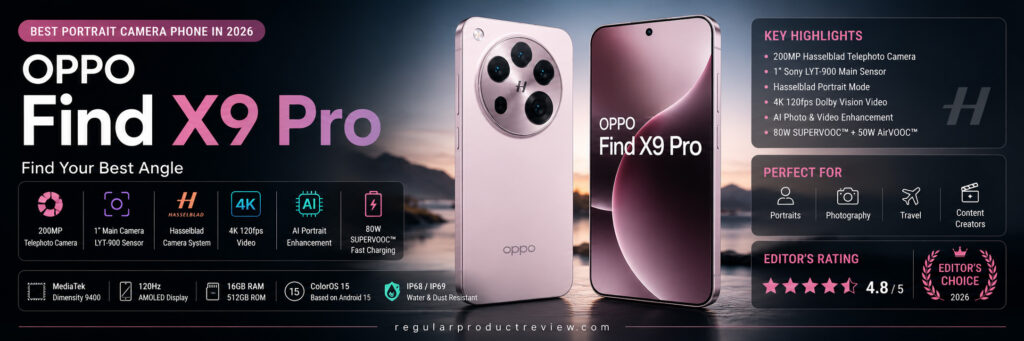
Official-source check: OPPO’s global specification page documents model CPH2791, camera hardware, 4K recording modes, Dimensity 9500, battery, charging, storage, display, bands, and ColorOS version.
📋 Key Specifications
| Feature | Officially Documented Detail |
|---|---|
| Model / Software | CPH2791; ColorOS 16 |
| Display | 6.78-inch 2772 × 1272 AMOLED, up to 120Hz |
| Processor | MediaTek Dimensity 9500 |
| Memory / Storage | 16GB RAM + 512GB UFS 4.1; no microSD |
| Rear Cameras | 50MP ultrawide + 50MP OIS main + 200MP OIS 3x telephoto + 2MP monochrome |
| Front Camera | 50MP autofocus |
| Video | Rear 4K up to 120fps; front 4K up to 60fps; supported HDR/Pro Video modes |
| Battery / Charging | 7,500mAh typical; 80W wired and up to 50W wireless charging |
| Authentication | In-display ultrasonic fingerprint sensor and face recognition |
✅ Documented Advantages
- 200MP OIS telephoto camera with a physical 3x optical position
- 50MP autofocus front camera
- 4K120 rear and 4K60 front video support
- 16GB RAM, 512GB UFS 4.1 storage, and USB 3.2 Gen 1
- Large documented battery and fast wired/wireless charging
❌ Limitations and Checks
- No expandable storage
- Global availability does not automatically mean full U.S. carrier or warranty support
- 200MP resolution alone does not prove portrait or zoom superiority
- Exact network version and seller support must be checked
- No controlled image-quality test was performed for this article
⚡ Camera Hardware and Expected Use
The 3x telephoto camera is a useful portrait and medium-distance focal length, while the ultrawide and main cameras cover broader scenes. Hasselblad-branded modes and Master/XPAN tools expand creative options, but the output should be judged from samples rather than branding.
☀️ Daylight Photography
The three main imaging cameras provide high-resolution capture across wide, standard, and 3x views. Detail, color, HDR, and lens matching were not independently measured.
🌙 Low-Light Photography
The main and telephoto cameras include OIS and OPPO offers Night modes. Those features are relevant, but motion, shutter speed, processing, and smaller secondary sensors still affect low-light results.
👤 Portrait Photography
The 3x telephoto perspective and portrait modes make the Find X9 Pro a reasonable portrait candidate on paper. Skin tones, edge separation, focus reliability, and bokeh rendering need controlled samples featuring varied subjects and lighting.
🔭 Zoom Photography
The dedicated telephoto is 3x optical, while OPPO documents digital zoom beyond it. The 200MP sensor provides cropping flexibility, but megapixel count does not remove the quality trade-offs at long digital zoom ranges.
🎥 Video Recording
OPPO lists rear 4K recording at up to 120fps and front 4K up to 60fps, along with Pro Video, HDR, and stabilization modes. Sustained recording, heat, audio, and autofocus behavior were not measured.
🤳 Selfie Camera
The 50MP front camera includes autofocus and 4K60 support. That is a strong documented specification, but it should not be converted into a quality score without comparative footage.
💻 Software Experience
The phone ships with ColorOS 16. Buyers importing the device should verify languages, preinstalled services, Android Auto, banking-app certification, update policy, and regional feature differences.
🔋 Battery Considerations
OPPO documents a 7,500mAh typical battery, 80W wired, and 50W wireless charging. Runtime and charging speed depend on settings, charger, temperature, camera workload, and local electrical conditions.
🧠 Camera Technology Explained (ELI10)
The 3x telephoto is like stepping closer without physically moving. The 200MP sensor records many pixels, which can help crop flexibility, but lens quality, focus, processing, and light still determine whether the final portrait looks good.
👤 Who Should Consider It
- Portrait and travel photographers interested in a 3x high-resolution telephoto
- Buyers who need 4K120 rear or 4K60 front recording
- Users comfortable with ColorOS and global-device purchasing
- Shoppers who can verify bands, warranty, and return protection
🚫 Who Should Avoid It
- U.S. buyers unwilling to manage import and carrier risks
- Users who need microSD storage
- Buyers who equate 200MP with guaranteed image superiority
- Anyone expecting an independently tested portrait winner from this article
⚖️ Why It Is Included
Its official hardware—particularly the 200MP OIS 3x telephoto and 50MP autofocus front camera—supports a portrait-oriented category fit. A numerical quality score would require documented comparative testing.
🏁 Bottom Line
The OPPO Find X9 Pro is a credible research-based option for portrait and medium-telephoto use, subject to regional compatibility and seller support. Verify model CPH2791, bands, warranty, software, and return terms before importing. No numerical rating is assigned.
Best For: Buyers interested in a 3x high-resolution telephoto and willing to verify global-model ownership risks.
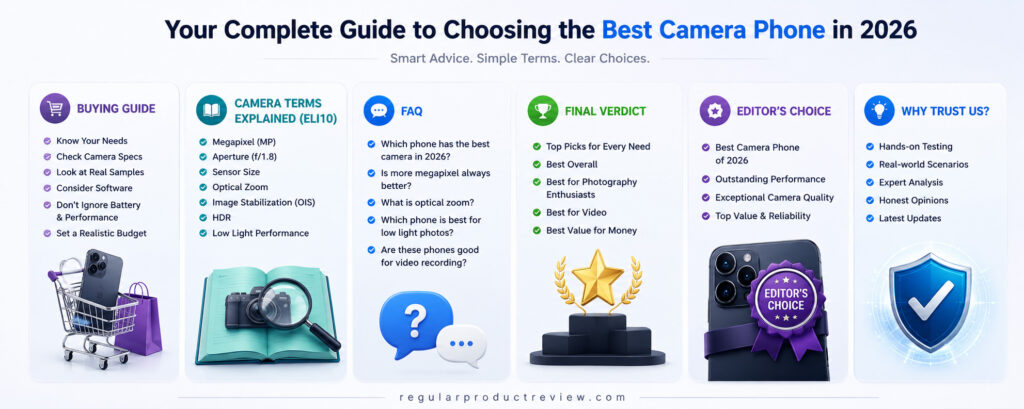
🛒 Buying Guide: How to Choose the Best Camera Phone in 2026
Buying a camera phone is not about choosing the largest megapixel number. The best fit depends on what you photograph, how much control you want, whether you shoot video, and how you store and edit files. Buyers with a strict ceiling can also compare our camera phones under $1,000 or camera phones under $500 rather than stretching to an imported flagship.
📷 If You Want Google’s Point-and-Shoot Tools
Research-Based Fit
Google Pixel 10 Pro
Choose it for Google’s documented computational features, 5x telephoto, autofocus ultrawide macro, 42MP autofocus front camera, and long update policy. Compare its price with the current Pixel lineup before buying.
Best For
- Google camera and editing features
- Families and travel
- Macro and group selfies
- Long software-support preference
🎥 If You Need a Professional Video Workflow
Research-Based Fit
Apple iPhone 17 Pro
The documented combination of ProRes RAW, Apple Log 2, ACES, Genlock, external recording, USB 3, and 4K120 makes it the clearest workflow candidate here. Storage and accessory costs matter.
Best For
- Mobile filmmaking
- Creator video
- External recording
- Apple-based editing workflows
🔭 If Physical Focal-Length Choice Matters Most
Research-Based Fit
Samsung Galaxy S26 Ultra
The S26 Ultra provides dedicated 3x and 5x telephoto cameras in addition to ultrawide and main cameras. Do not confuse 10x optical-quality or 100x Space Zoom with dedicated optical lenses.
Best For
- Travel and architecture
- Events and distant subjects
- Buyers who use several focal lengths
- Samsung/S Pen users
🎨 If You Encounter a “Xiaomi 16 Ultra” Listing
Verification Required
Xiaomi 16 Ultra
Do not buy based on this name. Require an exact model number and an official Xiaomi product page. Xiaomi’s official material currently documents 15 Ultra and 17 Ultra, not a verified 16 Ultra.
Best For
- No recommendation until product identity is verified
👤 If a 3x High-Resolution Telephoto Appeals to You
Research-Based Fit
OPPO Find X9 Pro
Its documented 200MP OIS 3x telephoto, 50MP main/ultrawide cameras, and portrait modes make it worth researching. U.S. buyers must verify model, network, warranty, and return support.
Best For
- Portrait-oriented framing
- Medium telephoto work
- Global-device buyers who understand import risks
📖 Camera Terms Explained (ELI10)
📸 What Is a Camera Sensor?
A sensor collects light. A larger effective light-collecting area can help in difficult conditions, but lens aperture, stabilization, exposure time, processing, and subject movement also affect the image. Sensor size alone does not crown a winner.
🌙 What Is Night Mode?
Night mode usually combines multiple exposures to brighten shadows and reduce noise. It works best when the phone and subject remain relatively still. A brighter result is not automatically a more accurate result.
🔭 What Is Optical Zoom?
Optical zoom uses a physical lens or optical system. “Optical-quality,” hybrid, AI, and digital zoom can include cropping and computation. Always check the wording beside a large zoom number.
🎥 What Is Image Stabilization?
Optical stabilization moves lens or sensor hardware; electronic stabilization crops and adjusts frames with software. Phones may combine both. Stabilization helps but cannot eliminate every step, pan, or fast subject movement.
🎨 What Is HDR?
HDR combines or maps different brightness information so highlights and shadows remain visible. The result can look natural or heavily processed depending on the camera and scene.
🤖 What Is Computational Photography?
Computational photography uses software to combine frames, adjust tone, reduce noise, detect subjects, or reconstruct detail. It can improve difficult images, but it also introduces manufacturer-specific processing choices.
❓ Frequently Asked Questions
Which phone has the best camera in 2026?
This article cannot prove a universal winner because the phones were not tested together. Within the documented hardware, Pixel 10 Pro emphasizes Google camera tools, iPhone 17 Pro has the broadest pro-video workflow here, Galaxy S26 Ultra offers the most physical focal-length choices, and OPPO Find X9 Pro provides a high-resolution 3x telephoto.
Which phone is best for video recording?
The iPhone 17 Pro has the most extensive officially documented professional video feature set among these products. A final choice should still consider stabilization samples, heat, storage, accessories, editing software, and total cost.
Which phone has the best zoom camera?
The Galaxy S26 Ultra has dedicated 3x and 5x telephoto cameras, while the Pixel has a dedicated 5x and OPPO a 3x telephoto. Quality beyond the optical positions depends increasingly on cropping and processing.
Which camera phone is best for portraits?
OPPO Find X9 Pro and the telephoto-equipped Pixel, iPhone, and Samsung all provide portrait tools. No controlled portrait test was supplied, so compare full-resolution samples featuring varied skin tones, hair, glasses, backgrounds, and lighting.
Is a higher megapixel camera always better?
No. Sensor size, lens, focus, stabilization, processing, output resolution, motion, and lighting all matter. A high megapixel figure may also operate in a lower-resolution default mode.
Which camera phone is best for beginners?
The Pixel 10 Pro may appeal to users who prefer Google’s automated camera tools, while iPhone users may prefer Apple’s familiar workflow. Try the camera app in person because interface preference cannot be determined from a specification sheet.
🏁 Final Verdict
The available evidence supports matching verified hardware to a use case rather than assigning every phone four or five stars.
The Google Pixel 10 Pro is the research-based fit for Google’s computational-camera tools and point-and-shoot use. The Apple iPhone 17 Pro has the strongest documented professional video workflow in this list. The Samsung Galaxy S26 Ultra offers the broadest physical focal-length selection, while the OPPO Find X9 Pro is a credible 3x telephoto and portrait-oriented global option with U.S. import caveats.
The Xiaomi 16 Ultra should not be recommended. Its official product identity was not verified, and specifications from Xiaomi 15 Ultra or 17 Ultra must not be transferred to it.
Before paying, compare current price, exact model number, regional bands, storage, warranty, return window, repair access, and recent full-resolution camera samples. A manufacturer’s feature list establishes capability; it does not replace independent evidence.
⭐ Editor’s Choice
No numerical Editor’s Choice score is assigned because the phones were not compared under one documented controlled test. The Google Pixel 10 Pro is the research-based point-and-shoot category fit among the verified products listed here—not a universal best-camera claim.
Why it is the lead research-based option:
- Verified 50MP + 48MP + 48MP rear camera system
- 5x optical telephoto and autofocus ultrawide macro
- 42MP autofocus front camera
- Extensive Google camera and editing features
- Seven-year official update commitment
Readers prioritizing professional video or physical focal-length flexibility should compare the iPhone 17 Pro and Galaxy S26 Ultra instead. No numerical score is assigned.