


Best Noise Cancelling Headphones Under $200: A Smarter Way to Buy
Shopping for the best noise cancelling headphones under $200 has become more complicated and more rewarding. This price range now includes headphones with adaptive active noise cancellation, customizable sound profiles, multipoint Bluetooth, high-resolution wireless codecs, transparency modes, and battery ratings that can stretch beyond 50 hours.
The challenge is that specifications do not always predict the real experience. Two headphones may both advertise hybrid ANC, yet one may suppress airplane-engine rumble effectively while allowing voices and keyboard noise to pass through. Another model might deliver powerful bass and impressive battery life but become uncomfortable after an hour because of its weight, clamping pressure, or shallow ear cushions.
We evaluated this category by prioritizing the qualities that matter during everyday use: noise-cancelling performance, sound quality, long-session comfort, microphone clarity, wireless reliability, battery life, app support, and value below the $200 ceiling. We also considered how each model fits a specific buyer instead of assuming one sound signature or feature set works for everyone.
The Soundcore Space One Pro earns our best-overall position because it offers the most complete balance of adaptive ANC, travel-friendly portability, customizable sound, high-resolution codec support, and practical battery life. The Sony ULT Wear is the stronger choice for listeners who want substantial bass, while the Sennheiser ACCENTUM Wireless prioritizes a more controlled and balanced presentation.
Comfort-conscious buyers should pay particular attention to the lightweight Sony WH-CH720N. Travelers and commuters who care more about endurance can consider the CMF Headphone Pro, which carries an unusually high manufacturer battery rating. Meanwhile, the EarFun Wave Pro, Edifier W830NB, and 1MORE SonoFlow Pro HQ51 demonstrate how much ANC and wireless functionality is now available well below the maximum budget.
Every selected product is an over-ear wireless model, but their strengths vary considerably. Some focus on deeper isolation, some emphasize sound quality, and others trade premium construction for longer battery life or a lower price. Buyers who do not need active noise cancellation can also explore our broader wireless headphones guide.
Prices frequently change through sales, coupons, and retailer promotions. A headphone qualifies for this guide only when its normal or commonly discounted US price stays at or below $200. If your budget is tighter, our guide to the best noise cancelling headphones under $100 covers more affordable alternatives.
Editorial Insight: Do not choose headphones by the advertised ANC label alone. Fit, ear-cup seal, microphone placement, processing quality, and firmware tuning can affect noise reduction as much as the number of microphones.
Quick Summary: Our Top Picks at a Glance
The Soundcore Space One Pro is our leading recommendation for most buyers. It combines strong adaptive noise cancellation with LDAC support, extensive app controls, a foldable travel design, and up to 40 hours of manufacturer-rated playback with ANC enabled.
Choose the Sony ULT Wear if energetic bass is the priority. Its dedicated ULT modes add considerable low-frequency impact, making it especially appealing for hip-hop, electronic music, movies, and workouts. Buyers who prefer a more balanced presentation should consider the Sennheiser ACCENTUM Wireless instead.
The lightweight Sony WH-CH720N is the easiest model to recommend for long workdays, studying, and users sensitive to heavy headphones. The JBL Live 770NC stands out for adaptive features, calls, and everyday smart functionality, while the CMF Headphone Pro leads this group in advertised battery endurance.
Value hunters have several compelling choices. The EarFun Wave Pro provides hybrid ANC and LDAC at a budget-friendly price, the 1MORE SonoFlow Pro HQ51 offers strong high-resolution value, and the Edifier W830NB combines extended battery life with a comfortable fit. The JBL Tune 770NC is a straightforward everyday option with dependable controls, multipoint connectivity, and a familiar bass-forward sound.
Fast Recommendations
- Best overall: Soundcore Space One Pro
- Best for powerful bass: Sony ULT Wear
- Best for balanced sound: Sennheiser ACCENTUM Wireless
- Best lightweight option: Sony WH-CH720N
- Best for calls and smart features: JBL Live 770NC
- Best battery life: CMF Headphone Pro
- Best high-resolution value: 1MORE SonoFlow Pro HQ51
- Best under $100: EarFun Wave Pro
- Best for extended listening: Edifier W830NB
- Best for everyday use: JBL Tune 770NC
For higher-end alternatives without a strict $200 limit, visit our broader guide to the best noise cancelling headphones.
Smart Comparison Table: Best ANC Headphones Under $200
| Product | Award | ANC System | Manufacturer Battery Rating | Audio Highlights | Primary Trade-Off |
|---|---|---|---|---|---|
| Soundcore Space One Pro | Best Overall | Adaptive ANC 3.0 | Up to 40 hours with ANC; 60 hours maximum | LDAC, Hi-Res Wireless, customizable EQ | Warm default tuning may require EQ adjustment |
| Sony ULT Wear | Best for Bass | Active noise cancellation with ambient mode | Up to 30 hours with ANC; 50 hours maximum | LDAC, ULT bass modes, Sony app support | Bass boost can overpower vocals on stronger settings |
| Sennheiser ACCENTUM Wireless | Best for Sound Quality | Hybrid ANC with transparency mode | Up to 50 hours | aptX HD, USB audio, adjustable sound profiles | Less compact than folding travel headphones |
| Sony WH-CH720N | Best for Comfort | Dual Noise Sensor ANC | Up to 35 hours with ANC; 50 hours maximum | DSEE processing, multipoint, lightweight design | Plastic construction and no LDAC support |
| JBL Live 770NC | Best for Calls and Smart Features | True Adaptive ANC with Smart Ambient | Up to 50 hours with ANC; 65 hours maximum | Personi-Fi 2.0, multipoint, spatial sound features | Clamping pressure may feel firm during long sessions |
| CMF Headphone Pro | Best Battery Life | Hybrid adaptive ANC | Up to 50 hours with ANC; 100 hours maximum | LDAC, physical sound controls, customizable tuning | ANC refinement trails the strongest premium-leaning options |
| 1MORE SonoFlow Pro HQ51 | Best Hi-Res Value | QuietMax adaptive ANC | Up to 65 hours with ANC; 100 hours maximum | LDAC, Hi-Res Wireless, app-based EQ | Ear-cup fit may feel shallow for larger ears |
| EarFun Wave Pro | Best Under $100 | Hybrid ANC with ambient mode | Up to 55 hours with ANC; 80 hours maximum | LDAC, multipoint, customizable EQ | Build and microphone performance are more budget-oriented |
| Edifier W830NB | Best for Long Listening Sessions | Hybrid ANC with multiple listening modes | Up to 54 hours with ANC; 94 hours maximum | LDAC, spatial audio mode, app controls | Call quality can become inconsistent in noisy environments |
| JBL Tune 770NC | Best for Everyday Use | Adaptive ANC with Smart Ambient | Up to 44 hours with ANC; 70 hours maximum | Multipoint, JBL Pure Bass, Bluetooth 5.3 | Mostly plastic build and a relatively narrow fit |
Battery figures in this table are manufacturer maximums rather than guaranteed real-world results. Playback volume, codec selection, ANC intensity, call time, temperature, and Bluetooth conditions can reduce runtime.
Models frequently move above or below the $200 threshold. Always confirm the final checkout price, return policy, warranty coverage, and seller authorization before ordering.
Why You Can Trust Our Headphone Recommendations
Our recommendations are based on a consistent editorial framework designed around buyer outcomes not the length of a feature list. Each product must solve a recognizable problem, remain competitively priced, and offer a meaningful advantage over similar headphones.
We separate manufacturer specifications from independently evaluated qualities. Battery ratings, codec compatibility, charging times, and supported features are checked against official US product documentation whenever possible. Subjective qualities such as sound, comfort, ANC behavior, and microphone performance are assessed through repeatable criteria rather than promotional language.
Our selection process also accounts for compromises. A headphone does not receive a top position simply because it offers powerful bass, a large battery number, or several ANC microphones. It must remain practical across the areas that affect daily ownership, including fit, controls, connectivity, app stability, charging, portability, and warranty support.
We do not assume the most expensive model automatically provides the best value. Products closer to $100 can outperform more expensive competitors in battery life or codec support, while upper-limit models may justify their price through stronger ANC, better microphones, improved construction, or more polished software.
Recommendations are not ranked according to brand popularity or commission potential. Each award reflects the buyer for whom that headphone makes the most sense.
How We Evaluate Noise Cancelling Headphones
Our evaluation framework examines seven major performance areas. Direct testing is used when product access is available. Where hands-on access is unavailable, official documentation is combined with verified measurements, comparative research, and recurring ownership feedback. Manufacturer claims remain clearly identified as claims rather than presented as independently measured results.
| Test Category | What We Examine | Score Weight |
|---|---|---|
| Noise cancellation | Reduction of low-frequency rumble, traffic, office noise, voices, and sudden sounds | 30% |
| Sound quality | Tonal balance, bass control, vocal clarity, treble detail, imaging, and EQ flexibility | 20% |
| Comfort and fit | Weight, clamping pressure, ear-cup space, heat buildup, glasses compatibility, and stability | 15% |
| Battery and charging | ANC-on endurance, maximum playback, charging speed, and wired-use options | 10% |
| Call quality | Voice clarity in quiet rooms, offices, traffic, and light wind | 10% |
| Connectivity and controls | Pairing reliability, multipoint, codec support, app quality, buttons, and touch controls | 10% |
| Value | Performance, construction, features, warranty, and price relative to competitors | 5% |
Noise-Cancellation Evaluation
ANC performance is considered across different noise profiles. Low-frequency tests focus on airplane-style rumble, buses, air conditioners, and engine noise. Mid- and high-frequency evaluation considers voices, television audio, keyboards, dishes, and nearby conversations.
We also assess whether ANC introduces uncomfortable cabin pressure, audible hiss, sound-quality changes, or instability when walking and moving between environments. Transparency modes are checked for voice clarity, naturalness, wind sensitivity, and situational awareness.
Sound-Quality Evaluation
Sound is evaluated with EQ disabled before app-based adjustments are applied. The listening selection includes vocal tracks, acoustic instruments, bass-heavy music, dense rock arrangements, podcasts, films, and compressed streaming audio.
We consider detail and tonal balance, but we do not automatically penalize a headphone for having a consumer-oriented sound. A bass-forward model can still earn a recommendation when its tuning suits the intended buyer and the low frequencies remain reasonably controlled.
Comfort and Usability Evaluation
Comfort is assessed during extended listening rather than a brief fitting. Weight distribution, headband padding, clamping force, ear-cup depth, heat buildup, and glasses pressure all influence the result.
Daily usability also includes button placement, folding mechanism, carrying protection, app navigation, voice prompts, automatic pause behavior, wired listening, and how easily the headphones switch between a phone and computer.
Calls, Connectivity, and Battery
Microphone performance is evaluated in both quiet and noisy environments. We pay attention to vocal intelligibility, background suppression, wind handling, sidetone, and whether aggressive processing makes speech sound unnatural.
Connectivity testing covers initial pairing, reconnection, multipoint switching, audio-video synchronization, codec availability, and connection stability. Battery estimates are compared using ANC-enabled playback whenever that figure is available because maximum battery claims often assume ANC is disabled.
How We Selected the Final 10
To qualify for this guide, every headphone had to meet the following requirements:
- US price eligibility: The normal or commonly available promotional price must be $200 or less.
- Active noise cancellation: Basic passive isolation alone does not qualify.
- Over-ear wireless design: The main comparison focuses on Bluetooth over-ear headphones rather than earbuds or on-ear models.
- Practical battery life: The headphones must support extended daily use without unusually frequent charging.
- Reliable availability: Products must be obtainable from the manufacturer or established US retailers.
- Clear buyer advantage: Every selection must lead its category or serve a distinct type of listener.
- Acceptable everyday performance: Major weaknesses in comfort, wireless stability, controls, or app support can outweigh an impressive specification.
- Competitive value: The overall experience must make sense at the current price not only at the original launch price.
We initially considered a broader field of budget and midrange ANC headphones. Products were removed when their US price regularly exceeded $200, availability became unreliable, ANC performance was too limited, or a competing model delivered a more complete experience for the same buyer.
The resulting list is intentionally varied. It includes all-rounders, bass-focused headphones, lightweight models, high-resolution options, battery leaders, and affordable alternatives. Readers primarily concerned with spending as little as possible can also compare our wider selection of best budget headphones.
Selection Principle: The winner is not necessarily the headphone with the strongest ANC or longest battery life. Our highest-ranked products deliver the best overall balance for their intended user while keeping their compromises reasonable.
Soundcore Space One Pro Review: Best Overall Noise Cancelling Headphones Under $200
Overall Rating: 9.1/10
Award: Best Overall Noise Cancelling Headphones Under $200
The Soundcore Space One Pro earns our best-overall recommendation by delivering the most complete combination of active noise cancellation, sound customization, portability, battery life, and everyday features available within this price range.
Its headline feature is Adaptive ANC 3.0, supported by a four-stage noise-cancelling system and six microphones that analyze environmental sound and compensate for changes in fit. This approach is particularly effective against steady low-frequency noise generated by airplanes, buses, trains, air conditioners, and traffic. Voices and sudden higher-frequency sounds are reduced rather than completely eliminated, but the overall isolation is competitive for a headphone capped at $200.
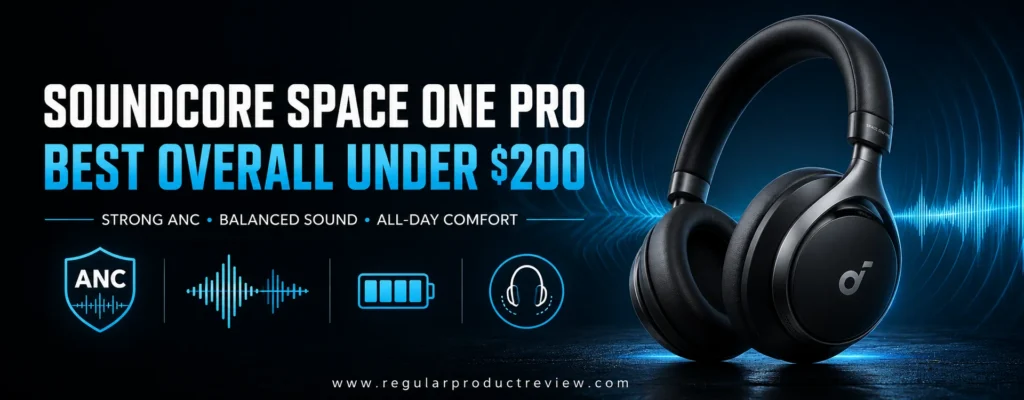
Soundcore also gives listeners significantly more control than many similarly priced competitors. The companion app includes HearID 2.0, an adjustable equalizer, preset sound profiles, ANC controls, transparency settings, Easy Chat, and an optional Dolby sound effect. Android users can activate LDAC for higher-bitrate wireless playback, although doing so disables multipoint connectivity.
The Space One Pro is also designed for frequent travel. Its segmented FlexiCurve structure allows the headband and earcups to fold into a substantially smaller shape. Soundcore says the design reduces the folded size by 50%, making it easier to pack than many conventional over-ear headphones.
There are compromises. At 286.2 grams, it is considerably heavier than the Sony WH-CH720N, and listeners sensitive to weight may notice pressure during extended sessions. Its default sound is energetic and warm rather than strictly neutral, while the strongest ANC systems from more expensive Bose and Sony headphones still perform better against unpredictable voices and sharp environmental sounds.
However, those premium alternatives normally exceed this guide’s price limit. At or below $200, the Space One Pro provides a stronger overall balance than headphones that lead in only one category. Official specifications and current US availability can be confirmed on the Soundcore Space One Pro product page.
Editorial Price Alert: The official US price was $199.99 at the time of review. Buy it at that price or lower, but compare current promotions before ordering because discounted premium headphones can occasionally enter the same range.
Quick Verdict: Feature-Rich ANC Without the Premium Price
The Soundcore Space One Pro is the best option for shoppers who want a versatile pair of ANC headphones rather than a specialist model. It provides strong low-frequency noise reduction, customizable sound, LDAC support, multipoint Bluetooth, clear physical controls, fast charging, and a compact folding mechanism.
Its sound profile is suitable for modern pop, hip-hop, electronic music, movies, and general streaming. Listeners who want greater neutrality can reduce the elevated bass and upper treble through the Soundcore app. HearID 2.0 offers another route by creating a profile based on individual hearing preferences.
The 40-hour manufacturer battery rating with ANC enabled is sufficient for commuting, work, and long-distance travel. A five-minute quick charge is rated for up to eight hours of playback in normal listening mode, making the headphones especially practical when charging time is limited.
Buy it if: You want the strongest all-around combination of ANC, battery life, sound customization, travel portability, and wireless features below $200.
Skip it if: You need the lightest possible headphones, reference-style tuning without EQ, class-leading microphone isolation in heavy wind, or the absolute strongest ANC regardless of price.
Soundcore Space One Pro Key Specifications
| Specification | Soundcore Space One Pro |
|---|---|
| Headphone type | Wireless over-ear headphones |
| Noise cancellation | Adaptive ANC 3.0 |
| ANC design | Four-stage system with six microphones |
| Transparency mode | Yes; adjustable through the Soundcore app |
| Driver design | Triple-composite diaphragm drivers |
| Wireless codecs | SBC, AAC, and LDAC |
| High-resolution audio | Hi-Res Wireless through compatible LDAC devices |
| Spatial effect | Optional Dolby sound effect |
| Custom sound | HearID 2.0, presets, and adjustable EQ |
| Battery with ANC | Up to 40 hours |
| Battery without ANC | Up to 60 hours |
| Fast charging | Five minutes for up to eight hours in normal mode |
| Call system | Four microphones with AI enhancement |
| Multipoint connection | Yes; two devices |
| Wired listening | 3.5mm AUX support |
| Controls | Physical buttons |
| Companion app | Soundcore app for Android and iOS |
| Foldable design | FlexiCurve segmented folding structure |
| Earcup rotation | Up to 180 degrees |
| Weight | 286.2 grams or 10.10 ounces |
| Available colors | Jet Black and Cream White |
| Official US price at review | $199.99 |
Battery results are manufacturer maximums measured under specific conditions. Volume, ANC intensity, LDAC, Dolby processing, EQ, calls, and wireless conditions can reduce actual playback time.
Why the Soundcore Space One Pro Is Our Best Overall Pick
Overall Value Rating: 9.3/10
Several headphones under $200 outperform the Space One Pro in one particular area. The Sony WH-CH720N is lighter, the Sennheiser ACCENTUM Wireless offers more restrained default tuning, and the CMF Headphone Pro advertises longer maximum battery life. The Space One Pro wins because it performs well across nearly every category without creating a major usability weakness.
Its most important advantages include:
- Strong adaptive noise cancellation for commuting and travel
- Useful adjustable ANC and transparency levels
- LDAC support for compatible Android devices
- HearID 2.0 and extensive equalizer controls
- Up to 40 hours of playback with ANC
- Effective five-minute quick charging
- Multipoint connectivity for two devices
- A compact folding structure for travel
- Physical controls that are easy to operate by touch
- AUX support when a wired connection is more practical
The headphones are suitable for commuting, office work, flights, studying, home entertainment, and everyday wireless listening. They can switch between a laptop and phone, suppress steady background noise, handle calls, and fold into a smaller package when the day is over.
That adaptability makes the Space One Pro easier to recommend to a broad audience than a product designed primarily around maximum bass, ultra-low weight, or audiophile tuning. Readers comparing additional designs can explore our complete noise-cancelling headphones collection.
Adaptive ANC 3.0 and Real-World Noise Reduction
Noise Cancellation Rating: 9.1/10
The Space One Pro uses a four-stage approach to noise control. Six microphones identify surrounding sound, the earcup design adds passive isolation, an adaptive algorithm monitors environmental changes and fit, and the drivers are tuned to maintain audio quality while ANC is active.
This system is most effective against consistent low-frequency noise. Airplane cabins, bus engines, train movement, HVAC systems, fans, and road rumble become considerably less distracting. That makes the headphones particularly useful for travelers, students, remote workers, and commuters.
The system also reduces nearby conversations, television audio, and general office activity, although it cannot erase unpredictable higher-frequency sounds completely. Voices may remain faintly audible when no music is playing, which is normal for ANC headphones in this price class.
Soundcore provides two approaches inside the app. Adaptive ANC automatically responds to changes in the environment and minor leakage around the earcups. Manual noise cancellation offers five selectable levels, giving users more predictable control when remaining in one location.
Adaptive ANC is disabled by default, so new owners should open the Soundcore app and activate it instead of assuming the feature is already operating. The adaptive system can take several seconds to analyze a new environment.
Fit remains important. Glasses, hair, hats, and incorrect headband adjustment can break the ear cushion seal and reduce low-frequency isolation. Users should position both earcups evenly and adjust the headband until the cushions fully surround the ears.
Expert Tip: Start with manual ANC at its highest setting during flights or train journeys. Use Adaptive ANC when moving between streets, public transportation, stores, and offices where the noise profile changes frequently.
Transparency Mode and Easy Chat
Transparency mode allows outside sound to pass through the microphones when situational awareness is more important than isolation. It is useful for station announcements, workplace conversations, airport security, or walking near traffic.
The Soundcore app lets users control how much external sound is introduced. The result is practical, although voices can sound slightly processed compared with listening without headphones.
Easy Chat automatically lowers music volume when it detects that the wearer is speaking. Its activation duration can be adjusted to five, ten, or fifteen seconds. This is convenient for brief conversations, but coughing or another sudden sound can occasionally trigger it. Users who experience unwanted activations can disable the feature and switch modes manually.
Sound Quality, LDAC, and HearID 2.0
Sound Quality Rating: 8.8/10
The triple-composite diaphragm drivers deliver an energetic, full-bodied presentation. Bass has substantial weight, vocals remain clear through most recordings, and the treble adds enough presence to prevent the sound from becoming dull.
The default tuning is designed for broad consumer appeal rather than strict neutrality. Low frequencies receive extra emphasis, giving drums, bass lines, movie effects, and electronic music a satisfying sense of impact. The upper frequencies can also sound lively, which adds perceived detail but may become tiring on bright recordings.
Fortunately, the app’s equalizer is one of the Space One Pro’s strongest advantages. Listeners can choose from existing presets or create a custom curve. Reducing the lower bass slightly and smoothing the upper treble can produce a more balanced presentation for acoustic music, vocals, podcasts, and long work sessions.
HearID 2.0 creates a personalized sound profile based on a guided hearing assessment and listening preferences. It will not replace a professionally calibrated audiogram, but it provides an approachable way to create individualized tuning without manually adjusting every frequency band.
LDAC and Hi-Res Wireless Audio
Compatible Android devices can use LDAC for higher-bitrate Bluetooth audio. The improvement is most noticeable with high-quality source files, lossless streaming tiers, and recordings with fine instrumental detail. Standard streaming at lower quality may produce a smaller difference.
LDAC has two important limitations:
- It is not supported by iPhones.
- Activating LDAC disables multipoint connectivity on the Space One Pro.
The optional Dolby sound effect expands the perceived soundstage for films and live performances. However, it cannot operate simultaneously with LDAC, and Soundcore notes that it may slightly compromise sound quality. For music, conventional stereo with LDAC or a customized EQ is usually the better choice.
Listeners who prioritize tonal accuracy over ANC strength should also compare our audiophile headphones under $200 before deciding.
Design, Comfort, and Travel Portability
Design and Comfort Rating: 8.6/10
The FlexiCurve structure distinguishes the Space One Pro from many inexpensive over-ear headphones. The headband uses five flexible segments, while the earcup joints rotate to create a compact folded shape. Soundcore claims this arrangement reduces the headphone’s stored size by 50%.
The folding process requires a particular sequence: rotate the earcups until the left and right markings are visible, fold one side, reposition the opposite earcup, and fold it into alignment. It may feel unfamiliar initially, but the mechanism becomes easier after a few attempts.
Soundcore says the segmented headband underwent 10,000 durability tests. That manufacturer claim is encouraging, although users should still fold and unfold the headphones with reasonable care because the design contains more moving joints than a conventional headband.
Soft ear cushions and a pressure-relieving headband distribute the weight effectively. The earcups provide sufficient room for most ears, while the padding helps create the seal required for effective ANC.
The main comfort concern is weight. At 286.2 grams, these headphones are not exceptionally heavy, but they are noticeably heavier than lightweight alternatives such as the Sony WH-CH720N. Users sensitive to headband pressure may prefer taking short breaks during multi-hour sessions.
The closed-back earcups can also accumulate heat in warm environments. This is common among over-ear ANC headphones and does not make the Space One Pro ideal for intense exercise.
Battery Life and Fast Charging
Battery Rating: 9.2/10
Soundcore rates the Space One Pro for:
- Up to 40 hours with active noise cancellation
- Up to 60 hours in normal mode
- Up to eight hours from a five-minute quick charge
The ANC-enabled rating is enough to cover several workdays, a week of typical commuting, or most round-trip flights without requiring a charger. Users who only activate ANC in noisy environments can extend the interval between charges further.
The five-minute quick-charge feature is particularly valuable before commuting or boarding a flight. The eight-hour figure applies under Soundcore’s normal-mode testing conditions, so enabling ANC, LDAC, Dolby processing, a customized EQ, or high playback volume may reduce that result.
Actual battery life will also vary with call duration, environmental temperature, Bluetooth stability, and battery age. Even with those variables, endurance remains one of the strongest reasons to buy the Space One Pro.
Charging uses USB-C. The headphones also support a 3.5mm wired connection, which is useful with airplane entertainment systems, desktop computers, and devices where Bluetooth is unavailable.
Calls and Microphone Performance
Call Quality Rating: 8.5/10
Four microphones with AI enhancement handle voice calls. In quiet rooms and moderately busy offices, speech remains sufficiently clear for routine meetings, online classes, and personal conversations.
The processing attempts to separate the user’s voice from background noise. It works reasonably well against consistent office sounds and general street activity, but strong wind and competing nearby voices can still affect intelligibility. Buyers who spend most of the day on professional calls may achieve better results with a dedicated boom-microphone headset.
Sidetone can be enabled through the app, allowing the wearer to hear their own voice during a call. This reduces the tendency to speak too loudly when ANC is active.
Bluetooth headset profiles reduce media quality while the microphone is being used, particularly on Windows computers. This is a general Bluetooth limitation rather than a fault unique to the Space One Pro. Users should select the stereo output for music and the hands-free profile when both audio and microphone access are required.
Soundcore App, Controls, and Connectivity
Features and Connectivity Rating: 9.3/10
The Soundcore companion app provides unusually extensive control for this price class. Available settings include:
- Adaptive and manual ANC controls
- Adjustable transparency mode
- HearID 2.0 personalization
- Preset and custom equalizers
- LDAC activation on compatible Android devices
- Dolby sound effect
- Easy Chat
- Sidetone
- Multipoint management
- Firmware updates
- Button customization
- Safe-volume options
Multipoint allows the headphones to remain connected to two devices. For example, users can listen to audio from a laptop and then switch to a phone when a call or mobile video begins. The Space One Pro prioritizes the device that starts playing most recently, although notification sounds can occasionally cause an unexpected switch.
Physical buttons handle power, volume, playback, calls, and ambient sound modes. They are easier to operate while wearing gloves and less prone to accidental commands than large touch-sensitive panels.
The important compatibility trade-off is that LDAC and multipoint cannot operate simultaneously. Users must decide between higher-bitrate Android playback and two-device convenience. The Dolby sound effect is also mutually exclusive with LDAC.
Soundcore Space One Pro Pros and Cons
| Pros | Cons |
|---|---|
| Strong adaptive ANC for commuting and travel | Heavier than several competing headphones |
| Manual five-level ANC control | Default tuning may sound too bass-forward for neutral listeners |
| LDAC and Hi-Res Wireless support | LDAC disables multipoint connectivity |
| HearID 2.0 and extensive equalizer settings | Dolby sound effect cannot operate with LDAC |
| Up to 40 hours with ANC | Voices and sharp sounds are reduced rather than eliminated |
| Five-minute quick charging | Easy Chat can activate accidentally |
| Multipoint connection for two devices | Ear cushions may become warm during extended use |
| Compact FlexiCurve folding design | Folding sequence requires some practice |
| Four microphones with AI call processing | Windy call performance is not class-leading |
| Physical controls and AUX support | Premium Bose and Sony models still provide stronger overall ANC |
Who Should Buy the Soundcore Space One Pro?
| Recommended Buyer | Why It Fits |
|---|---|
| Daily commuters | Adaptive ANC reduces traffic, train, bus, and general urban noise |
| Frequent travelers | Compact folding and long battery life suit flights and luggage |
| Hybrid workers | Multipoint makes switching between a laptop and phone easier |
| Android listeners | LDAC supports higher-bitrate wireless playback |
| Sound customizers | HearID 2.0, presets, and manual EQ offer extensive control |
| Students | ANC, long battery life, and comfortable padding support study sessions |
| Movie and streaming fans | Strong bass and the optional Dolby effect add impact |
| Value-focused shoppers | Delivers premium-style features while remaining within the $200 limit |
Who Should Avoid It?
| Consider Another Headphone If You Need | Primary Limitation |
|---|---|
| The lightest possible fit | The 286.2-gram design may cause fatigue for sensitive users |
| Completely neutral sound out of the box | Default tuning emphasizes bass and lively treble |
| Simultaneous LDAC and multipoint | The two features cannot operate together |
| The strongest ANC available at any price | Higher-priced Bose and Sony flagships remain more effective |
| Professional broadcast-style calls | No dedicated boom microphone |
| Headphones for intense workouts | Closed earcups retain heat and no sports-focused protection is emphasized |
| Maximum simplicity | The extensive app and folding mechanism require initial setup |
| A product costing more than $200 | Its value proposition depends on staying within the article’s price ceiling |
Our Expert Opinion
The Soundcore Space One Pro succeeds because its features work together as a useful package. Adaptive ANC controls environmental noise, the app addresses different sound preferences, multipoint supports daily productivity, and the folding design makes the headphones easier to carry.
Its ANC is strongest against continuous low-frequency sounds rather than unpredictable voices. That still makes it an excellent option for flights, trains, buses, air-conditioned offices, and busy study environments. Transparency mode and Easy Chat add convenience when users need to interact without removing the headphones.
Sound quality is engaging rather than reference-neutral. The elevated bass should appeal to mainstream listeners, while HearID 2.0 and the manual equalizer give more critical users room to refine the presentation. LDAC is valuable for compatible Android devices, but users should remember that enabling it removes multipoint and Dolby functionality.
Comfort is generally good, although the 286.2-gram weight prevents the Space One Pro from winning our lightweight category. The segmented headband distributes pressure effectively, but buyers who are particularly sensitive to weight may prefer the Sony WH-CH720N.
At $199.99 or less, the Space One Pro is a smart purchase for buyers who want premium-style functionality without paying premium-brand prices. Its balance of ANC, sound, customization, battery endurance, and portability earns it the highest overall position in this guide.
Expert Recommendation: Choose the Soundcore Space One Pro if you want one pair of headphones for commuting, flights, work, calls, streaming, and everyday music. Android users should select LDAC for focused music listening and return to the standard codec when multipoint convenience matters more.
Bottom Line: Is the Soundcore Space One Pro Worth Buying?
Yes. The Soundcore Space One Pro is worth buying under $200 because it offers one of the category’s most complete feature combinations. Its Adaptive ANC 3.0 system provides effective low-frequency isolation, while the Soundcore app supplies the customization required to suit different environments and listening preferences.
It is not a flawless replacement for flagship ANC headphones. Bose and Sony’s premium models remain better at suppressing complex environmental sounds, and lighter competitors may feel more comfortable during extremely long sessions. The Space One Pro also requires users to choose between LDAC, multipoint, and the Dolby effect rather than operating all three simultaneously.
Those compromises are reasonable at this price. Few competitors combine strong ANC, Hi-Res Wireless support, a detailed EQ, personalized sound, 40-hour ANC playback, quick charging, two-device connectivity, physical controls, wired listening, and a genuinely compact folding mechanism.
🏆 Award: Best Overall Noise Cancelling Headphones Under $200
Overall Score: 9.1/10
Recommended For: Commuters, travelers, students, hybrid workers, Android users, and listeners who enjoy customized sound
Award Reason: Its strong adaptive ANC, flexible audio controls, long battery life, multipoint connectivity, LDAC support, and travel-friendly folding design create the most balanced overall package below $200.
Sony ULT Wear Review: Best Noise Cancelling Headphones for Bass
Overall Rating: 9.0/10
Award: Best Noise Cancelling Headphones for Bass
The Sony ULT Wear (WH-ULT900N) is designed for listeners who want their music to feel energetic, physical, and unapologetically bass-heavy. A dedicated ULT button provides immediate access to two bass-enhancement modes, allowing users to move from an already powerful presentation to a substantially more forceful low-frequency experience.
ULT1 emphasizes deep bass while preserving more of the original tonal balance. It works particularly well with hip-hop, pop, electronic music, contemporary R&B, and bass-driven movie soundtracks. ULT2 increases the impact further, producing the kind of low-frequency pressure listeners can feel around the earcups. It is entertaining with selected tracks, although its intensity can overpower vocals and finer instrumental details.
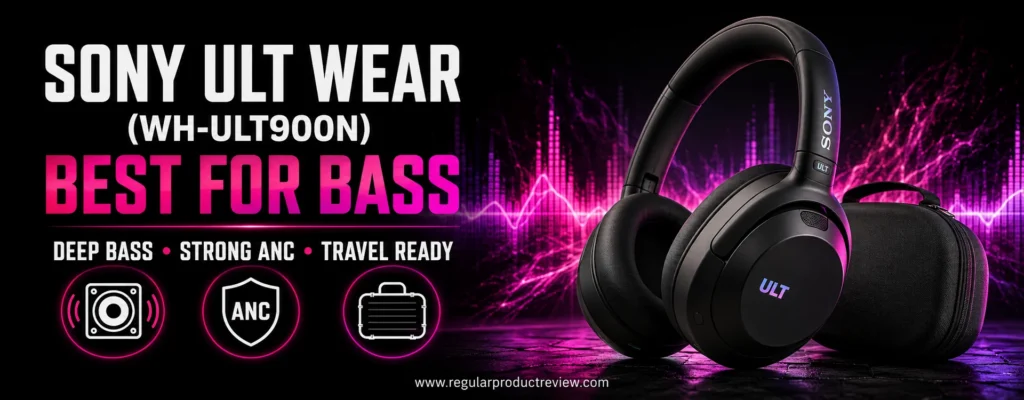
Bass performance is not the only reason to consider these headphones. Sony combines dual noise sensors with its Integrated Processor V1 to reduce commuting, airplane, office, and household noise. The ANC is especially capable against steady low-frequency sounds the same frequencies that can interfere with bass response in busy environments.
The ULT Wear also supports LDAC, DSEE, 360 Reality Audio, multipoint Bluetooth, wear detection, Adaptive Sound Control, wired listening, and customizable equalizer settings through the Sony Sound Connect app. Battery life reaches a manufacturer-rated 30 hours with noise cancellation or 50 hours without it when using AAC or SBC.
At approximately 8.99 ounces, the ULT Wear is lighter than the Soundcore Space One Pro. Sony’s thermo-foaming ear cushions conform comfortably around the ears, while a foldable structure makes the headphones suitable for commuting and travel.
The most important buying consideration is price. Sony lists the ULT Wear at a $249.99 MSRP, placing it outside this article’s limit at full price. However, Sony and major US retailers frequently discount it below $200. It deserves this recommendation only when its final price meets that ceiling.
Official specifications, current promotions, and color availability can be confirmed on the Sony ULT Wear product page.
Editorial Price Alert: Buy the Sony ULT Wear only when the final US price is $199.99 or lower. At its full $249.99 MSRP, shoppers should compare newer premium-leaning alternatives before ordering.
Quick Verdict: Serious Bass with Capable Sony ANC
The Sony ULT Wear is the best noise cancelling headphone for bass in this roundup because its low-frequency performance is powerful, adjustable, and easy to access. The dedicated ULT button lets listeners switch between ULT1, ULT2, and off without opening the companion app.
ULT1 is the most versatile setting. It adds deep, satisfying bass while keeping vocals and percussion reasonably clear. ULT2 is intended for listeners who want maximum impact and do not mind sacrificing some balance. Turning ULT off creates a more conventional Sony sound that can be refined through the app’s equalizer and Clear Bass control.
Noise cancellation is effective for flights, commuting, work, and studying. The headphones also offer a comfortable 8.99-ounce design, touch controls, automatic pause and resume, LDAC, multipoint, and up to 30 hours of battery life with ANC.
Buy it if: You listen to bass-focused music, want engaging sound for movies, and can find the ULT Wear at or below $200.
Skip it if: You prefer neutral sound, require LDAC and multipoint simultaneously, or need maximum battery endurance beyond 30 hours with ANC.
Sony ULT Wear Key Specifications
| Specification | Sony ULT Wear WH-ULT900N |
|---|---|
| Headphone type | Closed-back wireless over-ear headphones |
| Driver unit | 1.57-inch or 40mm dome-type driver |
| Noise cancellation | Dual Noise Sensor technology |
| ANC processor | Sony Integrated Processor V1 |
| Ambient listening | Ambient Sound and Quick Attention modes |
| Bass controls | ULT1, ULT2, off, and adjustable Clear Bass |
| Wireless codecs | SBC, AAC, and LDAC |
| Audio enhancement | DSEE |
| Spatial audio | 360 Reality Audio with supported services |
| Bluetooth version | Bluetooth 5.2 |
| Wireless range | Approximately 32.8 feet under suitable conditions |
| Multipoint | Yes; connects to two devices |
| Battery with ANC | Up to 30 hours using AAC or SBC |
| Battery without ANC | Up to 50 hours using AAC or SBC |
| LDAC battery with ANC | Up to 25 hours |
| LDAC battery without ANC | Up to 40 hours |
| Fast charging | Three minutes for approximately 90 minutes |
| Extended quick charge | Ten minutes for approximately five hours |
| Full charging time | Approximately 3.5 hours |
| Charging connection | USB-C |
| Wired listening | 3.5mm stereo mini jack with passive operation |
| Controls | Physical buttons and right-earcup touch panel |
| Wearing detection | Automatic pause, resume, and power management |
| Companion app | Sony Sound Connect |
| Weight | Approximately 8.99 ounces or 255 grams |
| Available colors | Black, Forest Gray, and Off-White |
| Official MSRP | $249.99 |
Battery ratings come from Sony under defined playback conditions. Volume, ULT mode, EQ, DSEE, voice assistants, LDAC, ANC, calls, and environmental conditions can reduce actual runtime. Detailed technical information is available through the official Sony ULT Wear specifications.
Why the Sony ULT Wear Is Our Best Pick for Bass
Bass Performance Rating: 9.6/10
Many wireless headphones advertise enhanced bass, but the ULT Wear is built around it as a central feature. Sony does not bury the bass adjustment inside a mobile app. A dedicated physical ULT button on the left earcup makes the effect immediately accessible.
The three available settings create meaningfully different listening experiences:
| ULT Setting | Sound Character | Best Use |
|---|---|---|
| ULT Off | More restrained bass with better overall balance | Podcasts, acoustic music, vocals, and long listening sessions |
| ULT1 | Emphasized deep bass with relatively controlled mids | Hip-hop, pop, R&B, electronic music, movies, and everyday listening |
| ULT2 | Maximum bass pressure and a more aggressive presentation | EDM, bass-heavy tracks, workouts, action movies, and listeners who prioritize impact |
ULT1 is the setting we recommend for most bass enthusiasts. Kick drums have greater weight, electronic bass lines extend deeply, and movie effects gain a convincing sense of scale without making every recording sound completely overwhelmed.
ULT2 moves beyond conventional bass enhancement. It adds considerable low-frequency energy and can make tracks sound more exciting at moderate volumes. However, the bass can intrude into the lower midrange, reducing vocal separation and masking subtle details in dense arrangements.
The setting remains active after the headphones are turned off, so users do not need to select their preferred ULT level every time. ULT1 is enabled by default when the headphones are first used or initialized.
The ULT button is unavailable during calls. Clear Bass and ULT adjustments can also interact with one another; pushing both controls to their highest positions may create excessive low-frequency emphasis without adding useful definition.
Expert Tip: Begin with ULT1 and leave Clear Bass near its default level. Move to ULT2 only when a specific track or movie benefits from extra impact. This approach preserves more vocal clarity and reduces listening fatigue.
Sound Quality and Customizable Tuning
Sound Quality Rating: 9.0/10
The ULT Wear’s 40mm drivers produce a warm, energetic sound with deep extension and a broad sense of scale. Bass receives the greatest attention, but the headphones can still deliver clear vocals and enjoyable treble when ULT1 or the off setting is used.
The midrange has enough presence for dialogue, podcasts, and contemporary vocals, although strong ULT2 bass can push singers and acoustic instruments farther into the background. Treble is relatively smooth rather than sharply analytical, helping the headphones remain comfortable with compressed streaming tracks.
These headphones are not intended to provide studio-monitor neutrality. Their purpose is to make mainstream music and entertainment sound powerful. Buyers looking for a flatter or more analytical presentation should compare our guide to the best audiophile headphones under $200.
Equalizer, Clear Bass, and DSEE
The Sony Sound Connect app provides additional control through preset profiles, a manual equalizer, and Clear Bass adjustment. This flexibility is important because it allows users to moderate the default low-end emphasis without abandoning the ULT system entirely.
Reducing Clear Bass and slightly lifting the central midrange can improve vocal presence. Conversely, listeners who want additional impact can increase Clear Bass, although combining aggressive EQ with ULT2 may make the sound congested.
Sony’s DSEE processing attempts to restore high-frequency information lost from compressed music files and lower-quality streams. The effect varies by source and recording. It can add a slightly more open character to compressed audio, but it will not turn a low-bitrate file into genuine lossless audio.
LDAC and High-Quality Wireless Playback
Android devices with LDAC support can transmit more audio data than conventional SBC or AAC connections. The benefit is most noticeable with lossless streaming, high-quality local files, and recordings containing subtle instrumental layers.
LDAC affects battery life. Sony rates the headphones for up to 25 hours with ANC and LDAC, compared with 30 hours when using AAC or SBC. With ANC disabled, the respective maximums are approximately 40 and 50 hours.
LDAC cannot be used while multipoint is enabled. Connecting the ULT Wear to two devices forces the codec to AAC or SBC. Users should turn off multipoint in the Sony app when higher-bitrate LDAC playback is the priority.
iPhones do not support LDAC, so iOS users will normally receive AAC. The ULT bass modes, EQ, ANC, wear detection, and other principal features remain available.
Noise Cancellation and Ambient Sound
Noise Cancellation Rating: 8.9/10
The ULT Wear uses external and internal microphones through a dual-noise-sensor configuration. Sony’s Integrated Processor V1 analyzes the captured noise and generates the opposing signal used by the ANC system.
Low-frequency reduction is strong for the price. Airplane-engine rumble, buses, trains, fans, air conditioners, and road noise become substantially quieter. This benefits bass reproduction because external low-frequency sound is less likely to compete with the music.
Office conversations, keyboard activity, television audio, and other midrange sounds are reduced but remain partly audible, particularly when music is paused. Sudden high-frequency sounds are also more difficult for the system to suppress completely.
The ULT Wear does not reach the isolation level of Sony’s flagship WH-1000X series, but it performs well when discounted below $200. It is particularly compelling for buyers who want capable ANC without giving up the dramatic bass presentation.
Adaptive Sound Control
Adaptive Sound Control can adjust the ambient listening configuration according to movement, activity, and frequently visited locations. The system may apply different settings when the user is sitting, walking, commuting, or waiting in one place.
This automation can be convenient after it learns the user’s routine. However, mode changes may briefly interrupt playback, and some users may prefer selecting ANC manually for a more predictable experience.
Ambient Sound and Quick Attention
Ambient Sound Mode uses the microphones to introduce external noise. The level can be adjusted through the app, and a voice-focused option helps make conversations and announcements easier to understand.
Quick Attention temporarily lowers playback and activates ambient sound when the user covers the right earcup. It is useful when speaking with a flight attendant, listening to a station announcement, or responding to someone without removing the headphones.
Wind can become more noticeable when Ambient Sound Mode is active. Disabling the voice-focused setting or turning off ambient processing may help in exposed outdoor environments.
Comfort, Fit, and Foldable Design
Comfort Rating: 8.9/10
At approximately 255 grams, the ULT Wear feels manageable for a full-size ANC headphone. It is lighter than the Soundcore Space One Pro and substantially lighter than several metal-heavy premium models.
Sony uses thermo-foaming ear cushions designed to conform around the wearer’s ears. The padding creates a comfortable seal while supporting effective passive isolation and ANC performance.
The earcups provide sufficient space for most users, and the headband distributes pressure reasonably evenly. Clamping force is secure enough for walking and commuting without becoming excessively tight for typical head sizes.
As with most closed-back over-ear headphones, heat can build up during long sessions or in warm environments. The synthetic cushion surface is designed for softness and isolation rather than maximum airflow.
The headphones fold for easier storage and include swiveling earcups. Their predominantly plastic construction keeps weight under control, but it does not feel as luxurious as premium metal-reinforced designs. Users should handle the hinges carefully and avoid placing heavy items on the headphones inside a bag.
Correct positioning is important. Sony recommends extending the sliders before putting on the headphones and then adjusting them until the headband rests evenly. A poor seal can weaken both bass response and noise cancellation.
Battery Life and Quick Charging
Battery Rating: 8.8/10
Sony’s maximum playback estimates depend on the selected codec and noise-control mode:
| Connection and Listening Mode | Maximum Playback |
|---|---|
| AAC or SBC with ANC | Up to 30 hours |
| AAC or SBC without ANC | Up to 50 hours |
| LDAC with ANC | Up to 25 hours |
| LDAC without ANC | Up to 40 hours |
| Three-minute quick charge | Approximately 90 minutes |
| Ten-minute quick charge | Approximately five hours |
The 30-hour ANC figure is enough for regular commuting, several workdays, or most long flights. It does not lead this roundup for endurance, but it should satisfy users who remember to charge their headphones periodically.
A full charge takes approximately 3.5 hours. The headset cannot be used over Bluetooth while charging, so the quick-charge feature is valuable when the battery is nearly empty.
ULT processing, EQ, DSEE, voice-assistant activation, Adaptive Sound Control, ANC, LDAC, and high volume can shorten battery life. Enabling several of these functions simultaneously creates the greatest reduction.
Wearing detection helps conserve power by pausing audio when the headphones are removed. The ULT Wear can also turn itself off after approximately 15 minutes without being worn, although the behavior can be modified through the companion app.
Call Quality and Voice Features
Call Quality Rating: 8.3/10
The built-in microphone system delivers clear enough speech for personal calls, online classes, and occasional work meetings in quiet or moderately noisy locations. Voices generally remain intelligible without sounding excessively thin.
Background processing attempts to separate speech from surrounding sound, but performance becomes less consistent near heavy traffic, strong wind, or several nearby speakers. The ULT Wear is suitable for everyday communication rather than replacing a professional headset with a boom microphone.
Removing the headphones during a call can automatically transfer the conversation to the connected smartphone. Placing them back over the ears returns the call to the headset. This behavior is convenient once users understand how the wearing sensor operates.
Bluetooth audio quality decreases when the microphone and headphones are used simultaneously on many Windows computers. This is caused by the hands-free Bluetooth profile and is common across wireless headsets.
The dedicated ULT bass enhancement is disabled during calls, preventing the voice channel from receiving unnecessary low-frequency processing.
Sony Sound Connect App and Smart Features
Features Rating: 9.2/10
The Sony Sound Connect app adds substantial control and is an important part of the ULT Wear experience. Available options include:
- ULT1, ULT2, and ULT-off selection
- Preset and manual equalizers
- Clear Bass adjustment
- DSEE processing
- ANC and Ambient Sound controls
- Adaptive Sound Control
- Multipoint management
- Wearing-detection settings
- Automatic power-off options
- Bluetooth sound-quality priorities
- 360 Reality Audio setup
- Spatial sound and head-tracking settings
- Voice-assistant configuration
- Firmware updates
- Battery monitoring
Sony provides two Bluetooth performance priorities. The sound-quality setting favors higher-quality transmission, while the stable-connection setting can reduce dropouts in crowded wireless environments.
Adaptive Sound Control can learn frequently visited locations and associate different ambient settings with them. This adds flexibility but can feel overly automated to users who prefer direct manual control.
The app is available for Android and iOS. Some features, including LDAC, depend on the connected device and operating system.
Touch Controls, Buttons, and Wired Listening
Controls and Connectivity Rating: 8.9/10
The ULT Wear combines physical buttons on the left earcup with a touch-sensitive panel on the right. This arrangement separates power and listening-mode commands from media navigation.
Physical controls include:
- Power and Bluetooth pairing
- ANC and Ambient Sound switching
- Dedicated ULT bass selection
The right touch panel handles playback, volume, calls, track navigation, and Quick Attention. Swiping vertically changes volume, while horizontal gestures move between tracks.
Touch controls are responsive, but they can occasionally register unintended movement when adjusting the earcup. Physical buttons would be more predictable while wearing gloves, although the dedicated ULT and ANC controls remain accessible.
Multipoint allows simultaneous connection to two devices, such as a phone and laptop. It is useful for hybrid work, but enabling it disables LDAC and switches playback to AAC or SBC.
The supplied 3.5mm cable supports passive listening when the battery is empty. With the headphones powered on, ANC can remain available during a wired connection. This makes the ULT Wear practical for airplane entertainment systems and devices without Bluetooth.
Sony ULT Wear Pros and Cons
| Pros | Cons |
|---|---|
| Exceptionally powerful and adjustable bass | ULT2 can overpower vocals and instrumental detail |
| Dedicated ULT button provides immediate bass control | Default ULT1 tuning is not neutral |
| Strong ANC against engines and steady low-frequency noise | Voices and sharp sounds remain partially audible |
| Integrated Processor V1 | Full $249.99 MSRP exceeds this article’s budget |
| LDAC support for compatible Android devices | LDAC cannot operate with multipoint |
| DSEE and customizable equalizer | LDAC reduces maximum battery life |
| Up to 30 hours with ANC | Battery endurance trails several competitors |
| Comfortable thermo-foaming cushions | Ear cushions can become warm |
| Relatively light 255-gram design | Plastic construction is less premium than metal alternatives |
| Multipoint for two devices | Multipoint is disabled when prioritizing LDAC |
| Wear detection and automatic power management | Touch controls can register accidental gestures |
| Wired passive operation | Call quality declines in heavy wind |
| Adaptive Sound Control and Quick Attention | Some smart automation requires initial configuration |
Who Should Buy the Sony ULT Wear?
| Recommended Buyer | Why It Fits |
|---|---|
| Bass enthusiasts | ULT1 and ULT2 provide two distinct levels of low-frequency enhancement |
| Hip-hop and electronic listeners | Deep bass extension gives beats greater weight and energy |
| Movie fans | Strong low frequencies add impact to soundtracks and action scenes |
| Commuters | Capable ANC reduces train, bus, traffic, and engine noise |
| Android users | LDAC supports higher-quality wireless playback |
| Frequent travelers | Foldable construction, wired listening, ANC, and quick charging are practical |
| Sony ecosystem users | The Sound Connect app provides extensive customization |
| Buyers finding a strong discount | Value improves significantly below the $200 ceiling |
Who Should Avoid It?
| Consider Another Headphone If You Need | Primary Limitation |
|---|---|
| Neutral or analytical sound | Bass emphasis remains central to the product’s identity |
| Maximum vocal clarity with no EQ adjustment | ULT modes can move vocals behind the bass |
| LDAC and two-device connectivity together | Multipoint forces AAC or SBC |
| More than 30 hours with ANC | Several competitors provide longer ANC playback |
| The most natural transparency mode | Ambient audio can sound processed |
| A premium metal construction | The lightweight chassis uses substantial plastic |
| A dedicated professional-call headset | No boom microphone |
| Purchase at the full $249.99 MSRP | The model no longer qualifies as an under-$200 recommendation |
Our Expert Opinion
The Sony ULT Wear WH-ULT900N is one of the most enjoyable choices for buyers who view powerful bass as a feature rather than a flaw. Sony gives that audience direct control instead of relying on a single permanently exaggerated tuning.
ULT1 adds meaningful depth while remaining suitable for everyday listening. ULT2 is more specialized it can make electronic music and movie effects exciting, but the increased low-frequency pressure reduces midrange openness and detail. The ability to turn both modes off prevents the headphones from becoming a one-sound product.
Noise cancellation complements the tuning effectively. By suppressing airplane, bus, train, and HVAC rumble, the ANC allows low-frequency details to remain audible without forcing the listener to raise the volume excessively.
The ULT Wear is also a capable general-purpose wireless headphone. It supports LDAC, multipoint, DSEE, customizable EQ, wearing detection, Adaptive Sound Control, touch gestures, wired listening, and Quick Attention. Its 255-gram weight and conforming cushions make it comfortable enough for commuting and extended entertainment.
Price determines the final recommendation. At $148 to $199, the Sony ULT Wear is an excellent bass-focused value. At its $249.99 MSRP, it moves into a more competitive category and no longer belongs in an under-$200 buying guide.
Expert Recommendation: Select ULT1 for everyday bass-heavy listening, use ULT2 selectively for maximum impact, and turn ULT off when vocals or acoustic instruments matter more. Android users should disable multipoint before activating LDAC.
Bottom Line: Is the Sony ULT Wear Worth Buying?
Yes, when it is discounted below $200 and powerful bass is one of your main priorities. The Sony ULT Wear combines deep low-frequency impact with effective noise cancellation, giving commuters and travelers a more immersive experience without requiring flagship-level spending.
Its two ULT modes create a clearer distinction than a conventional bass-boost preset. ULT1 balances depth and everyday usability, while ULT2 prioritizes physical impact. The app-based equalizer and Clear Bass control provide additional flexibility when the default presentation needs refinement.
ANC performance, comfortable cushions, wearing detection, wired operation, LDAC, multipoint, and quick charging make the headphones more versatile than a bass-only novelty. The compromises limited neutrality, reduced battery life with LDAC, touch-control sensitivity, and the inability to combine LDAC with multipoint are important but manageable.
🏆 Award: Best Noise Cancelling Headphones for Bass
Overall Score: 9.0/10
Recommended For: Bass enthusiasts, commuters, movie fans, Android users, travelers, and listeners who enjoy hip-hop or electronic music
Award Reason: Two dedicated ULT bass modes, strong low-frequency extension, capable Sony ANC, LDAC, comfortable cushions, and extensive app controls make it the most compelling bass-focused option below $200.
Sennheiser ACCENTUM Wireless Review: Best Under $200 for Sound Quality
Overall Rating: 8.9/10
Award: Best Noise Cancelling Headphones Under $200 for Sound Quality
The Sennheiser ACCENTUM Wireless is our preferred choice for listeners who place tonal balance, vocal clarity, and musical detail ahead of maximum bass impact or the most aggressive noise cancellation.
Sennheiser equips the headphones with an in-house 37mm dynamic transducer system. The resulting presentation is energetic enough for mainstream music but more controlled than many bass-heavy competitors in this price category. Low frequencies have convincing depth, vocals remain clearly defined, and the treble provides useful detail without turning every track into an exaggerated spectacle.
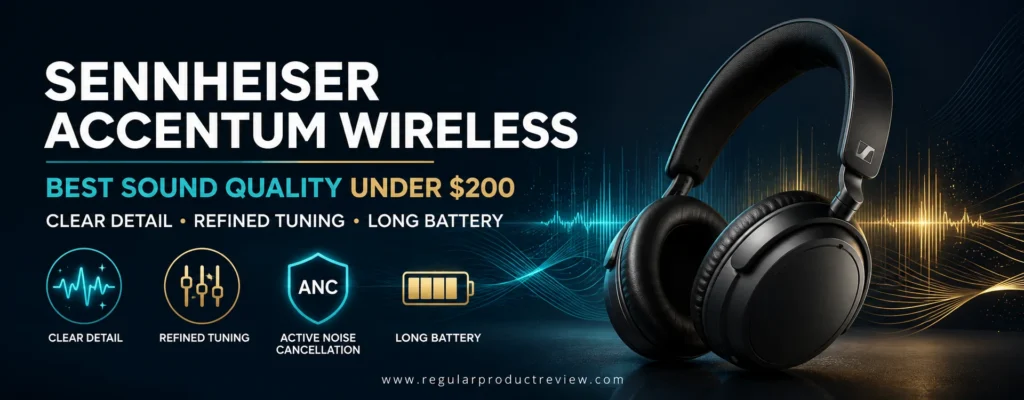
The ACCENTUM Wireless is not a neutral studio monitor. Bass still receives some emphasis, and certain brighter recordings can sound lively in the upper frequencies. However, its overall tuning preserves more separation between instruments, vocals, and low-frequency effects than products designed primarily around maximum bass.
Codec support strengthens its sound-quality position. In addition to SBC and AAC, the headphones support aptX and aptX HD on compatible devices. Android phones, computers, and Bluetooth transmitters that support these codecs can provide a higher-quality wireless connection than basic SBC playback.
The Sennheiser Smart Control Plus app adds a five-band equalizer, Bass Boost, Podcast mode, and Sound Personalization. These tools allow listeners to adjust the sound without abandoning the headphone’s underlying character. EQ settings are stored on the headphones, so the selected profile remains active when switching sources.
Sound quality is supported by effective hybrid ANC, Transparency Mode, USB audio, multipoint connectivity, and an excellent manufacturer-rated 50-hour battery life with ANC active. The lightweight 222-gram construction is also suitable for commuting, work, studying, and extended music sessions.
The principal compromises involve physical flexibility and accessories. The earcups rotate flat but the headband does not fold inward, no carrying case is included, and there is no conventional 3.5mm analog input. Buyers who need airplane-seat connectivity or passive playback should consider those omissions carefully.
The official US price was $189.95 at the time of review, keeping it below the article’s $200 limit. Current pricing and availability can be verified through the Sennheiser ACCENTUM Wireless product page.
Editorial Value Note: The ACCENTUM Wireless is a strong purchase at its $189.95 official price and becomes particularly compelling during discounts. Confirm that you are buying the standard ACCENTUM Wireless rather than the more expensive ACCENTUM Plus Wireless.
Quick Verdict: Refined Wireless Sound with Outstanding Battery Life
The Sennheiser ACCENTUM Wireless is the best option in this guide for buyers who want clear, engaging, and comparatively balanced sound without crossing the $200 threshold.
Its 37mm drivers deliver deep but controlled bass, intelligible vocals, and crisp upper-frequency detail. The headphones work particularly well with acoustic music, rock, pop, jazz, podcasts, singer-songwriter recordings, and tracks where vocal clarity matters.
Android users and compatible Bluetooth transmitters can access aptX or aptX HD. iPhone users receive AAC, but they retain the same tuning, app controls, hybrid ANC, USB audio, and Sound Personalization features.
The 50-hour battery rating with ANC is among the strongest advantages in the category. A ten-minute quick charge supplies up to five additional hours, making battery anxiety unlikely during ordinary commuting or travel.
Buy it if: Sound quality, vocal clarity, battery life, aptX HD, and a lightweight design matter more than maximum ANC strength.
Skip it if: You need a 3.5mm analog input, an included carrying case, a deeply foldable travel design, or highly adjustable noise cancellation.
Sennheiser ACCENTUM Wireless Key Specifications
| Specification | Sennheiser ACCENTUM Wireless |
|---|---|
| Headphone type | Closed-back wireless over-ear headphones |
| Driver system | Sennheiser-engineered dynamic transducers |
| Driver diameter | 37mm |
| Frequency response | 10Hz to 22kHz |
| Sensitivity | 106dB SPL at 1kHz |
| Total harmonic distortion | Less than 0.3% at 1kHz and 100dB SPL |
| Noise cancellation | Hybrid active noise cancellation |
| Ambient listening | Transparency Mode |
| Bluetooth version | Bluetooth 5.2, Class 1 |
| Bluetooth codecs | SBC, AAC, aptX, and aptX HD |
| Call codecs | mSBC and CVSD |
| Multipoint | Yes; two active Bluetooth connections |
| Sound customization | Five-band EQ, Sound Personalization, Bass Boost, and Podcast mode |
| Battery life | Up to 50 hours with Bluetooth and ANC |
| Fast charging | Ten minutes for up to five hours |
| Full charging time | Approximately three hours |
| Battery capacity | 800mAh lithium-ion battery |
| Charging connection | USB-C |
| USB audio | Yes; supported with compatible computers and mobile devices |
| 3.5mm analog input | No |
| Microphone system | Two MEMS microphones with beamforming |
| Microphone frequency range | 50Hz to 8kHz |
| Controls | Physical buttons |
| Foldable design | Earcups rotate flat; headband does not fold inward |
| Weight | Approximately 222 grams or 7.83 ounces |
| Included accessories | USB-C charging cable and quick guide |
| Carrying case | Not included |
| Available colors | Black and White, with availability varying by seller |
| Official US price at review | $189.95 |
Battery life was measured by Sennheiser using an iPhone at a medium volume level with ANC active. Actual endurance varies with volume, codec, calls, EQ settings, USB use, wireless conditions, and battery age.
Why the ACCENTUM Wireless Is Our Sound-Quality Pick
Sound Quality Rating: 9.3/10
The ACCENTUM Wireless earns this award because it prioritizes musical coherence instead of relying on one attention-grabbing feature. Its bass, midrange, and treble work together more naturally than the aggressively boosted tuning found on many inexpensive wireless headphones.
Several qualities distinguish its presentation:
- Bass reaches deeply without dominating every recording
- Vocals remain clear and centrally positioned
- Acoustic instruments retain recognizable texture
- Treble provides detail without constant sharpness
- Stereo imaging separates instruments effectively
- EQ changes respond predictably through the app
- aptX HD supports higher-quality playback on compatible sources
The sound is still shaped for enjoyable everyday listening. It has more bass and energy than a strictly neutral studio headphone. That makes it accessible to mainstream listeners while preserving enough detail for buyers who pay attention to recording quality.
The closed-back design creates a focused and intimate presentation. It does not produce the expansive openness of a wired open-back audiophile headphone, but it prevents substantial sound leakage and works more effectively in shared spaces.
Listeners who do not require ANC or wireless convenience may find greater technical performance among dedicated models in our audiophile headphones under $200 guide. The ACCENTUM’s advantage is combining enjoyable sound with portability, Bluetooth, ANC, calls, and a long-lasting battery.
Expert Tip: Listen with the default tuning before activating Bass Boost. The standard profile already delivers meaningful low-frequency depth, and excessive bass adjustment can reduce the vocal separation that makes the ACCENTUM distinctive.
Bass, Midrange, Treble, and Imaging
Bass Performance
Bass has good extension and enough impact for contemporary pop, electronic music, hip-hop, and movie soundtracks. It sounds fuller than a neutral studio monitor but less exaggerated than the Sony ULT Wear in ULT1 or ULT2 mode.
Kick drums have weight without becoming excessively soft, while bass guitars retain more individual texture than they do on aggressively boosted headphones. Sub-bass is present, although listeners seeking maximum physical impact may still prefer the Sony.
Bass Boost is available inside the app. It is useful at lower playback volumes or with thin recordings, but the default tuning will provide better balance for most music.
Midrange and Vocal Clarity
The midrange is the primary reason to choose the ACCENTUM Wireless over bass-focused alternatives. Vocals remain intelligible, guitars retain body, and piano notes are not buried beneath the low frequencies.
Male voices sound warm without excessive thickness, while female vocals receive sufficient upper-midrange presence to remain clear. Podcasts and spoken content also benefit from this presentation.
Podcast mode emphasizes speech and reduces unnecessary low-frequency energy. It can make dialogue easier to follow in noisy environments, although the standard profile sounds more natural for music.
Treble Detail
Treble is crisp and reveals more recording detail than many budget ANC headphones. Cymbals, strings, vocal harmonics, and acoustic transients remain distinguishable in busy tracks.
Bright or poorly mastered recordings can occasionally sound energetic in the upper frequencies. The five-band equalizer allows sensitive listeners to reduce the treble without significantly changing the rest of the presentation.
Imaging and Soundstage
Instrument placement is reasonably precise for a closed-back wireless headphone. The soundstage is not exceptionally wide, but individual elements maintain enough separation to avoid sounding congested.
Live recordings and orchestral music benefit from the cleaner layering. Movies also receive useful positional separation, although the standard ACCENTUM Wireless does not focus on virtual surround effects as heavily as some entertainment-oriented competitors.
aptX HD, AAC, and USB Audio
Audio Connectivity Rating: 9.1/10
Codec compatibility is a major strength. The ACCENTUM Wireless supports:
- SBC for universal Bluetooth compatibility
- AAC for Apple devices and other compatible sources
- aptX for supported Android devices and transmitters
- aptX HD for higher-quality Bluetooth transmission
aptX HD can preserve more information than basic SBC playback, but both the source device and headphones must support it. Many Android phones and dedicated Bluetooth transmitters offer compatibility, while iPhones do not support aptX or aptX HD.
The improvement depends on the original recording, streaming quality, listening environment, and individual hearing. High-quality lossless sources reveal the greatest benefit; heavily compressed music may sound similar across codecs.
USB-C Digital Audio
The supplied USB cable can connect the headphones to a compatible computer or mobile device for digital audio playback. USB audio bypasses the need for a Bluetooth codec and can provide a stable wired connection at a desk.
This feature is useful for laptops, desktop computers, and compatible USB-C phones. It also allows charging while connected to certain sources, depending on the device and USB configuration.
The ACCENTUM Wireless does not include a 3.5mm analog input. It therefore cannot connect directly to a conventional airplane entertainment jack without an appropriate external Bluetooth transmitter or USB-compatible source.
Unlike passive wired headphones, it also depends on internal electronics and battery power for its intended performance. Buyers who require analog playback with a depleted battery should choose another model.
Hybrid Active Noise Cancellation
Noise Cancellation Rating: 8.5/10
Hybrid ANC uses microphones inside and outside the earcups to monitor environmental sound. It is effective against continuous low-frequency noise such as airplane cabins, road rumble, bus engines, trains, air conditioners, and computer fans.
The system helps listeners hear more musical detail without raising playback volume excessively. This is especially important for a sound-quality recommendation because background noise can mask bass texture and quiet instrumental information.
Voices, keyboard sounds, dishes, and other irregular higher-frequency noises are reduced but remain partly audible. The ACCENTUM Wireless provides useful isolation rather than flagship-level silence.
Its ANC is less aggressive than the strongest systems from Bose, Sony, or premium Sennheiser models. It can also feel more basic than adaptive systems that offer several manually adjustable levels.
The standard ACCENTUM Wireless primarily switches between ANC and Transparency Mode. Buyers seeking adaptive ANC, touch gestures, a 3.5mm cable, and an included case should consider the more expensive ACCENTUM Plus Wireless, although that model normally exceeds this article’s budget.
Correct fit remains essential. The cushions should surround the ears completely, and the headband must hold both earcups evenly. Glasses, hair, or an incorrect slider position can weaken the seal and reduce ANC effectiveness.
Transparency Mode and Environmental Awareness
Transparency Rating: 8.2/10
Transparency Mode uses the external microphones to introduce surrounding sound. It is useful for announcements, conversations, office awareness, airport interactions, and walking near traffic.
A physical button provides quick access without requiring the app. The effect is functional, although outside voices can sound more processed than they would without headphones.
The standard ACCENTUM Wireless does not provide the same degree of adjustable transparency control available on some premium competitors. It focuses on a straightforward switch between isolation and awareness.
Wind can become more noticeable through the microphones outdoors. In strong wind, removing the headphones or returning to ANC may provide a more comfortable experience.
Comfort, Weight, and Everyday Design
Comfort Rating: 8.6/10
The ACCENTUM Wireless weighs approximately 222 grams, making it one of the lighter full-size headphones in this roundup. Its low weight reduces headband fatigue during work, study, and extended music sessions.
The circumaural ear cushions surround the ears, while a soft-touch silicone-lined headband helps distribute pressure. The fit is secure and supports the acoustic seal required for consistent bass and ANC.
Clamping pressure may feel firm for users with larger heads, particularly when the headphones are new. The pressure can help maintain isolation, but sensitive buyers should consider purchasing from a retailer with a practical return policy.
The earcups can become warm during long sessions because the closed-back construction and synthetic padding limit airflow. This is common among ANC headphones and becomes more noticeable in warm rooms.
The earcups rotate flat for storage, but the headband does not fold inward. This makes the ACCENTUM less compact than the Soundcore Space One Pro. No carrying case is included, so frequent travelers may want to purchase a compatible protective case separately.
Construction relies heavily on plastic to control weight. It feels practical and solid enough for routine use, although it lacks the luxury finish of more expensive aluminum or metal-reinforced headphones.
Replacement ear pads are available through Sennheiser, which can extend the useful lifespan when the original cushions become worn.
Battery Life and Fast Charging
Battery Rating: 9.5/10
Sennheiser rates the ACCENTUM Wireless for up to 50 hours of music playback over Bluetooth with ANC active. Unlike many competing manufacturers, Sennheiser’s headline figure does not require users to disable noise cancellation.
This endurance can cover:
- A full workweek of moderate listening
- Several days of commuting
- Long-distance travel in both directions
- Extended study sessions
- Multiple films or gaming sessions
- Several days of mixed music, calls, and podcasts
A ten-minute charge supplies up to five hours of playback under suitable conditions. A complete charge takes approximately three hours.
The internal 800mAh lithium-ion battery charges through USB-C. Actual runtime varies with playback volume, codec, microphone use, equalizer settings, temperature, connection stability, and battery age.
The 50-hour rating gives the ACCENTUM an important advantage over the Sony ULT Wear, which is rated for up to 30 hours with ANC using AAC or SBC. Some ultra-long-lasting competitors advertise higher maximum figures with ANC disabled, but the ACCENTUM’s ANC-on endurance remains particularly useful.
Calls and Microphone Quality
Call Quality Rating: 8.1/10
Two MEMS microphones use beamforming to focus on the wearer’s voice and reduce surrounding interference. The microphone system covers a stated frequency range of 50Hz to 8kHz.
Calls sound sufficiently clear in quiet rooms, home offices, and moderately active indoor spaces. The headphones are suitable for personal conversations, online classes, and occasional work meetings.
Performance becomes less consistent around traffic, strong wind, or several nearby speakers. The microphone processing may make voices sound thinner as it attempts to suppress environmental noise.
The headphones do not include a boom microphone, so users who spend most of their day in calls may prefer a dedicated office or gaming headset. Our gaming headset recommendations include alternatives designed around microphone placement and lower-latency communication.
ANC remains active during calls to help the wearer hear the conversation. However, the microphones used to transmit speech cannot deliver the same separation as a microphone positioned directly in front of the mouth.
Smart Control Plus App and Sound Personalization
App and Features Rating: 8.8/10
The Sennheiser Smart Control Plus app provides the primary interface for sound customization, firmware management, and connected-device settings.
Important features include:
- Five-band equalizer
- Sound Personalization
- Bass Boost
- Podcast mode
- Sound Check
- ANC and Transparency controls
- Connection management
- Firmware updates
- Battery status
- Sound-zone and preference features where supported
Sound Personalization guides the user through a series of listening choices and builds a profile around those preferences. It is useful for buyers who want customized tuning but do not know how to operate an equalizer.
The five-band EQ offers more precision than a simple bass-and-treble adjustment. Users can reduce bass warmth, bring vocals forward, or soften the upper frequencies.
Settings are stored on the headphones, allowing the selected tuning to continue when the app is closed or the source device changes.
The app adds meaningful value, although the ACCENTUM Wireless does not include some convenience features found on more expensive models, such as automatic wearing detection or touch controls.
Physical Controls and Multipoint Connectivity
Controls and Connectivity Rating: 8.6/10
The ACCENTUM Wireless uses physical buttons rather than a touch-sensitive panel. Separate controls manage volume, playback, tracks, calls, pairing, voice assistants, and ANC or Transparency switching.
Physical controls reduce accidental gestures and remain easier to use with gloves. The number of functions assigned to the buttons can require an initial learning period, but operation becomes predictable once the layout is familiar.
Bluetooth 5.2 Class 1 connectivity provides a stable connection under normal conditions. Walls, wireless congestion, body positioning, and the source device can still affect range.
Multipoint allows two Bluetooth devices to remain actively connected. A user can pair a laptop and phone, listen from one source, and receive a call from the other. The headphones can store additional paired devices, but audio plays from only one source at a time.
Unlike models that prioritize one proprietary high-resolution codec, the ACCENTUM supports both AAC for Apple devices and aptX HD for compatible Android or transmitter-based setups. This makes it flexible across different ecosystems.
Sennheiser ACCENTUM Wireless Pros and Cons
| Pros | Cons |
|---|---|
| Refined and comparatively balanced sound | Not strictly neutral or studio-flat |
| Clear vocals and good instrumental separation | Bright recordings can occasionally sound lively |
| Sennheiser-engineered 37mm drivers | Hybrid ANC is not class-leading |
| aptX and aptX HD support | iPhones cannot use aptX HD |
| AAC support for Apple devices | No LDAC support |
| Five-band equalizer and Sound Personalization | No 3.5mm analog input |
| Up to 50 hours with ANC | No passive listening when the battery is depleted |
| Ten-minute quick charging | Carrying case is not included |
| Lightweight 222-gram design | Headband does not fold inward |
| USB-C digital audio | Firm clamp may affect larger heads |
| Multipoint connectivity | No wearing detection |
| Replaceable ear cushions | No touch controls for buyers who prefer gestures |
| Physical buttons reduce accidental commands | Transparency mode offers limited adjustment |
| Official price remains below $200 | Plastic build does not feel luxurious |
Who Should Buy the Sennheiser ACCENTUM Wireless?
| Recommended Buyer | Why It Fits |
|---|---|
| Sound-quality-focused listeners | Balanced tuning preserves vocals and instrumental detail |
| Android users | aptX and aptX HD support higher-quality wireless playback |
| iPhone users | AAC provides reliable compatibility |
| Music enthusiasts | Five-band EQ and Sound Personalization offer useful adjustment |
| Students and office workers | Lightweight construction and long battery life support extended use |
| Frequent commuters | Hybrid ANC reduces engines, traffic, trains, and HVAC noise |
| USB audio users | Compatible computers and mobile devices can provide a direct digital connection |
| Battery-conscious buyers | Up to 50 hours with ANC minimizes charging frequency |
| Podcast listeners | Clear midrange and Podcast mode improve speech intelligibility |
| Buyers staying below $200 | The official price fits the article without depending on a temporary sale |
Who Should Avoid It?
| Consider Another Headphone If You Need | Primary Limitation |
|---|---|
| Maximum bass impact | Sony ULT Wear produces substantially stronger low-frequency emphasis |
| The strongest possible ANC | Premium Bose and Sony systems provide deeper isolation |
| A conventional 3.5mm cable | The standard ACCENTUM has no analog input |
| Passive playback with no battery | Internal electronics are required |
| A compact inward-folding design | The earcups only rotate flat |
| An included travel case | Only a USB-C cable and quick guide are supplied |
| Automatic pause when removed | Wearing detection is unavailable |
| Adjustable adaptive ANC | Noise-control options are relatively straightforward |
| A loose fit for a large head | Clamping pressure may feel firm |
| Professional call quality | Two integrated microphones cannot match a boom mic |
Our Expert Opinion
The Sennheiser ACCENTUM Wireless succeeds by concentrating on the part of a headphone that matters most: how music sounds. Its tonal balance is not perfectly neutral, but it avoids the excessive low-frequency dominance that affects many consumer ANC models.
Bass has depth and warmth, yet vocals and instruments remain distinguishable. Treble provides clarity, and the app allows sensitive listeners to reduce brightness. The result works across more musical genres than a strongly specialized bass headphone.
Codec support reinforces the recommendation. AAC serves Apple devices, while aptX and aptX HD offer better options for compatible Android phones, computers, and transmitters. USB audio provides another useful route for desk-based listening.
The 50-hour battery with ANC is exceptional, and the lightweight 222-gram design supports extended listening. Hybrid ANC performs well against engines, fans, and transportation noise, although it is not the main reason to buy this model.
Its omissions are deliberate but important. There is no 3.5mm analog input, carry case, wearing detection, inward-folding headband, or touch interface. Buyers who need those conveniences may prefer a different product even if it offers less refined sound.
At $189.95 or less, the ACCENTUM Wireless delivers an appealing combination of sound quality, wireless codec support, battery endurance, and everyday practicality.
Expert Recommendation: Start with the standard sound profile and listen before making adjustments. Use the five-band EQ to correct a specific preference, select Podcast mode for speech, and reserve Bass Boost for recordings that genuinely need additional low-frequency weight.
Bottom Line: Is the Sennheiser ACCENTUM Wireless Worth Buying?
Yes. The Sennheiser ACCENTUM Wireless is worth buying under $200 for listeners who prioritize sound quality, vocal clarity, codec flexibility, and long battery life.
Its 37mm dynamic drivers produce a musical presentation with controlled bass, intelligible mids, and crisp treble. aptX HD supports higher-quality wireless playback on compatible devices, while AAC maintains reliable performance for Apple users. USB audio adds a stable wired-digital option for computers and supported mobile devices.
The 50-hour ANC battery rating eliminates one of the most common inconveniences associated with wireless headphones. A lightweight construction, replaceable cushions, physical controls, hybrid ANC, Transparency Mode, and multipoint connectivity make it practical beyond dedicated music listening.
The lack of a 3.5mm input and carrying case prevents an unconditional recommendation for travelers. ANC performance is also solid rather than category-leading. Those limitations do not undermine its primary strength: delivering one of the most satisfying overall listening experiences available below $200.
🏆 Award: Best Noise Cancelling Headphones Under $200 for Sound Quality
Overall Score: 8.9/10
Recommended For: Music enthusiasts, vocal-focused listeners, students, office workers, Android users, iPhone users, and buyers seeking long ANC battery life
Award Reason: Refined tuning, clear vocals, aptX HD, AAC, USB audio, a five-band EQ, Sound Personalization, lightweight comfort, and 50-hour ANC playback make it the strongest sound-quality choice within the budget.
Sony WH-CH720N Review: Best Lightweight Headphones for Comfort
Overall Rating: 8.7/10
Award: Best Lightweight Noise Cancelling Headphones for Comfort
The Sony WH-CH720N earns our comfort award by solving one of the most common problems associated with full-size noise-cancelling headphones: excessive weight. At approximately 6.8 ounces or 192 grams, it is substantially lighter than most over-ear ANC competitors in this guide.
That reduced weight matters during extended listening. Heavy headphones can create pressure across the top of the head, pull against the ears, and become increasingly noticeable during work, study, flights, or long streaming sessions. The WH-CH720N minimizes those issues with a lightweight headband, softly padded earcups, and a relatively gentle fit.
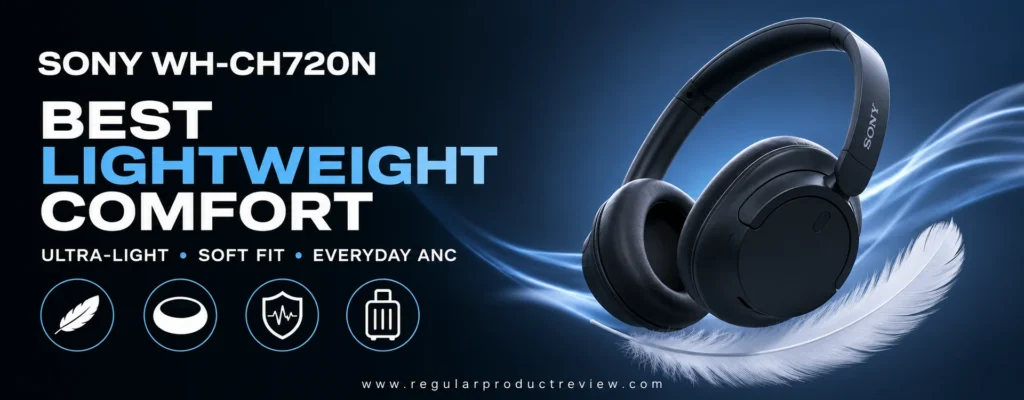
Sony does not sacrifice its most useful wireless features to achieve that low weight. The headphones include Dual Noise Sensor technology, the Integrated Processor V1, adjustable Ambient Sound, Adaptive Sound Control, DSEE processing, multipoint Bluetooth, a customizable equalizer, 360 Reality Audio support, and wired passive playback.
Noise cancellation is effective against steady low-frequency distractions such as air conditioners, traffic, buses, trains, and airplane cabins. It does not match Sony’s flagship WH-1000X models or the strongest premium ANC competitors, but it provides meaningful isolation for commuting, studying, office work, and home use.
Sound quality is clean and accessible, with moderate bass emphasis and good vocal intelligibility. The default presentation is less aggressive than the Sony ULT Wear, while the Sony Sound Connect app allows users to adjust Clear Bass and create a custom equalizer profile.
Battery life reaches a manufacturer-rated 35 hours with ANC or Ambient Sound enabled and 50 hours with both functions switched off. A three-minute quick charge supplies approximately one additional hour, while ten minutes can provide around 4.5 hours.
The primary compromises are visible in the physical construction. Extensive plastic keeps the weight low but makes the headphones feel less premium. The earcups rotate flat but do not fold inward, no carrying case is included, and codec support is limited to SBC and AAC.
Sony lists the WH-CH720N at a $179.99 MSRP, although it is frequently discounted. The official US price was substantially lower at the time of review. Current offers can be checked on the Sony WH-CH720N product page.
Editorial Price Guidance: The WH-CH720N delivers its strongest value when discounted close to $100. It remains a reasonable comfort-focused option at higher prices, but stronger ANC and higher-quality codec alternatives become available as the cost approaches $180.
Quick Verdict: Exceptional Comfort for Work, Study, and Travel
The Sony WH-CH720N is the best lightweight noise cancelling headphone for comfort because its 192-gram design creates less headband fatigue than most full-size alternatives.
Its low weight makes it suitable for students, office workers, travelers, glasses wearers, and anyone who keeps headphones on for several hours. The cushions provide a secure over-ear seal without requiring the heavy chassis or aggressive clamping pressure found on some premium models.
ANC performance is sufficient for routine commuting and indoor concentration. Twenty Ambient Sound levels, Focus on Voice, and Adaptive Sound Control provide more environmental control than many similarly priced headphones.
Sound is pleasant and easy to customize, although the absence of LDAC or aptX limits high-bitrate Bluetooth options. Multipoint, DSEE, wired passive playback, physical buttons, quick charging, and app-based EQ make the headphones practical for everyday use.
Buy it if: Low weight, long-session comfort, Sony app features, multipoint, and reliable everyday ANC are your priorities.
Skip it if: You need flagship-level isolation, high-resolution Bluetooth codecs, a compact inward-folding design, or premium construction.
Sony WH-CH720N Key Specifications
| Specification | Sony WH-CH720N |
|---|---|
| Headphone type | Closed-back wireless over-ear headphones |
| Driver unit | 1.18-inch or 30mm dynamic driver |
| Noise cancellation | Dual Noise Sensor technology |
| ANC processor | Sony Integrated Processor V1 |
| Ambient listening | Adjustable Ambient Sound Mode |
| Ambient adjustment | 20 levels plus Focus on Voice |
| Adaptive sound | Adaptive Sound Control |
| Wireless codecs | SBC and AAC |
| Audio enhancement | DSEE |
| Spatial audio | 360 Reality Audio with compatible services |
| Bluetooth version | Bluetooth 5.2 |
| Wireless range | Approximately 32.8 feet under suitable conditions |
| Multipoint | Yes; connects to two devices |
| Battery with ANC | Up to 35 hours |
| Battery without ANC | Up to 50 hours |
| Three-minute charge | Approximately 60 minutes of playback |
| Ten-minute charge | Approximately 4.5 hours of playback |
| Full charging time | Approximately 3.5 hours |
| Charging connection | USB-C |
| Wired listening | 3.5mm stereo input with passive operation |
| Controls | Physical buttons |
| Wearing detection | No |
| Companion app | Sony Sound Connect |
| Foldable design | Earcups rotate flat; headband does not fold inward |
| Water resistance | No official waterproof rating |
| Weight | Approximately 6.8 ounces or 192 grams |
| Included accessories | USB-C charging cable and 3.5mm connection cable |
| Carrying case | Not included |
| Available colors | Black, White, and Pink |
| Official MSRP | $179.99 |
Sony’s battery figures assume specific playback and feature settings. Equalizer adjustments, DSEE, voice-assistant activation, calls, volume, wireless conditions, and environmental temperature can reduce actual endurance. Full technical details are available through the official WH-CH720N specifications.
Why the Sony WH-CH720N Wins for Lightweight Comfort
Comfort Rating: 9.5/10
Weight is one of the most important and frequently overlooked comfort specifications. The WH-CH720N weighs approximately 192 grams, compared with:
| Headphone | Approximate Weight | Difference from WH-CH720N |
|---|---|---|
| Sony WH-CH720N | 192 grams | Reference |
| Sennheiser ACCENTUM Wireless | 222 grams | 30 grams heavier |
| Sony ULT Wear | 255 grams | 63 grams heavier |
| Soundcore Space One Pro | 286.2 grams | 94.2 grams heavier |
A difference of 30 to 90 grams may not seem substantial when holding headphones briefly. During a two- or three-hour session, however, extra weight can increase pressure on the headband and make the earcups feel more noticeable.
The WH-CH720N distributes its weight evenly without relying on a tightly clamped frame. This makes it a particularly good match for:
- Long study sessions
- Full workdays at a computer
- Movies and television
- Air travel
- Glasses wearers
- Listeners sensitive to headband pressure
- Users transitioning from lightweight on-ear headphones
- Anyone who frequently forgets they are wearing headphones
The earcups surround most ears comfortably, and the padding creates enough of a seal for useful passive isolation. Correct adjustment remains important. The headband should touch the top of the head without creating a concentrated pressure point, while both cushions should sit evenly around the ears.
Users with especially large ears may find the earcup openings less spacious than those on larger premium headphones. As with other closed-back designs, heat can also accumulate during warm weather or extended sessions.
Expert Tip: Extend the sliders before placing the headphones on your head, then shorten each side evenly. This produces a more consistent cushion seal and prevents the headband from supporting all the weight at one narrow point.
Lightweight Construction and Portability
Design Rating: 8.2/10
The WH-CH720N uses extensive plastic to achieve its low weight. This design decision improves comfort but creates a less premium feel than headphones with metal hinges, thicker padding, or reinforced headbands.
The construction is suitable for ordinary commuting and home use, but the headphones should not be placed unprotected beneath heavy items in a backpack. Sony does not include a carrying case, so frequent travelers may want to purchase a compatible hard-shell case.
The earcups rotate flat, allowing the headphones to occupy less vertical space in a bag. However, the headband does not fold inward. The stored shape is therefore larger than compact folding models such as the Soundcore Space One Pro.
Physical buttons are located along the earcup edges. They provide direct access to power, volume, playback, calls, and noise-control modes without relying on touch gestures.
The buttons can feel similar until users learn their positions. A tactile marker on the volume-up control improves identification by touch.
Sony offers Black, White, and Pink finishes. Availability and promotional pricing can vary by color, so buyers should compare every option before ordering.
The headset is not waterproof. It should be kept away from rain, heavy sweat, and moisture, particularly around the USB-C charging port and microphone openings.
Noise Cancellation and the Integrated Processor V1
Noise Cancellation Rating: 8.4/10
Sony combines two microphones in each earcup with Dual Noise Sensor technology and the Integrated Processor V1. The microphones monitor external and internal sound, while the processor generates the signal used to reduce environmental noise.
The WH-CH720N performs best against continuous low-frequency sounds, including:
- Air conditioners and fans
- Bus and train engines
- Road rumble
- Airplane cabin noise
- Computer ventilation
- Low household appliance noise
These distractions become less prominent, allowing music, podcasts, or low-volume background audio to support concentration.
Voices, keyboards, televisions, and sudden higher-frequency sounds are reduced less effectively. Conversations may remain audible when no music is playing, especially in a quiet office.
The ANC is useful but not flagship-level. Sony’s premium WH-1000X headphones provide deeper isolation and more sophisticated processing, while some competitors near the top of this article’s budget suppress voices more effectively.
The WH-CH720N remains competitive because its ANC is paired with exceptional comfort. A stronger noise-cancelling headphone offers limited value if its weight causes the user to remove it after an hour.
Wind Noise Reduction
Sony incorporates a Wind Noise Reduction Structure around the microphones. It reduces some of the turbulence created while walking outdoors, although strong wind can still reach the ANC and call microphones.
Wind noise is often most noticeable in Ambient Sound Mode because the external microphones intentionally pass environmental sound through the earcups. Returning to ANC or disabling ambient processing may provide a more comfortable outdoor experience.
Ambient Sound and Adaptive Sound Control
Environmental Awareness Rating: 8.9/10
The Sony Sound Connect app provides 20 levels of Ambient Sound adjustment. Lower settings admit a limited amount of external sound, while higher levels improve awareness of traffic, announcements, and nearby conversations.
Focus on Voice emphasizes speech within the captured environmental audio. It is useful when speaking with a coworker, hearing airport announcements, or communicating without removing the headphones.
Adaptive Sound Control can modify ambient settings based on activity and location. It may apply different configurations while the user is sitting, walking, commuting, or visiting a frequently recognized place.
The automatic behavior becomes useful after the system learns a routine, but it can feel unpredictable during initial use. Changes in the listening mode may also interrupt audio briefly. Users who want consistent isolation can disable automation and select ANC manually.
Ambient Sound is natural enough for routine interactions but still has a processed quality. Removing one earcup will provide clearer face-to-face communication when environmental awareness is critical.
Sound Quality and DSEE Processing
Sound Quality Rating: 8.4/10
The 30mm dynamic drivers deliver an approachable sound designed for mainstream music, podcasts, streaming, and casual entertainment. Bass has moderate warmth, vocals remain intelligible, and the treble provides enough clarity for everyday listening.
Low frequencies are less powerful than those of the Sony ULT Wear. The WH-CH720N will suit listeners who want bass presence without the physical pressure or dramatic boost of ULT1 and ULT2.
The midrange supports dialogue and vocals effectively. Podcasts, online videos, acoustic tracks, and singer-focused music remain easy to follow.
Treble is generally smooth, although the headphones do not reveal as much fine instrumental detail as the Sennheiser ACCENTUM Wireless. Their sound prioritizes comfort and accessibility over analytical resolution.
Sony’s DSEE processing attempts to restore high-frequency information lost during audio compression. It can make lower-quality streams sound slightly more open, but the improvement depends on the source. DSEE also consumes additional battery power.
Equalizer and Clear Bass
The Sony Sound Connect app includes EQ presets, custom adjustment, and Clear Bass control. These tools allow listeners to increase low-frequency weight, bring vocals forward, or reduce treble energy.
Clear Bass is particularly useful because it adjusts the low end without creating the same degree of midrange congestion associated with a broad bass boost. Moderate adjustments produce the most natural result.
Custom EQ settings are valuable because the WH-CH720N does not support high-resolution Bluetooth codecs. Careful tuning can improve the everyday experience even though it cannot add information absent from the source or codec.
SBC and AAC Codec Support
Wireless Audio Rating: 8.0/10
The WH-CH720N supports only two music codecs:
- SBC for universal Bluetooth compatibility
- AAC for compatible Apple devices and other supported sources
AAC provides a suitable connection for iPhones, while many Android devices can also use it. Devices without reliable AAC support fall back to SBC.
The headphones do not support LDAC, aptX, aptX HD, or aptX Adaptive. Android users seeking higher-bitrate wireless audio should consider the Sony ULT Wear, Sennheiser ACCENTUM Wireless, Soundcore Space One Pro, or another compatible alternative.
The lack of LDAC is less important for podcasts, casual streaming, background music, and noisy commutes. It matters more to listeners using lossless subscriptions or high-quality local files in quiet environments.
Sony provides two Bluetooth performance priorities in the app. “Priority on Sound Quality” is the default, while “Priority on Stable Connection” can reduce interruptions in crowded wireless locations.
Battery Life and Quick Charging
Battery Rating: 8.9/10
Sony rates the WH-CH720N for:
| Listening Condition | Maximum Playback |
|---|---|
| ANC enabled | Up to 35 hours |
| Ambient Sound enabled | Up to 35 hours |
| ANC and Ambient Sound disabled | Up to 50 hours |
| Three-minute quick charge | Approximately 60 minutes |
| Ten-minute quick charge | Approximately 4.5 hours |
| Full charging cycle | Approximately 3.5 hours |
Thirty-five hours with ANC is sufficient for several workdays, regular commuting, or most long-distance travel. The 50-hour maximum is available when both noise cancellation and Ambient Sound are disabled.
The quick-charge feature provides useful emergency playback. Ten minutes of charging can cover most of a workday or several commuting sessions.
Charging uses USB-C, but the port is intended for power rather than digital USB audio. The headphones turn off when charging begins and cannot play music during the charging process.
Equalizer settings, DSEE, voice assistants, calls, high volume, and unstable Bluetooth conditions can shorten runtime. Battery capacity will also decline gradually with age.
Users can check the estimated remaining charge through the Sony app, a compatible phone’s Bluetooth interface, or a voice prompt activated through the power button.
Multipoint and Everyday Connectivity
Connectivity Rating: 8.8/10
Multipoint enables simultaneous connection to two Bluetooth devices. A common arrangement is pairing the WH-CH720N with a laptop for music or video and a phone for calls.
The headphones can switch between the two sources without requiring manual disconnection. Compatibility and switching behavior can vary between devices and applications, particularly when one source continues sending silent audio in the background.
Bluetooth 5.2 provides stable everyday connectivity within an approximate maximum range of 32.8 feet under suitable conditions. Walls, Wi-Fi congestion, body positioning, and other wireless devices can reduce that range.
Unlike the Sony ULT Wear, the WH-CH720N does not require users to choose between multipoint and LDAC because LDAC is unavailable. AAC or SBC remains active during Bluetooth use.
A detachable 3.5mm cable supports wired listening. The headphones can operate passively when powered off, making them useful when the battery is depleted. With power available, ANC can remain active during a wired connection.
Call Quality and Microphone Performance
Call Quality Rating: 8.5/10
Sony combines beamforming microphone processing with a Wind Noise Reduction Structure to improve voice pickup. Calls are clear enough for routine work meetings, classes, family conversations, and mobile communication.
Voice quality is strongest in quiet rooms and moderately active indoor environments. Background suppression helps reduce steady office noise, although multiple nearby speakers can still compete with the wearer’s voice.
Outdoor calls remain understandable in light wind. Strong gusts or heavy traffic can overwhelm the processing and make speech less consistent.
The absence of a boom microphone limits voice isolation compared with a dedicated office or gaming headset. Users whose work depends on frequent calls in noisy environments may prefer a microphone positioned closer to the mouth.
On Windows computers, activating the Bluetooth microphone can reduce playback quality because the headset switches from the stereo profile to the hands-free communication profile. This is a general Bluetooth limitation.
Sony Sound Connect App and Smart Features
App and Features Rating: 8.8/10
The Sony Sound Connect app provides extensive customization despite the WH-CH720N’s relatively accessible price.
Available functions include:
- Equalizer presets
- Custom equalizer profiles
- Clear Bass adjustment
- DSEE control
- ANC and Ambient Sound selection
- Twenty Ambient Sound levels
- Focus on Voice
- Adaptive Sound Control
- Multipoint setup
- Bluetooth sound-quality priorities
- Voice-assistant configuration
- 360 Reality Audio setup
- Firmware updates
- Battery monitoring
- Automatic power-off settings
- Usage information
The WH-CH720N does not include wearing detection, so removing the headphones will not automatically pause playback. Users must press the playback button or pause the connected device manually.
Automatic power-off can still reduce unnecessary battery use after a period of inactivity. The exact behavior can be managed through the app.
360 Reality Audio requires compatible content and services. It is an optional ecosystem feature rather than a replacement for conventional stereo listening.
Physical Controls and Wired Playback
Controls Rating: 8.6/10
Physical buttons manage power, pairing, playback, calls, track navigation, volume, ANC, and Ambient Sound. This design avoids accidental touch gestures and works more reliably while wearing gloves.
The buttons are practical but not immediately distinguishable until the user learns their positions. Sony adds a tactile marker to the volume-up button to help with orientation.
The 3.5mm input expands compatibility with computers, handheld audio players, airplane entertainment systems, and other devices with a conventional headphone jack.
Passive wired operation remains available when the battery is empty. Sound quality may change when the headphones are powered off because internal processing, EQ, DSEE, and ANC are unavailable.
The included USB-C cable charges the battery but does not provide regular USB digital-audio playback. The headphones cannot be used while charging.
Sony WH-CH720N Pros and Cons
| Pros | Cons |
|---|---|
| Exceptionally lightweight 192-gram design | Extensive plastic construction feels inexpensive |
| Comfortable for long work and study sessions | Ear cushions may become warm |
| Gentle weight distribution | Earcups may feel compact for larger ears |
| Dual Noise Sensor ANC | Noise cancellation is not flagship-level |
| Integrated Processor V1 | Voices remain partly audible |
| Twenty Ambient Sound levels | Transparency still sounds processed |
| Focus on Voice and Adaptive Sound Control | Automatic mode changes may feel unpredictable |
| Up to 35 hours with ANC | Several competitors offer longer ANC battery life |
| Up to 50 hours without ANC | Full charging takes approximately 3.5 hours |
| Multipoint connectivity | No LDAC or aptX support |
| DSEE and customizable EQ | No wearing detection |
| AAC support works well with iPhones | No USB digital-audio playback |
| Passive 3.5mm wired operation | Headband does not fold inward |
| Physical buttons reduce accidental gestures | Carrying case is not included |
| Frequently discounted below MSRP | No official waterproof rating |
Who Should Buy the Sony WH-CH720N?
| Recommended Buyer | Why It Fits |
|---|---|
| Comfort-focused listeners | The 192-gram design minimizes headband fatigue |
| Students | Lightweight fit, ANC, and long battery life support study sessions |
| Office workers | Multipoint connects a computer and phone |
| Glasses wearers | Lower weight and moderate clamp can reduce pressure |
| Travelers | ANC, wired playback, and quick charging are practical |
| iPhone users | AAC provides reliable wireless compatibility |
| Podcast listeners | Clear midrange supports speech and dialogue |
| Buyers sensitive to heavy headphones | It is significantly lighter than most full-size competitors |
| Shoppers finding it near $100 | Discounted pricing creates strong everyday value |
| Casual wireless listeners | The app, EQ, ANC, and battery cover essential needs |
Buyers finding the WH-CH720N below $100 should also compare our broader guide to the best noise cancelling headphones under $100.
Who Should Avoid It?
| Consider Another Headphone If You Need | Primary Limitation |
|---|---|
| High-resolution Bluetooth audio | Only SBC and AAC are supported |
| Maximum bass impact | The Sony ULT Wear delivers substantially stronger bass |
| The best sound quality under $200 | The Sennheiser ACCENTUM Wireless is more detailed |
| Flagship-level ANC | The isolation is useful rather than class-leading |
| Premium construction | Low weight is achieved through extensive plastic |
| Automatic pause when removed | Wearing detection is unavailable |
| A compact folding headband | The earcups rotate but do not fold inward |
| An included travel case | Sony supplies only connection and charging cables |
| USB audio from a computer | USB-C is used for charging |
| Headphones for rain or workouts | No official water-resistance rating is provided |
Our Expert Opinion
The Sony WH-CH720N demonstrates why comfort cannot be evaluated through padding alone. Its approximately 192-gram weight reduces the physical load placed on the head, allowing the headphones to remain comfortable longer than many thicker, more luxurious alternatives.
Sony’s lightweight construction inevitably feels less premium. The plastic headband and earcups do not communicate the same durability or refinement as more expensive models. However, adding metal simply to improve appearance would undermine the primary comfort advantage.
ANC performance is appropriate for commuting, work, and studying. It handles engines, fans, and road noise well enough to improve concentration, while the 20-level Ambient Sound system provides unusually granular environmental control.
Sound quality is pleasant and customizable. The WH-CH720N does not deliver the detail of the Sennheiser ACCENTUM Wireless or the bass power of the Sony ULT Wear, but its presentation works well for mainstream music, podcasts, video, and background listening.
The absence of LDAC, wearing detection, inward folding, and USB audio prevents it from challenging higher-ranked all-around headphones. Multipoint, wired passive playback, DSEE, quick charging, and the comprehensive Sony app compensate for some of those omissions.
At the full $179.99 MSRP, buyers should compare every alternative carefully. When discounted close to $100, the WH-CH720N becomes one of the strongest comfort-focused values in the category.
Expert Recommendation: Choose the Sony WH-CH720N if comfort and low weight determine how often you will actually use your headphones. Start with the default sound, adjust Clear Bass moderately, and use manual ANC when Adaptive Sound Control changes modes too frequently.
Bottom Line: Is the Sony WH-CH720N Worth Buying?
Yes, especially when discounted. The Sony WH-CH720N is worth buying for lightweight comfort, practical ANC, multipoint connectivity, and a feature-rich companion app.
Its 192-gram construction makes it an excellent option for long workdays, online classes, study sessions, travel, and casual home listening. The cushioned over-ear design creates a useful acoustic seal without the fatigue associated with many heavier headphones.
Sony’s Integrated Processor V1 and Dual Noise Sensor system provide meaningful noise reduction, while Ambient Sound, Focus on Voice, and Adaptive Sound Control make environmental awareness easy to customize.
Sound, battery life, calls, and connectivity are all competent. The headphones are not designed for audiophile resolution, maximum bass, or flagship ANC. Their strength is providing a comfortable and convenient experience that remains easy to wear for several hours.
🏆 Award: Best Lightweight Noise Cancelling Headphones for Comfort
Overall Score: 8.7/10
Recommended For: Students, office workers, travelers, glasses wearers, podcast listeners, and anyone sensitive to heavy headphones
Award Reason: An exceptionally light 192-gram design, comfortable cushions, useful Sony ANC, 35-hour battery life, multipoint, wired playback, and extensive app controls create the most comfortable everyday package in this guide.
JBL Live 770NC Review: Best for Calls and Smart Features
Overall Rating: 8.8/10
Award: Best Noise Cancelling Headphones for Calls and Smart Features
The JBL Live 770NC is the most feature-rich communication-focused option in this roundup. It combines two beamforming call microphones with VoiceAware, TalkThru, multipoint connectivity, automatic playback control, voice-assistant integration, personalized sound, and True Adaptive Noise Cancelling.
For calls, the dual beamforming microphones focus on the wearer’s voice while attempting to reduce surrounding noise. JBL also incorporates wind-handling technology for outdoor conversations. VoiceAware lets users control how much of their own voice they hear through the headphones, reducing the tendency to speak too loudly while ANC is active.
Multipoint connectivity adds practical value for hybrid workers. The headphones can remain connected to a laptop and smartphone, allowing a user to watch a video or listen to music on one device and answer an incoming call from the other.
The smart-feature package extends well beyond calls. Personi-Fi 2.0 uses a guided hearing test to create a personalized sound profile. Wear detection automatically pauses music when the headphones are removed and resumes it when they are placed back over the ears. Additional features include JBL Spatial Sound, Audio and Video modes, Google Fast Pair, compatible Google device-finding support, voice assistants, and extensive customization through the JBL Headphones app.
True Adaptive Noise Cancelling uses four noise-sensing microphones to monitor environmental sound and adjust isolation. Smart Ambient includes Ambient Aware for general environmental awareness and TalkThru for brief conversations without removing the headphones.
Battery endurance is another major advantage. JBL rates the Live 770NC for up to 50 hours with ANC and 65 hours without it. A five-minute quick charge supplies up to four additional hours.
The 40mm drivers deliver an energetic JBL sound with elevated bass and a lively presentation. It suits pop, hip-hop, electronic music, movies, and casual streaming, while app-based EQ allows listeners to reduce the low end or bring vocals forward.
Price requires attention. JBL’s listed regular price is $219.95, which exceeds this article’s limit. However, the headphones are frequently discounted, and the official US price was $119.95 at the time of review. Current offers can be checked through the JBL Live 770NC product page.
Editorial Price Alert: Buy the JBL Live 770NC only when the final price is $199.99 or lower. It is an excellent value near $120, but it does not qualify for this guide at its $219.95 regular price.
Quick Verdict: A Smart Headphone for Calls, Work, and Everyday Listening
The JBL Live 770NC is the best noise cancelling headphone for calls and smart features because its communication tools work together as a practical system.
Two beamforming microphones support clear everyday calls, while VoiceAware controls how loudly the wearer hears their own voice. Multipoint helps users manage a phone and computer, and TalkThru provides a fast way to communicate with someone nearby.
The smart experience includes wear detection, automatic pause and resume, Personi-Fi 2.0, adaptive ANC, Smart Ambient, voice assistants, spatial processing, Google Fast Pair, and customizable app controls.
Battery life reaches up to 50 hours with ANC, reducing charging interruptions during work or travel. The foldable design and included carrying pouch further improve portability.
Sound is powerful and consumer-friendly rather than neutral. Bass receives substantial emphasis, but the JBL Headphones app provides enough EQ control to create a more balanced profile.
Buy it if: Calls, multipoint, wear detection, voice assistants, app customization, and long battery life are major priorities.
Skip it if: You need studio-neutral tuning, a high-resolution codec such as LDAC or aptX HD, a lightweight sub-220-gram design, or professional boom-microphone clarity.
JBL Live 770NC Key Specifications
| Specification | JBL Live 770NC |
|---|---|
| Headphone type | Wireless over-ear headphones |
| Driver unit | 40mm dynamic drivers |
| Frequency response | 20Hz to 20kHz |
| Driver sensitivity | 100dB at 1kHz/1mW |
| Impedance | 32 ohms |
| Noise cancellation | True Adaptive Noise Cancelling |
| ANC microphones | Four noise-sensing microphones |
| Ambient listening | Smart Ambient, Ambient Aware, and TalkThru |
| Call microphones | Two beamforming microphones |
| Call monitoring | VoiceAware |
| Personalized sound | Personi-Fi 2.0 |
| Spatial processing | JBL Spatial Sound |
| Bluetooth version | Bluetooth 5.3 |
| LE Audio | Listed as firmware- and device-dependent |
| Multipoint | Yes; two Bluetooth devices |
| Fast pairing | Google Fast Pair and compatible Windows pairing |
| Wearing detection | Automatic pause and resume |
| Voice assistants | Alexa and Google Assistant support where available |
| Battery with ANC | Up to 50 hours |
| Battery without ANC | Up to 65 hours |
| Maximum talk time | Up to 33 hours |
| Fast charging | Five minutes for up to four hours |
| Full charging time | Approximately three hours in JBL’s specification table |
| Charging connection | USB-C |
| Wired listening | Detachable audio cable included |
| Controls | Physical controls plus earcup interaction |
| Companion app | JBL Headphones app |
| Foldable design | Yes |
| Weight | Approximately 256 grams or 9 ounces |
| Carrying protection | Carrying pouch or case included |
| Available colors | Black, White, and Blue |
| Listed regular price | $219.95 |
| Official sale price at review | $119.95 |
JBL’s product page contains differing full-charge references: its main specification table lists approximately three hours, while separate promotional copy mentions as little as two hours. Charger output, temperature, battery condition, and usage can affect charging time.
Why the JBL Live 770NC Is Our Best Pick for Calls
Call Quality Rating: 8.9/10
Call quality depends on more than the number of microphones. The headphones must capture the wearer’s voice, limit environmental interference, provide comfortable monitoring, and switch between communication devices reliably.
The Live 770NC addresses those requirements with:
- Two beamforming call microphones
- Wind-noise reduction
- VoiceAware microphone monitoring
- Multipoint connection
- Automatic source switching
- Physical call controls
- Voice-assistant integration
- Long maximum talk time
- Comfortable over-ear isolation
- App-based behavior customization
Beamforming processing focuses the microphone pickup toward the wearer’s voice. In quiet rooms, home offices, and moderately active workplaces, speech remains clear enough for meetings, classes, customer calls, and personal conversations.
Background suppression helps reduce steady office activity and light outdoor noise. Strong wind, traffic, or several nearby speakers can still affect intelligibility. These headphones perform well for an integrated wireless microphone system but cannot replace a professional headset with a boom microphone positioned near the mouth.
VoiceAware
VoiceAware adjusts how much of the wearer’s speech is returned through the headphones during a call. Hearing a controlled amount of your own voice makes conversations feel more natural and helps prevent excessive speaking volume when ANC is active.
A low VoiceAware setting provides stronger isolation, while a higher setting creates greater awareness of the user’s voice and surroundings. The preferred level depends on the environment and personal comfort.
Multipoint for Phone and Computer Calls
Multipoint enables simultaneous connection to two Bluetooth sources. A typical setup pairs the headphones with a laptop for work and a smartphone for personal communication.
An incoming phone call can interrupt laptop audio without requiring manual Bluetooth disconnection. Once the call ends, users can return to music, video, or work content on the original device.
Some applications continue transmitting a silent audio signal in the background, which can interfere with automatic switching. Closing the inactive media application usually improves multipoint behavior.
Expert Tip: Set VoiceAware to a moderate level before joining an important call. A very high setting can introduce excessive environmental sound, while turning it off completely may cause you to speak louder than necessary.
TalkThru and Smart Ambient for Conversations
Communication Features Rating: 9.3/10
TalkThru lowers media playback and emphasizes nearby speech. It is designed for brief face-to-face interactions such as ordering coffee, speaking with a coworker, responding to airport staff, or communicating with a family member.
Ambient Aware provides broader environmental awareness without reducing playback as aggressively. It is more suitable for walking, hearing announcements, or remaining aware of activity in a shared office.
These features serve different purposes:
| Listening Mode | Primary Function | Best Use |
|---|---|---|
| True Adaptive ANC | Reduces environmental noise | Focused work, commuting, studying, and flights |
| Ambient Aware | Introduces surrounding sound | Walking, announcements, and general awareness |
| TalkThru | Lowers music and prioritizes speech | Brief conversations without removing the headphones |
| VoiceAware | Controls how much of your voice you hear | Phone calls and online meetings |
Smart Ambient is convenient, although external sound retains a processed quality. Strong wind can also become more noticeable when the microphones intentionally pass outdoor noise through the earcups.
True Adaptive Noise Cancelling
Noise Cancellation Rating: 8.8/10
JBL uses four noise-sensing microphones to monitor environmental sound and adjust the ANC response. The adaptive system is designed to react to changes in surroundings rather than applying one fixed level of processing.
Low-frequency noise receives the strongest reduction. The system performs well against:
- Airplane cabin rumble
- Bus and train engines
- Road noise
- Air conditioners
- Fans and ventilation systems
- General office hum
- Household appliances
Voices, keyboards, television audio, and other irregular sounds remain partly audible, especially when music is paused. The adaptive processing reduces their prominence but does not produce complete silence.
The JBL Headphones app allows users to customize noise-control behavior. This makes the Live 770NC more flexible than inexpensive ANC models with only a basic on-or-off switch.
Fit affects performance. The cushions must form a consistent seal around both ears. Glasses, hair, hats, and uneven headband adjustment can allow sound leakage and weaken low-frequency cancellation.
The ANC is competitive below $200 but not equivalent to the strongest flagship systems. Its advantage is being integrated with a broader package of call, ambient, and personalization features.
Personi-Fi 2.0 and Personalized Sound
Smart Feature Rating: 9.4/10
Personi-Fi 2.0 creates a personalized listening profile through the JBL Headphones app. The setup process uses a guided hearing assessment to identify differences in sensitivity and preference.
The completed profile adjusts the headphone output to better match the user’s hearing. It is not a medical hearing test and should not be treated as a clinical measurement, but it provides a simple path toward individualized sound.
Users can compare the personalized profile with the standard tuning and decide which they prefer. The results may be subtle for some listeners and more noticeable for others.
Personi-Fi is particularly useful for people who find standard presets too broad. Instead of selecting only “Bass,” “Vocal,” or “Studio,” the system creates a profile based on the individual assessment.
The app also provides conventional equalizer adjustment. Listeners who understand their preferences can manually reduce JBL’s bass emphasis, lift the midrange, or modify the treble.
Auto Play, Auto Pause, and Wear Detection
Wear detection automatically pauses playback when the headphones are removed and resumes it when they are placed back over the ears.
This feature is useful during work and travel because it eliminates repeated manual interaction. Removing the headphones to speak with someone, pass through security, or respond to an interruption stops the content automatically.
Sensor behavior can occasionally become inconsistent if the headphones are resting around the neck or positioned incorrectly. Firmware updates have addressed wearing-detection performance, so new owners should install the latest available software through the JBL Headphones app.
Users who prefer manual control can change the automatic behavior through the app.
Voice Assistants, Fast Pair, and Device Finding
The Live 770NC supports Alexa and Google voice-assistant functionality where the connected device, account, language, and region provide compatibility.
Voice assistants can handle common tasks such as:
- Starting a playlist
- Checking weather information
- Reading notifications
- Placing a call
- Setting a timer
- Sending a supported message
- Controlling compatible smart-home devices
Google Fast Pair simplifies the initial connection with supported Android devices. Compatible firmware also supports Google Audio Switch and Google’s device-finding ecosystem.
Windows devices can offer similarly simplified pairing when the required operating-system features are available.
These capabilities depend on software, account settings, permissions, and regional availability. Buyers should not assume every assistant or device-finding feature will function identically across Android, iOS, Windows, and macOS.
Bluetooth 5.3, LE Audio, and Video Mode
Connectivity Rating: 9.0/10
Bluetooth 5.3 provides modern wireless connectivity and supports multipoint operation. JBL also promotes LE Audio capability, but its availability depends on headphone firmware and compatibility with the source device.
Because LE Audio rollout has varied across devices and operating systems, buyers should check the JBL Headphones app and their phone’s Bluetooth settings before assuming the feature is active.
The app includes Audio and Video modes:
- Audio Mode prioritizes the best available music quality.
- Video Mode prioritizes synchronization between sound and picture.
Video Mode is useful for films, social media, and casual mobile gaming. It can reduce noticeable delay, although Bluetooth latency still varies by device and application.
JBL does not promote LDAC or aptX HD for the Live 770NC. Buyers who prioritize high-bitrate wireless music should consider the Soundcore Space One Pro, Sony ULT Wear, or Sennheiser ACCENTUM Wireless.
Multipoint remains one of the strongest connectivity advantages. The ability to maintain two active device connections is more valuable for work and communication than a high-resolution codec for many everyday users.
JBL Signature Sound and 40mm Drivers
Sound Quality Rating: 8.5/10
The 40mm dynamic drivers deliver JBL’s familiar consumer-oriented sound. Bass is elevated, vocals retain sufficient clarity, and the treble adds energy to pop, hip-hop, electronic music, movies, and casual entertainment.
Low frequencies provide good impact without reaching the extreme emphasis of the Sony ULT Wear’s ULT2 mode. Kick drums and electronic bass lines sound full, while movie effects gain additional scale.
The midrange is slightly less prominent than the bass, which can move vocals backward in dense recordings. Equalizer adjustment can improve vocal presence for podcasts, acoustic music, and dialogue.
Treble is lively enough to create clarity but does not deliver the fine detail available from the Sennheiser ACCENTUM Wireless. The Live 770NC prioritizes an entertaining presentation rather than neutral monitoring.
JBL Spatial Sound
JBL Spatial Sound processes conventional stereo content to create a broader virtual presentation. It can make films, games, and live recordings feel more expansive.
The effect does not create true multichannel speaker placement, and it may reduce tonal accuracy with some music. Conventional stereo is usually the better option for focused listening, while Spatial Sound is more useful for entertainment.
Equalizer Customization
The JBL Headphones app provides EQ presets and manual tuning. Users can:
- Reduce bass for a more balanced presentation
- Increase vocal frequencies for podcasts
- Add treble clarity
- Create profiles for music and movies
- Combine EQ with Personi-Fi personalization
Moderate changes provide the most natural results. Extreme bass or treble boosts can introduce congestion and listening fatigue.
Battery Life and Speed Charge
Battery Rating: 9.4/10
JBL rates the Live 770NC for:
| Usage Condition | Maximum Runtime |
|---|---|
| Bluetooth with ANC | Up to 50 hours |
| Bluetooth without ANC | Up to 65 hours |
| Voice calls | Up to 33 hours |
| Five-minute quick charge | Up to four additional hours |
| Full charging cycle | Approximately three hours in the specification table |
Fifty hours with ANC is enough for several workdays, regular commuting, or extended travel. Users who disable ANC can stretch the maximum rating to 65 hours.
The five-minute speed-charge feature is particularly useful before work or travel. Four hours can cover several meetings, a commute, or a substantial listening session.
Actual battery endurance depends on playback volume, calls, adaptive processing, voice assistants, spatial sound, multipoint activity, wireless conditions, temperature, and battery age.
USB-C handles charging. A detachable analog cable is included for devices with a conventional headphone output.
Comfort, Fabric Headband, and Foldable Design
Comfort Rating: 8.5/10
The Live 770NC weighs approximately 256 grams or nine ounces. It is lighter than the Soundcore Space One Pro but heavier than the Sony WH-CH720N and Sennheiser ACCENTUM Wireless.
Soft ear cushions surround the ears, while a textured fabric-covered headband gives the headphones a more distinctive appearance than plain plastic alternatives.
The fit remains secure during commuting and walking. Some users may experience firm clamping pressure during long sessions, particularly if they have a larger head or wear thick-framed glasses.
The internal earcup openings measure approximately 2.3 inches high and 1.6 inches wide. Larger ears may contact the cushion edges, making fit more dependent on individual anatomy.
Closed-back cushions can accumulate heat in warm environments. Taking short breaks during multi-hour sessions improves comfort and reduces moisture buildup.
The headphones fold for travel, and JBL includes a carrying pouch or case. This provides better out-of-box protection than products that require buyers to purchase a separate case.
No official water-resistance rating is emphasized. The headphones should be protected from rain, excessive sweat, and moisture.
JBL Headphones App and Feature Controls
The JBL Headphones app provides a central interface for:
- True Adaptive ANC
- Smart Ambient
- Ambient Aware
- TalkThru
- VoiceAware
- Personi-Fi 2.0
- Equalizer profiles
- JBL Spatial Sound
- Audio and Video modes
- Wear-detection behavior
- Voice-assistant setup
- Multipoint management
- Firmware updates
- Battery information
- Control customization
- Factory reset and support options
The number of options creates a more advanced experience than a basic Bluetooth headphone. It also means initial setup takes longer.
Installing firmware updates is particularly important because features such as wear detection, Fast Pair security, Google Audio Switch, device finding, and wireless stability have received software improvements.
Users who prefer a simple headphone with no app dependency may find the Live 770NC excessive. Most core playback and call controls remain available directly on the headphones, but the advanced customization requires the app.
JBL Live 770NC Pros and Cons
| Pros | Cons |
|---|---|
| Two beamforming microphones for calls | Cannot match a dedicated boom microphone |
| VoiceAware provides adjustable voice monitoring | Heavy wind can still affect call clarity |
| Multipoint connects a phone and computer | Some applications interfere with automatic switching |
| TalkThru supports quick conversations | External voices can sound processed |
| True Adaptive Noise Cancelling | ANC is not flagship-level |
| Four ANC sensing microphones | Sudden high-frequency sounds remain audible |
| Personi-Fi 2.0 personalized sound | Personalization requires app setup |
| Automatic pause and resume | Wearing detection can occasionally misread positioning |
| Google Fast Pair and compatible device finding | Smart features vary by device and region |
| Alexa and Google Assistant integration | Voice assistants require accounts and permissions |
| Up to 50 hours with ANC | JBL publishes differing full-charge estimates |
| Five-minute speed charge | Battery life decreases with advanced features |
| Foldable design and included carrying protection | Heavier than lightweight comfort-focused models |
| JBL Spatial Sound | Spatial processing is not ideal for every music track |
| Bluetooth 5.3 and multipoint | No LDAC or aptX HD advertised |
| Detachable analog cable | USB-C is primarily used for charging |
| Strong value during discounts | $219.95 regular price exceeds this guide’s limit |
Who Should Buy the JBL Live 770NC?
| Recommended Buyer | Why It Fits |
|---|---|
| Hybrid workers | Multipoint supports a computer and phone |
| Frequent callers | Beamforming microphones and VoiceAware improve communication |
| Students | ANC, long battery life, and TalkThru support study and campus use |
| Smart-feature enthusiasts | Personi-Fi, wear detection, assistants, and app controls add flexibility |
| Android users | Fast Pair, Audio Switch, and compatible device finding are useful |
| Travelers | Foldable construction, carrying protection, ANC, and long battery life help |
| Movie viewers | Video Mode and Spatial Sound improve entertainment flexibility |
| Bass-friendly listeners | JBL Signature Sound delivers energetic low frequencies |
| Buyers finding a discount | Sale pricing can create excellent feature-per-dollar value |
Readers comparing additional everyday designs can explore our broader wireless headphones recommendations.
Who Should Avoid It?
| Consider Another Headphone If You Need | Primary Limitation |
|---|---|
| Professional microphone quality | No dedicated boom microphone |
| Neutral sound without EQ | JBL tuning emphasizes bass |
| LDAC or aptX HD | Neither codec is advertised for this model |
| The lightest possible fit | The 256-gram design is heavier than several competitors |
| Minimal app setup | Advanced features depend on the JBL Headphones app |
| Consistent features across every platform | Assistant and device-finding support varies |
| Flagship noise cancellation | Higher-priced models provide deeper isolation |
| A loose fit for a larger head | Clamping pressure may feel firm |
| Waterproof headphones | No official IP rating is emphasized |
| Purchase above $200 | The regular $219.95 price exceeds this article’s limit |
Our Expert Opinion
The JBL Live 770NC succeeds because it connects communication features, smart automation, noise control, and battery life into a practical everyday package.
Its two beamforming microphones provide clear enough speech for routine work and personal calls. VoiceAware improves self-monitoring, while multipoint reduces the friction of moving between a laptop and phone. TalkThru and Ambient Aware help with brief in-person interactions.
Personi-Fi 2.0, automatic pause and resume, voice assistants, Fast Pair, compatible device finding, Spatial Sound, and Audio or Video modes make the Live 770NC one of the most customizable headphones in its price class.
The sound is energetic rather than neutral, and codec support does not target high-resolution enthusiasts. The Sennheiser ACCENTUM Wireless remains a better choice for tonal refinement, while the Sony WH-CH720N is lighter.
Battery life is excellent, and the foldable design with included carrying protection improves travel value. The main purchasing condition is price: at approximately $120, the Live 770NC is highly competitive; at its $219.95 regular price, it falls outside the article’s limit.
Expert Recommendation: Choose the JBL Live 770NC if your day involves calls, multiple devices, brief conversations, and changing environments. Configure VoiceAware, Personi-Fi, multipoint, and wear detection during initial setup, then install available firmware updates before judging feature reliability.
Bottom Line: Is the JBL Live 770NC Worth Buying?
Yes, provided that the final price remains below $200. The JBL Live 770NC is worth buying for calls and smart features, especially when discounted close to its official sale price.
The combination of beamforming microphones, VoiceAware, TalkThru, multipoint, and up to 33 hours of talk time makes it a practical communication tool. True Adaptive ANC and Smart Ambient provide useful control when moving between focused work and environmental awareness.
Its smart features extend the experience beyond conventional playback. Personi-Fi 2.0 personalizes the sound, wearing detection automates playback, and the app manages Spatial Sound, EQ, voice assistants, connection behavior, and firmware.
The Live 770NC is not the lightest, most neutral, or strongest-isolating headphone in the roundup. It wins because no other selection combines this many communication and convenience features as effectively within the discounted price range.
🏆 Award: Best Noise Cancelling Headphones for Calls and Smart Features
Overall Score: 8.8/10
Recommended For: Hybrid workers, frequent callers, students, travelers, Android users, and buyers who value app-based customization
Award Reason: Beamforming microphones, VoiceAware, TalkThru, multipoint, adaptive ANC, Personi-Fi 2.0, wear detection, voice assistants, and 50-hour ANC playback create the smartest communication-focused package below $200.
CMF Headphone Pro Review: Best Noise Cancelling Headphones for Battery Life
Overall Rating: 8.8/10
Award: Best Noise Cancelling Headphones for Battery Life
The CMF Headphone Pro delivers one of the most compelling combinations of battery endurance, sound customization, and active noise cancellation available below $200. Its headline claim of up to 100 hours of wireless playback is impressive on its own, but the headphones remain unusually competitive when ANC or the higher-quality LDAC codec is enabled.
With AAC and noise cancellation active, CMF rates the headphones for up to 50 hours. Selecting LDAC reduces that figure to approximately 38 hours with ANC or 70 hours without it still enough to outlast many considerably more expensive wireless headphones. A five-minute charge can provide up to eight hours of AAC playback with ANC disabled or four hours with ANC enabled.
Battery life is only part of the appeal. The CMF Headphone Pro includes custom 40mm drivers, adaptive noise cancellation rated at up to 40dB, LDAC, Bluetooth 5.4, dual-device connectivity, spatial-audio modes, personalized sound, and an unusually extensive set of physical controls. The dedicated Energy Slider can adjust bass or treble intensity without requiring the Nothing X app to remain open.
The compromises reflect the aggressive price. ANC is effective against steady low-frequency sounds, but it does not offer the same refinement as flagship Sony or Bose systems. The mostly plastic construction feels less premium than higher-priced alternatives, and the headphones do not support USB-C audio. The 3.5mm connection is playback-only, meaning its built-in microphone cannot be used for wired calls.
Despite those limitations, the CMF Headphone Pro represents exceptional value for commuters, travelers, students, and frequent listeners who dislike charging their headphones every few days. Buyers comparing similarly affordable models should also explore our complete guide to the best noise cancelling headphones under $100.
Editorial Price Alert: The official CMF Headphone Pro product page displayed a price of $69 when checked, reduced from $79. Pricing and color availability can change. It remains an excellent value at $99 or less, but shoppers should compare current promotions before ordering.
Quick Verdict: Extraordinary Endurance at a Budget Price
The CMF Headphone Pro is our preferred choice for shoppers who place battery life above class-leading noise cancellation. Its 100-hour maximum playback claim, 50-hour ANC runtime, efficient fast charging, and LDAC support create an endurance package that few sub-$200 competitors can match.
It is not simply a large battery attached to an ordinary pair of headphones. The Roller, Energy Slider, customizable shortcut button, adaptive ANC, dual connection, personal sound profile, and interchangeable cushions make it one of the most feature-rich options in the affordable category.
Buy it if: You want exceptionally long battery life, LDAC, adjustable bass or treble, strong app features, and useful physical controls at a budget-friendly price.
Skip it if: You need flagship-level ANC, premium metal construction, USB-C audio, a microphone that works through the 3.5mm cable, or substantial protection against rain and sweat.
CMF Headphone Pro Key Specifications
| Specification | CMF Headphone Pro |
|---|---|
| Headphone type | Wireless over-ear |
| Drivers | Custom 40mm dynamic drivers |
| Diaphragm | Nickel-plated |
| Noise cancellation | Adaptive ANC, rated up to 40dB |
| Transparency mode | Yes |
| Bluetooth | Bluetooth 5.4 |
| Wireless codecs | SBC, AAC, and LDAC |
| Hi-Res support | Hi-Res Wireless through LDAC; Hi-Res wired playback |
| Maximum battery life | Up to 100 hours with AAC and ANC off |
| Battery with ANC | Up to 50 hours with AAC |
| LDAC battery life | Up to 70 hours without ANC; 38 hours with ANC |
| Talk time | Up to 50 hours without ANC; 35 hours with ANC |
| Fast charging | 5 minutes for up to 8 hours without ANC or 4 hours with ANC |
| Battery capacity | 720mAh |
| Charging | USB-C, maximum 5W input |
| Multipoint | Yes; called Dual Connection |
| Wired playback | 3.5mm aux input |
| USB-C audio | No |
| Sound customization | Preset EQ, custom EQ, Personal Sound, bass or treble slider |
| Spatial audio | Static Cinema and Concert modes |
| Controls | Roller, Energy Slider, power/Bluetooth button, customizable shortcut button |
| App | Nothing X for Android and iOS |
| Ear cushions | Replaceable PU leather cushions with memory foam |
| Water resistance | IPX2 |
| Available colors | Light Grey, Dark Grey, and Light Green; availability varies |
The official specifications and current color choices are available through CMF by Nothing. Battery results are laboratory estimates measured under defined conditions, so volume, codec, ANC level, connection quality, and app features will affect actual runtime.
Why the CMF Headphone Pro Is Our Battery-Life Winner
Battery Rating: 9.8/10
The maximum 100-hour playback rating separates the CMF Headphone Pro from most affordable noise-cancelling headphones. Someone listening for four hours per day could theoretically go several weeks between charges under ideal AAC conditions with ANC disabled.
More importantly, turning on important features does not destroy its endurance:
| Listening Configuration | Rated Playback Time |
|---|---|
| AAC with ANC off | Up to 100 hours |
| AAC with ANC on | Up to 50 hours |
| LDAC with ANC off | Up to 70 hours |
| LDAC with ANC on | Up to 38 hours |
| Calls with ANC off | Up to 50 hours |
| Calls with ANC on | Up to 35 hours |
These figures make the headphones suitable for long flights, multi-day travel, extended study sessions, and busy workweeks. Even the most demanding listed configuration LDAC with ANC enabled provides more rated playback time than the maximum battery life of some competitors.
Nothing’s official CMF Headphone Pro battery documentation states that these estimates were measured at 50% volume under controlled laboratory conditions. Louder playback, weak wireless signals, frequent calls, and feature changes will shorten real-world runtime.
The 720mAh battery supports fast charging as well. According to the official fast-charging guidance, five minutes of charging can deliver eight hours of AAC listening with ANC disabled or four hours with ANC enabled.
That fast-charge performance is particularly useful when the headphones have been left empty before a commute or flight. Charging is limited to 5W, so a high-powered laptop adapter will not necessarily reduce the complete charging time.
Battery Tip: LDAC improves wireless audio potential but reduces maximum endurance from 100 to 70 hours without ANC, or from 50 to 38 hours with ANC. Use AAC during travel when runtime matters more than high-resolution transmission.
Adaptive Noise Cancellation and Transparency Mode
Noise Cancellation Rating: 8.4/10
The CMF Headphone Pro uses adaptive active noise cancellation rated at up to 40dB. The adaptive system can adjust its response according to the surrounding environment, reducing the need to change ANC intensity manually whenever background conditions shift.
Its strongest use case is reducing consistent, low-frequency sounds such as:
- Aircraft cabin rumble
- Bus and train noise
- Air-conditioning systems
- Computer fans
- Distant traffic
- Low office background hum
The headphones can also reduce portions of conversational and higher-frequency noise, although voices, keyboard clicks, announcements, and sudden nearby sounds may remain audible. This is normal for budget ANC systems and is where more expensive flagship headphones maintain an advantage.
CMF promotes the headphones as blocking up to 99% of environmental noise. That is a controlled maximum rather than a guarantee that 99% of every sound will disappear. Seal quality, ear shape, frequency, ANC mode, cushion condition, and the surrounding environment all influence the result. The more directly comparable official specification is the up-to-40dB ANC rating.
Transparency mode provides the opposite function, feeding surrounding sound through the microphones so users can hear announcements or hold brief conversations without removing the headphones. Holding the Roller switches between ANC and Transparency mode, while additional noise-control options are available through the Nothing X app.
The CMF Headphone Pro offers very good cancellation for its price, but shoppers who prioritize maximum isolation over battery life should compare the models in our broader noise-cancelling headphones collection.
Sound Quality and 40mm Drivers
Sound Quality Rating: 8.6/10
The custom 40mm dynamic drivers use nickel-plated diaphragms designed to control distortion and improve clarity. The default presentation is energetic and consumer-friendly, with enough low-frequency presence for pop, electronic music, hip-hop, movies, and casual gaming.
Bass is prominent without making the headphones useful only for bass-heavy genres. Vocals remain reasonably clear, while the upper frequencies provide sufficient detail for everyday listening. However, listeners seeking an immediately neutral studio-style response may want to reduce bass through the app or Energy Slider.
LDAC is the headline audio feature. When paired with a compatible Android device and a high-quality source, it can transmit more audio data than standard SBC or AAC. The difference is most noticeable with well-mastered recordings, higher-quality streaming tiers, and careful listening in quieter environments.
iPhone and iPad users cannot use LDAC because Apple devices rely primarily on AAC for third-party Bluetooth headphones. The CMF Headphone Pro remains fully usable with iOS, but buyers should not purchase it specifically for LDAC if they listen exclusively through Apple hardware.
For wired listening, the 3.5mm input supports Hi-Res playback from a compatible source. USB-C is used for charging only and does not carry digital audio. Listeners prioritizing a more analytical presentation can compare our audiophile headphones under $200 before choosing a feature-focused ANC model.
Energy Slider, EQ, and Personalized Sound
Customization Rating: 9.2/10
The Energy Slider is the CMF Headphone Pro’s most distinctive control. By default, sliding it upward or downward changes the strength of the bass enhancement. Users can switch the slider into treble-adjustment mode through the Nothing X app.
This physical adjustment is more convenient than opening an app whenever a track needs additional impact or clarity. A podcast can use a lighter bass setting, while electronic music or an action movie can receive more low-frequency energy in seconds.
The Nothing X app provides five named sound profiles Pop, Rock, Electronic, Enhance Vocals, and Classical along with a customizable mode. The official product page also describes an Audiodo-powered Personal Sound feature that creates a profile based on a short hearing assessment.
Static spatial audio is available in two configurations:
- Cinema Mode: Expands presentation for films, television, and video content
- Concert Mode: Creates a wider, more live-performance-style soundstage
These modes can make suitable content feel more spacious, but they are optional effects rather than replacements for Dolby Atmos source processing or true head-tracked spatial audio. Some listeners will prefer the cleaner stereo presentation with spatial processing disabled.
Expert Tip: Begin with a balanced EQ and move the Energy Slider gradually. Excessive bass enhancement can mask vocal detail, while aggressive treble adjustment may make bright recordings tiring.
Physical Controls and Everyday Operation
Controls Rating: 9.1/10
Instead of depending entirely on touch-sensitive panels, the CMF Headphone Pro provides tactile controls that are easier to locate without looking at the earcups.
The Roller supports several important functions:
- Rotate upward or downward to adjust volume
- Press once to play or pause
- Press once to answer or end a call
- Double-press to skip forward or reject a call
- Triple-press to return to the previous track
- Press and hold to switch between ANC and Transparency mode
The separate Slider adjusts bass or treble intensity from zero to 100%, while the additional button can activate a smart assistant or perform other functions assigned through the Nothing X app.
This control layout reduces accidental commands and provides more immediate feedback than flat touch surfaces. Nothing’s complete assignments are documented in the official CMF Headphone Pro control guide.
The large number of press combinations requires a brief learning period. After the layout becomes familiar, however, the physical controls are among the strongest usability features in this price range.
Bluetooth 5.4, Dual Connection, and Device Compatibility
Connectivity Rating: 8.8/10
Bluetooth 5.4 provides the core wireless connection, while Dual Connection allows the headphones to remain paired with two devices. A user can connect to a laptop and smartphone, listen to music from the computer, and switch to an incoming phone call without performing a complete re-pairing process.
Dual Connection is disabled by default and must be activated in the Nothing X app. Multipoint behavior can still vary between operating systems and communication applications, particularly when two devices attempt to take control of the microphone simultaneously.
The supported wireless codecs are:
- SBC
- AAC
- LDAC
Google Fast Pair simplifies pairing with compatible Android devices, while standard Bluetooth pairing works with Android, iOS, Windows, macOS, tablets, televisions, and other Bluetooth sources.
Low-latency mode is available for gaming and video, although Bluetooth headphones can still introduce more delay than a dedicated 2.4GHz gaming headset. Competitive players who need microphone monitoring and minimal latency should consider models from our gaming headset recommendations.
Comfort, Materials, and Interchangeable Cushions
Comfort and Design Rating: 8.5/10
The ear cushions combine PU synthetic leather with high-resilience memory foam. They create the seal needed for effective bass reproduction and ANC while distributing pressure around the ears.
Comfort should be suitable for long listening sessions, but synthetic leather can retain heat during warm weather or extended use. Users who wear glasses may also experience a slightly weaker seal, which can affect both bass response and noise cancellation.
CMF’s interchangeable cushion design adds a degree of personalization rarely available in this price category. Different cushion colors can change the headphones’ appearance without replacing the complete product. Availability and pricing of replacement cushions may vary, so buyers should confirm that the desired combination is sold in their region.
The chassis uses ABS plastic, reinforced sliding arms, and stainless-steel headband strips. It is more practical than luxurious, but the construction choices help maintain the aggressive price. The headband and hinges should still be handled carefully, particularly when packing the headphones into a tightly filled bag.
An IPX2 rating provides limited protection against light dripping water. It does not make the headphones suitable for swimming, showering, heavy rain, or intense workouts. The official water-resistance guidance recommends drying the headphones carefully after exposure to sweat or splashes.
Microphone and Call Quality
Call Quality Rating: 7.9/10
Environmental Noise Cancellation is used to reduce background noise captured by the microphones during calls. Voice quality should be adequate for routine phone conversations, online classes, and occasional remote meetings in relatively controlled environments.
The microphone system is less convincing when exposed to strong wind, nearby conversations, or sudden street noise. Users who spend several hours per day in professional video meetings may prefer a headset with a dedicated boom microphone.
There is also an important wired limitation. The 3.5mm connection uses a three-pole playback cable and does not support microphone input. Consequently, the CMF Headphone Pro’s microphone cannot be used for calls while connected through aux. USB-C audio is not supported either.
Wireless Bluetooth mode is therefore required when both listening and microphone access are needed.
CMF Headphone Pro Pros and Cons
| Pros | Cons |
|---|---|
| Up to 100 hours of AAC playback | ANC is not as refined as flagship systems |
| Up to 50 hours with ANC enabled | LDAC substantially reduces maximum battery life |
| Five-minute fast charging | No USB-C audio playback |
| Supports LDAC and Hi-Res Wireless | Wired connection does not support microphone input |
| Adaptive ANC rated up to 40dB | Plastic construction feels budget-oriented |
| Bluetooth 5.4 with Dual Connection | Synthetic cushions can become warm |
| Physical Roller for volume and playback | IPX2 provides only minimal water protection |
| Energy Slider controls bass or treble | Spatial audio is static rather than head-tracked |
| Custom EQ and Personal Sound profile | Not designed as a competitive gaming headset |
| Replaceable ear cushions | Dual Connection must be enabled in the app |
| Exceptional value at current pricing | Accessory availability can vary by region |
Who Should Buy the CMF Headphone Pro?
| Recommended Buyer | Why It Fits |
|---|---|
| Frequent travelers | Long battery life reduces charging during extended trips |
| Commuters | Adaptive ANC helps reduce steady vehicle and traffic noise |
| Students | Combines long endurance, comfortable cushions, and affordable pricing |
| Android listeners | LDAC enables higher-quality compatible wireless playback |
| Multi-device users | Dual Connection supports a phone and computer simultaneously |
| Bass enthusiasts | Energy Slider provides immediate low-frequency adjustment |
| App-focused users | Offers EQ, Personal Sound, spatial modes, and control customization |
| Bargain hunters | Delivers features normally associated with more expensive headphones |
Who Should Avoid It?
| Consider Another Headphone If You Need | Primary Limitation |
|---|---|
| Maximum possible noise cancellation | Premium Bose and Sony models provide stronger isolation |
| Professional wired calls | The 3.5mm input does not support the microphone |
| Digital USB-C playback | USB-C is limited to charging |
| A highly neutral factory tuning | Default presentation is more energetic and bass-friendly |
| Heavy workout protection | IPX2 is insufficient for major sweat or rain exposure |
| Head-tracked spatial audio | CMF provides static Cinema and Concert modes |
| Ultra-light construction | The design is substantial rather than exceptionally lightweight |
| Competitive gaming performance | Bluetooth latency and microphone design are not gaming-focused |
Our Expert Opinion
The CMF Headphone Pro earns its battery-life award by delivering meaningful endurance across every major listening configuration not just under an unrealistic feature-disabled scenario. One hundred hours with AAC and ANC off is outstanding, while 50 hours with ANC or 38 hours with both ANC and LDAC remain highly competitive.
Its feature set is equally notable. Adaptive ANC, LDAC, a customizable EQ, Personal Sound, spatial-audio modes, Bluetooth 5.4, Dual Connection, interchangeable cushions, and multiple physical controls would be respectable at twice the current price.
The ANC system should still be viewed in the proper context. It reduces repetitive environmental noise effectively, but it does not transform the CMF Headphone Pro into a direct replacement for premium flagship travel headphones. Sound quality is enjoyable and highly adjustable, although audiophile buyers may prefer a more neutral model.
The wired limitations are the clearest missed opportunity. A 3.5mm connection is useful, but the inability to access the microphone through that cable reduces its value for gaming and conference calls. Lack of USB-C audio is also disappointing for users who want one cable for charging and digital playback.
Those compromises are easy to accept when the headphones sell below $100. At that price, the CMF Headphone Pro is not merely a strong battery specialist it is one of the most complete budget wireless noise-cancelling headphones available.
Expert Recommendation: Choose the CMF Headphone Pro if you want the longest practical runtime, extensive sound customization, and LDAC without approaching the $200 limit. Prioritize another model only if stronger ANC, professional call quality, or USB-C audio matters more than battery endurance.
Bottom Line: Is the CMF Headphone Pro Worth Buying?
Yes. The CMF Headphone Pro offers exceptional value for travelers, students, commuters, and heavy listeners who want to spend less time near a charger. Its rated 100-hour maximum battery life leads this selection, while 50-hour ANC playback ensures the endurance advantage remains relevant during normal noise-cancelling use.
The 40mm drivers, LDAC support, adaptive ANC, Dual Connection, Personal Sound profile, Energy Slider, and physical Roller make it considerably more versatile than its price suggests. Its ANC performance and construction do not reach flagship standards, but neither weakness prevents it from being a highly practical everyday headphone.
Buyers should remember that battery claims depend on codec, volume, connection conditions, and enabled features. Even after accounting for those variables, the CMF Headphone Pro provides enough endurance to make frequent charging an occasional concern rather than a daily routine.
🏆 Award: Best Noise Cancelling Headphones for Battery Life
Overall Score: 8.8/10
Recommended For: Travel, commuting, studying, multi-device use, Android LDAC playback, and extended listening
Award Reason: Up to 100 hours of playback, 50-hour ANC endurance, useful fast charging, LDAC, and extensive physical controls give it the strongest overall battery package in this roundup.
1MORE SonoFlow Pro HQ51 Review: Best Hi-Res Noise Cancelling Headphones
Overall Rating: 8.7/10
Award: Best Hi-Res Noise Cancelling Headphones
The 1MORE SonoFlow Pro HQ51 is an unusually complete wireless headphone for listeners who want high-resolution audio without spending close to the article’s $200 limit. It combines LDAC, Hi-Res Wireless certification, custom 40mm diamond-like carbon drivers, QuietMax hybrid noise cancellation, extensive equalizer presets, and up to 100 hours of battery life.
Its sound-focused hardware is the principal reason it earns our Best Hi-Res Noise Cancelling Headphones award. The DLC composite diaphragm is designed to remain rigid while responding quickly, helping the HQ51 produce controlled bass, clear vocals, and more precise upper-frequency detail than many inexpensive bass-heavy headphones. Its frequency response extends up to 40kHz, while LDAC can transmit compatible audio at rates reaching 990kbps.
LDAC does not make every recording sound dramatically different, and it cannot restore detail that is absent from a compressed source. Nevertheless, Android users with lossless or high-resolution music libraries receive more wireless audio potential than basic SBC- or AAC-only headphones provide.
The 1MORE Music app expands that flexibility with 12 professionally tuned EQ presets. Listeners can select a profile for a particular genre instead of accepting one permanent factory sound. The overall tuning remains approachable rather than strictly analytical, making the HQ51 suitable for everyday music, movies, podcasts, and travel.
QuietMax dual-hybrid ANC is rated to reduce external noise by more than 42dB under controlled conditions. It performs best against continuous sounds such as aircraft rumble, traffic, ventilation systems, and office noise. Premium models still provide more sophisticated cancellation of voices and unpredictable sounds, but the HQ51 offers an impressive combination of isolation and audio quality for its price.
Editorial Price Alert: The official 1MORE US store listed the SonoFlow Pro HQ51 at $87.99 when checked. Pricing and stock can change. It remains a strong recommendation below $120, but shoppers should compare current promotions before purchasing.
Quick Verdict: High-Resolution Audio Without the Premium Price
The 1MORE SonoFlow Pro HQ51 is an excellent choice for value-conscious listeners who care more about sound quality and codec support than brand recognition. LDAC, Hi-Res Wireless certification, DLC drivers, 12 EQ modes, wired playback, and QuietMax ANC give it a technical package that competes well above its current price.
Its 100-hour maximum battery life and included protective case also make it practical for travel. At 246 grams, the headphones are light enough for extended listening, although the protein-leather cushions can become warm in hot environments.
The primary compromises are the plastic-oriented construction, limited call performance in difficult conditions, lack of USB-C audio, and ANC that does not reach flagship refinement. There is also no published water-resistance rating, so these headphones require more careful handling around rain and sweat.
Buy it if: You want LDAC, long battery life, detailed sound, extensive EQ presets, wired playback, and useful ANC at an affordable price.
Skip it if: You need Apple-compatible high-resolution Bluetooth, USB-C audio, a confirmed water-resistance rating, premium materials, or the strongest possible noise cancellation.
1MORE SonoFlow Pro HQ51 Key Specifications
| Specification | 1MORE SonoFlow Pro HQ51 |
|---|---|
| Headphone type | Wireless over-ear |
| Model number | HQ51 |
| Drivers | 40mm dynamic drivers |
| Diaphragm | Diamond-like carbon composite with soft PET film |
| Sound tuning | Tuned with Grammy Award-winning engineer Luca Bignardi |
| Noise cancellation | QuietMax dual-hybrid ANC |
| Advertised ANC reduction | More than 42dB under controlled conditions |
| Transparency mode | Yes |
| Hi-Res certification | Hi-Res Audio and Hi-Res Audio Wireless |
| Wireless codecs | SBC, AAC, and LDAC |
| Maximum LDAC bitrate | Up to 990kbps on compatible devices |
| Frequency extension | Up to 40kHz |
| Bluetooth | Bluetooth 5.4 |
| Bluetooth profiles | HFP, A2DP, and AVRCP |
| Wireless range | Approximately 10 meters in open space |
| Battery capacity | 720mAh |
| Battery with ANC off | Up to 100 hours |
| Battery with ANC on | Up to 65 hours |
| Fast charging | 5 minutes for up to 5 hours of playback |
| Full charging time | Approximately 80 minutes |
| Wired playback | Yes; 2.5mm-to-3.5mm audio cable included |
| USB-C audio | Not advertised; USB-C is used for charging |
| EQ options | 12 professionally tuned presets |
| Microphone | AI-assisted environmental noise reduction |
| Weight | Approximately 246 grams |
| Dimensions | 170 × 192 × 82mm |
| Impedance | 32 ohms |
| Carrying case | Included |
| Available colors | Black, Blue, and Silver |
The specifications above reflect information published on the official 1MORE SonoFlow Pro HQ51 page. Battery figures were measured by 1MORE using AAC at 50% volume, so real-world endurance will depend on codec, volume, ANC, wireless conditions, and listening habits.
Why the SonoFlow Pro HQ51 Is Our Hi-Res Value Pick
Hi-Res Audio Rating: 9.1/10
The HQ51 does more than place a Hi-Res logo on an ordinary budget headphone. Its driver construction, codec support, frequency extension, wired option, and adjustable tuning create a coherent sound-focused package.
LDAC is the central wireless feature. The codec can transmit audio at a considerably higher maximum bitrate than SBC, potentially preserving more detail from compatible lossless or high-resolution sources. It is most useful when three requirements are met:
- The phone or playback device supports LDAC
- The music source contains sufficient detail
- The connection remains stable at a high-quality LDAC setting
Most modern Android phones support LDAC, although implementation and available bitrate settings vary. Windows support is less consistent, while iPhones and iPads do not support LDAC. Apple users will normally connect through AAC and will not receive the headphone’s highest-quality Bluetooth mode.
LDAC should not be confused with universally lossless wireless audio. It remains a compressed Bluetooth codec, and its connection can dynamically reduce bitrate when interference increases. The correct advantage is greater wireless detail potential not a guarantee that every track will sound identical to a wired master.
The included audio cable provides an alternative for compatible sources. Wired mode eliminates Bluetooth compression and can continue working when the battery is depleted, although ANC and app-dependent processing may require power.
Listeners who prioritize tonal neutrality and critical listening over ANC can also explore our guide to the best audiophile headphones under $200.
Sound Quality and 40mm DLC Drivers
Sound Quality Rating: 8.9/10
The 40mm drivers use a diamond-like carbon composite diaphragm combined with a soft PET film. DLC materials are valued for their stiffness-to-weight characteristics, which can help a driver respond rapidly without introducing excessive unwanted movement.
The resulting sound is balanced enough for varied listening while retaining the energy expected from a consumer wireless headphone. Its general presentation can be summarized as follows:
- Bass: Controlled and rhythmic rather than overwhelmingly dominant
- Midrange: Warm enough for comfortable listening, with clear vocal placement
- Treble: Crisp and detailed without being continuously aggressive
- Soundstage: Respectable for a closed-back wireless headphone
- Detail retrieval: Strong for the price, especially with LDAC and high-quality recordings
Bass enthusiasts expecting exaggerated sub-bass impact may find the default presentation restrained compared with the Sony ULT Wear. However, listeners who want bass that supports rather than dominates the midrange should appreciate the more balanced approach.
Vocals, acoustic instruments, and dialogue remain easy to follow. Treble has sufficient presence to reveal percussion and recording texture, although bright tracks can still sound sharper when a treble-forward EQ preset is selected.
The tuning is not perfectly neutral, and the HQ51 should not replace professional studio-monitoring headphones. Its strength is delivering an engaging, detailed sound that works across many genres without requiring expensive source equipment.
Twelve EQ Presets and the 1MORE Music App
App and Customization Rating: 8.6/10
The 1MORE Music app offers 12 professionally created EQ presets. These modes allow users to adjust the sound for different music styles, vocal content, or personal preferences without manually configuring every frequency band.
The available profiles can help with several common situations:
- Increasing vocal clarity for podcasts and audiobooks
- Adding low-frequency energy to electronic or hip-hop tracks
- Creating a smoother presentation for long listening sessions
- Emphasizing detail in acoustic and classical recordings
- Compensating for differences between music sources
EQ presets are useful, but louder often sounds more immediately impressive during short comparisons. Users should compare profiles at similar perceived volume before deciding which one provides the best balance.
The app is also used for firmware updates and additional headphone settings. The official HQ51 user manual notes that app functions can vary between devices and operating systems.
Expert Tip: Start with the default or balanced-style profile before experimenting with stronger bass and treble presets. A subtle adjustment usually preserves more midrange detail than an aggressively shaped EQ.
QuietMax Dual-Hybrid Noise Cancellation
Noise Cancellation Rating: 8.5/10
QuietMax dual-hybrid ANC combines external and internal sound monitoring with digital processing. 1MORE claims the system can reduce more than 42dB of external noise under controlled conditions.
The headphones are particularly useful for reducing steady environmental sounds such as:
- Aircraft engine and cabin rumble
- Bus and train noise
- Air-conditioning systems
- Computer and appliance hum
- Moderate road noise
- Low-frequency office background sound
ANC performance becomes less complete with rapidly changing or high-frequency sounds. Nearby speech, mechanical clicks, alarms, and sudden announcements may remain partially audible. A good ear-cushion seal is therefore important because passive isolation supports the electronic cancellation system.
The advertised 42dB figure represents the strongest measured reduction under specific conditions rather than a universal reduction across the entire audible spectrum. Noise cancellation effectiveness varies by frequency, fit, cushion condition, head shape, and environment.
Transparency mode feeds outside sound through the microphones when awareness is necessary. It is helpful for transportation announcements, short conversations, and walking near traffic, although removing one earcup remains the safest option when complete awareness is required.
Shoppers comparing models across multiple price levels can visit our broader noise-cancelling headphones guide.
Battery Life and Fast Charging
Battery Rating: 9.6/10
The SonoFlow Pro HQ51 substantially improves on the already impressive endurance of the original SonoFlow. Its 720mAh battery provides:
| Listening Mode | Rated Battery Life |
|---|---|
| ANC disabled | Up to 100 hours |
| ANC enabled | Up to 65 hours |
| Fast charge | 5 minutes for up to 5 hours |
| Complete recharge | Approximately 80 minutes |
Sixty-five hours with ANC enabled is enough for multiple long flights, a week of commuting, or several days of intensive work and study. Turning ANC off increases the maximum to 100 hours, placing the HQ51 among the longest-lasting wireless headphones in its price category.
The 80-minute charging time is also convenient for such a large battery. A short five-minute charge supplies up to five hours of listening under 1MORE’s test conditions, reducing the risk of leaving home with unusable headphones.
These figures were measured in AAC mode at 50% volume. LDAC, high playback levels, difficult wireless conditions, repeated calls, and frequent mode changes can reduce runtime. Buyers should therefore treat the published numbers as ideal maximums rather than guaranteed everyday results.
For shoppers focused primarily on maximum endurance at the lowest possible price, the CMF Headphone Pro remains the battery-life winner. The HQ51’s advantage is combining similarly strong endurance with a particularly refined Hi-Res audio package.
Comfort, Weight, and Travel Design
Comfort Rating: 8.7/10
At approximately 246 grams, the SonoFlow Pro HQ51 is light enough for extended listening without placing excessive weight on the head. The adjustable padded headband distributes pressure, while the protein-leather cushions surround the ears and support the seal needed for bass and ANC.
The earcups should accommodate most users comfortably, but individual ear size and head shape remain important. People with larger ears may experience contact with the inner padding, while glasses can weaken the seal and slightly reduce low-frequency isolation.
Protein leather feels soft but can accumulate heat during long sessions. This is most noticeable in warm climates or poorly ventilated rooms. Brief listening breaks help reduce heat and pressure while protecting hearing.
The headphones fold for storage and include a protective carrying case. The case is a meaningful advantage for travel because it protects the hinges, earcups, and controls from direct pressure inside a backpack.
Construction is primarily practical rather than luxurious. Shoppers should expect lightweight synthetic materials instead of the aluminum arms and premium finishing found on substantially more expensive models. Handle the folding mechanism carefully and avoid placing heavy objects on the case.
No official IP water-resistance rating is published for the HQ51. The manual instructs users to avoid liquid exposure, making it unsuitable for heavy rain, intense exercise, or other wet environments.
Bluetooth 5.4 and Wired Connectivity
Connectivity Rating: 8.4/10
Bluetooth 5.4 provides the main wireless connection, with an advertised open-space range of approximately 10 meters. Walls, crowded wireless environments, and device placement can shorten that distance.
The supported codecs cover the major consumer platforms:
- SBC: Universal baseline compatibility
- AAC: Particularly relevant for Apple devices
- LDAC: Higher-bitrate playback on compatible devices
The headphone also supports standard HFP, A2DP, and AVRCP Bluetooth profiles for calls, media playback, and remote controls.
A 2.5mm-to-3.5mm audio cable is included for wired playback. The headphone-side connector uses 2.5mm, so replacing the cable requires the correct plug combination rather than a standard 3.5mm cable at both ends.
USB-C is used for charging. The official specifications do not advertise digital USB-C audio, so buyers should not assume that connecting the charging cable to a phone or computer will carry sound.
The product page does not clearly document Bluetooth multipoint for the HQ51. Buyers who require simultaneous connection to a phone and laptop should confirm current firmware support with 1MORE before purchasing rather than assuming that features from the original SonoFlow remain identical.
Microphone and Call Performance
Call Quality Rating: 8.0/10
The SonoFlow Pro uses a microphone system paired with an AI-assisted noise-filtering algorithm. Its purpose is to emphasize speech while reducing environmental interference during wireless calls.
Call quality is suitable for:
- Routine phone conversations
- Remote classes
- Occasional online meetings
- Voice messages
- Indoor work calls
- Conversations in moderately noisy locations
The algorithm can reduce consistent ambient noise, but strong wind, nearby voices, and sudden traffic sounds remain challenging. The microphone is integrated into the earcup rather than positioned near the mouth, so it cannot match the consistency of a dedicated boom microphone.
Users who spend most of the workday in meetings may prefer a purpose-built office or gaming headset. For ordinary calls between music sessions, the HQ51’s microphone is adequate and appropriately matched to its price.
1MORE SonoFlow Pro HQ51 Pros and Cons
| Pros | Cons |
|---|---|
| Supports LDAC at up to 990kbps | iPhones and iPads cannot use LDAC |
| Hi-Res Audio and Hi-Res Wireless certified | LDAC is compressed rather than universally lossless |
| Detailed 40mm DLC composite drivers | Bass may feel restrained to heavy-bass listeners |
| QuietMax hybrid ANC rated beyond 42dB | ANC does not reach flagship refinement |
| Up to 100 hours of battery life | Real runtime declines with LDAC and higher volume |
| Up to 65 hours with ANC enabled | No advertised USB-C audio |
| Five-minute fast charging | Multipoint support is not clearly documented |
| Twelve professionally tuned EQ modes | Mostly plastic construction |
| Lightweight 246-gram design | Protein-leather cushions can become warm |
| Wired playback cable included | Uses a less-common 2.5mm headphone-side connector |
| Protective carrying case included | No published water-resistance rating |
| Excellent sound-to-price ratio | Call performance is only moderate in difficult conditions |
Who Should Buy the 1MORE SonoFlow Pro HQ51?
| Recommended Buyer | Why It Fits |
|---|---|
| Android users | LDAC enables higher-bitrate compatible wireless audio |
| Hi-Res music listeners | Combines Hi-Res certification, DLC drivers, and wired playback |
| Value-focused audiophiles | Offers detailed, balanced sound without premium pricing |
| Frequent travelers | Long battery life, ANC, folding design, and carrying case |
| Students | Supports focused listening, long study sessions, and affordable ownership |
| EQ enthusiasts | Provides 12 professionally tuned sound profiles |
| Mixed-genre listeners | Balanced tuning works across vocals, instruments, and electronic music |
| Battery-conscious users | Delivers up to 65 hours with ANC or 100 hours without it |
Who Should Avoid It?
| Consider Another Headphone If You Need | Primary Limitation |
|---|---|
| High-resolution Bluetooth on an iPhone | Apple devices do not support LDAC |
| Maximum flagship ANC | Premium alternatives cancel more complex noise |
| Exaggerated bass impact | Factory tuning favors balance over extreme low-end emphasis |
| Digital USB-C playback | USB-C audio is not advertised |
| Guaranteed two-device multipoint | HQ51 multipoint support is not clearly documented |
| Protection against rain and sweat | No official IP rating is published |
| Premium metal construction | Chassis is designed around lightweight affordability |
| Professional microphone quality | Integrated microphones cannot match a boom mic |
Our Expert Opinion
The 1MORE SonoFlow Pro HQ51 is one of the most convincing examples of an affordable headphone built around sound quality rather than a single marketing feature. LDAC, a DLC composite driver, Hi-Res certification, wired playback, and 12 EQ presets give listeners several meaningful ways to improve or personalize the experience.
Its sound signature strikes a useful balance. Bass has presence without consistently overwhelming vocals, the midrange remains warm and intelligible, and treble provides enough detail to make well-recorded music engaging. LDAC can improve wireless transparency when the source and playback device support it, but AAC listeners still receive a satisfying presentation.
QuietMax ANC is effective enough for commuting, studying, and travel, although shoppers should keep the price context in mind. The system performs well against steady low-frequency noise but cannot match the adaptive refinement of premium Sony or Bose headphones.
Battery life is another major advantage. One hundred hours without ANC and 65 hours with ANC greatly reduce charging anxiety, while the 80-minute complete recharge and five-minute quick-charge function improve everyday convenience.
The clearest weaknesses are missing or uncertain convenience features. USB-C audio is not advertised, multipoint support is not clearly documented for the HQ51, and there is no official water-resistance rating. These limitations matter to certain users but do not undermine the core listening experience.
At approximately $88, the HQ51 offers exceptional price-to-performance value. Shoppers comparing other discounted options can also review our complete wireless headphones under $100 guide.
Expert Recommendation: Choose the SonoFlow Pro HQ51 if your priorities are LDAC, detailed sound, long battery life, effective ANC, and an included wired option. Android listeners receive the greatest benefit, while Apple users should decide whether AAC performance alone justifies choosing a Hi-Res Wireless-focused model.
Bottom Line: Is the 1MORE SonoFlow Pro HQ51 Worth Buying?
Yes. The 1MORE SonoFlow Pro HQ51 is a strong recommendation for anyone seeking affordable Hi-Res noise cancelling headphones with long battery life and flexible sound customization.
The 40mm DLC drivers deliver a balanced, detailed presentation, while LDAC provides higher-bitrate wireless playback from compatible Android devices. QuietMax ANC reduces common travel and workplace noise, and the 12 EQ presets help adapt the tuning to different genres.
Up to 100 hours of playback, 65 hours with ANC, an 80-minute charging time, and an included carrying case make it exceptionally practical. The lightweight design further supports long listening sessions, although the synthetic cushions may retain heat.
Its limitations no advertised USB-C audio, no published IP rating, and uncertain multipoint support should be considered before purchase. However, these omissions are easier to accept when the headphone costs well below $100 rather than approaching the $200 maximum.
For sound-conscious shoppers who want LDAC, Hi-Res certification, effective noise cancellation, and excellent battery endurance in one affordable package, the SonoFlow Pro HQ51 is one of the most capable choices available.
🏆 Award: Best Hi-Res Noise Cancelling Headphones
Overall Score: 8.7/10
Recommended For: Android users, Hi-Res music, travel, studying, extended listening, and sound customization
Award Reason: LDAC, Hi-Res certification, 40mm DLC drivers, QuietMax ANC, 12 EQ presets, wired playback, and exceptional battery life create an outstanding sound-focused value.
EarFun Wave Pro Review: Best Noise Cancelling Headphones Under $100
Overall Rating: 8.6/10
Award: Best Noise Cancelling Headphones Under $100
The EarFun Wave Pro proves that a sub-$100 headphone no longer needs to sacrifice every premium feature. It combines QuietSmart 2.0 hybrid active noise cancellation, LDAC, Hi-Res Audio certification, 40mm diamond-like carbon drivers, multipoint connectivity, an adjustable equalizer, low-latency gaming mode, and up to 80 hours of playback.
This unusually balanced feature set earns the Wave Pro our Best Noise Cancelling Headphones Under $100 award. Some similarly priced alternatives may surpass it in one specialized category, but few combine effective ANC, sound customization, call microphones, multipoint, wired playback, and long battery life as successfully.
QuietSmart 2.0 ANC is rated to reduce environmental noise by up to 45dB. The system performs best against steady sounds such as aircraft engines, road rumble, air conditioners, and office equipment. Anti-Wind Noise processing also helps control the turbulence that can overwhelm microphones when walking outdoors.
Sound comes from 40mm dynamic drivers using a diamond-like carbon composite diaphragm and soft PET film. The tuning is lively and approachable, with firm bass, warm mids, and enough treble clarity for music, movies, podcasts, and casual gaming. Android users can enable LDAC for higher-bitrate wireless playback, while the included 3.5mm cable offers a wired Hi-Res option.
The compromises are reasonable for the price. Its ANC cannot match the adaptive refinement of premium Bose or Sony models, and the largely plastic construction feels functional rather than luxurious. The headphones do not advertise USB-C audio or a formal water-resistance rating. Activating LDAC also disables multipoint because the two features cannot operate simultaneously.
At its official $79.99 price, however, the EarFun Wave Pro delivers enough performance and flexibility to make many more expensive budget headphones difficult to justify.
Editorial Price Alert: The official EarFun Wave Pro product page listed the headphones at $79.99 when checked. EarFun frequently runs promotional codes, so compare the final checkout price. We recommend buying at $89.99 or less and avoiding third-party listings that exceed $100.
Quick Verdict: The Most Complete Sub-$100 ANC Package
The EarFun Wave Pro is our top sub-$100 recommendation because it performs competently across nearly every category that matters to everyday buyers. Its hybrid ANC reduces common travel and workplace noise, LDAC improves audio potential on compatible Android devices, and multipoint makes switching between a computer and phone easier.
Battery performance is another highlight. EarFun rates the headphones for up to 55 hours with ANC enabled or 80 hours without it. A ten-minute charge can provide as much as ten hours of additional listening, making an empty battery easier to manage before a commute or trip.
The Wave Pro is particularly suitable for students, commuters, travelers, remote workers, and Android users. Buyers who want stronger premium ANC, exceptionally neutral sound, or higher-quality materials will need to increase their budget.
Buy it if: You want an affordable combination of ANC, LDAC, multipoint, long battery life, app-based EQ, wired playback, and low-latency mode.
Skip it if: You need flagship noise cancellation, USB-C audio, LDAC and multipoint at the same time, an official water-resistance rating, or premium metal construction.
EarFun Wave Pro Key Specifications
| Specification | EarFun Wave Pro |
|---|---|
| Headphone type | Wireless over-ear |
| Model number | HP200 |
| Drivers | 40mm dynamic drivers |
| Diaphragm | DLC composite with soft PET film |
| Noise cancellation | QuietSmart 2.0 hybrid ANC |
| Advertised ANC reduction | Up to 45dB |
| Wind-noise reduction | Yes |
| Ambient mode | Yes |
| Hi-Res certification | Hi-Res Audio for wireless and wired listening |
| Wireless codecs | SBC and LDAC |
| Frequency extension | Up to 40kHz |
| Microphones | Five-microphone array |
| Call processing | AI-powered environmental noise cancellation |
| Multipoint | Yes; connects to two Bluetooth devices |
| LDAC and multipoint | Cannot operate simultaneously |
| Low-latency mode | Game Mode, advertised below 55ms |
| Battery with ANC off | Up to 80 hours |
| Battery with ANC on | Up to 55 hours |
| Fast charging | 10 minutes for up to 10 hours |
| Battery capacity | 800mAh |
| Complete charging time | Approximately 2 hours |
| Charging input | USB-C, 5V/1A |
| USB-C audio | Not advertised |
| Wired playback | Yes; 3.5mm cable included |
| Wireless range | Up to 15 meters without obstacles |
| App | EarFun Audio for Android and iOS |
| Sound customization | Adjustable EQ and additional app controls |
| Dimensions | 159.7 × 82.4 × 210.8mm |
| Listed weight | 268 grams |
| Carrying case | Included |
| Available colors | Black and Oat White |
| Water resistance | No official IP rating published |
The specification table on EarFun’s product page lists the weight as 268 grams, although an earlier comfort description on the same page refers to 250 grams. We use the dedicated specification-table figure because it is the more explicit product measurement.
Why the EarFun Wave Pro Is Our Best Under $100
Value Rating: 9.5/10
A low price alone does not make a headphone a good value. The product must deliver features that remain useful after the excitement of the initial discount disappears. The EarFun Wave Pro succeeds because its main capabilities address real everyday needs.
For less than $100, buyers receive:
- Hybrid active noise cancellation
- Ambient listening mode
- Anti-wind processing
- Hi-Res Audio certification
- LDAC for compatible Android devices
- 40mm DLC composite drivers
- Five microphones for wireless calls
- Multipoint connectivity
- Customizable app-based EQ
- Low-latency gaming mode
- Up to 80 hours of playback
- Fast USB-C charging
- Passive 3.5mm playback
- A protective carrying case
Most affordable competitors omit at least two or three of these features. Some provide ANC without a useful app, while others support LDAC but eliminate multipoint or wired listening. The Wave Pro gives buyers a broader toolkit, even though LDAC and multipoint cannot operate together.
Its value is strongest around the official $79.99 price. Below $70 during a promotion, it becomes an exceptional bargain. Once the price moves above $100, models with more refined ANC or stronger construction become easier to justify.
Shoppers comparing additional affordable options can explore our complete selection of noise cancelling headphones under $100.
QuietSmart 2.0 Hybrid Active Noise Cancellation
Noise Cancellation Rating: 8.5/10
QuietSmart 2.0 uses hybrid ANC microphones and digital processing to reduce external sound by up to 45dB under ideal conditions. The system creates a quieter environment for music, studying, movies, and travel without requiring dangerously high playback volume.
It is most effective against predictable low-frequency noise, including:
- Aircraft cabin rumble
- Bus and train engines
- Road noise during commuting
- Air-conditioning systems
- Computer fans
- Household appliance hum
- Moderate office background noise
Voices and sudden higher-frequency sounds are more difficult to cancel. Conversations, keyboard clicks, alarms, and public announcements may remain audible, although their intensity can be reduced.
The advertised 45dB rating should not be interpreted as equal cancellation at every frequency. ANC effectiveness changes with the type of noise, ear-cushion seal, head shape, microphone exposure, and surrounding environment.
EarFun also includes Anti-Wind Noise processing. Wind is particularly challenging for ANC because air moving across the external microphones can create low-frequency turbulence. The wind-control system helps make outdoor listening more stable, although powerful gusts can still become audible.
Ambient mode allows external sound to enter when awareness is important. It is useful when listening for announcements or speaking briefly with someone, but users should pause playback or remove the headphones in situations requiring full attention.
The Wave Pro’s ANC is impressive for its price rather than equal to a premium flagship. Buyers seeking the highest possible isolation should compare more expensive options in our broader noise-cancelling headphones collection.
Sound Quality and 40mm DLC Drivers
Sound Quality Rating: 8.6/10
The Wave Pro uses 40mm dynamic drivers constructed with a diamond-like carbon composite diaphragm and soft PET film. This combination aims to balance rigidity, low weight, and controlled movement across the audible range.
Its default sound is energetic and broadly appealing:
- Bass: Full and impactful without constantly overwhelming vocals
- Midrange: Warm, clear, and suitable for speech or instruments
- Treble: Crisp enough to reveal percussion and recording texture
- Soundstage: Reasonably spacious for a closed-back budget headphone
- Detail: Competitive through SBC and improved further with LDAC-compatible sources
Bass has enough weight for pop, hip-hop, electronic music, movies, and games. It is not as aggressively boosted as the Sony ULT Wear, making the Wave Pro easier to use across different genres.
Vocals retain good intelligibility, while instruments remain reasonably separated during moderately complex passages. At louder volumes or with dense recordings, the presentation can lose some of the composure offered by more expensive headphones.
The EarFun Audio app provides equalizer controls for listeners who want more bass, clearer vocals, or reduced treble. A moderate adjustment generally produces better results than pushing multiple frequency bands to their limits.
For its price, the Wave Pro delivers enjoyable sound with enough technical flexibility to satisfy casual listeners and budget-conscious audio enthusiasts.
LDAC and Hi-Res Audio Support
Hi-Res Audio Rating: 8.7/10
The Wave Pro supports wireless LDAC and wired Hi-Res Audio. LDAC can transmit substantially more audio data than the standard SBC codec when paired with a compatible device and configured for its higher-quality operating mode.
Android users receive the largest benefit. EarFun requires LDAC to be activated through the EarFun Audio app, after which the headphones restart. Some Samsung phones may also require LDAC to be enabled within the device’s Bluetooth settings.
Important compatibility limitations include:
- LDAC requires Android 8.0 or a newer compatible platform
- Apple iPhones and iPads do not support LDAC
- LDAC and multipoint cannot run simultaneously
- High-bitrate LDAC can become less stable in congested wireless environments
- EarFun recommends remaining within approximately two meters if interruption occurs
LDAC does not automatically improve low-quality recordings. The greatest benefit comes from well-mastered music, lossless streaming, and local high-resolution files. It also remains a compressed Bluetooth system rather than guaranteed bit-perfect lossless transmission.
The included 3.5mm cable supports a wired Hi-Res listening path and allows playback when the battery is empty. The official product documentation does not advertise digital USB-C audio, so the USB-C port should be treated as a charging connection.
Expert Tip: Use LDAC when listening closely from one Android device. Switch to SBC and multipoint when seamless movement between a laptop and phone is more valuable than maximum wireless bitrate.
Battery Life and Fast Charging
Battery Rating: 9.3/10
The 800mAh battery gives the Wave Pro considerably more endurance than many premium headphones. EarFun publishes the following maximum estimates:
| Listening Mode | Rated Battery Life |
|---|---|
| ANC disabled | Up to 80 hours |
| ANC enabled | Up to 55 hours |
| Fast charging | 10 minutes for up to 10 hours |
| Complete recharge | Approximately 2 hours |
Fifty-five hours with ANC enabled can cover several days of commuting, office use, studying, and entertainment. Turning noise cancellation off extends the maximum to 80 hours, reducing the need to carry a charger during short trips.
Fast charging is equally practical. Ten minutes connected to power can provide as much as ten additional hours of playback, allowing the headphones to recover quickly before a flight, class, or workday.
Actual battery life will vary with volume, audio content, codec, ANC usage, calls, game mode, temperature, and wireless conditions. LDAC’s higher data rate may also increase energy consumption compared with SBC.
The two-hour full charging time is reasonable for the capacity. USB-C improves cable convenience, although the headphone accepts a standard 5V/1A input rather than relying on high-wattage fast-charging technology.
Multipoint Connectivity and LDAC Tradeoff
Connectivity Rating: 8.8/10
Multipoint enables simultaneous Bluetooth connections with two devices. A user can connect the Wave Pro to a laptop and smartphone, watch a video on the computer, and then respond when the phone rings.
This is particularly useful for:
- Remote workers using a computer and phone
- Students switching between a tablet and smartphone
- Travelers carrying multiple media devices
- Home users moving between a television and mobile device
- Anyone who wants fewer manual pairing steps
There is one important limitation: multipoint and LDAC cannot be enabled at the same time. Activating LDAC automatically disables multipoint, while reactivating multipoint requires switching LDAC off through the EarFun Audio app.
This is a chipset limitation rather than an app malfunction. Buyers must decide whether higher-bitrate audio or two-device convenience is more valuable for a particular situation.
The advertised unobstructed wireless range is up to 15 meters. Walls, Wi-Fi congestion, device antennas, and high-bitrate LDAC playback can shorten the reliable distance.
EarFun does not prominently identify the Bluetooth version in the Wave Pro’s current technical table. We therefore avoid assigning a version based on retailer listings that may mix specifications from newer EarFun products.
EarFun Audio App and Physical Controls
Controls and App Rating: 8.7/10
The EarFun Audio app extends the Wave Pro beyond its physical controls. Available functions include:
- Checking battery status
- Adjusting the equalizer
- Changing button assignments
- Switching noise-control modes
- Activating LDAC
- Enabling multipoint
- Selecting Game Mode
- Installing firmware updates
The controls on the headphones provide essential playback, volume, call, and noise-mode commands without requiring a phone. Physical buttons are easier to operate with gloves and less prone to accidental activation than large touch-sensitive panels.
The app’s main weakness is that important features are interdependent. LDAC and multipoint must be managed separately, and activating one disables the other. New users should review the current configuration before assuming both are operating.
Firmware updates are worth installing because they may improve connection stability, app behavior, or device compatibility. The headphones should have sufficient battery power and remain close to the phone during an update.
Game Mode and Video Performance
Low-Latency Rating: 8.3/10
Game Mode reduces advertised Bluetooth latency to below 55 milliseconds. This helps synchronize audio with mobile games, videos, and streaming content more closely than the standard wireless mode.
It is useful for:
- Casual mobile gaming
- Streaming video
- Social-media clips
- Cloud gaming where controller delay is already present
- Games that do not depend on frame-perfect audio timing
The stated latency is an ideal estimate and can change according to the phone, game engine, operating system, wireless interference, and audio settings. Game Mode may also trade some connection robustness or audio quality for reduced delay.
Competitive PC and console players should still choose a dedicated 2.4GHz wireless or wired gaming headset. Bluetooth latency, integrated microphone placement, and limited console compatibility prevent the Wave Pro from replacing a purpose-built esports headset.
Users with more demanding gaming needs can compare options in our gaming headset collection.
Five-Microphone Calling System
Call Quality Rating: 8.2/10
A five-microphone array works with AI environmental noise cancellation to isolate speech during wireless calls. The system is more advanced than the basic single-microphone arrangements found on many inexpensive headphones.
Voice transmission is suitable for:
- Phone calls
- Online classes
- Video conferences
- Voice messages
- Occasional livestream participation
- Remote meetings in controlled environments
The microphones can reduce steady background noise and help keep speech understandable. However, strong wind, nearby conversations, and sudden traffic noise can still reach the listener on the other end.
The integrated microphones sit inside the earcups rather than on a boom near the mouth. They cannot match the consistency of a professional office or gaming headset, but their performance is appropriate for everyday communication.
EarFun advertises the 3.5mm cable for continued playback and online entertainment when the battery is empty. The company does not clearly document microphone operation through that cable, so buyers who require wired calls should verify support instead of assuming the internal microphone remains available.
Comfort, Fit, and Portability
Comfort Rating: 8.5/10
The Wave Pro uses protein-leather ear cushions and a padded adjustable headband. The earcups surround the ears to create the passive seal required for consistent bass and effective ANC.
The dedicated specification table lists a weight of 268 grams. This is manageable for an over-ear ANC headphone, although it is heavier than the 192-gram Sony WH-CH720N.
Clamp pressure is moderate enough for commuting and extended home use, but comfort depends on head width, ear size, glasses, and temperature. The synthetic cushions can retain heat during long sessions, especially in warm rooms.
The headphones fold and include a protective carrying case. This makes them easier to transport while protecting the earcups, hinges, and buttons from direct pressure inside a bag.
Build quality is appropriate for the price but primarily plastic. Users should fold the headphones gently and store them in the case instead of leaving the hinges exposed inside an overcrowded backpack.
EarFun does not publish an IP water-resistance rating for the Wave Pro. Avoid heavy sweat, rain, and liquid exposure, and clean the cushions with a soft dry cloth after extended use.
EarFun Wave Pro Pros and Cons
| Pros | Cons |
|---|---|
| Excellent sub-$100 value | ANC does not match premium flagship systems |
| QuietSmart 2.0 hybrid ANC rated up to 45dB | Voices and sudden noises remain partly audible |
| Anti-Wind Noise processing | No advertised USB-C audio |
| Supports LDAC and wireless Hi-Res Audio | LDAC is unavailable on iPhones and iPads |
| Wired Hi-Res playback through 3.5mm | LDAC disables multipoint |
| Balanced 40mm DLC drivers | Only SBC and LDAC are listed as codecs |
| Up to 80 hours of battery life | No official water-resistance rating |
| Up to 55 hours with ANC enabled | Plastic construction feels budget-oriented |
| Ten-minute fast charging | Cushions can become warm |
| Two-device multipoint connectivity | Published weight information is inconsistent |
| Five-microphone call system | Wired microphone support is unclear |
| Low-latency Game Mode | Not a substitute for a 2.4GHz gaming headset |
| Adjustable EQ and controls | App is required for several important settings |
| Folding design and carrying case | Strong LDAC settings can reduce connection stability |
Who Should Buy the EarFun Wave Pro?
| Recommended Buyer | Why It Fits |
|---|---|
| Budget-conscious shoppers | Delivers premium-style features below $100 |
| Commuters | ANC and Anti-Wind Noise reduce common travel distractions |
| Students | Long battery life supports classes, study, and entertainment |
| Android users | LDAC enables higher-bitrate wireless playback |
| Remote workers | Multipoint and five microphones improve everyday productivity |
| Frequent travelers | Folding design, protective case, ANC, and long runtime |
| Casual gamers | Game Mode reduces Bluetooth latency below the standard setting |
| EQ enthusiasts | EarFun Audio app allows sound customization |
| Wired and wireless listeners | Includes Bluetooth and 3.5mm playback options |
Who Should Avoid It?
| Consider Another Headphone If You Need | Primary Limitation |
|---|---|
| The strongest available ANC | Premium headphones provide more complete isolation |
| LDAC and multipoint together | These modes are mutually exclusive |
| Hi-Res Bluetooth on an iPhone | Apple devices do not support LDAC |
| Digital USB-C sound | USB-C audio is not advertised |
| Reliable wired calling | Cable microphone support is not clearly documented |
| Heavy rain or workout protection | No official IP rating |
| Premium metal materials | Construction emphasizes affordability |
| Competitive gaming audio | Bluetooth cannot match dedicated 2.4GHz performance |
| An ultra-light fit | Several competitors weigh significantly less |
Our Expert Opinion
The EarFun Wave Pro succeeds by giving budget shoppers a well-rounded experience rather than concentrating on one headline feature. QuietSmart ANC, LDAC, multipoint, five microphones, wired playback, Game Mode, app-based EQ, and long battery life all provide practical value.
Its ANC is strong enough to improve commuting, studying, and air travel, particularly against steady low-frequency noise. It does not silence every voice or sudden sound, but that limitation is expected below $100.
Sound quality is equally competitive. The 40mm DLC drivers produce satisfying bass without completely obscuring vocals, while LDAC provides Android users with higher-quality wireless potential. Buyers who prefer a different tonal balance can adjust the EQ through the app.
The tradeoff between LDAC and multipoint is the most important technical limitation. Listeners cannot maximize wireless bitrate while remaining connected to two devices. Fortunately, changing modes is straightforward once the app configuration becomes familiar.
Battery life, call performance, and the included case complete an impressive package. The Wave Pro may not win every individual category, but it combines more useful features than most headphones at its price.
Expert Recommendation: Choose the EarFun Wave Pro if you want the most balanced combination of ANC, sound quality, battery life, calls, app controls, and connectivity below $100. Select the 1MORE SonoFlow Pro HQ51 for a more sound-focused experience or the CMF Headphone Pro when maximum battery endurance is the overriding priority.
Bottom Line: Is the EarFun Wave Pro Worth Buying?
Yes. The EarFun Wave Pro is one of the easiest sub-$100 noise-cancelling headphones to recommend because it handles music, commuting, calls, travel, and casual gaming without a major weakness.
QuietSmart 2.0 ANC provides meaningful relief from engines, ventilation systems, and general background noise. The 40mm DLC drivers deliver an enjoyable sound, while LDAC and wired Hi-Res support give audio-conscious users more flexibility than basic budget headphones provide.
Up to 80 hours of battery life, 55 hours with ANC, ten-minute fast charging, multipoint, a five-microphone system, adjustable EQ, and a carrying case make it practical beyond its attractive specification sheet.
It cannot provide flagship isolation or premium materials, and LDAC cannot operate alongside multipoint. Those limitations should be understood, but neither prevents the Wave Pro from representing excellent value at $79.99.
For buyers who want capable noise cancelling headphones under $100 without giving up modern wireless features, the EarFun Wave Pro is the strongest all-around choice in this roundup.
🏆 Award: Best Noise Cancelling Headphones Under $100
Overall Score: 8.6/10
Recommended For: Students, commuters, travelers, Android users, remote work, calls, and casual gaming
Award Reason: QuietSmart hybrid ANC, LDAC, 40mm DLC drivers, multipoint, five microphones, app-based EQ, wired playback, and long battery life create the most balanced sub-$100 package.
Edifier W830NB Review: Best Noise Cancelling Headphones for Long Listening Sessions
Overall Rating: 8.5/10
Award: Best for Long Listening Sessions
The Edifier W830NB is designed around a simple but valuable promise: comfortable, uninterrupted listening for hours at a time. Its ergonomic over-ear fit, soft cushions, adjustable headband, 94-hour maximum battery life, USB-C audio support, multipoint connectivity, and customizable sound make it particularly suitable for workdays, study sessions, travel, and home entertainment.
Battery endurance is central to that experience. Edifier rates the W830NB for approximately 94 hours with active noise cancellation disabled and 54 hours with ANC enabled. The battery can be fully recharged in approximately 90 minutes, providing substantially more listening time than many headphones that require a similar charging period.
Comfort receives equal attention. The W830NB weighs approximately 267 grams light enough for a full-size wireless ANC headphone without feeling insubstantial. Soft ear cushions distribute pressure around the ears, while the adjustable padded headband helps users find a more balanced fit.
The audio system is equally competitive. Large 40mm dynamic drivers and an independent acoustic chamber produce a warm, engaging sound with enough bass for modern music and sufficient midrange clarity for podcasts, movies, and voice content. LDAC and dual Hi-Res certifications provide higher-resolution playback potential from compatible Android devices.
Hybrid ANC is rated at up to 45dB and includes multiple listening modes. It works effectively against steady background sounds, although its cancellation of voices and sudden noises is less complete than premium flagship systems.
The W830NB also supports USB-C digital audio, an uncommon convenience at this price. Users can switch to a wired USB connection when the battery is empty instead of carrying a separate analog cable. The main disadvantages are the lack of a 3.5mm input, no included carrying case, and no published water-resistance rating.
Editorial Price Alert: The official Edifier Online USA store listed the W830NB at $79.99 when checked. It is an excellent value at that price and remains competitive below $100. Confirm stock because color availability can be limited.
Quick Verdict: Built for Workdays, Study Sessions, and Travel
The Edifier W830NB is our preferred model for long listening sessions because its comfort, battery life, connectivity, and sound customization work together effectively. The headphones can remain active throughout an extended workday without approaching their battery limit, while multipoint keeps a phone and computer connected simultaneously.
Its 267-gram design is not the lightest in this roundup, but the soft over-ear cushions and adjustable headband distribute weight more evenly than many compact or heavily clamped alternatives. USB-C audio provides another advantage for long sessions because playback can continue through a wired digital connection when the battery is depleted.
The principal limitations are portability and outdoor protection. Edifier does not include a travel case, publish an IP rating, or provide a standard 3.5mm analog input. Buyers who frequently connect to aircraft entertainment systems or older audio equipment may need a different headphone.
Buy it if: You want comfortable over-ear headphones with long battery life, LDAC, hybrid ANC, USB-C audio, multipoint, and flexible app controls.
Skip it if: You require a 3.5mm input, included protective case, ultra-light construction, water resistance, or flagship-level ANC.
Edifier W830NB Key Specifications
| Specification | Edifier W830NB |
|---|---|
| Headphone type | Wireless over-ear |
| Drivers | 40mm dynamic drivers |
| Acoustic design | Independent acoustic chamber |
| Frequency response | 20Hz–40kHz |
| Noise cancellation | Hybrid active noise cancellation |
| Advertised ANC depth | Up to 45dB |
| ANC modes | Multiple noise-control modes |
| Ambient listening | Supported through noise-control modes |
| Hi-Res certification | Hi-Res Audio and Hi-Res Audio Wireless |
| Bluetooth | Bluetooth 5.4 |
| Bluetooth profiles | A2DP, AVRCP, and HFP |
| Wireless codecs | SBC, AAC, and LDAC |
| Multipoint | Yes; two devices |
| Battery with ANC off | Approximately 94 hours |
| Battery with ANC on | Approximately 54 hours |
| Charging time | Approximately 1.5 hours |
| Charging input | USB-C, 5V/1A |
| USB-C audio | Yes |
| 3.5mm input | Not listed |
| Game Mode | Approximately 80ms advertised latency |
| Spatial Sound | Yes |
| Call processing | DNN-powered microphone noise reduction |
| EQ | Three presets and customizable EQ |
| App | EDIFIER ConneX |
| Weight | Approximately 267 grams |
| Dimensions | 170.99 × 78.88 × 194.01mm |
| Carrying case | Not included |
| Water resistance | No official IP rating published |
| Colors | Black, Gray, and Sand White; US availability varies |
The battery results were measured by Edifier using SBC at 80% volume. Codec, ANC mode, calls, connection quality, app features, temperature, and audio content can affect real-world runtime. Complete specifications are available on the official Edifier W830NB product page.
Why the W830NB Is Best for Long Listening Sessions
Extended Listening Rating: 9.2/10
A headphone intended for extended use must provide more than soft cushions. It needs balanced weight distribution, manageable heat, reliable connectivity, stable sound, and enough battery capacity to remove charging interruptions.
The W830NB performs well across these requirements:
- Soft over-ear cushions spread pressure around the ears
- An adjustable headband supports different head shapes
- The 267-gram weight remains manageable for a full-size ANC model
- Up to 54 hours of ANC playback covers multiple workdays
- Multipoint reduces repeated device switching
- USB-C audio provides continuous playback when the battery is empty
- App-based EQ can reduce listening fatigue from excessive bass or treble
- Physical controls limit the need to repeatedly reach for a phone
Fit remains personal. Users with larger ears may experience contact with the inner earcup, while people with wider heads may notice more clamping pressure. Glasses can also change the seal and create localized pressure around the temples.
The synthetic cushions may accumulate heat after several hours, particularly in warm rooms. This is common among closed-back ANC headphones because the same seal that supports bass and noise cancellation also limits airflow.
Taking a brief break every hour remains advisable even when the headphones feel comfortable. Breaks reduce heat and pressure while helping protect hearing from prolonged audio exposure.
The W830NB is not dramatically lighter than every competitor. Its advantage comes from combining acceptable weight with supportive padding, strong endurance, and useful wired or wireless listening options.
Battery Life and Charging
Battery Rating: 9.7/10
The W830NB’s battery is one of its strongest features. Edifier publishes the following estimates:
| Listening Configuration | Rated Playback Time |
|---|---|
| ANC disabled | Approximately 94 hours |
| ANC enabled | Approximately 54 hours |
| Complete charging time | Approximately 1.5 hours |
Ninety-four hours without ANC could cover several weeks of moderate daily listening. Activating noise cancellation reduces the maximum to 54 hours, which remains sufficient for multiple flights, work shifts, or study sessions.
Edifier measured the 94-hour figure with SBC decoding at 80% volume. That is a relatively demanding volume setting, but laboratory conditions remain different from everyday use. LDAC, calls, ANC mode changes, spatial processing, and wireless interference may shorten runtime.
The approximately 90-minute complete charging time is particularly impressive relative to the stated capacity. Edifier does not prominently publish a specific fast-charge estimate for this model, so buyers should rely on the verified full-charge specification rather than assuming quick-charge performance from another Edifier headphone.
USB-C simplifies charging because the same general cable type is used by most current phones, tablets, and laptops. The headphones accept a standard 5V/1A input, so connecting a high-wattage laptop charger will not necessarily shorten the specified charging time.
Battery Tip: Use SBC or AAC during background listening when maximum endurance matters. Enable LDAC for focused music sessions where higher-bitrate transmission is more valuable than achieving the longest possible runtime.
Comfort, Fit, and Heat Management
Comfort Rating: 8.9/10
The W830NB uses an over-ear design with soft padded cushions and an adjustable headband. The earcups surround rather than rest directly on the ears, reducing the concentrated pressure associated with on-ear headphones.
The 267-gram weight is moderate. It is heavier than the exceptionally light Sony WH-CH720N but lighter than some heavily reinforced or metal-intensive premium designs. Weight distribution therefore matters more than the number alone.
The headband adjustment helps position the earcups so they do not pull excessively against the top of the head. Users should extend both sides evenly and confirm that the cushions form a complete seal without requiring unnecessary clamping pressure.
A proper fit improves three areas simultaneously:
- Bass response
- Passive isolation
- Active noise cancellation
Glasses can interrupt the seal and create small pressure points. Thin frames generally produce less disruption than thick arms, although fit varies by user.
Like most closed-back headphones with synthetic cushions, the W830NB can become warm during extended sessions. Listeners in hot environments should remove the headphones periodically and wipe the cushions with a dry, soft cloth.
Edifier does not publish an IP resistance rating. Avoid heavy exercise, rain, and direct liquid exposure. This is primarily a work, study, travel, and home-listening headphone rather than a sports model.
Hybrid ANC and Multiple Noise-Control Modes
Noise Cancellation Rating: 8.5/10
The W830NB uses upgraded hybrid digital ANC rated at up to 45dB. Edifier states that this represents an improvement over the previous generation, although the maximum laboratory figure should not be interpreted as equal reduction across every sound frequency.
Its strongest targets include:
- Aircraft and vehicle rumble
- Ventilation systems
- Computer fans
- Appliance noise
- Low office background hum
- Consistent road noise
- Distant mechanical sounds
Human voices, keyboard clicks, alarms, and nearby sudden sounds are more difficult to remove. The system may soften them without making them disappear.
Multiple ANC modes allow the headphones to adapt to different environments. Maximum cancellation is useful during travel or focused work, while ambient listening improves awareness when announcements or conversations are important.
The ear-cushion seal significantly affects performance. A loose fit, glasses, hair, or worn cushions can reduce passive isolation and make the electronic ANC system appear less effective.
The 45dB figure comes from Edifier laboratory testing. Buyers should judge the W830NB as a capable budget ANC headphone rather than a direct replacement for a premium Bose or Sony flagship.
For alternative designs and price levels, see our complete noise-cancelling headphones recommendations.
Sound Quality and 40mm Dynamic Drivers
Sound Quality Rating: 8.6/10
The 40mm dynamic drivers operate within an independent acoustic chamber designed to control airflow and improve consistency. The frequency response extends from 20Hz to 40kHz, supporting both Hi-Res Audio and Hi-Res Audio Wireless certification.
The overall presentation is full and consumer-friendly:
- Bass: Deep enough for electronic music, pop, hip-hop, and movie effects
- Midrange: Warm and clear for vocals, dialogue, and instruments
- Treble: Detailed without making every recording excessively sharp
- Soundstage: Respectable for a closed-back wireless headphone
- Dynamics: Energetic enough for entertainment without constant exaggeration
The W830NB is not a neutral professional monitoring headphone. Its tuning favors enjoyable everyday listening rather than exposing every recording flaw.
This approach works well during extended sessions because an overly analytical or treble-heavy headphone can become tiring. Users who find the default bass too strong can reduce it through the customizable EQ in the EDIFIER ConneX app.
At high volume, complex tracks may lose some separation compared with more expensive audiophile headphones. Keeping playback at a moderate level generally produces a cleaner balance while protecting hearing.
Listeners who prioritize critical listening over wireless convenience can compare the models in our audiophile headphones under $200 guide.
LDAC and Hi-Res Wireless Audio
Hi-Res Audio Rating: 8.7/10
LDAC supports transmission rates reaching 990kbps under compatible conditions, giving Android users greater wireless audio bandwidth than standard SBC or AAC.
The benefit depends on several factors:
- A source device that supports LDAC
- Proper codec activation
- Lossless or high-quality music
- A stable wireless environment
- Suitable LDAC quality settings
- Careful listening at a reasonable volume
LDAC is compatible primarily with supported Android devices. Apple’s iPhone and iPad platforms do not provide LDAC, so those users will normally connect through AAC.
The codec is still a compressed Bluetooth format and should not be described as universally lossless. Its practical advantage is higher-resolution transmission potential rather than guaranteed bit-perfect delivery.
The W830NB also supports wired digital listening through USB-C. That provides a convenient alternative for computers, tablets, and phones capable of USB audio output, eliminating Bluetooth compression and connection interference.
The official documentation does not state whether LDAC and multipoint have any simultaneous-use limitations. Users who depend on both should verify the current app and firmware behavior with their specific devices.
USB-C Audio and Multipoint Connectivity
Connectivity Rating: 9.0/10
USB-C audio is one of the W830NB’s most valuable features. The included cable can carry digital audio from a compatible device, allowing listening to continue even when the headphone battery is depleted.
This is useful for:
- Laptop work sessions
- Desktop computers
- Compatible Android phones
- USB-C tablets
- Extended travel
- Environments with heavy Bluetooth interference
Compatibility depends on whether the connected phone, tablet, or computer supports USB audio output. Some devices may require a setting change, while consoles and older equipment may not recognize the headphones.
The absence of a standard 3.5mm analog input is a meaningful limitation. Many aircraft entertainment systems, audio interfaces, and older computers rely on 3.5mm connections. A basic passive adapter may not work because converting analog output to USB-C digital audio requires active electronics.
Bluetooth 5.4 provides the wireless connection, while multipoint allows the W830NB to remain linked to two Bluetooth devices. A listener can use a laptop for music or video and move to an incoming phone call without repairing the headphones.
Multipoint is disabled by default and must be enabled through the EDIFIER ConneX app. Once activated, switching behavior can still vary between operating systems and communication applications.
EDIFIER ConneX App, EQ, and Listening Modes
App and Features Rating: 8.7/10
The EDIFIER ConneX app provides three preset EQ profiles and a customizable equalizer. This allows users to change the tonal balance for music, speech, movies, or personal preference.
Additional app functions include:
- Enabling multipoint
- Customizing physical controls
- Selecting EQ presets
- Creating a custom EQ
- Finding the connected product
- Managing supported sound modes
- Accessing firmware updates
Spatial Sound uses a three-dimensional soundstage algorithm to create a wider, cinema-style presentation. It can make films and some live recordings feel more immersive, but stereo music may sound more natural with the effect disabled.
Game Mode reduces advertised latency to approximately 80 milliseconds. It improves synchronization for casual gaming and video but cannot match the near-instant response of a wired connection or dedicated 2.4GHz gaming headset.
Physical controls remain available for common operations, reducing dependence on the app after initial configuration.
DNN Call Noise Reduction
Call Quality Rating: 8.1/10
The integrated microphones use Deep Neural Network noise reduction to identify speech and separate it from environmental sound. This helps maintain intelligibility during wireless calls in offices, homes, and moderately noisy outdoor locations.
It is suitable for:
- Phone conversations
- Online classes
- Occasional video meetings
- Voice messages
- Remote work calls
- Casual gaming communication
DNN processing can reduce consistent background noise, but it cannot fully remove strong wind, nearby conversations, or sudden traffic sounds. Voice quality also remains less direct than a headset with a microphone positioned close to the mouth.
USB-C audio support does not automatically guarantee microphone compatibility with every computer, phone, application, or cable mode. Users who require wired two-way communication should confirm recognition within their operating system and meeting software.
For routine wireless calls between listening sessions, the microphone performance is appropriate for the price.
Portability and Included Accessories
Portability Rating: 7.8/10
The W830NB is portable enough for a backpack, but it is not the strongest travel package in the roundup. Edifier includes:
- W830NB headphones
- USB-C charging and audio cable
- User manual
- Safety documentation
A protective carrying case is not included. Buyers who travel frequently should purchase a compatible hard-shell case to protect the earcups, headband, and controls.
There is also no 3.5mm cable because the headphones do not list an analog input. This makes the W830NB better suited to current USB-C and Bluetooth devices than older audio equipment.
Global product information lists Black, Gray, and Sand White finishes, but the official US store may stock only selected colors. Verify the active product variant before ordering.
Edifier W830NB Pros and Cons
| Pros | Cons |
|---|---|
| Comfortable over-ear design | Not as light as the Sony WH-CH720N |
| Soft cushions and adjustable headband | Synthetic cushions can become warm |
| Up to 94 hours with ANC disabled | LDAC and other features may reduce runtime |
| Approximately 54 hours with ANC enabled | No published quick-charge playback figure |
| Full recharge in approximately 1.5 hours | No 3.5mm analog input |
| Hybrid ANC rated up to 45dB | No carrying case included |
| Supports LDAC, AAC, and SBC | LDAC is unavailable on Apple devices |
| Hi-Res Audio and Hi-Res Wireless certified | No published water-resistance rating |
| USB-C digital audio | USB-C audio compatibility varies by device |
| Bluetooth 5.4 | Multipoint is disabled by default |
| Two-device multipoint | Call quality trails dedicated boom microphones |
| Three EQ presets and custom EQ | Mostly plastic construction |
| Spatial Sound and Game Mode | Game Mode is not competitive-grade wireless |
| Excellent value at $79.99 | Premium headphones provide stronger voice cancellation |
Who Should Buy the Edifier W830NB?
| Recommended Buyer | Why It Fits |
|---|---|
| Long-session listeners | Ergonomic padding and manageable weight support extended use |
| Remote workers | Multipoint, USB-C audio, and call microphones improve flexibility |
| Students | Long battery life supports study, classes, and entertainment |
| Travelers | ANC and multi-day endurance reduce charging concerns |
| Android users | LDAC provides higher-bitrate wireless audio |
| Laptop users | USB-C digital audio offers a stable wired option |
| Movie watchers | Spatial Sound creates a wider entertainment presentation |
| Value-focused shoppers | Combines comfort, ANC, LDAC, and 94-hour battery life for $79.99 |
Who Should Avoid It?
| Consider Another Headphone If You Need | Primary Limitation |
|---|---|
| A standard 3.5mm input | W830NB relies on Bluetooth or USB-C audio |
| Aircraft entertainment compatibility | Many seat-back systems require 3.5mm |
| An included protective case | Edifier does not bundle one |
| Ultra-light construction | The headphone weighs approximately 267 grams |
| Heavy workout protection | No official IP rating is published |
| Maximum flagship ANC | Premium alternatives provide more refined cancellation |
| Professional call quality | Integrated microphones cannot replace a boom mic |
| Guaranteed console compatibility | USB-C and Bluetooth support varies by console |
| Hi-Res Bluetooth on an iPhone | Apple devices do not support LDAC |
Our Expert Opinion
The Edifier W830NB is a thoughtfully balanced headphone for people who listen for several hours at a time. Its award is not based on battery life alone. Soft over-ear padding, adjustable fit, multipoint, USB-C digital audio, customizable EQ, and a relatively relaxed sound presentation all contribute to its long-session suitability.
Ninety-four hours without ANC is excellent, while 54 hours with noise cancellation remains more than sufficient for multiple days of intensive use. The 90-minute complete recharge is another practical advantage.
Sound quality is enjoyable and flexible. The 40mm drivers provide full bass, warm vocals, and adequate treble detail, while LDAC gives compatible Android users access to higher-bitrate playback. The custom EQ can also reduce frequencies that become tiring during long sessions.
Hybrid ANC handles repetitive environmental noise effectively for its price. It is appropriate for travel, offices, and study spaces, though buyers should not expect complete removal of nearby speech or abrupt noises.
USB-C audio is both an advantage and a compromise. It creates a clean digital connection with compatible modern devices but removes the universal simplicity of a 3.5mm analog input. The lack of a carrying case also weakens its appeal for frequent travelers.
At $79.99, these limitations are acceptable. The W830NB provides an unusually strong combination of comfort, endurance, sound quality, and modern connectivity without approaching the article’s $200 limit.
Expert Recommendation: Choose the Edifier W830NB if you want comfortable ANC headphones for extended work, study, travel, and entertainment sessions. Confirm that your wired devices support USB-C audio, and budget for a protective case if you plan to carry the headphones regularly.
Bottom Line: Is the Edifier W830NB Worth Buying?
Yes. The Edifier W830NB offers one of the best long-session listening experiences available at its price.
Its ergonomic over-ear fit, soft cushions, 267-gram weight, 94-hour maximum battery life, and customizable sound help reduce common interruptions during work or entertainment. Hybrid ANC makes noisy environments easier to manage, while LDAC and Hi-Res certification add meaningful value for compatible Android users.
Multipoint supports a phone and computer simultaneously, and USB-C audio allows wired digital playback when Bluetooth is inconvenient or the battery is empty. Those features make the W830NB particularly effective for desk-based work and study.
The absence of a 3.5mm input, carrying case, and water-resistance rating prevents an unconditional recommendation. Nevertheless, buyers who primarily use modern Bluetooth and USB-C devices receive a remarkably complete package for $79.99.
For comfortable, uninterrupted listening across long workdays, study sessions, flights, and movie marathons, the Edifier W830NB is an easy value recommendation.
🏆 Award: Best for Long Listening Sessions
Overall Score: 8.5/10
Recommended For: Remote work, studying, travel, movies, Android LDAC listening, and USB-C devices
Award Reason: Comfortable over-ear padding, up to 94 hours of battery life, 54-hour ANC endurance, multipoint, USB-C audio, and customizable sound make it especially practical for extended use.
JBL Tune 770NC Review: Best Noise Cancelling Headphones for Everyday Use
Overall Rating: 8.4/10
Award: Best Noise Cancelling Headphones for Everyday Use
The JBL Tune 770NC earns its place in this guide by making the features people use most frequently easy to access. These wireless over-ear headphones combine adaptive noise cancellation, Smart Ambient modes, strong battery life, multipoint Bluetooth, app-based sound customization, physical controls, and a foldable design without approaching the article’s $200 limit.
They are not the most technically advanced headphones in this comparison. The noise cancellation cannot match premium travel models, the mostly plastic construction feels functional rather than luxurious, and JBL’s bass-forward tuning will not satisfy listeners searching for a neutral studio presentation. However, none of those compromises prevents the Tune 770NC from being a convenient daily companion.
At 8.2 ounces, the headphones remain light enough for commuting, studying, household tasks, and several hours of casual listening. The earcups fold flat, and the included detachable audio cable provides a useful wired option when Bluetooth is unavailable or the battery is empty. Multipoint connectivity can keep the headphones linked to two compatible devices, making it easier to move between a laptop and smartphone.
Battery performance is another practical advantage. JBL rates the Tune 770NC for up to 70 hours with ANC disabled or 44 hours with ANC active. A five-minute speed charge can provide approximately three additional hours of playback, while a complete charge takes about two hours. JBL documents these figures alongside the remaining hardware details in the official JBL Tune 770NC specifications.
The result is a dependable pair of everyday noise cancelling headphones for listeners who value convenience, battery endurance, recognizable bass, and straightforward controls more than premium materials or audiophile precision.
Editorial Price Alert: The JBL Tune 770NC was listed at $89.95 on JBL’s US website at the time of research, reduced from a stated $149.95 price. It represents excellent value below $100 and remains competitive around $120. At prices approaching $150, compare it carefully with the JBL Live 770NC and Soundcore Space One Pro before purchasing.
Quick Verdict: Practical Features Without Unnecessary Complexity
The JBL Tune 770NC is a sensible choice for work, school, commuting, streaming, and general home listening. It offers the right combination of active noise cancellation, long battery life, foldable portability, multipoint pairing, wired playback, and app support for people who want one affordable pair of headphones to handle most daily situations.
JBL Pure Bass Sound gives contemporary music an energetic low end, while the JBL Headphones app allows listeners to adjust the equalizer when the default tuning sounds too heavy. Ambient Aware and TalkThru provide quick access to outside sound, helping users hear announcements or hold short conversations without removing the headphones.
The biggest limitations are average microphone performance in difficult environments, a compact earcup opening that may not suit every listener, and ANC that works better against steady background noise than unpredictable voices. The headphones also lack the premium construction, advanced spatial processing, and higher-resolution wireless codec support available from some competitors.
Buy it if: You want affordable, foldable wireless noise cancelling headphones with long battery life, strong bass, multipoint pairing, and uncomplicated everyday controls.
Skip it if: You require class-leading ANC, spacious earcups, premium materials, a protective carrying case, neutral sound, or consistently clear calls in windy and crowded locations.
JBL Tune 770NC Key Specifications
| Specification | JBL Tune 770NC |
|---|---|
| Headphone type | Wireless over-ear headphones |
| Driver size | 40mm dynamic drivers |
| Sound profile | JBL Pure Bass Sound |
| Frequency response | 20Hz–20kHz |
| Driver sensitivity | 100dB at 1kHz/1mW |
| Impedance | 32 ohms |
| Noise cancellation | Adaptive Noise Cancelling |
| Ambient modes | Ambient Aware and TalkThru |
| Bluetooth version | Bluetooth 5.3 |
| Multipoint connection | Yes; two compatible Bluetooth devices |
| App support | JBL Headphones app |
| Microphone | Built-in microphone |
| Call feature | VoiceAware |
| Maximum battery life | Up to 70 hours with ANC off |
| Battery life with ANC | Up to 44 hours |
| Maximum talk time | Up to 39 hours |
| Charging time | Approximately 2 hours |
| Speed charge | 5 minutes for approximately 3 hours |
| Wired listening | Yes; detachable 3.5mm audio cable included |
| Controls | Physical earcup buttons |
| Voice assistant access | Yes |
| Foldable design | Yes; flat-folding earcups |
| Weight | 232g or approximately 8.2 ounces |
| Water-resistance rating | No published IP rating |
| Carrying case | Not included |
Battery life varies with volume, ANC use, call activity, Bluetooth conditions, and listening habits. JBL’s maximum figures should be treated as controlled estimates rather than guaranteed real-world runtimes.
Why It Is the Best Noise Cancelling Headphones for Everyday Use
The Tune 770NC wins this award because its features remain useful across a wide range of ordinary situations. Some headphones specialize in stronger noise cancellation, more analytical sound, or exceptionally advanced call processing. The JBL takes a broader approach and delivers a well-rounded experience that requires little effort from the listener.
Its everyday advantages include:
- Lightweight over-ear construction
- Foldable earcups for easier storage
- Up to 44 hours of playback with ANC active
- Multipoint connectivity for a phone and computer
- Physical controls that work without opening an app
- Ambient Aware for hearing the surrounding environment
- TalkThru for short conversations
- Detachable audio cable for wired listening
- Adjustable EQ through the JBL Headphones app
- Quick charging for unexpected low-battery situations
These features make the headphones appropriate for morning commutes, office work, online classes, streaming at home, and occasional travel. Buyers exploring other adaptable designs can also review our broader guide to wireless headphones.
The Tune 770NC does not dominate every individual testing category. Its value comes from combining the essential categories effectively while remaining easy to operate and frequently available below $100.
Noise Cancellation and Smart Ambient Performance
Noise Cancellation Rating: 8.2/10
JBL describes the Tune 770NC as using Adaptive Noise Cancelling. In everyday use, the system is most helpful against continuous low-frequency sounds such as air conditioners, appliance hum, bus engines, and the persistent background noise of an office or study space.
It can reduce the distraction created by a commute or busy household, allowing music and podcasts to remain intelligible at a lower volume. However, voices, keyboard sounds, nearby conversations, and sudden high-frequency noises may remain audible. Listeners expecting the near-silence associated with premium travel headphones should adjust their expectations.
The accompanying Smart Ambient options increase the headphones’ daily usefulness. Ambient Aware feeds more environmental sound through the microphones, which is helpful when walking near traffic or waiting for an announcement. TalkThru lowers music and emphasizes nearby speech so that users can handle a quick conversation without taking the headphones off.
Both modes can be managed through the JBL Headphones app. They provide more flexibility than a simple ANC-on-or-off design, especially for commuters and office users who frequently alternate between concentration and awareness.
The Tune 770NC is therefore a capable value option within the wider category of noise cancelling headphones, but its ANC should be viewed as practical noise reduction rather than premium isolation.
Expert Tip: A proper ear-cushion seal directly affects ANC and bass performance. Glasses, thick hair, or an uneven fit can allow more outside noise to enter and reduce low-frequency impact.
JBL Pure Bass Sound and Music Performance
Sound Quality Rating: 8.3/10
The 40mm drivers produce JBL’s familiar Pure Bass presentation. Low frequencies are emphasized, creating a warm and energetic sound that works especially well with pop, hip-hop, electronic music, contemporary R&B, and workout playlists.
Kick drums arrive with convincing weight, bass guitars sound full, and modern productions retain their intended energy at moderate listening levels. Vocals remain clear enough for mainstream music and spoken content, although the stronger bass can occasionally make the lower midrange sound thicker than neutral headphones.
Treble is generally accessible rather than extremely revealing. This helps reduce fatigue during casual listening, but listeners searching for maximum detail, instrument separation, or a spacious audiophile soundstage may find the presentation somewhat closed and simplified.
The good news is that the default tuning is not permanent. The JBL Headphones app provides EQ controls that can reduce bass, increase vocal presence, or add more upper-frequency clarity. Listeners who find Pure Bass Sound excessive should lower the deepest EQ bands before increasing the treble aggressively.
Podcasts, audiobooks, television dialogue, and online videos remain easy to follow. The Tune 770NC is not intended for professional mixing or critical mastering, but it provides an enjoyable consumer-oriented sound for everyday entertainment.
Shoppers who prioritize accuracy over features may prefer one of our audiophile headphones under $200 recommendations.
Comfort, Weight, and Long-Term Wear
Comfort Rating: 8.3/10
At approximately 232 grams, the JBL Tune 770NC is lighter than many full-size noise cancelling headphones. The low weight reduces pressure on the head and makes the headphones easier to wear while commuting, studying, or moving between rooms.
The padded headband distributes weight reasonably well, while the cushioned earcups create the seal needed for bass reproduction and noise reduction. The clamping force helps keep the headphones stable without making them excessively heavy.
Fit remains personal, however. The internal earcup opening measures approximately 2.12 inches high and 1.45 inches wide. Listeners with larger ears may find that the cushions press against the outer ear instead of surrounding it completely. Heat can also build during extended sessions because the ear cushions do not provide the airflow of open-back headphones.
The adjustable headband should accommodate a broad range of head sizes, but buyers who wear glasses may notice additional pressure where the temples pass beneath the cushions.
For most users, the combination of low weight and soft padding is comfortable enough for routine listening. Those with larger ears or sensitivity to clamp pressure should purchase from a retailer with a straightforward return policy.
Battery Life and Speed Charging
Battery Rating: 9.2/10
Battery endurance is one of the strongest reasons to choose the Tune 770NC. JBL rates the headphones for:
- Up to 70 hours of music with ANC disabled
- Up to 44 hours of music with ANC enabled
- Up to 39 hours of talk time
- Approximately three hours of playback after a five-minute charge
- Approximately two hours for a complete charge
Even when actual results fall below the maximum claims, the headphones should cover several days of mixed commuting, streaming, and work calls before requiring a recharge. Listeners who use them for only a few hours per day may need to charge them roughly once a week.
Charging takes place through USB-C, but the port is intended for power rather than digital USB audio. The included detachable 3.5mm cable provides the more dependable alternative when wired playback is required.
The absence of a premium battery-management feature is unlikely to affect most buyers. The long runtime already minimizes charging interruptions, and speed charging is useful when the battery is discovered to be low immediately before leaving home.
Bluetooth, Multipoint, and Wired Connectivity
Connectivity Rating: 8.6/10
Bluetooth 5.3 provides the foundation for wireless playback. Connection stability should be reliable within normal indoor distances, although walls, interference, and the transmitting device can affect performance.
Multipoint pairing is particularly valuable for everyday use. The Tune 770NC can remain connected to two compatible Bluetooth devices, allowing a listener to watch a video on a laptop and then answer an incoming smartphone call. This eliminates much of the repeated disconnecting and repairing associated with basic wireless headphones.
Multipoint behavior can still depend on the source devices and applications. Audio will not play from both sources simultaneously, and switching may occasionally take a moment. Even with those limitations, it is a meaningful convenience for students and hybrid workers.
The included 1.2-meter audio cable extends compatibility to airplane entertainment systems, older laptops, handheld controllers, and other devices with a 3.5mm output. Passive wired listening also provides a fallback when the battery is depleted, although active features may be limited when the headphones are powered off.
JBL promotes Bluetooth 5.3 with LE Audio support, but compatibility depends on the connected hardware, operating system, and available firmware. Buyers should not assume that every phone or computer will provide LE Audio automatically.
Physical Controls and JBL Headphones App
Controls and App Rating: 8.6/10
Physical earcup buttons make the Tune 770NC easier to operate by touch than headphones that rely entirely on swipe gestures. Users can manage playback, volume, calls, ANC modes, and voice-assistant access without repeatedly reaching for a phone.
The controls require a short familiarization period because several buttons sit near one another. Once their positions become familiar, they provide predictable feedback and remain usable with gloves more easily than capacitive touch surfaces.
The JBL Headphones app adds several important functions:
- Adjustable equalizer
- Sound presets
- ANC and ambient-mode management
- Voice prompt settings
- Product guidance
- Firmware updates
- Remaining battery information
App availability and individual features can vary by mobile operating system and software version. The headphones can still perform their basic playback and call functions without the app, but installing it is worthwhile for EQ adjustment and firmware maintenance.
The combination of tactile controls and optional software customization supports the everyday-use award. The app expands the experience without making routine listening dependent on constant phone interaction.
Calls, VoiceAware, and Voice Assistant Access
Call Quality Rating: 7.8/10
The built-in microphone is adequate for personal calls, short remote meetings, and voice messages in quiet indoor locations. Speech should remain understandable when background noise is limited, making the headphones suitable for occasional work and school communication.
VoiceAware allows users to adjust how much of their own voice they hear during a call. This sidetone effect helps prevent unnecessarily loud speaking when the earcups and ANC reduce environmental awareness.
Performance becomes less dependable in wind, crowded streets, or rooms containing several nearby voices. Competing sounds may enter the call, and the microphone can make speech sound thinner or less natural than a dedicated boom-microphone headset.
The Tune 770NC supports hands-free voice-assistant access, but the exact assistant and available commands depend on the connected smartphone. It is convenient for placing a call or managing playback, although it does not transform the headphones into a premium productivity headset.
Buyers who spend most of the day in important meetings should prioritize microphone performance over the Tune 770NC’s broader value. For routine personal communication, the call system remains serviceable.
Design, Portability, and Build Quality
Design Rating: 8.1/10
The Tune 770NC uses a lightweight, mostly plastic structure. This keeps the headphones affordable and portable, although it does not provide the substantial feel of models with metal hinges or premium surface materials.
The earcups rotate and fold flat, allowing the headphones to occupy less space in a backpack or desk drawer. However, JBL does not include a protective carrying case. Users who regularly place the headphones in a crowded bag should consider purchasing a compatible hard-shell case.
The hinges and headband should be handled with reasonable care. Folding the headphones by their intended joints is safer than twisting the earcups or pulling the headband outward unnecessarily.
Physical controls, USB-C charging, and the detachable audio connection are located on the earcups. The arrangement is practical and keeps the essential functions accessible.
There is no published IP water-resistance rating. These headphones should therefore be protected from rain, heavy perspiration, and accidental splashes. They can handle ordinary commuting and household use, but they are not designed as dedicated sports headphones.
JBL Tune 770NC Pros and Cons
| Pros | Cons |
|---|---|
| Up to 70 hours of battery life with ANC off | ANC is less powerful than premium alternatives |
| Up to 44 hours with noise cancellation active | Mostly plastic construction |
| Five-minute speed charge provides about three hours | Compact earcup openings may press against larger ears |
| Lightweight 232-gram design | No protective carrying case included |
| Flat-folding earcups improve portability | Bass-forward default sound is not neutral |
| Multipoint connection supports two devices | Microphone performance declines in wind and crowds |
| Ambient Aware and TalkThru modes | No published water-resistance rating |
| Adjustable EQ through the JBL Headphones app | No premium high-resolution Bluetooth codec advertised |
| Physical controls are straightforward | USB-C port is primarily for charging |
| Detachable 3.5mm audio cable included | Soundstage and detail are only moderate |
| VoiceAware helps during calls | Premium alternatives offer more advanced features |
Who Should Buy the JBL Tune 770NC?
| Recommended Buyer | Why It Fits |
|---|---|
| Daily commuters | ANC reduces steady transit noise while the foldable design travels easily |
| Students | Long battery life, multipoint pairing, and physical controls support classes and study sessions |
| Hybrid workers | Can remain connected to a laptop and smartphone |
| Casual music listeners | JBL Pure Bass Sound creates an energetic presentation |
| Streaming enthusiasts | Comfortable weight and dependable battery suit movies and television |
| Frequent travelers on a budget | ANC, wired playback, and long battery life cover essential travel needs |
| Value-focused shoppers | Sale prices below $100 deliver an especially strong feature set |
| Users who dislike touch controls | Physical buttons provide clear tactile feedback |
| People who charge infrequently | Up to 70 hours reduces charging frequency |
Who Should Avoid It?
| Consider Another Headphone If You Need | Primary Limitation |
|---|---|
| Class-leading airplane noise cancellation | ANC does not match premium flagship performance |
| Neutral or analytical sound | Pure Bass tuning emphasizes low frequencies |
| Large and spacious earcups | Internal earcup dimensions may feel compact |
| Premium build materials | Chassis relies heavily on plastic |
| Professional call quality | Single-microphone system is intended for routine calls |
| Outdoor exercise protection | No published IP water-resistance rating |
| High-resolution wireless codecs | Advanced codec support is not a central feature |
| A protective case in the package | No carrying case is included |
| Automatic wear detection | The official feature list does not advertise it |
| Competitive wireless gaming | Bluetooth latency can be noticeable in fast games |
Our Expert Opinion
The JBL Tune 770NC is successful because it concentrates on practical features instead of premium decoration. Its light weight, folding earcups, long battery life, multipoint connectivity, ambient modes, wired option, and physical controls address the situations most people encounter during a normal week.
JBL’s bass-forward tuning gives popular music an enjoyable sense of energy, while app-based EQ prevents the default sound from becoming an inflexible limitation. The headphones are equally useful for podcasts, video streaming, background music, and casual calls.
Noise cancellation is effective enough for commuting and concentration, but it is not the strongest in this guide. Voices and sudden sounds remain more noticeable than continuous engine or ventilation noise. Build quality is also appropriate for the price rather than exceptional, and users should protect the folding joints during travel.
Price has a substantial effect on the recommendation. Below $100, the Tune 770NC is one of the most complete affordable packages in the category. Between $100 and $130, it remains a reasonable everyday option. Around its stated $149.95 list price, stronger discounted competitors may offer better ANC, microphones, materials, or sound quality.
Buyers comparing other affordable models can review our broader best budget headphones guide before making a final decision.
Expert Recommendation: Choose the JBL Tune 770NC when it costs $129.95 or less, with prices below $100 representing the strongest value. Confirm the seller, warranty, return policy, and included detachable audio cable before ordering.
Bottom Line: Is the JBL Tune 770NC Worth Buying?
Yes, especially when it is discounted below $100. The JBL Tune 770NC provides the combination of features most everyday listeners need: useful active noise cancellation, Smart Ambient modes, strong battery endurance, recognizable bass, multipoint Bluetooth, app-based EQ, physical controls, and wired playback.
It is not the best choice for audiophile listening, professional meetings, demanding wireless gaming, or maximum airplane isolation. It is also less luxurious than premium headphones and may feel compact around larger ears.
For commuting, studying, household listening, office use, and general entertainment, those limitations are manageable. The headphones work across several devices and situations without requiring complicated setup or frequent charging.
That balance makes the Tune 770NC a strong pair of noise cancelling headphones for everyday use. It may not lead every individual performance category, but it combines convenience, portability, battery life, and value more effectively than many similarly priced alternatives.
🏆 Award: Best Noise Cancelling Headphones for Everyday Use
Overall Score: 8.4/10
Recommended For: Commuting, school, hybrid work, streaming, casual calls, travel, and daily music
Award Reason: Long battery life, adaptive ANC, Smart Ambient modes, multipoint pairing, physical controls, foldable portability, and wired playback create a versatile everyday package at an accessible price.
Detailed Buying Guide: How to Choose the Best Noise Cancelling Headphones Under $200
Finding the best noise cancelling headphones under $200 requires more than selecting the model with the longest feature list. Two headphones can advertise active noise cancellation, Bluetooth connectivity, app support, and extended battery life while delivering noticeably different experiences in real-world use.
The right choice depends on where the headphones will be used, which sounds need to be reduced, how long they will remain on your head, and what type of audio presentation you enjoy. A frequent traveler may prioritize low-frequency noise reduction and a folding design, while a remote worker may care more about microphone clarity, multipoint connectivity, and all-day comfort. Music-focused buyers may willingly accept average call quality in exchange for more balanced tuning or higher-resolution codec support.
Price is not a dependable shortcut to performance. A heavily discounted $100 model can occasionally provide better battery life or stronger app features than headphones selling closer to $200. Conversely, spending more may deliver improved comfort, microphones, construction, or sound refinement without producing dramatically stronger ANC.
This guide explains the specifications and practical differences that matter most when comparing affordable noise cancelling headphones for the US market.
Start by Identifying Your Primary Use
Before comparing drivers, codecs, or battery claims, decide where the headphones will be used most frequently. This prevents paying for features that sound impressive but offer little practical value for your routine.
| Primary Use | Most Important Features | Features with Lower Priority |
|---|---|---|
| Air travel | Strong low-frequency ANC, comfort, long battery life, wired connection, folding design | Voice assistant and decorative app features |
| Daily commuting | ANC, transparency mode, portability, secure fit, quick controls | Audiophile-grade wireless codecs |
| Office and remote work | Multipoint Bluetooth, microphone clarity, comfort, sidetone, stable connection | Maximum bass output |
| Studying | Comfort, steady-noise reduction, battery life, simple controls | Premium call processing |
| Music listening | Sound tuning, EQ options, driver control, codec compatibility | Advanced business-call functions |
| Movies and streaming | Comfortable fit, clear dialogue, stable Bluetooth, low latency | Strong outdoor microphone performance |
| Casual gaming | Low latency, wired option, microphone quality, platform compatibility | Maximum ANC strength |
| Outdoor walking | Transparency mode, wind management, physical controls | Maximum acoustic isolation |
| Long listening sessions | Low weight, moderate clamp, spacious earcups, balanced sound | Compact folding size |
| Shared daily use | Adjustable fit, easy controls, multipoint pairing, durable hinges | Specialized sound presets |
A model does not need to lead every category to be a good purchase. It needs to perform well in the categories that affect your daily experience.
Understand What Active Noise Cancellation Can and Cannot Do
Active noise cancellation, commonly shortened to ANC, uses external or internal microphones to detect environmental sound. The headphones then generate an opposing signal intended to reduce the sound reaching the listener.
ANC is generally most effective against steady, predictable, low-frequency noises such as:
- Airplane engine rumble
- Bus and train noise
- Air-conditioning systems
- Fans and household appliances
- Low office ventilation noise
- Continuous road noise
It is usually less effective against irregular or higher-frequency sounds such as:
- Nearby conversations
- Keyboard clicks
- Children speaking
- Doors closing
- Dishes and utensils
- Sudden announcements
- Wind passing across the microphones
This does not mean that voices will remain completely unchanged. The physical ear cushions can passively reduce part of the sound, and ANC may soften some lower vocal frequencies. However, shoppers should be skeptical of any inexpensive headphone promising complete silence in every environment.
Our broader noise cancelling headphones guide provides additional options across different price levels.
Adaptive ANC Versus Fixed ANC
Fixed ANC applies a predetermined level of noise reduction. Adaptive ANC can adjust its processing according to the environment, headphone fit, or settings selected in the companion app.
The word “adaptive” does not guarantee identical performance across brands. One manufacturer may offer several selectable intensity levels, while another automatically changes processing based on environmental microphones. Premium-sounding terminology should not replace careful evaluation of actual performance.
Useful ANC controls may include:
- Automatic environmental adjustment
- Manual noise-cancellation levels
- Wind-noise reduction
- Transportation, indoor, and outdoor profiles
- Ear-canal or fit-based calibration
- Location-based presets
A simple, well-tuned ANC system may produce better results than a feature-heavy adaptive system with inconsistent processing.
ANC Is Not Certified Hearing Protection
Noise cancelling headphones can make it easier to hear music at a lower volume by reducing background distractions. However, consumer ANC headphones should not be treated as a substitute for certified hearing-protection equipment in factories, workshops, shooting ranges, construction sites, or other hazardous environments.
Protective earmuffs and earplugs are tested for noise-reduction performance under standards designed for occupational or safety use. Most consumer headphones are designed for listening comfort and entertainment instead.
Evaluate Transparency, Ambient, and Talk Modes
A transparency or ambient mode uses the headphones’ microphones to pass environmental sound into the earcups. Depending on the manufacturer, the feature may be called Ambient Aware, HearThrough, Awareness Mode, Transparency Mode, or something similar.
A good ambient mode should make it possible to hear:
- Transportation announcements
- Nearby traffic
- A coworker asking a question
- A cashier during a transaction
- Family members inside the home
- Doorbells and other alerts
Poorly implemented transparency can sound artificial, hiss noticeably, exaggerate wind, or make voices seem distant. The best systems provide a relatively natural sense of awareness without forcing the user to remove the headphones.
Some models also include a conversation-focused mode that lowers music volume and emphasizes speech. This is useful for brief interactions but may not be comfortable enough for a long conversation.
Safety Note: Transparency mode can improve awareness, but it does not guarantee that every vehicle, warning, or hazard will be heard. Remove the headphones whenever full environmental awareness is necessary.
Do Not Judge Sound Quality by Driver Size Alone
Most over-ear headphones in this category use dynamic drivers measuring approximately 40mm. A larger driver can move more air, but driver diameter alone does not determine bass depth, detail, balance, distortion, or soundstage.
Sound quality is influenced by:
- Driver materials and construction
- Acoustic chamber design
- Ear-cushion seal
- Digital signal processing
- Amplifier tuning
- Bluetooth codec implementation
- ANC processing
- Equalizer settings
- Recording and streaming quality
A well-engineered 40mm driver can outperform a larger driver with less controlled tuning. Buyers should therefore concentrate on the overall sound profile rather than assuming that a larger number guarantees better audio.
Choose a Sound Profile That Matches Your Preferences
Manufacturers tune headphones differently. Understanding the common sound profiles makes it easier to select a model that suits your music.
Bass-Forward Sound
Bass-forward headphones emphasize the low frequencies that create impact and warmth. They work well with hip-hop, electronic music, pop, modern R&B, and workout playlists.
Potential advantages include:
- Strong kick-drum impact
- Fuller electronic bass
- Energetic presentation
- Satisfying sound at moderate volume
Potential disadvantages include:
- Vocals can sound recessed
- Lower midrange may become muddy
- Acoustic instruments can lose natural texture
- Listening fatigue may develop if the bass is excessive
A customizable equalizer is particularly valuable for bass-focused headphones because it allows the low frequencies to be reduced when necessary.
Balanced Sound
Balanced headphones attempt to prevent any major frequency region from dominating the presentation. They are often the safest option for listeners who alternate between music, podcasts, films, and online calls.
A balanced sound does not have to be completely neutral. A mild bass lift can add warmth without overwhelming vocals, while a controlled treble boost can improve clarity without becoming sharp.
Neutral or Reference-Oriented Sound
Neutral headphones aim for a more accurate presentation. They can reveal vocal texture, instrument separation, and production details that strongly colored headphones may obscure.
They are suitable for:
- Acoustic recordings
- Classical music
- Jazz
- Detailed vocal tracks
- Basic content editing
- Listeners who dislike exaggerated bass
However, a neutral presentation may initially sound less exciting to someone accustomed to heavily boosted low frequencies.
Buyers prioritizing accuracy should also explore our recommendations for audiophile headphones under $200.
Bright Sound
Bright headphones emphasize upper frequencies. This can improve perceived detail, speech clarity, and the presence of cymbals or strings. Excessive treble can also make recordings sound sharp, thin, or tiring.
Treble-sensitive listeners should look for app-based EQ or a smoother default tuning.
Check Whether the Equalizer Is Actually Useful
A companion app can substantially improve a headphone’s long-term value, but not every equalizer offers the same control.
Common EQ implementations include:
- Several fixed sound presets
- Three-band bass, midrange, and treble adjustment
- Five-band or multi-band graphic EQ
- Fully customizable frequency points
- Personalized hearing tests
- Saved listening profiles
A multi-band equalizer provides greater control than a few vague presets. It can reduce booming bass, bring vocals forward, or soften harsh treble without changing the entire presentation.
Before purchasing, check whether:
- The app supports both Android and iOS
- Custom settings remain stored in the headphones
- EQ works with ANC enabled
- Firmware updates are available through the app
- Account registration is required
- Essential controls remain usable without the app
The headphones should still support ordinary playback, volume, ANC, and calls if the app becomes unavailable.
Understand Bluetooth Codecs Without Overpaying for Them
A Bluetooth codec compresses and transmits audio between the source device and headphones. Common options include SBC, AAC, aptX variants, LDAC, and LC3.
Codec support can affect:
- Wireless audio quality
- Connection stability
- Power consumption
- Delay between video and sound
- Compatibility with different devices
However, codec names do not guarantee superior sound. Driver tuning, digital processing, fit, recording quality, and implementation can matter more than the codec itself.
SBC
SBC is the standard baseline codec supported by Bluetooth audio devices. It provides broad compatibility and can sound acceptable when implemented properly.
AAC
AAC is commonly used across mobile devices and is particularly relevant to Apple hardware. Performance can vary between devices, but it remains a practical option for mainstream music and video streaming.
aptX and Its Variants
Qualcomm’s aptX family includes versions designed for different priorities, such as sound quality, reduced latency, or adaptive performance. Both the headphones and source device must support the same codec.
An aptX logo on the headphones provides no advantage if the connected phone, tablet, or computer cannot transmit using that codec.
LDAC
LDAC can transmit at higher data rates than standard Bluetooth codecs when supported by both devices. It can benefit high-quality recordings and compatible Android hardware, but performance depends on connection conditions and the selected quality mode.
Higher data rates may reduce stability in congested wireless environments. LDAC should be treated as a useful option rather than proof that a headphone sounds better than every SBC or AAC model.
LC3 and Bluetooth LE Audio
LC3 is the codec associated with Bluetooth LE Audio. The Bluetooth Special Interest Group’s LE Audio overview explains that LC3 is designed to provide good quality at lower data rates while supporting more efficient power use and newer capabilities.
Compatibility requires more than seeing “Bluetooth 5.3” on a specification sheet. The headphones, source device, operating system, and firmware must support the relevant LE Audio features.
Buying Tip: Never choose headphones solely because they use a newer Bluetooth version. Confirm the actual codecs and features supported by both the headphones and your primary phone or computer.
Consider Connection Stability and Multipoint Bluetooth
Multipoint allows headphones to remain connected to two devices, such as a smartphone and laptop. It is one of the most valuable features for office workers, students, and anyone who changes devices frequently.
A typical multipoint experience might involve:
- Listening to music from a laptop.
- Receiving a call on a connected smartphone.
- The laptop audio pauses.
- The headphones switch to the phone.
- Laptop playback resumes after the call.
Multipoint does not usually mix audio from both devices. Switching behavior can also vary between operating systems and applications.
Check for potential limitations involving:
- High-resolution codecs
- Gaming or low-latency modes
- Voice assistants
- Manual source switching
- Call priority
- Reconnection after power cycling
A stable basic connection is more important than a long Bluetooth range claim. Walls, Wi-Fi congestion, USB devices, and source hardware can affect wireless performance.
Decide Whether You Need a Wired Connection
A detachable 3.5mm cable remains useful even on wireless headphones. It can provide compatibility with:
- Airplane entertainment systems
- Older computers
- Audio interfaces
- Portable music players
- Some gaming controllers
- Devices used when the battery is empty
Do not assume that every headphone sounds or behaves identically in wired mode. Some models can use ANC and EQ while powered on with the cable attached. Others offer passive audio only when powered off.
Important questions include:
- Is the audio cable included?
- Does the microphone work through the cable?
- Can ANC remain active in wired mode?
- Does the headphone support passive playback with an empty battery?
- Is the connector a standard 3.5mm port?
- Does USB-C carry digital audio or provide charging only?
USB-C charging does not automatically mean USB audio is supported.
Treat Battery Claims as Maximum Estimates
Manufacturers normally publish battery figures measured under controlled conditions. Actual battery life depends on:
- Volume level
- ANC strength
- Bluetooth codec
- Call duration
- Ambient mode use
- Spatial processing
- Equalizer and bass enhancement
- Connection distance
- Temperature
- Battery age
A headphone advertised for 60 hours may deliver less when ANC, a high-data-rate codec, and elevated volume are used simultaneously.
For most buyers, the following ranges are practical:
| Battery Life with ANC | Practical Assessment |
|---|---|
| Under 25 hours | Acceptable for short daily use but requires frequent charging |
| 25–39 hours | Suitable for commuting and several workdays |
| 40–59 hours | Strong battery performance for most users |
| 60 hours or more | Excellent for travel and infrequent charging |
Fast charging is more valuable than it initially appears. A five- or ten-minute charge that supplies several hours of playback can rescue a commute or flight when the battery is unexpectedly low.
Also check whether the headphones can play audio while charging. Many wireless models disable playback during the charging process.
Comfort Should Be Evaluated as Carefully as Sound
A headphone with excellent ANC is not useful if it becomes painful after 30 minutes. Comfort depends on several interacting factors.
Weight
Lighter headphones generally place less strain on the head and neck. However, weight distribution matters as much as the number on the specification sheet. A heavier model with a wide, supportive headband may feel more comfortable than a lighter model that creates a pressure point.
Clamping Force
Clamp helps maintain a stable seal and supports bass and ANC performance. Excessive clamp can create pressure around the jaw, temples, or glasses.
Listeners with larger heads should pay particular attention to clamp-related feedback. Very loose headphones create the opposite problem by shifting during movement and weakening the ear-cushion seal.
Earcup Size and Depth
“Over-ear” does not guarantee that the cushions will fully surround every ear. Internal height, width, and depth determine whether the ear rests inside the opening or presses against the padding and driver cover.
Buyers with larger or protruding ears should prioritize spacious earcups and a return policy that permits a genuine fit evaluation.
Ear-Cushion Material
Synthetic leather cushions usually provide a strong acoustic seal but can retain heat. Fabric or mesh materials may breathe more effectively, although they can allow additional sound to enter.
Memory foam can improve pressure distribution, but its quality and density vary.
Headband Padding
A narrow or lightly padded headband can create a concentrated pressure point. Wider padding spreads the load across a larger area and is preferable for long sessions.
Glasses Compatibility
Glasses can break the cushion seal, reduce bass, weaken ANC, and create pressure at the temples. Softer cushions generally adapt better around frames.
Fit Recommendation: Purchase from a seller with a clear return policy whenever possible. Head and ear shapes vary too much for comfort to be guaranteed by specifications alone.
Examine Build Quality and Portability
Most headphones below $200 use substantial amounts of plastic. Plastic is not automatically a weakness it reduces weight and can survive normal daily use when the hinges and internal reinforcement are well designed.
Inspect or research the following areas:
- Headband adjustment mechanism
- Folding hinges
- Earcup swivel points
- Cushion attachment
- Button stability
- Charging-port alignment
- Cable connectors
- Headband reinforcement
A folding design saves space but introduces additional moving parts. Users should fold the headphones only at the intended joints and avoid pulling the earcups outward unnecessarily.
For travel, consider whether the headphones include:
- A hard carrying case
- A soft storage pouch
- Flat-folding earcups
- Inward-folding hinges
- A detachable cable
- A compact charging cable
A carrying case is more important for frequent travelers than for listeners who keep their headphones on a desk.
Do Not Assume Headphones Are Water-Resistant
Many full-size ANC headphones have no published IP rating. Sweat, rain, and moisture can enter through microphones, buttons, charging ports, or ear-cushion seams.
If a manufacturer does not provide an IP rating, treat the headphones as unprotected from water.
For workouts, running, and outdoor exercise, consider sports-focused earbuds or headphones specifically designed for moisture exposure. An IP rating still has limitations and does not necessarily cover saltwater, steam, high-pressure water, or long-term sweat damage.
Check Microphone Performance for Your Actual Environment
Call quality is influenced by more than the number of microphones. Processing algorithms must separate the user’s voice from traffic, wind, conversations, and room echo.
A microphone can sound excellent in a quiet bedroom but perform poorly beside a road.
Evaluate call performance in the environment where you will use the headphones:
- Quiet home office
- Shared workplace
- Coffee shop
- Public transportation
- Outdoor street
- Windy location
- Echoing room
Useful call features include:
- Background-noise suppression
- Wind reduction
- Adjustable sidetone
- Dedicated mute control
- Multipoint call switching
- Clear microphone monitoring
- Boom microphone compatibility
Sidetone sometimes called VoiceAware feeds part of your voice back through the headphones. It can make conversations feel more natural and prevent you from speaking too loudly while ANC is active.
For frequent professional meetings or multiplayer communication, a dedicated model from our gaming headsets collection may provide clearer voice pickup through a boom microphone.
Understand Latency Before Using Bluetooth for Gaming
Bluetooth headphones can introduce a delay between an on-screen event and the sound reaching the listener. The delay may be unnoticeable during music but distracting during competitive games, rhythm games, instrument practice, or video editing.
Video applications can sometimes compensate for latency automatically. Games generally cannot predict an action before it happens, making wireless delay more noticeable.
For casual gaming, look for:
- A dedicated low-latency mode
- A wired 3.5mm connection
- USB audio support
- A proprietary wireless dongle
- Platform-specific compatibility
A headphone’s microphone may not work through its 3.5mm cable unless the included cable carries microphone signals. Confirm this before purchasing it as a gaming solution.
Use App Features as a Tiebreaker
A well-designed companion app can extend the useful life of the headphones. Important features may include:
- Custom equalizer
- ANC intensity adjustment
- Transparency control
- Button remapping
- Firmware updates
- Multipoint management
- Hearing personalization
- Battery status
- Volume protection
- Find-my-headphones function
- Automatic power-off timer
Avoid choosing a weaker headphone solely because its app contains more menus. Sound, fit, ANC, and connection stability remain more important.
Privacy-conscious buyers should check whether the app requires an account, location permission, or extensive data access for basic functions.
Protect Your Hearing During Long Listening Sessions
Strong ANC can reduce the temptation to overpower environmental noise with excessive volume, but the listener must still control playback level and duration.
The World Health Organization’s safe-listening guidance explains that both sound intensity and exposure duration affect hearing risk. Its example allows approximately 40 hours of weekly listening at 80dB, while safe time decreases significantly as volume rises.
Practical habits include:
- Keep the volume at the lowest comfortable level
- Use ANC instead of increasing volume to mask background noise
- Take regular listening breaks
- Enable volume warnings on your phone
- Avoid falling asleep with loud audio playing
- Reduce volume when listening for several hours
- Pay attention to ringing, muffled hearing, or discomfort
- Seek professional hearing advice if symptoms persist
The percentage displayed by a phone’s volume slider is not a universal decibel measurement. Output depends on the device, headphones, recording, and audio processing.
Choose the Right Price Range
The under-$200 category contains both entry-level models and discounted headphones originally positioned at higher prices.
Under $75
Expect basic ANC, plastic construction, limited microphone performance, and fewer advanced app features. Battery life can still be excellent.
This price range is appropriate for:
- Occasional commuting
- Backup headphones
- Students with simple requirements
- Basic home listening
- Buyers who prioritize affordability
Our budget headphones under $50 guide covers lower-priced alternatives when ANC is not the only priority.
$75 to $120
This is often the strongest value range. Buyers can find competitive ANC, app-based EQ, multipoint pairing, long battery life, ambient modes, and folding designs.
It is particularly suitable for:
- Daily commuters
- Students
- Hybrid workers
- General music listeners
- Budget-conscious travelers
Shoppers with a firm $100 ceiling should compare our dedicated noise cancelling headphones under $100 recommendations.
$120 to $160
Headphones in this range may offer more refined tuning, better microphones, improved comfort, stronger ANC, or higher-quality construction. Discounts frequently place models from higher product tiers within this bracket.
Look for meaningful improvements rather than assuming the higher price guarantees better performance.
$160 to $200
Products near the category ceiling should deliver a clear advantage in at least one major area:
- Stronger ANC
- Better sound quality
- Premium comfort
- More capable microphones
- Higher-resolution codec support
- Superior build quality
- Advanced smart features
If the improvement is minor, a less expensive model may provide better overall value.
Compare Sale Price, Not Only the List Price
Headphone prices change frequently. A model with a $199 list price may routinely sell for $149, while a $129 model may offer less value if it rarely receives discounts.
Before purchasing:
- Check the official manufacturer’s US price.
- Compare authorized US retailers.
- Confirm whether the item is new, refurbished, open-box, or renewed.
- Verify the warranty provider.
- Check the return period.
- Confirm which accessories are included.
- Look for color-specific price differences.
- Review the final price after shipping and tax.
A very low marketplace price can indicate an international version, incomplete package, used product, or seller-provided warranty rather than official manufacturer coverage.
Our broader budget headphones guide can help identify alternatives when a selected model rises above its recommended buying price.
Check the Warranty and Replacement Parts
Ear cushions and batteries naturally wear over time. Before buying, investigate whether replacement cushions, charging cables, and audio cables are available.
Important ownership considerations include:
- Warranty duration
- Authorized service availability
- Battery replacement options
- Cushion availability
- App and firmware support
- Replacement cable compatibility
- Return shipping costs
A headphone that costs slightly more but supports replaceable cushions may provide better long-term value than a cheaper model that becomes uncomfortable when its padding deteriorates.
Common Buying Mistakes to Avoid
Choosing the Highest Advertised ANC Number
Manufacturers do not always measure noise reduction under identical conditions. A claimed decibel figure cannot reliably compare two brands unless the testing methods are equivalent.
Assuming Bluetooth Version Equals Audio Quality
Bluetooth 5.3 does not automatically sound better than Bluetooth 5.0. Codec support, tuning, and implementation matter more.
Ignoring Earcup Dimensions
An over-ear label does not guarantee a spacious fit. Check internal dimensions when available.
Prioritizing Maximum Battery Life Over Comfort
A 100-hour battery provides little benefit if the headband becomes painful after one hour.
Buying for a Codec Your Phone Does Not Support
High-resolution codecs require compatible source hardware and settings.
Expecting Perfect Calls from Built-In Ear-Cup Microphones
A dedicated boom microphone normally places the microphone closer to the mouth and may provide more consistent communication.
Confusing Water Resistance with Waterproofing
An IP rating has specific limits. No rating should be interpreted as no confirmed protection.
Expecting ANC to Block Every Voice
ANC is generally better against continuous low-frequency sound than unpredictable speech.
Paying Full Price Without Comparing Discounts
Frequent promotions can move higher-tier models into the under-$200 category.
Ignoring Return and Warranty Conditions
Comfort and fit cannot be fully predicted online. A reliable return policy reduces purchasing risk.
Final Pre-Purchase Checklist
Use this checklist before ordering any wireless noise cancelling headphones under $200:
| Question | What to Confirm |
|---|---|
| Does the ANC suit my environment? | Performance against engines, traffic, office noise, or voices |
| Is the sound profile appropriate? | Bass-forward, balanced, neutral, or bright |
| Can the sound be adjusted? | Custom EQ, presets, and saved profiles |
| Will the headphones fit comfortably? | Weight, clamp, earcup dimensions, and headband padding |
| Is the battery sufficient? | Runtime with ANC active, not only ANC disabled |
| Does it support quick charging? | Playback provided by a short charge |
| Can it connect to two devices? | Multipoint compatibility and limitations |
| Does my phone support its codecs? | Matching codec support on both devices |
| Is wired playback available? | Included cable and passive-listening support |
| Are the controls practical? | Physical buttons, touch controls, or app dependence |
| Is transparency mode included? | Ambient awareness and conversation options |
| Is the microphone good enough? | Performance in the intended call environment |
| Is it suitable for gaming? | Latency, wired option, and microphone compatibility |
| Is water resistance documented? | Official IP rating rather than assumptions |
| Is a case included? | Hard case, pouch, or no protection |
| Is the seller authorized? | US warranty and authentic product |
| Is the price competitive? | Official price, retailer discounts, and model alternatives |
| Can worn parts be replaced? | Ear cushions, cables, and battery support |
| Can it be returned easily? | Return window, condition requirements, and shipping costs |
Final Buying Advice
The best noise cancelling headphones under $200 should match your daily routine rather than simply winning the most specification categories. Begin with your primary use, identify the two or three features that matter most, and accept that every model includes trade-offs.
For travel and commuting, prioritize effective low-frequency ANC, comfort, portability, and a wired connection. For office use, concentrate on multipoint connectivity, microphones, sidetone, and long-term comfort. Music-focused buyers should examine tuning, EQ flexibility, and codec compatibility, while casual users may receive greater value from straightforward controls and extended battery life.
Do not sacrifice comfort for a small technical advantage. A well-fitting headphone creates a stronger seal, which can improve bass, passive isolation, and ANC at the same time. Similarly, do not pay extra for codecs or smart features that your devices cannot use.
Battery claims should be compared with ANC active, manufacturer terminology should be evaluated carefully, and sale prices should always be checked against competing models. Most importantly, keep listening levels reasonable and use ANC to reduce distractions rather than justify higher volume.
A thoughtful purchase under $200 can provide strong noise reduction, enjoyable sound, dependable wireless performance, and several years of practical use without requiring flagship-level spending.
Product Comparison Tables: Best Noise Cancelling Headphones Under $200
The following comparison tables organize all ten recommended noise cancelling headphones under $200 by award, performance, battery life, sound technology, comfort, connectivity, and primary use. Separating the information into focused tables makes it easier to identify the strongest model for a specific requirement without treating every feature as equally important.
All battery figures are manufacturer-rated maximums. Actual playback time will vary with volume, ANC strength, Bluetooth codec, call activity, app features, and operating conditions. Prices also change frequently, so confirm that the final selling price remains below $200 before purchasing.
Overall Ranking and Award Comparison
| Rank | Product | Award | Rating |
|---|---|---|---|
| 1 | Soundcore Space One Pro | Best Overall Noise Cancelling Headphones Under $200 | 9.1/10 |
| 2 | Sony ULT Wear WH-ULT900N | Best Noise Cancelling Headphones for Bass | 9.0/10 |
| 3 | Sennheiser ACCENTUM Wireless | Best Under $200 for Sound Quality | 8.9/10 |
| 4 | JBL Live 770NC | Best for Calls and Smart Features | 8.8/10 |
| 5 | CMF Headphone Pro | Best Noise Cancelling Headphones for Battery Life | 8.8/10 |
| 6 | Sony WH-CH720N | Best Lightweight Headphones for Comfort | 8.7/10 |
| 7 | 1MORE SonoFlow Pro HQ51 | Best Hi-Res Noise Cancelling Headphones | 8.7/10 |
| 8 | EarFun Wave Pro | Best Noise Cancelling Headphones Under $100 | 8.6/10 |
| 9 | Edifier W830NB | Best for Long Listening Sessions | 8.5/10 |
| 10 | JBL Tune 770NC | Best Noise Cancelling Headphones for Everyday Use | 8.4/10 |
The rankings reflect overall value within the under-$200 category. A lower-ranked headphone may still be the better purchase when its award matches the buyer’s primary requirement.
Quick Strengths and Trade-Offs
| Product | Strongest Advantage | Most Important Trade-Off |
|---|---|---|
| Soundcore Space One Pro | Best balance of ANC, sound, portability, and features | Sits close to the $200 ceiling |
| Sony ULT Wear | Deep, adjustable bass with effective noise cancellation | Bass modes can overpower mids |
| Sennheiser ACCENTUM Wireless | Refined, balanced sound with aptX HD | No analog input or included case |
| JBL Live 770NC | Strong calls, smart features, and adaptive ANC | Best value depends on discount pricing |
| CMF Headphone Pro | Up to 100 hours of playback and distinctive controls | ANC is useful but not category-leading |
| Sony WH-CH720N | Exceptionally light and comfortable | Does not fold into a compact package |
| 1MORE SonoFlow Pro HQ51 | LDAC, long battery life, and included case | Multipoint support is not clearly advertised |
| EarFun Wave Pro | Excellent feature set below $100 | LDAC disables multipoint operation |
| Edifier W830NB | Long battery life, LDAC, and comfortable tuning | Bulky compared with lighter competitors |
| JBL Tune 770NC | Straightforward controls and broad everyday usability | Modest microphone and ANC performance |
Driver, Weight, and Bluetooth Comparison
| Product | Driver | Weight | Bluetooth |
|---|---|---|---|
| Soundcore Space One Pro | 40mm triple-composite dynamic | 286.2g | 5.3 |
| Sony ULT Wear | 40mm dynamic | Approx. 255g | 5.2 |
| Sennheiser ACCENTUM Wireless | 37mm dynamic | Approx. 222g | 5.2 |
| JBL Live 770NC | 40mm dynamic | Approx. 256g | 5.3 |
| CMF Headphone Pro | 40mm dynamic | Approx. 283g | 5.4 |
| Sony WH-CH720N | 30mm dynamic | Approx. 192g | 5.2 |
| 1MORE SonoFlow Pro HQ51 | 40mm DLC dynamic | Approx. 246g | 5.4 |
| EarFun Wave Pro | 40mm DLC dynamic | Approx. 268g | Not listed on current official page |
| Edifier W830NB | 40mm dynamic | Approx. 267g | 5.4 |
| JBL Tune 770NC | 40mm dynamic | Approx. 232g | 5.3 |
Driver diameter should not be treated as a direct sound-quality ranking. Acoustic design, diaphragm material, digital processing, ear-cushion seal, and manufacturer tuning can matter more than driver size.
The Sony WH-CH720N is the lightest model in the comparison by a considerable margin. The Sennheiser ACCENTUM Wireless and JBL Tune 770NC are also strong choices for buyers who want to minimize weight.
Active Noise Cancellation Comparison
| Product | ANC Type | Ambient Mode | Best ANC Use |
|---|---|---|---|
| Soundcore Space One Pro | Adaptive ANC 3.0 with four-stage system | Yes | Flights, commuting, offices, and mixed environments |
| Sony ULT Wear | Active noise cancellation with Sony V1 processor | Yes | Transit, bass-heavy listening, and travel |
| Sennheiser ACCENTUM Wireless | Hybrid ANC | Yes | Music, office focus, and everyday travel |
| JBL Live 770NC | True Adaptive Noise Cancelling | Smart Ambient and TalkThru | Commuting, calls, and changing environments |
| CMF Headphone Pro | Hybrid Adaptive ANC | Transparency mode | Daily travel and general concentration |
| Sony WH-CH720N | Dual Noise Sensor ANC | Adjustable Ambient Sound | Offices, study spaces, and lightweight commuting |
| 1MORE SonoFlow Pro HQ51 | QuietMax dual-hybrid ANC | Transparency mode | Travel, indoor work, and music |
| EarFun Wave Pro | QuietSmart hybrid ANC | Ambient mode | Commuting and budget travel |
| Edifier W830NB | Hybrid ANC with multiple modes | Ambient Sound mode | Long sessions, work, and transportation |
| JBL Tune 770NC | Adaptive Noise Cancelling | Ambient Aware and TalkThru | Everyday commuting and home use |
The Soundcore Space One Pro provides the strongest overall ANC package in this group. JBL Live 770NC is a convenient alternative for users who frequently move between noise cancellation, calls, and environmental awareness.
Manufacturer claims such as “up to 42dB” or “up to 45dB” are not directly comparable unless the brands use identical measurement methods. These figures should not be interpreted as a universal ANC ranking.
Readers with a tighter spending limit can compare additional models in our noise cancelling headphones under $100 guide.
Sound Profile and Codec Comparison
| Product | Default Sound Character | Main Codecs | Hi-Res Wireless |
|---|---|---|---|
| Soundcore Space One Pro | Warm, energetic, and customizable | SBC, AAC, LDAC | Yes |
| Sony ULT Wear | Powerful bass with two ULT modes | SBC, AAC, LDAC | Yes |
| Sennheiser ACCENTUM Wireless | Balanced, detailed, and natural | SBC, AAC, aptX, aptX HD | Yes |
| JBL Live 770NC | Warm JBL Signature Sound | Standard Bluetooth; LE Audio advertised | Device-dependent |
| CMF Headphone Pro | Energetic with adjustable bass and treble | SBC, AAC, LDAC | Yes |
| Sony WH-CH720N | Warm-balanced with adjustable EQ | SBC, AAC | No dedicated Hi-Res codec |
| 1MORE SonoFlow Pro HQ51 | Balanced with warm mids and crisp highs | SBC, AAC, LDAC | Yes |
| EarFun Wave Pro | Warm, bass-capable, and customizable | SBC, LDAC | Yes |
| Edifier W830NB | Smooth, rich, and relaxed | SBC, AAC, LDAC | Yes |
| JBL Tune 770NC | Bass-forward JBL Pure Bass Sound | Standard Bluetooth; LE Audio advertised | Device-dependent |
The Sennheiser ACCENTUM Wireless offers the most naturally balanced default presentation, making it the strongest sound-quality recommendation for listeners who do not want exaggerated bass.
The Sony ULT Wear is the clear choice for listeners who want maximum low-frequency impact. Its dedicated ULT button provides immediate access to stronger bass modes, although the most aggressive setting can reduce vocal and midrange balance.
Soundcore, CMF, 1MORE, EarFun, and Edifier include LDAC for compatible Android devices. Sennheiser uses aptX and aptX HD instead. Codec compatibility must exist on both the headphones and source device.
Apple devices do not transmit LDAC or aptX HD. iPhone users should place greater emphasis on AAC performance, tuning, comfort, ANC, and app quality.
Shoppers who prioritize accurate sound over maximum ANC can explore our audiophile headphones under $200 recommendations.
Battery Life Comparison
| Product | ANC On | ANC Off | Full Charge |
|---|---|---|---|
| Soundcore Space One Pro | Up to 40 hours | Up to 60 hours | Not prominently stated |
| Sony ULT Wear | Up to 30 hours | Up to 50 hours | Approx. 3.5 hours |
| Sennheiser ACCENTUM Wireless | Up to 50 hours | Not separately stated | Approx. 3 hours |
| JBL Live 770NC | Up to 50 hours | Up to 65 hours | Approx. 3 hours |
| CMF Headphone Pro | Up to 50 hours | Up to 100 hours | Under 2 hours |
| Sony WH-CH720N | Up to 35 hours | Up to 50 hours | Approx. 3.5 hours |
| 1MORE SonoFlow Pro HQ51 | Up to 65 hours | Up to 100 hours | Approx. 80 minutes |
| EarFun Wave Pro | Up to 55 hours | Up to 80 hours | Approx. 2 hours |
| Edifier W830NB | Approx. 54 hours | Approx. 94 hours | Approx. 1.5 hours |
| JBL Tune 770NC | Up to 44 hours | Up to 70 hours | Approx. 2 hours |
The CMF Headphone Pro and 1MORE SonoFlow Pro HQ51 share the highest manufacturer-rated ANC-off runtime at up to 100 hours. The 1MORE model takes the lead with ANC enabled, reaching a claimed 65 hours.
The Sony ULT Wear has the shortest ANC-on figure in the comparison, but 30 hours remains sufficient for multiple commutes or a long trip.
Fast-Charging Comparison
| Product | Short Charge | Claimed Playback |
|---|---|---|
| Soundcore Space One Pro | 5 minutes | Up to 8 hours |
| Sony ULT Wear | 10 minutes | Up to 5 hours |
| Sennheiser ACCENTUM Wireless | 10 minutes | Up to 5 hours |
| JBL Live 770NC | 5 minutes | Up to 4 hours |
| CMF Headphone Pro | 5 minutes | Up to 4 hours |
| Sony WH-CH720N | 3 minutes | Approx. 1 hour |
| 1MORE SonoFlow Pro HQ51 | 5 minutes | Up to 5 hours |
| EarFun Wave Pro | 10 minutes | Up to 10 hours |
| Edifier W830NB | Not clearly specified | Full charge takes approx. 1.5 hours |
| JBL Tune 770NC | 5 minutes | Up to 3 hours |
The Soundcore Space One Pro and EarFun Wave Pro provide the most impressive advertised quick-charge ratios. However, fast-charge results can vary with charger output, remaining battery level, temperature, volume, and enabled features.
Comfort and Portability Comparison
| Product | Comfort Advantage | Folding Design | Storage Accessory |
|---|---|---|---|
| Soundcore Space One Pro | Cushioned fit with flexible headband | Super-folding FlexiCurve design | Travel pouch |
| Sony ULT Wear | Soft cushions and balanced pressure | Yes | Carrying case |
| Sennheiser ACCENTUM Wireless | Lightweight 222g construction | Earcups rotate; no compact folding hinge | None |
| JBL Live 770NC | Comfortable padding and auto-pause sensor | Yes | Carrying case |
| CMF Headphone Pro | Thick padding and replaceable cushions | Flat-swiveling earcups | None |
| Sony WH-CH720N | Class-leading 192g weight | Earcups swivel; does not compact-fold | None |
| 1MORE SonoFlow Pro HQ51 | Soft protein-leather cushions | Yes | Carrying case |
| EarFun Wave Pro | Padded headband and soft ear cushions | Yes | Carrying case |
| Edifier W830NB | Relaxed tuning and ergonomic padding | Foldable design | Seller package may vary |
| JBL Tune 770NC | Lightweight 232g construction | Flat-folding design | None |
The Sony WH-CH720N is the best option for buyers who experience neck fatigue or discomfort from heavier headphones. Its lack of compact folding hinges makes it less convenient for small bags, but the low weight benefits extended use.
Soundcore Space One Pro offers the most space-efficient folding mechanism. The FlexiCurve structure reduces the folded volume significantly, making it particularly useful for travelers.
Comfort remains subjective. Head size, ear shape, glasses, cushion depth, and clamping-force preference can produce different experiences for different users.
Multipoint, App, and Smart-Feature Comparison
| Product | Multipoint | Companion App | Standout Smart Feature |
|---|---|---|---|
| Soundcore Space One Pro | Yes | Soundcore | HearID 2.0 and adaptive ANC |
| Sony ULT Wear | Yes | Sony Sound Connect | Wear detection and ULT bass control |
| Sennheiser ACCENTUM Wireless | Yes | Sennheiser Smart Control | Five-band EQ and Sound Personalization |
| JBL Live 770NC | Yes | JBL Headphones | Auto play/pause, spatial sound, and voice assistants |
| CMF Headphone Pro | Yes | Nothing X | Energy Slider, Roller, and personalized sound |
| Sony WH-CH720N | Yes | Sony Sound Connect | Adjustable ambient sound and DSEE |
| 1MORE SonoFlow Pro HQ51 | Not clearly advertised | 1MORE MUSIC | Twelve professionally tuned EQ presets |
| EarFun Wave Pro | Yes | EarFun Audio | Low-latency game mode and customizable controls |
| Edifier W830NB | Yes | EDIFIER ConneX | Game mode, spatial sound, and Find My Product |
| JBL Tune 770NC | Yes | JBL Headphones | VoiceAware and Smart Audio & Video modes |
The JBL Live 770NC provides the broadest smart-feature package, combining multipoint connectivity, wear detection, voice-assistant access, spatial processing, app control, and adaptive ANC.
The CMF Headphone Pro offers the most distinctive physical control system. Its Roller manages volume and playback, while the Energy Slider can adjust bass or treble without requiring the app.
Multipoint and high-resolution codecs may conflict on some models. EarFun states that LDAC and multipoint cannot operate simultaneously on the Wave Pro. Activating one disables the other.
Wired Playback Comparison
| Product | Wired Option | Connection Type | Can Play with Empty Battery? |
|---|---|---|---|
| Soundcore Space One Pro | Yes | 3.5mm audio cable | Yes, passive playback |
| Sony ULT Wear | Yes | Detachable 3.5mm cable | Yes, passive playback |
| Sennheiser ACCENTUM Wireless | No analog input | Bluetooth only; USB-C is primarily for charging | No |
| JBL Live 770NC | Yes | Detachable 3.5mm cable | Yes, passive playback |
| CMF Headphone Pro | Yes | 3.5mm audio connection | Yes |
| Sony WH-CH720N | Yes | Detachable 3.5mm cable | Yes, passive playback |
| 1MORE SonoFlow Pro HQ51 | Yes | 2.5mm-to-3.5mm cable | Yes |
| EarFun Wave Pro | Yes | 3.5mm audio cable | Yes |
| Edifier W830NB | Yes | USB-C digital audio | Model remains electronically powered |
| JBL Tune 770NC | Yes | Detachable 3.5mm cable | Yes, passive playback |
Travelers who use airplane entertainment systems should prioritize a standard 3.5mm connection. The Sennheiser ACCENTUM Wireless is the main exception in this comparison because it does not include a traditional analog input.
The Edifier W830NB supports wired digital audio through USB-C rather than a conventional 3.5mm cable. This works well with compatible phones and computers but may require an adapter or alternative headphone for airplane systems.
Call and Work-Feature Comparison
| Product | Call System | Work Advantage | Main Limitation |
|---|---|---|---|
| Soundcore Space One Pro | Four microphones with AI enhancement | Multipoint and strong voice isolation | Voice can sound processed |
| Sony ULT Wear | Beamforming microphones with noise reduction | Multipoint and wear detection | Wind can reduce clarity |
| Sennheiser ACCENTUM Wireless | Dual beamforming microphones | Natural indoor speech and multipoint | Limited microphone controls |
| JBL Live 770NC | Beamforming microphones with VoiceAware | Best smart office feature combination | Performance declines in strong wind |
| CMF Headphone Pro | AI-assisted call noise reduction | Physical Roller and multipoint | No dedicated boom microphone |
| Sony WH-CH720N | Beamforming microphones | Lightweight enough for long meetings | Busy environments remain challenging |
| 1MORE SonoFlow Pro HQ51 | AI-enhanced microphone | Useful indoor call clarity | Call features are relatively basic |
| EarFun Wave Pro | Five-microphone array with AI ENC | Strong value for calls below $100 | Outdoor results vary |
| Edifier W830NB | DNN call-noise reduction | Multipoint and long battery life | Speech may sound less natural |
| JBL Tune 770NC | Single built-in microphone with VoiceAware | Easy controls for occasional calls | Not ideal for professional meetings |
The JBL Live 770NC is the strongest option for buyers who divide their time between music, calls, smartphones, and computers. Soundcore Space One Pro and EarFun Wave Pro are also competitive when voice isolation and multipoint operation matter.
None of these models includes a dedicated boom microphone. Buyers who prioritize competitive gaming or full-day professional calls may receive better voice pickup from a purpose-built gaming headset.
Gaming and Video Comparison
| Product | Low-Latency Feature | Wired Backup | Gaming Suitability |
|---|---|---|---|
| Soundcore Space One Pro | No dedicated competitive mode | 3.5mm | Good for casual wired gaming |
| Sony ULT Wear | Standard Bluetooth operation | 3.5mm | Good for immersive casual games |
| Sennheiser ACCENTUM Wireless | No dedicated game mode | None | Better for music and video |
| JBL Live 770NC | Smart Audio & Video modes | 3.5mm | Good for video and casual gaming |
| CMF Headphone Pro | Low-lag mode through app features | 3.5mm | Suitable for casual mobile gaming |
| Sony WH-CH720N | Standard Bluetooth operation | 3.5mm | Better when connected by cable |
| 1MORE SonoFlow Pro HQ51 | Standard Bluetooth operation | 3.5mm | Suitable for casual wired gaming |
| EarFun Wave Pro | Dedicated game mode below 55ms | 3.5mm | Best wireless gaming option in this group |
| Edifier W830NB | Game mode around 80ms | USB-C audio | Strong for casual computer and mobile gaming |
| JBL Tune 770NC | Smart Audio & Video modes | 3.5mm | Good for streaming and casual games |
The EarFun Wave Pro offers the lowest advertised game-mode latency among these headphones. Edifier W830NB is another useful option, especially when USB-C audio is compatible with the gaming device.
Competitive players should still consider a dedicated 2.4GHz wireless or wired gaming headset. Bluetooth latency and microphone limitations can affect fast multiplayer games.
Best Product by Buyer Priority
| Buyer Priority | Best Choice | Why It Leads |
|---|---|---|
| Best overall performance | Soundcore Space One Pro | Strong ANC, LDAC, multipoint, fast charging, and compact folding |
| Deepest bass | Sony ULT Wear | Two dedicated ULT bass modes and powerful 40mm drivers |
| Most balanced sound | Sennheiser ACCENTUM Wireless | Refined tuning, aptX HD, and low distortion |
| Calls and smart features | JBL Live 770NC | Multipoint, wear detection, VoiceAware, spatial sound, and adaptive ANC |
| Longest total battery | CMF Headphone Pro | Up to 100 hours with ANC off |
| Longest battery with ANC | 1MORE SonoFlow Pro HQ51 | Up to 65 hours with ANC enabled |
| Lowest weight | Sony WH-CH720N | Approximately 192g |
| Best below $100 | EarFun Wave Pro | LDAC, ANC, multipoint, wired mode, and low-latency gaming |
| Long listening sessions | Edifier W830NB | Relaxed sound, soft padding, and up to 94 hours without ANC |
| Everyday simplicity | JBL Tune 770NC | Physical controls, foldable design, multipoint, and dependable battery |
| Most compact folded design | Soundcore Space One Pro | FlexiCurve structure reduces packed volume |
| Best app-free physical control | CMF Headphone Pro | Roller and Energy Slider provide direct adjustment |
| Best for airplane systems | Soundcore Space One Pro | Effective ANC, compact folding, and included 3.5mm connection |
| Best for Android Hi-Res audio | 1MORE SonoFlow Pro HQ51 | LDAC, 40mm DLC drivers, and strong battery performance |
| Best for iPhone users | Sennheiser ACCENTUM Wireless | Strong AAC performance and balanced tuning |
| Best casual gaming option | EarFun Wave Pro | Dedicated low-latency mode and wired connection |
Recommended Price Ceiling Comparison
| Product | Strong Buy | Acceptable Maximum | Reconsider Above |
|---|---|---|---|
| Soundcore Space One Pro | $179.99 or less | $199.99 | $200 |
| Sony ULT Wear | $149.99 or less | $199.99 | $200 |
| Sennheiser ACCENTUM Wireless | $149.99 or less | $179.99 | $180 |
| JBL Live 770NC | $129.99 or less | $169.99 | $170 |
| CMF Headphone Pro | $99.99 or less | $119.99 | $120 |
| Sony WH-CH720N | $99.99 or less | $129.99 | $130 |
| 1MORE SonoFlow Pro HQ51 | $89.99 or less | $109.99 | $110 |
| EarFun Wave Pro | $79.99 or less | $99.99 | $100 |
| Edifier W830NB | $89.99 or less | $109.99 | $110 |
| JBL Tune 770NC | $99.99 or less | $129.99 | $130 |
These are editorial buying thresholds rather than fixed retail prices. A product may remain technically eligible for this guide at a higher price while becoming less competitive against other discounted headphones.
Check whether the listing is new, refurbished, open-box, or sold by an unauthorized marketplace seller before comparing prices.
Final Comparison Verdict
The Soundcore Space One Pro is the most complete option for shoppers who want one pair of headphones to handle travel, commuting, music, calls, and everyday wireless use. Its combination of adaptive ANC, LDAC, multipoint connectivity, rapid charging, and compact folding justifies the best-overall award when the final price stays below $200.
Sony ULT Wear is the strongest alternative for bass enthusiasts, while the Sennheiser ACCENTUM Wireless is better for listeners who prioritize balanced sound. JBL Live 770NC provides the most complete collection of call and smart features, and the Sony WH-CH720N remains the easiest model to wear for long periods because of its exceptionally low weight.
Buyers concentrating on battery life should choose between the CMF Headphone Pro and 1MORE SonoFlow Pro HQ51. CMF combines exceptional endurance with distinctive physical controls, while 1MORE provides the longest claimed ANC-on playback and strong LDAC performance.
Below $100, the EarFun Wave Pro delivers the most aggressive combination of features. Edifier W830NB is preferable for relaxed long-session listening, while JBL Tune 770NC offers the simplest everyday ownership experience.
No single headphone leads every comparison table. The strongest purchase is the model whose advantages match the buyer’s most frequent listening environment, preferred sound profile, device ecosystem, and comfort requirements.
Frequently Asked Questions About Noise Cancelling Headphones Under $200
1. What are the best noise cancelling headphones under $200 overall?
The Soundcore Space One Pro is our best overall choice because it combines effective adaptive ANC, LDAC support, customizable sound, multipoint Bluetooth, rapid charging, and an unusually compact folding design. Its balanced feature set makes it suitable for commuting, flights, work, music, and everyday wireless listening.
It is also one of the most expensive recommendations in this guide. Buyers who do not need its advanced folding mechanism or stronger ANC can save money with the EarFun Wave Pro, 1MORE SonoFlow Pro HQ51, or JBL Tune 770NC.
2. Are noise cancelling headphones under $200 worth buying?
Yes. The under-$200 category now includes features previously associated with premium headphones, including adaptive ANC, multipoint pairing, high-resolution wireless codecs, app-based equalizers, ambient modes, wear detection, and battery life exceeding 50 hours.
The principal compromises involve construction materials, microphone consistency, and the ability to suppress voices or sudden high-frequency sounds. Premium models may provide stronger overall isolation and more natural transparency, but a carefully selected sub-$200 model can cover most daily requirements.
3. Which headphones in this guide have the strongest noise cancellation?
The Soundcore Space One Pro provides the strongest overall ANC package among our selections. Its four-stage system uses adaptive processing and multiple microphones to respond to changing environments.
Sony ULT Wear and JBL Live 770NC are also strong alternatives for transportation, offices, and general travel. None should be expected to eliminate every voice, keyboard click, or sudden sound.
Buyers comparing additional ANC designs can explore our broader collection of noise cancelling headphones.
4. Which model has the best sound quality?
The Sennheiser ACCENTUM Wireless offers the most balanced and refined default tuning in this comparison. Its 37mm drivers produce controlled bass, natural mids, clear vocals, and detailed treble without relying on exaggerated low frequencies.
It also supports AAC, aptX, and aptX HD. The absence of a traditional analog input is its most significant limitation. Listeners who value sound accuracy more than maximum ANC should also compare our audiophile headphones under $200 recommendations.
5. Which noise cancelling headphones are best for bass?
The Sony ULT Wear WH-ULT900N is the best option for bass enthusiasts. Its dedicated ULT button provides two enhanced low-frequency modes, allowing listeners to move from warm everyday bass to a much stronger presentation.
The most aggressive ULT setting works particularly well with hip-hop, electronic music, modern R&B, and workout playlists. It can sound excessive with acoustic recordings, podcasts, or vocal-focused music, so Sony’s app-based equalizer remains valuable.
6. What are the best noise cancelling headphones under $100?
The EarFun Wave Pro is our leading under-$100 recommendation. It includes hybrid ANC, LDAC, multipoint pairing, an app-based equalizer, a low-latency game mode, wired playback, and up to 80 hours of battery life with ANC disabled.
LDAC and multipoint cannot operate simultaneously on the Wave Pro, so users must choose between higher-data-rate audio and dual-device convenience. Other affordable choices are available in our dedicated noise cancelling headphones under $100 guide.
7. Which headphones have the longest battery life?
The CMF Headphone Pro and 1MORE SonoFlow Pro HQ51 both claim up to 100 hours with ANC disabled. With noise cancellation active, the 1MORE SonoFlow Pro HQ51 leads with a manufacturer-rated maximum of 65 hours, while the CMF model provides up to 50 hours.
Edifier W830NB is another battery-focused option, offering approximately 94 hours without ANC and 54 hours with ANC. Real-world results will vary with volume, codecs, calls, and app features.
8. Which noise cancelling headphones are the lightest and most comfortable?
The Sony WH-CH720N is the lightest model in this guide at approximately 192 grams. Its low weight reduces head and neck fatigue during study sessions, work, streaming, and travel.
Comfort remains personal. Earcup size, clamping force, head shape, ear dimensions, glasses, and heat sensitivity can change the experience. Purchase from a retailer with a practical return policy whenever possible.
9. Which model is best for calls and remote work?
The JBL Live 770NC offers the strongest combination of call and work features. It supports multipoint Bluetooth, VoiceAware sidetone, wear detection, smart ambient controls, voice assistants, and app-based customization.
Soundcore Space One Pro and EarFun Wave Pro are also competitive for occasional calls. None includes a dedicated boom microphone, so professionals working in consistently noisy locations may prefer a business headset or gaming headset with a microphone positioned near the mouth.
10. What are the best headphones for flights and frequent travel?
The Soundcore Space One Pro is the most complete travel option because it combines strong low-frequency ANC, a compact FlexiCurve folding design, long battery life, rapid charging, and a 3.5mm connection for compatible airplane entertainment systems.
Sony ULT Wear is another strong travel choice for listeners who prefer deeper bass. Before flying, confirm that the audio cable and any required airplane adapter are packed with the headphones.
11. Which headphones are best for iPhone users?
The Sennheiser ACCENTUM Wireless is a strong iPhone choice because it supports AAC and provides excellent sound without requiring LDAC. The Sony ULT Wear, Sony WH-CH720N, Soundcore Space One Pro, and CMF Headphone Pro also support AAC.
iPhones do not transmit LDAC or aptX HD. Apple users should prioritize AAC implementation, tuning, comfort, ANC, app support, and microphone performance instead of paying solely for an unsupported codec.
12. Which model is best for Android and LDAC audio?
The 1MORE SonoFlow Pro HQ51 is the strongest Hi-Res-focused choice. It supports LDAC, uses 40mm DLC drivers, includes wired playback, and provides up to 65 hours of claimed battery life with ANC enabled.
Soundcore Space One Pro, Sony ULT Wear, CMF Headphone Pro, EarFun Wave Pro, and Edifier W830NB also support LDAC. The Android phone and selected Bluetooth settings must support LDAC before the codec can be used.
13. Can affordable ANC headphones completely block voices?
No. ANC is generally more effective against continuous low-frequency sounds such as engines, fans, air conditioners, and road rumble. Human speech changes rapidly and contains frequencies that are more difficult to cancel.
Ear cushions provide additional passive isolation, so a proper seal can soften conversations. However, voices, announcements, keyboard clicks, and sudden noises may remain audible even when ANC is operating correctly.
14. What is multipoint Bluetooth, and do I need it?
Multipoint allows headphones to remain connected to two compatible Bluetooth devices. A user can listen to a video on a laptop and then answer a call from a smartphone without manually disconnecting and repairing the headphones.
It is particularly helpful for students, office workers, and people who regularly alternate between a computer and phone. Multipoint does not normally mix sound from both devices, and it may conflict with LDAC or low-latency modes on some models.
15. Can these headphones work when the battery is empty?
Models with passive 3.5mm playback can usually continue producing audio after the battery is depleted. This includes Soundcore Space One Pro, Sony ULT Wear, Sony WH-CH720N, JBL Live 770NC, CMF Headphone Pro, 1MORE SonoFlow Pro HQ51, EarFun Wave Pro, and JBL Tune 770NC.
ANC, EQ, microphones, and other powered functions may become unavailable in passive mode. Sennheiser ACCENTUM Wireless does not include a traditional analog input, while Edifier W830NB uses a powered USB-C audio connection.
16. Are noise cancelling Bluetooth headphones good for gaming?
They are suitable for casual gaming, but ordinary Bluetooth can introduce noticeable latency. The EarFun Wave Pro provides a dedicated low-latency mode, while Edifier W830NB includes an approximately 80ms game mode and USB-C audio.
Competitive players should consider a wired or proprietary 2.4GHz headset for lower delay and more consistent microphone performance. Our gaming headset recommendations include models designed specifically for multiplayer communication.
17. Can I use these headphones for workouts or in the rain?
Most full-size ANC headphones in this guide do not advertise a meaningful water-resistance rating. Moisture can enter through the microphones, buttons, charging ports, hinges, and cushion seams.
They may be suitable for light indoor activity, but heavy perspiration, rain, and outdoor exercise can shorten their lifespan. Sports-focused earbuds or headphones with a documented IP rating are safer choices for demanding workouts.
18. Do glasses affect ANC and comfort?
Yes. The temples of eyeglasses can create a small opening between the ear cushions and the head. This may reduce passive isolation, weaken bass, and lower ANC effectiveness.
Soft cushions and moderate clamping force usually work better for glasses wearers. The lightweight Sony WH-CH720N is a good starting point, although individual frame thickness and head shape will still affect comfort.
19. Are noise cancelling headphones safe for long listening sessions?
ANC itself is not inherently dangerous and may help users avoid raising the volume to overpower background noise. Listening level and exposure time remain the primary concerns.
The World Health Organization’s safe-listening guidance gives an example of up to 40 hours per week at an average level of 80dB. Safe exposure time decreases rapidly as volume increases.
Use the lowest comfortable volume, take regular breaks, and pay attention to ringing, muffled hearing, or discomfort. Consumer ANC headphones are not substitutes for certified hearing protection in hazardous workplaces.
20. How long should noise cancelling headphones last?
A well-maintained pair can remain useful for several years. Battery capacity, ear cushions, folding hinges, charging ports, and headband adjustment mechanisms are the components most likely to show wear.
To extend the lifespan:
- Store the headphones in a case or pouch
- Avoid extreme heat and moisture
- Fold them only at the intended hinges
- Clean the cushions with a soft, lightly dampened cloth
- Do not pull cables from the wire
- Install stable firmware updates
- Recharge the battery periodically during long-term storage
- Replace worn ear cushions when compatible parts are available
Warranty support and replacement-part availability should be considered alongside the initial purchase price.
Final Verdict: Which Noise Cancelling Headphones Under $200 Should You Buy?
The best noise cancelling headphones under $200 no longer feel like temporary alternatives to flagship models. The strongest options in this category provide effective ANC, enjoyable sound, multipoint Bluetooth, customizable equalizers, ambient modes, fast charging, and enough battery life to cover several days of normal use.
The Soundcore Space One Pro is our best overall recommendation. It does not lead every individual category, but it combines the most important qualities more successfully than its competitors. Adaptive ANC 3.0 reduces a broad range of steady environmental noise, LDAC provides a higher-resolution option for compatible Android devices, and HearID 2.0 adds meaningful sound personalization. Multipoint pairing and rapid charging improve daily convenience, while the FlexiCurve structure makes the headphones unusually compact when folded.
Its primary disadvantage is price. The Space One Pro sits close to the article’s $200 ceiling, so buyers with simpler requirements can save a substantial amount without sacrificing the features they actually need.
Choose the Sony ULT Wear when powerful bass is the priority. Its dedicated ULT modes deliver considerably more low-frequency impact than a conventional equalizer preset. The headphones also provide capable ANC, LDAC, multipoint connectivity, wear detection, and a folding travel-friendly design. They are less suitable for listeners who want neutral or vocal-focused tuning.
The Sennheiser ACCENTUM Wireless is the best choice for balanced sound. Its controlled bass, clear midrange, detailed treble, aptX HD support, and low 222-gram weight make it appropriate for extended music listening. The lack of a 3.5mm input, folding hinge, and carrying case prevents it from becoming the strongest all-purpose travel option.
For calls and smart features, the JBL Live 770NC offers the most complete package. True Adaptive Noise Cancelling, multipoint pairing, VoiceAware, wear detection, spatial sound, and voice-assistant support make it particularly useful for hybrid work. Its value becomes strongest when a discount keeps it comfortably below the category limit.
Battery-focused shoppers have two exceptional options. The CMF Headphone Pro provides up to 100 hours with ANC off while adding replaceable cushions and distinctive physical controls. The 1MORE SonoFlow Pro HQ51 matches the 100-hour maximum and extends its manufacturer-rated ANC-on runtime to 65 hours. The 1MORE model is the stronger choice for listeners who also prioritize LDAC and Hi-Res sound.
The Sony WH-CH720N remains the easiest recommendation for buyers sensitive to weight. At approximately 192 grams, it places noticeably less strain on the head and neck than most full-size ANC headphones. Its ANC and codecs are less ambitious, but its comfort, app support, multipoint connection, and balanced everyday performance remain compelling.
Below $100, the EarFun Wave Pro delivers the most aggressive value. It combines hybrid ANC, LDAC, multipoint connectivity, wired listening, long battery life, and a low-latency mode. The inability to use LDAC and multipoint simultaneously is a notable limitation, but it does not undermine the overall feature-to-price ratio.
The Edifier W830NB is ideal for relaxed, long listening sessions. Its warm tuning, comfortable construction, LDAC support, USB-C audio, and extended battery life create a dependable home, office, and travel experience. The JBL Tune 770NC completes the list as the most straightforward everyday option, offering familiar bass, physical controls, multipoint pairing, foldable portability, and reliable battery performance.
Before purchasing, confirm the current US price, seller authorization, included accessories, warranty, and return policy. Comfort cannot be guaranteed by specifications, and a headphone that fits properly will normally deliver better bass, passive isolation, and ANC.
🏆 Best Overall: Soundcore Space One Pro
Best for Bass: Sony ULT Wear
Best Sound Quality: Sennheiser ACCENTUM Wireless
Best for Calls: JBL Live 770NC
Best Battery Life: CMF Headphone Pro
Best Lightweight Option: Sony WH-CH720N
Best Hi-Res Value: 1MORE SonoFlow Pro HQ51
Best Under $100: EarFun Wave Pro
Best for Long Sessions: Edifier W830NB
Best for Everyday Use: JBL Tune 770NC
The Soundcore Space One Pro is the safest all-around purchase, but the best personal choice depends on whether ANC, bass, sound accuracy, comfort, calls, battery life, or price matters most. Match the award to your primary use, remain below the recommended buying ceiling, and you can obtain an excellent pair of wireless noise cancelling headphones without spending more than $200.